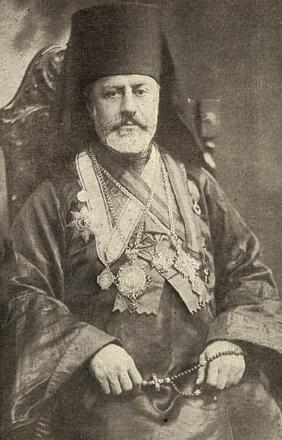
Back in June, I wrote a post on parish priest stability in the 1910s, and I found that the Syrians under St. Raphael had a higher clergy retention percentage than any other American Orthodox group. Way higher. Of the 14 Syrian parishes that had resident priests in 1911, 10 of them had the same pastor four years later. That’s 71.4%. Here’s how the various ethnic groups break down:
71.4% Syrian (10/14)
42.9% Serbian (3/7)
20.3% Russian (15/74)
27.5% Greek (11/40)
The Syrians were stable in almost every measurable way. According to the U.S. Census Bureau’s Census of Religious Bodies, conducted in 1906 and 1916, the Syrians had the most balanced male-to-female ratio of any group. Here are the percentages of women in 1916 (median includes smaller groups such as Romanians, Bulgarians, and Albanians):
44.5% Syrian
37.5% Russian
28.5% median
23.1% Serbian
16.6% Greek
The Syrians also had the highest ratio of priests per capita. Here is the number of parishioners per priest for each group:
386 Syrian
493 Serbian
623 Russian
755 median
1164 Greek
How about parishioners per church edifice?
446 Syrian
608 Russian
946 median
1430 Serbian
2032 Greek
I’m probably beating a dead horse at this point, but here are the Sunday School student-teacher ratios:
17 Syrian
40 Greek
41 median
45 Russian
59 Serbian
The Syrians were becoming more established, too. Here is the percentage growth in the number of church edifices from 1906 to 1916:
1200% Syrian
257% Russian
211% median
103% Greek
25% Serbian
Bottom line, by any method I can think of to measure stability, the Syrians under St. Raphael were the most stable Orthodox group in America. This makes me curious to learn more about how exactly he functioned as a bishop. The statistics alone suggest that he was doing something right.
6 responses to “The stability of the Syrian Mission under St. Raphael”
This is not a significant point to this study, but the GOAA did not require a Sunday School system in that era, though a Catechism was a part of the Greek School curriculum. Greek School was typically held in the late afternoons and the priests were usually instructors in an effort to supplement their meager salaries at the time.
Basil, the statistics I cited are from 1916, i.e., before the founding of the GOA.
His comment is still important, though, Matthew. One needs to be careful with how “Sunday School” was thought of during this time. It originated as an American Protestant phenomenon, I do believe, and the Orthodox adapted it, but where, how, and when, is a detailed study I have not yet seen. Also, don’t forget, other factors are involved when investigating stability. It is not just a matter of what St. Raphael was doing. The Russians were using clergy on what we might call short term missionary work, as I know you know. Also, the imigration patterns themselves had an effect, and St. Raphael couldn’t determine that. I believe the Syro-Arab community rallied around him personally, and he’s a saint, but we must take care not to stretch our evidence too far. There were other factors at play as well.
[…] we come to the Syrians… and as we’ve seen before, the Syrians are an outlier. This is what the 1916 Census has to say: Of the 25 organizations, 13, […]
[…] we come to the Syrians… and as we’ve seen before, the Syrians are an outlier. This is what the 1916 Census has to say: Of the 25 organizations, 13, […]
[…] with St. Raphael. In particular, check out this article on his consecration to the episcopate, this one on the stability of the Syrian Mission under his care, and this one on the widespread use of […]