From 1870 to 1883, Fr. Nicholas Bjerring operated a Russian chapel in New York City. At the time, there were very few Orthodox Christians in New York, and Bjerring’s parish was always small. As we’ve discussed before, in 1883, the Russian government decided to pull its funding and close the chapel. Bjerring responded by leaving the Orthodox Church and becoming a Presbyterian minister. The next year, Fr. Stephen Hatherly, a convert priest of the Ecumenical Patriarchate, traveled from England to America and attempted to start a new Orthodox church in New York City. His efforts failed, mainly due to lack of interest from the tiny Orthodox community.
Thus, for the rest of the 1880s, New York — and all of the Eastern United States — did not have even one Orthodox parish. But things were about to change.
Before 1880, immigration from Greece to America was inconsequential. In the entire decade of the 1870s, only 210 Greeks immigrated to the United States. That number increased tenfold in the 1880s: from 1881 to 1890, 2,038 Greeks came to America. And with most immigrants coming through the Port of New York, it makes sense that the Greek community in New York City grew substantially by 1890. (Of course, after 1890, and most especially after 1900, Greek immigration to all parts of the US would skyrocket. But even by the early 1890s, the Greek community in New York City numbered around a thousand.)
And of course, with a big Greek community, you needed a Greek Orthodox church. The Baltimore Sun (January 12, 1892) reported that, “since the closing of the Russian chapel, they [the Greeks] have found the lack of spiritual aid and counsel to be a great drawback to happiness.” In 1891, Prince George of Greece visited New York, and the Greeks came out to meet him. I’ll let the New York Sun tell the story (via the Wheeling Daily Register, January 12, 1891):
The Greek colony in New York has been growing rapidly in the past few years. When Prince George visited here last summer the Greeks found to their surprise that they were a thousand and strong. Then they thought what an excellent thing it would be to have a society.
And so they formed the Society of Athena, and they made a small restaurant on Roosevelt Street their headquarters. The Society’s secretary, a man named A.C. Evangelides, wrote a letter to Archbishop Methodius of Syra. (Incidentally, Syra is the same see that had previously been occupied by Archbishop Alexander, who, in 1869, ordained the American convert James Chrystal to the priesthood.) The Sun article continues:
The Archbishop conferred with a dignitary at Athens, and the dignitary at Athens wrote to the Patriarch of Constantinople, and the Patriarch said: “To be sure. They must have a priest. As it is their souls are in peril.”
Things moved quickly. The Society of Athena made arrangements to rent the basement of the German-Swiss Evangelical Church at 340 West 53rd Street, and, as the Sun put it, they “set plasterers to plastering, and painters to painting, and carpenters to building.” Fr. Paisios Ferentinos arrived in early January (sent, apparently, by the Archbishop of Athens), and on January 9, he blessed the makeshift chapel. The next day, he held the first church services there. Among those present were the consul generals of Greece, Russia, and Turkey, as well as representatives of the Ralli Brothers merchant firm (which also had connections with the Greek church in New Orleans). And of course, the place was packed with Greek immigrants; for the first time in history, New York City had a Greek Orthodox priest.
Fr. Paisios came with impressive qualifications. He had been born on the fabled island of Patmos, and as a boy, he entered the monastery of St. John. When he got older, he attended a theological school near Constantinople, and then he returned to Patmos, where he taught Greek to the youth of the island. Then, for two years, he was a deacon in the Patriarchate of Alexandria. In 1885, Patriarch Sophronios ordained him a priest. From then until his departure for America, he had been librarian and assistant chaplain at the Pizarian Theological School in Athens. (This information is from the Sun article.)
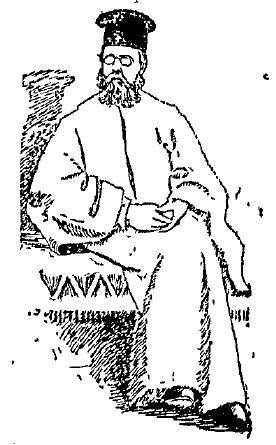
He also looked the part, to the joy of all the New York Greeks. Here’s a fantastic description from the Sun — if only journalists wrote like this today:
The Rev. Paisius Ferendinos is short of stature and probably quite slenderly built, although at first glance he appears to be fat. He wears atop his head a tall dark brown cylindrical hat, like a huge spool with the lower end sawed off. In this hat he keeps his hair, which is straight and soft and brown, and but for the hat and the hairpins he wears it would fall in a beautiful shower to his waist.
The face that looks out at you from behind the beard and moustaches, the heavy eyebrows and the blue glasses is mild and pleasant and most intelligent. The voice is soft and cultured, and you feel at once that Father Ferendinos is a gentleman of the type which is not confined to any nation or century. He speaks ancient and modern Greek, French, Italian, and Arabic. He is studying English, but as yet does not venture to speak a single word of it.
The Philadelphia Inquirer (January 11, 1892) was less verbose: “The Archimandrite is a middle aged man, and wears his hair on the back of his head done up like a woman.”
At the time it was founded, the New York church was one of only three Orthodox parishes in the contiguous United States, and the only one east of the Mississippi River. But everything was about to change. Just a couple of months later, on March 25, St. Alexis Toth and his Minneapolis parish converted from Uniatism (Eastern Rite Catholicism) to Orthodoxy. In April, the Greeks of Chicago established their own church, and in May, a Russian parish was formed in Chicago. The spread of Orthodoxy throughout the United States had begun.
3 responses to “The First Greek Church in New York”
A NY Times article on Greek Independence Day (April 9, 1894: as the article states “The Orthodox Greek Church has not adopted the Gregorian calendar, so that it still computes time after the old style. The declaration of Greek Independence was made March 25, 1821, but according to the tenets of the Greek Church it does not occur until April 6 following) hints at the subsequent history in NYC, and the disunity not only among the Orthodox, but the Greek Orthodox.
“The services consisted of a solemn high mass celebrated by the Archimandrite Paisios Ferendinos,” the article relates “with much pomp at the Orthodox Greek Church 340 West Fifty-third Street.” “After the cermonies, the Greek Consul D. N. Botassi [also involved with the Church at New Orleans], who was dressed in full uniform shouted out, “Long live the Greek Nation!”…”Long live the King!”….”Long live the Queen of Greece!” [Olga Romanov, who had a hand in causing the Evangelika controversy, which brought Meletios Metaxakis’ nemesis Theoklitos to the throne of Athens] and there was an answering shout of enthusiasm.” The article then sums up “Services were also held by the recently established Greek Church in the basement of the Memorial Bapist Church, Washington Square South. Archmandrite Kalinikos Dilveis officiated. An address was made by Solon J. Vlasto, President of “Athena,” the Greek Society of New York.”
http://query.nytimes.com/mem/archive-free/pdf?res=9C01EEDE1630E033A2575AC0A9629C94659ED7CF
The Exarch’s Cathedral in NYC credits Mr. Vlastos as leading the “first Greek association in this hemisphere, and the Holy Trinity Greek Orthodox parish.”
http://www.thecathedral.goarch.org/vsItemDisplay.dsp&objectID=E9AED050-369E-48B6-BC125D72FB79A659&method=display
Soon after the parish was established the Church Board of Trustees decided to separate the Church administration from that of the Society of Athena. The disaffected group decided then to form a new parish and this time applied to the Ecumenical Patriarchate for a priest. The patriarchate was unaware of the situation and sent Fr. Callinicos Dilbaes to be the new pastor of Annunciation, the new parish.”
http://books.google.com/books?id=Uh4VnseTNZkC&pg=PA130&dq=Callinicos+Dilbaes&lr=#v=onepage&q=Callinicos%20Dilbaes&f=false
Annuciation in NYC also claims these same roots to 1892: “Founded in 1892, the Annunciation Greek Orthodox Church is one of the oldest Hellenic-American ecclesiastical communities in New York. From its humble beginnings in Judson Memorial Baptist Church in Greenwich Village, where the community celebrated its first liturgy…”
http://www.evangelismos.org/history.html
Arch. Ferendinos ended up at the New Orleans parish.
http://books.google.com/books?id=HHmOYmd05BUC&pg=PA54&dq=Greeks+in+America+Ferentinos&lr=#v=onepage&q=Greeks%20in%20America%20Ferentinos&f=false
It is interesting that the Russian Consul was present: did it prompt the founding of St. Nicholas? On that Church, an early NY Times (aug. 6, 1899) says: “St. Nicholas’s Church was established in 1893 and has about 300 communicants. The Rector, the Rev. Alexander A. Hotovitzky is a secular (or white) priest…and has been in this country for four years, and for three years has had charge of St. Nicholas Church….His bishop is the Right Rev. Tikhon, whose recent visit to the Church of St. Nicholas was memorable event among the Russian Orthodox Christians in New York” [St. Tikhon had been welcomed the previous year, arriving as Bishop of the Diocese]
http://query.nytimes.com/mem/archive-free/pdf?_r=1&res=9C0CE6DB153CE433A25755C0A96E9C94689ED7CF
Isa,
I’ll continue to chronicle the history of Orthodoxy in New York in future posts, but, about the founding of the Russian church — I don’t think the founding of the Greek church “prompted” the founding of the Russian one. Certainly, there is evidence that the Russian Orthodox in New York attended the Greek church prior to the formation of St. Nicholas. As in many cities, when the Orthodox community was small, ethnic divisions tended not to matter as much. When the various ethnic groups grew in size, the natural tendency was to separate and form a church for that specific ethnic group.
Also, with New York, as the Russian Mission began to focus its attention on converting Uniates to Orthodoxy, it became clear that an East Coast headquarters was needed. New York was the obvious place for it.
[…] course, it was hardly the end of Orthodoxy in New York. One Greek church was established in 1892, and another in 1894. In 1895, a new Russian church was […]