The first Greek Orthodox church in New York City — named for the Holy Trinity — was formed in January of 1892. It was organized by a group called the Society of Athena, which, as the name suggests, was composed mainly of Greek immigrants from Athens. The community’s first priest, Fr. Paisios Ferentinos, was sent by the Archbishop of Athens, apparently in consultation with the Ecumenical Patriarch.
By the end of 1893, though, many of the Holy Trinity parishioners wanted to start a second church. The reasons are not entirely clear. The New York Times (January 8, 1894) reported at the time that Holy Trinity was “attended chiefly by the up-town colony of Greeks, and did not fully meet the wants of those who live at the lower end of the city.” The president of the Society of Athena, Solon Vlasto, made direct contact with the Ecumenical Patriarch. In response, the Patriarch sent Archimandrite Kallinikos Delveis to New York, authorizing him to found Annunciation, the city’s second Greek Orthodox church.
Now, it’s not entirely clear why exactly the Society of Athena made this request. There were, by most accounts, something like a thousand Greeks in New York City at the time, and the newly-formed Annunciation parish claimed 300 or 400 members. In his book Orthodox Christians in America, Fr. John Erickson writes that a “dissatisfied group wrote to the Patriarchate of Constantinople, rather than to the Holy Synod of Greece, asking for ‘an educated priest.’” But, as I’ve noted in an earlier post, the priest of Holy Trinity, Fr. Paisios Ferentinos, was in fact quite well-educated. There must have been some sort of dispute, but at the moment, I don’t know the details.
The Times described the new priest, Fr. Kallinikos, in this way:
The Rev. Kalinikos Dilveis is a man of striking personality. He is thirty-two years old, of medium height, olive complexion, and long black hair and beard. He was born in Constantinople, and was educated in the theological seminary of Halki, in that city. His voice is resonant, and he is reputed to be a preacher of great eloquence.
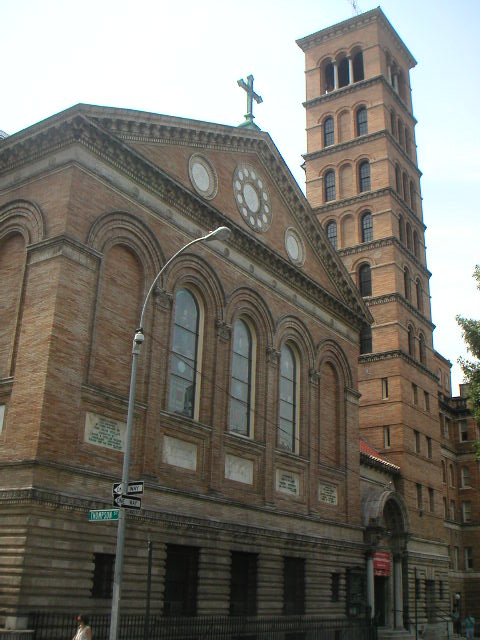
The new parish had a little trouble in finding a building, but eventually made arrangements to rent space in the basement of Judson Memorial Baptist Church, located in Washington Square. And as things worked out, the first church service was the Divine Liturgy on Christmas Day.
Later that year, when Tsar Alexander III died, both Greek churches in New York held memorials for the Emperor. The older church, Holy Trinity, drew some 300 people to its memorial, including the Russian consul. Annunciation’s service had around a hundred people in attendance. Holy Trinity clearly remained the “main” Greek church in the city, and it seems likely that most of the Russians in New York attended Holy Trinity, rather than Annunciation.
3 responses to “One city, two churches: New York, 1894”
“Later that year, when Tsar Alexander III died, both Greek churches in New York held memorials for the Emperor. The older church, Holy Trinity, drew some 300 people to its memorial, including the Russian consul. Annunciation’s service had around a hundred people in attendance. Holy Trinity clearly remained the “main” Greek church in the city, and it seems likely that most of the Russians in New York attended Holy Trinity, rather than Annunciation.”
The difference might have to do with Russia’s policy of supporting the CoG at Constantinople’s expense, and the connection of Holy Trinity to the Greek Royal family, heavily intermarried with the Russian Imperial Family.
The article menitoned, NYT Jan. 8, 1894 has several points of interest on the jurisdiction question of Orthodoxy in North America, starting from its headline:”DOWN-TOWN GREEKS WORSHIP; NEW CONGREGATION ESTABLISHED AT JUDSON MEMORIAL. With the Blessing of the Ecumenical Patriurch of Constantinople, the Rev. Kalinokos Dilveis, a Newly- Arrived Archimandrite, Conducts the Picturesque Opening Service”
its opening paragraph:
“With the blessing of this Holinesa the Ecumenical Patriarch of Constantinople and Pope of New Rome, Neophytus VIII., transmitted through his accredited representative, a new congregation of the orthodox Greek Church was born in this city yesterday.”
and its concluding paragraph:
“President Vlasto, in speaking of the circumstances of the founding of the new church said last evening…’The Church which was established today is the fifth of our faith in America, the others being, besides the one in this city already, in Chicago, New-Orleans, and San Francisco, but the services in the last-named are conducted in the Russian language.’”
Mr. Vlasto’s list is incompletet-St. Alexis Toth’s back to Orthodoxy parishes were already being received, the Chicago Greek parish had a twin Russian Archdiocese parish (and according to a 1899 NY Times artiicle
http://query.nytimes.com/mem/archive-free/pdf?res=9C0CE6DB153CE433A25755C0A96E9C94689ED7CF
St. Nicholas in NY had been beeen founded in 1893, but that may refer to formation of the borad of trustees or the Virgin Mary Brotherhood-but the last mentioned is important because whatever his intentions to send to Constantinople instead of San Francisco for a priest, it wasn’t from ignorance of the existence of the Russian Bishop in SF.
It is also interesting that he recognizes both the Holy Trinitys, in NYC and New Orleans, the later being described as attached to the Greek consulate in that city (and presumably to the Greek Holy Synod)
http://books.google.com/books?pg=PA40&dq=Religious+census+Greek+Orthodox+1890&cd=1&id=lb_rAAAAMAAJ#v=onepage&q&f=false
the former being known as under the Greek Holy Synod, its priest “sent from Athes” (Fr. Ferendinos in time ended up in New Orleans), i.e. not under the EP, from whom, the article makes clear, Annunciation was deriving (at least in lip service) its existence, with his “blessing” “through his accredited representative” “delegated by the Ecumenical Patriarch fo assume the spiritual charge of his fellow-countrymen” and “assigned to the pastoral care of the new flock.” The rift between jurisdictions is hinted when the article states that “on this representation” of “Solon S. J. Vlaspo, President of the Greek Society of New York-Athena” that the first Greek Church “did not fully meet the wants of those who live at the lower end of the city…the Patriarch consented to select from among the best of his ministers” “come direct from Constantinople.” Yet the priest “implored the heavely blessings on the head of the King of hte Hellenes” (in addition to “ask[ing] for the Divine blessing on President Cleveland and for the continued welfare of the American Republic).
Something that may not look jurisdictional, in the context of the times profoundly was:
“On the altar stood a golden receptacle containing the oil of annoitnment, which the Archimandrite had brought with him from Constantinople after it had received the blessing of the Patriarch. This sacred oil is used in baptism and during the observiance of Holy Weeek.”
This was a major bone of contention between Constantinople and Moscow. In the Tomoi of Autocephaly granted by Constantinople (including that to the Church of Greece, and also the Tomos of 1908 to the CoG over the Diaspora) the EP reserved the right of blessing chrism to himself, a sort of “reserve power” like the British monarch has in the British Commonwealth countries. Moscow, however, had begun . At the time of this parishes founding, the Russian Church was also supplying the chrism to Montenegro (at the time autocephalous), Bulgaria (at the time under anathema from Constantinople, so worse than the present autocephlaous status of the OCA), and, with the election of the Arab Patriarch (and the subsequent declaration of schism by the Greek Church), Antioch, perhaps putting St. Raphael’s indepedence into perspective.
http://books.google.com/books?id=UPr1ZCxPW6QC&pg=PA288&dq=Meletios+Petersburg+chrism&cd=1#v=onepage&q=Meletios%20Petersburg%20chrism&f=false
The autocephalous Churches in (and largely the creation of) the Empire of Austria Hungary-the Serbian Patriarchate of Karlovci, the Romanian Metropolitanate of Transylvania, and the Romanian/CR Archdiocese of Bukowina, all blessed their own chrism, but the autonomous Church of Bosnia-Herzegowina still received hers from Constantinople, one of the few rights the Phanar retained that keep BH from joining the other autocephalous Churches.
http://books.google.com/books?id=UPr1ZCxPW6QC&pg=PA334&dq=Bosnia+chrism&cd=2#v=onepage&q=Bosnia%20chrism&f=false
http://www.newadvent.org/cathen/06752a.htm
It had become a major internatinal issue in Orthodoxy when Romania (autocephalous by statute and acknowledgement of the EP, who had not yet issued a Tomos of Autocephaly) , decided to consecrate its own chrism, and the Romanian parliament voted to fund the budget of obtaining the necessary materials (expense, and the fees the other patriarchates paid the Phanar for it was partly why it became an exclusive right of the EP), over the protest of the Phanar and the strident Greek press which went on for three years and ended in the EP issuing a formal Tomos of Autocephaly, 8 years before Annuciation’s founding in NYC: the original issue began with the complications of anointing with chrism from a hiearch subject to the Porte, a sovereign in communion with the Vatican and his Protestant wife king and queen of a self proclaimed Kingdom whose Turkish suzerain and the Great Powers had defined as a Principality, which had formed an autocephalous Orthdoox Church as its state Church without proclaiming autocephaly. And people think the situation in North America is complicated ;).
http://books.google.com/books?id=iskRAAAAYAAJ&pg=PA250&dq=Bucharest+chrism+Constantinople+protest&hl=en&ei=32sTTK70BcXgnAes442MDA&sa=X&oi=book_result&ct=result&resnum=2&ved=0CCoQ6AEwAQ#v=onepage&q&f=false
(Frank Leslie’s Sunday magazine, Volume 16 By Charles Force Deems)
http://books.google.com/books?id=UPr1ZCxPW6QC&pg=PA331&dq=Bucharest+chrism+Constantinople+parliament&cd=1#v=onepage&q=Bucharest%20chrism%20Constantinople%20parliament&f=false
http://www.newadvent.org/cathen/06752a.htm
http://books.google.com/books?id=iskRAAAAYAAJ&pg=PA250&dq=Bucharest+chrism+Constantinople+protest&hl=en&ei=32sTTK70BcXgnAes442MDA&sa=X&oi=book_result&ct=result&resnum=2&ved=0CCoQ6AEwAQ#v=onepage&q&f=false
As Fortescue points out, the rejection of EP St. Photios’ chrism had been a major contention in Bulgaria, and was becoming so again when the seeds of jurisdictional disunity were being sown in NYC.
The article also has two ominous passages which presage jurisdictional problems to come. Although not the full blown canon-28-disapora-universal-jurisdiction dogma (unknown at the time), one can see already how it had fertile grown in Mr. Vlasto’s words “The head of the Church to whiich this new body belongs is the spiritual sovereign of more thatn 150,000,000 people. The Greek Church was transferred from Rome to Constantinople after the early schism between the Western and Eastern Churches. Then the Western Church established its sovereign pontificate in Rome, while the Eastern Church made Constantinople its spiritual seat of empire.”
His preceeding words, however, show the rise of the real “hierarchs” of the new church, its trustees: “The new church will be supported by voluntary contributions on the part of the Greek society, its members having pledged themselves to pay the pastor’s salary of $800 a year. It is the intention of the colony to build a handsome place of worship before long.” That arrangement came to nought very soon, as Fr. Delveis resigned the next year, and had to sue for his pay.
http://query.nytimes.com/mem/archive-free/pdf?res=9C04EFDE113DE433A25756C0A96F9C94649ED7CF
For comparison, the HGS earmarked 1,200 gold rubles ($5,363, today $165,000) for St. Raphael to pastor the parishes in Brooklyn, Chicago, SF, etc)
http://query.nytimes.com/mem/archive-free/pdf?res=9E0CE3D7173CE433A25756C1A96F9C94649ED7CF
[…] course, it was hardly the end of Orthodoxy in New York. One Greek church was established in 1892, and another in 1894. In 1895, a new Russian church was […]