I got a little tired of quoting long sections of primary sources, and thought I’d try something a little different for a change. Don’t worry, though; I’ll be back with my regular style tomorrow. And if you’re wondering about sources, just let me know — I didn’t make any of this up, or anything.
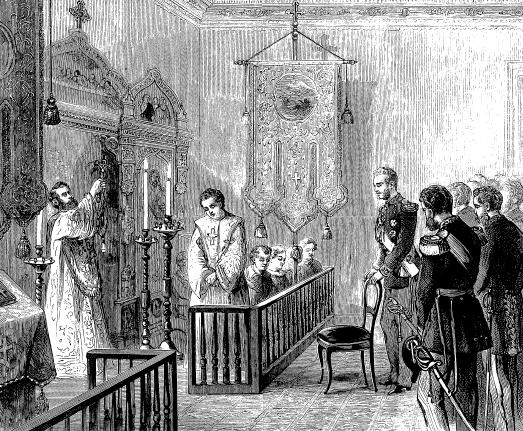
Walking along Second Avenue in New York City in the 1870s, we encounter #951, a private residence in a nondescript brownstone. The only odd thing about the place is a gilt Greek cross that hangs over the door. As it turns out, this place isn’t just a home; it’s the only Russian Orthodox place of worship east of San Francisco.
We enter on the parlor floor. Originally, this was two rooms, but it has been modified — now, one of the “parlors” is the sanctuary, while the other is the nave. Where there were once doors separating the two rooms, now there is an iconostasis, surmounted with a gorgeous icon of the Mystical Supper. The iconostasis has only the Royal Doors — no deacon’s doors — which makes for an odd-looking Great Entrance. Inside, the altar table is lavishly ornamented. The altar cloth alone is worth a king’s ransom, made of yellow satin and embroidered with gold and silver lace. The sacred objects in the chapel — marriage crowns, chalice, candelabras, censer, diskos, crosses, etc. — were all gifts from the Tsar, and they looked the part, made of pure gold and studded with gemstones. On the opposite end of the room, over the mantelpiece, is a large mosaic and a gold cross — gifts of the Russian government. On the four ends of the cross, there are medallion icons with scenes from Christ’s life. The rest of the walls are covered with more icons and banners, also depicting scenes from the life of Christ.
The room feels bigger than it is, with no pews and only a couple of chairs on the floor. An impressive chandelier hangs from the high ceiling. But really, the place is tiny, and it feels crowded with a couple dozen people inside. When the Grand Duke visited in 1871, throngs of American girls begged the priest to let them in, but, as one journal said, the chapel wouldn’t hold a tithe of them.
They talked for years about building a great Orthodox church in the city; the Russian government even bought land on Lexington Avenue, but it all came to naught. The Russians pulled their money, and the Danish priest joined the Presbytery. Makes me wonder what exactly happened to all those treasures in the chapel. Rumor has it that some of them turned up in a pawn shop, of all places! It’s quite a shame how things turned out, and one has to wonder if this is the end of Orthodoxy in New York.
Of course, it was hardly the end of Orthodoxy in New York. One Greek church was established in 1892, and another in 1894. In 1895, a new Russian church was founded.
One response to “Inside Bjerring’s chapel”
Interestingly, the next Church set up by the Russian Holy Synod in NYC was a half hour/one and a half mile down Second Avenue:
“The past winter will long be remembered by the majority of Russians as marking the one hundredth anniversary of the establishment on the western hemisphere of the Eastern Orthodox Church—an event fittingly celebrated throughout the length and breadth of the Russian Empire.
It was exactly a century ago that a Russian Church mission arrived on one of the Aleutian Islands of the North Pacific Ocean and built the first house of worship devoted to their creed. Since that period the work has steadily gone on, so that at the present day the Russian Church in North America embraces within its fold many thousands of American citizens and residents of the United States, under the spiritual authority of a bishop, having his headquarters in San Francisco. Almost every large city in the northern part of this country, with the exception of New York, has its Russian Orthodox house of worship, and by the time these lines appear in print even the Eastern metropolis will be provided for in this particular.
The truth of the matter is that the celebration of this great anniversary has given a tremendous impetus to the efforts of Bishop Nicolai, of San Francisco, in the direction of solidifying his church in this country by the proselytization of the numerous elements that have drifted hither of late years from the Orient….Bishop Nicolai, on the other hand, commenced an extended missionary tour throughout the United States late in the fall of last year, and paid prolonged visits to those sections of the country where the Uniates abound, His efforts, it is claimed, have been amply repaid by the incorporation .within the fold of the Eastern Orthodox Church of hundreds and hundreds of these semi-Catholics. A new Russo-Greek Church was consecrated by him at Streator, 111., ninet\’flve miles from Chicago, on the Chicago and Alton Railroad, where many Galician Uniates are employed among the neighboring coal This church, by the way, was formerly the beautiful Russian pavilion of the Manufacturers’ Building at the World’s Fair, and was presented by the Imperial Russian Commission. The architecture is purely Slavonic, and the materials used are fragrant tchen wood and pine. Father Ambrose, the pastor of the Russian Orthodox Church in Chicago, will officiate at Streator for the next few months, after which he will be replaced by one of the bishop’s assistants of San Francisco.
When Bishop Nicolai reached Xew York he discovered to his intense satisfaction that the Orthodox citizens of the great metropolis had anticipated his desires, for a delegation of members of the Virgin Mary Brotherhood, a local Slavonic benevolent association, at once presented him with a petition for official authorization to construct a Russo-Greek chapel. Consul General Olarovsky is the honorary president of the brotherhood, the actual chairman being Nicolas Murzitch, and it reckons among its members a number of Russian citizens of NewYork. The bishop duly endorsed the petition and forwarded it on to the Holy Synod, which passed favorably on the same, and in due time dispatched Father Yevtikhi Balanovitch to open a temporary house of worship at No. 325 Second Avenue. It should be added that the successful termination of this undertaking is largely due to the efforts of Mme. Barbara MacGahan, wife of the celebrated American war correspondent of the same name. She herself is the American correspondent of several Russian periodicals, and has exercised all her influence to bring about the result in question. Without her efforts but little would have been attained.”
The American magazine, Volume 40. 1895
http://books.google.com/books?pg=PA33&dq=Streater+Russian+Church+New+York+Bishop+Nicholas&id=d8wiOQO3Td0C#v=onepage&q&f=false