As regular readers of this website know, I am particularly interested in the “Americanization” of Orthodoxy in the New World — things like clergy appearance (beards vs. shaved faces, cassocks vs. collars), pews, church music (organs and mixed choirs), early converts, the use of English, and so forth. Today, I’m going to talk about organ music.
A disclaimer, up front: I am not an historian of church music. In fact, I’m not particularly musical at all — I don’t sing in the church choir, don’t play an instrument, and can’t even read musical notation. However, I’ve become reasonably adept at picking up a phone and asking questions, and by now, I’ve accumulated enough information to have a general sense of when organs became popular in Greek churches in America. Like so much of what I write, this article is merely an introduction to a topic, rather than the last word. Hopefully, five years from now, we’ll know a lot more than we do today about the history of Orthodox music in America.
There seem to be two general theories about how organs became popular in Greek-American churches. These theories aren’t mutually exclusive, and taken together, they sound pretty darned convincing. The first theory is similar to the pew theory — that early Greek communities bought existing Protestant or Roman Catholic church buildings, inherited the previous church’s organ, and adopted it for use in the Orthodox church. Of course, it has the same problem that the pew theory has — namely, that most early Greek churches were actually built by the Orthodox community, rather than purchased. Also, the chronology doesn’t fit: as we’ll see, organs were typically added to existing Orthodox churches, rather than introduced when a building was acquired.
The other theory is that Archbishop Athenagoras Spyrou, who took over the Greek Archdiocese in 1931, was a big fan of organs and encouraged their use in America. In his 1976 book From Mars Hill to Manhattan, Fr. (later Bishop) George Papaioannou wrote about Abp Athenagoras and organ music:
Athenagoras was a lover of music. His ministry to the people of Corfu, who had and still retain the reputation of being the most musically inclined in Greece, encouraged him to introduce a revolutionary idea into the Orthodox worship. That was the use of the organ. His people enthusiastically endorsed the idea, but the Church hierarchy condemned it as a terrible unorthodox innovation. From the official publication, St. Spyridon, 1928, we are informed that a case was brought against him in court by members of the Holy Synod for having introduced into the church a musical instrument that was foreign to Orthodox tradition. Athenagoras refused to yield to the Synod’s pressure, claiming that a similar musical instrument had first been used by the Byzantines in the Church of St. Sophia. A renowned church historian and liturgical scholar, Fr. Constantine Callinikos, came to Athenagoras’ defense, advising him not to give in and continue his praiseworthy policy of upgrading the Orthodox worship. Athenagoras ignored the demands of his fellow hierarchs and apparently the case was dropped because the organ continued to be used in the services at the Cathedral of St. Spyridon. Today, St. Spyridon’s in Corfu remains the only church in Greece to include the organ in its services.
Be all that as it may, Abp Athenagoras did not introduce organs into Greek-American churches. Oh, he certainly contributed to the spread of organs, but well before his arrival in 1931, Greek churches in the United States had begun to adopt the instrument.
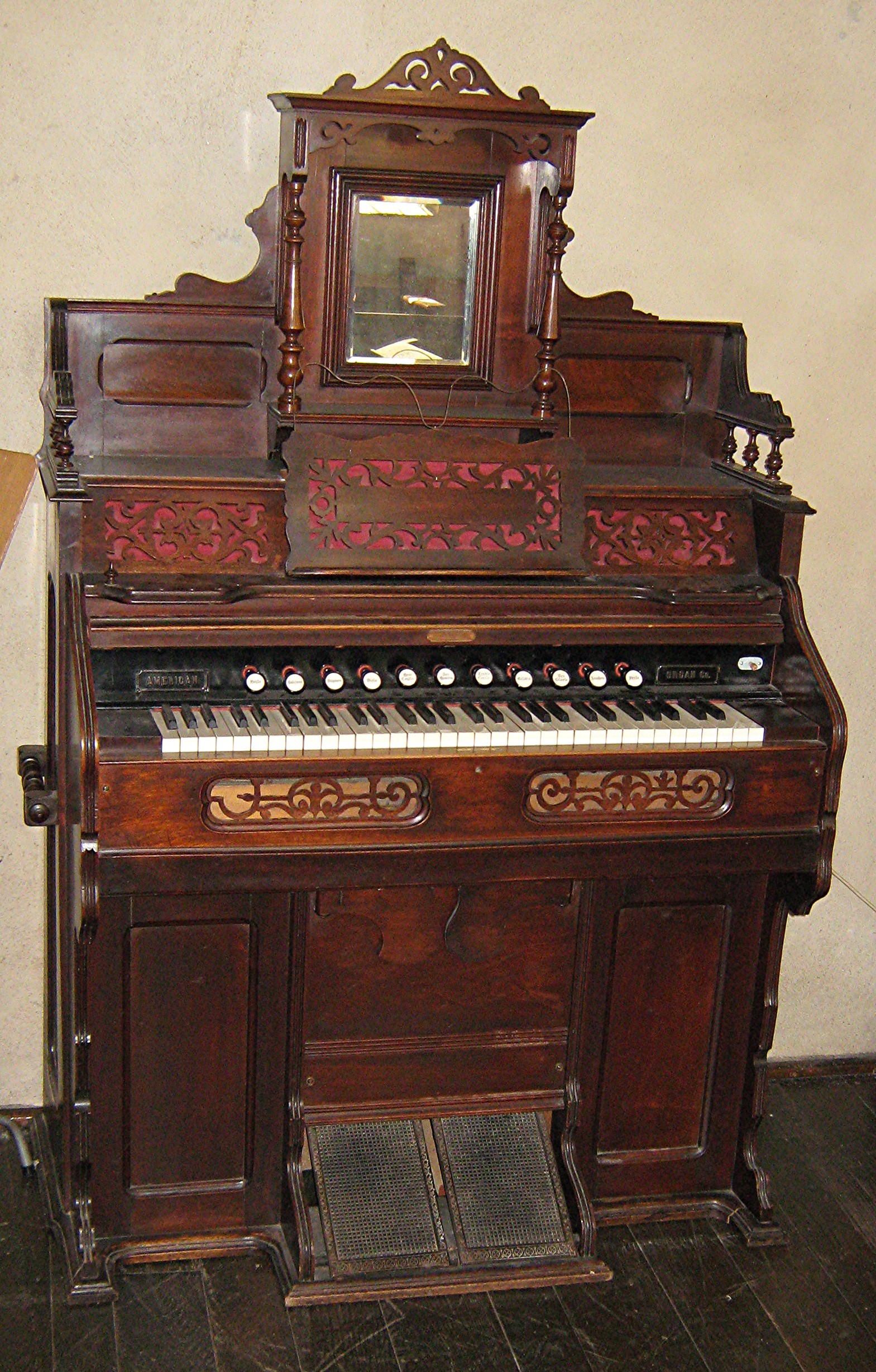
The first organ ever used in American Orthodoxy was actually in the very first Orthodox church in the contiguous US — Holy Trinity in New Orleans. I was rather shocked to learn that the New Orleans parish introduced an organ way back in the 19th century. This is from Elizabeth Cumings, “Where it is Summer in February,” in the journal Music, April 1895: “In the tiny Greek church far down the Esplanade is an American melodeon with a fine American squawk of its own.”
Here’s what Wikipedia has to say about the melodeon:
A melodeon (also known as a cabinet organ or American organ) is a type of 19th century reed organ with a foot-operated vacuum bellows, and a piano keyboard. It differs from the related harmonium, which uses a pressure bellows. Melodeons were manufactured in the United states from 1846 until the Civil War era. While it was sometimes used as a substitute for the pipe organ in small churches, it was primarily used in domestic settings.
It seems like the New Orleans parish introduced this organ sometime between 1885 and 1895. I’ve seen a few descriptions of church services there from the mid-1880s, and they seem to suggest (but don’t say outright) that the music was acappella chanting.
I don’t know why the New Orleans parish added an organ. It’s just a theory, but perhaps it had something to do with the priest, Fr. Misael Karydis. We know that he was obsessed with building a flying machine, and if he fancied himself an inventor and tinkerer, he may have been intrigued by the innerworkings of an organ. I’m not sure whether the New Orleans church kept using the organ after Karydis died in 1901, but if they did, they would have been an anomaly. Excepting New Orleans, I have yet to find a Greek church with an organ prior to the 1920s.
St. Sophia’s in Washington, DC didn’t have an organ in 1908, when the Washington Herald (11/1/1908) said, “Not a note of instrumental music accompanies them, for in the Greek Church it is forbidden.” But by the early 1920s, the parish had added an organ. From the Washington Post (4/8/1923): “On this Greek Easter Day the choir of St. Sophia’s, L and Eighth Streets, N.W., is of unusual interest, there being only five Greek Orthodox churches in the world having mixed choirs and an organ.” (Earlier this year, I spoke with the current priest of St. Sophia’s, Fr. John Tavlarides. Fr. John has been there since the 1950s, and he told me that he actually stopped using the organ in 1967. It is now only used for occasional wedding processions.)
The Washington church had an influence on its Baltimore neighbor, Annunciation. From Nicholas Prevas’ House of God… Gateway to Heaven:
By the mid-1920’s, choirs and organs accompanied the Divine Liturgies – a departure from customs in the homeland where this type of music was considered a ‘western innovation’ and not typically used. Historically, up to this point, only the psaltes (cantors) sang the responses to the priest during religious services. In April 1923, however, records show $50 was paid to host a Greek church choir from Washington, D.C. Their performance must have been impressive.
Soon after, the spring 1923 general assembly approved the ‘installation of European music’ with organ accompaniment and hired Spyridon Safridis as the first music director. Within a few months, a small choir was singing liturgical hymns for the first time in the church on Homewood Avenue. The community was slowly adapting to American culture though not without objections. The following year, after many debates, parishioners voted at the general assembly meeting on March 9, 1924 as to whether or not this type of music should be kept in the church. The music remained and by the mid-1930’s a vibrant choir of voices complemented liturgical services at Annunciation.
We’ll discuss the question of mixed choirs in a future article. For now, it’s enough to note that organs were beginning to grow in popularity in the mid-1920s. The innovative priest Fr. Mark Petrakis, who had introduced pews in St. Louis, oversaw the addition of pews, an organ, and a mixed choir to Ss. Constantine and Helen Church in Chicago. From the parish history: “In 1927, George Dimopoulos, a talented chanter and choirmaster, organized a choir that included women. The choir was accompanied by an organ. Pews and an organ represented a departure from traditional Greek churches and a movement towards Americanization.”
Holy Trinity Greek Church in San Francisco had added an organ by at least 1925. When Abp Athengoras arrived in 1931, the majority of Greek churches still didn’t have organs, but the instruments were not totally unheard of. After 1931, and throughout Athenagoras’ tenure as archbishop, many more Greek churches introduced organs. This was certainly with the encouragement of Athenagoras, but he was not the originator of the practice.
I don’t have a clear answer to the question, “Why were organs introduced into Greek churches?” However, it seems like the parishes that introduced organs did so with the conscious desire to “Americanize.”
9 responses to “Organs in Greek Orthodox churches”
In George Anastasiou’s “Αρμονικη Λειτουργικη Υμνωδια” he claims to be the originator of organs in Greek Orthodox churches. In a paragraph appropriately titled “Organ Introducer” he says:
“I am convinced that I first introduced the organ in our Churches in America with the musical cooperation of ever-memorable artist and musical [sic] Spyridon Saphrides upon my arrival in America and my appointment as precentor-choir leader of the Greek Church of St. Sophia in Washington at the time of the progress and reformatory presidency of Mr. T. H. Theotokatos, lawyer and at that time teacher of this community in the year 1921. Later I introduced it also in New York and in other places by special musical-historic lectures, descriptions in our Greek press, and by special teaching in the choirs of our communities, which I formed, and lately in the beloved Greek city of Florida, Tarpon Springs, where there is played today, in that very beautiful cathedral church of America (as it is called today by all the Greeks and Americans by reason of the Pan-American celebration of Theophany services every year) an organ of great value electrically, microphonically, megaphonically, and with chimes, on the great singing tower, the bell tower of about 100 feet in height of this Greek Church of St. Nicholas in Florida, called the Greek singing Tower of America.
And thus, and in time, the organ of Greek invention became the valuable leader and coadjutor of our choirs and in America for the elevation of the Divine Worship and for our reunion through our choirs (which, I am convinced, I first introduced in America), with the ancient Greek Byzantine greatness of our church.”
In earlier paragraphs, Anastasiou claims that the organ was invented by Greeks at Alexandria, was used in the “Hebrew church” and was even employed by such great saints as Athanasius and Basil the Great. He also mentions its use in the narthex of Hagia Sophia, and its subsequent introduction into the West via Byzantium.
On the matter of seating, I will say that I saw rows of chairs at every church I was inside of when I was in Greece this summer. I asked somebody about it, and I was told that open floors were a monastic thing, and that parish churches usually had seating.
Make of that what you will.
David,
Thanks for posting this! Do you know when this was published, and whether it is available in English? (I take it that this is an autobiography — correct?)
Also, is there any indication that Anastasiou influenced Abp Athenagoras’ decision to introduce an organ on Corfu in the 1920s?
Richard, I’ve heard similar things about churches in Syria. Were these seats that you saw folding chairs, or nicer, more permanent-looking seats? I take it they weren’t the stadia/leaners that monasteries often have.
I’d love to know when seats started being used in Greece and Syria. And why.
“Αρμονικη Λειτουργικη Υμνωδια” is a choral hymnal (original copywrite 1944; the edition I have is from 1960), with music for the Divine Liturgy, feasts, etc. It is Byzantine-based (i.e. the soprano line usually contains a melody that is Byzantine), but in western notation, harmonized and designed for use with an organ.
Aside from music, the book contains some explanatory material, either technical (how to organize a choir) or historical (the above “history” of organs). This material is in Greek and English, the Greek text being written by Anastasiou (who is listed as the protopsaltis of the Greek Archdiocese) and the English translations by Rev. Anastasios C. Bandy.
In the front and back of the book, there are letters from various hierarchs, including two from Athenagoras–one as archbishop and one as patriarch. These letters are in Greek and no translation is given, so I don’t know if they contain any clues to the organ on Corfu.
Anastasiou also notes in his introduction:
“Upon my arrival in this hospitable country of United States of America in August of 1920, God deemed me worthy to serve progressive Greek Communities thirsty for musical regeneration and ecclesiastical greatness and order and in which I was accorded brotherly hospitality and support, I proceeded to the organization, teaching, and formation of various many-voiced ecclesiastical choirs from the stems of our new Greek-American generation, which I found most eager for cooperation, and I taught for the past 10 years nearly all of the contents of this work of music for trial and elaboration with perseverance and patience up to application and success, for distribution, preservation, and perpetuation of the institution of choirs, conformably also with the ecclesiastical organ or harmonium, though this Greek Byzantine music; and in order that we might preserve unbroken in the bosom of our Greek Orthodoxy all its music-loving and religious children.”
Oddly, the Greek text of the introduction is dated September 1, 1943 and the English translation is dated September 1, 1955.
Anastasiou’s book was well distributed around the US, and appears to have gone through several reprints, so finding a copy shouldn’t be too hard.
It might be interesting to wonder not only why early Greek parishes added organs, but why Slavic/Russian parishes in America did not. Is there any history of any early Slavic/Russian Orthodox parish in America adding an organ?
My initial thought is that the Slavic parishes would be opposed to organs because it would sound awful against the beauty of the 4-part Orthodox a cappella singing. This western-style singing is definitely appreciated by non-Orthodox westerners — you don’t need an organ to make it better, and yes, it would sound worse with an organ. I also imagine that most of the Russian bishops in America would be opposed to it.
By contrast, Greek-style byzantine chant takes some training to appreciate, and not all appreciate its beauty and tonality (even a lot of Orthodox don’t like it — possibly because it clashes with our western concepts of what is beautiful and what is not?). Maybe adding organs in Greek/byzantine churches was a way to make this type of worship more appealing to the western ear, and more “american”? Also, adding organs and choir singing would lend itself more to congregational participation whereas traditional byzantine chant does not.
I’d be curious to know if any Russian/Slavic Orthodox parish in America has ever added an organ, though…. I’ve never heard of one.
ggg (Mr.? Miss?),
The music that the Greek immigration brought with them was not mainly authentic Byzantine chant. During the late 19th and early 20th centuries, the churches in Greece were undergoing a flirtation with harmonized music (along with Western-style icon painting), a sharp departure from a fairly unbroken tradition of many centuries. I’m not sure if this included the use of organs or not.
The flirtation in Greece eventually ended with a return to authentic forms. But its legacy remains here in America, where the majority of Greek churches are still using harmonized choral pieces during the Divine Liturgy. There is an ongoing movement in American Greek parishes to return to traditional Orthodox music, but it hasn’t gotten very far yet.
I also have my doubts about any motivations based on trying to be more appealing to the Western ear—American Orthodoxy of the early immigrations was mostly not interested in making any appeals to Westerners, musical or otherwise.
I think we’ll need some sort of period testimony to figure out the “why” on organs.
[…] of the early life of that parish. The hints that we do have are tantalizing. For instance, Holy Trinity used an organ decades before any other American Orthodox church is known to have added one. But we don’t […]
[…] like pews, organs, mixed choirs, the cassocks vs. collars debate, clean shaven priests, etc. (Click here to read my article on organs in Greek […]