Pews are a common sight in American Orthodox churches, especially those in the Greek and Antiochian Archdioceses. I remember, as an adolescent in an Antiochian parish, learning that my fellow Orthodox in Greece or Russia or Lebanon don’t have pews in their churches.
When I asked why we had pews and the rest of Orthodoxy (for the most part) did not, I got an answer which I accepted as perfectly reasonable. The way I heard it, when the Orthodox were first getting established in America, they bought old Protestant or Roman Catholic church buildings, and just kept the pews (and organs) that came with the purchase. That, I was told, is how pews came to be in so many Orthodox parishes.
Until a couple of years ago, it had never occurred to me to question this story. But then I started to look for hard evidence, and I was rather surprised at what I found. I should stress that my research on this is far from complete. But I’ve gotten into the habit of sharing my unfinished work with the world, and I figured I’d present some of my initial findings. I’ll actually be doing this in multiple parts, because I’ve got a good bit of information to share.
Today, I’m not going to delve into the data on pews; instead, I want to focus on the underlying assumption: that most early American Orthodox churches were purchased from Protestant or Roman Catholic congregations. Is this actually true?
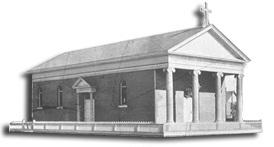
I decided to focus, initially, on the Greeks. I was able to find hard data on 23 early Greek parishes. The surprise? Of those 23, 14 built their own churches from the ground up, and 9 purchased existing places of worship.
I also looked at Thomas Burgess’ 1913 book Greeks in America. On page 55, Burgess lists the Greek parishes which constructed their own churches, and those which bought former Protestant churches. His numbers? 16 built their own, and 12 bought Protestant churches.
So in both cases, well over half of the early Greek parishes constructed their own churches. And, given that a number of the churches in my count were built or purchased after Burgess’ book was published, there’s not too much overlap between the two sets of numbers.
If the Greeks weren’t just buying old Protestant churches, then the old explanation isn’t sufficient, and there must be some other reason why they adopted pews. More to come.
11 responses to “Built or Bought? Greek church buildings in the 1910s”
It’s also very much worth noting that many old country parishes now have pews, especially in the formerly Byzantine lands.
Yes, I’ve heard this. It would be interesting to learn more about how they came to be introduced in those countries.
I suppose you’ll probably get to this, but the pic makes me wonder how many of the churches were built according to what we would think of as a traditional Byzantine design and how many adopted more typically Western architecture. My gut reaction is to expect that, if a church was built on a more Western model (no dome, for instance), it would likely have included pews and maybe an organ.
It’s also worth noting that there are many traditional churches from the olden days that had no domes. Domes do not Orthodox architecture make! 🙂
Be that as it may, I would guess it’s probably possible to determine from looking at a structure whether it was an attempt to follow some ancient, domeless model or simply mimicking contemporary church buildings.
I haven’t done an exhaustive study of church architecture, but keep in mind that most of these early churches had limited funds and were working with non-Orthodox architects. These churches, built in the 1900s and 1910s, almost universally did not have pews when they were built. Pews were added later. (That is certainly the case with the Pueblo, Colorado church depicted above.)
Also, remember that these churches were commissioned by laymen, often before a priest was even present in the community. I don’t have lots of details, but it seems to me that often, you’d have a group of Greek laymen get together and say, “We need an Orthodox church in this city.” They would raise the money and try to get a priest, and they’d approach a local architect about building the church. A typical church might cost, say, $10,000. The architect probably had a standard church design to offer the parish; after all, with that small amount of money, they most likely couldn’t afford a custom-built model. Quite often, after a few decades, the parish would construct a new, bigger building. The Pueblo church is unusual in that it is one of the few early 1900s Greek church buildings still in operation.
When a parish could do so, they often incorporated pillars and columns, recalling Greek structures like the Parthenon. While we don’t think of those designs as “Orthodox,” I believe in Greece, Orthodox worship took place in buildings like that. Most parishes did avoid using pews, at least until the 1920s.
The Ukrainian Orthodox Church building dedicated to Ss. Peter and Paul out in Belfield, ND, was built by a Ukrainian farmer with no architectural training, from what he remembered back in the old country. It has a dome 🙂 I was in it a little over a year ago.
[Image added by Fr. Andrew.]
I questioned pews when I was a kid, because our North Jersey, self built 1905 Metropolia parish and many neighboring orthodox parishes (but not ROCOR) had pews. My grandmother’s church, a Metropolia cathedral on 2nd street in New York City, once a Protestant church, did not. A priest speculated that many of our North Jersey parishes were built by former Uniat folks. I think that people just liked pews. Another reason could be that the suburban Metropolia churches could afford the expense of pews.
[…] Yesterday, I introduced one of my ongoing research projects, a study of the origins of pews in American Orthodox churches. Oh, I’m famililar with the old story — that early Orthodox parishes bought old Protestant churches and retained the inherited pews — but whenever I hear that story, it seems to be just a bald assertion, without any evidence to back it up. Certainly, that must have happened in some cases, but is it really the primary reason? Can we prove it? And if it’s not, then why do so many of our churches have pews? […]
[…] same problem that the pew theory has — namely, that most early Greek churches were actually built by the Orthodox community, rather than purchased. Also, the chronology doesn’t fit: as we’ll see, organs were […]