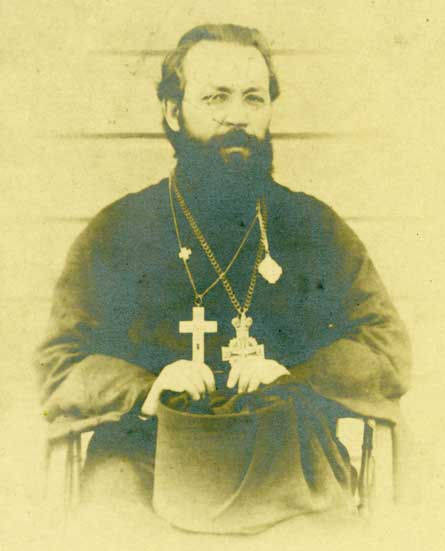
Originally, the following was made as a comment over on Frontier Orthodoxy, but I (Fr. Oliver) have asked Fr. Andrew Morbey to write it up as a separate post because I think it is good reading for everyone. I had forgotten that I had been told that Kamenskii was canonized. I am very thankful that Fr. Andrew reminded me of this. I should also point out that Fr. Andrew says he has not actually seen an icon yet at this point. His references are, at least in part, the Irkutsk diocese website and calendars from ROCOR and the Moscow Patriarchate. So, with no further ado, the guest post:
Readers may be interested to note that Fr. Antonii – actually Anatole (Alexey Vasilevich) – Kamenskii is glorified as a Russian New-Martyr on the calendars of the Moscow Patriarchate and the Russian Church Abroad. His memory is commemorated and heavenly intercessions are especially sought on the Feast of the Synaxis of of the New-Martyrs of the American Land (December 12/25). He is known as the New Hieromartyr Anatole (Kamensky), Archbishop of Irkutsk. Dates of his repose vary – September 20 (1920) and January 24 (1921) are sometimes given.
St Anatole went from Sitka to Minneapolis, btw. He even took a degree from the University of Minnesota – in History! He was born October 3, 1863 in the Samara diocese. In 1888 he graduated from the Samara Theological Seminary. He married and on August 6, 1888 was ordained a priest for the church of the village Hilkova in the Samara diocese.
Following the death of his wife, in 1891 he entered the St. Petersburg Theological Academy and graduated with the degree of Candidate of Theology in 1895. In the same year on August 26, Bishop Nikandr (Molchanov) tonsured him a monk and he was appointed the Rector of Sitka (Alaska) Archangel Michael Cathedral, Superintendent of missionary schools, and Dean of the Sitka District. He became an Archimandrite in 1897. In 1898 he is listed on the staff of the Bishops’ house in San Francisco. In 1899 he was appointed Head of Minneapolis missionary school (founded in 1897 it became the first Orthodox Seminary in North America in 1905). Some material concerning this period of his life can be found in Sergei Kan’s introduction of the recent edition to Tlingit Indians of Alaska. (The University of Alaska Press. Fairbanks, 1999) – a translation of St Anatole’s ethnographic work, Indiane Aliaski, published in Odessa in 1906.
Some photos of St Anatole in Alaska can be found at:
http://vilda.alaska.edu/cdm4/item_viewer.php?CISOROOT=/cdmg21&CISOPTR=4987&REC=5
http://vilda.alaska.edu/cdm4/item_viewer.php?CISOROOT=/cdmg21&CISOPTR=5140&REC=6
http://vilda.alaska.edu/cdm4/item_viewer.php?CISOROOT=/cdmg21&CISOPTR=815&REC=7
In 1903 he returned to Russia and was appointed Rector of the Odessa Theological Academy. On December 10, 1906 he was consecrated Bishop of Elizavetgrad, vicar of the diocese of Kherson. The consecration was held at the Holy Trinity Cathedral of Alexander Nevsky Lavra. Consecrators: Anthony, Metropolitan of St Petersburg and Ladoga; Metropolitan Vladimir of Moscow; Metropolitan Flavian of Kiev, and other archbishops and bishops. On July 30, 1914 he was appointed Bishop of Tomsk and Altai. [Curiously, my son Rowan, also a University of Minnesota graduate in History ended up in Tomsk too] He was a member of the State Duma convocation. He attended the 1917-18 All-Russian Church Council in Moscow. In 1919 he was one of the main organizers of *Teams of the Sacred Cross* in the White Army of Admiral Kolchak. (There is an interesting story about his involvement in the attempt to move precious icons and relics to the east) After the defeat of Kolchak’s armies, however, he remained in Russia. In 1920 he was appointed Bishop of Irkutsk.
In April 1922, St Anatole was arrested by the Bolsheviks, charged with concealing church property, and in July he was sentenced to execution. His sentence was commuted to 10 years imprisonment in strict isolation, and he was retired as Bishop. In 1924 he was released from prison, and re-appointed by Patriarch Tikhon as Archbishop of Irkutsk. However,the Provincial Administration refused to allow him to register as Archbishop of Irkutsk or to occupy his Cathedral, which was then in the hands of the Living Church. St Anatole therefore resided in Omsk.
His repose is variously dated November, 1924 or September 20, 1925. One account has him dying in Omsk: “He was vouchsafed a blessed repose in the altar of the Bratsk church during the Vigil for Sunday. Sensing the weakness of his heart, he said good-bye to all and, sitting in a chair as the choir was singing ‘Glory to God in the highest’ he quietly died.
Holy Hieromartyr Anatole, pray to God for us!
4 responses to “St. Anatole Kamenskii: A Guest Post by Fr. Andrew Morbey”
I do not know about Anatolii Kamenskii’s holiness of life but to canonise him as a Martyr of the Faith is stretching it a bit. Although imprisoned by the Bolsheviks it was for concealing ‘church property’ obviously protecting icons and other church items from destruction by Communists not for being a Christian and not wanting to betray his Faith and Church. He died naturally he was not killed for the Faith as eg St Peter the Aleut. So hardly a martyr. Seems to be a trend in the Russian church (MP & ROCOR) OF PUSHING CERTAIN INDIVIDUALS to be “canonised” ala Rom/ Cath style, eg Tsar Nikolas Etc as martyrs of faith when they were just victims of political savagery. Tsar Niks life can hardly be considered an example of holy Christian living and martyrdom. Saints are revealed to us by God, that the Church recognises officially by dedicating a day in calendar and composing hymns etc., we don’t ‘canonise’ or make saints for whatever reason.
Fr. John,
I agree that “New Martyr” is probably not an appropriate title for St. Anatolii. “New Confessor” seems to fit better.
Regarding Tsar Nicholas II and his family, remember the precedent of Ss. Boris and Gleb, “Passion Bearers” who were murdered for political reasons which had nothing directly to do with the Orthodox faith.
Fr. John, with all due respect, don’t you think that wanting to protect the icons, chalice, and tabernacle of your church (especially from militant atheists) would constitute “not wanting to betray… (one’s) …faith”? How do you know that his heart condition was not due to his persecution by the Communists? Patriarch Tikhon, photographed in his patriarch’s robes, looks like an old man of 80, but he was only in his late 50s. That’s what stress will do to you… isn’t that martyrdom as well? (For that matter, I guess we shouldn’t call St. Natalia a martyr, since she didn’t have her legs smashed on an anvil, she only watched her husband go through that).
As for the Tsar-Martyr Nicholas II, it is well documented that, in spite of particular weaknesses & character flaws, he in fact did live a Christian life, and his household was a model Orthodox family in many ways. The fact that he was in fact shot for being an Orthodox Christian alone makes him a saint, not how he lived prior to that. The comparison to Sts. Boris & Gleb is a good one, as well. When the Greek bishop of Kiev doubted their saintliness, he was struck blind… and yet there was a huge icon of them at the time in Agia Sophia. I suggest you not place too much stock in Western histories of Nicholas II, considering the fact that they are all heavily influenced by Soviet sources.
The Russian Orthodox Church is well aware that God reveals His saints, and besides, as I understand, the correct term is “glorify”, not “canonize”, as the latter term is associated with the convoluted Latin method of declaring someone a saint…
[…] Orthodox Orthodox Wiki Orthodox Canada Orthodox History Russian Crusaders (in Russian) Wikipedia, Russian (in Russian) (Thanks to Deacon Igor for research […]