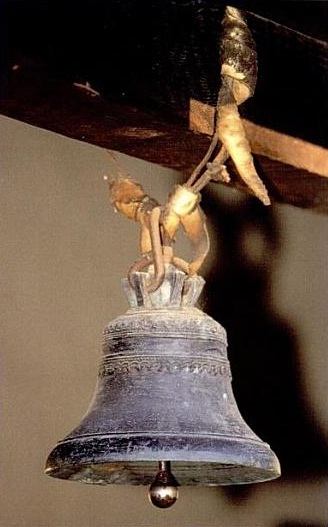
Yesterday, Isa Almisry made a great comment full of fascinating links and references. One of the most intriguing is this one, on a Russian bell housed at the Mission of San Fernando el Rey de Espana, located 40 miles from San Pedro (where St. Peter the Aleut was reportedly captured):
A hundred-pound bell was unearthed in an orange grove near the Mission in 1920. It carried the following inscription (translated from Russian): “In the Year 1796, in the month of January, this bell was cast on the Island of Kodiak by the blessing of Archimandrite Joaseph, during the sojourn of Alexsandr Baranov.” It is not known how this Russian Orthodox artifact from Kodiak, Alaska made its way to a Catholic mission in Southern California.
Another reference presents a theory about how the bell made it to the Roman Catholic mission:
A bell hangs in the belfry of the church. Another bell, weighing 100 pounds and dated to 1796, bears inscriptions for both Mission San Fernando and a Russian Orthodox Church official of the island of Kodiak, Alaska. It is believed by some that the bell originated with Nikolay Petrovich Rezanov’s 1806 Russian trading expedition to Alta California.
I did some further digging, which turned up this note (and the accompanying photo) from the book Mission San Fernando Rey de Espana, by Jacqueline Ching: “A Russian count traded it for food in San Francisco, and from there it went to Mission San Fernando.” According to Ching, the bell went missing sometime before 1860, and wasn’t rediscovered until 1920. In addition to the Russian inscription, “DE Sn FERNO” was hammered into the surface.
So who was this “Russian count,” Nikolay Rezanov? According to his Wikipedia page, he lived quite a life. He was a statesman (serving as Russian ambassador to Japan), an explorer (circumnavigating the globe), and a scholar (member of the St. Petersburg Academy of Sciences). But he is most famous for his role in founding the great Russian-American Company, the state-sponsored monopoly that ruled Alaska in the 19th century.
In 1806, he sailed from Sitka (then called New Archangel) to Spanish California. Apparently, the bell in question was on board his ship, although I can’t imagine why. Caught in a storm, he was forced to stop at San Francisco, where he fell in love with the daughter of a high-ranking Spanish official. In part because of this relationship, Rezanov negotiated a treaty between Russia and Spain regarding their claims in America, but on his way back to St. Petersburg to present it to the Tsar, Rezanov took ill and died in Siberia. Click here to see a website dedicated to preserving Rezanov’s memory.
None of this explains how a bell cast on Kodiak in 1796 made it onto a ship bound for California ten years later. The bell itself was probably the first Orthodox church bell made in the Western Hemisphere. For that matter, it may have been the first Orthodox bell in America, period, regardless of where it was originally made. It’s a rare artifact from the original Kodiak Mission, and it’s sitting in a Roman Catholic church in California, unknown (as far as I can tell) to virtually all Orthodox Christians despite its historical significance. I, for one, would love to visit that church and see the bell for myself. If anyone learns more about it, please let us know.
This article was written by Matthew Namee.
6 responses to “18th century Russian bell in California”
What size and kind of bell is it? Is it the sort that might have been common on Russian ships of that day? Or, is it a more common Russian church bell?
The language about it being cast “during the sojourn of Alexsandr Baranov” is odd. Does that mean it was cast while Baranov was in charge, or during a sojourn of Baranov that took him to Kodiak and beyond? This could have meant that the bell was intended to be taken somewhere else, e.g., a parish.
If it “was unearthed in an orange grove near the Mission”, it would seem that it might have been stolen and hidden, but never retrieved. I wonder if there any other artifacts or archaeological evidence in that same area. I’m sure that orange grove is a subdivision now, unfortunately.
The sources say that it weighs 100 pounds, so it’s kind of a medium-sized bell. 1796 was just two years after the start of the Kodiak Mission, and I don’t think there were “parishes” to speak of yet.
There’s a story here, to be sure. I am continually amazed by what I learn from readers, and by how much information on American Orthodox history is just sitting there, waiting to be discovered.
Very interesting! If I may, I’d like to direct your attention to some older books about “Russian America” if you have not found them yet.
These include:
*Hector Chevigny, “Russian America – The Great Alaskan Venture 1741 – 1867″, New York, The Viking Press, 1965, Library of Congress catalog number: 65-12027. (Of which I have copy),
and also by Hector Chevigny:
*”Lost Empire – The Life of Nikolai Rezanov”
*”Lord of Alaska – The Life of Aleksandr Baranov”
I have not read these.
Also,
William H. Hutchinson, “California, “Two Centuries of Man, Land, and Growth in the Golden State”, Palo Alto, American West Publishing Co., 1969
The claim about the bell being made in Kodiak in the late eighteenth century I find interesting as Chevigny and Hutchinson note the ‘advanced’ technical world that existed in Alaska as compared to that in California under the Spanish, such as the first steamship built, except for its engine, in the eastern Pacific was the “Nicholas I” built in New Archangel in 1841. The shipyard machine shop, however, had started to build an engine for the next ship!
The point being that the Alaskans, under Russian tutorage, were developing a civilization more advanced than that of the Spanish of the time in California.
I had left a few things out as off the subject (never stopped me before (:P)), but since you bring up civilization in CA
Auguste Bernard Duhaut-Cilly, captain of a French trade expedition to the Kingdom of Hawaii, sailing up the coast of CA in 1828, noted “All the buildings at Ross are of wood but well built and well maintained. In the apartment of the governor are found all the conveniences valued by Europeans but still unknown in California”
A voyage to California, the Sandwich Islands & around the world in the years 1826-1829 By Auguste Bernard Duhaut-Cilly, August Frugé, Neal Harlow
http://books.google.com/books?id=dF7BSXx_sW4C&pg=PA184&dq=Ross+conveniences+unknown+California&hl=en&ei=M6xMTf2cI8HYgAeU-dzcDw&sa=X&oi=book_result&ct=result&resnum=2&ved=0CDkQ6AEwAQ#v=onepage&q=Ross%20conveniences%20unknown%20California&f=false
http://www.americanjourneys.org/aj-098/summary/index.asp
Antonio Maria Osio, son-in-law of José Darío Argüello (the founder of Los Angeles, then sub-lieutenant and commandant of the Presidio of Santa Barbara 1782, then of San Francisco until 1791, then of Monterey, then SF again 1796-1806, and acting governor of CA awaiting the last governor from Spain, 1814-15), and brother-in-law of Luis Antonio Argüello (CA’s first native born governor, under the Mexican Empire) and María Concepción Argüello, Rezanov’s financee (who, btw, never left the SF Bay area, dying there in 1857), had lost his title to Angel Island (what became the Ellis Island of the West Coast) when the Ameicans took over CA
http://openjurist.org/64/us/273/the-united-states-v-antonio-maria-osio
having fled to Honolulu (btw, Fort Ross had Hawaiians, and evidently Hawaii had a number of Aleuts) when American troops landed on his island at the entrance to SF Bay in 1846 during the Bear Flag Revolt, returning to Monterey in 1850 before returning to Mexicon in 1852. Before returning, at the request of a priest of Santa Clara., he finished a memoires of pre-American CA based on his career in LA and SF. In it he notes “The Russian-American Company already [1825, the year he arrived in LA] had begun its trade, which benefitted those engaged in agriculture. Each December two or three ships would come down from the settlements which they had on both sides of the Bering Strait and load up with wheat. Don Kirill Khlebnikov, the agent in charge of this operation, gained the respect of every inhabitant of California by his gentlemanly behavior. In conducting his business, he never experienced any problems or had any disagreements with anyone, since he always acted clearly and honorably. To assure himself of a regular supply of wheat, he offered to pay three pesos silver per fanega, every year, even though he knew from various people in the country, that, depending on the harvest, the wheat was not worth more than one peso or twelve reales per fanega. He also would bring very fine goods from Europe and Asia, including fabrics of superior quality and beauty which were ordered by the Reverend Fathers of the missions for vestments and church ornaments.”
The history of Alta California: a memoir of Mexican California By Antonio María Osio, Rose Marie Beebe, Robert M. Senkewicz
http://books.google.com/books?id=dwquQrGFqrUC&pg=PA70&lpg=PA70&dq=Bering+Strait+and+load+up+with+wheat&source=bl&ots=lyrNtt3ice&sig=k37aWM0hKkDo5z67_XZYaXQ7Wfg&hl=en&ei=xb5MTcbYAYragAfN2Mwb&sa=X&oi=book_result&ct=result&resnum=1&ved=0CBMQ6AEwAA#v=onepage&q&f=false
For a summary of “Kirill Khlebnikov’ California Correspondents, 1823-1833”
http://www.2010rac.com/papers/Farris.pdf
To MATTHEW NAMEE
Thank you for your stories related to St. Alexander, a much beloved Saint to me.
I wish to talk to you about HIS help in my life, because he is a GREAT St. that we know very little about.
God Bless the Orthodox Faith!
[…] February 4, I wrote an article on an 18th century Russian bell that currently hangs in an old Roman Catholic mission in California. Thanks to Mr. Clifford Argue, […]