29
Jun

Bishop Basil on the Episcopal Assembly

   Posted by: Matthew Namee   in Inter-Orthodox

Editor’s note: On June 12, Ancient Faith Radio aired an interview I did with Bishop Basil of Wichita, the Secretary of our Episcopal Assembly. Recently, I learned that AFR produced a transcript of that interview. For our readers who might prefer text to audio, I’m reprinting that transcript here in full. I’ve made a few minor changes, mostly correcting spelling and punctuation (and if you find any additional errors, please let me know in the comments). To listen to the audio of the interview, click here.

Bishop Basil of Wichita

Matthew Namee: I’m privileged today to be sitting here with His Grace, Bishop Basil of Wichita, the new Secretary of the Episcopal Assembly. His Grace has graciously agreed to sit down and chat with me a little bit about the Episcopal Assembly, the process, and his own impressions of it. Thank you very much for your time, Sayedna. First of all, could you tell us a little bit about what your impressions were of the meetings? What was it like to be one of the hierarchs there?

His Grace Bishop Basil: Before I do that, I just want to thank you for being interested in Episcopal Assembly. It’s been about two weeks now — two, two and half weeks — since the Episcopal Assembly ended, and the enthusiasm that was surrounding the assembly seems to have dwindled a little bit since the Assembly ended. I don’t know what it was that people expected us to do at the Assembly, but something very exciting happened. And I think it’s important that we do talk about it, and that the enthusiasm continue and that it builds. It was a very historic event in that — unlike Ligonier which was self-motivated. You know, that came from the bishops here in the United States and Canada at that time. We convened ourselves — SCOBA convened that meeting for us to define ourselves and to discuss our own ministry here.

The Episcopal Assembly is very different in that we were called to this assembly by the Mother Churches and given specific tasks. That was not self-driven or even self-motivated, and in that, it’s a very historic meeting. We’ve been sitting back for decades now waiting for the Mother Churches and in some instances even criticizing Mother Churches for being inactive or inattentive. Well, they’ve not been inactive or inattentive. They’ve been having their preconciliar meetings. Perhaps we were a little bit impatient with them. And now, the time has come, and they gave us very specific tasks. And it’s not just us in the New World that got the tasks. It’s all the Orthodox that are outside the “historic” geographic territories of the Mother Churches. So, all of the Orthodox in Western Europe, in the New World, in Australia, in Oceania, the Far East, have been given tasks by the Mother Churches.

The atmosphere, that first day, I think was a combination of excitement. We knew this was a historic event as we gathered. It was interesting because there were so many new bishops since our last gathering. Again, it was a SCOBA-sponsored event in Chicago, our last gathering, but so many new bishops since then have been consecrated or assigned here to this country. So we were busy meeting each other. What was evident besides that excitement of just meeting brother bishops was the goodwill. I think that’s a description that characterized the entire assembly for those two days. It was palpable, the goodwill. It didn’t mean there weren’t some rough spots or some levels of uncomfortability, I guess, because we were discussing very serious matters, but the goodwill was palpable. Everyone wanted this thing to work. Everyone was willing to lay aside their own agendas to see what the agenda was that the Mother Churches had presented to us, and it’s a very serious agenda that was given to us. So I think the atmosphere was wonderful. It was evident in the meetings. It was a little bit more staid in the meetings because the meetings, of course, were organized in a very business-like manner, but it was especially evident during mealtimes and during the breaks. The bishops delighted in being together and doing the work of the Church.

The hierarchs of the North American Episcopal Assembly

Matthew: You mentioned the agenda that was given, the purpose of the Assembly. Could you talk a little bit about that? What are we doing with this?

Bishop Basil: The Assembly has planned obsolescence in it. The Assembly will only last until the convening of the Great and Holy Council. I don’t even know if we’re going to incorporate ourselves legally. That wasn’t discussed, but I can’t imagine us having a need to legally incorporate ourselves when, God-willing, we’ll go out of business very soon. Again, that’s not within our purview to decide when that will happen.

The business that was given to us to attend to, the task that was given to us to attend to, first of all, was to define our region. As Father Mark Arey and others have already reported through various means, the hierarchs of Canada have asked that they constitute their own distinct Episcopal Assembly, and the hierarchs of Mexico, which is geographically part of North America, and those which have oversight for the nations of Central America have asked that they be attached to the South American region Episcopal Assembly which would then leave us just the United States as the Episcopal Assembly. So that was one task: to define who we are, just geographically, what that would be. Those recommendations or desires will be communicated by the chair of our Episcopal Assembly, which now is called the North American Episcopal Assembly to his All-Holiness. And what we expect will happen is that Canada will become a distinct Episcopal Assembly, and Mexico and Central America will be removed from the North American Episcopal Assembly, and according to their wishes, attached to the South American Assembly. So, that leaves us the United States. That was our first task.

But the ultimate task is to prepare the Orthodox of this region, now that we define, or hopefully will define just as the United States, to prepare the Orthodox Christians: that includes hierarchs and priests and deacons and sub-deacons and readers and laity, all Orthodox Christians of this region are to constitute itself as a canonical, single Church. And to use the language that’s been floating around our country for decades: an administratively united Church. That’s one of several committees that has been prescribed for us. Even the names of the committees — we certainly can add to the list of committees — but even the names of the primary committees had been given to us. These are committees that the Mother Churches want us to constitute: a canonical committee, a legal committee, and this committee that will formulate our plan, or our vision for what the Church here in this region — as I said by that time that should be defined as the United States, I’m expecting, what the Church here would look like and how it would function. So that when we do go, and all hierarchs of the world, of course, would be invited to that Great and Holy Council, that the hierarchs from America will have adopted through the work of a committee then presented to the entire Episcopal Assembly here that we all tweak and then finally adopt, our plan, then, we would submit then to the Great and Holy Council for what we see the Church in America looking like.

That’s a huge task! It’s something that Orthodox Christians in America — I would say the vast majority, I’m not so unrealistic to think that it’s 100 percent, but the vast majority of Orthodox Christians in America have been praying for, have been hoping for, sometimes have been working for, always talking about for a long, long, long time. It seems that it’s at the doorway. I don’t know, you know, we’re Orthodox. I’m not saying it’s going to happen next month or next year even, but it is closer today than it was yesterday. And as I said, what’s unique about this approach is that it’s something that’s coming from the Mother Churches themselves to us. It’s as if they’re saying: look, you have been asking for this. We’re getting ready to give you this, but before we give it to you, we would like to know, what is your plan? That’s really a very exciting kind of task that’s set before us. It’s a very sobering kind of responsibility and it’s one that will take prayer and thoughtfulness and patience, continued humility and goodwill, all of that, I think, topped by what covers all of that is that it’s going to require patience.

I think many people were hoping that great fireworks and beautiful things were going to be announced from our Episcopal Assembly in New York City, and it was a rather quiet meeting in that sense. We didn’t have huge announcements coming out, but it was our first meeting, organizing ourselves, getting officers, setting up committees. We couldn’t even finish committees because we need to define the committees before we can ask the men, the hierarchs, to volunteer for a committee. How can they volunteer for something that they don’t know what the committee’s responsibility is? So, we have to do very basic things, and we have to do it carefully as I said, prayerfully, and thoughtfully because this is laying the groundwork for a very profound event, and that’s in God’s time and certainly by his grace, the establishment of a canonically structured Church here in the United States.

Matthew: You’ve been mentioning the committees and obviously it sounded like there are several committees, not just the committee to look at the canonical administrative unity issue. Could you maybe talk a little bit about what these sorts of committees might be doing? I know you said you haven’t defined them completely.

Bishop Basil: We haven’t defined them at all. [laughter] We’ve got a list of the committees. I’ll tell you what happened during the meeting. His Eminence Archbishop Demetrios, who of course is the chair, distributed among all the hierarchs present a list of about the 10 committees that were prescribed the preconciliar meeting in Chambesy. As I said, that includes the Canonical Committee, the Legal Committee, the Pastoral Committee, things like that. They were the titles, the names of the committees, and each bishop was asked to select three that they would be interested in serving on, and to prioritize them. The committee you’d like to serve on the most, make it number 1, and then number 2, and number 3. I was able to do that, several other bishops were able to do that, but there were others of our brothers who asked questions like “what does this committee do?” What is the difference between a legal committee and the canonical committee? And they were taking it so seriously—and really I admire that in them—that they were hesitant to even prioritize their choices for committees until they knew what those committees were going to do.

That wasn’t because they might sign up for a committee that they didn’t want to work on, that wasn’t the point. They wanted to be sure that they prioritized their choices for the committee that they wanted to be on the most, but they wanted that defined. That’s yet to be done. The archbishop is chair and the other officers of the Episcopal Assembly will, probably within the next week, or for sure within the next several weeks, have those defined and sent out again to all the bishops, now with brief paragraphs describing the work of each committee and then ask each bishop to prioritize their three choices.

Another important committee is the Pastoral Committee. And since the meeting in Chicago, we are aware of over 20 different issues that the various Orthodox jurisdictions handle very differently in this country, pastoral issues. They are, of course, tinged with canonical coloring, but we handle them very differently and create pastoral problems for the Church here in this country.

For instance, how do we handle marriage? Some jurisdictions recognize only marriages which take place in the Orthodox Church, others recognize every marriage, whether it’s a civil marriage or a marriage done in another faith group as well as those that happen in our own Church. How do we handle divorces? Some have that the actions of the civil court, civil decree of divorce, is sufficient while others have their own marital courts, church-run marital courts. What do we do about the reception of converts? Some baptize all who come into the faith, others receive some by chrismation, and even that is different because some do chrismation according to their koloyan on the forehead, the eyes, the ears, the nose, the lips, etc, etc, while other groups can receive a person simply by chrismation on the forehead, and it’s prescribed for that. Others simply by a profession of faith. What do we do when we receive clergymen most especially from the Latin Church, the Roman Church? Do we re-ordain or do we vest?

Those kinds of matters will be discussed in the pastoral committee. So again, it’s a very important work that has been set before us to do. The Legal Committee will not only help the Episcopal Assembly with its own legal work, but I think its first task will be to help the agencies of SCOBA reincorporate themselves. How will they legally now change themselves from being answerable to SCOBA, which really doesn’t exist anymore, to being answerable or having oversight given them by the Episcopal Assembly. One important thing I should say about these committees is that they will not just be constituted of bishops. You know, this is the work of the whole Church. The bishops, through the Episcopal Assembly, will establish the committees and will be the first to volunteer for those committees, but we’re going to need the help and the input of all talented and interested Orthodox Christians.

The Legal Committee is going to need attorneys, and it doesn’t matter if you’re ordained a bishop or a priest or a layman, we need experts in all of these areas: people, again, who come with goodwill, who come with patience, who come with humility to work for the accomplishment of that task. This is the work of the Church. It’s not just the work of the bishops. But as parents have to have themselves together before they can go to their children and make sure they’re both on the same page, a mother and dad have to be on the same page, we bishops who have been charged to be the overseers for the Church in this country, need all to be on the same page. Then we go to our flock, and not only ask and invite their participation, we expect it. It’s their Church like it’s our Church, together it’s our Church. But the bishops, like parents have to all be on the same page first. That was the purpose of that “closed” session of the Episcopal Assembly. It’s not that we did anything secret. It’s just that we needed to get our act together before we could go to the Church at large.

This late 1950s meeting of Orthodox bishops led to the creation of SCOBA in 1960. At the center, L-R, are Metropolitan Antony Bashir, Archbishop Michael Konstantinides (in front of the US flag, and holding a white object), and Metropolitan Leonty Turkevich.

Matthew: You mentioned SCOBA. And SCOBA, as you said, is pretty much no more. It’s been superseded. Can you give us some thoughts about both the legacy of SCOBA and also what makes the Episcopal Assembly something much different than SCOBA.

Bishop Basil: At the Episcopal Assembly, His Eminence Archbishop Nicolae of the Romanian Orthodox Archdiocese gave an overview of the 50-year history of SCOBA and its work. And when he was finished, I mentioned to the bishop sitting next to me, ”That was the best description of SCOBA I have ever heard.” What’s a shame is that it came at the demise of SCOBA. It was really a brilliant paper presented by Archbishop Nicolae. This is the 50th anniversary year of the establishment of SCOBA: the Standing Conference of the Canonical Orthodox Bishops in the Americas. We were blessed, really, by the work of SCOBA. The work of the Episcopal Assembly was made quite easy by the 50 years that were used as preparation for that. We didn’t come together as strangers.

There’s a legacy of inter-Orthodox cooperation, not only with the goodwill among the bishops, but the actual incarnating of the work of the Church under the auspices of SCOBA, its various agencies, feeding the poor, clothing the naked, preaching the gospel, and etc, etc. The Episcopal Assembly, I believe, is the natural outgrowth of SCOBA or the fruit that SCOBA bore. They can’t exist together, and it’s not because one is good or one is better than the other, just that there was a time for everything, there was a season, and there was a 50-year season preparing us for this very sacred moment of doing what it was that SCOBA had hoped.

SCOBA, again, was self-constituted. It was the bishops themselves, the primates of the jurisdictions here in the United States and Canada, the goodwill that they had one for another. So there’s a big difference between the constitution of SCOBA and how it was constituted and established and the Episcopal Assembly. The Episcopal Assembly is compromised of every Orthodox bishop, just not the primates, or the prime bishops of the jurisdictions. We had 55 in attendance, or was it 56? The number is a little bit confusing. I think 55, where the maximum that would’ve been SCOBA members would’ve been eight of the eight jurisdictions. SCOBA also allowed for proxies to attend, so for instance if Metropolitan Philip could not attend a SCOBA meeting, he could send Bishop Antoun or myself or Bishop Joseph or anyone of our bishops of the Antiochian Archdiocese to represent that jurisdiction, our jurisdiction.

There are no proxies on the Episcopal Assembly because we don’t represent jurisdictions. We’re there because we’re bishops, and only a bishop can be a member of an Episcopal Assembly. We’re not representing jurisdictions. We received invitations, not as members of a jurisdiction but as Orthodox bishops. We bless the memory of the founders of SCOBA. They were brilliant men, people with a lot of foresight for what the Church should be in this country, people like Metropolitan Leonty and Archbishop Michael of the Greek Archdiocese, and others. They foresaw and worked for the day that we’ve come to now, and we bless their memory. We thank those who were their successors in SCOBA who worked right up until the moment of the assembling of the Episcopal Assembly, but there’s something new now, and it’s the fruit that SCOBA bore.

Matthew: We’ve heard various things, reports, about the Executive Committee of the Assembly, but my understanding is that the voting is actually done by the whole Assembly. Is that right? The Assembly itself is where the power lies, essentially.

Bishop Basil: The word “Executive Committee” was not even mentioned. You didn’t hear those words at all during the whole Episcopal Assembly. What constitutes the members of the Executive Committee—there’s a lot of speculation and a lot of talk going on about it, but those words were not even mentioned at the Episcopal Assembly because it is so secondary. Its importance is so secondary, or even tertiary to the work of the assembly and its committees. Unlike what we Americans generally think of as an Executive Committee being just the officers, the chair, the vice-chairs, the secretary, and treasurer, that’s not what the Chambesy document defines as the Executive Committee. It’s that: it’s the officers, but then the heads of the Mother Churches representatives in this country. So that those who are not officers—for instance, Metropolitan Christopher is the senior hierarch of the Serbian Orthodox Church, he’s not an officer of the Episcopal Assembly, but as the senior hierarch of the Serbian Orthodox Patriarchate, he would be a member of the Executive Committee. But it’s really just for consultation, no decisions will be made by the executive committee, everything has to be referred back to the Episcopal Assembly. That’s why I believe it wasn’t even discussed at this meeting at all.

I don’t want to say it’s not important because it did come from Chambesy so I assume it has some function, but you know, in the age of teleconferences and everything, we can have an Episcopal Assembly just at the drop of the hat, doesn’t mean we have to travel anywhere. All we need is telephones or a computer, and we can have the entire Episcopal Assembly. Times have changed. The voting, that’s another interesting thing that did not happen at the Episcopal Assembly. There were no votes. Everything was done—it was supposed to be done by consensus, asking everyone, how does this church feel, how does this church feel? There wasn’t even any voting by consensus.

We were of such one mind that everything was done unanimously. His Eminence Archbishop Demetrios simply asked if there was any objection to the item being discussed. If there was no objection, there was no need to even ask for a consensus. Everything was done unanimously. It was really a very God-blessed assembly, a fruitful time together. It’s by God’s providence, I believe, honestly, that it was convened during the week following Pentecost. As I said, the goodwill was palpable. The love was palpable, the joy was palpable, and those are gifts of the Holy Spirit.

Matthew: At the Assembly, you were obviously elected Secretary, and I have understood that you’re not just taking notes and minutes of the meeting. You’ve got a bit more of a role than that. Could you talk about your role and then the Secretariat that you’ll be working with?

Bishop Basil: I’m sort of discovering day-by-day. Yeah, the first three officers, the Chair and the two Vice Chairs were done by the diptychs and the presbeia or the seniority within those diptychs, so that the first church among the diptychs is the Church of Constantinople, and the first hierarch of the Church of Constantinople became the Chair. That’s Archbishop Demetrios. The second church in the diptychs is the Church of Alexandria. Well, we don’t have that in America, so they went to the third church in the diptychs which is the Church of Antioch. Senior hierarch of the Church of Antioch in the new world is His Eminence Metropolitan Philip so he’s the first Vice Chair. After that comes Jerusalem. We don’t have Jerusalem in this country. Next in the diptychs comes the Church of Russia and the first hierarch of the Church of Russia in this country is the newly appointed Archbishop Justinian. So he was second Vice Chairman. So the first three positions of the officers were done by the diptychs or the order of the Churches, and by the presbia, there’s seniority within those diptychs.

The other two officers, the Secretary and Treasurer were done as we would do, like Robert’s Rules of Order, sort of an American style. The Archbishop made a nomination, Archbishop Demetrios nominated myself to be Secretary. It was seconded by Metropolitan Philip I believe. The Archbishop asked if there were any other nominees, and not being any other nominees, I was elected by acclamation. The same thing happened for His Eminence Archbishop Antony of the Ukrainian Church. He was nominated by Treasurer by Archbishop Demetrios. He was seconded, again I believe it was by his primate, Metropolitan Constantine, and the Archbishop asked if there were any other nominees. There were none, and he was nominated by acclamation.

The responsibilities of the Secretary are more than just taking minutes. That would be nice if it were just taking minutes. [laughter] I understand, and I’m understanding more and more every day that it will — its prime responsibility of the office is to oversee a Secretariat and an entire staff, whether it’s one or two or three persons. It certainly won’t be an enormous Secretariat, but that does the work of the assemblies, that spurs on the work of the committees. It seems that which will be communicating not only among the hierarchs itself, keeping the hierarchs informed of the work of the assembly that is being accomplished, but the entire Church involving all the clergy and lay people, setting up a website, making sure all the documents that have been issued for or by the assembly are available for everyone to see so there’s no secrecy in anything. Because again, it’s the work of the Church, the body of Christ, which is all of us. Certain tasks, again, were given to the assembly by the preconciliar committee in Chambesy, and the Episcopal Assembly gave it over to the Secretariat to do that. We’re going to have a database of all the Orthodox hierarchs in America which doesn’t exist right now. That will be easy because there’s like 55 of us.

The more difficult is going to be a common database for all of the Orthodox clergy, the higher clergy, the priests and the deacons. That’s something that needs updating, probably weekly, not only because of deaths but because of new ordinations, because of suspensions, because of depositions. And beyond that, we were mandated to create a list of all the Orthodox congregations, all the Churches and missions, and that’s another thing that will have to be updated rather frequently. Hopefully not because anything is closing, but because new ones are being established all the time. That’s all the work of the Secretariat, not the Secretary (me), the Secretariat. [laughter] And it will be daily work because I honestly believe that we have not a lot of time to get all of this accomplished.

As I mentioned earlier, once the Great and Holy Council is convened, the work of the Episcopal Assembly and all of its committees really is done. At least that’s the plan now, and not our plan, that’s the plan of the Mother Churches, but at that time, various either autocephalous or autonomous Churches will be established in these now Episcopal Assembly regions, that’s what we’re called now, around the world and that those hierarchs which prior to that moment constituted themselves as an Episcopal Assembly will become a Synod.

That’s what’s foreseen, and there’s a lot of work that needs to be done before that time whether it one year or whether it’s 10 years. That’s what’s on everyone’s mind. How long of a timetable do we have? I don’t know, and I don’t know that anyone knows. Whatever it is, it’s shorter than we thought it was because the Mother Churches are moved now by the Holy Spirit. The time is here, and the time for us talking about it and complaining “how come it’s not happening”, and everything that’s been going on for these past decades here in America, it’s not time for that anymore. It’s time for all of us to get the work and do it, and again, to do it with goodwill and love and patience and humility.

Matthew: Thank you very much, Sayedna. Do you have any final thoughts that you’d like to offer before we close this interview?

Bishop Basil: I’m so excited about this. Really, I’m very excited, and I hope our clergy and people can be joyfully excited with their hierarchs. We need everyone to help in this. As I said, the bishops now have met. We’re all on the same page. We might not know all the writing on the page, but we’re all on the same page, and we’ll discover what’s written on that page as time goes by. I have my diocese in conference next week. The very first evening I’m going to share all of this with our clergy and more. Your questions were rather specific. I have more things, even, about the Episcopal Assembly I’ll share with all of my clergy and their wives that very first evening, inviting their help and their participation, their ideas, the offering of their talents.

And the very next night, I’ll present the thing to the work of the Episcopal Assembly in my assessment of it to our entire diocese, to all the lay people, from church-school children all the way up to senior citizens, parish councils, ladies groups, teen groups, choirs, so that everyone in our diocese will be apprised and will have the invitation to help in this. I hope everyone accepts the invitation. As I said, when you accept though, you have to come with goodwill and patience and love and humility. This is an offering to the body of Christ, and we need to do it with pure hearts, with joyfulness, and with a spirit of sacrifice.

Matthew: Sayedna, thank you so much for your time and for telling us all about the Assembly. And we will look forward in the coming weeks and months to getting more information and seeing the website that the Assembly will launch and learning more about what we can do to help the work of the Episcopal Assembly.

Tags: , , , , , , ,


Copyright © 2010 by Matthew Namee. All rights reserved. Your use of this article is subject to our Terms of Use.


In the closing years of the 19th century, a number of Roman Catholic leaders in America were accused of a heresy called Americanism, and Pope Leo XIII wrote an apostolic letter specifically denouncing elements of this teaching, Testem Benevolentiae Nostrae. Americanism was essentially the emphasis on American political values over against the Roman Catholic political tradition, which was at the time at least distinctly uneasy regarding political positions such as the separation of church and state, freedom of the press, liberalism (in the classic sense) and the individualism which so marks American culture in general. While the episode in Catholic history was really quite minor, what was at stake was the question of religious identity in American society. It was probably not until the election of John F. Kennedy to the American presidency that Roman Catholics came to feel that they had finally come into their own in America, despite their presence on the continent for nearly as long as the English Separatists who founded the seminal colonies of American national life.

In our time, it would be regarded as absurd that anyone would accuse American Catholics of heresy over a devotion to such staples of American political values. Setting aside for the moment the controversial peculiarities of modern American Roman Catholicism even within the wider Roman communion, it must be admitted that the “Americanists,” such as they may have been, have essentially won. Few American Catholics would say that one cannot be fully American and yet fully Roman Catholic. There has come to be no contradiction seen between these identities. (For an example of a rather less successful merger of such values, one need only look at the liberation theology of South American Catholic Marxists.)

Like those Roman Catholics living in 19th century America, for Orthodox Christians living in 21st century America, the question of how exactly one is to be faithful to one’s communion in this particular place is again paramount. Though the debates about Orthodoxy’s history, present and future in America range widely—from canons to language to proofs to corruption to double-dealing to controversial candidates for the episcopacy or canonization—the question at the heart of all these debates is really this: What is our identity?

One attempt to grapple with our past and our future might also be termed Americanism. Unlike those 19th century Roman Catholics, however, modern Orthodox Americanists (not to be confused with Orthodox Americans) have chosen different elements of American identity with which to interpret and (I would argue) distort not only our history but our faith.

Legalism

Perhaps the clearest and most troubling such element is the spirit of legalism which pervades Americanist readings of our history, accompanied by their prescriptions for our future. The narrative typically follows this shape: Because the Church of Russia was the first in America (in Alaska, 1794), it gained immediate rights to the whole continent. Thus, when in 1970 it granted autocephaly to the Russian Orthodox Greek Catholic Church of America (the Metropolia), which subsequently renamed itself as the Orthodox Church in America (OCA), the exclusively legitimate Orthodox Church for America finally was born.

There are numerous problems with this narrative even on purely “legal” grounds: Does jurisdiction in Russian Alaska automatically extend to the entire continent, under the control of multiple colonial powers at the time? Did the Russian Metropolia even view itself as exclusively legitimate prior to the establishment of other jurisdictions in America? What does it mean that the Metropolia granted canonical release to the Antiochian parishes operating on its territory? For the purposes of ecclesiastical annexation, do the canons actually allow for appointing bishops outside one’s canonical territory? (The opposite, really.)

But the issue here is not really all these legal grounds. For one thing, it is anachronistic to read our history in this fashion, since there is no indication prior to about 1927 that anyone was making the claim that all Orthodox in America had been united under the Russians, that the Russians enjoyed an exclusive, universally acknowledged claim over the whole continent, or that the Metropolia ever really regarded the other Orthodox in America outside its jurisdiction as illegitimate, uncanonical, etc. But now there are some commentators saying precisely all these things, some even going so far now as to claim that all those outside the Metropolia’s jurisdiction were really not Orthodox. Such a claim, if true, would render most Orthodox Christians currently in America bereft of the sacraments.

What is most troubling, however, is this dedication to legal technicalities. It is certainly a major facet of American life that we like to get the legal authorities involved at the drop of a hat, so much so that, even when we are not actually involving the police or the courts, we still think and speak in such precise technicalities. Even if this anachronistic narrative of our history were actually defensible on purely canonical, legal grounds, this spirit goes wholly against the spirit of the Orthodox Christian faith. We were not appointed by God to be lawyers for His Kingdom, but rather “able ministers of the New Testament; not of the letter, but of the spirit: for the letter killeth, but the spirit giveth life” (2 Cor. 3:6). Reading history in order to find ammunition for “claims,” etc., is basically a Westernization, a distortion of our church life along lines foreign to our basic ethos. It is what Fr. Georges Florovsky would have called a “pseudomorphosis” (a term he used when referring to the distortions which accrued in Russian theological life as a result of the “Western Captivity” which led up to the Bolshevik Revolution).

While it is surely an American thing to call out the lawyers and pull out the law books in order to adjudicate nearly every dispute, this is not the content of our Orthodox Christian faith. If we wanted to be Christian legalists, we would find no better home than Calvinism, a theology designed by a lawyer.

Sectarianism

A dedication to “the letter” typically leads to sectarianism, the rigid sense that one particular ecclesiastical faction is right while all the others are wrong. At the foundation of this sensibility is also a historiographical problem, the identification of a sort of “golden thread” which stretches unbroken from some favored moment (e.g., St. Herman landing in Russian Alaska) to the current day. The favored sect is the sole lens through which this history is read.

The theological problem at the heart of this side of Americanism is the refusal to look into the faces of fellow Orthodox Christians and see the Church. This ideological approach to faith is the same one which gives rise to totalitarianism in politics, which always necessarily follows a dedication to ideology. What is most important is the transcendent narrative, not the other person. That is why the other can be dehumanized and demonized, and insulting epithets can be hurled at church leaders who do not represent one’s preferred sect. In politics, this leads to persecution, but in ecclesiology, this leads to schism.

I believe that one of the major elements in the Americanist approach to our history and our future is precisely the schismatic spirit, the one that prefers to be “right” rather than to love, the one that makes demands and sets exclusive terms rather than taking every opportunity to work together and sacrifice for the other. This attitude has been rarely more evident than in the recent Internet storm over the newly formed Episcopal Assembly, which it seems can only be up to no possible good. I very much believe that the Americanists want it to fail in its task. I’m not really sure what they would put in its place, however, other than an entirely unrealistic expectation that the overwhelming majority bow to the small minority of their favored “jurisdiction.”

But all our “jurisdictions” must die in order that our Church may live. We cannot become one Church for America without all giving up what we are in order to become what God has called us to be: a single testament to the Orthodox Christian faith. I cannot see any workable solution which would not require the disbanding of all our current “jurisdictions.”

Demonization

As an example of the demonization typical of the sectarian spirit, many Americanists will point to the controversial claim of the Ecumenical Patriarchate of Constantinople to jurisdiction over all the diaspora (i.e., all areas outside universally acknowledged canonical territories) based on Canon 28 of the Council of Chalcedon, the Fourth Ecumenical Council. It is true that such a claim is almost never taken seriously except by Constantinople itself. Yet while Constantinople’s claim is raged about, few of the Americanists, who typically have a much greater affection for Constantinople’s main rival of Moscow, will criticize the much broader claim made by Moscow in its very Statute:

The jurisdiction of the Russian Orthodox Church shall include persons of Orthodox confession living on the canonical territory of the Russian Orthodox Church in Russia, Ukraine, Byelorussia, Moldavia, Azerbaijan, Kazakhstan, Kirghizia, Latvia, Lithuania, Tajikistan, Turkmenia, Uzbekistan and Estonia and also Orthodox Christians living in other countries and voluntarily joining this jurisdiction. (emphasis added)

Not only does Moscow define its jurisdiction primarily as one over “persons” rather than simply over geographic territory, the very wording of its Statute permits Moscow jurisdiction everywhere in the world, limited not only to specific territories and the diaspora, but even theoretically to within the territories of existing Orthodox churches.

This disturbing, universalist approach to ecclesiology, with some variations, is not exclusive to Constantinople and Moscow, however. Contrary to the canons, Antioch, Jerusalem, Moscow, Serbia, Romania, Bulgaria, Georgia, Poland and even the OCA also maintain parishes outside their officially claimed canonical territory. This anomaly is rampant, and almost no Orthodox church in the world is innocent of it. We have indeed seen the enemy, and he is us.

Nationalism

The problem of nationalism in Orthodoxy throughout the world is of course also rampant and its sins well-known. For Americanists, it is most often expressed on grounds which are basically Orthodox—a desire to be shepherded by local shepherds—but the expression of those grounds often takes us into a rebellious and nationalistic direction. So-called “foreign” bishops are rejected (which discounts missionaries), total local independence is assumed to be the norm at all times (which discounts the numerous centuries throughout Church history in which various churches were dependent for lengthy periods on “foreign” administrations far away). The ultimate desire of Americanist nationalism is that our bishops would simply thumb their ecclesiastical noses at the “foreigners” in other lands and declare us immediately to be an independent, autocephalous church. As precedent for such an act, they correctly point to when this has happened before.

But with modern communication and travel, “foreign” bishops are not so foreign as they once were. In the past, a unilateral self-declaration of autocephaly was much more practical than it is today, due precisely to these same factors. Though uncanonical, it is now much more possible to have an international, worldwide jurisdiction answering to a single synod. What Rome declared de jure and enforced with anathema has now become de facto for ten Orthodox jurisdictions which operate outside their traditional and/or self-defined territory (Constantinople, Antioch, Jerusalem, Moscow, Serbia, Romania, Bulgaria, Georgia, Poland and the OCA).

Yet with such unilateral self-declarations of autocephaly in the past, the driving factor was practical: the need to form a local, self-sustaining common church life. What we have now is numerous overlapping networks of self-sustaining church life, bound together internationally by easy communication and speedy travel. Globalization has taken a toll on our Church life, permitting it to become distorted beyond the essentially localist approach witnessed to in our canonical tradition, where decisions made by leaders had to be lived with by those leaders. They were shepherding their neighbors.

If we are to regain our localist sensibility for church governance, then we cannot rely on a means which was supported by a different technological age. The unilateral declaration of autocephaly is impractical in our time. Why? It’s because there are already existing international networks for American Orthodox Christians to fall back on. This is why the formation of local networks is so critical. This is why our mother churches have mandated the formation of the Episcopal Assemblies.

It may well be that the Assemblies are just a power grab by whatever jurisdiction we hate the most. But even if that is true, what is happening at them is the formation of a common local identity.

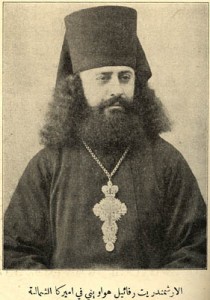
St. Raphael Hawaweeny


The Cure for Americanism: The Common Identity

All of this fractiousness may be cured by looking no further than our common Creed, which attests to our belief in one, holy, catholic and apostolic Church. As Orthodox Christians living in America, we have no path to unity—indeed, no path to our own salvation—except through love. We must look at one another’s faces and see the Church there. When we cease to do so, we have become sectarians and schismatics.

All of the history of Orthodoxy in America is our common history. It does not matter which “jurisdiction” we are in. The saints, the sinners, the laity, the clergy, the successes, the failures—all of these are mine. All of this history is our history. It is not the history of Russians or Greeks or Syrians or converts, etc. It is the history of the Orthodox. We need to learn to say with St. Raphael of Brooklyn, “I am an Arab by birth, a Greek by primary education, an American by residence, a Russian at heart, and a Slav in soul.” He didn’t just tolerate these other people; he identified himself with them.

Many of these elements of American culture that I call “Americanism” and that are at odds with our faith also are now characteristic of other cultures throughout the world, and we can see their ill effects in other Orthodox churches, as well. Claims and counter-claims, legalism, sectarianism and nationalism are all major pastoral problems plaguing Orthodoxy worldwide, and no doubt we would have a more peaceful and united presence in the world if we could shed these sins. American culture has much that is worth preserving and enhancing, but as truly Orthodox Christian Americans, there are some elements of that culture that need not preservation, but repentance.

We have an opportunity in our time to put aside all of our claims and sectarianism Phariseeism, to see one another as fellow children of God, and to build a common church life. We’ve come a long way, and at least to me, it seems that the future is starting to look a lot brighter.

I really cannot wait to see where we go from here.

[This article was written by Fr. Andrew S. Damick.]

Tags: , , , ,


Copyright © 2010 by Fr. Andrew S. Damick. All rights reserved. Your use of this article is subject to our Terms of Use.
4
Mar

A Greek bishop in America in 1893

   Posted by: Matthew Namee   in Firsts

Sketch of Archbishop Dionysius Latas of Zante, published in the New York Tribune (8/1/1893)

In 1893, the World’s Fair was held in Chicago. In conjunction with the Fair, something called the “World’s Parliament of Religions” was held from September 11-27. This was a remarkable gathering, which brought together not only Christian leaders of various denominations, but people of every religious stripe — Jews, Muslims, Hindus, Buddhists, etc. It seems to have been more of a spectacle than anything substantive, although, as we’ve discussed previously, the crazy Antiochian archimandrite Christopher Jabara thought that perhaps the Parliament could come up with a brand-new, global religion. His hopes were unfulfilled.

Anyway, besides Jabara, at least two other Orthodox leaders gave speeches at the Parliament — Fr. Panagiotis Phiambolis of Chicago’s new Greek church, and Archbishop Dionysius Latas of Zante (Zakynthos). Latas was by far the most significant Orthodox figure at the gathering, and from the time of his arrival in America, he was a media sensation. He also happens to have been the first non-Russian Orthodox hierarch to set foot in the New World. This is the first of several articles that will chronicle his visit to America.

Latas arrived in America at the end of July, and on August 1, the New York newspapers ran stories about him. Here’s a brief biography, from the New York Tribune:

Dionysius Latas was born in Zante in 1836. At an early age he attended the Greek Seminary in Jerusalem, where he remained for ten years, afterward spending four years at the University of Athens. Later he studied for a year in the University of Strasburg, before the annexation to Germany, and three years at the universities of Berlin, Leipsic and other German universities, and then spent some time in England. From 1870 to 1884 he was the eloquent preacher of Athens, when he became Archbishop.

Latas was thus about 57 when he came to the United States. He was accompanied by his deacon, Homer Peratis, and one of their first stops was the new Greek church in New York. “I preached yesterday in the little Greek church in this city,” Latas told the New York Times (8/1/1893), “and it reminded me of the little churches I preached in years ago when I was an Archimandriti.”

Not to go off on too much of a tangent, but Latas was a very, very popular preacher when he was an archimandrite in Athens. I have a letter from a Protestant visitor to Athens in 1870 — so, just at the outset of Latas’ preaching career. This letter, written by a certan Rev. Dr. Goodwin of First Congregational Church in Chicago, was published in the New York Evangelist (7/21/1870), and provides a glimpse into the sort of figure the young (34-year-old) Latas was:

The chief sensation of Athens just now is a priest named Dionysius Latos, and among the mummeries dinning the ear on every side during these festivities, it was refreshing to find one service that was an exception. This young priest was originally one of the candle-snuffers, a lad of no education, and with no apparent gifts, except a fine rich voice. Promoted because of this to assist in the chorals, he somehow obtained leave to talk or preach, and astonished every one, and greatly captivated the people by his eloquence. He speedily acquired a wide notoriety, and won many friends. Among them was a rich Athenian, who proposed to him to spend three years in the schools of Germany and France, at his expense. He accepted the offer, spent time in diligent application, and has just returned, and is creating the highest enthusiasm.

I went on Friday morning to hear him preach, and found the church literally packed. And the Greek churches having no seats, admit of such a crowding as is entirely unknown to American audiences. There was no getting near the main entrance, the throng extending into the street. I found a side door, however, to the women’s gallery, and there at last succeeded, by climbing upon a pile of boards, in getting a view of the preacher and his congregation. Below me was a sea of men’s faces, all upturned toward a man of fine intellectual features, and searching dark eyes, and who in the black gown and round brimless hat or high stiff fez of a Greek priest, stood in a pulpit projecting from one of the columns near the middle of the church.

I was impressed at once with the earnestness of the preacher’s face and manner. There was that in the kindling of the eye, the tone of the voice, and the sweep of the hand even, that witnessed unmistakably to the preacher’s deep conviction of the truth and importance of his words. One could not look and listen without a conscious sympathy in response It would have been no common privilege to hear the language of Socrates and Demosthenes spoken, and that in their own Athens, with the distinctness and grace and fervor which marked the speaker’s utterance. Certainly there was a rhythm and music and richness about it that I had never imagined, and that seemed to thrill and move the people somewhat as did the great orators in those earlier days.

But when in the course of a fervent passage my ears caught in Greek the words, “Ye men of Athens,” and then following the whole discourse of Paul from Mars Hill, in the very words he used, and under the very shadow of the spot where he stood, I felt as if centuries were suddenly rolled back, and not a Greek priest, but a greater than he, and a greater than Demosthenes or Plato were there before me, preaching in this wonderful language Christ and Him crucified. I could only now and then understand a word, but caught enough to divine that the theme of the discourse was the love of God as revealed in the life and death of Jesus Christ.

The preacher continued for a full hour and a half, closing with many quotations of Scripture and with much impassioned eloquence, and the people stood eager to the end. It is believed here by those who know Latos intimately, that he is in every respect heartily in sympathy with evangelical religion. And the hope is warmly cherished that he will prove to the Greek Church in Athens far more than Pere Hyacinthe to the Latin Church in Paris — a fearless and mighty apostle of the truth, that cannot be cajoled from his purpose by flatteries, nor silenced by threats.

Latas was a genuine sensation, and as a bishop, he remained a prominent figure in the Church of Greece. He spoke out against anti-Semitism, advocated (as did so many in those days) dialogue with the Episcopalians, and was skeptical that any sort of union would happen with Rome. When he came to the United States, he was warmly welcomed by the various Episcopalian bishops that he encountered. Immediately upon his arrival, he was invited by Bishop Henry Potter to join him at Saratoga Springs. We’ll pick up the Latas story there.

Tags: , , , , , , , ,


Copyright © 2010 by Matthew Namee. All rights reserved. Your use of this article is subject to our Terms of Use.
11
Feb

The Ghost Story of the Bulgarian Monk

   Posted by: Matthew Namee   in Uncategorized

Bayhorse, Idaho -- the last known residence of "the Bulgarian Monk"

Back in September, I discussed the incredible story of Rev. A.N. Experidon, better known as “The Bulgarian Monk.” (Click here for the podcast, and here for the OH.org articles.) To briefly recap, for those of you who are unfamiliar with the story: “The Bulgarian Monk” was the stage name of Fr. Experidon, who claimed to be a Bulgarian monk from Jerusalem. He was in America from the 1870s until his apparent death in the early 1890s. He was an amazing character, traveling all over the United States and giving lectures on street corners and in small-town opera houses. He befriended many politicians of his day, tried to convert Brigham Young to Orthodoxy, and probably drowned in Idaho around 1891 or so.

Shortly before his death, Experidon met Ethelbert Talbot, who was, at the time, the Episcopal Bishop of Wyoming and Idaho. (By sheer coincidence, many years later, Talbot was the bishop who deposed Rev. Ingram Irvine, leading to Irvine’s conversion to Orthodoxy.) Anyway, in his memoirs (My People of the Plains, published in 1906), Talbot wrote about his encounter with the wild Bulgarian Monk:

It was at this latter place [the mining camp of Bay Horse, Idaho] that I met for the first and only time a strange, wild man of the mountains, who was spoken of as the “Bulgarian monk.” He carried a gun, and was followed by a dog. Occasionally he would descend from the hills, where he led a solitary life in the woods, to a mining-camp, and preach the Gospel to those who were attracted by his weird appearance and mysterious personality. He affected the conventional dress and bearing of the apostles, and seemed to consider himself a sort of modern John the Baptist. By the more superstitious and impressionable he was regarded with much awe and wonder; by others, and especially the young, he was greatly feared, and mothers would conjure with his name in keeping their children in the path of obedience. Whence he came and whither he went, no one knew. His movements were enshrouded in mystery. I tried to engage him in conversation and elicit from him some information as to his life and purpose. But my efforts were unavailing. As the weather grew cold in the autumn he would disappear, not to be seen again until the winter had passed and the snow had melted in the mountains. Then with his rifle and faithful dog he would once more be seen in the woods. Whenever he condescended to come to a settlement, it was only for a brief hour, to deliver his message or warning, and then disappear. He repelled all attempts to draw him into conversation, nor would he accept hospitality or kindness from any one. He suddenly ceased to make annual visits, and no one seemed to be able to solve the enigma of his life. On the occasion of my seeing him at Bay Horse he was just leaving that place, and I can vividly recall his curiously clad retreating figure, as he climbed the mountain and disappeared among the pines.

Note in particular this sentence: “By the more superstitious and impressionable he was regarded with much awe and wonder; by others, and especially the young, he was greatly feared, and mothers would conjure with his name in keeping their children in the path of obedience.”

In the 1990s, various ghost story books began to include legends of “the Bulgarian Monk” ghost. The first reference I’ve seen is from Deborah L. Downer’s 1990 book, Great American Ghost Stories. In 1995, the fullest story appeared, in Historic Haunted America, by Michael Norman and Beth Scott. Here is what they have to say about the Bulgarian Monk:

Every community has its own eccentric character – an oddly dressed or reclusive man or woman, seeking no meaningful friendships, yet amiable enough when spoken to.

In Bayhorse, Idaho, the recluse was known by all as the “Bulgarian Monk of the Church of Jerusalem.” Some said the monk had no ecclesiastical credentials because he never saved anyone from sin. But that scarcely mattered. He did look somewhat churchly, a young man, tall and lean with a long, black cloak flapping about his ankles and a red fez perched atop his head. He claimed to speak thirty-two languages and said he’d been a guide for Mark Twain in the Holy Land. All quite credible in nineteenth-century Idaho.

Two weary horses and a scrawny dog accompanied the monk as he wandered from one mining camp to another along the Salmon River. He never caused any trouble and if his strange appearance brought a comment from a newcomer to the area, the old-timers would say, “Oh, he’s a harmless coot. Just part of the scenery.” And they always said it with respect, for they both admired and sometimes feared this “missionary man” who lived among them. What proselytizing he did came in tolerable doses.

Rumor had it that the monk had a tiny cabin somewhere in the woods and that he was hospitable enough to the few lost travelers who stumbled to his door. He always left provisions for the taking.

The monk fished and hunted, his scarlet cap warning other hunters of his presence in the wilderness. Although generally he was uneasy with adults, children loved him. They came running from all directions when he stopped by the village store for supplies. It was as if they knew he was coming before they ever saw him. The smaller children thought he was so tall because he probably walked on stilts. At other times he would sprint down the road chasing after the children, the sides of his cloak flapping like giant wings, gales of laughter greeting the startled passersby. Of course, he never caught them, for that would spoil the game. He would always fall flat on his face and cry and beat the ground, as if in great suffering.

In the harsh winter of 1890, shortly before Idaho became a state, the Bulgarian Monk vanished. A blizzard blew for endless days, the temperature dropped, and ice-crusted snow made it dangerous for search parties looking for stranded prospectors and families. Avalanches killed many miners, and trains between Shoshone and Ketchum were snowbound for days. Livestock and wild game starved.

And when the storm abated, people started reappearing, searching for family and friends. The old mining town of Galena had been hardest hit, but many had escaped in time.

And where was the monk? Some said he was in Bellevue, Idaho. He wasn’t. Another said he’d seen him in Shoshone. He wasn’t there either. Children sobbed, fearing their friend had died in an avalanche.

In fact, the Monk had been at Galena when the storm struck and he stayed on, camping on Titus Creek. But when the storm grew, he knew he’d have to get over Galena Summit to the safety of the mining camps on the Salmon River. He made snowshoes for his horses and for himself and, carrying the little dog through waist-high drifts, reached safety. He said in all the thirty-two languages he knew that he had “never traveled faster than 100 miles per hour.”

In February 1891, the rains came. Roofs weakened by the weight of snow now collapsed under tons of water. Legend has it that in one section of Hailey Hot Springs people burned a whole block of shanties just trying to keep warm.

Meanwhile, a few miles outside Bayhorse, the Bulgarian Monk set about repairing his remarkably undamaged cabin. Some slabs of siding were gone and the roof had sprung a few leaks. He left for Bayhorse and the supplies he would need. At the village limits, he heard the running and the laughing of youngsters, and his heart quickened. He’d give them a good race this time. But, as he leaped over a boulder, he lost his balance and fell into the rain-swollen river. Pieces of his robe were found later tangled in some brush near the riverbank. The children wept and their parents mourned their lost apostle.

Yet two weeks later a visitor arrived in Bayhorse and was shocked by reporters of the Monk’s death. On the day of the supposed drowning, the stranger said, the monk was twenty-five miles away, playing with the children at Yankee Fork, Idaho.

Could the monk have been in two places at once? Not likely. But soon riders traveling the areas of Bayhorse, Bonanza, and Yankee Fork told of seeing a black-robed figure pacing the riverbanks. He held a lantern high in his hand, but always vanished at the approach of a rider.

Was it the Bulgarian Monk searching for his mortal remains? The questions still provide plenty of speculation around campfires in the Sawtooth National Forest.

In the 2005 book Weird U.S., the authors say that the Bulgarian Monk was “a strange young man” who “was actually no monk at all, but locals took to calling him that because of his odd choice in garb. He wore hooded burlap robes that he tied off at the waist.” They tell the same basic story — the Bulgarian Monk drowned, and then turned into a ghost.

None of the ghost story writers are aware of Fr. Experidon, as an historical figure. From those stories, you get the sense that this Bulgarian Monk was a crazy young man from Idaho, not a well-traveled lecturer and raconteur in his sixties. Of course, it’s not like these ghost story writers are historians, concerned with factual details. I actually emailed Michael Norman (coauthor of Historic Haunted America) awhile back, and he couldn’t provide me with any sources for the above story.

It’s pretty easy to see how these ghost stories would develop, though. Bishop Ethelbert Talbot said that “mothers would conjure with his name in keeping their children in the path of obedience” — Don’t make me call the Bulgarian Monk! The children who grew up in the 1880s and early 1890s would have known him personally, as a strange and frightening figure. Given this hold he apparently had on the imaginations of the locals, it’s not surprising that kids would tell campfire stories about him after his death. This would be especially likely if, as the stories say, his body was never found.

The Bulgarian Monk is not a ghost, haunting a remote region in Idaho. That said, his last known residence — Bayhorse, Idaho — is now a ghost town. Just last year, it became part of a state park, and it’s now open to the public.

Tags: , , , ,


Copyright © 2010 by Matthew Namee. All rights reserved. Your use of this article is subject to our Terms of Use.
16
Dec

Antebellum Southerners on Orthodoxy

   Posted by: Fr. Andrew S. Damick   in American South

The following is an excerpt from a post Copyright © 2009 by Tyson (Silouan) Smith, originally posted February 12, 2009, and used here by permission. Read the original here.

For the most part, the attitudes we find towards the Orthodox Church, typically referred to as the “Greek Church” among southerners, were either negative or ambivalent. There were some individuals, particularly George Fitzhugh, who praised the Orthodox Church, but for the most part southern attitudes towards Orthodoxy were informed by either a prejudice against anything that seemed Catholic or were filtered through an Enlightenment lens. Much of what southerners knew of Orthodoxy was through Gibbon’s The History of the Decline and Fall of the Roman Empire. Gibbon took an unfavorable view of the eastern churches and wrote of the rise of Islam thusly:

More pure than the system of Zoroaster, more liberal than the law of Moses, the religion of Mahomet might seem less inconsistent with reason than the creed of mystery and superstition which, in the seventh century, disgraced the simplicity of the Gospel.

Southerners consistently praised Islam and Muhammad for limiting the influence of the Eastern Churches. C.A. Woodruff, who wrote for the Southern Quarterly Review, judged Islam “more pure” than the “depraved” Orthodox churches that were existing in the Near East. Those churches had fallen into “gross superstition,” through the “idolatrous introduction of images as objects of worship,” and the “deification of saints and martyrs.” An article in the Southern Quarterly Review on Peter the Great contrasted the “self-control” enforced by Islam with the “merely nominal” Greek Christianity adopted by the Russians. John Fletcher, a New Orleans Orientalist and author, also credited Muhammad and Islam with limiting the influence of the “degenerate” Eastern Church, even though he argued that Islam adopted the “errors” of the Eastern Churches to mollify Greek Christians. Just what these errors were, Fletcher does not say.

An article that appeared in the 18 April, 1846 issue of the Southern Quarterly Review described the condition of life in Palestine and Jerusalem in particular, with a great deal of attention given to what the author considered the “nominal” Christians of the Eastern churches. The author ridiculed the descent of the Holy Fire at Pascha as a “farce” and compared the gathering of the faithful in the rotunda of the Holy Sepulchre as more akin to a heathen ceremony or an Indian war dance. “Of the iniquity of the bishop, who thus annually deceives these deluded pilgrims, it is not necessary to speak,” he writes.

The article is an indictment of the worship and lifestyle of eastern Christians, and the author wonders how such a brand of Christianity could ever attract anyone:

Read the rest here.

Tags: , , , ,


Copyright © 2009 by Fr. Andrew S. Damick. All rights reserved. Your use of this article is subject to our Terms of Use.
27
Oct

Jerusalem’s Abp Panteleimon in America, 1924-1931

   Posted by: Matthew Namee   in Defunct Jurisdictions

On October 19, I wrote about Archbishop Panteleimon of Neapolis (today’s Nablus), a bishop of the Jerusalem Patriarchate who was active in America in the 1920s. Since then, thanks to help from some readers, I’ve learned more about Abp Panteleimon’s later years in America. Here’s an update.

Abp Panteleimon seems to roughly parallel the Antiochian Metropolitan Germanos Shehadi. Both came to America for specific, temporary purposes (Germanos to raise money, Panteleimon to attend an Episcopal Church conference and also to raise money). Both were initially quite popular and well-received. Both developed a liking for America, and decided to stick around indefinitely. Both attracted some parishes to join them. Germanos was opposed by the Syro-Arab leadership under the Russian Mission, as well as the later leadership of the Antiochian Archdiocese. Panteleimon was opposed by the Greek Archdiocese and the representatives of the Ecumenical Patriarchate. And finally, both ultimately left the US in the early 1930s.

On March 12, 1924, Ecumenical Patriarch Gregory I wrote to Patriarch Damian of Jerusalem, explaining that Abp Panteleimon was meddling in the affairs of the Greek Archdiocese in America. Later that year, on September 5, the Greek Bishop Philaret of Chicago complained to his superior, Abp Alexander, that Panteleimon had come to Chicago and was “trespassing on canonical territory.” Shortly after this, in November, Panteleimon assisted the Antiochian Metropolitan Zacharias of Hauran in consecrating Abp Victor Abo-Assaly to be the first head of the new Antiochian Archdiocese.

For the rest of the 1920s, Panteleimon caused one problem after another for the leaders of the Greek Archdiocese, and successive Ecumenical Patriarchs asked Jerusalem to recall him. At one point, reference was made to a “dependency of the Jerusalem Patriarchate in New York”; this seems to refer to Panteleimon’s metochion (embassy church).

By the late ’20s, Abp Panteleimon was in Canada. On February 23, 1929, leaders of an Episcopal church in Montreal wrote to the Greek Abp Alexander:

We expect to proceed against the emissaries of Panteleimon at any moment, and hope to secure their punishment and deportation. Panteleimon himself will never again be permitted to enter this country, being now known to the Canadian Department of Immigration as an imposter and fraud one, who took part in securing large sums of money in Montreal by false pretenses.

The story wasn’t over, though. In 1930, both Abp Alexander and the Ecumenical Patriarch were trying to arrange for Panteleimon to leave North America. By November, the representatives of the Ecumenical Patriarchate seem to have hit upon a solution: Panteleimon could be assigned to the Jerusalem Patriarchate’s metochion in Constantinople, thus removing him from America and offering him a comfortable alternative. Finally, in January of 1931, the Patriarch of Jerusalem recalled Panteleimon.

But in March, Panteleimon was still in America, apparently requesting funds in order to leave the country. The new Greek Archbishop, Athenagoras, worked with the Greek Ambassador, and they came up with the money: 100 British pounds, a small price to pay to get rid of what by 1931 was quite a migrane for the Greek Archdiocese.

At long last, on August 14, Abp Athenagoras sent a telegram to the Greek Ambassador, informing him that Panteleimon “is immediately departing from the United States.” Panteleimon initially planned to go, not to the Jerusalem Patriarchate, but to the Patriarchate of Alexandria. This switch was said to be for “personal reasons.” (Interestingly enough, the Patriarch of Alexandria was none other than former Ecumenical Patriarch Meletios Metaxakis, the founder of the Greek Archdiocese of America.) In the end, Panteleimon doesn’t seem to have actually gone to Egypt; as best I can tell, he returned to the Jerusalem Patriarchate. I can’t find any traces of him after 1931.

Most of this information comes from Paul Manolis’ three-volume collection of primary sources, The History of the Greek Church in America in Acts and Documents. Unfortunately, most of the documents are in Greek, which I can’t read, so I’m relying mainly on the short English summaries provided by Manolis at the beginning of each document. The gist, however, is clear enough: Abp Panteleimon, who came to the US as a sort of religious ambassador / fundraiser, ended up contributing his share to the jurisdictional chaos that was American Orthodoxy in the 1920s.

Tags: , , , , , , , , , , , , , , , , , , , ,


Copyright © 2009 by Matthew Namee. All rights reserved. Your use of this article is subject to our Terms of Use.
Abp Panteleimon of Neapolis (Jerusalem Patriarchate), presenting a portion of the True Cross to President Warren G. Harding in 1922

Abp Panteleimon of Neapolis (Jerusalem Patriarchate), presenting a portion of the True Cross to President Warren G. Harding in 1922

When most people think of the Jerusalem Patriarchate in America, they think of the controversial jursidiction that spung up in the past decade or so, which included ethnic Palestinians and some former clergy of Ss. Peter and Paul (Antiochian) in Ben Lomond, California. This jurisdiction received a bishop in 2002, but it was dissolved just last year by an agreement between the Patriarchs of Jerusalem and Constantinople.

But the history of the Jerusalem Patriarchate in America goes back long before the 21st century — all the way back to 1922 (and, in some respects, even earlier). In a 1905 report (translated by Fr. Andrew Kostadis in his 1999 St. Vladimir’s Seminary thesis Pictures of Missionary Life), St. Tikhon wrote to the Russian Holy Synod,

[I]t is difficult to trust the Greeks: although they have parishes in America, some are dependent upon the Synod of Athens, some on the Patriarchate of Constantinople, and some on Jerusalem (quite a weak dependence!), and, according to the politics characteristic of Greeks, they would hardly wish to be under any kind of subjection to the Russian hierarchy.

I’m not sure which specific Greek parishes were tied to Jerusalem; it couldn’t have been more than a few, as almost all Greek churches at the time had connections with either Constantinople or Athens.

Seventeen years later, in 1922, a hierarch of the Jerusalem Patriarchate arrived in America. He was Archbishop Panteleimon of Neapolis, and he came, initially, as the Patriarchate’s representative to the conference of the Episcopal Church, held in Portland, Oregon. (This conference was a pretty big deal, and lots of major Orthodox figures attended, but that is a story for another day.)

Abp Panteleimon got to Portland in early September, and he served the Divine Liturgy at the Greek church there. After the conference, he remained in the US, mostly with the goal of raising money for the Holy Land. Panteleimon told one newspaper (Bridgeport Telegram, 11/12/1923),

The World War and the Russian revolution are the chief reasons why the Eastern Orthodox church is unable to carry out its sacred trust as it should and endeavors to. Whereas 10,000 pilgrims from the steppes of Russia came to Jerusalem to place their life savings in our coffers each year to enable us to keep from harm the places and keep alive the memory of Our Lord, not one comes to Jerusalem today.

Abp Panteleimon also explained that the Jerusalem Patriarchate had land holdings in Russia, Turkey, and Romania, and in each case the governments of those states confiscated the land. This virtually cut off the Patriarchate’s revenue stream. (Incidentally, this highlights some of the ripple effects of the Bolshevik takeover in Russia. Its impact was felt all over the Orthodox world.)

The Washington Post (12/28/1922) reported that the Abp Panteleimon had just met with President Harding. The Archbishop made Harding a “Knight of the Order of the Holy Sepulcher,” and, most significantly, gave him a splinter of wood from the True Cross, “imbedded in wax, and inclosed in a gold box set with diamonds.”

Actually, Abp Panteleimon seems to have made a habit of awarding people with pieces of the Cross. In addition to the one he gave President Harding, he handed out at least five or six other pieces to various people. One went to the promient Episcopal Bishop William Manning, another to a Chicago merchant named A. Theodoracoplos, and another to a Washington lawyer named Soterios Nicholson. According to the Chicago Heights Star (4/12/1923), Panteleimon gave the relics “in recognition of the aid given by the people of the United States in relieving the distress of the Greek people who were murdered, outraged and rendered homeless by the Turks.”

As an Orthodox Christian, this is a little shocking. The True Cross is one of the most priceless relics we have, and the idea of it being used as a thank-you gift is a bit unsettling. I don’t doubt that the recipients were worthy of some sort of honor, but why not just give them a medal, or an icon, or something? Why the Cross of Christ?

Anyway, Abp Panteleimon appears to have established a metochion (basically, an embassy church)  in the US. I’m not sure where this metochion was; possibly New York City, though it may have been in Washington, DC, since the Archbishop spent a lot of time in that city. While in America, Abp Panteleimon convinced a young Greek man named John Nicholaides to be ordained a priest. This man later returned to Greece and went on to become a great Athonite ascetic, Elder Joachim of St. Anne’s Skete.

The last traces I have of Abp Panteleimon are from 1924, and he was certainly gone by 1930 at the latest. (That’s when the Ecumenical Patriarchate reorganized the Greek Archdiocese.) I’d be very interested to learn more about Abp Panteleimon and his metochion, if anyone out there has any information.

Also, it would be interesting to know what happened to the pieces of the Cross distributed by Abp Panteleimon. Is President Harding’s piece still in the White House, or did it go to his family? What about the pieces given to the aforementioned Mr. Theodoracoplos of Chicago, or Soterios Nicholson of Washington, or Peter Vanech of Stamford, Connecticut?

As you can see, there’s a lot left to be learned about Abp Panteleimon.

Tags: , , , , , , , , , , ,


Copyright © 2009 by Matthew Namee. All rights reserved. Your use of this article is subject to our Terms of Use.
24
Sep

Elder Joachim in America

   Posted by: Matthew Namee   in Online Sources

In the 1920s, a young Greek priest named Fr. John Nicolaides served in America — oddly enough, as a clergyman of the Patriarchate of Jerusalem. In 1930, he left for Mount Athos, where he became Fr. Joachim, now well-known as Elder Joachim of St. Anne’s Skete. He is prominently featured in the book Contemporary Ascetics of Mount Athos, and he’s famous for his sanctity, his wisdom, and his floor-length beard. Yesterday, John Sanidopoulos posted some information on Elder Joachim’s time in America, and the story behind his incredible beard.

I’m not entirely certain where Elder Joachim served when he was in the United States. The parish website of Ss. Constantine and Helen Church in Reading, Pennsylvania lists a “Rev. Nicolaides” as having served in 1924, but I’m not sure if this is Elder Joachim (Fr. John) or another priest, since there was a Fr. George Nicolaides who served in the 1930s/1940s. If anyone out there has concrete information about Elder Joachim’s service in America, please let me know.

Tags: , , , , ,


Copyright © 2009 by Matthew Namee. All rights reserved. Your use of this article is subject to our Terms of Use.
10
Sep

Fact-checking the Bulgarian Monk

   Posted by: Matthew Namee   in Uncategorized

Continuing on the theme of Rev. A.N. Experidon (aka “the Bulgarian Monk”) from yesterday, I thought I would check out some of the claims made by our itinerant friend.

In the Atlanta Constitution (April 30, 1876) Fr. Experidon is reported to have met Loring and Colston, two former Confederate soldiers, in Egypt, where they were in the service of the Egyptian Khedive. About 50 ex-Confederate soldiers did go to Egypt after the Civil War, and both William W. Loring and Raleigh E. Colston were given rather high positions. Both ended up returning to the United States before their deaths, and Loring wrote a book about his experiences, called A Confederate Soldier in Egypt (1884). There’s no mention of Fr. Experidon in the book.

Speaking of books, Fr. Experidon claimed to have been a tour guide in Jerusalem for a group which included Mark Twain. Twain did in fact visit Jerusalem in 1867, and he sent accounts of his experiences back to a U.S. newspaper. In 1869 they were published under the title Innocents Abroad. Again, no mention of Fr. Experidon.

Fr. Experidon also claimed to have met Brigham Young and attempted to convert him to Orthodoxy. This is reported as early as January 8, 1876 (in the Atlanta Constitution). Young died in 1877. There doesn’t seem to be any mention of Fr. Experidon in the various books about Young available on the Internet, but, as Reader Mo suggested in the comments yesterday, it’s possible that the Mormons — who are great record-keepers — have some record of that visit.

So the famous people Fr. Experidon is supposed to have met were in the right places at the right times. That doesn’t necessarily mean he actually met them, of course, but it helps. I suppose in the case of Twain, Fr. Experidon could have simply read Innocents Abroad and then made up the claim that he had met the author. The reporter in the Constitution article on January 8, 1876 remarks, “He occasionally quoted Mark Twain, and it is the opinion of your reporter that it is from this history, he obtained most of his information.” In other words, Fr. Experidon is a fraud who is basing his tales on Twain’s book. I personally don’t buy that argument, but it’s easy to see why someone might come to that conclusion.

One last thing — in the article I posted yesterday, from the San Jose Daily Evening News (March 28, 1889), we find this sentence: “He is a Bulgarian by birth and in his own country was a lawyer by profession.” Over on our Facebook page, Florin Curta pointed out that Bulgaria (and Jerusalem, for that matter) were under Ottoman rule when Fr. Experidon lived there. Florin writes, “There was no other law in the Empire than sharia modified by kanuni (imperial decrees and/or lawcodes).” In other words, since Fr. Experidon was a Christian, he simply could not have been a lawyer in the Ottoman Empire. That doesn’t mean he wasn’t some kind of lawyer, somewhere (Greece, perhaps, as Florin speculates?). But whatever the truth, it is complicated.

UPDATE (9/14/09): I contacted the Church of Jesus Christ of Latter-Day Saints, and they could find no record of Fr. Experidon’s visit to Brigham Young. However, they said, “It is very possible that he visited and it was never recorded.” And while I still suspect that Fr. Experidon did meet Brigham Young, I would be remiss if I didn’t mention that Mark Twain wrote extensively of his own encounter with Brigham Young in his 1872 book Roughing It, which was a prequel to his earlier Innocents Abroad. I can certainly see why some people thought Fr. Experidon was just ripping off Twain.

Tags: , , , , , ,


Copyright © 2009 by Matthew Namee. All rights reserved. Your use of this article is subject to our Terms of Use.
9
Sep

The Bulgarian Monk visits San Jose

   Posted by: Matthew Namee   in Uncategorized

In the latest episode of my American Orthodox History podcast,  I talk about Rev. A.N. Experidon, better known as “the Bulgarian Monk.” He was, without a doubt, the weirdest man in the history of American Orthodoxy.

For the whole story, I’d encourage you to listen to the podcast, but below, I’m reprinting an article from the San Jose Daily Evening News (March 28, 1889):

A BULGARIAN MONK

He Will Preach on Santa Clara Street This Evening

A Man With a Mission and a Strange History – A Former Guide in the Holy Land

A Bulgarian monk, was on the streets to-day and attracted much attention. He called at the office of the Mayor this morning to secure permission to preach at the corner of First and Santa Clara street, in the open air, this evening. A large crowd gathered around the man, attracted by his strange garb. He was dressed in a long black gown reaching to his heels. His hair is long and he wears a red cap.

A reporter for the EVENING NEWS engaged the monk in conversation and found him to be a man of pleasing address, and evidently of intelligence and education. His name is Rev. A.N. Experidon and he says he is a Bulgarian monk of the Christian Church of Jerusalem. He is 60 years of age and has been engaged in his mission for 30 years.

FORMERLY A LAWYER

He is a Bulgarian by birth and in his own country was a lawyer by profession. In his early life he acted as a guide at Jerusalem to many prominent American tourists, among them the United States party under Dr. Gibson. In this party was Mark Twain, then a young man, and it was during this journey that Mark got his material for “Innocents Abroad.” The traveling monk therefore finds numerous old friends among prominent people in the United States. There is one gentleman in Woodland, a clergyman there, who was piloted through the

WONDERS OF THE HOLY LAND

By him. Thirty years ago the monk entered upon his mission of teaching the gospel to the people of the earth in accordance with the belief of his church. He studied at St. Marys, Oxford, being associated there with many who are now prominent in the politics of England and Canada. He afterwards studied at Paris, St. Petersburg, Berlin and Constantinople, his studies there being largely devoted to theology and languages. He speaks now thirty-two languages and dialects, and if he has the same command of the others as he exhibits in English he may be said to be fluent in all.

The Christian Church of Jerusalem, of which the Rev. Experidon, or “the Bulgarian Monk,” as he advertises himself, is a member, is what is known in Russia as “Stahto Bratsu,” “The Old Brotherhood.” It preaches the Gospel of Christ, love and charity, regardless of any sect, and recognizing no arbitrary teachings,

NO TRADITIONS

And no canonical laws. Indeed, the monk seems to delight in demonstrating from the Bible the inconsistency of the teachings of each of the Christian sects. He quotes Timothy to prove that women are forbidden to preach until after they are 60 years of age, and offers it as an indication of the absurdity of any divine inspiration being received by the Salvation Army or the Methodist female revivalist.

The Bulgarian monk has been thirteen years in America and has preached through Mexico and

EVERY STATE IN THE UNION

Except California. He is now “doing” every county in this State and from here goes to South America. If he manages to finish the countries there he will return to the United States and end his days here. He will die somewhere on this continent, and while prosecuting his self-appointed mission of preaching the gospel of Christ, free from arbitrary interpretations and canonical laws. He is engaged also in the preparation of what he states is a cyclopedia of the world, which he intends for publication.

He will lecture this evening at the corner of Santa Clara and First streets. He states that his subject will be “To Convert all American Preachers, Priests and Christians.”

Was he Orthodox? Originally, yes, but by 1889, I’d guess not. He had been in the United States for around 15 years at that point, and he became stranger and stranger as time passed.

The message of the Bulgarian Monk, if indeed there is a message, seems to be this: America is a frontier for Orthodoxy. I’ve said this before; Orthodox America, like the Wild West, attracted both heroes and outlaws — the good, the bad, and the ugly. And the Bulgarian Monk is one of the ugly ones.

I think the point is, not all of the Orthodox clerics who came to America were saints, or missionaries, or even normal human beings. We had our fair share of oddballs, of whom the Bulgarian Monk might be the oddest.

Tags: , , , , ,


Copyright © 2009 by Matthew Namee. All rights reserved. Your use of this article is subject to our Terms of Use.
17
Jul

“When we speak of Tsarist pressure”

   Posted by: Fr. Andrew S. Damick   in Inter-Orthodox, Pre-1921 Unity

Alexander and Aftimios (both not yet archepiscopal rank) in 1921, 2nd from left and 2nd from right, respectively

Alexander and Aftimios (both not yet archepiscopal rank) in 1921, 2nd from left and 2nd from right, respectively

In the late 1920s, after Abp. Aftimios Ofiesh (the successor to St. Raphael in the see of Brooklyn and the subject of my M.Div. thesis and possible future book) had in 1927 established, with the blessing of the Russian Metropolia, the so-called “American Orthodox Catholic Church,” he engaged in something of a debate via correspondence with Abp. Alexander Demoglou, the Greek archbishop for America. In the debate, he repeatedly made the claim that the Russians had for 130 years had jurisdiction in America, and that since 1927 his new autocephalous jurisdiction was the sole canonical authority for the United States, as the rightful successor to the Russian presence. He also asserted that all Orthodox in America had accepted Russian authority prior to the 1921-22 establishment of the Greek Archdiocese.

Alexander’s replies to Aftimios are consistent in asserting the now-infamous interpretation of Chalcedon Canon 28, namely, that the Ecumenical Patriarchate has jurisdiction in the “diaspora.” He also writes that Alaska, while it was Russian territory, rightly belonged to Moscow, but that it is another thing entirely to “jump” from there to Canada and the U.S.

As I was re-reading some of this correspondence, I was interested in note one element of Alexander’s arguments (quoted here verbatim from a March 4, 1929, letter to Aftimios [*]):

The Canons, which you mis-quote, do not apply in the case of the Orthodox Church in America. They regard certain provinces, particularly rural localities, outside the defined limits of established Patriarchates or autocephalous Churches or Metropolises. How could it be otherwise, since, in accordance with Canon 28 of the Fourth Oecumenical Council, (and as you confess in your letter) the Oecumenical Patriarhate (or as you rather contemtuously prefer to call it the Constantinople Patriarchate and the Constantinopolitan Bishops) “has the primary right to assert jurisdiction over the faithful in the Diaspora”, (which includes American as well). Such being the case, it makes no difference if our Russian brethren attempted to impose their ecclesiastical rule in a territory canonically accorded to the Oecumenical Patriarchate, no matter if these attempts lasted for 3, 30 or 130 years. Te lawful incumbent does not thereby lose his rights to the pretenders. The Russians were all this time conscious of their precarious un-canonical standing, and that is why they exercized, during the Tsarist Regime immense political pressure to bear upon the Oecumenical Patriarchate to force it to accept and recognize the Russian claims over the Orthodox in America. In selfdefense, the Patriarchate temporarily conceded the Churches of America to the Church of Greece. You are, no doubt, familiar with the sinister designs of the overthrown Tsarist Regime of Russia, and, especially, of the then powerful Pan-Slavistic Society, seeking to promulgate, under the cloak of religion, the abortive ends of the oppressing Tsarist Russian Imperialism. Being of Syrian descent, you must of course be aware of their intrigues in connection with the Patriarchates of Antioch and Jerusalem, with Mt. Athos and so on. Likewise, American Orthodoxy felt the weight of similar designs and intrigues. Therefore, you are not supposed to be taken by surprise, when we speak of Tsarist pressure.

This was new to me. I had heard of pressure from the Turkish government on Constantinople due to Greek priests in America engaging in anti-Turkish activities, but this is the first time I’ve read about there also being “Tsarist pressure.” No doubt this fell on fairly deaf ears, since the Tsarist government was looked upon by many Arab Orthodox Christians in the Middle East as a benefactor.

Alexander goes on in the same letter to rebut Aftimios’s claim that all Orthodox in America previously accepted Russian rule:

It is not true that any group of Greeks in America did ever willingly recognize the asserted Russian jurisdiction in America. On the contrary, it is historically true, that they fought staunchly these baseless claims, especially in 1907, when the Russian Church tried to legalize their pretentions by legislative act with the legislature of the State of New York. The Greeks rose as one man and happily annulled these designs. It is also a contravention of the true for you to assert that, at the time I came to this country, “I found one of your Syrian Priests (presumably the Rev. Joseph Xanthopoulos) in charge of a Parish of Greek people under your jurisdiction.” The Greek Communities of Wilkesbarre, Pa, and Scranton, Pa., where the said Priest has served, belonged always to the Greek Church. And not only the Greeks, but also the most important sections of other Orthodox nationalities in America, did and do reject the Russian jurisdiction. We had in the past, and, espesially after the war, we have numerous national Orthodox Churches in America, like the Serbian, Rumanian, etc. which ignore entirely the Russian authority and are under the direct jurisdiction of their respective Churches in Serbia, Rumania, etc. The same is true and even more so with the Syrian Church, where, perhaps the majority of the Syrian Orthodox in this country, opposed and still oppose you and your Russian superiors. There are more than one schisms in your own Church. Some remain faithful to the Patriarchate of Antioch and to its representative in America, Bishop Victor; others recognize the Metropolitan of Selefkia Germanos; still others are “independent”. Thus, your assertion that the Russian Church and its creations in America were universally accepted by the Orthodox people in America, and that they “governed the whole North American Province undisputedly, peacefuly and without opposition”, falls to pieces. I believe, one is justified to add here, without malice: My brother, before attempting to put in order your neighbor’s house, first, put in order your own household.

He also later writes that in 1921, the Russian-American hierarchy recognized his own jurisdiction:

…your superior prelates of the Russian jurisdiction, by an official communication of theirs, as far back as 1921, “look to me and to my Canonical Superiors as the head in America North and South of the interests of the Hellenic members of our faith” and “until further action by the Oecumenical Patriarchate at Constantinople … are in full Communion with me, as the only valid and Canonical head of the Hellenic Mission for care of the spiritual interests of citizens and former citizens of the Kingdom of Greece” etc.

That’s a particularly curious admission on the part of the Russians! Not only do they admit some sort of jurisdiction to Alexander, but they definite it as a “Mission” and particularly on ethnic/national terms. As you might imagine, Aftimios’s reply to this comment is that it was just a temporary “permission” granted by the Russians, though that doesn’t much square with their language of “until further action by the Oecumenical Patriarchate at Constantinople.”

In any event, the 1920s and 1930s remain, for me, one of the most fascinating periods in the history of Orthodoxy in America.

[*]Manolis, Paul. The History of the Greek Church in America: In Acts and Documents. Berkeley: Ambelos Press, 2003, pp. 1551-57.

Tags: , , , , , , , , ,


Copyright © 2009 by Fr. Andrew S. Damick. All rights reserved. Your use of this article is subject to our Terms of Use.
15
Jul

The First Black Orthodox Priest in America

   Posted by: Matthew Namee   in Early Converts, Firsts

Fr Raphael Morgan

On today’s episode of the American Orthodox History podcast, we’re running a lecture I gave at the Brotherhood of St Moses the Black conference in Indianapolis at the end of May. The subject is Fr Raphael Morgan, the first black Orthodox priest in America. The text of the lecture is below. Also, later this year, St. Vladimir’s Theological Quarterly will be publishing a paper I wrote on Fr Raphael.

Read the rest of this entry »

Tags: , , , , , , , , , , , , , , , , , ,


Copyright © 2009 by Matthew Namee. All rights reserved. Your use of this article is subject to our Terms of Use.