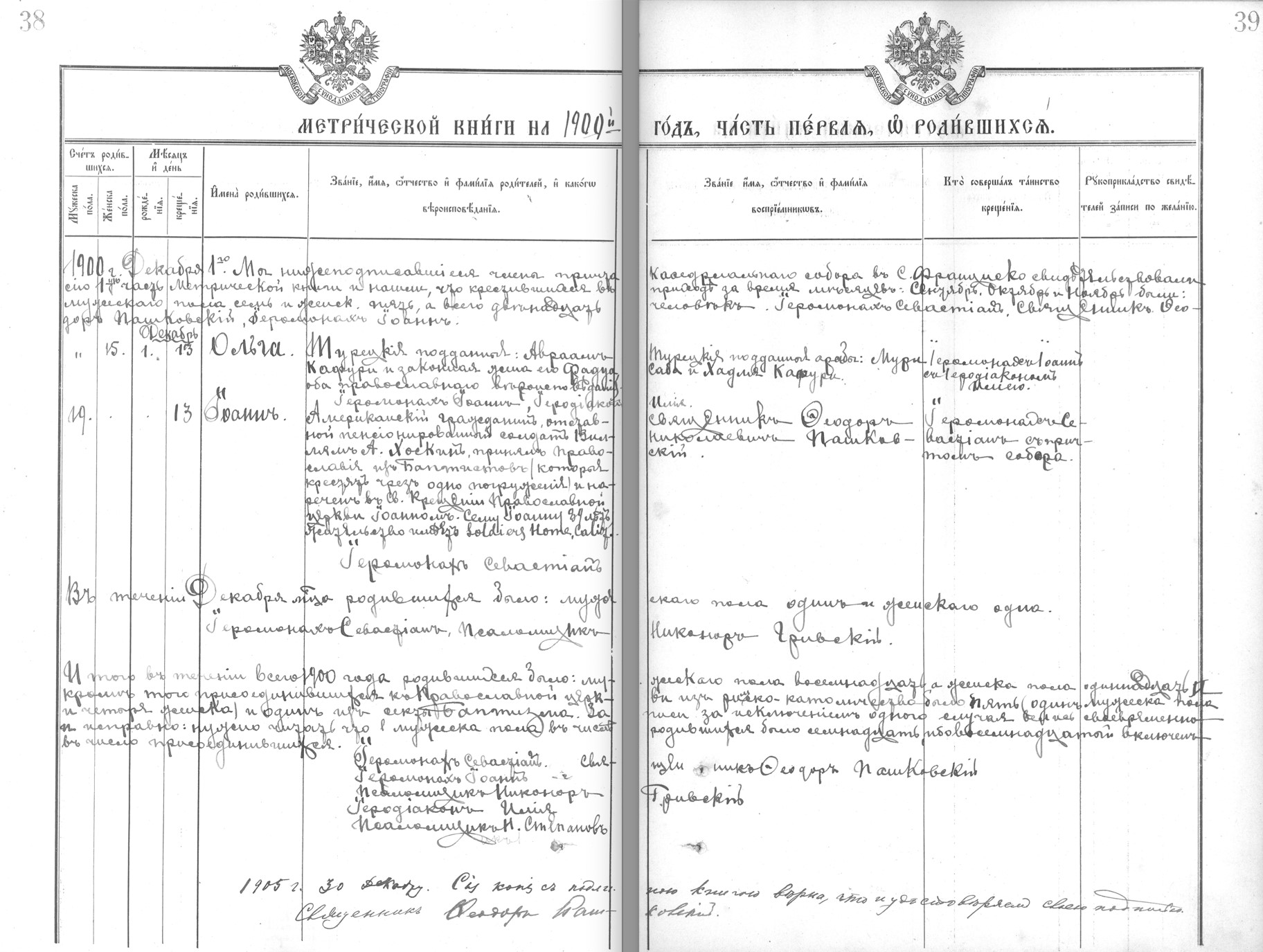
Posts Tagged ‘Sebastian Dabovich’

29
Jan

Irvine warns Dabovich about the Episcopal Church

   Posted by: Matthew Namee    in Early Converts

Fr. Sebastian Dabovich

Fr. Sebastian Dabovich was a monumental figure in American Orthodox history. An American-born Serb, he founded numerous parishes — Serbian and otherwise — under the auspices of the Russian Mission in America. He is currently being considered by the Serbian Orthodox Church and the OCA for glorification as a saint.

Dabovich knew Fr. Ingram Nathaniel Irvine rather well. He was serving in Philadelphia when Irvine, who was also in that city, decided to convert to Orthodoxy in 1905. Dabovich was instrumental in arranging a meeting between Irvine and St. Tikhon, which ultimately led to Irvine’s ordination in November of that year. Nevertheless, Irvine, who was nothing if not bold, felt compelled to rebuke Dabovich in 1916, for the latter’s relations with the Episcopal Church. A former Episcopalian himself, Irvine felt that Dabovich was going too far in his ecumenical activity, and he wrote a strongly-worded letter. It’s rather long, but I am reprinting it in full below. The letter is dated September 16, 1916, and was found in the OCA archives.

Very Rev. and dear Brother:

I am very much perplexed and no one but you can give me a satisfactory explanation. However, I am sending a copy of this letter to our Archbishop for fear that, your acts are authorized by him, and, therefore I may have from him through you a sufficient answer.

You will surely remember that, when I was about to enter the Holy Orthodox Eastern Catholic Church, I called upon you in Philadelphia, and  through you and by your kindness and courtesy, I transmitted my credentials and applications as an Anglican to the Most Reverend, and ever dear to America, Archbishop Tikhon. You, My Very Rev. and dear Brother, were my first door to a Church, wherein I am happy and for whom I am ready to live and die as well as serve in the humblest capacity.

Now, I entered the Holy Orthodox Russo-Greek Catholic Church believing that she, waiving all and every political and worldly consideration, brought my mind, soul and convictions nearer to God’s peace, “which passeth all understanding” than Anglicanism or any other portion of the Church founded by the Great Head of the Church, our one and only Lord and Saviour Jesus Christ. In the Russo-Greek Church My Soul is at peace with the whole family of God in Heaven and Earth, my only aim is to prove by a loving heart that, within her fold we see revealed as the Mother Church of Christendom, the “Faith once for all delivered unto the Saints” and held in trust to be transmitted, age after age, to a world hungry for the Bread of Life and the Living Water which alone are found in the Incarnate One’s bosom the Son of the Ever Virgin Mary and only Begotten of her and the Eternal Father by the operation of the Holy Spirit.

But, Very Rev. and dear Brother, though my peace, personally, is satisfactory I am anxious about what you are doing and what the results may be, for it seems to me that you are, unintentionally, tearing down the house which you helped to build as a refuge of Souls.

I read in the “Churchman” of September 16th, that you, clad in the Clerical Robes of the Orthodox Church attended both the Morning and Evening services of the Protestant Episcopal Church at Bar Harbor, Maine, and preached to large congregations. Is this true? Is it true that, you took part with the Rector of a Protestant Episcopal Church, a Clergyman whose Holy Orders are not acknowledged by the Holy Orthodox Church? I need not remined you of the Apostolical Canons. You are too well versed, I am sure, for me to quote any of them to you and show wherein you have overlooked the seriousness of your act.

But I need say no more on the following points, permit me only to add the facts as follows, namely: –

There is no intercommunion between the Holy Orthodox Church and the Anglican Communion. This you surely know. Then think of the incongruity of any Orthodox Archimandrite standing at or near the Altar of a Church, side by side of one of her priests, which one half of whose clergy look upon as more benighted than the Church of Rome and only a relic of the dim past of Christianity and Icon Superstition! Think of the perplexing thoughts of the summer guests of Bar Harbor and the Laymembers of the Protestant Episcopal Parish, but, alas, think of the disturbed feelings of the members of the Holy Orthodox Church if any were present in that Congregation or in that watering place!

Perhaps, I may be pardoned if I remind you that, while the Protestant Episcopal Church may welcome you personally as a priest of the Holy Orthodox Church at her Altar and likewise any of our Bishops, she honestly and sincerely in her heart of hearts has no use for our Bishops. Why should she? Will you not please read again if you have before the Appendix written to my Booklet on “Anglican Claims” by t he Rev. William J. Seabury, D.D., late Professor of Canon Law in the  General Theological Seminary of the Protestant Episcopal Church. The Anglican Church claims full jurisdiction in the United States. Of course her claims and the Preface to her Book of Common Prayer contradict each other, for while in the former she claims full jurisdiction, in the latter she only speaks of herself as one of the Churches of the Republic. However, our Bishops are regarded as only provisional — Bishops in the United States of a Church whose members can not understand the English language and who in time may be swallowed up in the embrace of Anglicanism and fall under the supervision of the Anglican Episcopate.

Are you, my Very Rev. Brother, willing to concede this?

I believe that, the Orthodox have been led into traps by a certain Society known as the “Anglican and Eastern Orthodox Churches Union.” We have been misinterpreted and misrepresented by that Society. Rome, and the unlearned Orthodox surely have misinterpreted our Prelates. And some of our Prelates have made mistakes, and some have seen then after having become members or advocates of such a Society.

We cannot be united with the Anglican Communion if we truly hold the faith fo the Holy Orthodox Church. A fraction of the former believe as we do, but two thirds disagree with us in Matters which we deem essential.

We, as a Church, have but one view of Doctrine, Discipline and Worship. Not so with the Anglican. That Communion, is as varied in views as the Shades of the members of Protestant Sects or Romish perverts who may drop into her fold.

But, Very Rev. Brother, there is something bordering on to an Ecclesiastical tragedy in our hob-nobing with the Anglican Church.

It is cruel to the Anglicans. You know and so do I that, there is no intercommunion. Why should we not be honest and say that while we love all who believe in our Lord and Saviour, Jesus Christ, yet there are essentials important to us that are lacking to them, that, it would be cruel to deceive by Society Courtesy those who do not believe in its entirety the “Faith once for all delivered to the Saints?”

But the Tragedy is still more appalling in this respect, namely, we are disturbing the faith of the Youth of the Holy Orthodox Church. Remember, please, that no Anglicans come to us except it be to hear our music, which by some outside and others within the Russian Church is exploited for mercenary purposes. On the other hand, hundreds of our people, and, running up into thousands of our young are being lost to us because of, on the one hand our folly and the superciliousness of some of our Ecclesiastics, and, on the other, our lack of preparation to hold them, our priest being hide-bound to their own foreign language in a Country where nothing scarcely is taught but English to the Young of ever Nationality coming to our shores.

Won’t you, very Rev. and Dear Brother, review the past? Please do. Just think of my coming to the door of the Russian Church through you and knocking for entrance. Think of the day when I was ordained at St. Nicholas Cathedral. Think of the first service ever said in English of the Holy Orthodox Church. You and I said that service in the Russian Cathedral. What now does it all mean that you should help to tear down the house which you had helped to build?

I have prepared a long article on the reunion of Christendom etc., and the great danger in which the Orthodox Church in the United States stands in having any thing to do with such a step, as “Federation” or “Unions” at the present time. I hope some day, when I have the means, to have it published. It will explain fully to my brother priests our dangerous position stoical indifference and in flirting with the Anglican Church.

Trusting that you will pardon my long letter and any unintentional grief which it may give you, I am,

Affectionately Yours,

Ingram N.W. Irvine, D.D.

Tags: , , , , , ,

18
Nov

Early Orthodoxy in Portland, Oregon

   Posted by: Matthew Namee    in Firsts, Pre-1921 Unity

Fr. Sebastian Dabovich oversaw the foundation of the first Orthodox place of worship in Portland, Oregon.

Fr. Sebastian Dabovich oversaw the foundation of the first Orthodox place of worship in Portland, Oregon.

Orthodoxy has been in Portland, Oregon for well over a century, and its history is of particular interest to me, as my in-laws live in the city, and I have visited there many times. Today, we’re going to look at the beginnings of organized parish life in Portland.

According to Brigit Farley, there are records of some sort of Orthodox religious activity in Portland dating to at least 1881. That year, Fr. Vladimir Vechtomov, the rector of the San Francisco cathedral, visited Portland to bury a Russian woman. That said, organized church life didn’t begin until the 1890s. In November of 1892, 29-year-old Fr. Sebastian Dabovich baptized two Greek children, in what the Oregonian (11/7/1892) called “the first ceremony of the kind that ever took place in this city.” The service was held in the St. Charles Hotel, the first brick hotel in all of Portland. The paper went on,

The Greek colony in this city only comprises about 20 members, but they are very active in church matters. They are at present contemplating the building of a church on the East side, and have purchased half a block of land at Twentieth and East Morrison streets. The structure will cost $5000, of which $1000 has already been raised. The Russian government contributes about $400,000 annually to the support of the Greek church in North America, and part of this fund will be available for the construction of a church in Portland. The bishop, of San Francisco, will furnish the chancel, pictures and other fixtures for the church, and will be present at the laying of the cornerstone.

I’m not sure how many actual Orthodox Christians were in Portland. The article says that the city’s Greek colony had only 20 people, but there were surely Orthodox of other nationalities, and there were also Greeks in neighboring communities. In fact, I’ve found evidence that at least one member of the Dabovich family was living in Portland at the time. In any event, Fr. Sebastian was convinced that Portland was the right place for an Orthodox chapel.

In March of 1894, Bishop Nicholas Ziorov, accompanied by Dabovich and Fr. Alexander Pustynsky, paid a visit to Portland. It was his first stop in the city, but he actually wasn’t the first Orthodox bishop to set foot in Portland. In 1890, Bishop Vladimir Sokolovsky had spent a night in Portland while en route from Alaska to San Francisco, but there’s no evidence that he interacted with the small Orthodox population of the city.

Anyway, Bp Nicholas made another visit in June, on his way to Seattle. Then, in July and August, Fr. Sebastian Dabovich spent three weeks in Portland, raising money for the chapel. Instrumental in this was an Alaskan Creole named Chernov, who was living in the city and apparently had some means. By August 15, construction had begun at East 20th and Morrison. The chapel’s name would be “Holy Trinity Greek Russian Mission.” Dabovich was telling the locals not just that it was an Orthodox chapel, but that it was a part of the “One Holy Catholic and Apostolic Church.”

With things going smoothly in Portland, Dabovich then left for Seattle, where he hoped to replicate his success. The pattern repeated itself the following spring: Dabovich visited Portland to dedicate the new chapel in March, and then traveled to Seattle to perform the same service. The two communities, Portland and Seattle, would be closely linked years to come. The Russian diocese never assigned a priest to the Portland chapel, so it operated as a sort of dependency of St. Spiridon Church in Seattle.

It’s often said that the current OCA parish in Portland, St. Nicholas, is identical with this original Holy Trinity chapel, which was founded in the 1890s. This isn’t really accurate… By the early 1900s, the original chapel had fallen into disrepair, and the Greeks organized their own parish in 1908. There wouldn’t be a Russian church in the city until 1927, when St. Nicholas Church was founded.

Tags: , , , , , , , , , , , , , , , ,

12
Nov

1905: the busiest year in American Orthodox history

   Posted by: Matthew Namee    in Saints

The ordination of Fr. Ingram Nathaniel Irvine, November 1905 (from the Wilkes-Barre Times)

The ordination of Fr. Ingram Nathaniel Irvine, November 5, 1905. This sketch appeared in the Wilkes-Barre Times on November 9.

2009 has been an eventful year for American Orthodoxy — perhaps the most eventful in our history. But it’s got competition. The year 1905 may well have been even crazier. Here is a list of the major happenings of 1905, in no particular order:

  • The headquarters of the Russian Mission were transferred from San Francisco to New York. Bishop Tikhon was elevated to Archbishop, and the Diocese of the Aleutian Islands and Alaska became the Archdiocese of the Aleutian Islands and North America.
  • Archbishop Tikhon wrote his now-famous proposal for an American Church divided into ethnic jurisdictions, all under the authority of the Russian Archbishop.
  • The first Orthodox seminary in America was founded, in Minneapolis.
  • Bishop Raphael published the first issue of Al-Kalimat (The Word).
  • Then-Bishop Tikhon received an honorary doctorate from Nashotah House, the famous Episcopalian seminary. Later that year, the degree would be rescinded.
  • To ensure its independence from the Russians, Holy Trinity Greek church in New York City was legally incorporated — by an act of the New York State Legislature — as, “The Hellenic Eastern Orthodox Christian Church of New York.”
  • Bishop Raphael consecrated the grounds of St. Tikhon’s Monastery, in South Canaan, PA.
  • A fake bishop, Seraphim Ustvolsky, was operating in Canada.
  • Fr. Alexander Hotovitzky, the dean of the Russian cathedral in New York, received a bomb threat, which turned out to be a hoax.
  • The first Orthodox services were celebrated in Utah. Construction began on a Greek church in Salt Lake City a few months later, and by October, the church building was consecrated.
  • Fr. Michael Andreades, an ethnic Greek who was educated in Russia, was ordained a priest by Abp Tikhon. He was one of a handful of Greek priests to serve in the Russian Mission.
  • The first Orthodox parish was organized in Washington, DC (St. Sophia Greek church).
  • The Russian statesman Sergei Witte came to the US to negotiate with the Japanese to end the Russo-Japanese War. Fr. Alexander Hotovitzky was present for the negotiations.
  • Bishop Raphael was arrested and charged with conspiracy to murder. This crisis lasted for a couple of months, but in the end, Bishop Raphael was exonerated.
  • Isabel Hapgood put the finishing touches on her English translation of the Service Book, which would be published the following year.
  • Just in the month of October, Fr. Sebastian Dabovich 1) established the first Serbian church in Chicago, 2) was raised to the rank of archimandrite by St. Tikhon, and 3) laid the cornerstone for the first Orthodox church in Montana.
  • Robert Morgan, a black Episcopal deacon, regularly attended the Greek church in Philadelphia.
  • Ingram Nathaniel Irvine converted to Orthodoxy and was ordained a priest by Abp Tikhon. With his conversion, the “English Department” of the Russian Mission was created.
  • Fr. Aftimios Ofiesh arrived in New York, beginning his colorful career in America.

And those are just the big events. An interesting book could be written, just on American Orthodoxy in 1905. Eventually, we’ll have articles on each of these events here at OrthodoxHistory.org. For now, though, it’s worth reflecting on a year that was, quite possibly, even more chaotic than our current one.

Tags: , , , , , , , , , ,

16
Oct

Fr. Ambrose Vretta: pioneering priest in Chicago & Seattle

   Posted by: Matthew Namee    in Firsts

Fr. Ambrose Vretta, 1895

Fr. Ambrose Vretta, 1895

In the past, I’ve mentioned the Russian Mission’s practice of employing “client clergy” — non-Russian priests with ties to Russia, who served multiethnic or non-Russian parishes in America. St. Raphael and Fr. Sebastian Dabovich are perhaps the most famous examples, but there were many more. One of the earliest of these client clergy was Fr. Ambrose Vretta, who has the distinction of being the first pastor of Holy Trinity Cathedral in Chicago and St. Spiridon’s Cathedral in Seattle.

Vretta (or Wretta) was originally from Macedonia. He was born in 1859, attended the Imperial Medical College in Istanbul, and then toured Europe and studied in Rome. He then returned to his homeland, but, according to the Chicago Tribune (9/2/1895), “he found the systematic persecution to which he was subjected by the Turkish Government too much for comfort.” So he left for Orthodox Russia, where he was warmly received. It wasn’t long before he had developed close ties with the Metropolitan of St. Petersburg (probably Metropolitan Isidore). At some point along the way he was ordained a priest; I assume this happened in Russia, but I can’t be sure. Vretta may have encountered a young Jovan (later Fr. Sebastian) Dabovich, who studied in St. Petersburg in the late 1880s.

When the newly-consecrated Bishop Nicholas Ziorov was assigned to America in 1892, the 33-year-old Vretta came along with him. His first assignment was Chicago, where a significant Orthodox community existed. For several years, the Orthodox of the city had been trying to organize a parish, but for various reasons, they hadn’t been successful. (We’ve discussed that a bit in the past, and will talk about it in great detail in the near future.)

On May 17, 1892, the first Russian Orthodox church was founded in Chicago (although, it should be noted, there were hardly any actual Russians, with much of the congregation being Serbian). This came only weeks after the first Greek parish was organized in the city. Vretta was present at that initial meeting, and he remained at the parish for the next three years. During that time, he also assumed responsibility for a new Orthodox parish in Streator, Illinois.

One of the most notable aspects of Vretta’s tenure in Chicago was the warm relationship between the Russian and Greek churches: although the Orthodox community of the city had split into two parishes, there doesn’t seem to have been any rivalry. Vretta concelebrated with the Greek priest, Fr. Panagiotis Peter Phiambolis, on numerous occasions. When the Greek Archbishop Dionysius of Zante visited Chicago for the World’s Fair, the Vretta went over to the Greek church for services. When the Russian Bishop Nicholas came to town, it was Phiambolis’ turn to visit the Russian church. In 1894, a special service was held to commemorate the 100th anniversary of Orthodoxy in North America, and both Vretta and Phiambolis were present. Later that year, Tsar Alexander III died, and for the memorial, Vretta went over to the Greek church, which was simultaneously dedicating its new building.

Vretta was transferred to Seattle shortly after that, in November 1895. Up to that point, the fledgling Orthodox community of Seattle had never had a resident priest. Fr. Sebastian Dabovich had been holding services on Saturdays, but Vretta was the first full-time pastor of the new St. Spiridon’s Church. He didn’t confine himself to working in Seattle, though. In the spring of 1896, Vretta and his young reader Vladimir Alexandrov traveled to Montana, where they celebrated the first-ever Orthodox services in the state. In her fascinating paper, “Circuit Riders to the Slavs and Greeks”, Brigit Farley tells this story:

[Vretta] began in Anaconda, where he administered the sacraments of marriage and chrismation to several Serbian Orthodox believers. The priest moved on to Butte, where he learned of an Orthodox miner named Mike Gamble, who wished to see a priest in order to receive Communion. Fr. Vretta finally located Gamble after a long climb up the side of a mountain, during which he had only the assistance of dogs and a sled for his baggage. After his meeting with the miner, he reported, he managed to convince two Uniates to accept union with the Orthodox church.

In December of 1896, Vretta was transferred from Seattle… And I’m not sure where he went. He was only 37 years old, so he presumably had a long career ahead of him, but I can’t find him on any later lists of clergy (and I’ve got lists for 1906, 1911, 1912, 1913, 1914, and 1918). He doesn’t seem like the type of priest — non-Russian, literate, mission-minded — who would be sent to Russia; in fact, he’s exactly the sort of priest that was being sent from Russia to America.

It’s possible, I suppose, that he remained with Bishop Nicholas. In 1898, Bishop Nicholas was transferred to a diocese in Russia; perhaps Vretta joined him (?). If anyone out there has more information about Vretta, particularly his whereabouts after 1896, please email me at mfnamee [at] gmail [dot] com.

Tags: , , , , , , , , , , , , , , ,

5
Oct

Dabovich’s Miter

   Posted by: Matthew Namee    in Uncategorized

If you read one of the many articles on the life of Fr. Sebastian Dabovich, you might run across a story about his miter (that is, his archimandrite’s crown). Dabovich had been elevated to archimandrite by St. Tikhon in 1905, and Tikhon gave Dabovich a miter on the occasion. According to St. Nicholai Velimirovich, the crown was worth 1,000 roubles in gold. St. Nicholai reported, “But Fr. Dabovich quickly sold that precious gift and gave it to the church towards paying its debts” (quoted in Fr. Damascene Christiansen’s recent article on Dabovich).

That’s one version of the story. Here’s another, from Fr. George Gray’s Portraits of American Saints: “[Dabovich] sold St. Tikhon’s mitre (which he had been awarded when he was made an archimandrite) and used the money in an attempt to alleviate St. Tikhon’s sufferings at the hands of the communists.”

As it turns out, neither story is accurate. What really happened is this: In 1912, Serbia was in the midst of the Balkan Wars. And although he was born in America, Dabovich was a patriotic Serb. In October, he decided to auction off many of his most valued personal possessions to raise money for the Serbian war effort. Here’s an article about the auction, from the Los Angeles Times (October, 25, 1912):

The Balkan war between the Serbs and Turks, has developed many cases of self-sacrifice among the Serbs in and around Los Angeles, but probably none greater than that of Father Sebastian Dabovitch, bishop of the Orthodox Eastern Catholic Church, who has for two years been working among the Slavs and Greeks of this city, to induce them to higher ideals in living. He has built a small chapel on Boyle Heights and has just begun to get his work on a better fotting, when he feels called upon to sacrifice his personal belongings for the benefit of the hospital work in the Serb army.

At the meeting of the Friday Morning Club this morning, in the Woman’s Clubhouse, the following historic relics will be offered at auction to the highest bidder above the minimum price named:

A bishop’s gorgeous miter, handmade and painted in Russia, by nuns, to be sold to the highest bidder above $100; a jeweled pectoral cross and chain, made by a Serb jeweler in Bosnia, minimum bid. $100; twelve sacred hand-paintings on panels of steel minimum $50 for the set; beautiful icon of the Savior, which belonged to a Russian nobleman, who had it with him in the campaign against Napoleon at Moscow, minimum, $50. Four decorations — Order of St. Sabbas, from the King of Servia; Order of Danilo, from the King of Montenegro; Order of St. Anne, from the Emperor of Russia; a medal from the Emperor of Russia, in memory of Alexander III; minimum bid for all, $25. A handsome medium-size hand-made rug, made by the Christian peasant girls of Macedonia; minimum bid, $50.

These were Dabovich’s most prized possessions, and it must have pained him to auction them off. The whole lot was being offered for a minimum of $375, which works out to a little over $8,000 in today’s money. The minimum of $100 for the miter is roughly $2,000 today. And Dabovich wasn’t alone in trying to raise money for the war effort. A few days before the auction, the Greeks and Serbs of Los Angeles had combined to raise a whopping $10,000 — equivalent to $218,000 today.

I would love to find out who bought the miter, and Dabovich’s other valuables. If anyone out there lives in the L.A. area and is interested in tracking down these items, please send me an email at mfnamee [at] gmail [dot] com.

Tags: , , , , , ,

15
Sep

Robert Josias Morgan visits Russia, 1904

   Posted by: Matthew Namee    in Early Converts

It’s been a while since we talked about Robert Josias Morgan, the black Episcopal deacon who became an Orthodox priest in 1907, taking the name “Fr. Raphael.” In the past, I’ve mentioned that, prior to his conversion to Orthodoxy, Morgan visited Russia in 1904. Upon his departure, he wrote a letter, which was reprinted in the October/November 1904 English supplement to the Vestnik (Russian Orthodox American Messenger), the official publication of the Russian Archdiocese in America. Here is the text of that letter:

I, Robert Josias Morgan, a legally consecrated cleric of the American Episcopal Church, find it necessary to make it publicly known, that I am not a Bishop, as it was announced in some magazines and daily papers…

… I am not a Bishop, but a legally consecrated deacon.  I came to Russia in no way to represent anything, and I was not sent by anybody.  I came as a simple tourist, chiefly with the object to see the churches and the monasteries of this country, to enjoy the ritual and the service of the holy Orthodox Church, about which I heard so much abroad.  And I am perfectly satisfied with everything I saw and witnessed.

The piety and the fear of God amongst the Russian clergy, both superior and lower, and of the lay people in general are too great to be spoken of.  I like Russia, and as to the people I have simply grown to love them for their gentleness, their politeness, their amiability and kindness.  It would seem as if the Christian religion penetrated the whole life of the people.  This can be observed both in the private home life and the social life.  You have but to go to Church in this country, and you immediately see, that there is nothing too valuable for the people to be offered to God.  Note how they pray, how patiently they stand through the long Church services…

Now, having spent here about a month, I leave your country with a feeling of profound gratitude and take back to North America all the good impressions I received here.  And when there I shall speak boldly and loudly about the brotherly feelings entertained here in the bosom of the holy Orthodox Church towards its Anglican sister of North America, and about the prayers which are offered here daily for the union of all the Catholic Christendom.

My constant humble prayer is for the union of all Churches, and especially the union of the Anglican faith with the Orthodox Church of Russia.  I solicited the Metropolitans and the Bishops to grant me their blessing in regard to this prayer and obtained it.  Now I pray daily and eagerly for a better mutual understanding between the character and their union.  God grant a blessing to this cause and a hearing to our prayers and supplications.  Let us solicit the prayers of the Saints.  Let us seek the intercession of the holy Mother of God.  Virgin Mary, pray for us!

In conclusion I must say, that my stay in Russia did me personally much good: I feel now firmer and stronger spiritually than I did before I came.

God bless the holy Catholic and Apostolic Church of this country!  God bless the Emperor and all the reigning family!  God grant them a long life, peace and prosperity!

            I am sincerely yours in God and in the name of Mary,

                        Robert Josias Morgan.

Years later, he told the Kingston Gleaner (7/22/1913) that he had visited Russia on two occasions, and both times was “received and entertained at the Great Monasteries of the Russian Orthodox Church in Odessa, St. Petersburg, Moscow, and Kieff. He was also present at the anniversary service of the Coronation of the present Czar [Nicholas II] and at the Requiem High Mass said for the repose of the soul of the late Emperor [Alexander III], at which time, as special guest at the Kremlin Palace, his photographs appeared in the leading journals and magazines of Russia, Europe and other countries.”

As I’ve noted elsewhere, it’s odd that Morgan didn’t join the Russian Church in America, but instead traveled all the way to Constantinople for ordination, and affiliated himself with the Greek churches. In Morgan’s day, the Greeks had no resident bishop in America, whereas the Russians had three. The Russians had a multiethnic diocese with seminary and a monastery, and very close relations with the Episcopalians. They also had just received Fr. Ingram Nathaniel Irvine, who began promoting the use of English in church services. The Greeks, meanwhile, were much less organized, had no national structure or institutions, and were almost exclusively focused on Greek immigrants. In Philadelphia, where Morgan was based, the Russians had a parish, and one of the priests there was Fr. Sebastian Dabovich, an American-born Serb who spoke perfect English and was friends with Fr. Irvine. And yet, Morgan went with the Greeks and not the Russians.

Originally, I had thought that perhaps Morgan had developed a good relationship with the Greek priest in Philadelphia, Fr. Demetrios Petrides, who wrote a letter of recommendation to the Ecumenical Patriarchate on Morgan’s behalf in 1907. Petrides was an outstanding priest and was very involved in dialogue with the Episcopalians, which might have drawn Morgan to him. But Morgan started attending the Philadelphia Greek church before Petrides even came to America, so that can’t have been the reason.

There must have been some reason why Morgan joined the Greeks and not the Russians, but I can’t come up with it. It’s one of the many mysteries of Morgan’s life.

Tags: , , , , , , , , , , , ,

8
Sep

Fr. Sebastian Dabovich on the Condition of Society, 1899

   Posted by: Matthew Namee    in Uncategorized

Fr. Sebastian Dabovich preaching in San Francisco, 1900.

Fr. Sebastian Dabovich preaching in San Francisco, 1900

In 1899, Fr. Sebastian Dabovich published a book of homilies, called Preaching in the Russian Church. One of those sermons, “On the Condition of Society,” is especially interesting, because it gives us Dabovich’s perspective on life at the turn of the last century. As you can see, despite all that has changed in the past 110 years, much has remained the same.

How long will it thus go on! When will the baptized become active Christians, so that the pastors may give their attention to the conversion of the heathen? What a terrible battle we must fight. Already the fire of hell is in the world. Great cities are multiplying throughout the land. The farmer, as the word is defined in our dictionaries, is a thing of the past. It is now the land-owner with a mansion in the city, a yacht on the sea, and with a private train across the continent. There are comparatively but a few laborers in the fields – too poor to support families. The quiet country homes are becoming few, shall I say precious? I fear not so, because people are fast losing their ability to rightly estimate the value of things. Most of the cities in all the world are overcrowded. The female portion of the population is most conspicuous. A stupid craze after unwholesome fashions is the one all-absorbing passion of the majority of women. There is no room for gardens and yards; most of the children in San Francisco are actually brought up in the streets. Oh, how few of them feel the blessed influence of a Christian home! Young men and young women are continually “on the go,” as they say. And this “go” is a nervous, unsteady rush to “keep up with the times.” And after all their hurry nothing is left but steam and vapor, for they are empty, as empty as the changing and vanishing world can be. Yet they fret and inquire: “Where shall we go to and what shall we see? What shall we do? Oh! what can we do?” If you promenade along the broad avenue or pass through the narrow lane, if you visit the meeting halls in the city or look into the factories, everywhere you see that same all-devouring gaze of the bold young woman, who stares with a kind of artificial movement of the eyes. And sometimes you hear even so-called Christians say that it is a weakness of character in one who has the downcast eyes of modesty, the blush of innocence. Such people do not know the live sense and fine impulse of a pure conscience. When a young man puffs tobacco smoke or shows his teeth with a disapproving smile in the presence of and at the conversation of older people, then society is wrong; something is the matter with his family.

In view of all this, beloved, the preacher of the Word of God is obliged by a terrible oath he has given before he received the gift in Apostolic succession at his ordination, to present to you the whole of the Truth, not a part of it.

The number of unmarried people is increasing. And there are some married people who say: “We do not want children, because we want to have as much pleasure as possible.” This is a false position, for in a Christian marriage one kind of pleasure is not allowed continually. Christians marry for the sake of God and His law as much as they do for themselves. But Christians who remain single renounce marriage and live holy for the sake of God and Him alone. Thus we find that the family tie is abused, as well as the single state. Courtship of young people just out of school is not to be advised, because it often leads to debauchery. A courtship running through long years also gives occasion to sin and a species of wrongdoing to God, for the heart and its love are stolen from God and thrown away on a man.

Throughout all the long centuries of Christianity there have been in the Church heroic members, young people of both sexes, who by the grace of God have kept their souls pure and intact, and have dedicated to the honor of God the noblest attribute of their human life, namely, an untarnished purity of soul and body. Such persons have had the courage and such unbounded confidence in God’s assistance that, although living in the world and its dangers, though threatened by the cravings of their own individual passions and by the temptations of the devil, yet they have succeeded bravely in preserving this treasure even in a frail earthen vessel, have carried it uninjured through life’s long journey here below, and have finally presented it to their Lord.

Christian heroes and heroines, you who have imitated or who still do imitate the sublime example of the Most Blessed Virgin, the Church admires your spirit of sacrifice as she does that of the holy martyrs, who in a few hours finished their contest and proved their fidelity to God and their faith; because you have to combat, to suffer, and to sacrifice your whole life through. With joy and veneration do the angels look down upon you, for you resemble themselves. With motherly affection and with mighty power does the Holy Virgin Mary when you earnestly pray throw her sheltering omophorion around you, for you are her pupils and imitators. With the sweetness of divine love the heavenly Bridegroom will fill your heart and more than compensate you for the fleeting, transient, worldly love that you have laid down at His feet. The eternal Judge will find you waiting like the wise and prudent virgins who all through life carry in their hands the pure oblation of love and the burning light of good example. Therefore, faithful to the end, He will invite you to the eternal wedding feast in heaven. Amen.

Tags: , , , , , , ,