Fr. Andrew S. Damick

Fr. Andrew S. Damick

(56 comments, 34 posts)

This user hasn't shared any profile information

Posts by Fr. Andrew S. Damick

St. Raphael of Brooklyn on the Episcopalians

0

Today being the ninety-eighth anniversary of the repose of St. Raphael of Brooklyn (+1915), here is a pastoral letter he sent out in 1912 regarding relations with the Episcopal Church, mostly likely written on his behalf by Fr. Ingram Nathaniel Irvine. Thanks to Fr. Joseph Huneycutt of Houston for posting it today.

To My Beloved Clergy and Laity of the Syrian Greek-Orthodox Catholic Church in North America:

Greetings in Christ Jesus, Our Incarnate Lord and God.

My Beloved Brethren:

Two years ago, while I was a Vice-President and member of the Anglican and Eastern Orthodox Churches Union, being moved with compassion for my children in the Holy Orthodox faith “once and for all delivered to the Saints” (St Jude ver. 3), scattered throughout the whole of North America and deprived of the ministrations of the Church; and especially in places far removed from Orthodox centres; and being equally moved with a feeling that the Protestant Episcopal (Anglican) Church possessed largely the Orthodox faith, as many prominent clergy professed the same to me before I studied deeply their doctrinal authorities and their liturgy — the “Book of Common Prayer” — I wrote a letter as the Bishop and Head of the Syrian Catholic Mission in North America, giving permission, in which I said that in extreme cases, where no Orthodox priest could be called upon at short notice, the ministrations of the Protestant Episcopal (Anglican) clergy might be kindly asked. However, I was most explicit in defining when and how the ministrations should be accepted, and also what exceptions should be made. In writing that letter I hoped, on the one hand, to help my people spiritually, and, on the other hand, to open the way toward bringing the Anglicans into the communion of the Holy Orthodox faith.

On hearing and in reading that my letter, perhaps unintentionally, was misconstrued by some of the Episcopalian (Anglican) Clergy, I wrote a second letter in which I pointed out that my instructions and exceptions had been either overlooked or ignored by many, to wit:

(a) They (the Episcopalians) informed the Orthodox people that I recognized the Anglican Communion (Protestant Episcopal Church) as being united with the Holy Orthodox Church and their ministry, that is holy orders, as valid.

(b) The Episcopal (Anglican) Clergy offered their ministrations even when my Orthodox clergy were residing in the same towns and parishes, as pastors. And,

(c) Protestant Episcopal clergy said there was no need of Orthodox people seeking the ministrations of their own Orthodox priests, for their (the Anglican) ministrations were all that were necessary.

I, therefore, felt bound by all the circumstances to make a thorough study of the Anglican Church’s faith and orders as well as of her discipline and ritual. After serious consideration I realized that it was my honest duty, as a member of the College of Bishops of the Holy Orthodox Greek Apostolic Church, and Head of the Syrian Mission in North America, to resign from the vice-presidency of and membership in the Anglican and Eastern Orthodox Churches Union. At the same time, I set forth, in my letter of resignation, my reason for so doing.

I am convinced that the doctrinal teaching and practices as well as the discipline of the whole Anglican Church are unacceptable to the Holy Orthodox Church. I make this apology for the Anglicans whom as Christian gentlemen I greatly revere, that the loose teaching of a great many of the prominent Anglican theologians are so hazy in their definition of truths, and so inclined toward pet heresies that it is hard to tell what they believe. The Anglican Church as a whole has not spoken authoritatively on her doctrine. Her Catholic minded members can call out her doctrines from many views, but so nebulistic is her pathway in the doctrinal world that those who would extend a hand of both Christian and ecclesiastical fellowship dare not, without distrust, grasp the hand of her theologians, for while many are orthodox on some points, they are quite heterodox on others. I speak, of course, from the Holy Orthodox Eastern Catholic point of view. The Holy Orthodox Church has never perceptibly changed from Apostolic times, and, therefore, no one can go astray in finding out what she teaches. Like her Lord and Master, though at times surrounded with human malaria — which He in mercy pardons — she is “the same yesterday, and today, and forever” (Hebrews 8:8) … the mother and safe deposit of “the truth as it is in Jesus” (Eph.4:21).

The Orthodox Church differs absolutely with the Anglican Communion in reference to the number of Sacraments and in reference to the doctrinal explanation of the same. The Anglicans say in their Catechism concerning the Sacraments that there are “two only as generally necessary to salvation, that is to say, Baptism and the Supper of the Lord.” I am well aware that, in their two books of homilies (which are not of a binding authority, for the books were prepared only in the reign of Edward VI and Queen Elizabeth for priests who were not permitted to preach their own sermons in England during times both politically and ecclesiastically perilous), it says that there are “five others commonly called Sacraments” (see homily in each book on the Sacraments), but long since they have repudiated in different portions of their Communion this very teaching and absolutely disavow such definitions in their “Articles of Religion” which are bound up in their Book of Common Prayer or Liturgy as one of their authorities.

The Orthodox Church has ever taught that there are seven Sacraments. She plainly points out the fact that each of the seven has an outward and visible sign and an inward and spiritual Grace, and that they are of gospel and apostolic origin.

Again, the Orthodox Church has certain rites and practices associated and necessary in the administration of
the Sacraments which neither time nor circumstances must set aside where churches are organized. Yet the Anglicans entirely neglect these, though they once taught and practiced the same in more catholic days.

In the case of the administration of Holy Baptism it is the absolute rule of the Orthodox Church that
the candidate must be immersed three times (once in the name of each Person of the Holy Trinity). Immersion is only permissory in the Anglican Communion, and pouring or sprinkling is the general custom. The Anglicans do not use holy oil in the administration, etc., and even in doctrinal teaching in reference to this Sacrament they differ.

As to the doctrine concerning Holy Communion the Anglican Communion has no settled view. The Orthodox Church teaches the doctrine of transubstantiation without going into any scientific or Roman Catholic explanation. The technical word which She uses for the sublime act of the priest by Christ’s authority to consecrate is “transmuting” (Liturgy of Saint John Chrysostom). She, as I have said, offers no explanation, but She believes and confesses that Christ, the Son of the living God Who came into the world to save sinners, is of a truth in His “all-pure Body” and “precious Blood” (Liturgy of Saint John Chrysostom) objectively present, and to be worshiped in that Sacrament as He was on earth and is now in risen and glorified majesty in Heaven; and that “the precious and holy and life-giving Body and Blood of Our Lord and God and Saviour Jesus Christ are imparted” (to each soul that comes to that blessed Sacrament) “Unto the
remission of sins, and unto life everlasting” (Liturgy of Saint John Chrysostom).

Confirmation or the laying on of hands, which the Orthodox Church calls a sacrament—”Chrismation”—in the Anglican Church is merely the laying on of hands of the Bishop accompanied by a set form of prayers, without the use of Holy Chrism, which has come down from Apostolic days as necessary.

Holy Matrimony is regarded by the Anglican Communion as only a sacred rite which, even if performed by a
Justice of the Peace, is regarded as sufficient in the sight of God and man.

Penance is practiced but rarely in the Anglican Communion, and Confession before the reception of Holy Communion is not compulsory. They have altogether set aside the Sacrament of Holy Unction, that is anointing the sick as commanded by Saint James (see James 5:14). In their priesthood they do not teach the
true doctrine of the Grace of the Holy Orders. Indeed they have two forms of words for ordination, namely, one which gives the power of absolution to the priest, and the alternative form without the words of Our Lord, whosoever sins ye remit, etc. (John 20: 23). Thus they leave every bishop to choose intention or non-intention in the act of ordination as to the power and Grace of their priesthood (“Ordination of Priests,” Book of Common Prayer).

But, besides all of this, the Anglican Communion ignores the Orthodox Church’s dogmas and teachings, such as the invocation of saints, prayers for the dead, special honor to the blessed Virgin Mary the Mother of God, and reverence for sacred relics, holy pictures and icons. They say of such teaching that it is “a foul thing, vainly invented, and grounded upon no warranty of Scripture, but rather repugnant to the word of God” (Article of Religion, XXII).

There is a striking variance between their wording of the Nicene Creed and that of the Holy Orthodox Church;
but sadder still, it contains the heresy of the “filioque.”

I do not deem it necessary to mention all the striking differences between the Holy Orthodox Church and the Anglican Communion in reference to the authority of holy tradition, the number of the General Councils, etc. Sufficient has already been said and pointed out to show that the Anglican Communion differs but little from all other Protestant bodies, and, therefore, there cannot be any intercommunion until she returns to the ancient holy Orthodox Faith and practices, and rejects Protestant omissions and commissions.

Therefore, as the official head of the Syrian Holy Orthodox Catholic Apostolic Church in North America and as one who must “give an account” (Hebrews 13:17) before the judgment throne of the “Shepherd and Bishop of Souls” (1 Peter 2:25), that I have fed the “flock of God” (1 Peter 5:2), as I have been commissioned by the Holy Orthodox Church, and inasmuch as the Anglican Communion (Protestant Episcopal Church of the United States) does not differ in things vital to the well being of the Holy Orthodox Church from some of the most arrant Protestant sects, I direct all Orthodox people residing in any community not to seek or to accept the ministrations of the Sacraments and rites from any clergy excepting those of the Holy Orthodox Catholic and Apostolic Church, for the Apostolic command, that the Orthodox should not commune in ecclesiastical matters with those who are not of “the same household of Faith” (Galatians 6:10), is clear: “Any Bishop; or presbyter or deacon who will pray with heretics, let him be anathematized; and if he allows them as clergymen to perform any service, let him be deposed” (Apostolic Canon 45). “Any bishop, or presbyter, who accepts baptism or the Holy Sacrifice from heretics, we order such to be deposed, for ‘what concord hath Christ with Belial, or what part hath he that believeth with an infidel?’” (Apostolic Canon 46).

As to members of the Holy Orthodox Church living in districts beyond the reach of Orthodox Catholic clergy, I direct that the ancient custom of our Holy Church be observed, namely, in cases of extreme necessity, that is, danger of death, children may be baptized by some pious Orthodox layman, or even by the parent of the child, by immersion three times in the names of the (persons of the) Blessed Trinity, and in case of death such baptism is valid: — but, if the child should live, it must be brought to an Orthodox priest for the Sacrament of Chrismation.

In the case of the death of an Orthodox person where no priest of the Holy Orthodox Church can be had, a pious layman may read over the corpse, for the comfort of the relatives and the instruction of the persons present, Psalm 91 and Psalm 118, and add thereto the Trisagion (“Holy God, Holy Strong One,” etc). But be it noted that so soon as possible the relative must notify some Orthodox bishop or priest and request him to say the Liturgy and Requiem for the repose of the soul of the departed in his Cathedral or parish Church.

As to Holy Matrimony, if there be any parties united in wedlock outside the pale of the holy Orthodox Church because of the remoteness of Orthodox centers from their home, I direct that as soon as possible they either invite an Orthodox priest or go to where he resides and receive from his hands the holy Sacrament of Matrimony; otherwise they will be considered excommunicated until they submit unto the Orthodox Church’s rule.

I further direct that Orthodox Christians should not make it a practice to attend the services of other religious bodies, so that there be no confusion as to the teaching or doctrines. Instead, I order that the head of each household, or a member, may read the special prayers which can be found in the hours of the Holy Orthodox Service Book, and such other devotional books as have been set forth by the authority of the Holy Orthodox Church.

Commending our clergy and laity unto the safe-keeping of Jesus Christ, and praying that the Holy Spirit may keep us all in the truth and extend the Borders of the Holy Orthodox Faith, I remain.

Your affectionate Servant in Christ,

RAPHAEL
Bishop of Brooklyn, Head of the Syrian
Greek Orthodox Catholic Mission in America

Issued late in the year 1912; from The Most Useful KNOWLEDGE for the Orthodox Russian-American Young People, compiled by the Very Rev’d Peter G. Kohanik, 1932-1934 (pp. 297-303).

Aftimios Ofiesh, Archbishop of Brooklyn

The Death of Aftimios Ofiesh

0

Aftimios Ofiesh, Archbishop of Brooklyn

I had meant to write something about this yesterday, since July 24 marks the anniversary of the death of Aftimios Ofiesh, the sometime Archbishop of Brooklyn, who departed this earthly life in 1966. Aftimios was briefly the leader of the American Orthodox Catholic Church (1927-33), the first attempt to create a united, pan-Orthodox, autocephalous Orthodox Church for North America.

Aftimios has been a special interest of mine for a number of years now, particularly after I heard from the Antiochian priest in Wilkes-Barre, Pennsylvania, that he was buried there. When I heard that, I was in seminary at St. Tikhon’s at the time, and Wilkes-Barre is only about forty-five minutes from the seminary. After having heard his strange tale and being intrigued by his story’s proximity to where I was then living, I set about to find the grave of this tragic archbishop, who is buried next to his wife Mariam, just across the street from the Orthodox cemetery. My intrigue eventually led to my writing my M.Div. thesis on Aftimios.

Aftimios is of course mainly remembered for the act that effectively ended his ecclesiastical career—marrying Mariam Namey. But this successor to the great St. Raphael Hawaweeny in the see of Brooklyn was also a brilliant, energetic churchman, victim not only to his personal failings but also to the ecclesiastical turbulence of his time. Under Aftimios, the fissures that had begun opening during Raphael’s tenure widened into cracks and finally into full-blown schism, as different parties within the Syrian Brooklyn diocese aligned their loyalties with the American Russians, the renegade Antiochian Metropolitan Germanos Shehadi, or with Aftimios himself. This history is complicated, though fascinating.

What I’m remembering today, however, is an encounter I had with Fr. Herbert Nahas, whom I interviewed in the process of writing my thesis. Fr. Herb was one of the last people to visit Aftimios before he died. Following is the portion of my thesis that deals with this encounter and the death of Aftimios at the age of eighty-five:

Shortly before his death, Aftimios was paid a visit by the local Syrian Orthodox priest in Wilkes-Barre, Fr. Herbert Nahas. Nahas had not wished to see Aftimios, mainly because of the disgrace in which Aftimios and Mariam lived and also because doing so would possibly mean stirring up dissension in the parish. However, Nahas had received a letter from Metropolitan Antony (Bashir), the head of the Syrian archdiocese, instructing him to visit Aftimios to see what kind of biographical information could be had regarding the period between his marriage and the current time. There was also a personal connection between Nahas and Aftimios, as the latter had ordained Nahas’ father George.

When Nahas entered the house in Kingston, Aftimios looked up and saw him coming. When the old bishop recognized that the son of one of his priests was entering, he looked at him and bitterly said, “Now you come to see me?” Nahas showed him the letter from Antony, but Mariam, “always a tough woman,” refused to allow Aftimios to speak with him. “You just leave him alone,” she said. The priest left their home without anything to send the metropolitan. This encounter was probably Aftimios’ last contact with the Orthodox Church.

Peace does seem to have come to Aftimios, however:

One evening, shortly before his demise, Mariam asked him if she had spoiled his life. His answer was that he had been saved from a pit of corruption; then slowly looking up with a mirthful smile and laugh as at a secret joke, he quietly said the word “Ob-stack-L” at which Mariam laughed, and he fell silent, reassured.

[The mispronunciation of "obstacle" by Aftimios was the occasion of his first meeting with Mariam. This quotation is from her book about him. -ed.]

Aftimios Ofiesh died on July 24, 1966, at the age of eight-five. His will stipulated that his funeral was to have no flowers, no viewing, no gathering and no religious services of any kind. “No clergy of any denomination” were to have anything to do with his body. He was buried according to his wishes the next day at Maple Hill Cemetery in Hanover Township (near Wilkes-Barre), across the street from the Orthodox cemetery.

Archbishop Aftimos Ofiesh and his young wife, Mariam, shortly after their wedding on April 29, 1933

Photo of the week: a newlywed archbishop

0

Archbishop Aftimos Ofiesh and his young wife, Mariam, shortly after their wedding on April 29, 1933. Photo from the Brooklyn Daily Eagle (5/8/1933).

In the half-dozen years before his wedding on April 29, 1933, Archbishop Aftimios Ofiesh had moved further and further away from mainstream Orthodoxy, setting himself up as the head of an “autocephalous” jurisdiction called the American Orthodox Catholic Church—which at its inception in 1927 had the official blessing of the Russian Metropolia in America (which would in 1970 become the OCA).

His wedding to the former Mariam Namey (no relation to our own Matthew Namee) essentially represented his final break with any official Orthodox ecclesiastical authorities. Aftimios continued to call himself an archbishop, and he even made occasional visits to Orthodox parishes, but his hierarchical career was effectively over the moment he tied the knot. He also became a pariah in the Syrian community in and around Wilkes-Barre, Pennsylvania, where Mariam was from and where the couple lived (among other places) for years after their wedding.

From the Wilkes-Barre Times-Leader, May 1933

Before he met Mariam, there were indications that Aftimios had planned to marry, essentially to try to make a point about his opinions on episcopal celibacy—that it was a “man-made” institution that could be abrogated at any time, especially now that he was in the New World. Even though his own synod in the American Orthodox Catholic Church officially agreed with him, they also declared him “retired” in the same message with which they congratulated him on his nuptials.

Despite the ideological premeditation of his marriage, when Mariam later recounted their meeting in her biography of her late husband, she described it in endearing, romantic terms. Their marriage lasted until his death thirty-three years later, producing a son named Paul within a couple of years after the wedding.

Aftimios never served as a bishop of the Orthodox Church ever again, although he dressed as one, and members of the Namey family remembered him as Amo Sayidna (“Uncle Master”; sayidna is the Arabic equivalent of the Greek despota or Russian vladyka). His break with Church authorities was so bitter that in his will he stipulated that his funeral and burial were to involve no clergy of any kind. He died in 1966.

SOCHA Updates, Changes and Expansions

0

There have been a lot of interesting things in the works for SOCHA as of late, and we’re going to put them all into a single post so our readers can be brought up to speed all at once.

It’s hard to believe, but SOCHA has been around for nearly three years. Our founding directors were Fr. Oliver Herbel, Fr. Andrew Stephen Damick, and Matthew Namee. This past October 1st, at the 2011 SOCHA Symposium, we added Aram Sarkisian to our board.

On March 9th, SOCHA was incorporated as a legal entity in the State of Kansas, a step we have long anticipated. We are in the process of obtaining 501(c)(3) nonprofit status from the IRS. Once that happens, we’ll be able to do all sorts of things to expand the work of SOCHA, and we look forward to including all of our readers in these endeavors.

We would also like to announce that on March 9th, Fr. Oliver Herbel resigned from his position as the Executive Director of SOCHA, and is no longer a member of our board of directors.  We thank Fr. Oliver for his contributions to the society’s work. With Fr. Oliver’s resignation and our incorporation, we’ve also moved to a different shape of governance for the Society. There will no longer be an Executive Director or Associate Directors, but simply a board of directors.

We also welcome Matthew J. Baker to the SOCHA Advisory Board. Matthew has an M.Div. from St. Tikhon’s Orthodox Theological Seminary, as well as a Th.M. from Holy Cross Greek Orthodox School of Theology. He is a Ph.D. student in the Theology department of Fordham University, specializing in the writings of Fr. Georges Florovsky, a towering figure in 20th century Orthodoxy, both in America and throughout the world. Matthew’s special interests include hermeneutics, the intersection of patristics and modern philosophy, and questions of reason, revelation and tradition in Orthodox dogmatics. He has published articles in International Journal of Systematic Theology, Participatio: The Journal of the Thomas F. Torrance Theological Fellowship, Transactions of Russian-American Scholars in the U.S.A., Theologia: The Journal of the Holy Synod of the Church of Greece, and Crkvene Studije, and has several book chapters forthcoming. He is editorial assistant to the journal Participatio and theological advisor to the Fr. Georges Florovsky Orthodox Theological Society of Princeton University. Matthew spoke at the 2011 SOCHA Symposium and has been featured prominently at the 2011 and 2012 Patristics Symposiums hosted by the Florovsky Society at Princeton Theological Seminary.

We are also working on a new format and name for the SOCHA journal (a sort of “reboot”), to be entitled the Journal of Orthodox Church History in the Americas (JOCHA). It will take a while to put together, but we’ll be offering some exciting content from a variety of authors, on subjects both familiar and perhaps less known. Matthew Baker will also be serving on the editorial board of the journal. We’re planning a re-launch later this year.

We’ve decided to postpone the previously scheduled 2012 SOCHA Symposium that had been slated for Princeton this Fall and to expand to a national-level conference in 2013, as well as looking at some regional conferences on a smaller scale.  This was a difficult decision for us to make, but we feel it will lead to an extremely productive event next year.  We thank Princeton Seminary and the Florovsky Society for their support, and look forward to working with them again in the future.

Also of note is that SOCHA is now on Twitter! You can find us there as @OrthodoxHistory. We hope to see you there, too.

We are very excited about the future of SOCHA. There are a lot of things in the works, and we look forward to keeping you posted through OrthodoxHistory.org, our Facebook page and our new Twitter account.  As always, we welcome your input on topics you would like us to research, as well as any other ideas you may have for SOCHA’s consideration.

30 Year Anniversary of Bob Marley’s Death

In honor of the 30th anniversary of the passing of Bob Marley, who finished his life as a member of the Ethiopian Orthodox Church (his baptism was just six months before his death), we’re reposting this piece we posted last year featuring the program from his funeral in Jamaica. Memory eternal!

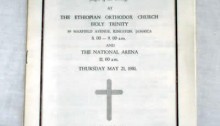
Bob Marley's Funeral program

Journey To Orthodoxy yesterday ran a piece about the conversion of reggae artist Bob Marley to the Ethiopian Orthodox Tewahedo Church (a non-Chalcedonian church very similar to but not currently in communion with the [Eastern] Orthodox Church). It’s worth a read. We thought it might also be of interest to see this primary source document pictured above which also witnesses to his 1980 baptism—at which he took the name Berhane Selassie (“Light of the Trinity”)—and subsequent burial in 1981 by the Ethiopian Orthodox in Jamaica.

The image we found is a little small, so here’s the full text for those whose eyes (zoom capability) might not be quite up to the task:

OFFICIAL FUNERAL SERVICE
FOR THE
HON. ROBERT NESTA MARLEY, O.M.
(BOB MARLEY – BERHANE SELASSIE)
(Light of the Trinity)

AT

THE ETHIOPIAN ORTHODOX CHURCH
HOLY TRINITY
89 MAXFIELD AVENUE, KINGSTON, JAMAICA
8.00—9.00 a.m.

AND

THE NATIONAL ARENA
11.00 a.m.

THURSDAY, MAY 21, 1981

OFFICIATING:
HIS EMINENCE, ABOUNA YESSEHAQ
ARCHBISHOP OF THE ETHIOPIAN ORTHODOX CHURCH
IN THE WESTERN HEMISPHERE

Assisted by Priests and Deacons of the Ethiopian Orthodox Church in Jamaica

SERVICE WILL BE PERFORMED IN GEEZ, AMHAIRIC AND ENGLISH

Addition for the 30th anniversary: Below is some footage from his funeral and the events surrounding it. Ethiopian Orthodox clergy are visible at several points.

Fr. Andrew S. Damick's RSS Feed
Go to Top