Firsts
The Righteous Shall Be in Everlasting Remembrance: Further Reflections on Colonel Philip Ludwell III
1Introduction
March 14/27 this year will mark the 266th anniversary of the falling asleep in the Lord of Colonel Philip Ludwell III of Williamsburg, Virginia. As many readers of this web site will know he is the first documented convert to Orthodoxy in the Americas, following his reception into the Church in London in December 1738. Last year, Metropolitan Hilarion, the First Hierarch of ROCOR and Ruling Bishop of its Eastern American Diocese blessed for panikhidas to be held in his memory on the anniversary of repose. Since this blessing was given more information has come to light that further enhances our picture of Colonel Ludwell and the relevance of his life to Orthodoxy in America today.
Philip Ludwell III was born in Virginia in 1716, some sixty years before the revolution that would give birth to the United States of America and the modern concept of the “nation state” founded on ideological ties rather than those of family, kinship and language. He travelled to London, England in 1738 and was received into Orthodoxy at one of the first parishes of the Russian Church established outside the boundaries of the Empire: But it should be clear that this was not a Russian church in any modern narrowly defined nationalistic setting. The priest of the parish who received him was Fr Bartholomew Cassanno, a half French, and half Alexandrian Greek who spent most of his adult life in England and had married an English women converted to Orthodoxy in the 1720’s. Following her repose he would become a hieromonk. Like the priest and his matushka most of the parish were either from the Greek speaking lands of the eastern Mediterranean or English converts to Orthodoxy.
From the Archives of the Holy Synod
Thanks to the tieless efforts of my dear friend Misha Sarni in London, I have recently obtained copies of documents regarding Colonel Ludwell from the archives of the Holy Synod in St Petersburg. As regards Ludwell’s arrival in London, Fr. Stephen Ivanovsky, the second ethnic Russian priest of the parish writes to the Holy Synod in St Petersburg in 1761:
In 1738, during the incumbency of the late Hieromonk Bartholomew Cassano at this holy Church, an English gentleman named Ludwell [transliterated as Лодвел – Lodvel – tr.], born in the American lands and living there in the province of Virginia, came to London seeking the True Faith, which he, with God’s help, has swiftly found in the Holy Graeco-Russian Church. And so on the 31st of December of the same year he was confirmed in the same with the holy Chrism. The next year, 1739, he returned to his native land, from whence he, having lived there for twenty years, came back to London last month of September, and brought with him his three daughters, two of whom are eleven years of age, and the third, twenty, who long time ago in America lost their mother, minding to have them united with the Holy Eastern Church here, gaining through this union the one Mother for them and himself.
Ivanovsky goes on to explain that during his years in America Ludwell had translated into English “The Orthodox Confession” of Metropolitan Peter Moghila of Kiev and now sought the Synod’s blessing to publish and distribute it to all sons of the Holy Eastern Church dwelling in London, without charge, for their spiritual nourishment.
He continues:
The same man, filled with Orthodox piety, requested that I, unworthy, humbly petition the Most Holy Ruling Synod concerning the future condition of his soul. How should he conduct himself after returning to his home land with his family, what shall he and them do, keep the practice of prayer only at their home, or would they be permitted to go temporarily to an English church, having no church of their own? So that they could offer their Creator some due in public, even thrice a year, thus drawing away from themselves the anger of the local people, since there, and in the whole Province of Virginia, and in the whole of America, except nearby Pennsylvania, any other Religion except Protestant, is forbidden. Besides in his home country still nobody knows about his change of Religion, since he is a councilor in a high position in the King’s service.
Concerning the Holy Gifts, he humbly petitions the Most Holy Ruling Synod, whether it would consider it possible to send them from here once a year some Consecrated Holy Gifts, as was practiced by the Early Christians, so that they, having been deprived of this Spiritual Nourishment after their departure from here, should not fall into despair. Since he had no greater concern throughout his twenty years there than the absence of these Divine Gifts, which he oftentimes longed to partake for the strengthening of his faith. And this petition of the selfsame man who is full of pious zeal, which is stemming from his great love for the Holy Church, I, unworthy, make bold to bring for the Most Holy Ruling Synod’s compassionate consideration, and humbly beg for a decision that will bring him joy.
In response to Ivanovsky’s petition the Holy Synod very swiftly blessed the printing and distribution of the catechism and for Ludwell to dispense it freely to those who would like to own it for their benefit.
The Synod also responded:
That he, Priest Ivanovsky, having properly instructed and established the three daughters of the said gentleman Ludwell in the knowledge of our Orthodox faith, shall receive them into the Holy Eastern Church, of their own volition, through the appropriate Church service. As to ways to preserve their Orthodox faith after their departure, what order of prayer to follow in their native land, and other matters related to Church mysteries, you, priest Ivanovsky, shall, having diligently obtained from them the knowledge of all circumstances and customs observed there, and having carefully considered these, advise them with suitable caution.
Finally, as regards the Holy Gifts:
At the time of departure of said Ludwell and his family to their native land, in consideration of their needs and circumstances as reported by you, priest Ivanovsky, and also his, Ludwell’s, most fervent desire. If there is an unfailing hope in his perfect will to hold fast, now and henceforth, to our Orthodox faith, and in view of the above needs, the Most Holy Synod gives you, priest Stefan Ivanovsky, the blessing to provide him with the Holy Gifts, for himself and his children, in a proper Tabernacle, having given him appropriate instruction concerning their keeping.
Philip Ludwell and Benjamin Franklin
Last December I was able to visit the only extant house in the world of Benjamin Franklin, in Craven St, London. Colonel Ludwell also lived in Craven St during the last seven years of his life and the extent of his friendship with Franklin is gradually becoming clearer. In the mid 1760’s Franklin briefly returned to America and in February 1763 he wrote from there to Ludwell back in London:
I must shortly make a journey to your Country, which I should undertake with much greater Pleasure, if I could promise myself the happiness of meeting there with my dear Friend, (but this is not to be expected, for I hear you are to continue this year in England). I pray sincerely that every Blessing may attend you, wherever you are, and particularly that of Health. O that I could invent something to restore and establish yours! But we shall meet, I trust, in a better Country, and with better Constitutions, vigorous health and everlasting youth; and since t’will be an additional pleasure so great in itself and so easily afforded us, I am persuaded we shall know one another.
From this letter it is clear that Ludwell did not intend to remain in London, but rather to return to his native Virginia. God’s will was otherwise and he was to repose in London in 1767. Its seems highly probable that Benjamin Franklin may have been present at his funeral in the Russian Church at the end of March that year.
Franklin and Ludwell worked together in a number of important educational and charitable initiatives in early America. Franklin is credited with founding America’s first hospital, in his native Philadelphia, the Pennsylvania Hospital in 1751. Two years prior to this he began the educational establishment that was to grow into America’s first full University – the University of Pennsylvania. What is much less widely realized is that Ludwell was the founding donor for both these institutions. Ludwell and Franklin together along with others funded an organization known as “The Associates of Dr Bray” who in 1760 opened the first schoolhouse for African American children in Williamsburg, Virginia.
The Piety of Philip Ludwell
All these actions attest to Ludwell’s love for his fellow man. His love for God is equally demonstrated by his adherence to the Orthodox Faith he embraced in his youth, retained for over twenty years whilst cut off from outward Church life and then brought his family into. In those wilderness years he labored to translate the catechism into English and also the Divine Liturgies of St John Chrysostom and St. Basil the Great. He penned a brief exhortation to piety entitled “How to Behave Before, In and After Divine Services in the Church.” In this he demonstrates the importance of reverence for God and awe in the presence of His holiness:
As then passest along to the Church present thy self before the King as the awfull majesty before whom thou art going to content thy self in the Courts of his house.
Enter the Church with gravity and composure and present thy self before the sanctuary and devoutly adore thrice; bless thy self with the sacred sign and say:
Surely the Lord is in this place!
How awfull is this place!
This is none other than the house of God and this is the Gate of Heaven!
How amiable is thy dwelling O Lord of Hosts!
My soul hath a desire a longing to enter the Courts of the Lord; my heart and flesh rejoice in the living-God.
…………………………………………………………………………………………….
Let the Words of my Mouth and the Meditation of my heart be always acceptable in thy Sight O Lord my Strength and my Redeemer.
Conclusion
It is surely a remarkable thing that a man so connected to the early history of this Republic was also a devout Orthodox Christian who faithfully and diligently strove to live and witness to the Orthodox Faith, to love God and to care for the poor and disadvantaged. May his memory be eternal and may he be numbered among the blessed!
Orthodoxy in America – an Interconnected and Shared History
0Presentation given by Nicholas Chapman of Herkimer NY at the OCL 25th Anniversary Conference, Washington DC on Oct 27, 2012. (Original here)
Before I begin let me thank George Matsoukas and the Board of OCL for the invitation to present today. I would also like to acknowledge Matthew Namee whose place I have filled due to his current work and other commitments. His constant support over the past three years has stimulated, informed and helped to sustain my own research.
Introduction
Your Grace’s, Reverend Fathers and Mothers, Brothers and Sisters: The study of the history of Orthodoxy in America is still at a very early stage with a substantial amount of primary documentary materials as yet unread or undiscovered, in both English and other languages. The realms of archeology and oral history are even more virgin fields. The present circumstances of the Church in America make it increasingly important to get to grips with these sources. I believe a more complete understanding of our common heritage will help to forge a single present identity, that in turn can provide a foundation for wider efforts to bring an end to the canonical irregularities of Church governance that have arisen in North America and elsewhere in the past one hundred or more years.
The work that I have done to date suggests that we have a more interconnected and shared history than is commonly realized and that an awareness of this can help to foster a clearer single Orthodox identity. Such an identity would transcend the narrow categories of modern nationalistic philosophies that have impacted the life and mentally of all Orthodox churches to differing degrees since at least the early 19th century. In the short time available I will present five themes of American Orthodox history. Dr Walsh and Dr Yiannis will then develop some of these in more detail, after which there will be opportunity to flesh them out further in open discussion.
1. The Genesis of Orthodoxy in the Americas
There has been some presence of Orthodox peoples in the Americas from the beginnings of European colonization following Columbus’s first landing in 1492. Early Spanish historians place Greeks in Santa Domingo by 1500 AD and fighting with the conquistador Cortes in the capture of what is now Mexico City in 1521. The first person identified by Spanish records as a Greek Christian is Doroteo Teodora, a member of a Spanish exploration party on the Florida coast in 1528. The early French explorer Samuel de Champlain records two Slavonians in his party exploring what is now the coast of Maine at the end of the 16th century and he has a Greek as an interpreter with the native peoples of the St Lawrence Valley in the 1620’s. Merchants, many of whom were associated with the London based companies trading with Russia and the Ottoman near east, began the first permanent English settlement at Jamestown. These settlers compared Jamestown to Constantinople and referred to the native Americans as infidels or Turks. Two of the Directors of the Virginia Company published works that include references and substantial sections on Orthodox faith and practice. These interactions between Virginia, Muscovy and the Levant continued throughout the 17th century, fueled by economic and religious considerations. Thus the Royal Governor Sir William Berkeley proposes importing workers from the Greek Morea in 1675, whilst his successor Lord Culpepper advocates for sending a delegation of Virginia planters to the Patriarch of Moscow in 1681. Ultimately these connections between Virginia and centers of Orthodox life may be seen to culminate in the conversion to Orthodoxy of Colonel Philip Ludwell III of Virginia who was received into the Russian church in London in 1738, after travelling there for this purpose. To borrow a phrase from the writer of the epistle to the Hebrews, “time does not permit me to tell” of many other early events prior to the transfer of Alaska to the United States in 1867. Suffice it to say that by 1865 the Orthodox presence in what is now the lower 48 had become substantial enough for St Metropolitan Philaret of Moscow to propose the creation of in America, a Russian Orthodox Church. (It should be noted that at no time does Philaret include Alaska within his definition of America.)
Metropolitan Philaret notes the possible presence of as many as thirteen thousand Orthodox believers in America but suggests the primary motivation for establishing an ecclesiastical structure is American spiritual leaders who first showed the desire to have an Orthodox Church in America…. This is a reference to approaches to Moscow, from the Episcopalian diocese of California, whose Bishop in San Francisco reported the presence of some four hundred persons belonging to the Greek Church who, while they recognized his authority up to a certain point, yet refused to receive communion from his hands. Such developments in California and elsewhere led to an Episcopalian delegation visiting Moscow in 1864, headed by the Episcopalian Bishop of New York.
By 1866 a decision had been made to construct an Orthodox temple in New York City. A major fundraising event for this was held in Moscow in 1866 in conjunction with the visit to Russia of Gustavus Vasa Fox, the assistant secretary of the US navy. At that banquet ( T)he attorney to the Synodal board of Moscow, spoke of the proposal to erect a Russian church in New York City, for which …., a subscription in America had produced already seven thousand dollars…. Mr. Curtin expressed in the name of General Clay… the hope that the Russians would soon find, in coming to New York, an orthodox church worthy of the Greek religion. Mr Clay, he said, would subscribe 500 rubles, and Mr Fox as much; and he believed that private subscriptions in New York would yet yield twenty five thousand more. He was certain, too, that twenty four thousand rubles, additional to the thousand given by Messrs.’ Clay and Fox, would be raised in Russia. These were substantial amounts of money, possibly millions in current dollars. I do not know what became of these monies: perhaps we are looking at the first question of financial accountability in American Orthodox history!
2. Orthodoxy as an aspect of American History
Dr. Walsh will develop this theme so I will only touch upon it briefly. Suffice it to say that the history of Orthodoxy in North America should first be studied within the wider context of the exploration and subjugation of the new world by the European powers and how their geopolitics were fueled by economic and religious considerations. These determine their interactions from the fall of Constantinople in 1453 through to the Bolshevik revolution in Russia in 1917 and beyond. The impact on the emergence of Orthodox life in the United States of American independence, the Civil War, the concept of Manifest Destiny, the Cold war, changing immigration policy etc. must be appraised. The internal situation of the Orthodox churches in the near East, Russia and the Balkans must be understood as it impinged upon their activities or lack of same in the United States. We also need to be aware of the growth of the Church in other parts of the West in the same period that interconnect with and often predate developments here.
3. The Crucial Role of Ordinary Believers
Until now the history of Orthodox mission in North America has tended to focus almost exclusively on the clergy and monastics that arrived in Kodiak, Alaska in 1794. There is almost no recognition of the work that had already taken place before their arrival whereby devout but un-ordained Orthodox believers had brought Orthodoxy to the native peoples. One such person was Osip Prianishnikov, a merchant from Tobolsk in Siberia who by 1791 was fluent in the Kodiak, Aleut and Chugach Yupik languages. Combining this with his knowledge of church services he was able to lead the native peoples in morning services, hours and evening services, even before the arrival of the missionary fathers. After their arrival he became their translator and continued to fulfill the ministry of a reader.
Prianishnikov was not the only Russian to have taught the Alaskans prayer. John Ledyard of Connecticut, the great early explorer records in his 1778 visit to Alaska that the Russians assembled the Indians in a very silent manner, and said prayers after the manner of the Greek Church….I could not but observe with what particular satisfaction the Indians performed their devoirs to God, through the medium of their little crucifixes, and with what pleasure they went through the multitude of ceremonies attendant on that sort of worship. This was 16 years before St Herman and his fellow laborers arrived!
In a similar vein, but very different cultural context we have the aforementioned Colonel Philip Ludwell III who appears to have created an Orthodox prayer house in Williamsburg, Virginia in the 1740’s and 50’s and was able to commune from the presanctified gifts that the Holy Synod of Russia had blessed him to take from London to Virginia in 1739. During this period Ludwell would also translate the liturgies of St John Chrysostom and St Basil as well as the Orthodox Catechism of Metropolitan Peter Moghila of Kiev. The latter was published in London in 1762. He is an example in his life of Orthodox piety and philanthropy and evidence points to some of his descendants continuing in the Faith until very recent times.
Some of these descendants quite probably played a part in the formation of an Orthodox prayer house in Galveston, Texas in the 1850’s. Galveston had also been the home of George Fisher, a Serbian Orthodox seminary drop out who arrived in America in 1814. He ended his life in San Francisco in 1873, having served in the 1860’s as the Greek consul and been one of the founders of the Holy Trinity parish in that city.
So the creation of Orthodox churches in America was much more the fruit of the devotion and labor of pious believers both clergy and lay, than the result of some kind of hierarchical master plan formulated in Constantinople, Moscow or anywhere else!
4. Orthodoxy in America and the emergence of Evangelicalism
Time once again does not permit me to develop this theme, but I strongly believe there was a connection between early Orthodoxy in America and the Moravian, Methodist and Episcopal churches. The more contemporary phenomena of the Evangelical Orthodox Church actually has much deeper historical roots. The Moravians from their mid 15th century beginnings in the Czech lands until at least their arrival in America in the mid 18th century perceived themselves as an orphaned Eastern church. According to the New York Gazette of Jan 21, 1751, in petitioning the British authorities for permission to settle in America they presented a public writing from the chief Patriarch of the Greek Church, in 1740, acknowledging them to be descended from the Eastern Church.
In a similar vein the early Methodists looked east for ecclesiastical legitimacy. One of the reasons the young John Wesley was expelled from Savannah was for celebrating the liturgy of St John Chrysostom when it was not an authorized rite of the Church of England. A later 18th century American source says that Wesley, with the encouragement of his Moravian friends, travelled to Constantinople in the 1780’s and was ordained a Bishop by the Patriarch.
At the same time, the then dominant Anglican Church in America looked to the Church of Russia as its model in its achievement of its independence from Constantinople, when considering its own distinctiveness from the Church of England. Following independence from Britain the American Episcopal Church obtained its first resident Bishop in the person of Samuel Seabury of Connecticut. He was ordained Bishop in Scotland by Bishops of the non- juror tradition whose early 18th century antecedents had actively negotiated for acceptance as an Orthodox Church. Seabury brought to America forms of liturgical office based on the Scottish Book of Common Prayer. His Communion Office, published in New London in 1786, contains an explicit epiclesis or prayer for the descent of the Holy Spirit on the gifts after the words of institution, following the Orthodox tradition. This tendency of the Episcopal Church in America towards Orthodoxy came to a head in the 1860’s with the formation of the Russo-Greek Committee that actively sought union with the Orthodox East.
5. Orthodoxy, Democracy and the Emergence of Nationalism
In a major speech before the General Assembly of the State of Connecticut in 1783, the seventh President of Yale, Dr Ezra Stiles, suggests that the Orthodox Church may offer a model of religious tolerance for the nascent American republic. He said:
The United States will embosom all the religious sects or denominations in Christendom… (He then enumerates all the Christian churches he knows to be present in America, including a Greek church.) All religious denominations will be independent of one another, as much as the Greek and Armenian patriarchates in the East; and having, on account of religion, no superiority as to secular powers and civil immunities, they will cohabit together in harmony, and, I hope, with a most generous catholicism and benevolence.
A few years later in Paris, France, the Orthodox believer and first naturalized US citizen, John Paradise introduced Thomas Jefferson to Adamantios Koreas, one of the fathers of the modern Greek nation and language. After their meeting Jefferson and Koreas corresponded for many years regarding the understanding of liberty, democracy etc. Koreas was also a graduate of the Orthodox founded Evangelical Greek School in Smyrna where he studied alongside his contemporary, the future St Nikodemos of the Holy Mountain. Perhaps these two could be said to typify two polarities of the contemporary Greek church in America and I will leave it to the far more capable hands of Dr Yiannis to develop these points further.
Another renowned early American philosopher was Benjamin Franklin who corresponded frequently with the early Russian enlightenment thinker and Orthodox churchman Mikhail Lomonosov. It was Franklin who arranged for John Paradise to gain American citizenship and the latter in turn corresponded with Eugenios Voulgaris, the Corfu born Bulgarian who went on to become the Archbishop of Cherson in the Russian church and is remembered with the epithet “Teacher of the Nations.” Thus the Orthodox enlightenment in Greece and Russia is seen to interact with some of the founding fathers of the American republic.
Conclusion
Our Orthodox past is not isolated from the mainstream of American history but interwoven with it. Within this past we have both saints and philosophers. The time has come to begin building upon the foundation they have laid through their prayers, writings and actions. This must be done in a spirit of charity and mutual respect whilst understanding our God given calling to pass on the faith which was once for all delivered to the saints. (Jude 1:3)
Fr. Andreades’ 1867 New Orleans homily
0Archimandrite Stephen Andreades was the first priest of Holy Trinity Orthodox Church in New Orleans. He arrived in late 1867, making him the very first resident Orthodox priest in the contiguous United States. Very little is known about Andreades, and most of what we know comes from a short homily he gave upon his arrival. The homily was published in the March 15, 1868 issue of the Alaska Herald (vol. 1, issue 2), a periodical published by the infamous Agapius Honcharenko.
Until recently, I had seen references to that homily, but I had never gotten my hands on the text itself. But a couple of months ago, Maggie Maag, who heads up the great historical work being done at Holy Trinity in New Orleans, sent me a copy. The homily was originally given in Greek, but it was translated into Russian for the Alaska Herald. Maggie found the Alaska Herald issue at the Library of Congress, and she arranged for Roman Alokhin of the New Orleans Museum of Art to translate it from Russian into English. I ran the translation past a Russian translator friend of mine, who made some minor edits. The result is below.
The homily is dated December 25, 1867. I suspect that’s the Julian (Old) Calendar date, so it would have been January 6, 1868 according to the Gregorian Calendar used in America. The original translation from Greek to Russian was done by a man named Thomas Kraskovsky, about whom we know nothing. Here’s the whole thing, followed by my own comments:
I see with which Heavenly glory the hearts of Orthodox Christians of the Eastern Church are filled, because of the establishment of the first Orthodox Church in the New World.
In the name of this blessed event, let’s exalt our hearts to God and thank Him for raising this church in the land of freedom, equality, enlightenment and humanity.
Here, the notion of the history of Christianity gives an acknowledgement that our Church is the only true and unshakable church. As the mother of other churches that enlightened the universe with Godly and human law is understood by those, who did not spare means, when our church in the east was subject to danger, they (Christians of Holy Trinity church) regardless of payoff decided: what to Greece is not given, is subsequently (after all) given to it (to this church).
The erection of this Orthodox Church is a great jubilation of Orthodoxy, Christian strength and virtue, it increases the magnificence of our church crown. You, coming here from so far away for trading business and for improving your fate, did not forget your motherland and your protectress Orthodox Church. You understood that God’s temple is a union of devout and illuminated by the heavenly truth society, that entering the temple as if into a place of unseen God, we strengthen our faith, receive light from the sky, receive holy mysteries and while reading the holy gospel we hear the voice of almighty God.
Such feelings of Christian love prompted you to build this delightful temple, where you invited me from Greece to conduct this first Godly Liturgy.
Rejoice with me, Orthodox Christians, and receive my heartfelt spiritual blessing. Blessed and glorified the name of God, who granted me to conduct a spiritual service in this new church, and I beg Him for help in my task. The permanent duty of my service in this church will be: to keep the commandments of God and to comply with church bylaws. To conscientiously perform the holy mysteries, as the source of immortality, so as our life is not deprived of God’s grace.
My children! Have faith with virtue and virtue with reasonableness. Accustom to sobriety, be pious and patient, love each other as this is the source and root of all goodness and foundation of Christian morals. Respect your parents and older people, equally respect property and rights of your neighbors. These qualities make humanity great, produce kind citizens, well-doers/benefactors and great people.
Holy Trinity! Infinite mercy, inconceivable light, illuminating anyone coming to you, we beg you, remain amidst your children and honor us with your grace. Illuminate us the sinful and give us the strength to praise your beneficence and dominion. Guard this new church and protect it against all dangers. Shelter the flock and the shepherd, turn away bad intentions of invisible enemies, accompany to the jubilation of Orthodoxy. Strengthen us in our reasonableness and sustain in all undertakings – Amen.
The part about Andreades coming from Greece is the one thing I had seen before. The homily makes it sound like the church building was recently constructed, which fits with my impressions from other sources. The June 13, 1867 issue of the New Orleans Times reported that the New Orleans Board of Aldermen adopted the following resolution:
Resolved, That the Surveyor be and he is hereby instructed to cause to be constructed a wooden sidewalk, 250 feet long and 2 feet wide, and a wooden crossing 42 feet long by 4 feet wide, opposite the Greek Trinity Church, on Dorgenois street, between Barracks and Hospital streets.
So obviously, by June, there was a church building — which means that the church building preceded the priest by at least six months.
This is just one of the many, many fascinating discoveries that they are making in New Orleans. The historical work being done by that community, and spearheaded by Maggie Maag, is really tremendous. We’ll have much more on that work in the future.
Matthew Namee
St Raphael Hawaweeny & Spanish language Orthodoxy in the Americas
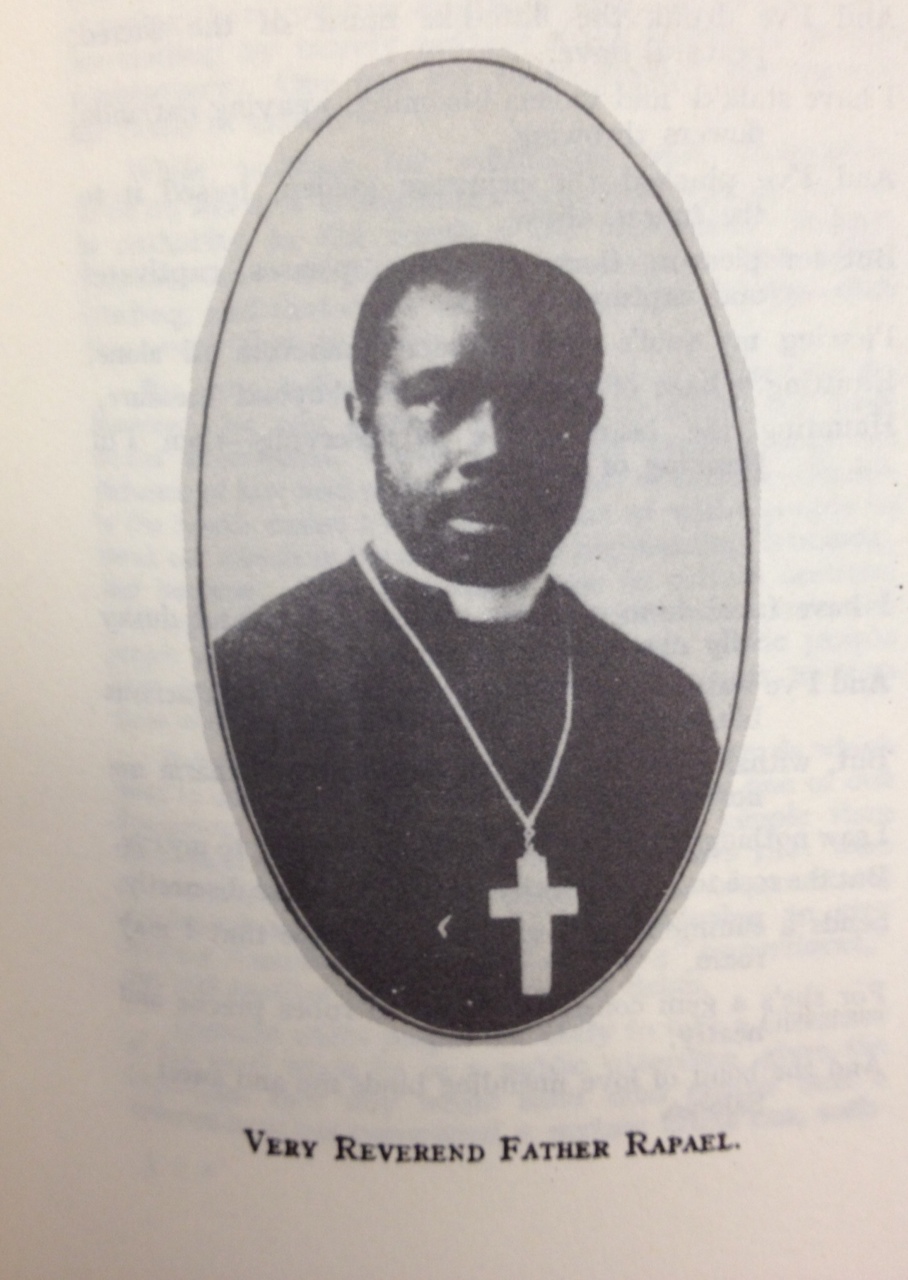
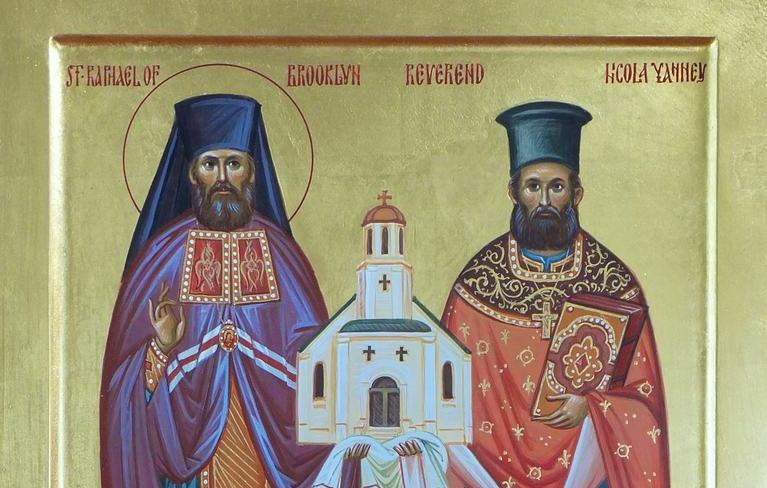
3St Raphael Hawaweeny was a native of Lebanon, who in 1904 became the first Orthodox bishop ordained in the new world. As Bishop of Brooklyn he had oversight over the Syro-Lebanese communities that were beginning to appear in the Americas in the early twentieth century and he worked tirelessly for their growth and consolidation. It has been noted previously by Matthew Namee on this web site that during the years of St Raphael’s ministry until his repose in 1915 there was a dramatic increase in the extent and use of the English language in the liturgical life of these communities.
Last year, whilst I was researching in the National Archives in London, England, I discovered a document that shows that St Raphael’s missionary concerns extended beyond English to the Spanish language. The document I found was a letter (written in Russian) in 1912 from St Raphael to Fr. Eugene Smirnov, the priest of the Russian Embassy church in London. By way of background it should be mentioned that Fr. Eugene had briefly served as a reader at the Russian Orthodox parish in New York in the early 1870’s under Fr Nicholas Bjerring. Fr Eugene maintained an active interest in Orthodox missionary work throughout his life and in particular facilitated considerable support for the development of the church in America by way of both material and financial assistance.
The letter, which is translated in full below, is evidence of the expansive missionary vision of both St Raphael and Fr. Eugene. I am indebted to Dr. Karina Ross of St George Antiochian Orthodox George in Utica for its translation:
Your Blessedness,
Esteemed Father Protopriest!
The box with five hundred copies of St. John’s Liturgy in the Spanish language that you promised to me in your letter from Feb. 13th / 26th of the current year was conveyed to me yesterday from the Russian Cathedral in New York.
I humbly request you to notify of this the deeply respected – apostles of Orthodoxy in the twentieth century in the heterodox West – splendid general V. Vich(?)-Perez and remarkable warrior of Christ G. A. K (can’t make out the surname), (the life and the conversion to Orthodoxy of the former through the latter, your spiritual son, I described in great detail from its account in “Church News” in my Arabic spiritual publication “Al-Khalimat” (“The Word”) last year), and also to let them know of my deepest gratitude and prayerful blessing.
I intend to send out these copies to our Orthodox Syrian Arabs who are living in Spanish language countries in Northern and Central America, in hope that this very beneficial book with (?) mercy will be of great use for the support of Orthodoxy and, quite likely, for its proliferation among Spanish speakers. Let the Lord of Hosts support all those who labour in Christ’s vineyard.
I sincerely thank you, esteemed Father Protopriest, for the love that you have shown me and for your trust in my unworthiness, with deep reverence and sincere gratitude, yours truly.
Perpetually praying for you to Lord Jesus, Raphael, Bishop of Brooklyn.
To His Blessedness
Father Protopriest
Evegenii Smirnov
32 Welbeck St., London
It is my hope that a reader of this article might be able to find and translate the article of St Raphael in Al-Khalimat” (“The Word”) referred to in the letter so that we might learn the identity of the two Spanish language apostles of Orthodoxy in the twentieth century and thus place this document within the wider context in which it obviously belongs. I am not certain to what extent Spanish is currently employed liturgically in any of the Antiochian Orthodox parishes in the USA and whether any evidence exists of its earlier use that St Raphael clearly intended to promote through the distribution of this translation of the Divine Liturgy of St John Chrysostom.
Nicholas Chapman, Herkimer, NY, August 26, 2012
A 5th century Greek church in Connecticut? Nope.
0Things have gotten more, rather than less, chaotic of late, and I apologize for the lack of new material here. I’ve had this article written for a couple of months, and now seems like a good time to run it.
Recently, an article has been circulating among some Orthodox folks on the Internet on a purported Greek Orthodox church in Connecticut, dating to the 5th century. If the article is accurate, it’s an absolute bombshell — it claims that Orthodox monks from North Africa fled persecution in the late 400s and ended up on the east coast of America. That’s centuries before the Orthodox Vikings traveled to the Western Hemisphere, and even before the legend of St. Brendan the Navigator’s voyage to America. (To read the article, click here.)
According to the article, ruins of the church in Connecticut include an altar, a throne (for a bishop?), a baptismal font, and a “candelabra” — all carved from stone. Also (again according to the author), the site features inscriptions in Greek (such as “ICXC”).
I’m not a historian of the Byzantine Empire or ancient “pre-contact” America; my own focus, as you probably know, is on Orthodoxy in America in the 19th and 20th centuries. Here at SOCHA, the furthest back we can go with much confidence is the 18th century, thanks to the work of Nicholas Chapman. But the fifth century? That’s way, way out of our comfort zone.
That said, I do think I should say something about this case. What can we determine, simply on the basis of what we non-experts know? Looking first at the article itself, it features some pretty unspectacular photos. (Click here to see them.) Three of them, to be precise:
- A photo of the “Main Altar,” which looks like a rock with lines and holes. It’s not a great shot, and it’s not clear exactly what we’re actually looking at.
- A photo of a “flame-shaped Baptismal Font,” which looks like a hole in the ground.
- A photo of an “Overflowing Fountain” sculpture, which looks kind of cool, but doesn’t scream “Byzantine” to me.
Maybe an expert could look at those photos and see something more, but to me, they’re unconvincing. The article also features several drawings by the author, including a map of the site, a sketch of another baptismal font, and reproductions of the Greek letters. In all of this — the article, the photos, the sketches — we’re being asked to trust the author. The article isn’t peer-reviewed; we’re relying on the credibility of the author and, by extension, the magazine that published the article. So let’s look at the author and the magazine.
The author’s name is John Gallager (no “h”), who claims to be a “historical detective” who used to work at the “American Institute of Archaeological Research” in New Hampshire. The problem? I can’t find anything else on this John Gallager, and the American Institute of Archaeological Research appears not to exist. (If it does, Google doesn’t know anything about it — which seems implausible.)
The magazine is called Ancient American. On its website, the magazine describes itself in this way:
Each issue presents such otherwise neglected and even suppressed factual evidence demonstrating the lasting impact made on the Americas by Scandinavian Norsemen, Pharaonic Egyptians, Bronze Age Mediterraneans, Semitic Phoenicians, West Africans, Dynastic Chinese, seafaring Polynesians, and many other culture- bearers. All contributed to the birth and development of numerous and sophisticated civilizations which flourished throughout the American Continents in pre-Columbian times.
The description goes on,
As such, our staff and contributing reporters believe they are writing a New History of our nation by convincingly offering research that, in the coming century, will amount to virtually a total revision of American antiquity. Because of its revolutionary potential, Ancient American, although authoritatively written, is not a scholarly journal. It is a popular science publication specifically aimed at attracting the broadest possible general readership, while refusing to compromise its scientific credibility.
In general, I’m sympathetic to alternative historical views, including the idea that Old World cultures may have come into contact with Native Americans prior to the arrival of Columbus. The problem is, when you start looking at research on that sort of thing, it’s difficult to separate the wheat from the chaff. And there’s a lot of chaff: in addition to legitimate historical and archaeological work, there’s all manner of speculative writings out there — spurious “discoveries,” far-out theories, and crazy Atlantis-esque notions that are more fantasy/science fiction than reality.
So we can’t find any traces of John Gallager, and Ancient American has virtually no credibility. But what about the purported site itself? Gallager’s article says that the “church” is in Cockaponset State Forest, near the town of Guilford in southern Connecticut. So I picked up the phone and called Cockaponset State Forest and spoke with an official there. His response? They’d never heard of such a thing, and thought it was kind of funny.
I’m not a professional scholar myself, and a lot of my work isn’t peer-reviewed (although some of it is). But I always try to be transparent about my sources, and my methodology is available for all to see. John Gallager… well, he (whoever he is) just expects us to take him at his word. But on what grounds? He writes this one-off article in a beyond-fringe publication, disappears, and we’re supposed to just believe him? When no one else has written a single word of original research on this supposed 5th century “church,” and the people at the supposed site have never heard of it? That’s asking too much.
So to be very, very clear: there is no evidence whatsoever that 5th century North African Orthodox monks established a Greek church in what is now Connecticut. As they say on Mythbusters, this myth is BUSTED.