Oriental Orthodox

Ancient stone St. Thomas Cross with Persian (Pahlavi) script

History of the Malankara Church in America

0

Ancient stone St. Thomas Cross with Persian (Pahlavi) script

Steven Kurian is a member of the Malankara Orthodox Syrian Church. Originally from Tampa, Florida, he holds a Bachelor’s Degree in Chemical Engineering from the University of Florida, as well as a Master’s Degree in Environmental Engineering from Rutgers University in New Brunswick, New Jersey. Currently he works as a project engineer for a process equipment manufacturer in Warminster, Pennsylvania.

Mr. Kurian has been an active member of the Mar Gregorios Orthodox Christian Student Movement (MGOCSM) as well as its sister organizations, the Fellowship of Orthodox Christians in the US (FOCUS) and Orthodox Vacation Bible School (OVBS).  He is also the moderator of the “Orthodukso” facebook page (www.facebook.com/orthodukso). While he grew up in the St. Gregorios Orthodox Church of Tampa, he and his wife Sherry, are currently members of the St. Thomas Indian Orthodox Church of Philadelphia. He may be reached at stevekurian@yahoo.com for any questions or comments.

Introduction

When speaking of India’s religious makeup, one is usually most familiar with the great “Eastern” religions of Hinduism and Buddhism, as well as with India’s long history of Islam. It may be one of history’s best kept secrets then, that India possesses a  Christian history as old as Christianity itself. In fact, there remains to the present day a Christian community in the South Indian state of Kerala that traces its heritage in continuity back to the Apostolic foundation of Saint Thomas, one of the Twelve Apostles of Christ Himself. These “St. Thomas Christians,” also called Nazranis (Nazarenes) maintained their distinct identity within the larger ethnic and cultural context of South India for roughly two millenia. From this group, an Orthodox Church affirming “Oriental,” or Non-Chalcedonian, theology emerged. This Church, the Malankara Orthodox Church, while having endured its share of struggles throughout history, has emerged as a flourishing Church; growing, along with the general Keralite Diaspora, far beyond her original borders; to other parts of India as well as to the Middle East and Europe, even to the United States. It is in this new American context-where many small “Old World” Orthodox communities have come together, that the Malankara Orthodox are beginning to contribute their own unique experience to what is slowly becoming an “American” Orthodox Church.

Historical Background

The Indian Church maintains the tradition that the Apostle Thomas came to India following the trade routes which at the time of Christ had already brought an existing Jewish  merchant community to India. According to the early Syriac document, “The Acts of Thomas,” the Apostle preached throughout the Indian subcontinent, performed miracles, converted many Hindus to Christ, and was finally martyred at Mylapore near the present day city of Chennai (formerly Madras). Tradition also holds that in the midst of his journey, in the year 52 A.D., St. Thomas arrived in the Malabar Coast (present day Kerala) and established 7 and a half Churches: at Kodungallur, Kollam, Niranam, Nilackal, Kokkamangalam, Kottakkayal, Palayoor, along with a smaller “half” Church at Thiruvancode. Collectively, this Christian community, the St. Thomas Christians would continue to grow, developing into a separate class within the wider cultural and caste system of the region. These Christians would remain in relative isolation from the rest of the Christendom, particularly in the Roman or Byzantine world. Isolated as they were, though, the St. Thomas Christians would also come to be defined by their reliance on distant ecclesiastical authorities.

In the early history of the Malankara Church (Malankara being another name for region particularly around the island of “Maliankara” off the coast of Malabar) Church, the Church’s isolation resulted in a constant struggle to maintain Apostolic succession and continuity of priesthood.This community, fortunately, was sustained at various times in hierarchy and Sacraments by a long-standing relationship with the Syriac Churches of the East. The native Christians of Kerala came to identify themselves with the Syriac Churches so much that they would take on yet another descriptor for themselves,  “Suryani Christyanis” (Syrian Christians). On several occasions, migrants, including priests and bishops, from various parts of the Syriac world would arrive in Malankara and integrate within the existing Christian community. At one point, the East-Syriac Church of Persia even elevated a Metropolitan Bishop for the “Gate of All India.” Whatever the particular theological and liturgical disposition possessed by the Malankara community, the people themselves remained united until the coming of great European colonial powers, who brought schism for the first time to the Kerala Church.

Each major European power brought to Kerala a particular theological and hierarchical bias. The arrival of Vasco Da Gama and the Portuguese to India also signaled the first contact of Latin Rite Catholicism with Malankara. The occasionally heavy handed tactics of the Portuguese to bring the alleged “heretic” St. Thomas Christians under the jurisdiction of the Pope of Rome also hastened a significant party against forced Latinization to pursue a formal relationship between Malankara and the (Non-Chalcedonian) Syrian Orthodox Church of Antioch in the mid-17th century. Thus marked the first split amongst the St. Thomas Christians, between the “Orthodox” Christians in Communion with Antioch, and the community which chose to enter into Communion with the Rome. The latter party would later coalesce into the Syro-Malabar Rite Catholic Church, an East Syriac rite underneath the Papacy. Years later, after the arrival of the English and inspired by Protestant theology, another schism between the Orthodox and a “Reformed” party within the Church would occur. The product of this became what is known as the Mar Thoma Syrian Church whose adherents to this day use a modified Syriac-rite liturgy imbued with Reformed theology.

The 20th Century saw two more schisms which further divided the St. Thomas Christians. In 1912, Baselios Paulose I was elevated as “Catholicos of the East” and primate of the Malankara Orthodox Christians. A faction of the Church, declaring his elevation invalid,  pledged their allegiances solely to the sitting Patriarch of Antioch, Ignatius Yakub III. Thus, a schism pitting Orthodox Christians against other Orthodox was precipitated. Those claiming the supremacy of the local Catholicos continued as the Malankara Orthodox Syrian Church (Metran Kakshi, or Metropolitan’s group), while those who claiming the spiritual and temporal primacy of the Syrian Patriarch of Antioch continued as the Malankara Syrian Orthodox Church (Bhava Kakshi, or the Patriarchal group). Though there was a brief period of reunion between the two factions between 1958 and 1975, this division has persisted to this day even in the diaspora. Yet another schism occured when in 1930, two Metropolitans of Orthodox Syrian Church, Geevarghese Mar Ivanios and Jacob Mar Theophilos, entered into communion with Rome bringing with them the Bethany Ashram monastery and a number of faithful. Their followers subsequently became the Syro-Malankara Catholic Church, remain as an Eastern Rite Catholic Church using essentially the same Liturgy as their former Orthodox brethren. Thus, even amongst the St.Thomas Christians sharing an identical Liturgy, there are at least three jurisdictions celebrating separately in Kerala on any given Sunday.

Photo of Malankara bishops taken in 1892; Rene Villate (Mar Timotheos) seated on the far left with Parumala Mar Gregorios second from the right, Alvarez Mar Julius far right

History of the Malankara Orthodox in America

It is worth noting that, in a sense, the history of the Malankara Orthodox Christians in America began in the early 1900s in the mysterious person of Joseph Rene Villate. Villate, who at various times of his life was a priest in the Old Catholic, American Episcopal, and Russian Orthodox Churches as well as a minister in the Presbyterian Church, had contacted the fledgling Goan mission of the Malankara Church. On May 29th, 1890, Villate was consecrated as Metropolitan Mar Timotheos by three Malankara Orthodox bishops: Alvarez Mar Julius, Kadavil Mar Athanasius, and the Saint Parumala Mar Gregorios in Colombo, Ceylon (now Sri Lanka). Mar Timotheos was tasked with ministering to America, presumably amongst the ‘Old Catholic’ community from which he came (The term “Old Catholic refers to the body of Churches which maintained the Latin Rite but which had grown dissatisfied with developments in the Roman Papacy, including Papal Infallibility). It is also worth noting that after his consecration, the Malankara Church had lost contact with Mar Timotheos as well as any connection with the American Orthodox. What is known though is that Joseph Rene Villatte Mar Timotheos continued ministering in America independently. And, almost a century later, a handful of Churches in America unaffiliated with any of the “canonical” Apostolic Churches have been found to nonetheless trace their Episcopal succession through the alleged “Villate Succession.”

The history of the Malankara Orthodox Syrian Church in the Americas properly begins in the 1960s with the rise of the global Malayalee diaspora. Kerala, with its high percentage literacy and relative number of opportunities for women, began to import large numbers of young nurses overseas. In 1965, President Lyndon B. Johnson and the United States Congress passed the “Immigration and Nationality Act,” liberalizing American immigration policy and giving preference to skilled laborers entering the US, particularly in those occupations with chronic labor shortages. Women nurses generally preceded their husbands and families in settling overseas, but nonetheless, Malayalee communities began to form. By the 1970s, many of America’s major cities, particularly New York City in the Northeast, but also Boston, Philadelphia, Chicago, Houston, and Dallas began to see Malayalee parishes of the various denominations, including the Orthodox Church form. According to self-reporting (via parish websites and jubilee souvenirs), parish were formed both in Manhattan, New York and Boston in 1964; in Washington D.C. in 1965, and in Chicago, Illinois in 1971. The parish in Manhattan (having since moved to Yonkers, New York) is the first to be incorporated as a parish of the Malankara Orthodox Church. However, many of these early parishes were also resistant to official incorporation as they were “ecumenical” in nature; having members from all the various Kerala Churches, who at that time came together to worship with fellow Malayalee immigrants.

Responding to the rapid diaspora, the Holy Synod of the Malankara Orthodox Church originally formed a single Diocese for “Outside Kerala,” encompassing the entire diaspora community in 1959 under the Metropolitan Alexios Mar Theodosius. Later, in 1976, new dioceses were formed at  Bombay, New Delhi, and Calcutta, with the Americas falling under the jurisdiction of Bombay (now Mumbai). Finally, the American Diocese was properly formed in 1979 underneath the Late Lamented Metropolitan Dr. Thomas Mar Makarios (formerly Metropolitan of Bombay) who resided in New York  while also lecturing at Alma College in Michigan. In 1992 Metropolitan Mathews Mar Barnabas (formerly of the Idukki, Kerala Diocese) succeeded Mar Makarios, becoming the second Bishop presiding over the American Diocese, establishing his Episcopal residence in Bellerose, New York.

Meanwhile, the “Patriarchal” Orthodox from Kerala were initially placed under the direct supervision of the local Syrian Orthodox Archbishop, the Late Lamented Mar Athanasius Yeshue Samuel. This arrangement put the “ethnic” Syriac community from the Middle East in one jurisdiction with the immigrants from Kerala. Answering the petitions of the Malayalees within the diocese,  a separate Archdiocese was established for the Malankara Syrian Orthodox Christians in North America in 1992 with the Archbishop Zachariah Mar Nicholovos as its first hierarch. After ten years, in 2002, this Archbishop entered into Communion with the Malankara Orthodox Syrian Church along with a handful of followers. This resulted in his immediate suspension and subsequent excommunication by the Patriarch of Antioch, Ignatius Zaka Iwas.

At this present day in America, roughly 4 decades after the first immigrants from Kerala began arriving in America, the Malankara Orthodox Churches (both Patriarchal and under the Catholicate) are experiencing unprecedented growth; both due to sustained immigration from India as well as continued population growth among the existing 1st and 2nd generation communities. As of 2010, the American Diocese of the Malankara Orthodox Syrian Church was divided into the Northeast American Diocese under the aforementioned Metropolitan Zachariah Mar Nicholovos, and the South West Diocese (based in Houston, Texas) under Metropolitan Alexios Mar Eusebios. The current Archbishop of the Malankara Archdiocese of the Syrian Orthodox Church in North America is Archbishop Mar Tithos Yeldho. According to the comprehensive US Orthodox Census by Alexei Krindatch in 2010, the Malankara Orthodox Syrian Church has 15,700 adherents in America while the Archdiocese has 6,400. Both numbers are a 53% increase from the year 2000. This combined community of 22,100 faithful has rooted itself firmly in America, and as time progresses, will reflect an increasingly American-born and English-first population. As this happens, the Malankara Orthodox Church(es) will continue to carve out their own unique place amongst the Churches of this nation.

References:

Daniel, David. The Orthodox Church of India. New Delhi: Rachel David, 1986. Print.

England, John C.. The hidden history of Christianity in Asia: the churches of the East before the year 1500. [2nd ed. Delhi: ISPCK ;, 19981996. Print.

Krindatch, Alexei D.. Atlas of American Orthodox Christian churches. Brookline, Mass.: Holy Cross Orthodox Press, 2011. Print.

Kuriakose, M. K.. History of Christianity in India: source materials. Madras: Published for the Senate of Serampore College by Christian Literature Society, 1982. Print.

“Malankara Archdiocese of The Syrian Orthodox Church In North America.” Malankara Archdiocese of The Syrian Orthodox Church In North America. N.p., n.d. Web. 16 Mar. 2012. <http://www.malankara.com>.

“Northeast American Diocese of the Malankara Orthodox Syrian Church.” Northeast American Diocese of the Malankara Orthodox Syrian Church. N.p., n.d. Web. 17 Feb. 2012. <http://www.neamericandiocese.org>.

Roberson, Ronald. The Eastern Christian Churches: a brief survey. 7th rev. ed. Roma: Pontificio Instituto Orientale, 2006. Print.

Varghese, Dn. Gregory. Rise of the Malankara Orthodox Church in America. Submitted in partial fulfillment of the requirements of Master of Divinity in St. Vladimir’s Orthodox Theological Seminary, Crestwood, N.Y., May 6, 2008


This article was written by Steven Kurian. He may be reached at stevekurian@yahoo.com for any questions or comments.

Burial of Fr. Theoclitos Triantafilides of Galveston, TX. Courtesy Ss. Constantine and Helen Orthodox Church.

Photo of the week: The funeral of Fr. Theoclitos of Galveston

0

Continuing with the theme from Wednesday…

(Click to enlarge) Burial of Fr. Theoclitos Triantafilides of Galveston, TX. Courtesy Ss. Constantine and Helen Orthodox Church.

This photo depicts the burial of Archimandrite Theoclitos Triantafilides, the great priest of Galveston, TX, on October 27, 1916. We actually have several photos of this event — all courtesy of Ss. Constantine and Helen parish — but this one particularly interests me because of the individuals standing on the stairs on the right side of the photo. Look closely, and you’ll see that they are black — possibly Copts or Ethiopians. These Oriental Orthodox Christians were members of Fr. Theoclitos’ flock. In fact, this is the earliest evidence I’ve seen for Copts or Ethiopians attending an Eastern Orthodox parish in America.

In this way, as in so many others, Fr. Theoclitos was decades ahead of his time — today, it’s quite common to meet Copts, Ethiopians, and Eritreans at an Eastern Orthodox church, but that is a relatively recent phenomenon.

Notes on an Ethiopian Orthodox court case

Right now, I’m fully immersed in work on my big paper on Orthodoxy and the civil courts. I just thought I’d offer some notes on a case I just read, Kidist Mariam Ethiopian Orthodox Tawahedo Church, Inc. v. Kidist Mariam Ethiopian Orthodox Tawahedo Church, Inc., a 1995 Georgia Court of Appeals case involving the split of an Ethiopian Orthodox parish. (And yes, the case is Kidist Mariam Church versus Kidist Mariam Church — both factions claimed to be the “true” church.)

The basic facts are as follows: In 1993, the Kidist Mariam board of directors, “after a vote by the congregation,” fired the parish priest. The priest told the archbishop, who responded by disbanding the board of directors. This led to a split in the parish — the “Atlanta Group” sided with the archbishop, while the “Decatur Group” was led by the old board of directors. Both groups elected new boards of trustees and claimed the right to control the parish funds. Hence this court case.

Rather than defer to the bishop’s definition of which group constituted the “true” parish, the court applied the neutral principles of law approach. The parish articles of incorporation stipulated that the parish was autonomous with respect to the ”internal affairs of the corporation.” The parish bylaws indicated acceptance of the archbishop’s authority only over religious, spiritual, and liturgical matters. Based on these facts, the court concluded that Kidist Mariam was a “hybrid” congregational/hierarchical church.

The court ruled that, “even assuming Archbishop Matthias was authorized in declaring the removal of the corporation’s Board of Directors because of their decision to remove Rev. Haregewoyn as priest of the Kidist Mariam Church, neither the Archbishop nor the Atlanta Group had authority to appoint the corporation’s Board of Directors.” So the Atlanta Group (i.e. the pro-archbishop group)’s new board elections didn’t conform to the parish articles of incorporation and bylaws; meanwhile, the Decatur Group’s board elections were consistent with those official documents. The result? A victory for the Decatur Group, and a loss for the archbishop’s faction.

I find the court’s reasoning curious — and not in a good way. The court has confused the legitimacy of the archbishop’s decision to disband the original board of directors with the legitimacy of the Atlanta Group’s new board. It is entirely possible (probable, even) that no board is legitimate — that the archbishop’s board failed to conform to the parish governing documents, but the Decatur Group’s board failed to qualify even as church members in the first place.

Membership status in a parish is an ecclesiastical (religious, spiritual, liturgical) matter. The archbishop had the authority to determine who was and wasn’t a parish member — and that means he had the authority to disband the board (because you can’t serve on the board if you’re not a parish member). If the archbishop declared the entire Decatur Group not to be parish members on the grounds that they rebelled against his ecclesiastical authority and purported to fire the priest… well, the archbishop had the right to do that, and it seems like he had a pretty good reason. I mean, you can’t have parish boards firing priests — not in the Orthodox Church, and while I know the Ethiopian Church isn’t in communion with the Eastern Orthodox Churches, I don’t think their ecclesiology on that point differs from ours.

The court’s reasoning demonstrates — as do so many other cases — that the neutral principles approach to Orthodox parish disputes is fatally flawed. It assumes that a real distinction exists between ecclesiastical and non-ecclesiastical issues, when in fact Orthodoxy permits no such dichotomy. Here, the issue of which was the “real” board hinged, in large part, on the issue of who were “real” parish members. That’s an ecclesiastical question, and the court overstepped its bounds when it ignored this fact.

This article was written by Matthew Namee.

What is an Armenian parish?

Matthew Namee’s somewhat recent post concerning what constitutes a parish caught me by surprise, as I was preparing a very similar article of my own to illustrate a problem I’ve been having in continuing to tell the story of the Armenian Orthodox Church for SOCHA.  When I agreed to assist SOCHA in covering Armenian topics, I envisioned my first posting to be a quick narrative about the Armenian Church (which it was, you can read that here), and my second to follow soon thereafter, containing a listing of the first parish in each of the twenty-four states where the Armenian Church is found.  Matthew Namee, of course, did the same thing for the growth of Eastern Orthodox parishes, and I thought it might be helpful to our readers if I did, too.

I quickly found that writing such an entry was difficult, precisely out of the primary question Matthew posed in his entry:  What truly constitutes a parish?  I was consulting parish and diocesan websites, several books published by the church (dating back as early as the 1940’s), newspapers, and couldn’t find a set standard anywhere.  Some parishes gauged their founding from the building of their first sanctuary.  Others dated it from the first vestiges of a board of trustees, or the first time there was really any appreciable, united Armenian community.  Even more confusing are the so-called “Mission Parishes,” which ordinarily do not have (and probably never have had) either a permanent sanctuary or a priest, often both.  These communities tend to date their founding by the year in which they were formally recognized as a Mission Parish, which doesn’t seem to have been general practice until the 1970’s, even if an Armenian presence and some modicum of organized church life existed long before.

My home parish (when I’m not in Chicago), St. John Armenian Church in Southfield, Michigan, is celebrating its 80th anniversary this year.  That’s all well and fine, except the first evidence of a parish organization apparently dates to 1909, and first priest assigned to Detroit arrived in 1913.  There was no sanctuary, so the community met in a number of borrowed spaces, especially St. John Episcopal Church in downtown Detroit (which, interestingly, also housed the plenary sessions of the 4th All-American Sobor in 1924, for those interested in Metropolia/OCA history), until they could afford to purchase land and build a church of their own.  The movement to build the first church began in 1928, and it was ready for consecration in 1931.

So there’s three possible anniversary dates here if we look at when the community came together, when the first priest came, and when the first church was built:  1909, 1913, and 1931.  To give you an idea of what standard the parish ended up using, in 2006, we celebrated our 75th anniversary, and this year we celebrate the 80th.

Then there’s the situation of the Armenian community in Chicago, which seems to truly defy explanation, and gets at the root of the incredibly strange arrangements that combined to form the Diocese of the Armenian Church in America in 1898 (which I hope to cover later on).  The previous year, the entire country was separated into four “ecclesiastical districts:” Massachusetts, Rhode Island, Fresno (California), and Chicago, and the scant amount of Armenian clergy distributed amongst them.   This could be considered an odd choice, considering an 1898 list of the seven largest Armenian communities in the United States prepared by Bishop Hovsep Saradjian ranked Chicago dead last, numbering just 400 people.   Yet this was the biggest Armenian community in the Midwest at the time.  Fr. Khat Markarian was assigned to travel to Chicago, but a disagreement over his reassignment from his parish in Boston resulted in Markarian instead going to New York.  No replacement was named, and Chicago languished.

While other communities around the country rapidly grew, taking advantage of massive waves of immigration to build churches and the infrastructures of parish life, Chicago was a comparative non-starter.  Though he visited nearly every corner of the country, Bp. Saradjian never visited the city.  In 1901, he sent Fr. Vahan Messirlian to Chicago to organize a slate of trustees to establish a parish, and while he may have been marginally successful in the short-term, there were no representatives from Chicago at the 1902 Diocesan Assembly.   There were loose associations of parish life over the next decade, but there would not be a permanent priest assigned to Chicago until 1915.  St. Gregory the Illuminator Armenian Church formally dates its establishment to that year, and was the culmination of all that had happened in Chicago since 1898.  Since St. Gregory is the oldest Armenian parish in Illinois, is 1915 really the right year to pick for its establishment?

So, like Matthew, I’m struggling a bit with how one gauges the intricacies of parish formation, especially looking at situations that were anomalous both in geographical dispersal as well as the highly irregular way in which the Armenian Church in America constituted its hierarchical administration in its earliest years.  Long story short, I guess, that list I mentioned at the opening is forthcoming, once I can determine some kind of standard, and wade through the evidence enough to come to a consensus.

Until then, SOCHA readers, are there any particular issues you want me to cover about the Armenian Church?

This article was written by Aram Sarkisian.

30 Year Anniversary of Bob Marley’s Death

In honor of the 30th anniversary of the passing of Bob Marley, who finished his life as a member of the Ethiopian Orthodox Church (his baptism was just six months before his death), we’re reposting this piece we posted last year featuring the program from his funeral in Jamaica. Memory eternal!

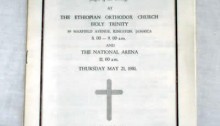
Bob Marley's Funeral program

Journey To Orthodoxy yesterday ran a piece about the conversion of reggae artist Bob Marley to the Ethiopian Orthodox Tewahedo Church (a non-Chalcedonian church very similar to but not currently in communion with the [Eastern] Orthodox Church). It’s worth a read. We thought it might also be of interest to see this primary source document pictured above which also witnesses to his 1980 baptism—at which he took the name Berhane Selassie (“Light of the Trinity”)—and subsequent burial in 1981 by the Ethiopian Orthodox in Jamaica.

The image we found is a little small, so here’s the full text for those whose eyes (zoom capability) might not be quite up to the task:

OFFICIAL FUNERAL SERVICE
FOR THE
HON. ROBERT NESTA MARLEY, O.M.
(BOB MARLEY – BERHANE SELASSIE)
(Light of the Trinity)

AT

THE ETHIOPIAN ORTHODOX CHURCH
HOLY TRINITY
89 MAXFIELD AVENUE, KINGSTON, JAMAICA
8.00—9.00 a.m.

AND

THE NATIONAL ARENA
11.00 a.m.

THURSDAY, MAY 21, 1981

OFFICIATING:
HIS EMINENCE, ABOUNA YESSEHAQ
ARCHBISHOP OF THE ETHIOPIAN ORTHODOX CHURCH
IN THE WESTERN HEMISPHERE

Assisted by Priests and Deacons of the Ethiopian Orthodox Church in Jamaica

SERVICE WILL BE PERFORMED IN GEEZ, AMHAIRIC AND ENGLISH

Addition for the 30th anniversary: Below is some footage from his funeral and the events surrounding it. Ethiopian Orthodox clergy are visible at several points.

Go to Top