This week in American Orthodox history (Sept. 10-16)

0

September 11, 1893: The World’s Parliament of Religions opened in Chicago. I’ve written quite a bit about the Parliament in past articles, and you can read all of them by clicking here. The super-short version: In conjunction with the Chicago World’s Fair, representatives from every major world religion convened in Chicago for the mother of all ecumenical gatherings.

Among the most impressive figures at the event was a Greek Orthodox archbishop, Dionysius Latas of Zante, one of the best known hierarchs in the Church of Greece. Archbishop Dionysius attracted a lot of press, but the most interesting Orthodox figure at the Parliament was Fr. Christopher Jabara, an Antiochian archimandrite who rejected the doctrine of the Holy Trinity and wanted to create a single world religion. To read more about Jabara, click here.

September 10, 1900: Nicholas Bjerring died in New York. Bjerring had converted from Roman Catholicism to Orthodoxy in 1870. He was immediately ordained a priest in Russia and sent back to America to establish the first Orthodox chapel in New York City. Bjerring’s chapel was one of only three Orthodox houses of worship in the contiguous United States (the others being in San Francisco and New Orleans). And while there was a Russian bishop living in California, Bjerring and his chapel were directly under the Metropolitan of St. Petersburg.

Things didn’t work out all that well. After sputtering along for 13 years, the chapel was closed by the Russian government, and a disenchanted Bjerring converted to Presbyterianism. A few years before he died, Bjerring re-converted to Roman Catholicism, as a layman.

Fr. Demetrios Petrides

September 12, 1912: Fr. Demetrios Petrides arrived in Atlanta to become the priest of Annunciation Greek Orthodox Church. Petrides had been in Philadelphia, where he clashed with a rich Greek tobacco magnate. It’s a crazy story — the millionaire layman wanted Petrides to bow to him and follow his every order, and Petrides flatly refused. The rich guy got Petrides fired from the parish (that was how things worked back then), and Petrides moved to Atlanta. One newspaper dubbed him the “stormy petrel of the cloth,” and he continued his distinguished career until his untimely death from diabetes in 1917.

Another interesting aspect of Petrides’ career is that he was the priest who recommended that the Ecumenical Patriarchate ordain Fr. Raphael Morgan, who became the first black Orthodox priest in America. For a time, Morgan — who had a troubled marriage that ended in divorce — actually lived in Petrides’ house.

September 13, 1921: Two big events on this day: the birth of Fr. Alexander Schmemann, and the opening of the first Clergy-Laity Congress of the Greek Archdiocese.

The Clergy-Laity Congress accomplished the legal incorporation of the Archdiocese, and many date the beginning of the GOA to this date. It’s sort of arbitrary, though — you could pick any number of dates between 1918 and 1922. I think the Congress itself, rather than the act of legal incorporation, is ultimately more historically significant.

As for Fr. Alexander Schmemann, he was one of the most famous and important figures in late 20th century American Orthodoxy. What did he do? What didn’t he do? He’s probably best known for his writings — seminal works like For the Life of the World, The Eucharist, Great Lent, and many, many more. Or maybe he’s best known as a professor and longtime dean of St. Vladimir’s Seminary, where he educated hundreds of future church leaders. Or perhaps it’s his role as a churchman: he played a key role in the establishment of the OCA, and the founding of SCOBA. He attended Vatican II as an observer, and he advised the Evangelical Orthodox Church on its path to conversion to Orthodoxy. After the death of Metropolitan Leonty in 1965, the Metropolia/OCA lacked a dominant hierarchical presence. Schmemann, a married priest, filled that role, and was for the OCA what Archbishop Iakovos was to the Greek Archdiocese, and Metropolitan Philip Saliba was for the Antiochians.

September 11, 1927: Fr. Emmanual Abo-Hatab, former archdeacon to St. Raphael Hawaweeny, was consecrated a bishop for the newly established American Orthodox Catholic Church. The AOCC was led by Archbishop Aftimios Ofiesh, and it was fringe from the beginning. Bishop Emmanuel eventually split from Aftimios and went to the Russian Metropolia, where he succeeded Aftimos as leader of the “Russy” (pro-Russian) faction of the Arab Orthodox in America.

September 14, 1931: Eleanor Roosevelt, wife of New York Governor Franklin Roosevelt, attended the cornerstone-laying ceremony at Holy Trinity Greek Orthodox Cathedral in New York. The ceremony was performed by Archbishop Athenagoras, the new head of the Greek Archdiocese. From the following day’s New York Times:

Mrs. Roosevelt said that the members of the Greek congregations had expressed their worship of God by means of beautiful edifices erected in this city. She added the hope that their fine spirit would be carried on by the new members of these congregations.

Members of the Holy Trinity congregation, whose church was destroyed by fire several years ago, and those of the congregation of the Church Evangelismos [Annunciation] will be amalgamated into one congregation in the new edifice which is expected to be completed in April at a cost of $600,000.

$600 grand in 1931 is equivalent to roughly $8.5 million today — a decent chunk of change in any era, but particularly during the Great Depression.

September 10, 1933: Fr. Benjamin Basalyga was consecrated a bishop in Pittsburgh, for the Russian Metropolia. The 46-year-old bishop was born in a Pennsylvania coal town, and as a child, he was one of the first students at the Russian missionary school in Minneapolis and then at the Minneapolis seminary. Later, he became a hieromonk and served in parishes all over America and Canada, without spending much time in any particular community. For a while in the 1920s, he was the personal secretary to Metropolitan Platon, head of the Russian Metropolia.

After being consecrated, Benjamin served as Bishop of Pittsburgh for about a dozen years, after which he led the Orthodox Church of Japan from 1946 to 1953. He then returned to his see in Pittsburgh for another decade before his death in 1963.

September 11, 1948: Bishop Alexis Panteleyev (or Panteleev), the Russian Metropolia’s Bishop of Alaska, died. I know next to nothing about Bishop Alexis, but I can tell you that he was originally consecrated Bishop of San Francisco in 1927, and served in that post until 1931. In 1934, he became the Bishop of Alaska. Then, in 1945, he was sent by the Metropolia to attend the enthronement of Alexei I, the newly elected Patriarch of Moscow. In this period, there was some hope that Moscow and the Metropolia could reestablish communion. As it turned out, the Metropolia couldn’t accept Moscow’s terms, and reunion didn’t happen.

The next year, though, Bishop Alexis decided to join Moscow himself. He explained his reasoning in this way: “In order to be in unity with the Eastern Orthodox Church, it is necessary for the Russian Orthodox clergy to be under the Patriarch of Moscow.” (New York Times, 4/20/1946) Bishop Alexis died two years later, in 1948.

September 16, 1949: St. John Maximovitch, then the ROCOR Bishop of Shanghai, spoke before the United States Congress. This article is getting a bit long, and St. John’s visit to Congress is really interesting, so I think I’ll save this one for another day.

September 14, 1951: Fr. Demetrios Makris was consecrated a bishop for the Greek Archdiocese, with the title “Bishop of Olympus” (yes, that Olympus). This was back when the GOA had a single Archdiocese composed of a series of “Archdiocesan Districts,” each overseen by a titular bishop but ultimately answerable to the Greek Archbishop. Later, those Districts became Dioceses (and their leaders diocesan bishops), and today they’re Metropolises with Metropolitans. Anyway, Bishop Demetrios was initially assigned to the massive First Archdiocesan District, which included New York, New Jersey, Pennsylvania, Washington DC, and more. Later, he headed up the Districts based in San Francisco and then Boston.

To be honest, I know even less about Bishop Demetrios than I do about Bishop Alexis Panteleyev (above). I’m not even sure when he died, though I’d guess it was in the 1970s (his tenure in Boston ended in 1973). If anyone out there can fill us in, please do.

That’s it for this week. Thanks for reading, and for your patience during this period of irregular output here at SOCHA.

St Raphael Hawaweeny & Spanish language Orthodoxy in the Americas

3

St. Raphael Hawaweeny

St Raphael Hawaweeny was a native of Lebanon, who in 1904 became the first Orthodox bishop ordained in the new world. As Bishop of Brooklyn he had oversight over the Syro-Lebanese communities that were beginning to appear in the Americas in the early twentieth century and he worked tirelessly for their growth and consolidation. It has been noted previously by Matthew Namee on this web site that during the years of St Raphael’s ministry until his repose in 1915 there was a dramatic increase in the extent and use of the English language in the liturgical life of these communities.

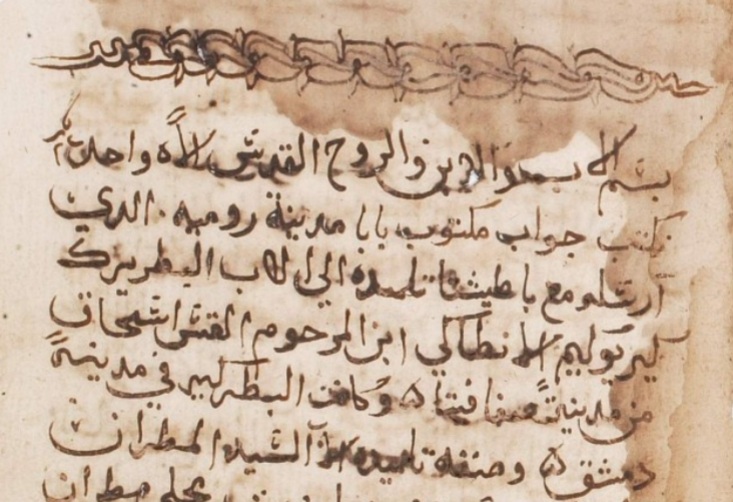
Last year, whilst I was researching in the National Archives in London, England, I discovered a document that shows that St Raphael’s missionary concerns extended beyond English to the Spanish language. The document I found was a letter (written in Russian) in 1912 from St Raphael to Fr. Eugene Smirnov, the priest of the Russian Embassy church in London. By way of background it should be mentioned that Fr. Eugene had briefly served as a reader at the Russian Orthodox parish in New York in the early 1870’s under Fr Nicholas Bjerring. Fr Eugene maintained an active interest in Orthodox missionary work throughout his life and in particular facilitated considerable support for the development of the church in America by way of both material and financial assistance.

The letter, which is translated in full below, is evidence of the expansive missionary vision of both St Raphael and Fr. Eugene. I am indebted to Dr. Karina Ross of St George Antiochian Orthodox George in Utica for its translation:

Your Blessedness,

Esteemed Father Protopriest!

The box with five hundred copies of St. John’s Liturgy in the Spanish language that you promised to me in your letter from Feb. 13th / 26th of the current year was conveyed to me yesterday from the Russian Cathedral in New York.

I humbly request you to notify of this the deeply respected – apostles of Orthodoxy in the twentieth century in the heterodox West – splendid general V. Vich(?)-Perez and remarkable warrior of Christ G. A. K (can’t make out the surname), (the life and the conversion to Orthodoxy of the former through the latter, your spiritual son, I described in great detail from its account in “Church News” in my Arabic spiritual publication “Al-Khalimat” (“The Word”) last year), and also to let them know of my deepest gratitude and prayerful blessing.

I intend to send out these copies to our Orthodox Syrian Arabs who are living in Spanish language countries in Northern and Central America, in hope that this very beneficial book with (?) mercy will be of great use for the support of Orthodoxy and, quite likely, for its proliferation among Spanish speakers. Let the Lord of Hosts support all those who labour in Christ’s vineyard.

I sincerely thank you, esteemed Father Protopriest, for the love that you have shown me and for your trust in my unworthiness, with deep reverence and sincere gratitude, yours truly.

Perpetually praying for you to Lord Jesus, Raphael, Bishop of Brooklyn.

To His Blessedness

Father Protopriest

Evegenii Smirnov

32 Welbeck St., London

It is my hope that a reader of this article might be able to find and translate the article of St Raphael in Al-Khalimat” (“The Word”) referred to in the letter so that we might learn the identity of the two Spanish language apostles of Orthodoxy in the twentieth century and thus place this document within the wider context in which it obviously belongs. I am not certain to what extent Spanish is currently employed liturgically in any of the Antiochian Orthodox parishes in the USA and whether any evidence exists of its earlier use that St Raphael clearly intended to promote through the distribution of this translation of the Divine Liturgy of St John Chrysostom.

Nicholas Chapman, Herkimer, NY, August 26, 2012

Metropolitan Anastasii Gribanovsky, First Hierarch of ROCOR

May 1964: A Radical Change in the History of the Russian Church Abroad

0

Metropolitan Anastasii Gribanovsky, First Hierarch of ROCOR

The 1964 Council of the Bishops of the Russian Church Abroad (ROCOR) marked a new milestone in its history: on May 27, 1964 Metropolitan Anastasii (Gribanovskii) retired. Bishop Anastasii’s episcopal consecration took place in Moscow in 1906. In 1913 he was appointed to devise rites for the glorification of St. Patriarch Germogen, which was presided by Patriarch Gregory IV of Antioch. In 1915, Anastasii was appointed Bishop of Chisinau and Khotin. He designed the rite of installation of St. Tikhon as Patriarch of Moscow on November 21, 1917. On December 7, 1917, the local council of the Russian Church elected him a member of the Synod of Bishops.

In 1918, after the accession of Bessarabia to Romania, Archbishop Anastasii refused to subordinate to the Romanian Church and was sent out of country by the Romanian military authorities. In 1920 he was appointed by the Supreme Church Administration of the South-East of Russia to Constantinople, which was occupied by the French and British troops, to address ecclesiastical needs of Russian refugees.

Evacuated from the Crimea in November 1920, the Russian Army created their own worldwide network – the Russian All-Military Union – in order to continue the struggle against Bolshevism. The Russian Church Abroad became the Church of this emigration that was traumatized by the civil war. The flock of the Russian Orthodox Church was very anti-communist: one could not expect from them a politically correct attitude toward the Bolsheviks. In 1924, the Ecumenical Patriarchate required Archbishop Anastasii to stop commemorating Patriarch Tikhon in the Divine Liturgy and to abstain from any political rhetoric. Archbishop Anastasii did not fulfill this demand and was suspended.

After his departure from Constantinople in 1924, Archbishop Anastasii was appointed to Jerusalem as an administrator for the Russian Ecclesiastical Mission. There he continued his encounter with Greek Orthodoxy, and he also visited Damascus. In 1927, at the request of Patriarch Damian of Jerusalem, he took part in the consecration of new bishops for the Jerusalem Patriarchate. At that time Palestine was under British mandate. Archbishop Anastasii maintained intensive contacts with the British and took part in joint prayers with the Anglicans. As a result of his labors, the Gethsemane monastic community was founded by former Anglican nuns who had become Orthodox.

In 1936, after the death of Metropolitan Antonii (Khrapovitskii), Anastasii became the second Primate of the Russian Church Abroad. During World War II, he did not escape the illusions prevailing among the flock of the Russian Church Abroad that the Germans, having liberated Russia from Bolshevism, would permit the establishment of an independent Russian state. Metropolitan Anastasii supported Russian Liberation Army of General Andrei Vlasov. Nevertheless, Metropolitan Anastasii’s intuition and caution saved him from calling to the entire flock of the ROCOR to support Drang nach Osten (that is, German expansion into Slavic lands).

In 1950, Metropolitan Anastasii moved to the United States. Here he maintained warm relations with the Greek Archbishop Michael (Konstantinides), whom he had met in Constantinople. In the postwar period, Metropolitan Anastasii had a rigid attitude toward the Moscow Patriarchate. At the ROCOR Council of Bishops in 1959, the decision was made to accept clergymen of the Moscow Patriarchate through repentance. In his so-called last testament, Metropolitan Anastasii called on the faithful to have no public contacts with representatives of the Moscow Patriarchate. Today, those who did not recognize the 2007 reconciliation of the Moscow Patriarchate and the Russian Orthodox Church Abroad refer to this document, pulling the words out of historical context.

In exile, Archbishop Anastasii showed a rare ability to step back from the noise of the dominant trends. At the Pan-Diaspora Council of 1921, he was against the adoption by the council of an appeal for the restoration of the Romanov dynasty, supported by Metropolitan Antonii. He was acutely aware that St. Patriarch Tikhon had a very different experience of life than those Russian bishops who left the country. At the Council of Bishops in 1953, Metropolitan Anastasii spoke out against the glorification of St. John of Kronstadt, believing that it was not the business of the refugee Church to glorify the All-Russian miracle worker. Metropolitan Anastasii was against Russian intervention in the internal affairs of the Greek Orthodox Church, and a Bishop’s Council passed a resolution not to participate in the consecration of the Greek Old Calendarists. This resolution was breached in 1962 by Archbishop Leontii of Chile and Peru.

It became very difficult for Metropolitan Anastasii to head the bishops’ “conclave” of the Russian Church Abroad due to his advanced age, and he summoned a Council of Bishops with the purpose of electing a successor. On May 27, 1964 Metropolitan Anastasii confirmed that he had not changed his mind about retirement. Since Byzantine times, conciliarity was maintained in the Orthodox Church by the confrontation between the “diplomats” and “zealots.” At the time of the Council of Bishops in 1964 there was a sharp confrontation between these two episcopal parties. The leader of “zealots” was St. John (Maximovitch) of Shanghai and San Francisco, and the leader of the “diplomats” was Archbishop Nikon (Rklitskii) of Washington and Florida. The election of a First Hierarch from either of these two factions would have made it extremely difficult for the other party to work with this person. To resolve this crisis, St. John offered to withdraw his candidacy, if Archbishop Nikon would follow suit. The result was that Bishop Philaret (Voznesenskii) became the Primate of the Russian Church Abroad. This opened a new period in ROCOR history. Bishop Philaret had been consecrated only a year earlier, and represented a new generation of leaders. On November 1 at the Synodal Cathedral in New York and later in Utica, New York, the glorification of St. John of Kronstadt took place. The Russian Church Abroad was turning into a self-sufficient entity.

On May 22, 1965, Metropolitan Anastasii died and was buried in Holy Trinity Monastery, Jordanville, NY.

Deacon Andrei Psarev teaches church history at Holy Trinity Russian Orthodox Seminary in Jordanville, NY. He also serves on the SOCHA advisory board and runs the ROCOR Studies website (www.rocorstudies.org).

Nicholas Chapman podcast on early 18th century Orthodox catechism in English

1

As you may (or may not) know, regular OrthodoxHistory.org author Nicholas Chapman — the man who has single-handedly rewritten our understanding of early Orthodoxy in America — hosts a podcast on Ancient Faith Radio, called Speaking of Books. For his most recent episode, Nicholas reviewed an intriguing volume: The Russian catechism, composed and published by order of the Czar. To which is annex’d, a short account of the church-government, and ceremonies, of the Moscovites. Illustrated with cuts.

As the title suggests, this isn’t a new book. In fact, it was published in the early 18th century. In English. And it was advertised in the New England Courant — a Boston newspaper — in 1723. All of which cuts against the notion that Orthodoxy was virtually unknown in America until the 19th century.

To listen to the podcast, CLICK HERE. It’s 17 minutes long, and definitely worth your time.

A 5th century Greek church in Connecticut? Nope.

0

Things have gotten more, rather than less, chaotic of late, and I apologize for the lack of new material here. I’ve had this article written for a couple of months, and now seems like a good time to run it.

Recently, an article has been circulating among some Orthodox folks on the Internet on a purported Greek Orthodox church in Connecticut, dating to the 5th century. If the article is accurate, it’s an absolute bombshell — it claims that Orthodox monks from North Africa fled persecution in the late 400s and ended up on the east coast of America. That’s centuries before the Orthodox Vikings traveled to the Western Hemisphere, and even before the legend of St. Brendan the Navigator’s voyage to America. (To read the article, click here.)

According to the article, ruins of the church in Connecticut include an altar, a throne (for a bishop?), a baptismal font, and a “candelabra” — all carved from stone. Also (again according to the author), the site features inscriptions in Greek (such as “ICXC”).

I’m not a historian of the Byzantine Empire or ancient “pre-contact” America; my own focus, as you probably know, is on Orthodoxy in America in the 19th and 20th centuries. Here at SOCHA, the furthest back we can go with much confidence is the 18th century, thanks to the work of Nicholas Chapman. But the fifth century? That’s way, way out of our comfort zone.

That said, I do think I should say something about this case. What can we determine, simply on the basis of what we non-experts know? Looking first at the article itself, it features some pretty unspectacular photos. (Click here to see them.) Three of them, to be precise:

  1. A photo of the “Main Altar,” which looks like a rock with lines and holes. It’s not a great shot, and it’s not clear exactly what we’re actually looking at.
  2. A photo of a “flame-shaped Baptismal Font,” which looks like a hole in the ground.
  3. A photo of an “Overflowing Fountain” sculpture, which looks kind of cool, but doesn’t scream “Byzantine” to me.

Maybe an expert could look at those photos and see something more, but to me, they’re unconvincing. The article also features several drawings by the author, including a map of the site, a sketch of another baptismal font, and reproductions of the Greek letters. In all of this — the article, the photos, the sketches — we’re being asked to trust the author. The article isn’t peer-reviewed; we’re relying on the credibility of the author and, by extension, the magazine that published the article. So let’s look at the author and the magazine.

The author’s name is John Gallager (no “h”), who claims to be a “historical detective” who used to work at the “American Institute of Archaeological Research” in New Hampshire. The problem? I can’t find anything else on this John Gallager, and the American Institute of Archaeological Research appears not to exist. (If it does, Google doesn’t know anything about it — which seems implausible.)

The magazine is called Ancient American. On its website, the magazine describes itself in this way:

Each issue presents such otherwise neglected and even suppressed factual evidence demonstrating the lasting impact made on the Americas by Scandinavian Norsemen, Pharaonic Egyptians, Bronze Age Mediterraneans, Semitic Phoenicians, West Africans, Dynastic Chinese, seafaring Polynesians, and many other culture- bearers. All contributed to the birth and development of numerous and sophisticated civilizations which flourished throughout the American Continents in pre-Columbian times.

The description goes on,

As such, our staff and contributing reporters believe they are writing a New History of our nation by convincingly offering research that, in the coming century, will amount to virtually a total revision of American antiquity. Because of its revolutionary potential, Ancient American, although authoritatively written, is not a scholarly journal. It is a popular science publication specifically aimed at attracting the broadest possible general readership, while refusing to compromise its scientific credibility.

In general, I’m sympathetic to alternative historical views, including the idea that Old World cultures may have come into contact with Native Americans prior to the arrival of Columbus. The problem is, when you start looking at research on that sort of thing, it’s difficult to separate the wheat from the chaff. And there’s a lot of chaff: in addition to legitimate historical and archaeological work, there’s all manner of speculative writings out there — spurious “discoveries,” far-out theories, and crazy Atlantis-esque notions that are more fantasy/science fiction than reality.

So we can’t find any traces of John Gallager, and Ancient American has virtually no credibility. But what about the purported site itself? Gallager’s article says that the “church” is in Cockaponset State Forest, near the town of Guilford in southern Connecticut. So I picked up the phone and called Cockaponset State Forest and spoke with an official there. His response? They’d never heard of such a thing, and thought it was kind of funny.

I’m not a professional scholar myself, and a lot of my work isn’t peer-reviewed (although some of it is). But I always try to be transparent about my sources, and my methodology is available for all to see. John Gallager… well, he (whoever he is) just expects us to take him at his word. But on what grounds? He writes this one-off article in a beyond-fringe publication, disappears, and we’re supposed to just believe him? When no one else has written a single word of original research on this supposed 5th century “church,” and the people at the supposed site have never heard of it? That’s asking too much.

So to be very, very clear: there is no evidence whatsoever that 5th century North African Orthodox monks established a Greek church in what is now Connecticut. As they say on Mythbusters, this myth is BUSTED.

Go to Top