Posts tagged Herman of Alaska
Herman, A Wilderness Saint: From Sarov, Russia to Kodiak, Alaska
0
The following is a book review from our friend and colleague Nicholas Chapman:
Herman, A Wilderness Saint: From Sarov, Russia to Kodiak, Alaska is a new book that I think will be of interest to many readers of this web site. It has been translated from Russian and contains material not previously available in English, which only became accessible in Russia after the fall of communism. Through its use of primary sources such as letters and reports, St. Herman’s life and character is revealed with startling clarity, together with many aspects of the wider Russian ecclesiastic mission to America of which he was an integral part. The three appendices bring the story of New Valaam up to our own time, offer details of the saint’s canonization by both the OCA and ROCOR in 1970 and provide more biographical background to some of the eyewitnesses to the saint’s life. The primary text is supported by easily referenced endnotes and rounded off by an index.
Of particular note for readers of this web site following previous articles published here will be the account of the martyrdom of St Peter the Aleut with a brief discussion of its historicity.
Further information about the book and how to order it in either print or digital formats can be found here. The monastery also published an earlier edition of this book in Russian, details of which may be found here. A look inside preview is available courtesy of Amazon here.
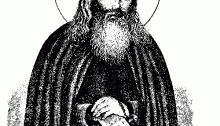
St. Herman and Fr. Alexander
0Today, December 13, is the New Calendar feast day of St. Herman of Alaska. A year ago on this feast, we reprinted a life of St. Herman written by Vera Johnston and published in 1919. To read (or re-read) that biography, click here.
Today is also the 28th anniversary of the death of Fr. Alexander Schmemann, the longtime dean of St. Vladimir’s Seminary and arguably the most important writer in American Orthodox history. If you haven’t seen it yet, take a few minutes and check out the Fr. Alexander Schmemann website, www.schmemann.org. There, you’ll find photos of Schmemann, a collection of his writings, and articles written about him by others. Perhaps the best memorial for Schmemann is the sermon given by his son-in-law, Fr. Thomas Hopko, at the memorial Divine Liturgy three days after Schmemann’s death. More recently, in 2008, Bishop Basil Essey gave a wonderful lecture in Schmemann’s honor at St. Vladimir’s Seminary. To listen to it on Ancient Faith Radio, click here.
The Kodiak Bell should be returned to Alaska

The Kodiak Bell, created in 1796 for the first Orthodox church in the Western Hemisphere, now hangs in an old Spanish Catholic mission near Los Angeles.
On February 4, I wrote an article on an 18th century Russian bell that currently hangs in an old Roman Catholic mission in California. Thanks to Mr. Clifford Argue, I have since learned a great deal more about the Kodiak Bell, and I am convinced that this bell needs to be returned to the Orthodox Church in Alaska.
As most American Orthodox Christians know, in 1794, nine Russian monks arrived on Kodiak Island in Alaska and initiated the first Orthodox mission in the New World. The missionaries included the wonderworker St. Herman and the future hieromartyr St. Juvenaly, and their leader was Archimandrite Joasaph Bolotov, who would go on to become the first Orthodox bishop consecrated for service in the Americas. (Tragically, the newly-consecrated Bishop Joasaph drowned when his ship sank en route to Kodiak, and it would be nearly a half-century longer before a bishop, St. Innocent Veniaminov, would set foot in Alaska.)
Anyway, in 1796, the Kodiak Bell was cast for the first Orthodox church in Alaska — the Church of the Resurrection. The bell bore an inscription, which, translated into English, reads something like this: “In the year 1796 in the month of January this bell was cast on the island of Kodiak by the blessing of Archimandrite Joaseph during the sojourn of Alexander Baranof.”
That bell now hangs at the historic Roman Catholic mission of San Fernando Rey de Espana, not far from Los Angeles. How it got there remains a mystery. One story — which I briefly related in my original article on the bell — is that the Russian nobleman Nikolay Rezanov exchanged the bell to the Spanish for food on an 1806 visit to California. The bell found its way to Mission San Fernando and was there as late as 1860. It was then removed and buried to protect it from vandals, was forgotten, and was finally rediscovered in 1920. It’s a colorful story, with a lot of romance, but it appears to be mostly speculation, with little hard evidence to back it up.
In the book The Mission Bells of California, by Marie T. Walsh (1934), there is a fascinating chapter entitled “Russian Bells in California.” The Kodiak Bell is featured prominently, and after relating the Rezanov story, Walsh offers this alternative theory:
Shortly after the transfer [of Alaska to United States control] two shipments of bells were made from Sitka to San Francisco. One of these shipments was consigned to Hutchinson & Hirsch on January 21, 1868, and the other to [Russian consul] Klinkofstrom on November 18, 1868. Also, in 1882, the three bells from the Kodiak church were sent down to be recast by a San Francisco company, but were substituted with other material. Reverend [Alexander] Kashevaroff says that he remembers ringing the 1796 bell as a boy for the church services and on big holidays, especially during Christmas and Easter, when the bells would be rung the whole day in honor of the feast. So taking this historian’s word for it, the Kodiak bell first saw California in 1882 and not in 1806 as has been so romantically suggested.
I plan to reprint the whole chapter at some point, as Walsh provides a lot of details and theories.
Anyway, so much for the basic history. In 1987, on the eve of the millenium of Russian Orthodoxy, OCA priest Fr. Andrew Harrison, then of St. Innocent Church in Tarzana, California, wrote to Pope John Paul II to ask that the Kodiak Bell be loaned to the Orthodox in Alaska. Roman Catholic Archbishop Roger Mahony of Los Angeles responded, granting permission for a 3-month loan in 1988. Most of the details were worked out, but for reasons that remain unclear, the loan never happened and the bell has remained at Mission San Fernando to this day.
That was 23 years ago. And while the idea of a three-month loan is nice, honestly, that bell belongs in Alaska, permanently. It is one of the few surviving artifacts from the original Kodiak Mission — from the original Orthodox temple in the Western Hemisphere. It should be, not loaned, but returned. Because, however it got down to a Roman Catholic mission in California, it is of comparatively little value to its present owners, in light of its extraordinary significance for the Orthodox Church.
This calls to mind two recent “returns,” both of which are relevant for our purposes. First, there was the celebrated 2004 return of relics by Pope John Paul II to the Ecumenical Patriarchate — relics of the great Fathers St. Gregory the Theologian and St. John Chrysostom. Here, the late Pope should serve as a model for the current owners of the Kodiak Bell, willing to return a precious relic to the Orthodox in a spirit of Christian friendship.
Even more recently, there was Harvard University’s 2008 return of 18 historic bells to Danilov Monastery in Russia. These bells had been donated to Harvard in 1930 by a philanthropist who saved them from destruction by the Communists, and they were ultimately returned in exchange for a new set of bells (donated by a Russian foundation). Here, too, we see a model for the Kodiak Bell situation: we Orthodox should raise the (certainly small) sum of money necessary to create a replacement bell, to give to Mission San Fernando in exchange for the Kodiak Bell.
In my view, this plan — for the Roman Catholics to return the Kodiak Bell in exchange for a high-quality replacement — is exactly the sort of “ecumenical” activity that has positive benefits all around. It would foster goodwill between the two groups, attract positive attention from outsiders, give the Orthodox an important relic from their past, and give the Roman Catholics a new artifact demonstrating our Christian brotherhood. This can happen, and should happen.
This article was written by Matthew Namee. Many thanks to Mr. Clifford Argue for his invaluable assistance.
Vera Johnston: “Herman — Russian Missionary to America”
Editor’s note: We first published this article nearly a year ago, but today is St. Herman’s feast day on the New Calendar, and it seemed appropriate to reprint this early Life. The author, Vera Vladimirovna Johnston, was born in the Russian Empire, married an Englishman, and eventually moved to New York. Her own story is extremely fascinating, and we discussed it in some detail in August. This article originally appeared under the title “Herman — Russian Missionary to America,” in a publication called The Constructive Quarterly 7:1 (March 1919). That is, it was written for an audience of literate Christians of various denominations, rather than specifically for Orthodox readers. I have not edited the text at all; any misspellings are in the original.
A Russian missionary to America! Yes, indeed, a servant of God, lowly and simple of heart, who attained to such perfection of spirit that in our day and generation there are many in Alaska and throughout the Orthodox parishes in the United States who think that Herman, the humble monk, should be and will be canonized—a saint of the Church.
In the second half of the eighteenth century the northern boundaries of Russia came so close to America that Russian pioneers reached the Aleutian Islands. Towards the end of the reign of the great Catherine, when Gabriel was Metropolitan of St. Petersburg, it was arranged that the light of Christ should be brought to the inhabitants of these inhospitable islands, which were inaccessible part of the year. Ten recluses of the Valaam Monastery were chosen and in 1794 started for far-off America.
The letters written home to the Prior of Valaam by some of the members of the mission were full of quaint descriptions and observations of the wonders met with in Siberia and in the cold regions of the Pacific Ocean: sea monsters, and the not less monstrous aboriginal Red men, who fought the Russian sailors by night, with queerly carved and painted masks of animals on their heads. Some of these letters are well worth reading after the lapse of 125 years.
However, the mission landed at last, and the success of these preachers of the Gospel among the new sons of the Russian Empire was great. Many thousands became Orthodox Christians, the word taking such deep root in their hearts that time and vicissitudes have done little to sap its vitality even to this day; a school was founded, a church was built, round which were grouped the dwellings of the new converts and their spiritual fathers. Yet the general success of the mission did not continue very long. After five years the Archimandrite Joasaph, head of the mission, who about this time became a bishop, was drowned off the coast of Alaska with other members of the mission; the hieromonk Juvenalius “won the crown of martyrs,” having been killed by the arrows of the natives; and one after another the missionaries disappeared, until only Herman was left.
The Yelovoi Ostrov—Spruce Island—was Herman’s dwelling place. It faces Kadiak, where stood the original church and mission house, and is separated from it by a channel a mile and a half wide, which is so rough at times that Yelovoi becomes entirely inaccessible. The island is thickly covered with fir trees, and there is a swift stream of fresh water on it, so that one is never out of hearing of the murmur of the stream and the noise of rushing tumbling breakers on the stony beach. And it was in this sylvan and watery solitude that the Russian monk worked in America.
Retiring into this wilderness, Herman first of all dug with his own hands a cave, in which he lived until a wooden cell was built for him; but the cave he preserved in good condition during all the forty years he stayed on Yelovoi, retiring there for prayer at times, and destining it for the grave in which his frail old body should find rest at last. Later a small wooden chapel was built next to his cell and a bigger one for the school children.
For more than forty years Herman worked incessantly. He was the first to introduce various European vegetables into these regions. When he was not praying or teaching, he was digging, planting, weeding, watering; and the wild little island produced vegetables on quite a large scale—good potatoes and cabbage. He was an expert at finding edible fungus crops in the thickets beneath the trees; and he pickled great quantities of mushrooms, obtaining salt from the seawater. He carried to his vegetable beds fertilizing seaweed in such a huge basket that it was not easy to lift it even when empty; yet at times the frail old monk transported several of these basketfuls daily, though the distance to the seashore was quite considerable. The endurance and vigour of his emaciated body were incredible, his contemporaries say; for instance, one snowy winter’s night, young Jerassimos, one of his disciples, by chance saw Apa (Grandfather) Herman walking barefooted in the woods, carrying with unbent shoulders a tree so big that Jerassimos said not even four strong men could have borne it. And all this was done to supply food, fuel, clothing, and even school books, for the many Aleutian children of whom he took care. And as if all this was not enough, whenever sufficient sugar and flour could be obtained, Herman made cookies and little cakes for the children, who adored him.
His own food consisted only of a very small piece of fish or a little boiled vegetable. He wore the same light clothes summer and winter. He slept on a wooden bench covered with a doe’s skin, which as years went on had no hair left on it at all, becoming simply a thin piece of leather. Two bricks, carefully concealed from visitors, were his pillow; and instead of a blanket he used a piece of board, which still covers his body in the cave which is his grave. But such as it was, Apa Herman loved his wilderness home. He was a frequent visitor of the Russian officials on the shore, but he always returned home for the night, even if it was very dark, or foggy, and if the sea rolled heavy waves. On the rare occasions when it was necessary to stay away for the night, and his hosts put him in a comfortable bedroom, in the morning it would be discovered that the bed had not been touched, and indiscreet people would have seen him at all hours of the night kneeling in prayer.
Even in his youth he had never looked very robust, for he was sparely built, but not tall; yet in addition to all the physical and moral self-imposed fatigue, he always wore heavy chains on his body, thus inflicting on himself further mortification of the flesh. His nearest disciple in the Aleutian Island, whose name was Ignatius Aligyaga, was often heard in later times to say: “Yes, Apa led a hard life, and no one could follow him.”
Yet, for all the incessant labour of his outward life, his inner life was the more intense of the two, and far the more important in his own eyes. Bishop Peter, who knew Herman well, wrote that his principal concern was “the exercise of spiritual achievements, in the isolation of his cell, where no one could see him.” And this statement is further confirmed by what Herman himself said when somebody asked him whether he did not feel dull, being so much alone in the woods. “No, I am not alone. God is there as He is everywhere. Holy angels are there. Then how can I feel dull? With whom is it better and pleasanter to converse, with men or with angels?”
Herman’s attitude towards the aboriginal inhabitants of Alaska and the way in which he understood Russia’s relation to them is well worth attention. He wrote to the Governor of the colony: “The Lord gave this land to our beloved mother country like a new-born babe, who has not as yet any faculty to acquire knowledge, nor the sense to do so; because of its lack of strength and its infancy, it not only needs protection, but even support; but this it has as yet no ability to ask of anyone. And as Providence has made the prosperity of this people to depend, until some unknown date, on the Russian authorities … I, the humble servant of the people of this land, and their nurse, standing before you on behalf of all, do implore you, writing with tears of blood. Be our father and our benefactor. It is needless to say we have no eloquence. But with our inarticulate infant tongues we say to you: ‘Wipe the tears of defenceless orphans, cool the hearts which are melting in the fire of sorrow, help us to understand what joy is.’ “
Herman’s self-abnegation in his devotion to the Aleutian people was complete. A ship from the United States brought to Sitka a very contagious fatal disease, which spread from there to Kadiak. The plague ran its deadly course in three days. There were no doctors and no drugs on the island. The mortality was such that dead bodies lay unburied for days. Herman wrote of it in the following words: “I can imagine nothing more sad or more horrible than the sight I beheld on visiting an Aleutian kajem. It is a big barn or barrack with bunks, in which the Aleutians live with their families. It held about one hundred people. Some were dead and were cold already, but lay side by side with the living; some were in their last agony; their moaning and screaming were enough to rend one’s soul with pity. … I saw mothers over whose dead bodies crawled little hungry babies.”
And throughout this terrible epidemic, which lasted for a whole month, gradually declining, Herman never gave a thought to his own discomfort or danger. He stayed most of the time with the sick, tending them, praying with them, comforting them or preparing them to die as Christians should.
Herman’s concern for the moral growth of the Aleutians was deep. He read and explained to them the Scriptures. And their progress in singing in Church was quite remarkable. The Aleutians liked his lessons and his preaching, and flocked to his island in great numbers. His talks delighted them, and through them a miraculous influence was exercised over his unlettered listeners. Here is one instance which has reached us in his own description:
“Glory be to the holy ways of God’s compassion! His Providence, which passes understanding, has manifested to me something which I never saw before in all the twenty years I have spent in Kadiak. A little after Easter a certain young woman who can speak Russian well came to me. She did not know me before, had never seen me, but when she came and heard about the Incarnation of the Son of God, and about life eternal, she was consumed with such ardent love for Jesus Christ, that she will not leave me and has persuaded me, in spite of my preference for isolation, in spite of all the obstacles and hardships I represented to her, to receive her. And now for more than a month she has lived in the school and does not seem homesick. Wondering at this greatly, I recall the words of our Saviour, that much is revealed to babes which is hidden from the wise and the prudent.” This Aleutian woman, who was baptized Sophia, stayed on the island of Yelovoi, taking care of the school children, long after the death of the recluse.
Here is further testimony to the work of grace in the hearts of the people, made accessible to them by the simple words of Herman. This testimony comes from the Russian Governor of the colony, who was a man of high social standing at home, well acquainted with the ways and opinions of the great European world. Governor Janovsky writes: “I was thirty when I met Father Herman. I must mention at once that I was educated in the School of the Naval Corps, that I was acquainted with many sciences and had read a good deal. But unfortunately I had but a very superficial understanding of the science of all sciences, the Law of God, and that only theoretically, never applying it to life; in fact, I was a Christian in name only, in thought and deed I was an atheist. My rejection of the holiness and divinity of our religion was only the greater because I read quantities of agnostic literature. It was not long before Father Herman became aware of this. . . . To my great surprise he spoke with much force and intelligence; his arguments were so convincing that, even as I recall them now, it seems to me that no learning and no worldly wisdom could withstand him. Daily we discussed till midnight and even later the subjects of divine love, eternity, the salvation of the soul and Christian living. His delightful talk poured forth freely, unhindered.” In after life Governor Janovsky became known for his truly Christian disposition. He concludes his reminiscences as follows: “For all this I am indebted to Father Herman: he is my true benefactor.” The same official left a description of Herman’s external appearance. “I remember very vividly,” he says, “the Father’s pleasant features, luminous with grace, his pleasing smile, his gentle attractive eyes, his humble quiet disposition and kindly address. He was not tall; his face was pale and covered with innumerable fine wrinkles; his eyes sparkled with inner light . . . and his speech was never loud, but very agreeable.”
From one source and another there is a very considerable record of the life of this quiet kindly Apa of the Aleutian Islands. But perhaps the surest indication of his coming though delayed canonization is in the fact that, having died in his eighty-first year on December 13, 1837, he is still remembered by the descendants of those who were his spiritual children in the true’ sense. The healing and miracle working power of prayer at his poor grave, most of the time snowed up and inaccessible, still prevails in that little known, northernmost corner of America.
Monk Herman died fully prepared, having arranged for all the details and foretold many of the circumstances of his death. On the evening of his death some Russian Creoles and Aleutians saw a pillar of light ascending from the island of Yelovoi, brighter and more distinct than any northern lights. Some of the beholders are recorded as having said: “Father Herman has left us.” And many on Kadiak, Athognak and other islands stretching from America to Asia knelt down and prayed in their simple faith, seeking consolation in their bereavement.
Many are the records of the good deeds and the verified prophecies of this unusual Russian life spent in the service of Americans. But perhaps his own commentary on his life can best show what he really was and what were his aspirations. “The hollow desires of this life draw us away from our heavenly native land; love of these desires and habits clothes our souls as with an unclean garment; the Apostles called this the ‘outer man.’ We, in our wanderings through life, calling on God for help, ought to lift this uncleanness from ourselves, clothing ourselves with new desires and a new love of the future life, and thus judge of our drawing near to our heavenly native land or away from it. It is impossible to do this in haste, but we may follow the example of sick people who desire a glad recovery, and never give up their search for a cure. I can speak suggestively only.”
The first biography of St. Innocent, part 2
Editor’s note: Last week, we presented the first part of the first biography of St. Innocent, written by the Episcopalian clergyman Charles R. Hale. What follows is Part 2, which details the introduction of Orthodoxy to Alaska and the priestly ministry of Fr. John Veniaminoff, the future St. Innocent. Tomorrow, we will publish the last section of Hale’s article, which focuses on St. Innocent’s tenure as a bishop.
“Who in the West,” asks Mouravieff, “hears anything of the truly apostolical labors of the Archbishop of Kamchatka, who is ever sailing over the ocean, or driving in reindeer sledges over his vast but thinly settled diocese, thousands of miles in extent, everywhere baptizing the natives, for whom he has introduced the use of letters, and translated the Gospel into the tongue of the Aleoutines?” Few, indeed, have heard, doubtless there are many who would be glad to hear.
The present Metropolitan of Moscow, late Archbishop of Kamchatka, has been called “the Russian Selwyn,” but he began his missionary labors much earlier than the late [Anglican] Bishop of New Zealand, and has been called to a yet higher position of dignity and influence in his own Church, than that held by the Bishop of Lichfield. John Veniaminoff was born August 20 (September 1, o.s.), 1797, was educated in the Seminary of Irkutsk, from which he graduated in 1817, and entered upon the sacred ministry in May of that year. He was advanced to the priesthood in 1821. December 15 (27 o.s.), 1840, Innocent, for by this name he is henceforth known, was consecrated, by the Episcopal members of the Holy Synod, in the Kazan’s Cathedral at St. Petersburg, to the newly founded Bishopric of Kamchatka. In 1850, his See was made Archi-episcopal. Early in 1868 he succeeded the honored Philaret as the Metropolitan of Moscow. It is a curious coincidence that Bishop Selwyn was consecrated but a few months later than he, October 17, 1841; and the appointment of Innocent to Moscow was announced within a very few days of the time when the Bishop of Lichfield entered upon his new charge, January, 1868.
Of the first two years after his ordination to the priesthood, in which he seemed to have been engaged in parish work in the Diocese of Irkutsk, we have no record. But in 1823 he offered himself as a missionary and was sent by his Bishop to Ounalashka [Unalaska]. Let us preface the story of his labors there, as he himself does, by a brief account of earlier work in the same region. In doing this we translate from his own words, for lack of space however greatly abreviating [sic] his narrative.
How attractive his exordium:
Knowing how pleasant it is for the true Christian to hear of the propagation of Christianity among nations previously unenlightened by the Holy Gospel, I have determined to set forth what I know concerning the propagation and establishment of Christian truth in one of the most remote parts of our country, where, by the will of God, I have been led to spend many years.
Then he goes on to show how
The Christian religion crossed to the shores of Russian America with the first Russians who went to establish themselves in those parts. Among those who sought at once to establish a new industry for Russia, and to acquire gain for themselves, there were those who resolved, at the same time, upon the establishment of Christianity amongst the savages with whom they dwelt. The Cossack, Andrean Tolstich, about 1743 discovering the island known under the name Andreanoffsky, was probably the first to baptize the natives. In the year 1759, Ivan Glotoff discovering the island of Lisa, baptized the son of one of the hereditary chiefs of the Lisevian Aleoutines. He afterwards took the young man to Kamchatka, where this first fruits of the Ounalashka Church spent several years and studied the Russian language and literature and then, returning to his native country, with the position of chief Toen (Governor) conferred upon him by the Governor of Kamchatka, helped greatly by his example, in the propagation of Christianity.
The good missionary confesses that self-interest had something to do with the desire, on the part of many of the first settlers, for the spread of Christianity among the savages, they thinking that thus they would be able to establish better relations with the natives. When we think of the way in which Americans and English have too often acted toward the savage tribes with whom they have been brought into contact, instead of blaming the defective motive, on the part of some, we may rejoice that, in this instance: “The desire of Russians for gain served as a means for diffusing the first principles of Christianity among the Aleoutines, and aided the labors of the missionaries who came after.”
Mr. Shelikoff, founder of the American company:
Among his many plans and projects for the advancement of the interests of the American part of our territory, had in view especially the propagation of Christianity, and the founding of Churches. On which account, on his return from Kadiak [sic] in the year 1787, he laid a memorial in regard to this before the Government and begged it to found an Orthodox Mission, of which he and his associate Golikoff took upon them the expense both of establishment and sustaining. As a result of his intercessions there was founded at St. Petersburg a mission of eight monks, under the lead of Archimandrite Joseph, for the preaching of the word of God among people brought under Russian dominion. Well provided for by Shelikoff, Golikoff, and other benefactors, the mission set out from St. Petersburg in the year 1792, and in the following autumn arrived at Kadiak.
At once they entered upon their work, beginning on the Island of Kadiak. In 1795, Macarius went to the Ounalashka district on a missionary tour, and Juvenal visited the Tehougatches, and crossed over the Gulf of Kenae, both being everywhere warmly received by the natives. The year after, Juvenal, in the neighborhood of the lake of Pliamna, or Shelikoff, “finished his apostolic labors with his life, serving the Church better than any of his associates.” Many years afterward, the circumstance[s] of his martyrdom were related by the natives. Some other members of the mission gave special attention to the education of the children, one of them, Father German [Herman], founded an Orphan Asylum, of which he remained in charge until his death in 1837.
Shelikoff realized the importance of having the work properly organized, and so he was not content with such a mission as was sent out. “He urged the founding of a Bishopric in Russian America, under the charge of its own bishop. He fixed upon Kadiak as a the proper residence of a bishop, estimating the population of that island as about fifty thousand. In consequence of his entreaties, and in consideration of the number of inhabitants,” an Episcopal See was founded, and Joseph, Archimandrite of the mission, was summoned to Irkutsk, and there consecrated, in March 1799, by the Bishop of Irkutsk, and there consecrated, in March 1799, by the Bishop of Irkutsk, to be the first Bishop of “Kadiak, Kamchatka and America.” The new Bishop, as he returned homeward, was lost at sea, in the ship Phoenix, with all who accompanied him, including the priest Macarius and the deacon Stephen, who had come with him from St. Petersburg, when the mission was founded.
Soon after this Shelikoff died, and all thought of extending the mission, and of setting up a Bishopric, seemed lost sight of for years. In the whole colony there was but one missionary priest, until in 1816, in response to the entreaties of Baranoff the Governor, Michael Sokoloff was sent to Sitka.
A fact in this connection, not generally known, may here be mentioned that a Russian settlement, under the name of Russ, was made, under the auspices of Baranoff, in California, on the coast about forty miles northwest of San Francisco. A number of Indians here became members of the Orthodox Church, and when the colony was removed to Sitka, went northward with it. Of these Indian converts or their descendants there were in 1838 nine still living at Sitka. In 1821 new privileges were granted to and new regulations made for the Russian American Company, and the duty was laid upon it of maintaining a sufficient number of priests for the colony. Accordingly three were obtained from Irkutsk, in 1823 John Veniaminoff for Ounalashka, in 1824 Frumentius Mordovsky for Kadiak and in 1825 Jacob Netchvatoff for Atcha.
Veniaminoff entered upon his work with enthusiasm and a hearty liking for those among whom he was to labor. He recounts how Father Macarius and others who had preached the Gospel amongst them
did not present to them with fire and sword the new faith, which forbade them things in which they delighted — e.g., drunkenness and polygamy, but notwithstanding this the Aleoutines received it readily and quickly. Father Juvenal remained in the Ounalashka district but one year, and voyaging to distant islands, and travelling from place to place with only one Russian attendant, the Aleoutines whom he had baptized, or whom he was preparing for Holy Baptism, conveyed him from place to place, sustained him and guarded him without any recompense or payment. Such examples are rare.
Although the Aleoutines willingly embraced the Christian religion, and prayed to God as they were taught, it must be confessed that, until a priest was settled amongst them, they worshipped one who was almost an unknown God. For Father Macarius, from the shortness of time that he was with them, and from the lack of competent interpreters, was able to give them but very general ideas about religion, such as of God’s omnipotence, His goodness, etc. Notwithstanding all of which, the Aleoutines remained Christian, and after baptism completely renounced Shamanism, and not only destroyed all the masks which they had used in their heathen worship but also allowed the songs which might in any way remind them of their former belief to fall into oblivion. So that when, on my arrival amongst them, I through curiosity made enquiry after these songs, I could not hear of one. And as to superstitions, from which few men well taught in Gospel truth are quite free, many which they had they quite gave up, and others lost their power over them. But of all the good qualities of the Aleoutines, nothing so pleased and elighted my heart as their desire, or, to speak more justly, their thirst, for the word of God, so that sooner would and indefatigable missionary tire in preaching than they in hearing the word.”
But Veniaminoff’s missionary service was not with the peaceful Aleoutines only. There was a fierce tribe, the Koloshes, who, to use his words, when first met with, in 1804, “like fierce wild beasts hunted the Russians to tear them in pieces, so that these had to shut themselves up in their fortresses or go out in companies.” And even in 1819 they still looked “on Russians as their enemies, and slew such as they could take by night, in revenge for the death of their ancestors slain in contests with them.”
To these he resolved to carry the Gospel. To this end he came to Sitka, in the neighborhood of which the Koloshes lived, towards the close of 1834. That Winter and the ensuing Spring imperative duties detained him among the Aleoutines at Sitka. When Summer came, he found that the Koloshes had left their settlements and were scattered in different parts for the purpose of fishing. Veniaminoff confesses, too, that he had a shrinking from meeting these hostile savages. Ashamed of himself for what he felt to be cowardice he resolved that immediately upon the close of the Christmas holidays he would take his life in his hand and go.
“Let no one wonder,” he goes on to say, “at the decrees of Providence.”
Four days before I came to the Koloshes the small-pox suddenly broke out amongst them and first of all at the very place where I had expected to make my first visit. Had I begun my instruction of the Koloshes before the appearance of the small-pox they would certainly have blamed me for all the evil which came upon them, as if I were a Russian shaman or sorcerer who sent such a plague amongst them. The results of such inopportune arrival would have been dreadful. The hatred towards the Russians, which was beginning to wane, would have become as strong as ever. They would perhaps have killed me, as the supposed author of their woes. But this would have been as nothing in comparison with the fact that my coming to the Koloshes just before the small-pox would probably have caused the way to be stopped for half a century to missionaries of God’s word, who would always have seemed to them harbingers of disaster and death.
But, Glory be to God who orders all things for good! The Koloshes were not now what they were two years previously (when he had meant to come among them). If they did not immediately become Christians they, at least, listened or began to listen to the words of salvation. Few were baptized then, for, while I proclaimed the truth to them, I never urged upon them or wished to urge upon them the immediate reception of Holy Baptism, but, seeking to convince their judgment, I awaited a request from them. Those who expressed a desire to be baptized I received with full satisfaction. I always obtained from the Toens (or chiefs) and from the mothers of those desiring to be baptized a consent which was never denied, and this greatly pleased them.”
Veniaminoff introduced inoculation amongst the Koloshes, and the good they saw ensuing from this “greatly changed their opinion of the Russians and of their shamans (or magicians). They neither forbade nor did anything to hinder the reception of Holy Baptism by those desiring it. Instead of despising or avoiding those baptized they looked on them as persons wiser than themselves and almost Europeans.”
After sixteen years of missionary toil Veniaminoff was sent to St. Petersburg to plead for help for the mission. The Czar Nicholas proposed to the Holy Synod to send one who had proved so faithful a priest back to the scene of his labors as a Bishop, for Episcopal supervision was manifestly greatly needed. “Your Majesty must consider,” suggested some members of the Synod, “that, though he is no doubt an excellent man, he has no Cathedral, no body of clergy and no Episcopal Residence.” “The more then, like an Apostle,” replied the Czar, “Cannot he be consecrated?” The objections of those prelates remind us of some that have more recently been heard nearer home. It is to be hoped that, where the need of a Bishop is evident, such objections may soon be things of the past.
As has been already stated the good missionary priest was, December 15 (27 o.s.), 1840, consecrated in St. Petersburg to be Bishop of Kamchatka, with the name, by which he will hereafter be known, of Innocent.