Posts tagged Leonty Turkevich

Turkevich_Metr_Leonty (c1950)

Met. Leonty: A Life in Moments

0

As Matthew pointed out in his post yesterday, this week marks the 47th anniversary of the death of one of the truly  great Orthodox churchmen of the 20th century, Metropolitan Leonty Turkevich.  With an ecclesiastical career in the United States spanning from 1906 to 1965, there are few figures in the history of Orthodoxy in America who can claim such longevity, much less a comparable length of time spent at the heights of church administration.  From his first assignment in America, as Dean of the North American Russian Orthodox Theological Seminary in Minneapolis, Minnesota, to his last, as Metropolitan of All-America and Canada of what was then the Russian Metropolia, Leonty served as a key figure in nearly every moment and institution of note for nearly six decades.

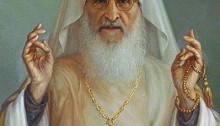
Met. Leonty Turkevich

When Matthew asked me to write a piece about Leonty, I kept coming back to a single moment at the end of his life, a story for which there is a rare corroboration of accounts from multiple sources (one from the Moscow Patriarchate, the other from the Metropolia) that each give a unique picture of who Leonty was, and how his personality, longevity, and the weight of his institutional memory impacted those around him.

In early 1963, at the height of the Cold War, the National Council of Churches invited a delegation from the Church of Russia to visit the United States for a goodwill visit to acquaint the American religious establishment with leaders of the living, breathing Church behind the Iron Curtain.  Led by Archbishop Nikodim Rotov of Yaroslavl, head of the Patriarchate’s Department of External Relations, a side benefit of the delegation would be an opportunity for an informal assessment the true situation of the tensions between the Metropolia and the Patriarchal Exarchate as it existed on the ground, if not possible dialogue. Through the formation of the Exarchate in 1933, a longstanding lawsuit over control of St. Nicholas Cathedral in New York City, and stalled negotiations following the decision of the 7th All-American Sobor to renew the Metropolia’s administrative ties with Moscow in 1946, a bitter period of animosity between two jurisdictions with a shared history had dominated both local and national church life for decades.  Aside from an informal meeting in 1961 at a World Council of Churches meeting in New Delhi, by 1963, no formal or significant dialogue between the two parties had occurred for over a decade.

As he would recall over a decade later, one evening in March of 1963, Fr. Alexander Schmemann, Dean of St. Vladimir’s Seminary, received a telephone call from an Episcopalian acquaintance announcing that Nikodim and the delegation wished to visit the seminary, and would be arriving on campus within a few hours.  Schmemann quickly dispatched a call to Metropolitan Leonty to ask for permission to receive the delegation.  Leonty quietly replied, “receive them with love.”  The visit went well, and Schmemann arranged for Nikodim to meet with Leonty several days later over dinner at the Metropolia’s Chancery in Syosset.

Schmemann recalled the elderly Leonty descended the Chancery stairs that evening dressed in his trademark white cassock, “so majestic… and yet so simple and joyful, so obviously the head of the Church to which he had given his entire life.”  After dinner, Leonty rose to give an informal speech, in part a narrative of his ministry in America, as well as an expression of what the events meant for the future of Orthodoxy in North America.  His was an institutional memory that stretched back to the administration of Bishop Tikhon Belavin, the bishop who had invited the young Fr. Leonid Turkevich to the United States in 1906 to oversee the Minneapolis Seminary, which Turkevich repaid in turn by personally nominating his former bishop for the office of Patriarch of Moscow on the floor of the All-Russian Sobor eleven years later.  In fact, it is likely many of the events he described that evening occurred before the relatively young Nikodim (born in 1929) was even alive.  According to Schmemann, Leonty’s words movingly expressed his love for the Church of Russia, yet also his firm belief in the future of the Church in America. (Constance Tarasar, ed. Orthodox America, 1794-1976. Syosset, 1975. 262-3.)

Met. Nikodim Rotov

Several years later, Nikodim would recall the events of the Syosset dinner to Archimandrite Serafim Surrency, a priest who served as an assistant to Metropolitan John Wendland (then head of the Patriarchal Exarchate) at St. Nicholas Cathedral in New York City.  Surrency describes the elderly Leonty asking Nikodim firmly and directly, how he viewed Leonty and the other bishops of the Metropolia.  Though Nikodim was clearly moved by his meeting with Leonty, and the momentum of the evening would carry into several more informal dialogues between the Metropolia and the Patriarchate (especially Nikodim) in the ensuing years, reality dictated he reply “as kindly as he could:”

“Your Eminence, forgive me, but I have no choice but to regard you and your bishops as schismatics.”  According to Surrency, “…tears welled in the eyes of the aged Metr. Leonty.”  (Archimandrite Serafim Surrency. The Quest for Orthodox Church Unity in America. New York, 1973. 78.)

As a historian, this moment in a lifetime of truly monumental moments offers a good entry point by which we can understand the broader picture and historical narrativity of Leonty’s impact in America.  His role as a priest in the highest levels of diocesan administration, theological education, and publication shows the ambitious vision of the pre-Revolution North American Diocese to serve a rapidly growing, geographically expansive flock, and the extent to which the Revolution would fundamentally change this trajectory.  Leonty’s episcopal career (and the process by which he became a bishop) is a lens by which we can explore the deep divisions of the jurisdictional fracture of Orthodoxy in America in the wake of the rise of Bolshevism.  And in his final years, his hospitality and dialogue with Abp. Nikodim put in motion a series of sometimes tense, yet ultimately fruitful meetings leading to the granting of Autocephaly to the Metropolia in 1970, forming what is now the Orthodox Church in America.

In the months to come, I hope to further explore this dynamic figure, exploring how his roles within the Church found him intimately involved in some of the most controversial and heated moments Orthodoxy has seen on the North American continent, yet whose demeanor, deep spirituality, and kind and quiet disposition found him almost universally revered even in the face of discord.

Metropolitan Leonty visiting Los Angeles (LA Daily News, 7/1/1952)

This week in American Orthodox history (May 14-20)

0

May 17, 1870: The newly ordained convert priest Fr. Nicholas Bjerring celebrated his first Divine Liturgy in St. Petersburg, Russia. He didn’t know Church Slavonic, so he served in German.

May 19, 1884: Archimandrite Stephen Hatherly, a convert priest from England, arrived in Philadelphia. I wrote about Hatherly’s visit almost three years ago. The basic story is this: In 1883, the Russian government closed its chapel, and the priest, Bjerring, became a Presbyterian. Hatherly, a priest under the Ecumenical Patriarchate, heard about these events and asked for permission to make a go at his own New York mission. After getting the all-clear from Russia, he sailed for America in 1884, arriving in Philadelphia on May 19 — this week. But, as I explain in the article, the mission was a failure; the few Orthodox people in New York had little interest in attending a church. Hatherly returned to England disappointed.

One thing I’ve been meaning to do, but haven’t yet, is tell Hatherly’s own story, because it’s phenomenally interesting. He was an exact contemporary of the somewhat better known English convert J.J. Overbeck, an author and editor of the Orthodox Catholic Review. Overbeck wanted to establish a “Western Orthodox Church,” including union with the Church of England, and today he’s regarded as a sort of progenitor of the Western Rite. Hatherly, on the other hand, viewed a full-blown union between Orthodoxy and Anglicanism as unrealistic. Instead, he preferred simply to convert Anglicans to (standard Byzantine Rite) Orthodoxy — something that raised the ire of the Anglican hierarchy, who in turn induced Constantinople to forbid Hatherly from evangelizing his countrymen. On top of all this, Hatherly was an accomplished church musician. As I said, writing an article about his life is on my to-do list.

May 19, 1905: Bishop Tikhon Bellavin, head of the Russian Mission in North America, was elevated to Archbishop by the Holy Synod of Russia.

May 17, 1922: Ecumenical Patriarch Meletios Metaxakis issued a tomos, formally establishing the Greek Orthodox Archdiocese of North and South America as a jurisdiction under the Ecumenical Patriarchate. As Archbishop of Athens, the controversial Meletios had been in America from 1918-1921, during which time he organized the Greek Archdiocese and convened its first Clergy-Laity Congress. While in America, Meletios was deposed by the Holy Synod of Greece, but soon after this, he was elected Patriarch of Constantinople. This 1922 tomos thus transferred the GOA from Meletios’ old see (Athens) to his new one (Constantinople).

How could he get away with such unilateral action? Well, back in 1908, the Ecumenical Patriarchate had “transferred” the Greek churches in the “diaspora” (particularly America) from itself to Athens. Which is sort of misleading, because a lot of the Greek churches in America were already under Athens, so the transfer affected only that portion of the Greeks who had been under Constantinople. Anyway, Athens didn’t really do much with America over the next decade, until Meletios, as Archbishop of Athens, came along in 1918. In issuing this 1922 tomos, Meletios was revoking the earlier 1908 transfer. And the GOA has been under Constantinople ever since.

May 14, 1957: Archbishop Jeronim Chernov of Eastern Canada (Russian Metropolia) died.

Metropolitan Leonty visiting Los Angeles (LA Daily News, 7/1/1952)

May 14, 1965: Metropolitan Leonty Turkevich, primate of the Russian Metropolia, died. Leonty is one of those giants of American Orthodox history, on par with Tikhon, Iakovos, and Bashir. Many think he’s a saint, and I strongly suspect that they’re right. One of the amazing things about Leonty is that he lived through so much. Originally known as Fr. Leonid, he was a key figure in the Russian Mission dating to the episcopate of St. Tikhon. He ran the seminary, succeeded St. Alexander Hotovitzky as dean of the main cathedral, and generally was the most important priest in the Archdiocese prior to the Russian Revolution.

Then, in 1917, he participated in the monumental All-Russian Sobor — one of the pivotal church councils in Russian history. He made it out of revolutionary Russia and back to the US, where he was, again, probably the key priest in the Russian Metropolia, which rose from the ashes of the Russian Mission. After being widowed, he was almost consecrated a bishop for Aftimios Ofiesh’s American Orthodox Catholic Church experiment, and he ended up becoming the Metropolia’s Bishop of Chicago. When the Metropolia’s primate, Metropolitan Theophilus Pashkovsky, died in 1952, Leonty was elected to be his successor.

Anyway, all that is ridiculously cursory, and I can only fit so much into this article. But Aram Sarkisian, who knows far more about Leonty than I do, will be running a full-length piece here very soon.

May 18, 1970: The Patriarchate of Moscow formally granted autocephaly to the Russian Metropolia in America, which changed its name to the “Orthodox Church in America.” This event reverberated throughout the Orthodox world, and it remains controversial to this day. While everyone recognizes the OCA as fully canonical, only a minority of the world’s Orthodox Churches acknowledge the OCA as an autocephalous Local Church.

May 14, 1972: Tragedy struck at ROCOR’s Holy Trinity Seminary in Jordanville, NY, where one seminarian stabbed another to death. Both men had been studying for the priesthood.

May 15, 1979: Bishop Dionisije Milivojevich, the Serbian Orthodox bishop whose battle with his mother church went all the way to the U.S. Supreme Court, died in Illinois.

May 18, 1985: Fr. John Karastamatis, a Greek priest in Santa Cruz, CA, was brutally murdered. Some of his admirers immediately declared him to have been martyred for the faith, and to this day, you’ll run into lists of saints that include “Hieromartyr John of Santa Cruz.” But the subsequent police investigation revealed that he was killed by the husband of the parish secretary, and at trial, witness testimony made it clear that Karastamatis was not someone who should be venerated as a saint. I don’t want to get into the gory details, mainly because this didn’t happen all that long ago and Karastamatis’ family is still around, but suffice it to say that while his murder was a great tragedy, the calls for his canonization were terribly misplaced.

May 18, 2000: Archbishop Sylvester Haruns of Montreal (OCA) died.

May 14, 2006: Conclusion of the ROCOR All-Diaspora Council, which approved reconciliation between ROCOR and the Moscow Patriarchate.

May 17, 2007: In Moscow, ROCOR signed the Act of Canonical Communion, re-establishing full communion with the Moscow Patriarchate.

May 18, 2008: Another big ROCOR moment — Metropolitan Hilarion Kapral was enthroned as First Hierarch of ROCOR.

Blessing the cornerstone of St. Nicholas Church, New York City, May 22, 1901

Fr. Ilia Zotikov: A Hieromartyr in a File Drawer

0

Fr. Ilia Zotikov

One of the little mysteries I’ve been meaning to research for some time has a bit of a family connection.  This past week, I finally had the opportunity to delve into it, and the results were far different than I ever anticipated.

My great-grandparents were married on May 2/15, 1908 at St. Nicholas Russian Orthodox Cathedral in New York City.  As someone who specializes in that particular era, and who has focused a lot of research on events and figures at St. Nicholas at the time, it’s always been a bit of a curiosity as to which priest married them.  With the number of notable clegymen in and around New York at the time, and being a historian, I just had to know.  Last week, while having lunch with my grandmother (their youngest daughter, now 97 years old), I asked if she had their marriage certificate.  A few minutes later, she retrieved a rather fascinating set of documents from a file drawer, which included not only the answer to my original question, but also led me to something I think our readers would find interesting.

In 1916, my great-grandparents,who had moved to Detroit, wrote to the cathedral and requested the metrical records for their wedding and the baptisms of the three of their children who were born in New York.  In return, they received pre-printed forms designed for this purpose, with the requested information from the metrical books filled in by hand by Vsevolod Andronoff, the cathedral’s deacon, and signed by Fr. Leonid Turkevich (the future Metropolitan Leonty), then the Dean of the Cathedral.

Fr. Alexander Hotovitzky (third from left) and Archimandrite Raphael Hawaweeny (fourth from left) assisting Bp. Tikhon at the blessing of the cornerstone of St. Nicholas Church, New York City, May 22, 1901

In the record for the marriage, I was surprised to find the name of a priest I had never seen before:  Fr. Ilia Zotikov.  When I got home, I searched through the print and online sources I normally use to find information on priests, and found surprisingly little.  Other than the fact that he was in New York at the early part of the 20th century, Zotikov seemed to have fallen into obscurity.  Then, like any crafty, 21st-century researcher, I ran a Google search in Russian.  Dozens of hits popped up.  This is where the story became something quite interesting.

In 1922, Fr. Ilia Zotikov, like untold thousands in his vocation during the Soviet era, was forced into the murky abyss of the Soviet prison system, where his personal and professional lives were interrupted by a dizzying series of arrests, trials, imprisonments, exile, and ultimately, death.  Of course, Orthodox Americans are quite familiar with the Hieromartyr Fr. Alexander Hotovitzky, who is depicted and venerated in iconography throughout the world, and whose biography has been published far and wide.  This has as much to do with the circumstances of his various trials and ultimate martyrdom in the Gulag in the Soviet Union as his prominence in the North American Diocese during the nearly two decades he served in the United States.  Yet the same cannot be said for Zotikov, even though his life, ministry, and subsequent fate were quite similar, and intrinsically tied, to those of Hotovitzky.

Ilia Ivanovich Zotikov was born into a priestly family in Finland in 1863.  He was educated at the St. Petersburg Theological Seminary, where his classmates included John Kochurov and Alexander Hotovitzky.  In 1895, Zotikov was one of a number of Russian seminarians recruited for service as missionaries in America by Bishop Nicholas Ziorov, Bishop of Alaska and the Aleutians.  Zotikov was assigned to be an assistant to Fr. Evtikhy Balanovitch, and both were sent to New York City to start the small parish that would ultimately become St. Nicholas Cathedral.

They arrived in New York with their wives, both named Mary, on April 1, 1895 (NY Sun, 4/2/1895).  On May 19th, Bp. Nicholas ordained Zotikov to the priesthood in the parish’s tiny house parlor sanctuary at 323 2nd Avenue (New York Herald, 5/20/1895).  When Balanovitch left St. Nicholas in 1896, Zotikov stayed on to assist Balanovitch’s replacement, his seminary classmate Fr. Alexander Hotovitzky, who had been ordained a priest in San Francisco earlier in the year.  Together they were instrumental in both the growth of the congregation and the subsequent building of the parish’s new church on 97th Street, which would become the cathedral of the entire North American Diocese in 1905.  Hotovitzky became the Cathedral Dean, and Zotikov the Sacristan.  It was there that Zotikov officiated the marriage of my great-grandparents in 1908, and where, as my grandmother’s files revealed, Hotovitzky baptized their first daughter two years later.

In the late summer of 1910, Zotikov returned to Russia. For most of the ensuing decade, he served in various parishes in St. Petersburg.  In 1919, he was reassigned to Christ the Savior Cathedral in Moscow, where, alongside Hotovitzky, he served as Sacristan of the Cathedral and assistant to Patriarch Tikhon, in a nearly identical arrangement to that at St. Nicholas Cathedral more than a decade before.  There, the Patriarch, Hotovitzky, Zotikov, and Cathedral Dean Fr. Nicholas Arseniev were on the front lines of the defense against the repression of the Church by the Bolshevik government.  Both Patriarch Tikhon and Fr. Alexander would be arrested and imprisoned multiple times in the early years of Bolshevik rule.

Metropolitan Benjamin of St. Petersburg, a seminary classmate of Frs. Hotovitzky and Zotikov, before the Petrograd Revolutionary Tribunal, June 1922

In early 1922, the Bolshevik government ordered the seizure of all ecclesiastical vessels and objects of value held by the Church.  This was met with resistance by clergy and laity alike.  The clergy of Christ the Savior Cathedral, led by Hotovitzky, were especially instrumental in resisting the order, and meetings were held at Hotovitzky’s apartment to draft resolutions in opposition.  For his participation in these meetings, Zotikov was amongst a group of clergy and laity arrested in the spring of 1922, and was subsequently sent to Butyrki Prison.

In December, Zotikov, Hotovitzky, and others appeared before the Moscow Revolutionary Tribunal.  Hotovitzky and two others were given ten-year sentences.  Most of the others, Zotikov amongst them, were sentenced to three years’ imprisonment and one year of deprivation of civil rights.  Appeals were unsuccessful, but in late 1923, many of the sentences were cut short on amnesty.  Zotikov returned to Christ the Savior, and in 1924, was reassigned to the Descent of the Holy Spirit, where he remained for several years.  Hotovitzky was left without a parish assignment, instead filling in where he was needed.

Zotikov was arrested again in June 1927.  Found to be in possession of the “Solovki Declaration,” a document issued by bishops imprisoned in the Solovki prison camp in opposition to the Soviet government, Zotikov was again imprisoned at Butyrki, put on trial, and sentenced to three years of exile in Vladimir, about 120 miles east of Moscow.  There, he became rector of a small cemetery chapel then serving as the cathedral for the entire Diocese of Vladimir following the forced closure of Dormition Cathedral earlier in 1927.  By this point in time, Soviet law had restricted the clergy from nearly every aspect of their vocations, leaving priests like Zotikov on dangerous ground as they attempted to perform even the most basic sacramental duties.  By 1929, widespread arrests of clergymen were underway.

In 1993, the Journal of the Moscow Patriarchate published an article by Andrei Kozarzhevsky about parish life in Moscow in the 1920s and 1930s, which sheds some light on this period of Zotikov’s life.  (Thе article was recently translated into English and published on the Russian website Pravoslavie.ru.)  Kozarzhevsky was baptized by Zotikov in 1918, and was well acquainted with both Zotikov and Hotovitzky in his adolescence.  As a child, he assisted Zotikov during services in Vladimir, and recalled Zotikov’s third arrest, on October 13th, 1930, for “membership in a counter-revolutionary organization of churchmen,” that being the Church.

On October 19th, 1930, Zotikov was convicted by the OGPU (the arm of the Soviet secret police who spearheaded the repression of religious groups) and was relegated to the notoriously brutal Vladimir Central Prison.  On October 23rd, Zotikov was sent for execution.  Some sources state both he and Protodeacon Michael Lebedev were shot by a firing squad, though Kozarzhevsky claims he suffered a fatal heart attack on the way to the execution.   Regardless, Fr. Ilia Zotikov is considered a Hieromartyr, and is commemorated according to the church calendar with the New Martyrs and Confessors of Russia on January 25/February 7.

Andrei Kozarzhevsky’s recollections of Zotikov do not end with his death.  After Fr. Alexander Hotovitzky was martyred in the Gulag in 1937, Kozarzhevsky came into possession of a few of Hotovitzky’s personal effects, including a copy of a poem written by Hotovitzky in New York during the summer of 1910, on the occasion of a “triple event:” The feast of St. Elias, Zotikov’s name-day, and his imminent departure for Russia.

By any measure, it is clear that Zotikov and Hotovitzky (and their wives) were particularly close, a bond which apparently began in seminary, yet was forged largely in America.  When Hotovitzky departed for Russia in 1900 to raise money for the building of St. Nicholas Church, it was Zotikov who officiated the service blessing his trip.  When the church complex was finished, the Hotovitzkys and Zotikovs were neighbors in its apartments.  Mary Hotovitzky and Mary Zotikov later served together on the board of the Cathedral Sisterhood.

Far away from their native land, the two former classmates depended on each other, and continued to do so after they were reunited in Russia, where they ultimately met similar fates in the Gulag.  It is no surprise, then, that Fr. Alexander Hotovitzky’s 1910 poem was “dedicated to my best friend Fr. Ilia Zotikov.”

A note on sources:  Much of the metrical data for this article, including the particular dates of Fr. Zotikov’s biography, can be found (in Russian) here.  Additionally, biographical details and a brief biography of Zotikov can be found in The Holy New Martyrs and Confessors of Central Russia (Vladimir Moss, 2009, 657-8), available for download (along with other similar works) here.

Archbishop Arseny

OCA Canonization Commission issues statement

This past weekend, the Canonization Commission of the OCA issued a statement at OCA.org. According to Commission secretary (and OCA archivist) Alexis Liberovsky, the Commission will begin detailed studies of the lives of both Metropolitan Leonty Turkevich and Archbishop Arseny Chagovtsov, to determine whether the OCA should canonize them. Canonization obviously has a strongly historical element to it — after all, these are historical figures — so the potential canonization of an American saint is of special interest to historians of American Orthodoxy.

Metropolitan Leonty

Here at OrthodoxHistory.org, we haven’t yet done a whole lot of work on Metropolitan Leonty, but he is a giant of an historical figure. The OCA statement provides a brief outline of his life:

Metropolitan Leonty [1876-1965] came to America as a young priest in 1906 to assume duties as rector of the seminary in Minneapolis, MN, which had been established by Saint Tikhon, at the time Archbishop of the Aleutians and North America. As a delegate from the North American Diocese to the All-Russian Church Council of 1917-18 in Moscow, he had experienced first-hand the horrors of the Russian Revolution. Upon returning to America, he sought to incarnate the conciliar spirit and groundbreaking decisions of the Moscow Council into the life of the Church in America in his every action. After the death of his wife, he became Bishop of Chicago in 1933. In 1950, he was elected Metropolitan of All America and Canada by a nearly unanimous vote. Many who knew him remember his personal holiness.

My favorite Leonty anecdote comes from Fr. Alexander Schmemann:

Great Lent, 1964. The special solemn service for all those persecuted for the Orthodox faith just ended at New York’s Greek Cathedral. At the end of the service Metropolitan Leonty approaches Archbishop Iakovos to thank him on behalf of the Metropolia. Something extraordinary takes place: the Greek Hierarch, in all his majesty, bows before the Elder in white, kisses his hand and says, You have a great soul.

Anyway, the statement goes on to outline Abp Arseny’s life as well. If you’ve been following our website recently, you know that we’ve devoted a good deal of attention to Arseny, particularly the 1909 rape allegations against him, and the subsequent criminal libel trial. In response to this, Liberovsky said, “The Canonization Commission has been aware for some time of the controversy surrounding Archbishop Arseny arising from allegations of serious moral transgression and unethical behavior, which has recently been publicized on the internet. These allegations, which Archbishop Arseny challenged in the courts a century ago, and attendant issues require further study and verification.”

Archbishop Arseny

It’s important to understand that there are actually two committees looking into the canonization of Abp Arseny. There is the main OCA Commission, of which Liberovsky is the secretary, and there is also a separate Canadian committee. Liberovsky explains, “[S]everal years ago His Eminence, Archbishop Seraphim of Ottawa and Canada established an Archdiocesan Canonization Committee in Canada, which conducted extensive research.”

Both the Timeline and Life of Arseny were produced by the Canadian committee, not the main OCA Commission. Having recently spoken with Alex Liberovsky, I am confident that the OCA Commission will exercise due diligence in its investigations into both Leonty and Arseny.

If anyone has information or source materials that might help the Commission’s work on either Leonty or Arseny, they can send an email to canonization@oca.org; write to PO Box 675, Syosset, NY 11791; or call 516-922-0550 extension 121.

[This article was written by Matthew Namee.]

The Reversal of Platon Rozhdestvensky

L to R:  Archim. Aftimios Ofiesh, Adn. Emmanuel Abo-Hatab, Abp. Alexander Nemolovsky

At the Funeral of St. Raphael of Brooklyn: L to R: Archim. Aftimios Ofiesh, Adn. Emmanuel Abo-Hatab, Abp. Alexander Nemolovsky

On today’s podcast on AFR, we discuss the American Orthodox Catholic Church, an early attempt at multi-ethnic jurisdictional unity in the United States. One of the issues brought up was that, within about a year after the creation of the AOCC by Russian Metropolia authorities in February of 1927, the Metropolia’s head, Metr. Platon Rozhdestvensky, withdrew his support from the new jurisdiction. Indeed, even within just a few months, Platon wrote to Aftimios telling the latter to cease his “steppings out” against the Episcopalians—some of Aftimios’s priests were publishing excoriating comments against the Episcopalians, who had been providing the Russian Metropolia with financial support (hoping, most likely, eventual recognition of the validity of their holy orders). Platon wrote: “I must attest before Your Eminence that without their (American Episcopalian) entirely disinterested assistance our Church in America could not exist.”

On October 29, 1928, Abp. Aftimios Ofiesh wrote a letter complaining of the withdrawal of support, including Platon’s refusal to let Aftimios consecrate Fr. Leonid Turkevich as the first auxiliary for the AOCC. (Read the full letter here.) Here are some interesting excerpts, showing how distressed Aftimios was and the strong sense of the betrayal he felt at his treatment by Platon:

It is with the deepest grief and pain that I enclose a copy of a telegram which persistent reports have forced me to send to His Grace Bishop Theophilos [Pashkovsky] since I was unable to discover your address even by telephoning to the Archimandrite Benjamin in New York. I am most deeply and sadly disappointed in having to call to the attention of Your Eminence injurious reports which I had preferred to ignore. Even in the face of the fact that Your Eminence forbid Bishop-Elect Leonid Turkevich from accepting Consecration after Your Eminence had yourself proclaimed his election and given order for his Consecration. I have wished to believe it impossible that Your Eminence should secretly attempt to destroy the work of your own hands in the creation of an American Orthodox Catholic Church founded by your order and committed by Your Eminence and the other Russian Bishops into my charge and authority. As a son to his father, I turn to Your Eminence now asking an explanation of your attitude and a final setting at rest of the ugly rumors which are a disgrace to our mutual work for our Holy Orthodox Church and Faith.

Not only was Platon apparently working against Aftimios’s new jurisdiction, but it seemed that he may also have been interfering in the parishes under Aftimios which still remained under the Syrian Mission:

At all times I have defended Your Eminence loyally and labored without ceasing for the Church and for the position of Your Eminence as Head of the Russian Archdiocese in America. Yet I hear repeated rumors that Your Eminence is dissatisfied and I do not know why. Finally it comes to me that Your Eminence has received some unauthorized and rebellious letters and requests from a few with whom I have trouble in my Diocese of Brooklyn and Syrian Mission or in the new American Orthodox Church and that Your Eminence will answer favorably these irresponsible troublemakers and will take action interfering in the Diocese of Brooklyn and Syrian Mission. I can not believe that Your Eminence will do so or that it is your intention. But I am forced to ask that Your Eminence give me formal assurance in this matter and put a stop to the rumors and reports which interfere with the peace and unity of our work together for Holy Church.

No doubt the need for money and other kinds of material support from the Episcopalians was not the only reason for Platon’s reversal on his support for Aftimios, but whatever the case, it’s clear that Platon’s loyalty to his heterodox supporters and to his own agendas was greater than his investment in the new jurisdiction he had signed into being. Aftimios, as may be imagined, reacted quite badly.

Go to Top