Posts tagged Meletios Metaxakis

Metropolitan Leonty visiting Los Angeles (LA Daily News, 7/1/1952)

This week in American Orthodox history (May 14-20)

0

May 17, 1870: The newly ordained convert priest Fr. Nicholas Bjerring celebrated his first Divine Liturgy in St. Petersburg, Russia. He didn’t know Church Slavonic, so he served in German.

May 19, 1884: Archimandrite Stephen Hatherly, a convert priest from England, arrived in Philadelphia. I wrote about Hatherly’s visit almost three years ago. The basic story is this: In 1883, the Russian government closed its chapel, and the priest, Bjerring, became a Presbyterian. Hatherly, a priest under the Ecumenical Patriarchate, heard about these events and asked for permission to make a go at his own New York mission. After getting the all-clear from Russia, he sailed for America in 1884, arriving in Philadelphia on May 19 — this week. But, as I explain in the article, the mission was a failure; the few Orthodox people in New York had little interest in attending a church. Hatherly returned to England disappointed.

One thing I’ve been meaning to do, but haven’t yet, is tell Hatherly’s own story, because it’s phenomenally interesting. He was an exact contemporary of the somewhat better known English convert J.J. Overbeck, an author and editor of the Orthodox Catholic Review. Overbeck wanted to establish a “Western Orthodox Church,” including union with the Church of England, and today he’s regarded as a sort of progenitor of the Western Rite. Hatherly, on the other hand, viewed a full-blown union between Orthodoxy and Anglicanism as unrealistic. Instead, he preferred simply to convert Anglicans to (standard Byzantine Rite) Orthodoxy — something that raised the ire of the Anglican hierarchy, who in turn induced Constantinople to forbid Hatherly from evangelizing his countrymen. On top of all this, Hatherly was an accomplished church musician. As I said, writing an article about his life is on my to-do list.

May 19, 1905: Bishop Tikhon Bellavin, head of the Russian Mission in North America, was elevated to Archbishop by the Holy Synod of Russia.

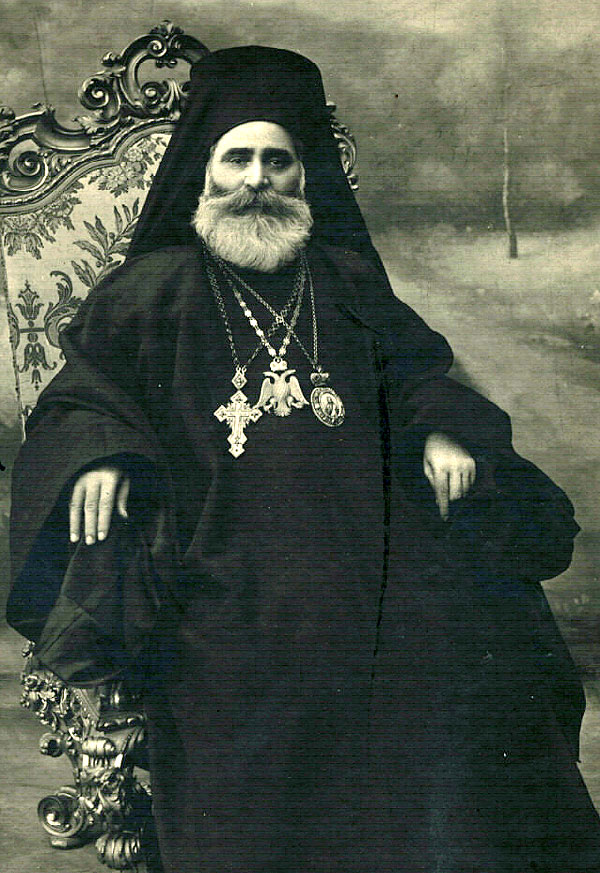
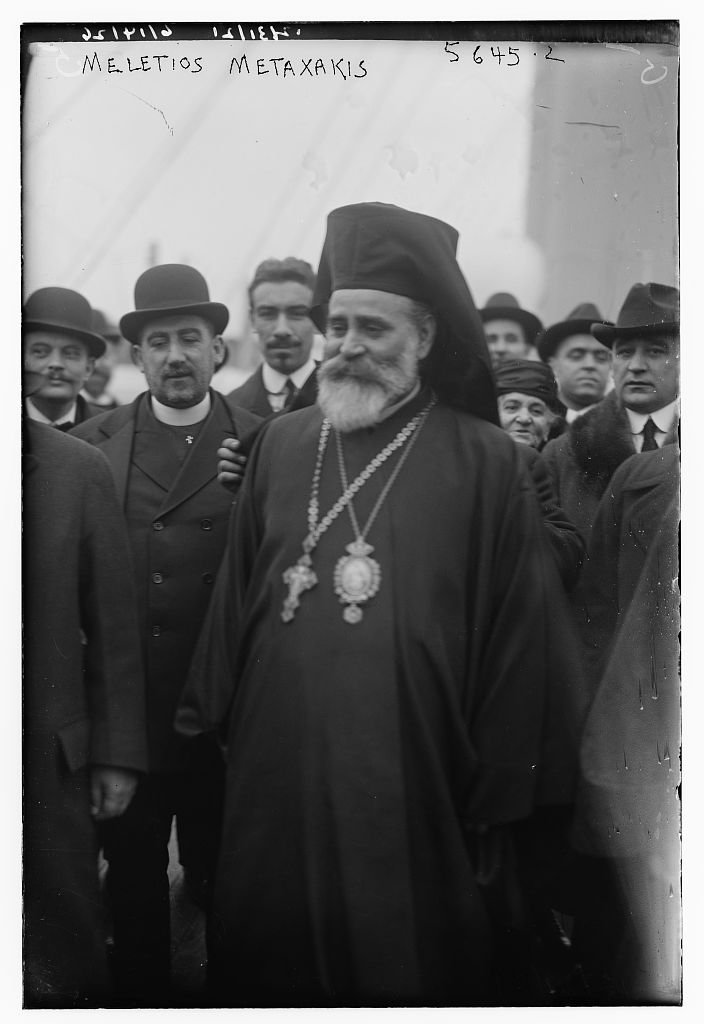
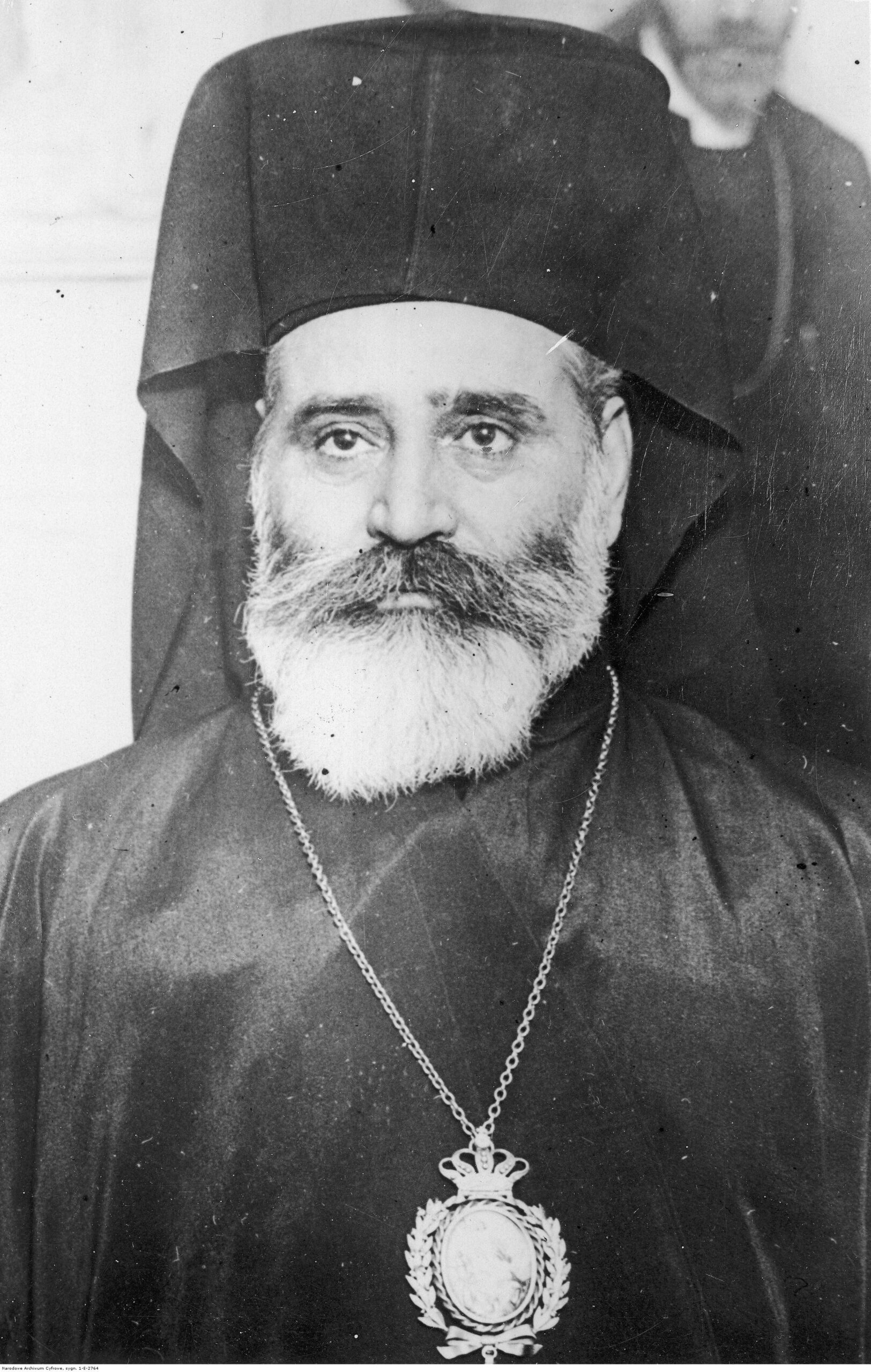
May 17, 1922: Ecumenical Patriarch Meletios Metaxakis issued a tomos, formally establishing the Greek Orthodox Archdiocese of North and South America as a jurisdiction under the Ecumenical Patriarchate. As Archbishop of Athens, the controversial Meletios had been in America from 1918-1921, during which time he organized the Greek Archdiocese and convened its first Clergy-Laity Congress. While in America, Meletios was deposed by the Holy Synod of Greece, but soon after this, he was elected Patriarch of Constantinople. This 1922 tomos thus transferred the GOA from Meletios’ old see (Athens) to his new one (Constantinople).

How could he get away with such unilateral action? Well, back in 1908, the Ecumenical Patriarchate had “transferred” the Greek churches in the “diaspora” (particularly America) from itself to Athens. Which is sort of misleading, because a lot of the Greek churches in America were already under Athens, so the transfer affected only that portion of the Greeks who had been under Constantinople. Anyway, Athens didn’t really do much with America over the next decade, until Meletios, as Archbishop of Athens, came along in 1918. In issuing this 1922 tomos, Meletios was revoking the earlier 1908 transfer. And the GOA has been under Constantinople ever since.

May 14, 1957: Archbishop Jeronim Chernov of Eastern Canada (Russian Metropolia) died.

Metropolitan Leonty visiting Los Angeles (LA Daily News, 7/1/1952)

May 14, 1965: Metropolitan Leonty Turkevich, primate of the Russian Metropolia, died. Leonty is one of those giants of American Orthodox history, on par with Tikhon, Iakovos, and Bashir. Many think he’s a saint, and I strongly suspect that they’re right. One of the amazing things about Leonty is that he lived through so much. Originally known as Fr. Leonid, he was a key figure in the Russian Mission dating to the episcopate of St. Tikhon. He ran the seminary, succeeded St. Alexander Hotovitzky as dean of the main cathedral, and generally was the most important priest in the Archdiocese prior to the Russian Revolution.

Then, in 1917, he participated in the monumental All-Russian Sobor — one of the pivotal church councils in Russian history. He made it out of revolutionary Russia and back to the US, where he was, again, probably the key priest in the Russian Metropolia, which rose from the ashes of the Russian Mission. After being widowed, he was almost consecrated a bishop for Aftimios Ofiesh’s American Orthodox Catholic Church experiment, and he ended up becoming the Metropolia’s Bishop of Chicago. When the Metropolia’s primate, Metropolitan Theophilus Pashkovsky, died in 1952, Leonty was elected to be his successor.

Anyway, all that is ridiculously cursory, and I can only fit so much into this article. But Aram Sarkisian, who knows far more about Leonty than I do, will be running a full-length piece here very soon.

May 18, 1970: The Patriarchate of Moscow formally granted autocephaly to the Russian Metropolia in America, which changed its name to the “Orthodox Church in America.” This event reverberated throughout the Orthodox world, and it remains controversial to this day. While everyone recognizes the OCA as fully canonical, only a minority of the world’s Orthodox Churches acknowledge the OCA as an autocephalous Local Church.

May 14, 1972: Tragedy struck at ROCOR’s Holy Trinity Seminary in Jordanville, NY, where one seminarian stabbed another to death. Both men had been studying for the priesthood.

May 15, 1979: Bishop Dionisije Milivojevich, the Serbian Orthodox bishop whose battle with his mother church went all the way to the U.S. Supreme Court, died in Illinois.

May 18, 1985: Fr. John Karastamatis, a Greek priest in Santa Cruz, CA, was brutally murdered. Some of his admirers immediately declared him to have been martyred for the faith, and to this day, you’ll run into lists of saints that include “Hieromartyr John of Santa Cruz.” But the subsequent police investigation revealed that he was killed by the husband of the parish secretary, and at trial, witness testimony made it clear that Karastamatis was not someone who should be venerated as a saint. I don’t want to get into the gory details, mainly because this didn’t happen all that long ago and Karastamatis’ family is still around, but suffice it to say that while his murder was a great tragedy, the calls for his canonization were terribly misplaced.

May 18, 2000: Archbishop Sylvester Haruns of Montreal (OCA) died.

May 14, 2006: Conclusion of the ROCOR All-Diaspora Council, which approved reconciliation between ROCOR and the Moscow Patriarchate.

May 17, 2007: In Moscow, ROCOR signed the Act of Canonical Communion, re-establishing full communion with the Moscow Patriarchate.

May 18, 2008: Another big ROCOR moment — Metropolitan Hilarion Kapral was enthroned as First Hierarch of ROCOR.

Fr. Kyrill Johnson: The Prestige of the Oecumenical Patriarchate

Archimandrite Kyrill Johnson

Editor’s note: On Monday, we introduced Fr. Kyrill Johnson, who converted to Orthodoxy in the 1920s and spent most of his career in the Antiochian Archdiocese. Then, on Tuesday, we presented an article by Johnson reviewing a Protestant translation of the Divine Liturgy. Below, we’ve published another article by Johnson, on “The Prestige of the Oecumenical Patriarchate.” This piece originally appeared in the Orthodox American in its October 1944-February 1945 issue. Oh, and please be warned: Johnson can be… well, abrasive, I guess. I hope no one is offended by our publication of this historical document.

One of the pleasant myths in the uninformed Orthodox mind is that which infers that the various statements and pronouncements of certain individual Orthodox Patriarchs in conjunction with their Synods have binding force in the realm of Orthodox faith and morals. Nothing could be further from the facts.

It is true that there was a time in Orthodox history when such documents and pronouncements, although local and racial in origin, did have a certain weight and authority. That period came to an end with the reconstitution of the Greek nation and the consequent subservience of Orthodox faith and institutions to the Greek political ideal among ecclesiastics of Greek blood. Even the most casual student of Orthodox Church history is struck by the fact that all too often men of high ecclesiastical position in Orthodoxy, if they are of Greek blood, have been willing to use their positions to further and advance, not pure Orthodoxy, as such, but Greek political and racial aspirations.

Without doubt the ideal series of documents by which this thesis could be adequately proved is that which proceeded from the various Greek Patriarchates during the crises in Russian Church affairs after the Russian Revolution.

When the late Russian Patriarch Tikhon, of blessed memory, was deposed by a rump Synod of Bishops, the then Patriarch of Constantinople, Meletios, condemned this act as uncanonical. His successor, Gregory VII, reversed this pronouncement, and in his turn Gregory VII was reversed by his own successor, Basil III.

The Greeks who occupied the Patriarchate of Jerusalem reveal an equally unpleasant record of having no mind of their own, or any Orthodox mind at all for that matter, issuing document after document each in conflict with itself and with those, which had come before. Aside from the Russian Patriarchate of Moscow, only the Syrian Patriarch of Antioch seems to have had the ability to make up his own mind for himself and to stick to his decisions.

If one collates this series of pronouncements issued by Greek ecclesiastics with the political events and pressures, which paralleled their appearance, one soon discovers an obvious relation between their interpretation of Orthodox canon law and faith and the political tensions to which they were subjected.

Tempting as it is to explore this field in terms of the Russian question, we prefer at this time to direct attention to a lesser Greek political-ecclesiastical document. We do this because we have collected a considerable body of firsthand and as yet unpublished data relative to this lesser document. We refer to the pronouncement in the year 1922 by Meletios, Patriarch of Constantinople, on Anglican orders.

The facts necessary to understand the problems involved are simple enough. On July 28th, 1922, Meletios issued two documents. The first was in the form of a personal letter, not to the legal head of the Protestant religion established by law in England, the King, but to one of his political appointees, the senior of the two Protestant archbishops functioning in England. The other document was a sort of round robin addressed to “The Presidents of the Particular Eastern Churches.” The subject matter of both documents concerned itself with the much-debated question of the possible validity of Protestant ordinations in the state religion of England.

These two documents were hailed as a seven days’ wonder throughout the Protestant world. With this reaction we are in hearty agreement. Unfortunately their content was so neatly phrased in the subtle niceties of the Greek language that neither the casual nor learned reader could be quite sure what meaning they were intended to convey.

It is not our intent to add another essay in the necessarily dull exegesis of these documents. Obviously they follow the Pauline injunction, so dear to the Greek heart, of being all things to all men.

It is our purpose to throw some historical light on the confused background, which made these documents possible, and to trace the devious actions of the Greek mind when occasion demands of it that it say something without saying anything. It can be safely taken for granted that historical scholarship is fully justified in judging any document, not only in terms of its content, but also in terms of the conditions and the men, which brought it forth.

First let us consider the man over whose signature these two documents saw the light of day. He was one Meletios. By birth he was a Cretan; and if Pauline injunctions mean anything the wary should at once be put on their guard. His ecclesiastical career paralleled that of his fellow Cretan, Venizelos, in the realm of Greek politics. When this statesman was in power in the Greek world, Meletios also held a position of power. When the statesman fell, as he did many times, the ecclesiastic also fell. Let us grant at once that they were both very able men, intensely devoted to the Greek political ideal.

After the First World War Venizelos fell from power. Meletios, who was his Archbishop of Athens, fell with him and came to the United States as an exile. There is sufficient historical evidence to justify the statement that both the politician and the ecclesiastic were creatures whose power and position depended upon British foreign policy and backing. As exile in this country Meletios found favor with only a minority of Greek-Americans. He did receive much support from a section of the Protestant Episcopal Church in this country.

During this period of exile the Throne of Constantinople suddenly became vacant, and with equal suddenness Meletios was elected to the Patriarchate. How the Throne of Constantinople became vacant, and how Meletios was elected, does not concern us here.

In this country the Greeks with consternation received this election. Some were delighted; many refused to accept it as fact. It goes without saying that the Protestant Episcopalians received the news with great rejoicing. How tense the situation was in this country can be gathered from an article in the New York Tribune of Jan. 8th, 1922. The headline stated that this election “shakes the foundations of the Greek Church.” It did not hide the fact that Meletios’ chief support came from Protestant circles.

In Greece itself the Holy Synod of that country refused to accept the election of Meletios as canonical and valid. Meletios journeyed to his Throne by way of England, and it was currently reported that he entered the Golden Horn on a British man-of-war.

Let us now turn to analyze the conditions, which existed during the brief administration of Meletios in Constantinople. An inter-allied military control entered the city. It was made up of representatives of England, France, Italy and the United States. The city itself had been promised by secret treaty to Russia at the beginning of the war. All the nations represented in the city save the United States were playing the age-old game of power politics. As was natural, the religious issues of the centuries merged into the political issues. France and Italy, representing Roman Catholic ambitions, were moving with not too much caution to establish a claim to the Cathedral Church of Orthodoxy, Hagia Sophia. If anything was necessary to throw Meletios even further into the hands of the British, this was more than sufficient.

At the same time the drama of the tragedy of Christian Asia Minor was developing. A mutual and secret agreement by France and Italy on the one hand to support Turkish aspirations, and by England on the other to support Greek aspirations, to the end that a fatal collision of these two minor powers might ensue to the mutual profit of the Great Powers, sealed the doom of the ancient Christian Churches of Asia Minor.

It is quite probable that Meletios at that time knew only the externals of this situation. The hard fact was that he had to sit on his uncomfortable Throne at the Phanar and watch the growing tension between the various members of the Allied military control and to hear each day of new Greek disasters in Asia Minor.

The implications of the situation were obvious to Meletios. Each day the diminished Greek race was being decimated throughout Asia Minor; the Great Idea of a reconstituted Byzantine Empire was dissolving into dust and ashes before his eyes. Meletios, the Greek nationalist, became a desperate man. He had but one last jewel to spend on wooing British Imperialism to stop the decimation of his co-racialists in Asia Minor. The jewel was his Orthodox Faith. He would offer up this precious jewel to international politics in a last desperate gesture. Out of Meletios’ racial agony was born his pronouncement on Anglican ordinations.

A number of years after it was issued we spent a very pleasant afternoon with Meletios in Cairo, Egypt. (British influence had translated him to the Throne of Alexandria.) During our lengthy discussion of Orthodox affairs we introduced the subject of these two documents. Without any hesitation Meletios discussed them quite frankly. He admitted that they had been issued against his better Orthodox judgment. He also pointed out some pertinent facts, which should become part of the record if these documents are to be judged in their proper perspective.

From our notes on this conversation we outline those things, which seem to have some historical import. He prefaced his remarks by saying that as a Greek he could not have been expected to sit quietly and not use everything at his command in an effort to avert the Asia Minor disaster. He made it quite clear that he realized fully that if the Turks won he lost the throne of Constantinople. He did not try to excuse the incongruities contained in the documents. His only disappointment was that he misjudged British opinion (something which Greeks are always prone to do).

He made no attempt to deny that his documents accomplished nothing for the cause of Greece. This he could not quite understand. Like so many other Greek ecclesiastics he had been thrown into contact with only the High Church minority, and he had no clear notions about the staid and respectable Protestantism of the majority of the English church. He was actually convinced that the majority of the clergy and members of the Establishment were smarting under the sting of the pronouncement of Leo XIII declaring English ordinations null and void in form and intent, and would reward handsomely any statement to the contrary.

It was at this point that Meletios sighed and said, “But these English, they just do not have any sense of history.” Piqued by this statement we pursued it further, and Meletios replied fully as to his meaning, and the following is an outline of his convictions as an Orthodox theologian.

In the first place, he pointed out, as Patriarch of Constantinople he had no historical or canonical right to intrude into the ecclesiastical problems of the Christian West. He contended that the bases of the centuries’ old contention between the See of Constantinople and the See of Rome rested upon the thesis that the See of Rome had no canonical jurisdiction in the Christian East. By the same token he had to admit that the See of Constantinople had no canonical right to intrude into the domestic problems of the See of Rome; and certainly the question of Anglican Orders, deriving from Rome, was essentially a problem coming under the jurisdiction of that Patriarchate.

Obviously, he said, England could not by any perversion of logic be considered within the jurisdiction of any Eastern Patriarchate; and to presume to settle any ecclesiastical problem arising among non-Orthodox peoples in that area would destroy once and for all the foundation and corner stone upon which all contentions between the Eastern Patriarchate and Rome had been erected.

In writing his documents, Meletios contended that he made his Greek sufficiently vague and subtle so as not to commit Orthodoxy to any untenable position. When I raised honest doubts, he further pointed out that the most that any person could obtain in the way of satisfaction from his documents was a mere opinion; and that even though an opinion derived from the Patriarch and Synod of Constantinople, it still remained an opinion and nothing more, and opinions never had and probably never would have any binding force in the realm of dogma or upon the Orthodox conscience.

Because I was still unconvinced, he reiterated that if I would re-examine the documents with care I would discover that Constantinople had only reviewed the report of a committee, merely taking note of the things contained therein. He then made a distinction between his encyclical to the Orthodox Churches and his private letter to the Archbishop of Canterbury. The former he held was the document upon which Orthodoxy could pass judgment; the latter was a personal matter. An analysis of the two documents will reveal why Meletios made this distinction. It is interesting to note in this connection that all copies and translations released in England of this letter carry the simple signature of Meletios, not his rank and title. Meletios in our conversation desired me to keep in mind that in his encyclical it was clear that both he and his Synod in accepting the report of the committee accepted it as an opinion and requested further opinion from other Orthodox Patriarchates. If the English had any sense of history, Meletios continued, the English should know that the Orthodox Church can only speak as a whole.

“Opinions,” Meletios said with a twinkle in his eye, “are, after all, just opinions, and the Greeks, as a people, have a considerable reputation for being able to change them very quickly. Remember, my son, there is a world of difference between opinions and conclusions.”

This then is a brief summary of Meletios’ own estimate of his own documents.

There is another angle to this whole involved question of the historical setting of these documents, which merits passing attention. It has to do with the question of who constituted this committee and just what its full report said. When we were in residence in Constantinople, we were unable to locate this report, and so was everyone else. It was just counted as among the number of missing documents. While we are in no position to say with finality that no such report ever existed, until it is produced we will remain of the opinion that it never did exist. This does not mean that it never will be produced. Knowing the ability of the Phanar to produce documents when and where needed, we think it is entirely possible that if pressure were brought the report would come into being in short order.

At least two conclusions are justified by any historian of these particular documents. The first is, that since the reconstituting of the Greek nation to a precarious existence, Greek ecclesiastics are very prone to consider themselves as Greeks in the political sense first and as representatives of the Orthodox Faith afterward. Secondly, our Christian charity demands that we do not judge too harshly the acts of Greek hierarchs, when as men and members of a once great race they use every instrument at their command to stem the tide of the destruction of the Greek people by the Christian powers of the West. As documents these pronouncements, which we have considered, are no more than interesting ecclesiastical curiosa, reflecting the political stresses and strains of the Greeks as political beings. As statements of Orthodox teaching and dogma they are completely meaningless and not worth the paper they were written on.

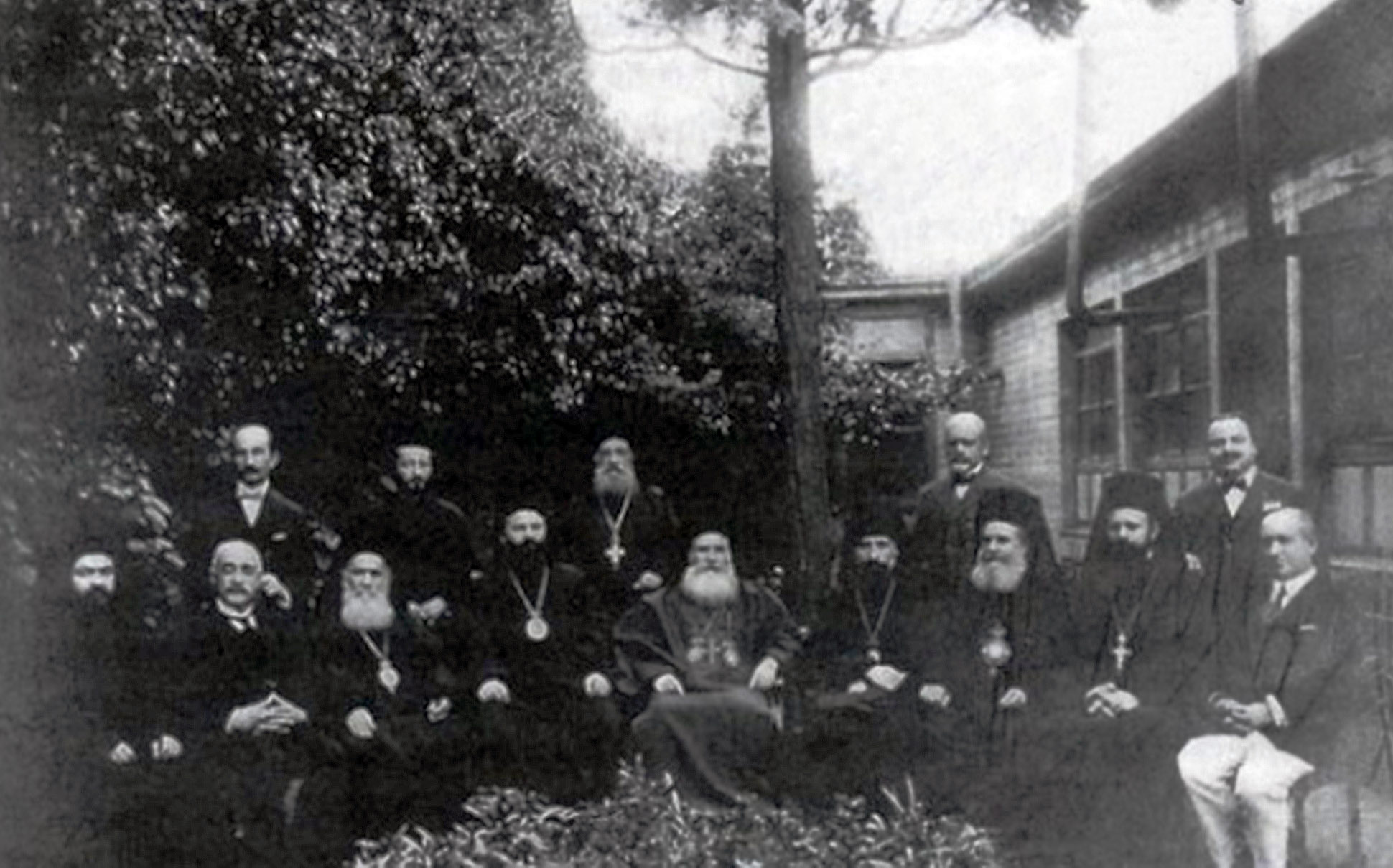
This photo, of the December 19, 1921 gathering of Orthodox bishops, appeared in the New York Evening Telegram the following day.

Solving the mystery: the 1921 pan-Orthodox gathering of bishops

L to R: Future Metropolitan Germanos Polyzoides, Bp Alexander Demoglou, Met Platon Rozhdestvensky, Patriarch-elect Meletios Metaxakis, Abp Alexander Nemolovsky, Bp Aftimios Ofiesh, and Archdeacon Vsevolod Andronoff

Back in July, Fr. Andrew wrote about the above photo, which depicts a gathering of American Orthodox bishops in the early 1920s: Greeks Meletios and Alexander, Russians Platon and Alexander, and Syrian Aftimios. At the time of Fr. Andrew’s original post, no one knew exactly when this photo was taken, or what occasion brought all these hierarchs together. Fr. Andrew wrote, 

This photograph was found in the archives of the Library of Congress. As yet, there have been no official documents that have surfaced detailing what this 1921 meeting must have entailed. It might have been only a courtesy call, with a photo op at the end. 

Fr. Andrew went on to observe that, based on the photo, the other bishops appear to have regarded Metaxakis as “first in seniority among them.” To read the rest of Fr. Andrew’s post, click here

Why am I bringing all this up again? Becasue I believe I now know when and where this photo was taken, and why all these bishops were in the same place. On December 9, 1921, Abp Meletios Metaxakis was elected Patriarch of Constantinople. He was in New York at the time, having been deposed from his previous position as Archbishop of Athens. With Bp Alexander Demoglou, Metaxakis had come to the US to organize the Greek-American churches into a unified archdiocese. The New York Times (12/10/1921) announced that one of Metaxakis’ first acts as Patriarch would be to appoint Alexander as bishop of North and South America. 

The Times also reported, “This morning at 10 o’clock the Most Rev. Alexander, Archbishop of the Aleutian Islands and North America for the Russian Church, will formally call upon the Patriarch-elect and officially present the felicitations of the 100,000 Russians who are in the Western Hemisphere, who are his spiritual subjects.” 

The Russian goodwill towards Metaxakis’ election was not limited to Abp Alexander Nemolovsky. Archimandrite Patrick Mythen, the powerful convert priest, hastily organized a special ceremony. December 19 was the St. Nicholas day, the patronal feast of the Russian cathedral in New York. Invitations were sent out, in the names of both Met Platon and Abp Alexander. Besides the two Russian and two Greek bishops, the guest list included the Syrian Bp Aftimios and four Episcopalian hierarchs. Representatives of the new African Orthodox Church were also present, as well as the “Hungarian prelate [...] Bishop Stephan of Pittsburgh.” I think this was Bp Stephen Dzubay, a former Uniate who converted to Orthodoxy in 1916 and became the Russian Archdiocese’s Bishop of Pittsburgh. (Dzubay returned to Roman Catholicism in 1924.) 

After the Divine Liturgy, there was a buffet luncheon for the clergy at the neighboring parish house. The above photo must have been taken during or after this luncheon. Here is another, nearly identical photo, which appeared in the New York Evening Telegram on December 20, 1921: 

This photo, of the December 19, 1921 gathering of Orthodox bishops, appeared in the New York Evening Telegram the following day.

Comparing the two photos, it’s quite clear that they were taken at the same event, probably within moments of one another. The Evening Telegram photo doesn’t include the non-bishops, Polyzoides and Andronoff, but it’s possible that they were just cropped out before publication.

The event itself, the pan-Orthodox liturgy, is evidence of the rather friendly (or at least cordial) relations between the Greek and Russian hierarchy in 1921. Speaking to the Evening Telegram (12/19/1921), Fr. Patrick Mythen expressed what must have been on the minds of the Russian bishops as well: that Metaxakis’ election as Ecumenical Patriarch marked the first time since the fall of Constantinople that the Patriarch was elected without the consent of the Turkish sultan. He would thus be “politically free and will rule the Church as a priest and not as a politician.” Mythen meant that Metaxakis would not be bound to the Turkish state, but I’m sure many today would find his words ironic, Metaxakis being the controversial Church politican that he was.

Fr. Kallinikos Kanellas: filling in the gaps

A couple of weeks ago, I introduced Fr. Kallinikos Kanellas, one of the first ethnic Greek priests to serve in America. At the time, I mentioned that Paul Manolis had published a letter — in Greek — written by Kanellas to then-Archbishop Meletios Metaxakis in 1918. I asked for help in translating it, and several people offered their assistance. I ended up getting a translation from Ioannis Fortomas, who has offered to help with other translations from the Greek as well.

Kanellas’ letter, which runs over 900 words, gives a lot of details on his life and ministry. We already know that he was born in 1837. In 1880, while probably just a monk, he was invited to become the priest of the Greek church in Calcutta, India. Bishop Dionysios of Gefthia quickly moved Kanellas through the ranks of the clergy, all the way up to archimandrite.

Apparently, the Calcutta parish had their priests on five-year terms. After his first term ended, Kanellas re-upped for another five years, and the community gave him a raise of 50 British pounds. Kanellas explains (translation by Fortomas):

But unfortunately, becoming sick before the first year ended, I resigned and traveled to Europe for one year for my therapy. Then I went to the United States, not for work, but to visit. Unfortunately, here another illness was made manifest to me, on which I spent my money, and because of this need, I took refuge in being the rector and teacher of the in California Russian Church, with a very small wage, because I was not a member of the Russian Church.

After some years, Hierarch Vladimir was called back, and his replacement, Hierarch Nicholas, came with his entourage, and new staff consisting of six priests and deacons. He let the old staff go, especially me not being Russian.

I then went towards the east, to my friends and countrymen. Then, the Birmingham Association “Lord Byron” invited me to be the regular rector, under the appointment of the Sacred Synod of the Church of Greece, with a wage, which you can see in the letter of invitation, and so I continued for eight whole years, having as my main concern the establishment and advancement of the Church.

Bp Nicholas Ziorov took over the Russian Diocese in 1892, and Kanellas didn’t move to Birmingham until 1902 or 1903, so he must have spent a whole decade roaming around the Eastern US. He served in Birmingham until 1911, and he goes on to note that, at the time, he was one of the only Orthodox priests in the entire American South. In addition to his duties in Alabama, he visited the Greek churches in Atlanta and Memphis (among other places).

Health problems seem to have plagued Kanellas — they drove him out of Calcutta, and, in 1911, he began to have issues with a cataract in his right eye. He resigned his post in Birmingham and had surgery. The Holy Synod of Greece then appointed him to St. Nicholas Church in Tarpon Springs, Florida, but within a year, Kanellas became ill and had to resign yet again. He moved to Arkansas, hoping that the thermal springs would cure his ailment. In Little Rock, he happened to meet a handful of Greeks. He continues:

There I came into religious contacts with a few from the community so that I could be invited to serve here, finally being hired as the regular rector. But unfortunately, right away in the beginning and in the first meeting of the few that I called, it was forbidden for me to take an active part in the establishment and advancement of the Church. Certain members said that the Community would take care of the Church as a whole: I was to only liturgize not as I should have wanted to liturgize, but as they wanted me to, that is at a quick speed because their occupations did not allow them time to allot for prayers and churches.

Take note of this: the Community so far is comprised of 17 families and 150 people, from 4 regions (of Greece). They are Kravarites, Argirites, Maniates, and Peloponisians, who are from different cities. Instead of something happening, it does not happen without much noise.

The Church did not advance from then until today – there is a committee for the collection of funds for the preservation of the so called Church (because I liturgize in some sort of hall, and after the end of the liturgy, I need to quickly transfer the holy vessels, because another organization rents the hall).

By 1918 — when he wrote this letter to Metaxakis – Kanellas had had enough. He was over eighty, and he was tired of dealing with all the drama in Little Rock. He put out the word that he was going to leave, and began to search for a replacement. As it happened, several priests wrote to him about the job, and Kanellas passed these contacts on to the parish trustees. But the trustees didn’t bother to respond, and Kanellas, frustrated, told Metaxakis that he was considering a return to Birmingham. Of the Little Rock parish, he said to the archbishop, “From this Community, do not wait for any show of response, or any written acts.”

And yet, in the end, Kanellas did not leave. He stayed in Little Rock for another three years, dying there in 1921. He had lived through a turbulent period of American Orthodox history, from the scandalous era of Bp Vladimir in San Francisco, through the conversion of the Uniates and the mass immigration of the Greeks, all the way up to the founding of the Greek Archdiocese. He may not have been the very first Greek priest in America, but he was the first important one, and, by all accounts, he was a good man.

Fr. Kallinikos Kanellas: the first Greek priest in America?

According to some sources, Archimandrite Kallinikos Kanellas was the first ethnic Greek priest to serve in America. And those sources may be right, depending on your definition of “Greek.” The only other candidates would be from the Greek church in New Orleans. Fr. Stephen Andreades was the priest in the late 1860s, and Fr. Gregory Yayas served there from 1872-74; considering their names, both were almost certainly Greeks of one sort or another. Archimandrite Misael Karydis (or Kalitski) was the priest from 1881-1901, but he was reportedly from Bulgaria. In any event, Kanellas was one of the very first Greek priests in America.

I don’t know anything about Kanellas’ early life. I do know that, before he came to the United States, Kanellas had spent some time in India. From 1880 to 1886, he was the rector of the Greek church in Calcutta (the origins of which dated to the 1700s; see this fascinating history for more information). He first shows up in the US in 1889, as one of the priests of the Russian cathedral in San Francisco. He seems to be the first of several non-Russian priests brought over to America to serve in the Russian Diocese — “client clergy,” as Fr. John Erickson has called them. Soon, he would be followed by people like Fr. Ambrose Vretta, Fr. Theoklytos Triantafilides, Fr. Sebastian Dabovich, Fr. Raphael Hawaweeny, and Fr. Michael Andreades. But Kanellas seems to have been the original.

I’m not sure what Kanellas was doing from 1886 to 1889, but I suspect he might have been in Russia. This would explain his connection to the Russian Diocese in America.

Kanellas appears to have been trusted by Bishop Vladimir Sokolovsky, who appointed him to serve on the Alaskan Spiritual Consistory, the group of clergy which ran many of the day-to-day affairs of the diocese. He was particularly useful in ministering to ethnic Greeks. In 1891, he made a cross-country missionary trip. He stopped in Savannah, Georgia, and baptized a Greek child. The Columbus Enquirer-Sun (6/24/1891) reported that the child’s father spent $650, which presumably included transportation and lodging costs. The paper said that the amount “includes a handsome fee.” $650 seems outrageous, though. I checked an online inflation calculator, and it estimated that $650 in 1891 is equivalent to over $15,000 in 2008.

From Savannah, Kanellas went to New York City, where he baptized the daughter of Anthony Ralli (who was possibly connected with the well-known Ralli Brothers merchant firm). The New York Sun (6/26/1891) said that Kanellas had a “patriarchal beard and jewelled gown.”  According to one account, he actually had to bring his own baptismal font — can you imagine taking one of those on a train?

I’ve seen some references to Kanellas having served in Chicago. That’s a bit of a puzzler… In July 1891, the Chicago Inter Ocean (7/11/1891) reported that a certain Archimandrite Lininas, “who presides over a temple in San Francisco,” was visiting Chicago and holding services for the Orthodox there. I haven’t been able to find evidence of this Fr. Lininas being in San Francisco, and it’s very possible that this was actually Kanellas, on his way back from New York to California. However, the Inter Ocean says that Fr. Lininas “is a finely educated gentleman, speaking German, Russian, and French fluently, but his English is best understood through an interpreter.” So according to the paper, he didn’t speak Greek (which, if true, means he wasn’t Kanellas).

In 1892, amid much turmoil and scandal, Bp Vladimir was recalled to Russia and replaced with Bishop Nicholas Ziorov. On July 1 (June 19 Old Style), the members of the Spiritual Consistory (of which Kanellas was apparently no longer a member) wrote to the new bishop,

Today, the Archimandrite Kallinikos was informed that he has to leave the Mission as of July 1. He replied that he has nowhere to go. In accordance with Your Grace’s will, we deemed it was better to say nothing in reply: Your Grace has ordered not to drive him out.

Obviously, something was up, but I don’t know what. The 1893 San Francisco city directory  doesn’t list Kanellas among the cathedral clergy, so he didn’t stick around much longer. And for the next 18 years, I can’t figure out he was. I’m pretty sure he stayed in America, and by at least 1911 (and probably earlier), he was pastor of the Greek church in Birmingham, Alabama. In the 1913 book Greeks in America, Thomas Burgess, writing about the Birmingham church, said,

Of its former pastor, says the “Greek-American Guide,” “The Rev. Arch. Kallinikos Kanellas is a very sympathetic and reverend old man of whom it is possible to say that of the Greek clergy in America he is the most—shall we say ‘disinterested’? The Greek word is a dandy, (literally, ‘not loving of riches’). Plutarch used to use that word.

In 1913, Kanellas moved to Annunciation Greek Orthodox Church in Little Rock, Arkansas. He spent the rest of his life there. This is from Annunciation’s parish history:

Father Kallinikos Kanellas was brought to Little Rock on a permanent basis in 1913, and services were held in an upstairs meeting hall near 9th and Main Streets for the next eight years. This hall included a small chapel for Liturgies and Sacraments such as weddings, baptisms, etc., as well as a place for social gatherings. Incidentally, research indicates that Father Kanellas probably was the first Orthodox priest of Greek ancestry to come to the United States. When Father Kanellas became seriously ill, young Theo Polychron visited him daily, bringing soup from his little café. Father died in 1921 and is buried at Oakland Cemetery where most of the early Greek immigrants were also interred.

As  you can see, Kanellas’ story has a lot of missing pieces. I suspect a lot of the gaps could be closed by a letter Kanellas wrote to Archbishop Meletios Metaxakis on March 16, 1918, in which he gave an account of his career in both the Russian Diocese and the Greek communities in America. That letter appears on page 333 of Paul Manolis’ History of the Greek Church in America in Acts and Documents… unfortunately, though, I can’t read Greek, so for now, I don’t know what the letter says. If any of you out there can read Greek and are interested in Kanellas, email me at mfnamee [at] gmail [dot] com.

Go to Top