Posts tagged Michael Konstantinides

The Life of Archbishop Michael Konstantinides

0

Editor’s note: Today, July 13, marks the 54th anniversary of Archbishop Michael Konstantinides, primate of the Greek Archdiocese. Archbishop Michael has been largely (and unfairly) forgotten, for a simple reason: his eight-year tenure was sandwiched in between the larger-than-life Archbishops Athenagoras and Iakovos. But Archbishop Michael was a genuinely outstanding hierarch, and he’s worthy of our attention.

The following biography of Archbishop Michael was written by Presbytera Nikki Stephanopoulos and originally appeared on the GOA website. It is reprinted with permission from the Greek Archdiocese of America.

His Eminence Archbishop Michael served as spiritual leader of Greek Orthodox Christians in the Western Hemisphere from 1949 until his untimely death in 1958. A noted scholar, theologian, pastor, ecumenist, author and administrator, he is most remembered as a man of deep spirituality with a devotion to his sacred mission of promulgating the Faith in the United States. A man loved and respected for his exemplary life and for having personalized the motto of his beloved Greek Orthodox Youth of America (GOYA). “Live Your Orthodox Faith”, his nine years as Archbishop in the Americas were a bridge between Archbishop Athenagoras and Archbishop Iakovos.

Born Thucydides Constantinides on May 27, 1892, in Maronia, Western Thrace, he was admitted to the Halki Theological School in 1907. He was ordained to the Diaconate in 1914 and assumed the ecclesiastical name of Michael. He taught at Halki for one year and did his post-graduate work at the historic seminaries of Kiev and St. Petersburg, where he was an eye-witness of the Bolshevik Revolution. In 1919 he was ordained priest in Constantinople and appointed pastor of St. Stephen Church. In 1923 he was appointed Chancellor of the Archdiocese of Athens and All Greece and from 1927 to 1939 he served as Dean of the Cathedral of Saint Sophia in London. During his priestly tenure he represented the Patriarchate at the Assembly of Faith and Government at Lausanne of 1927, and as representative of the Church of Greece at the Conference of Anglicans and Orthodox in London in 1930.

In 1939 he was elected by the Holy Synod of Greece as Metropolitan of the ancient historic Apostolic Diocese of Corinth. As Metropolitan of Corinth, with his own money he established a small general hospital and organized soup kitchens for the poor, and a library to educate faithful. He established an Ecclesiastical School, Philoptochos Society and afternoon and Sunday schools. He established the St. Paul Association, held spiritual gatherings and Sunday Bible study. Metropolitan Michael could not imagine a parish without a preacher, Sunday school or philoptochos society.

ARCHBISHOP OF NORTH AND SOUTH AMERICA

On October 11, 1949, the Holy Synod of the Ecumenical Patriarchate elected him Archbishop North and South America and he was enthroned December 18, 1949 during a four-hour service attended by 2,000 at Holy Trinity Cathedral. In his comments Archbishop Michael thanked President Harry Truman and the American people for recent moral and material aid to Greece and declared his mission would be to build upon native traditions in making 1,000,000 Greeks better American citizens. He emphasized the place religion had taken in Greek life particularly as a fortifying element against totalitarianism.

Archbishop Michael was internationally known as an outstanding theologian, writer and administrator who wrote many theological treatises in Greek and English. He was also a linguist and was fluent in Greek, English, French, Russian and Turkish. Highly regarded in religious, education and government circles, he received honorary degrees from Yale University, St. Vladimir’s Theological Seminary and General Theological Seminary. In 1954 Archbishop Michael represented the Ecumenical Patriarchate at the Second Assembly of the World Council of Churches in Evanston, IL and in recognition of his many services to the Church and other Christian groups was elected as one of the six presidents of the WCC.

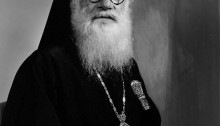
Archbishop Michael Konstantinides

A dynamic hierarch, his pastoral virtues excelled. In 1950, he officiated and gave sermons in 107 parishes and traveled 46,952 miles by airplane, train and car. He also was the first Greek Orthodox Archbishop to travel to South America and had extensive discussions with Juan and Eva Peron in Argentina. In a report to Patriarch Athenagoras On July 21, 1951, His Eminence said:

I was successful in persuading President Peron to permit the immigration of 50,000 Greeks to Argentina for a span over five years and having clothing (produced by Greek women in Buenos Aires factories) sent to Greece, without any hindrance, for the orphan victims of the rebellion, as well as financial assistance from the Greeks to friends and relatives in Greece, wounded by the despicable plague of communism. Mrs. Peron recalled the prayers offered by Your All Holiness on the occasion of Mr. Peron’s illness and asked me to convey to Your All Holiness her fervent gratitude and thanks The President himself said that he will be at my disposal for any matter that relates to our Greek brethren in Argentina.

Another significant contribution of Archbishop Michael was to continue the efforts of Archbishop Athenagoras to obtain recognition of Orthodoxy as a major Faith in the United States. He succeeded in having this resolution passed in twenty-six states. The recognition led the Congress to adopt a bill that recognized Eastern Orthodox in the Armed Forces as separate from Catholics and Protestants. Because of this, Orthodox Christians included the initials E.O. for Eastern Orthodox on their tags.

Archbishop Michael’s efforts were recognized at the highest level when on January 21, 1957, he became the first Orthodox hierarch to take part in the inaugural ceremony of a president, that of Dwight D. Eisenhower, by delivering the invocation. Earlier, on September 30, 1956, President and Mrs. Dwight Eisenhower participated in the laying of the cornerstone of Saint Sophia Cathedral in Washington, DC. First attending the Divine Liturgy and at the conclusion an overflowing crowd of over 1000 witnessed the President as he approached the foot of the altar and was presented with the Golden Cross of St. Andrew fastened around his neck by the Archbishop; Mrs. Mamie Eisenhower received a similar medal. It was a moving and historical moment (to be recognized also on the front page of the New York Times the next day). as the Archbishop blessed the President and Mrs. Eisenhower with these words:

May the Almighty and Everlasting God, our common Heavenly Father whom we know and love through our common Savior, the Lord Jesus Christ bestow upon you and Mrs. Eisenhower and all your family the best of health and all His blessing so that you, Mr. President, carry on the most effective way your high and responsible duties to the benefit of our dearly beloved America and the freedom living peoples and nations of the world.

Recognizing the financial and spiritual needs of a growing national church, Archbishop Michael proposed at the 1952 Clergy-Laity Congress in Los Angeles an increased family obligation to the Archdiocese, first introduced at the 1950 Clergy-Laity Congress in St. Louis. For ten years, the monodollarion, or one dollar per family obligation, instituted by Archbishop Athenagoras, had sustained the needs of the Archdiocese. Archbishop Michael urged the Congress delegates to approve the dekadollarion, or $10 per family.

On May 28th, 1958, Archbishop Michael opened the doors to St. Michael’s Home, the only Archdiocesan institution serving the needs of elderly Greek Orthodox. He also created the Office of News and Information/Public Relations, brought about acceptance of the Uniform Parish By-Laws of the Archdiocese and gained membership for the Archdiocese in the National Council of Churches of Christ.

GREEK ORTHODOX YOUTH OF AMERICA

Archbishop Michael’s accomplishments and innovations were many and varied. Foremost, however, was the founding of the Greek Orthodox Youth of America (GOYA) In a message to the 6th GOYA Conference in Los Angeles, July 15th, 1957, His Eminence concluded with these words:

As modern Americans of Greek descent you will accomplish much; but in attaining worldly destinies, never forget that as members of GOYA, you who are our pride and hope belong to an essentially religious organization, and whatever you attain on this earth is, in the last analysis, of little value without a deep and firm belief in the tried and tested religion of your forefathers. Adhere firmly to this faith, observe strictly its tenets, and in so doing you will in fact realize the motto of GOYA and truly live your Orthodox faith, thus becoming better Christians and better American citizens worthy of your noble Greek descent. With all my blessings for the future, in the name of our Lord Jesus Christ.

The untiring efforts of the Archbishop paid off. GOYA became the most vital segment of the Archdiocese with chapters in practically every community of the country. By the time of its founder’s death, GOYA had reached a membership of over 30,000. The 1957 Birmingham GOYA Conference approved a National Memorial Chapel Drive to raise funds for a Chapel to be built on the grounds of Holy Cross School of Theology in Brookline, MA. Under the chairmanship of Ernie and Vickie Villas, GOYA pioneers, a goal of $150,000 was set, funds were raised and the magnificent Holy Cross Chapel became a reality – dedicated to Archbishop Michael and the Greek immigrants, the parents, who established Orthodoxy in the Nation, nurtured it, sacrificed and saved for it and placed it in the hands of new generations for safekeeping.

LAST PUBLIC APPEARANCE

The Grand Banquet of the 14th Biennial Congress at Salt Lake City was on July 5th, 1958 with almost 1000 people in attendance and had as the main speaker Howard W. Pyle, deputy assistant to President Eisenhower. He spoke eloquently on the importance of the Churches to American life and world peace. Leaving his sick bed again, Archbishop Michael told the delegates that “our Church never felt it has a monopoly of salvation” over other religions. He declared, “We must co-operate with other Christian denominations all over the world to settle social and moral questions”.

He concluded his remarks by referring to St. Paul’s famed epistle on agape: “Now abideth Faith, Hope and Love, of these, Love is the greatest.” And as he stepped down from the rostrum and prepared to depart for his coming struggle with death, which was to claim him a week later, he looked at the GOYA representatives and with a benign and prophetic smile he told them: “Look after GOYA”.

Immediately following the banquet, he was flown to New York by an army plane sent by President Eisenhower, and entered Doctors’ Hospital, where he was operated on for an intestinal disorder. He died in Doctors’ Hospital on July 13. Funeral services for Archbishop Michael, the first Greek Orthodox Archbishop to die in the United States, were held on July 17 at Holy Trinity Cathedral. Bishop Germanos of the Southern States Diocese, later to be named Patriarchal Vicar of the Archdiocese, officiated, assisted by five Greek Orthodox bishops, Archbishop Athenagoras of Great Britain and Metropolitan Germanos of Elias, Greece. Attending also were Archbishops and Bishops of Orthodox churches in the United States and over 150 priests from every state in the union. Also, in attendance were many religious, diplomatic and government officials.

[This article was written by Presbytera Nikki Stephanopoulos. Copyright Greek Orthodox Archdiocese of America and used with permission.]

This week in American Orthodox history (January 16-22)

0

January 16, 1924: Patriarch Tikhon of Moscow — former Archbishop of North America, and future canonized saint — issued an ukaz removing Metropolitan Platon Rozhdestvensky from his post as primate in America for “public acts of counter-revolution.” Of course, Tikhon was under pressure from the Soviet government. Really, “pressure” is an understatement; I have no doubt that he was compelled to issue that ukaz. Because this ukaz and stuff like it, later in the same year, the Russian Archdiocese declared itself independent from the Moscow Patriarchate.

January 17, 1869: Former Episcopal priest James Chrystal was ordained to the Orthodox priesthood in Syra (Greece). This would have been the eve of Theophany on the Old Calendar. Chrystal had only recently been baptized into the Orthodox Church, and very soon after returning to America, he left Orthodoxy, saying that he couldn’t tolerate the veneration of icons.

January 21, 1957: Greek Archbishop Michael Konstantinides delivered the invocation at President Dwight Eisenhower’s inauguration. This was the first time that an Orthodox bishop was invited to participate in a presidential inauguration. In the years surrounding this event, Orthodoxy came to be recognized by dozens of states as the “fourth major faith,” along with Roman Catholicism, Protestantism (treated as a generic whole, in spite of its myriad divisions), and Judaism.

If you know of another major American Orthodox historical event that occurred between the 16th and 22nd of January, let us know in the comments!

Fr. Michael Konstantinides during his tenure as dean of St. Sophia Cathedral in London

The Life of Archbishop Michael Konstantinides

Fr. Michael Konstantinides during his tenure as dean of St. Sophia Cathedral in London

Editor’s note: The following biography of Archbishop Michael Konstantinides of the Greek Archdiocese was written by Presbytera Nikki Stephanopoulos and originally appeared on the GOA website. It is reprinted with permission from the Greek Archdiocese of America.

His Eminence Archbishop Michael served as spiritual leader of Greek Orthodox Christians in the Western Hemisphere from 1949 until his untimely death in 1958. A noted scholar, theologian, pastor, ecumenist, author and administrator, he is most remembered as a man of deep spirituality with a devotion to his sacred mission of promulgating the Faith in the United States. A man loved and respected for his exemplary life and for having personalized the motto of his beloved Greek Orthodox Youth of America (GOYA). “Live Your Orthodox Faith”, his nine years as Archbishop in the Americas were a bridge between Archbishop Athenagoras and Archbishop Iakovos.

Born Thucydides Constantinides on May 27, 1892, in Maronia, Western Thrace, he was admitted to the Halki Theological School in 1907. He was ordained to the Diaconate in 1914 and assumed the ecclesiastical name of Michael. He taught at Halki for one year and did his post-graduate work at the historic seminaries of Kiev and St. Petersburg, where he was an eye-witness of the Bolshevik Revolution. In 1919 he was ordained priest in Constantinople and appointed pastor of St. Stephen Church. In 1923 he was appointed Chancellor of the Archdiocese of Athens and All Greece and from 1927 to 1939 he served as Dean of the Cathedral of Saint Sophia in London. During his priestly tenure he represented the Patriarchate at the Assembly of Faith and Government at Lausanne of 1927, and as representative of the Church of Greece at the Conference of Anglicans and Orthodox in London in 1930.

In 1939 he was elected by the Holy Synod of Greece as Metropolitan of the ancient historic Apostolic Diocese of Corinth. As Metropolitan of Corinth, with his own money he established a small general hospital and organized soup kitchens for the poor, and a library to educate faithful. He established an Ecclesiastical School, Philoptochos Society and afternoon and Sunday schools. He established the St. Paul Association, held spiritual gatherings and Sunday Bible study. Metropolitan Michael could not imagine a parish without a preacher, Sunday school or philoptochos society.

ARCHBISHOP OF NORTH AND SOUTH AMERICA

On October 11, 1949, the Holy Synod of the Ecumenical Patriarchate elected him Archbishop North and South America and he was enthroned December 18, 1949 during a four-hour service attended by 2,000 at Holy Trinity Cathedral. In his comments Archbishop Michael thanked President Harry Truman and the American people for recent moral and material aid to Greece and declared his mission would be to build upon native traditions in making 1,000,000 Greeks better American citizens. He emphasized the place religion had taken in Greek life particularly as a fortifying element against totalitarianism.

Archbishop Michael was internationally known as an outstanding theologian, writer and administrator who wrote many theological treatises in Greek and English. He was also a linguist and was fluent in Greek, English, French, Russian and Turkish. Highly regarded in religious, education and government circles, he received honorary degrees from Yale University, St. Vladimir’s Theological Seminary and General Theological Seminary. In 1954 Archbishop Michael represented the Ecumenical Patriarchate at the Second Assembly of the World Council of Churches in Evanston, IL and in recognition of his many services to the Church and other Christian groups was elected as one of the six presidents of the WCC.

Archbishop Michael Konstantinides

A dynamic hierarch, his pastoral virtues excelled. In 1950, he officiated and gave sermons in 107 parishes and traveled 46,952 miles by airplane, train and car. He also was the first Greek Orthodox Archbishop to travel to South America and had extensive discussions with Juan and Eva Peron in Argentina. In a report to Patriarch Athenagoras On July 21, 1951, His Eminence said:

 I was successful in persuading President Peron to permit the immigration of 50,000 Greeks to Argentina for a span over five years and having clothing (produced by Greek women in Buenos Aires factories) sent to Greece, without any hindrance, for the orphan victims of the rebellion, as well as financial assistance from the Greeks to friends and relatives in Greece, wounded by the despicable plague of communism. Mrs. Peron recalled the prayers offered by Your All Holiness on the occasion of Mr. Peron’s illness and asked me to convey to Your All Holiness her fervent gratitude and thanks  The President himself said that he will be at my disposal for any matter that relates to our Greek brethren in Argentina.

Another significant contribution of Archbishop Michael was to continue the efforts of Archbishop Athenagoras to obtain recognition of Orthodoxy as a major Faith in the United States. He succeeded in having this resolution passed in twenty-six states.  The recognition led the Congress to adopt a bill that recognized Eastern Orthodox in the Armed Forces as separate from Catholics and Protestants. Because of this, Orthodox Christians included the initials E.O. for Eastern Orthodox on their tags.

Archbishop Michael’s efforts were recognized at the highest level when on January 21, 1957, he became the first Orthodox hierarch to take part in the inaugural ceremony of a president, that of Dwight D. Eisenhower, by delivering the invocation. Earlier, on September 30, 1956, President and Mrs. Dwight Eisenhower participated in the laying of the cornerstone of Saint Sophia Cathedral in Washington, DC. First attending the Divine Liturgy and at the conclusion an overflowing crowd of over 1000 witnessed the President as he approached the foot of the altar and was presented with the Golden Cross of St. Andrew fastened around his neck by the Archbishop;  Mrs. Mamie Eisenhower received a similar medal. It was a moving and historical moment (to be recognized also on the front page of the New York Times the next day). as the Archbishop blessed the President and Mrs. Eisenhower with these words:

May the Almighty and Everlasting God, our common Heavenly Father whom we know and love through our common Savior, the Lord Jesus Christ bestow upon you and Mrs. Eisenhower and all your family the best of health and all His blessing so that you, Mr. President, carry on the most effective way your high and responsible duties to the benefit of our dearly beloved America and the freedom living peoples and nations of the world.

Recognizing the financial and spiritual needs of a growing national church, Archbishop Michael proposed at the 1952 Clergy-Laity Congress in Los Angeles an increased family obligation to the Archdiocese, first introduced at the 1950 Clergy-Laity Congress in St. Louis.  For ten years, the monodollarion, or one dollar per family obligation, instituted by Archbishop Athenagoras, had sustained the needs of the Archdiocese. Archbishop Michael urged the Congress delegates to approve the dekadollarion, or $10 per family.

On May 28th, 1958, Archbishop Michael opened the doors to St. Michael’s Home, the only Archdiocesan institution serving the needs of elderly Greek Orthodox. He also created the Office of News and Information/Public Relations, brought about acceptance of the Uniform Parish By-Laws of the Archdiocese and gained membership for the Archdiocese in the National Council of Churches of Christ.

GREEK ORTHODOX YOUTH OF AMERICA

Archbishop Michael’s accomplishments and innovations were many and varied. Foremost, however, was the founding of the Greek Orthodox Youth of America (GOYA) In a message to the 6th GOYA Conference in Los Angeles, July 15th, 1957, His Eminence concluded with these words:

As modern Americans of Greek descent you will accomplish much; but in attaining worldly destinies, never forget that as members of GOYA, you who  are our pride and hope belong to an essentially religious organization, and whatever you attain on this earth is, in the last analysis, of little value without a deep and firm belief in the tried and tested religion of your forefathers.  Adhere firmly to this faith, observe strictly its tenets, and in so doing you will in fact realize the motto of GOYA and truly live your Orthodox faith, thus becoming better Christians and better American citizens worthy of your noble Greek descent. With all my blessings for the future, in the name of our Lord Jesus Christ.

The untiring efforts of the Archbishop paid off. GOYA became the most vital segment of the Archdiocese with chapters in practically every community of the country. By the time of its founder’s death, GOYA had reached a membership of over 30,000.  The 1957 Birmingham GOYA Conference approved a National Memorial Chapel Drive to raise funds for a Chapel to be built on the grounds of Holy Cross School of Theology in Brookline, MA. Under the chairmanship of Ernie and Vickie Villas, GOYA pioneers, a goal of $150,000 was set, funds were raised and the magnificent Holy Cross Chapel became a reality – dedicated to Archbishop Michael and the Greek immigrants, the parents, who established Orthodoxy in the Nation, nurtured it, sacrificed and saved for it and placed it in the hands of new generations for safekeeping.

LAST PUBLIC APPEARANCE

The Grand Banquet of the 14th Biennial Congress at Salt Lake City was on July 5th, 1958 with almost 1000 people in attendance and had as the main speaker Howard W. Pyle, deputy assistant to President Eisenhower. He spoke eloquently on the importance of the Churches to American life and world peace. Leaving his sick bed again, Archbishop Michael told the delegates that “our Church never felt it has a monopoly of salvation” over other religions. He declared, “We must co-operate with other Christian denominations all over the world to settle social and moral questions”. 

He concluded his remarks by referring to St. Paul’s famed epistle on agape: “Now abideth Faith, Hope and Love, of these, Love is the greatest.” And as he stepped down from the rostrum and prepared to depart for his coming struggle with death, which was to claim him a week later, he looked at the GOYA representatives and with a benign and prophetic smile he told them:  “Look after GOYA”.

Immediately following the banquet, he was flown to New York by an army plane sent by President Eisenhower, and entered Doctors’ Hospital, where he was operated on for an intestinal disorder. He died in Doctors’ Hospital on July 13.  Funeral services for Archbishop Michael, the first Greek Orthodox Archbishop to die in the United States, were held on July 17 at Holy Trinity Cathedral. Bishop Germanos of the Southern States Diocese, later to be named Patriarchal Vicar of the Archdiocese, officiated, assisted by five Greek Orthodox bishops, Archbishop Athenagoras of Great Britain and Metropolitan Germanos of Elias, Greece. Attending also were Archbishops and Bishops of Orthodox churches in the United States and over 150 priests from every state in the union. Also, in attendance were many religious, diplomatic and government officials.

[This article was written by Presbytera Nikki Stephanopoulos. Copyright Greek Orthodox Archdiocese of America and used with permission.]

Orthodox hierarchs meet at the Greek Archdiocese headquarters

Who Will Replace Athenagoras?

Orthodox hierarchs meet at the Greek Archdiocese headquarters. Archbishop Michael is fifth from the left, in between Metropolitans Antony Bashir and Leonty Turkevich.

Editor’s note: In our continuing effort to learn more about Greek Archbishop Michael Konstantinides, we are publishing the following article by Ernest Villas, former director of the GOA Department of Religious Education. Mr. Villas died in 2006. This article is reprinted with permission from the Greek Archdiocese of America.

In 1949, after eighteen years of shepherding the Church in the Americas, Archbishop Athenagoras was elected Ecumenical Patriarch. He was flown to Constantinople in the presidential plane of Harry S. Truman, and the question of the day was, “Who will succeed Athenagoras?” That name had become synonymous with Greek Orthodoxy in the Americas, and another Archbishop would be a totally new experience for everyone.

In 1950 his successor, Archbishop Michael, arrived. He was a kindly, soft spoken man, fluent in English, of moderate stature with a white flowing beard. Almost a year passed before the new Archbishop met many of his parish leaders at the 1950 Clergy Laity Congress in St. Louis during the cold days of late November. Who could then imagine that our new spiritual leader would only live long enough to lead his flock through four more Clergy Laity Congresses before being called home to God?

The arrival of Archbishop Michael coincided with the flurry of Greek Orthodox youth activity following World War II. Youth groups from parishes in Chicago, New York, the Upper Midwest, New England and the Rocky Mountain area were already organized and following initiatives by the youth leaders in Chicago.  The first gathering of youth delegates met in November at the 1950 Clergy Laity Congress. This meeting set the stage for the first national youth conference in Chicago eight months later where GOYA and the Archdiocese youth movement were born.

While the goal of uniting our youth was high among the priorities of the new Archbishop, so was the need to stabilize Archdiocese finances. For ten years the “monodollarion” instituted by Archbishop Athenagoras in 1942, had sustained the needs of the Archdiocese. In 1952 at the Clergy Laity Congress in Los Angeles, where the magnificent new Cathedral of St. Sophia was consecrated, Archbishop Michael ignited financial shock waves when he convinced Congress delegates to legislate the “dekadollarion.” He also pricked our moral consciousness with a controversial edict prohibiting dances on Saturday evenings as inappropriate to our participation in the Divine Liturgy on Sunday. There was no lack of items for discussion when delegates returned to their parishes after the Los Angeles Congress!

Meanwhile, Michael moved ahead in another area that was new to most of us, ecumenism. He ushered the Greek Orthodox Church into the National Council of Churches, and began the preliminary efforts of convening his fellow Orthodox prelates into what eventually would become the Standing Conference of Orthodox Bishops in the Americas (SCOBA) organized by Archbishop Iakovos.

His attention also focused on the inner life and order of the Church. Congregations were urged to recite the Lord’s Prayer and Creed in both Greek and English, the taking of flash pictures during weddings and baptisms was forbidden, and, to focus attention on smaller parishes, he had the 1954 Clergy Laity Congress convene in Savannah, GA to demonstrate what could be accomplished by a small Parish.

In 1956, the President of the United States, Dwight D. Eisenhower, accepted an invitation from the Archbishop to participate in the cornerstone laying ceremony of St. Sophia Cathedral in Washington D.C. Later that year, following his reelection to a second term, the President extended to His Eminence the historic invitation to offer the first Orthodox prayer at a U.S. Presidential inauguration. This was a huge step toward the recognition of Orthodoxy as a major faith in America.

The life of Archbishop Michael on earth ended shortly after the 1958 Clergy Laity Congress in Salt Lake City. He had not been feeling well, and eight years of spartan-like existence, plus the never-ending pastoral visitations and duties of the Archbishop took its toll.

His Last Liturgy

Only he knew it, but his sermon on that day was his own eulogy. He must have known the end was near, for at the conclusion of the Divine Liturgy, which opened the 1958 Clergy Laity Congress in Salt Lake City, he came out of the altar to deliver the sermon, but he paused, and instead of proceeding to the Bishop’s throne he took off his Mitre, placed it on the altar and went directly to the pulpit. Why he chose to spurn tradition and deliver his sermon from the pulpit instead of the Bishop’s throne we will never know. Perhaps for physical reasons, for he leaned heavily on its sides and drank deeply from the glass of water placed conveniently there before him. For whatever reason, the sermon he delivered on that day will eternally be enshrined in the minds of those who heard it. There, white beard and hair flowing, ablaze with spiritual fire, His Eminence fervently preached on his favorite topic, St. Paul the Apostle; his words, his great tribulations and temptations, his travels and his famous epistles, and it could  not have been more fitting, that this Sunday coincided with the feast day of Saints Peter and Paul, the latter of who has had a living champion in the person of the Archbishop. Immediately after the Congress banquet, he returned to New York, by an  ambulance plane sent by President Eisenhower, and entered the hospital. On Sunday July 13, 1958, a telegram announcing his unexpected death was read in all of our Churches. It shocked everyone.

The unforgettable funeral with over 150 priests chanting the funeral hymns ended with the long cortege that made its way to St. Basil’s Academy where, amid tears and final goodbyes, Archbishop Michael was laid to rest. His entire life was a total testimony to the Church he loved and served so well, and a dynamic witness to the living God, our Lord and Savior Jesus Christ. The Will of God had been served, and once again history had been set in motion for the next major chapter in the life of our Greek Orthodox people in North and South America.

This article was written by the Ernest Villas. Copyright Greek Orthodox Archdiocese of America and used with permission.

Archbishop Michael Konstantinides

The Treasure of Archbishop Michael

Archbishop Michael Konstantinides

Editor’s note: In its nine decades of existence, the Greek Archdiocese has been served by only six primates — Alexander, Athenagoras, Michael, Iakovos, Spyridon, and Demetrios. And 55 of those years are covered by just two men, Athenagoras and Iakovos. That pair looms large over American Orthodoxy, and an argument can be made that either one is the most influential person in our history. Sandwiched in between those two, the nine-year tenure of Archbishop Michael Konstantinides is often forgotten. Outside of Greek circles, his name is almost totally unknown. Yet Archbishop Michael provided an important bridge between Athenagoras and Iakovos, and his own influence on American Orthodox history was substantial. To help fill in this gap in our historical understanding, SOCHA has received permission from the Greek Archdiocese to reprint a series of articles on the life and work of Archbishop Michael. These articles overlap one another to some degree, but they provide a helpful variety of perspectives. The first of these articles, below, was written by the late Bishop George Papaioannou of New Jersey and originally published in the Hellenic Chronicle (7/11/1996). Bishop George was an historian of Greek Orthodoxy in America, and he was the first widower to be consecrated a bishop in the Greek Archdiocese. He unexpectedly died just six months after his enthronement, on November 22, 1999.

Among the first and most difficult tasks of Ecumenical Patriarch Athenagoras as spiritual leader of World Orthodoxy was to select an Archbishop for the Greek Orthodox Archdiocese of North and South America, a replacement for himself.

On October 11, 1949, Patriarch Athenagoras, in a telegram to Bishop Germanos of Nyssa, locum tenens of the Archdiocese, announced to the Greek American faithful that the Holy Synod, under the guidance of  the Holy Spirit, had elected as legal and canonical Archbishop, Metropolitan Michael of Corinth. Like his predecessor, Michael resembled a biblical personality, imposing yet gentle, sweet and joyful. Like Athenagoras, he was a graduate of the Theological School of Halki but unlike him, Michael had served as a priest in London, was fluent in English, and had pursued theological studies abroad. Corinth enjoyed days of spiritual exaltation during the tenure of Michael in that city. He was a very spiritual man, in the truest sense of the word, unshakable in his dedication to his calling.

Archbishop Michael arrived in New York on December 15, 1949 to take up the reins of the Greek American Church. In contrast to the deplorable conditions that Athenagoras had found when he assumed his duties in 1930, the conditions awaiting Michael were very favorable. His Greek American flock was in harmony and peace and there was prosperity throughout the land. These favorable conditions, however, did not mean that the ministry of Michael was to be an easy one. On the contrary, the beginning of Michael’s tenure coincided with the growing pains, the hopes, the dreams and the expectations of a community in transition from the old guard to the new, from the generation of the pioneer immigrants to the American-born generation.

He entered the picture and devoted all his energy to his people. Michael’s personality was different from that of Athenagoras, who was a diplomat churchman, Michael was an intellectual pietist, he emphasized matters of piety, discipline and sacramental life, especially spiritual and sacramental reawakening. Michael dealt admirably with the two most pressing problems facing the Greek Orthodox community in the United States: religious education and youth.

It was Michael who first allowed a limited use of English in the church. It all began with the teaching of religion in Sunday School. Michael’s predecessor had refused to yield to the pleas of the native born generation and allow the use of English in their teaching of the faith. Although Michael was no less a lover of Greek culture and language than Athenagoras, his deep religious convictions made him recognize the need for the use of English in teaching the Faith.

At the Tenth Clergy-Laity Congress in St. Louis in 1950, he painfully but most eloquently articulated. change that would allow the use of English in Sunday Schools. This innovation was followed by the preaching of the sermon in both Greek and English and the use of English in the sacraments, especially in the western states. Michael’s greatest contribution, however, was in dealing with the second most pressing problem of the Archdiocese, the youth. He labored more than anyone else to advance the rights of the youth in the church.

In April 1951, Archbishop Michael announced through an encyclical letter to the parishes that a national youth conference was to be held in Chicago and asked for their support. The Conference was held as scheduled and heralded as a new era in the Orthodox Church in the United States. The national youth organization became a reality: its name, “GOYA,” was destined to capture the imagination and fulfill the dreams of tens of thousands of young people throughout the American Continent. Michael took personal command of the crusade for GOYA’s acceptance as an inseparable part of our communities.

A churchman of ecumenical dimensions, he advanced the cause of Christian unity; in 1954 he was elected and served as president of the World Council of Churches. Archbishop Michael’s tenure as Primate of the Greek Archdiocese of North and South America was cut short by his untimely death in July of 1958, depriving Orthodoxy of a learned Bishop who was vastly informed, had a wonderfully retentive memory, was fluent in many languages, was an eloquent orator and a brilliant writer. Michael had many talents and virtues. The genius of the man, however. was his spirituality. He was a spiritual man with a deep devotion to his sacred mission of promulgating the Faith in the United States, a man who was loved and respected for his exemplary life and for having personified the motto of his beloved GOYA, Live Your Orthodox Faith.

This article was written by the late Bishop George Papaioannou of New Jersey. Copyright Greek Orthodox Archdiocese of America and used with permission.

Go to Top