Posts tagged Russian Mission
This week in American Orthodox history (March 5-11)
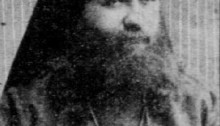
0March 10, 1866: The future Archbishop Arseny Chagovtsov was born in Kharkov, in what was then the Russian Empire and what is today Ukraine. A widowed priest, he became a monk and came to America in 1903 to serve in the Russian North American Mission. He was instrumental in the establishment of St. Tikhon’s Monastery in 1906, and in 1908 he was assigned to be the administrator of Russian churches in Canada. Arseny — at this point an archimandrite — returned to Russia in 1910, fled to Serbia after the Revolution, and, in 1926, was chosen to return to Canada as the Bishop of Winnipeg. In 1936, he was apparently shot (I don’t really know about the details of his incident). After this, he retired from the episcopate and ultimately moved to St. Tikhon’s Monastery in Pennsylvania, where he was involved in founding what became St. Tikhon’s Seminary. Archbishop Arseny died in 1945.

Sketch of Holy Trinity chapel in Portland, OR, founded by Lavrenty Chernov. Image courtesy of St. Nicholas Orthodox Church in Portland.
March 10, 1895: Fr. Sebastian Dabovich dedicated Holy Trinity Orthodox chapel in Portland, OR. The small Portland community included Greeks, Syrians, and Russians, among others. The man most responsible for its establishment was a layman named Lavrenty Chernov. An Alaskan Creole, Chernov was born in 1848 and eventually moved to Portland. The ramshackle chapel was used for perhaps a decade, but it eventually fell out of use. In the first decade of the 20th century, the Greeks of Portland began using it for their own church, which was also called Holy Trinity.
March 5-7, 1907: The Russian Archdiocese held its first “All-American Sobor” in Mayfield, PA. A few years ago, OCA archivist Alex Liberovsky gave a nice lecture on the Sobor, which you can read on the OCA website. The Sobor was held concurrently with the convention of the Russian Orthodox Catholic Mutual Aid Society. And while it was called “All-American,” it was a purely “Russian” affair: the other ethnic groups affiliated with the Russian Archdiocese, such as the Syro-Arabs and the Serbs, were not included. That said, the Sobor was a major step for the Russian Mission in America.
March 7, 1915: The funeral for St. Raphael Hawaweeny was held in his Brooklyn cathedral. Something interesting, which I’d never noticed before: St. Raphael was apparently friends with an American named Gary Cronan, who got permission from the New York Heath Administration to have St. Raphael buried in a crypt in St. Nicholas Cathedral. Cronan reportedly built the crypt himself. (My source for this is the unpublished St. Vladimir’s Seminary M.Div. thesis by A. Issa.) St. Raphael actually didn’t rest in the crypt for very long — Bishop Aftimios Ofiesh acquired a new cathedral in 1920, and St. Raphael’s relics were transferred to Mount Olivet Cemetery in 1922. Today they rest at the Antiochian Village in Ligonier, PA. Anyway, I’m really curious to learn more about Gary Cronan.
Back in December, we reprinted Isabel Hapgood’s very good New York Tribune article on Raphael’s death and funeral.
March 6, 1921: Fr. Kallinikos Kanellas, one of the first Greek Orthodox priests in America, died in Little Rock, AR. Kanellas came to America from India, where he had been the priest of the Greek Orthodox church in Calcutta. He initially came to America just for a visit, but he fell ill and was forced to stay for awhile. He became affiliated with the Russian cathedral in San Francisco, which had a very large Greek population. He made at least one major mission trip through the country, visiting Georgia, New York, and Chicago, among other places. He was one of the first Orthodox priests to visit Chicago. In 1892, Bishop Nicholas Ziorov took over the Russian Diocese, and he released Kanellas, who then traveled to the eastern part of the United States. He eventually spent eight years as rector of the Greek church in Birmingham, AL, which was under the Church of Greece. Later, he became the first priest in Little Rock, where he died in 1921. Toward the end of his life, the Greek-American Guide described Kanellas as “a very sympathetic and reverend old man.”
UPDATE: To listen to a podcast based on this article, click here.
Fr. Theoclitos of Galveston on Charity
0Recently, I’ve been working with a group of researchers to document the life of Fr. Theoclitos Triantafilides, the remarkable priest of Galveston, Texas. Fr. Theoclitos was from Greece — his father had fought in the Greek Revolution — and as a young man, Fr. Theoclitos lived on Mount Athos and later studied in Russia. He tutored the children of King George of Greece, and later the children of Tsar Alexander III (including the future Tsar Nicholas II). He was apparently quite close to Nicholas II, and when, in 1895, the Orthodox of Galveston requested a priest, the Tsar sent to them his former tutor. Fr. Theoclitos was already in his mid-60s — quite old for his era — but he served in America for a full two decades before his death in 1916.
The American ministry of Fr. Theoclitos was utterly unique. He was, as I said, an ethnic Greek, but he served under the auspices of the Russian Mission in America. His parish was composed of Greeks, Serbs, Syrians, and even Copts, and today, that parish is a part of the Serbian Church. Fr. Theoclitos was also one of the first Orthodox priests in America (and perhaps the first) to actively proselytize Americans. His parish was truly pan-Orthodox, and he was uniquely capable of ministering to the needs of such a diverse flock.
Until recently, we knew a fair number of facts about Fr. Theoclitos, but nobody, as far as I know, had found any surviving sermons or writings. Just the other day, though, the lead researcher — Mimo Milosevich, from Galveston — discovered the full text of Fr. Theoclitos’ Christmas sermon, given on January 7, 1914 and published in the next day’s issue of the Galveston Daily News.
It’s a short sermon, but it reveals much about the character and vision of the great archimandrite. According to the newspaper, Fr. Theoclitos began by recounting the story of the star, the wise men, their gifts, and King Herod. Then, said the paper, “Father Theoclitos took off his spectacles and used them to gesticulate with, as he preached a fatherly sermon on charity and its relation to happiness.”
My children: Before Jesus came into our world the earth lacked the attributes of sympathetic understanding, which we find necessary to our happiness in this era. The Lord gave us his son, Jesus, to soften us, to give us understanding of human wants, to give us a sense of forgiveness, to teach us that to forgive is our duty, and to teach us charity.
My children, be charitable, open your hearts, for only in charity is there happiness. Make life brighter for your brother and your sister and the candle you light for them will make your light brighter.
God gave us Jesus, and Jesus gave us his all, even his life. We can do no more than emulate him, and in doing that we do all.
Think today of the poor whom he loved, lighten their burdens, even as he did. Open your hearts, oh, my children, even as did Jesus of Bethlehem.
My children, when he came among us he did not ask, “Of what nationality art thou? What is thy belief?” No! He came down among us and was one of us and he ministered to us. Open thy hearts, likewise, my children, and go among the poor and succor them; all the poor, for they are thy brothers and sisters, my children, and they are his people.
My children, many of you are not native to this land and it is well to treasure memories of thine own country, but think that this is a good land, and its people are good to thy people, and you all are his people. Learn to love, be honest, tolerant, forgiving, and charitable.
I pray you Merry Christmas, my children, and many, many years of happiness.
After the sermon, Fr. Theoclitos passed a plate to collect alms for the poor. “The plate was heaped high with bills and coins,” reported the Daily News, “the merry chink-clink-chink of the contributions accenting like tiny cymbals the smooth melody of a beautiful hymn.”
To learn more about Fr. Theoclitos, visit Mimo Milosevich’s website, and listen to his recent lecture.