Posts tagged Serafim Surrency

Turkevich_Metr_Leonty (c1950)

Met. Leonty: A Life in Moments

0

As Matthew pointed out in his post yesterday, this week marks the 47th anniversary of the death of one of the truly  great Orthodox churchmen of the 20th century, Metropolitan Leonty Turkevich.  With an ecclesiastical career in the United States spanning from 1906 to 1965, there are few figures in the history of Orthodoxy in America who can claim such longevity, much less a comparable length of time spent at the heights of church administration.  From his first assignment in America, as Dean of the North American Russian Orthodox Theological Seminary in Minneapolis, Minnesota, to his last, as Metropolitan of All-America and Canada of what was then the Russian Metropolia, Leonty served as a key figure in nearly every moment and institution of note for nearly six decades.

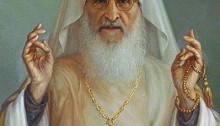
Met. Leonty Turkevich

When Matthew asked me to write a piece about Leonty, I kept coming back to a single moment at the end of his life, a story for which there is a rare corroboration of accounts from multiple sources (one from the Moscow Patriarchate, the other from the Metropolia) that each give a unique picture of who Leonty was, and how his personality, longevity, and the weight of his institutional memory impacted those around him.

In early 1963, at the height of the Cold War, the National Council of Churches invited a delegation from the Church of Russia to visit the United States for a goodwill visit to acquaint the American religious establishment with leaders of the living, breathing Church behind the Iron Curtain.  Led by Archbishop Nikodim Rotov of Yaroslavl, head of the Patriarchate’s Department of External Relations, a side benefit of the delegation would be an opportunity for an informal assessment the true situation of the tensions between the Metropolia and the Patriarchal Exarchate as it existed on the ground, if not possible dialogue. Through the formation of the Exarchate in 1933, a longstanding lawsuit over control of St. Nicholas Cathedral in New York City, and stalled negotiations following the decision of the 7th All-American Sobor to renew the Metropolia’s administrative ties with Moscow in 1946, a bitter period of animosity between two jurisdictions with a shared history had dominated both local and national church life for decades.  Aside from an informal meeting in 1961 at a World Council of Churches meeting in New Delhi, by 1963, no formal or significant dialogue between the two parties had occurred for over a decade.

As he would recall over a decade later, one evening in March of 1963, Fr. Alexander Schmemann, Dean of St. Vladimir’s Seminary, received a telephone call from an Episcopalian acquaintance announcing that Nikodim and the delegation wished to visit the seminary, and would be arriving on campus within a few hours.  Schmemann quickly dispatched a call to Metropolitan Leonty to ask for permission to receive the delegation.  Leonty quietly replied, “receive them with love.”  The visit went well, and Schmemann arranged for Nikodim to meet with Leonty several days later over dinner at the Metropolia’s Chancery in Syosset.

Schmemann recalled the elderly Leonty descended the Chancery stairs that evening dressed in his trademark white cassock, “so majestic… and yet so simple and joyful, so obviously the head of the Church to which he had given his entire life.”  After dinner, Leonty rose to give an informal speech, in part a narrative of his ministry in America, as well as an expression of what the events meant for the future of Orthodoxy in North America.  His was an institutional memory that stretched back to the administration of Bishop Tikhon Belavin, the bishop who had invited the young Fr. Leonid Turkevich to the United States in 1906 to oversee the Minneapolis Seminary, which Turkevich repaid in turn by personally nominating his former bishop for the office of Patriarch of Moscow on the floor of the All-Russian Sobor eleven years later.  In fact, it is likely many of the events he described that evening occurred before the relatively young Nikodim (born in 1929) was even alive.  According to Schmemann, Leonty’s words movingly expressed his love for the Church of Russia, yet also his firm belief in the future of the Church in America. (Constance Tarasar, ed. Orthodox America, 1794-1976. Syosset, 1975. 262-3.)

Met. Nikodim Rotov

Several years later, Nikodim would recall the events of the Syosset dinner to Archimandrite Serafim Surrency, a priest who served as an assistant to Metropolitan John Wendland (then head of the Patriarchal Exarchate) at St. Nicholas Cathedral in New York City.  Surrency describes the elderly Leonty asking Nikodim firmly and directly, how he viewed Leonty and the other bishops of the Metropolia.  Though Nikodim was clearly moved by his meeting with Leonty, and the momentum of the evening would carry into several more informal dialogues between the Metropolia and the Patriarchate (especially Nikodim) in the ensuing years, reality dictated he reply “as kindly as he could:”

“Your Eminence, forgive me, but I have no choice but to regard you and your bishops as schismatics.”  According to Surrency, “…tears welled in the eyes of the aged Metr. Leonty.”  (Archimandrite Serafim Surrency. The Quest for Orthodox Church Unity in America. New York, 1973. 78.)

As a historian, this moment in a lifetime of truly monumental moments offers a good entry point by which we can understand the broader picture and historical narrativity of Leonty’s impact in America.  His role as a priest in the highest levels of diocesan administration, theological education, and publication shows the ambitious vision of the pre-Revolution North American Diocese to serve a rapidly growing, geographically expansive flock, and the extent to which the Revolution would fundamentally change this trajectory.  Leonty’s episcopal career (and the process by which he became a bishop) is a lens by which we can explore the deep divisions of the jurisdictional fracture of Orthodoxy in America in the wake of the rise of Bolshevism.  And in his final years, his hospitality and dialogue with Abp. Nikodim put in motion a series of sometimes tense, yet ultimately fruitful meetings leading to the granting of Autocephaly to the Metropolia in 1970, forming what is now the Orthodox Church in America.

In the months to come, I hope to further explore this dynamic figure, exploring how his roles within the Church found him intimately involved in some of the most controversial and heated moments Orthodoxy has seen on the North American continent, yet whose demeanor, deep spirituality, and kind and quiet disposition found him almost universally revered even in the face of discord.

This week in American Orthodox history (February 20-26)

0

February 20, 1874: The future hieromartyr Vasily Martysz was born in Poland. He served in America — first in Alaska, and then in Pennsylvania, Connecticut, New York, and Canada — from 1901 to 1912. He died in 1945 and was canonized by the the Orthodox Church of Poland in 2003. To read a biography of St. Vasily, click here.

February 20, 1900: At the behest of Bishop Tikhon, the Russian Holy Synod officially changed the name of its North American missionary diocese, from “Diocese of the Aleutians and Alaska” to “Diocese of the Aleutians and North America.”

February 21, 1923: Serbian clergy held a meeting in Gary, Indiana, where they formally declared their independence from the Russian Church and their affiliation with the Serbian Church.

February 23, 1934: The Ukrainian Bishop Joseph Zuk died.

February 23, 1984: Archimandrite Serafim Surrency died in New York, at the age of 58. He was a historian, best known for his important work The Quest for Orthodox Church Unity in America (published in 1973). Until recently, Surrency’s book was the source for information on many American Orthodox historical subjects, including the American Orthodox Catholic Church, the Federation, and the early years of SCOBA. And, despite its limitations, the book remains an essential resource. One mystery which Fr. Oliver and I have been trying to solve for years is what became of Surrency’s personal files — we think they’re full of important material, but we don’t know what happened to them after he died.

February 24, 1904: The newly-consecrated Bishop Innocent Pustynsky arrived in America to take up his post as auxiliary bishop of Alaska. As Scott Kenworthy recounted in an interview with me last year, Bishop Tikhon had been trying for years to get an auxiliary to help govern his immense diocese. Eventually, Tikhon just went to Russia and refused to leave until he had a duly consecrated bishop in hand for his return voyage to America. Very soon after Bishop Innocent’s arrival, he and Tikhon consecrated Fr. Raphael Hawaweeny to the episcopate — the first Orthodox consecration in the New World.

February 24, 1931: The newly-elected Archbishop Athenagoras Spyrou arrived in America to take charge of the Greek Archdiocese.

February 25, 1896: The future hieromartyr Alexander Hotovitzky was ordained to the priesthood by Bishop Nicholas Ziorov. Fr. Alexander was assigned as rector of the fledgling St. Nicholas Russian Orthodox Church in New York.

February 26, 1895: Fr. Sebastian Dabovich celebrated the first Orthodox services in the newly established multiethnic chapel in Portland, Oregon. (To read more, check out my 2009 article on early Orthodoxy in Portland.)

The founding members of SCOBA

Recently, I happened to look at Fr. Serafim Surrency’s 1973 book The Quest for Orthodox Unity in America, an invaluable study of American Orthodoxy from 1794 to 1973. This book is one of the best sources for information on, among other things, Archbishop Aftimios Ofiesh’s “American Orthodox Catholic Church,” as well as the proto-SCOBA 1940s Federation. It’s also a great source for information on the very early years of SCOBA. Fr. Serafim himself was closely involved with SCOBA, and he provides all sorts of details not available elsewhere.

I thought our readers might be interested in Fr. Serafim’s list of the original member jurisdictions of SCOBA when it was founded in 1960. Here is the list, with Fr. Serafim’s notes:

  • Albanian Diocese (under Constantinople)
  • Carpatho-Russian Diocese (under Constantinople)
  • Bulgarian Diocese (not in canonical relationship with the Mother Church of Sofia)
  • Greek Archdiocese (under Constantinople)
  • Romanian Archdiocese (under Bucharest)
  • Russian Metropolia (not in canonical relationship with the Mother Church of Moscow)
  • Russian Exarchate (under Moscow)
  • Ukrainian Diocese (under Constantinople)
  • Ukrainian Autocephalic Diocese (not in canonical relationship with the Mother Church)
  • Syrian Archdiocese of N.Y. (under Antioch)

Of the eleven founding member jurisdictions, ten are what we would today consider “mainstream.” The odd one out is the Ukrainian Autocephalic Diocese, also sometimes known as the Ukrainian Church in Exile. In addition to those eleven jurisdictions, Surrency listed several more jurisdictions which, for one reason or another, didn’t participate in the founding of SCOBA:

  • Albanian Archdiocese (in communion with the Church in Albania)
  • Syrian Archdiocese of Toledo (under Antioch)
  • Independent Romanian Diocese (not in canonical relationship with Bucharest)
  • Russian Church in Exile (not in canonical relationship with the Church of Moscow)
  • Ukrainian Metropolia (not in canonical relationship with the Mother Church)

Oddly, the Serbs are not mentioned at all.

Fifty years later, at the end of its existence, SCOBA also included eleven jurisdictions:

  • Greek Archdiocese of America
  • Antiochian Archdiocese of North America
  • Serbian Church in North and South America
  • Carpatho-Russian Diocese in the USA (under Constantinople)
  • Romanian Archdiocese in the Americas (under Bucharest)
  • Bulgarian Eastern Orthodox Church (under Sofia)
  • Orthodox Church in America
  • Ukrainian Church of the USA (under Constantinople)
  • Moscow Patriarchal Parishes (under Moscow)
  • Russian Orthodox Church Outside of Russia (under Moscow)
  • Albanian Diocese of America (under Constantinople)

There have been various mergers, name changes, and so forth, but the biggest difference between the 1960 list and the 2010 list is the absence of the Ukrainian Autocephalic Church. This body was led by Archbishop Palladios Rudenko. Here is what Surrency had to say about them (p. 114):

In the United States there are two other Ukrainian jurisdictions with less than a dozen parishes between them: one is called the “Holy Ukrainian Autocephalic Orthodox Church in Exile” headed by Archbishop Palladios who has been hospitalized and unable to function for the last four or five years-his jurisdiction seems to enjoy a quasi-canonical relationship with the Greek Archdiocese-and the second group is known as the “Ukrainian Autocephalic Orthodox Church in Exile” (Sobornopravna) which is headed by Archbishop Gregory.

They were, in 1973, one of the smallest jurisdictions in America, with just one bishop and five parishes. I’m still trying to get a handle on their history, but eventually, I’ll try to get an article done. Surely there’s a story to be uncovered.

[This article was written by Matthew Namee.]

Go to Top