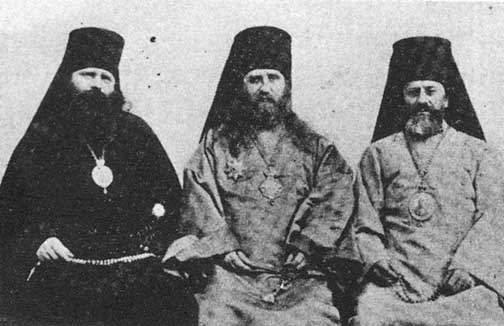
In 1905, the Holy Synod of Russia was preparing for an All-Russian Council. In advance of this, the Synod asked all the diocesan hierarchs of the Russian Church to send in their opinions on various church reform issues. St. Tikhon was among the respondents, and a portion of his reply has become rather famous among American Orthodox Christians. There are a couple of translations of this section of Tikhon’s response; I’ll print one of them here:
The diocese of North America must be reorganized into an Exarchate of the Russian Church in North America. The diocese is not only multi-national; it is composed of several orthodox Churches, which keep the unity of faith, but preserve their peculiarities in canonical structure, in liturgical rules, in parish life. These particularities are dear to them and can perfectly be tolerated on the pan-orthodox scene. We do not consider that we have the right to suppress the national character of the churches here; on the contrary, we try to preserve this character and we confer on them the latitude to be guided by leaders of their own nationality. Thus, the Syrian Church here received a bishop of its own (the Most Rev. Raphael of Brooklyn), who is the second auxiliary to the diocesan bishop of the Aleutian Islands, but is almost independent in his own sphere (the bishop of Alaska having the same position). The Serbian parishes are now organized under one immediate head, who for the time beign is an archimandrite, but who can be elevated to the episcopacy in the nearest future. The Greeks also desire to have their own bishop and are trying to settle the matter with the Synod of Athens. In other words, in North America a whole Exarchate can easily be established, uniting all orthodox national Churches, which would have their own bishops under one Exarch, the Russian Archbishop. Each one of them is independent in his own sphere, but the common affairs of the American Church are decided in a Synod, presided by the Russian Archbishop. Through him a link is preserved between the American Church and the Church of Russia and a certain dependence of the former on the latter. It should be remembered however that life in the New World is different from that of the old; our Church must take this into consideration; a greater autonomy (and possibly autocephaly) should therefore be granted to the Church of America, as compared with the other Metropolitan sees of the Russian Church. The North American Exarchate would comprise: (1) the archdiocese of New York, with jurisdiction over all Russian Churches in the United States and Canada. (2) the diocese of Alaska, for the orthodox inhabitants of Alaska (Russians, Aleutians, Indians, Eskimos). (3) The diocese of Brooklyn (Syrian). (4) the diocese of Chicago (Serbian). (5) a Greek diocese.
That translation comes from St. Vladimir’s Theological Quarterly, in 1975. There was, however, an earlier translation, commissioned by St. Tikhon himself. This earlier version appeared in the Vestnik (the official periodical of the Russian Mission), in March of 1906. There are some notable differences between the two translations. Among them:
- The 1906 version includes St. Tikhon’s full (and fascinating) response to the Holy Synod, which runs 22 pages. The 1975 version consists only of the section quoted above, thus lacking the context of St. Tikhon’s proposal.
- The 1906 version says that St. Raphael is “nominally the second vicar”; the 1975 version does not include the word “nominally.”
- The 1906 version does not include the parenthetical “(autocephaly)”, which the 1975 version has. On this point, the 1975 version appears to be more accurate; I am told by those who can read Russian that the original Russian text does include that parenthetical.
- The 1906 version, when it mentions a diocese (bishopric) for the Greeks, includes a question mark: “The bishopric (?) of the Greeks.” The 1975 version omits this question mark, which does in fact appear in the original Russian.
Otherwise, the two versions basically agree with each other, aside from the obvious differences in word choice in translation. I don’t know who translated either version — neither the 1906 nor the 1975 version credited anyone.
Needless to say, St. Tikhon’s vision was never fully realized. Fr. Sebastian Dabovich never became bishop for the Serbs, and the Greeks weren’t about to submit to Russian authority. And, as pragmatic as it might have been, St. Tikhon’s proposal was also completely uncanonical, predicated as it was upon overlapping episcopal territories that were a total violation of Orthodox ecclesiology. But St. Tikhon’s vision would inspire two later efforts to form a single American Orthodox jurisdiction — the “American Orthodox Catholic Church” in the 1920s/30s, and, in 1970, the OCA — and it is still hailed by many today as a viable solution to our present jurisdictional situation.
PODCAST NOTE: Today on the American Orthodox History podcast on Ancient Faith Radio, we’re airing Part 2 of my interview with Fr. John Erickson, on the subject of the Russian Mission. In this two-part interview, Fr. John gives us, among other things, the context to understand St. Tikhon’s vision.
4 responses to “St. Tikhon’s Vision, 1905”
This just caught my eye:
“The Greeks also desire to have their own bishop and are trying to settle the matter with the Synod of Athens.”
This is interesting, coming as it does not only before the Tomos of 1908, but before the 1907 conference on the issue of the “diaspora.” It is also interesting that while the precious little we have about the relationships between the Russian Church and the Greek Church all point to Constantinople (which would fit with the version enshrined in the 1908 Tomos and present theory), the Greeks here are contacting instead the Church of Greece.
Yes, that’s no surprise. Despite the EP’s (retroactive) claim to jurisdiction before 1908, in reality more early Greek parishes in America were under the Church of Greece than the EP. This makes sense when you consider that the majority of Greek immigrants in that period came from Greece proper, and not from Turkey. They naturally looked to their own Mother Church, rather than to Turkish-oppressed Constantinople.
I was more suprised that St. Petersburg and New York seemed to be dealing with Constantinople, when they were aware of the Greek parishes dealing with the Synod in Athens, in particular given the ties of the Imperial and Royal Families. That, however, might be the issue, given the fallout over the Evangelika Controversy.
I’m wondering if the Greek Government census of Greeks abroad had anything to do with the sudden interest of the Phanar in the “diaspoa.” It seems by the turn of the century the Greek Kingdom was increasingly looking at the Greeks abroad as a resource against the larger Ottoman Empire, even as it was loosing its subjects to the diaspora (the figures show that 74.33 % of the Greek immigrants in the US in 1908 came since 1905, with a nearly 4 to 1 ratio from Greece versus the Ottoman Empire). The Holy Trinity website has a lot on the Greeks of San Francisco going back home to fight in the 1897 conflicte over Crete (interestingly enough, the home of both Venizelos and Meletios, and under Prince George, who first motivated the Greeks of NYC to organize into a parish when he came through with the Russian consul, after saving the Russian Czarovitch in Japan, and also what led to the Evangelika riots). Among them is the April 1, 1897 newspaper clipping:
“High mass will be celebrated next Wednesday morning in the Orthodox Greek Catholic Church on Powell street [i.e. the Archdiocesan Cathedral] for the repose of the souls of the Cretan insurgents killed in the recent engagements. On the same occasion prayer will be offered for the success of the Greek cause.
Archbishop Nicholas will officiate, and the Greek Archimandrite Theoclitos [in Russian Archdiocese serving at the Galveston parish] will preach a sermon in the Greek language. Next Wednesday will be March 25, in the Greek calendar, and is the anniversary of the day on which the Greek raised the banner of independence from the Turks.
There may be some significance in the fact that the Czar of Russia is the head of the Greek church, and that all the bishops and archbishops of that church are appointed by him. Hence, if they offer up prayers for the Greek cause it may be inferred that the Czar must have a friendly feeling for the Greeks in their present struggle against the unspeakable Turk.”
http://www.holy-trinity.org/
The CoG had more parishes at the time (1906), but it was close, about 20 versus 15. It would seem, however, that the Kingdom’s start in organizing Greek outside its borders (as Meletios, for instance, was doing in Cyprus at the time), might give us the context of what was going on.
[…] in America. The Russians themselves clearly understood Raphael to be one of theirs, and in his 1905 plan for Orthodoxy in America, St. Tikhon includes the Syrian bishop as a crucial part — while at the same time recognizing […]