Posts tagged 1900
Bogus aristocrats and Orthodox saints
0
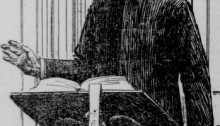
The caption reads, "Photograph of Rev. Alexander A. Hotovitzky which bogus Baron de Stuart passed off as his own."
At the very end of the 19th century, a fellow going by the name “Theodor O’Brien MacDonald, Baron de Stuart” appeared in New York City. His second and third names notwithstanding, the “Baron” claimed to be the son of a Russian general. He left Russia, so he said, because he wanted to leave the Orthodox Church and become a Roman Catholic. After spending time in a Jesuit monastery in Maryland, the Baron became dissatisfied with Rome and decided to convert again, this time to Protestantism.
He traveled to New York, where he became a bit of a sensation among well-to-do Protestant clergy. An ex-Catholic priest, who edited a journal called The Converted Catholic, saw the Baron as “a brand snatched from the burning” and arranged for the him to give speeches about his religious journey. According to the New York World, the Baron’s “chief stock in trade” was a photograph of a priest dressed in Orthodox vestments. The photo was supposed to be of the Baron himself, and it did look just like him, even in little details, such as the small mustache and bowed eyeglasses.
But it wasn’t a photo of the Baron — it was Fr. Alexander Hotovitzky, rector of the Russian church in New York. Apparently, the Baron showed the photo to one person too many: one lady recognized it as Hotovitzky, and when the Baron was confronted with this charge, he vanished. Hotovitzky and an Episcopal Church leader (who himself had been duped by the Baron) issued a joint letter, warning New Yorkers that the purported Baron was a fraud. As far as I know, the Baron was never heard from again.
Several years later, another fraudulent nobleman appeared in New York, and this time, he wasn’t a mere “baron” — he was supposedly a Serbian prince. The purported Prince Stefan Nemanjich-Dushanjich and his family first showed up in a fashionable Long Island town in 1906, but it wasn’t until 1909 that he revealed his “true” identity as a member of the Serbian royal family. He convinced an impressive list of people, including Bishop Raphael Hawaweeny, Bishop Alexander Nemolovsky, Fr. Alexander Hotovitzky, and Fr. Methodios Kourkoulis, the longtime priest of Holy Trinity Greek Orthodox Church in New York. In 1910, the Prince induced these four prominent Orthodox clergymen to travel to Long Island to serve a memorial Divine Liturgy for his reputed royal ancestors — quite the “pan-Orthodox” affair!
As with the earlier Baron, the Prince’s ultimate downfall was a result of a lecture tour. The First Balkan War broke out in the fall of 1912, and the Prince began giving speeches, ostensibly on behalf of the Serbian Red Cross. This caught the attention of Michael Pupin, a Columbia professor and Serbia’s honorary consul general. Professor Pupin immediately saw through the Prince’s charade, and it quickly came to light that the Prince was neither royal nor Serbian, but rather a con man named Jimmy “Alphabet” Andrews.
Decades earlier, Andrews had made headlines by eloping with a prominent Chicago woman, who divorced him when Jimmy started an affair with his stenographer. It was the same stenographer who later posed as the Prince’s wife, and even their kids were in on the act.
I don’t know what became of either the purported Baron or “Prince” Jimmy Andrews. As usual, if you have any clues, let us know.
Main sources: New York World (Jan. 27, 1900) and New York Times (Nov. 27, 1912).
The census record of Fr. Misael Karydis

Fr. Misael Karydis' name in the 1900 US Census. His surname isn't clear; any ideas what the census worker wrote? (Click for a larger image.)
Fr. Misael Karydis is one of many odd, mysterious figures from early American Orthodox history. We’ve discussed him at length in past articles. He was the longtime pastor of Holy Trinity Church in New Orleans, from 1881 until his suicide in 1901, and besides his pastoral work, he was apparently something of an inventor. Among the unexpected facts of Karydis’ life is that he was reportedly neither Greek (the dominant ethnicity in the New Orleans parish) nor Russian, nor Syrian, nor Serbian. According to all the sources I’ve seen, he was, of all things, Bulgarian — a nationality that, even today, represents a minuscule proportion of American Orthodoxy. Needless to say, if Karydis was, in fact, from Bulgaria, he represents the first Bulgarian priest ever to set foot in America.
Recently, I stumbled onto the 1900 US Census record containing Karydis’ information. (And just to be thorough, he was in the 6th Ward of New Orleans, Supervisor’s District 1, Enumeration District 60, Sheet 7, Line 74.) Fr. Misael’s last name (another ambiguity, as it’s listed in various sources as “Karydis” and “Kalitski”) is reported in the census as something like “Rache” or maybe “Kachi.” Or something else — the census entries are handwritten, and the census employee who recorded Fr. Misael’s name didn’t have the best penmanship. (See the above image.)
According to the census, Fr. Misael was indeed born in Bulgaria, of Bulgarian parents, in October of 1847 — making him 53 at the time of his death. He came to America in 1880, but never obtained US citizenship. His occupation is listed simply as “priest.”
[This article was written by Matthew Namee.]
The Russian Diocese in the <i>San Francisco Call</i>, 1900
Editor’s note: On April 22, 1900, the San Francisco Call published a full-page spread on Orthodoxy in America. The author, Sarah Comstock, visited San Francisco’s Holy Trinity Cathedral and interviewed the cathedral dean, Fr. Sebastian Dabovich. The resulting article (below) was accompanied by several photos, some of which I have reproduced here.
It has advanced quietly enough. Churches and missions have been established here and there, and without the blowing of trumpets. Now, at the top of all the years’ climbing, the Most Holy Synod in St. Petersburg creates the diocese of North America, names a Bishop therefore and chooses San Francisco as the see city. This is the largest diocese in the world. And it was only so long ago as 1759, I believe Mr. Inkersley turned aside from his seal skinning long enough to set up the first cross ever planted by orthodox hands on this side of the Pacific.
“Most Rev. Tikhon, Bishop of the Aleutian Islands and North America,” is the whole of it. A man of no more than 35 years claims the title. Rev. Tikhon of San Francisco is the Bishop over all our continent.
Over in the northern part of our city live the Greeks and the Russians and the Slavs who trudge hills up or hills down to their orthodox service. There are so many of them that little Trinity Cathedral nigh overflows. In the days to come there will be such a cathedral built here as the great cities of the mother land have built. So much the 600 members are glad of and proud of, but they do not wait until then to worship. They are a hard-handed, bleakly clad congregation for the most part, who drudge for the six days that it is permitted to drudge, and on the seventh day they stand for two hours in reverence that will be no deeper when the splendor of the Orient is about them.
Last Sunday I saw them come in ones and twos and threes of them, and some came in the weariness of sagging muscles and some brought curious, restless little children because they must bring them or forego the worship of people together. Great, vigorous men were there, such and so many as I have not seen before inside church walls on a Sunday when the green things outside are newly green and the ceiling of the park is of a color with the blue, far away glimpses where north-bound streets come to their end. From first to last these people stand while they watch green-robed priests moving slowly, intricately through the royal gates; while they listen to the voices that chant without accompaniment as it is written.
Trinity Cathedral is an adapted house. From without it gives no promise of Oriental gorgeousness. Within is the color spilling from high windows and the gleam of rare ikons, gold draped, and warmth of paintings. The monotony solemn sound and the heavy fragrat from swaying censers and the presence faith make all things drifting.
In the midst of the priests and deacons I saw the Bishop – the newly famous man. He stood with his back to the people, and for a time I knew only that his robe was splendidly green and gold like the rest, only more splendid, and that the miter was beautiful with turquoises, and that beneath it flowed long locks of yellow hair that may or may not indicate something by its fineness. I saw that the form of the man was magnificent enough to belong to the savage past or the enlightened future.
So much I watched during long and ceaseless music, all of which was a mere accompaniment to the organ tones of the big faced proto deacon, who is known to people and clergy as “the man of the strong voice.” Now and again I caught a glimpse of the Bishop’s hand extended for the kisses of baby acolytes, and I thought the hand was like a woman’s. It contradicted the power of the figure. And I waited to see the face.
When at last the man, the teacher, the priest turned, it was borne in upon me that there was no contradiction after all. The candles had been given to him. The signs he made with them were mechanical. But while I understood not one word of his, I looked into his face and I felt that we were being blessed. I am sure that he is gentle as a woman and strong as a man, and that is why he has been chosen for a spiritual guide to both.
The race of him is written in every feature. Dully fair in coloring as Russians are; wide and square of countenance as the Russians are; clumsy of feature as the Russians are. But the expression is one that claims no race, for it is great enough to be universal.
Father Sebastian Dabovich, who is the Bishop’s tireless assistant in charge of Trinity Cathedral, has outlined the Bishop’s life for me. It seems that he was the son of a parish priest in the Russian province of Pskov, and in the steps of his narrowly bound father he went about doing good. Then there was a reach toward bigger things and the young Tikhon was sent away to St. Petersburg, where the world is a wider one than in the province of Pskov. The boy liked to learn and he studied well, and at last he came to teach others, for he was made a professor of theology in the Seminary of Kazan. In 1892 came a presidency at the Seminary of Cholm, and 1897 saw his consecration. He was made Bishop of Lublin, assistant to the Bishop of Warsaw.
From that year on he has grown greater in the eyes of the church. He was promoted to the independent diocese of Alaska in 1898, and then began his American labors. It was not altogether easy to pull up roots. Russia is his home and the church’s home, and Alaska gives dreary welcome to strangers. But the seal of the work was upon him, and he knew the joy of sacrifice.
He came to the field where those first eight missionaries had labored. It was in 1794 that they cut a way through pathless Siberia and struggled to achievement. This achievement was the conversion of the Aleuts. In the time that followed, chapels were built. They were simple affairs, but they held together the worshipers. The Indians came regularly to service and joined the church. To-day a priest on the Aleutian Islands has little to do in the way of conversion. The ground is won and must be settled.
One church, that of Sitka, has been adorned. Its royal gates are famous. Its ikons are rich. Its peal of bells is music. This cathedral will hold the first place for beauty in the Greek Church of America until the San Francisco cathedral is built.
Among the meek Aleuts Bishop Tikhon labored in churches and schools. He saw the little Indians making themselves awkward in the clothes of civilization and he was happy as a father. But he was not satisfied with this work alone. Alaskan affairs were in smooth running order, hence he helped the church extend. It is reaching to all parts of our land now.
His new title is the outward climax of his labors. The American diocese, being so large, has been divided into four deaneries, Father Sebastian tells me: one in the Eastern States, one in the Western and two in Alaska. “The Bishop is to be assisted in the administration by a consistory,” he says. “This sits with him in San Francisco. There are thirty priests in the diocese, four deacons, two sub-deacons and twenty-five teachers and parish clerks.
“We have strong parishes in Pennsylvania and New York. We have one in Portland, in Seattle, in Jackson, California, and we hope to build in Los Angeles before long.”
Already there are treasures here that will go to make beautiful the new cathedral. An ikon of Christ is one, and one of the Mother and Child is another. The orthodox church differs from the Roman in its view of the Mother. In this point it comes nearer to the Anglican branch, while on the other hand, its elaborate service is more like the Roman.
Another treasure kept at Trinity Cathedral is a miter worn by the Bishop on great days. It is set with jewels of every color and is valued at $2000. It is the finest in America. Such is the wealth of the church in Europe that there are miters there worth as much as $50,000.
The wealth of adornment, the dignity of service, the devotion of worship have established themselves in our land. How much stronger hold they will gain – who knows?
Early Orthodoxy in Alabama and Georgia
In June of 1900, an Archimandrite Dorotheo — I don’t know his last name — came to Birmingham, Alabama. He had traveled there from Chicago, although I’m not sure which Chicago parish he was affiliated with. Borrowing a local Episcopal church — the Church of the Advent — he performed the first known Orthodox sacraments in Alabama, baptizing two Greek children. Besides the 50-60 Greeks who attended the ceremony, about a score of Protestants turned out to witness what was, for them, a remarkable spectacle.
A couple of days later, on June 23, Archimandrite Kallinikos Kanellas came to Birmingham. I don’t know if he intentionally coincided his visit with that of Fr. Dorotheo, but the next day was a Sunday, and the two Greek priests concelebrated the Divine Liturgy — the first ever in the state of Alabama. As was typical in those days, the male-to-female ratio of the congregation was 50 to 1 — literally, 50 men and a single woman, Mrs. Chronaki, whose child had been baptized a few days earlier. The clergy commemorated both the Ecumenical Patriarch and the Archbishop of Athens, and offered prayers for numerous government leaders, from the King of Greece and the US President all the way down to the Mayor of Birmingham.
Leaving Birmingham, the two priests moved on to Georgia — Fr. Dorotheo to Atlanta, Fr. Kallinikos to Savannah. In Atlanta, Fr. Dorotheo performed more baptisms, including one of a three-year-old girl named Antigonie Constantine. The Atlanta Constitution (6/26/1900) reported, “But one of the children offered the slightest protest when it was placed in the water. This was Antigonie, and to her protestation Father Dorotheo smilingly spoke words of such soothing power that the little one was laughing when lifted from the water and dried by her happy parents and several of their neighbors.”
We’ve discussed the life of Fr. Kallinikos Kanellas in several articles already, and this story helps fill in part of a decade-long gap in his career (between his 1892 departure from the Russian cathedral in San Francisco and his 1902/1903 arrival in Birmingham as the first parish priest). Fr. Dorotheo is a bit of a mystery; the most biographical information I’ve found on him is from the Atlanta Constitution, quoted earlier. Here’s what they said about Fr. Dorotheo:
Father Dorotheo is a native of Samos, an independent principality in the Turkish dominion of Asia Minor, and was sent to take charge of the orthodox Greek church in this country by the patriarch at Constantinople. During his residence in the United States he has built up the orthodox church in Chicago until it now numbers among its congregation hundreds of the best known Greek citizens of that city. [...] Father Dorotheo, though a man of some years, is as erect as an athlete and possesses a strong and intelligent face, lit up by twinkling eyes that denote a genial character. He is a graduate of one of the great colleges of learning in his native land and speaks Russian, German and Arabic almost as easily as he speaks his native tongue.
Savannah, Atlanta, and Birmingham had sizeable and growing Greek Orthodox populations, numbering in the hundreds, and all three communities established Orthodox parishes within a few years of Fr. Dorotheo’s and Fr. Kallinikos’ visits to their cities. The Savannah church was begun first, in 1900. The Birmingham Greeks brought back Fr. Kallinikos Kanellas to be their first pastor in about 1902, and the Atlanta church was founded in 1905. Thus, the 1900 pastoral visits of Frs. Dorotheo and Kallinikos were pivotal in the establishment of Orthodoxy in the southern United States.
[This article was written by Matthew Namee.]
Fraudulent “Chaldean” fundraisers in America
As I’ve probably said a hundred times now, America is a frontier region for Orthodoxy. This was especially the case at the turn of the last century, when the chaotic nature of the American Orthodox scene provided ample opportunity for imposter priests to make a good living on unwitting Orthodox immigrants. I’m sure we’ll discuss various examples of this phenomenon in the future. Today, I’m going to talk about two fundraising “monks” from, apparently, Kurdistan.
This report appeared in a number of newspapers (including the Baltimore Sun and the Washington Post) on November 6, 1900:
Two priests of the Greek Church, Fathers Simeon and Joseph Nathan, from the Monastery of Oyos Caralambos, of Kurdistan, were ordered deported by the immigration authorities today. They are said to have come to this country by commission of Bishop Laveneu, the head of their order, to raise funds for the Church. Having very little money they were excluded as likely to become public charges. They said that they had passports from the authorities in Greece.
Frs. Simeon and Joseph appear to have been non-Chalcedonians of some sort or another. From later reports, it seems that they had previously visited India, Ceylon (Sri Lanka), and Japan. They then reached the Pacific Coast of the US, where they met the Episcopal Bishop of Olympia, Washington. They traveled across the country (stopping in St. Paul, Minnesota, among other places), and eventually found their way to New York City. They claimed to be raising money for an orphanage. From the Gleaner (Kingston, Jamaica, 10/30/1902):
It seems that they church to which they belong was destroyed at the time of the Armenian massacres by the Turks and their mission is to raise funds to establish a new church, and also an orphanage in connection with it, for the support of fifty orphans whose parents perished in that terrible affair.
After being deported from the US, these “Chaldeans” went to Haiti, and in the fall of 1902, they came to Jamaica. The Gleaner newspaper encouraged readers to contribute money, pointing out that the fundraisers had a letter of recommendation from (among others) the Anglican Archbishop of the West Indies. This effort appears to have been successful, and even the Acting Governor of Jamaica made a donation. After leaving Jamaica in November 1902, the “Chaldean agents” went to Colon and collected still more money.
It was only after they were long gone that the Gleaner received a letter of warning from Anglican representatives in Persia. From the December 5, 1902 issue of the newspaper:
We ask your permission to warn your readers against all persons coming from this country to England for begging purposes, whether they call themselves Assyrians, Chaldeans, Nestorians, Armenians, or by any other name. Many of the most worthless of these Christians have learnt to travel to Europe to beg nominally, in most cases, for some school or other institution, but in reality for themselves. Many persons in England have been deceived by them, even those universally known to be most astute, and the amount of money that has been wasted in this way is most lamentable.
The letter went on to comment that these fraudulent fundraisers displayed “a wonderful versatility in their religion. They will one day be Baptists, the next Anglican, the third Roman Catholics, and the fourth Orthodox Easterns. No religion comes amiss to them, if they can make money by it.”
Many years later, in 1914, other Chaldean fundraisers — or perhaps the same ones — surfaced in America. St. Raphael Hawaweeny found it necessary to publish this notice in the Russian Archdiocese’s Vestnik magazine:
For a long time already, various “collectors” with counterfeit documents, written in various languages, are traveling around North America… They claim to be Syrian or Orthodox Syrian-Arabs while they are Chaldeans and Nestorians by religion… Many times I warned my Syrian compatriots… now I found out that those “collectors” act among the Russian clergy… so I warn you… that those who do not have the papers with my signature and seal are tricksters. Raphael, Bishop of Brooklyn.
[I found this in Fr. Andrew Kostadis' 1999 St. Vladimir's Seminary thesis, Pictures of Missionary Life, page 39. The ellipses are in Kostadis' text.]
We’ll probably never know the true origins of these Chaldeans, or what became of them. But they were just two of many fake, or at least unauthorized, individuals who claimed to be Orthodox clergymen in America.