Posts Tagged ‘1963’

22
Jun

Abp Iakovos opposed civil rights demonstrations in 1963

   Posted by: Matthew Namee    in Uncategorized

  • Facebook
  • Twitter
  • Delicious
  • Digg
  • StumbleUpon
  • Add to favorites
  • Email
  • RSS

LIFE Magazine cover with Archbishop Iakovos and Martin Luther King, Jr., 3/26/1965

When I hear “Archbishop Iakovos” and “civil rights,” I immediately recall that famous cover of LIFE, with the powerful Greek Archbishop standing next to Martin Luther King, Jr. during King’s legendary 1965 march in Selma, Alabama. So imagine my surprise when I stumbled onto an August 14, 1963 Los Angeles Times article in which Iakovos argued against public civil rights demonstrations.

Don’t get me wrong — Archbishop Iakovos was opposed to racism, and he supported the civil rights movement. But he told the LA Times that he wouldn’t participate in a planned demonstration in Washington, DC, even though the National Council of Churches (in which Iakovos was a leading figure) was involved.

“I am for civil rights and equality,” Iakovos explained, “but I think that if we believe we have some sort of moral influence over our congregations we should limit ourselves to that task and not try to exert influence in massive demonstrations.”

He continued, “Too often the demonstrators go home and say, ‘I did my part,’ but refuse to carry through. How many of them are willing to live with Negroes as neighbors, or give them a job or train them for a skill? In those areas lie the long-range benefits.”

What about Orthodoxy and the black population? “Our doors are open to all who care to worship with us,” Archbishop Iakovos said, but then he added, “though of course it is difficult for one of a non-Orthodox background to come into our faith.”

Just a couple of months before this, both Iakovos and Martin Luther King had been named to the National Council of Churches’ Commission on Religion and Race. The 20 or so months that followed must have changed the Archbishop’s views, because in March 1965, Iakovos joined King in his Selma march.

This article was written by Matthew Namee.

Tags: , ,

8
Mar

Source of the week: Schmemann on Vatican II

   Posted by: Matthew Namee    in Uncategorized

  • Facebook
  • Twitter
  • Delicious
  • Digg
  • StumbleUpon
  • Add to favorites
  • Email
  • RSS

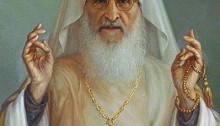
Fr. Alexander Schmemann in 1963

Fr. Alexander Schmemann was one of the observers at Vatican II, the landmark 1960s council of the Roman Catholic Church. His reaction to the event is priceless — Schmemann took the “opportunity to thank God” that he was Orthodox. Here’s the story, from the New York Times (11/16/1963):

A Russian Orthodox theologian-observer at the second session of the Vatican Council said Thursday that the gathering in Rome was “sobering from the Orthodox point of view.”

The Rev. Dr. Alexander Schmemann, dean of St. Vladimir’s Theological Seminary in Tuckahoe, N.Y., said that he had “no doubt the actions of the council thus far are good for the Roman Church itself.” But, he added, “the reality, unfortunately, is that they are far from ecumenity.”

Dr. Schmemann delivered his report on the council at the quadrennial sobor, or convocation, of the Russian Orthodox Greek Catholic Church in America. The sobor, at the Holy Virgin Protection Cathedral, 59 East Second Street, ended yesterday.

Dr. Schmemann, who was also vice chairman of the sobor, emphasized that he had not gone to Rome as an official delegate for his denomination but rather as a special guest.

He explained that the Moscow Patriarchate of Russian Orthodoxy had several official delegates at the council, as had the Russian Orthodox Church Outside Russia. The Russian Orthodox Greek Catholic Church severed administrative relations with the Moscow Patriarchate in 1924 and regarded the Russian Orthodox Church Outside Russia as a splinter group.

In his report to his denomination, Dr. Schmemann said he did not bear “any bad will” to Roman Catholicism. But, he said, considering the actions of the council in their ecumenical aspect, he had “opportunity to thank God” that he was Orthodox.

Dr. Schmemann’s objections to the council’s discussions were based on the Roman Catholic view of the papacy. “What builds a wall between the Roman Church and Eastern Orthodoxy is the doctrine of papal infallibility,” he said.

“There may be democritization going on,” the theologian added, “but so much of the Catholic Church is built on reverence of the Pope.”

He said that even the collegiality of the bishops was defined purely in its relationship with the papacy.

“In 17 lines of definition of the bishop in the schema on the church,” he went on, “the word ‘pope’ appears four or five times.

“In Eastern Orthodoxy it is our understanding that teaching about the Pope should be balanced with teachings about the bishops.”

Now, I’m no expert on Vatican II or Orthodox-Roman Catholic relations in general, so I don’t really have any commentary to add. But I stumbled upon this article in my collection and thought it might be of interest to others, so I figured I’d publish it here.

Tags: , , , , ,