Posts tagged African-American Orthodoxy
Newly-discovered documents on Fr. Raphael Morgan
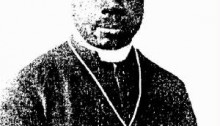
0We’ve devoted a fair amount of attention here at OrthodoxHistory.org to Fr. Raphael Morgan, the first black Orthodox priest in America. Very briefly: Morgan was born in Jamaica, traveled widely, and eventually became an Episcopalian deacon in the United States. In 1907, after many years of study, he traveled to Constantinople and was received into the Orthodox Church and ordained a priest. He was commissioned to establish an Orthodox mission for black Americans in Philadelphia. We know that he remained Orthodox through at least 1916, but we’ve found no traces of him after that.
In 1909, Morgan and his wife Charlotte divorced. Fr. Raphael retained custody of their 13-year-old daughter, Roberta Viola Morgan, while their 9-year-old son Cyril Ignatius lived with his mother. Charlotte later remarried, and I think Cyril went on to become some sort of Protestant minister in New York. The April 6, 1933 issue of the Philadelphia Tribune reported that “Rev. Cyril Morgan of New York was the weekend guest of his mother, Mrs. Charlotte Baylis[s]” in Wayne, PA. This is as far as I’ve been able to trace Cyril’s whereabouts, although I have found references to a Rev. Cyril T. Morgan of New York — who may or may not be our man – into the late 1940s.
Roberta Viola Morgan has proven more difficult to find — until now. The website Ancestry.com recently opened their travel and immigration records to the public, for an extremely short period of time. I took advantage of the opportunity to search for Morgan, and I quickly struck gold. I found an Emergency Passport Application for Roberta dated April 5, 1924. It turns out that she had been living in Greece from 1912 to 1924 (so, roughly ages 15-27). Here are some highlights:
- Roberta said that her father was “Rafael Morgan,” and that he was deceased.
- There are a bunch of question marks in the fields for Fr. Raphael’s US citizenship information, suggesting that Roberta didn’t know whether her father was a US citizen.
- She said that her permanent residence was “Waine” (Wayne), PA (where her mother lived).
- Roberta left the US in 1910, lived in England for two years, and then moved to Athens for the purpose of “education.”
- The application said that Roberta “knows no American citizen in Athens.”
There’s other good stuff, too — a photo of Roberta, a rather detailed description of her physical characteristics, etc. And it looks like Roberta’s passport application was approved: I also found a passenger manifest showing that Roberta arrived in New York on May 3, 1924. She listed her US address as 241 Island Ave. in Wayne, PA, which I assume was her mother’s home.
We can glean a lot from all this information. For one, we now know that Fr. Raphael Morgan died sometime between 1916 and 1924. We know that, almost immediately after his 1909 divorce, Morgan sent his daughter to live in Europe. And it’s not like it was a brief stay — the woman spent most of her teenage and young adult life in Greece. She probably didn’t see her mother in all that time, either.
We already have a passenger manifest for Fr. Raphael from 1911: he arrived back in the US from Greece in October of that year. Now that we have Roberta’s passport application, we can say rather confidently that Fr. Raphael was returning after leaving his daughter overseas. Also, this helps clear up an ambiguity: in his 1981 article on Morgan, the Greek Orthodox historian Paul Manolis wrote that an elderly Philadelphia Greek parishioner said that Morgan’s daughter was “a graduate of Oxford.” That seems highly unlikely — she was only in her mid-teens during her stay in England — but the parishioner correctly remembered that she was educated in the UK.
What could have motivated Fr. Raphael Morgan to send his teenage daughter across an ocean, and leave her there for the rest of his life? Why not just let her live with her mother, brother, and stepfather in Pennsylvania? My guess is that it’s because Morgan’s divorce was so hostile that he simply did not want his daughter anywhere near her mother.
And what was she doing all those years in Greece? Can you imagine a black American girl living in Greece for a decade? She may very well have remained Orthodox, given where she was. This new document answers some important questions, but it raises even more.
This article was written by Matthew Namee.
Fr. Raphael Morgan, the African Orthodox Church, and the Brotherhood of St. Moses the Black
I’m taking a moment to publish this piece in the midst of a very busy time for my family, so I apologize for the delay between some of my posts. What I wish to do is alert my readers to an article of mine that has now hit the press: “The Relationship of the African Orthodox Church to the Orthodox Churches and Its Importance for Appreciating the Brotherhood of St. Moses the Black,” Black Theology, an International Journal 8:1 (2010): 10-31.
Those desiring to read it may find the article here:
http://www.equinoxjournals.com/BT/article/view/6861/6042
This is not the most comprehensive look at any one of the people noted here (for example, I discussed Fr. Raphael Morgan to a greater extent in my dissertation, a work I am editing with the hopes of future publication). It is, however, the first time in academic print that Fr. Raphael Morgan has been linked to the African Orthodox Church and that church to the Brotherhood of St. Moses the Black. The former connection is historical and direct, the latter is a thematic connection.
Matthew Namee had mentioned the connection of Fr. Raphael and the AOC in a post on SOCHA’s website:
http://orthodoxhistory.org/2009/07/indirect-conversion-of-thousands-theory/
So, interested readers now have the opportunity to learn more about the connections that some of us have known about but not published about extensively.
[This article was written by Fr. Oliver Herbel and originally published on Frontier Orthodoxy.]
Fr. Antony Hill: the second black Orthodox priest in America
After a week’s worth of articles on the Archbishop Arseny criminal libel case, I thought I’d break things up a bit by looking at something completely different — the story of Fr. Antony Hill, the second black Orthodox priest in America.
By now, a lot of people know that Fr. Raphael Morgan was the first black Orthodox priest in America, ordained in 1907 and based out of Philadelphia’s Greek church. But the second black priest in America, and the first under the Russian Archdiocese, is still virtually unknown. And, while Morgan’s life is full of mystery, the man who followed him — Fr. Antony Hill — is even more of an enigma.
We don’t know when Hill was born, where he was born, or how he came to join the Orthodox Church. His given name was Robert F. Hill, and the first traces I’ve found of him are from a New York Times article dated January 3, 1921. Orthodox and Episcopalian clergy had gathered together for a prayer service, asking God to restore the Hagia Sophia in Constantinople to the Orthodox. The Orthodox included Russians, Greeks, Serbs, and Syrians, and among the Russian contingent was “the Very Rev. Anthony R.F. Hill, a canon of the Russian Cathedral.” Also in the group was another recent American convert, Fr. Stephen (Geoffrey) Lang.
Several months later, in September 1921, Hill and Fr. Patrick Mythen attended the First General Synod of the brand-new “African Orthodox Church.” As we’ve discussed before, this noncanonical body was headed by “Patriarch” George Alexander McGuire, who had been consecrated by the vagante Old Catholic bishop Joseph Rene Vilatte. McGuire was an associate of Marcus Garvey, and he most likely had known Fr. Raphael Morgan.
In the 1956 book The History of the African Orthodox Church, A.C. Terry-Thompson writes extensively about the AOC’s initial General Synod. From Terry-Thompson, we know that Fr. Patrick Mythen gave a rousing speech on the Synod’s first day, comparing the AOC’s organizers to Christ’s apostles in the upper room on Pentecost, and expressing the hope that all of Orthodoxy would accept the AOC as a legitimate Church. Hill then offered a few words, “recording his earnest desire to see us launch out successfully.”
Shortly after this, Hill decided to leave the Russian Archdiocese and throw his lot in with the African Orthodox Church. He became rector of the Church of the Good Shepherd, which had been McGuire’s parish before he became a bishop. It was Hill who, on September 15, seconded the motion that the new ecclesiastical body be known as the “African Orthodox Church.” The next day, he was appointed dean of the AOC’s seminary. In other words, he was a major player in the new organization.
In his book Words Like Freedom: Essays on African American Culture and History (1996), Richard Newman writes that Hill “was released by the Russians to work with McGuire and the fledgling AOC.” Further on, though, Newman says that Hill “was excommunicated by the Russians.” I find it hard to believe that the Russian Archdiocese would actually release Hill to a noncanonical body. However, in 1921, Archbishop Alexander Nemolovsky was primate of the Russian Archdiocese. He was a highly ineffective hierarch, and he delegated an unusual amount of authority to Fr. Patrick Mythen. Given Mythen’s own affinity for the AOC, it’s very possible that Mythen himself granted Hill a “release,” but that later Russian leaders recognized this as irregular and went on to defrock Hill.
Hill lasted about 13 years in the AOC. According to Terry-Thompson, “Due to some difference of policy Father Anthony resigned his post late in 1934.” It’s worth noting that 1934 is the same year that Patriarch McGuire died, and it’s possible that Hill’s resignation was part of the fallout from McGuire’s death. Richard Newman writes, “When he left the AOC he founded an independent church in Harlem.” Newman adds, “This story needs to be told.” Alas, Newman died in 2003, so we can’t ask him for more information.
Hill’s career in the Russian Archdiocese must have been extremely brief. He most likely joined the Russians in mid-to-late 1920, when Fr. Patrick Mythen’s short-lived, English-speaking Church of the Transfiguration was in operation in New York City. We know that he left Orthodoxy in September 1921, when he joined the AOC. But beyond the scant details I’ve presented in this article, we know next to nothing else about Fr. Antony Hill.
[This article was written by Matthew Namee.]
Fr. Raphael Morgan against Marcus Garvey

Marcus Garvey
Marcus Garvey was a widely influential black nationalist from Jamaica. He promoted black pride and championed the “back to Africa” movement. In 1916, when he was just 29 years old and at the outset of his public career, he visited the United States and embarked on a 38-state speaking tour. Not all of the black Americans who attended his lectures liked what they heard. Among those unhappy with Garvey was Fr. Raphael Morgan, the first black Orthodox priest in America. As we’ve discussed in the past, Morgan was born in Jamaica, and in 1916, he was living in Philadelphia, affiliated with the city’s Greek Orthodox church. In response to Garvey’s speeches, Morgan and some associates addressed the following letter to the editors of the Jamaican newspapers:
Philadelphia, U.S.A.
September 19, 1916
The Editor, Dear Sir, –
We the undersigned Jamaicans, residents of the United States for several years beg your permission to call to your attention and the public of Jamaica a matter affecting the welfare of Jamaicans at home and abroad.
Under the caption of Journalist and President of the Universal Negro Improvement Association, Jamaica, W.I., one Marcus Garvey, Jr., is giving an extended series of lectures in this Country, pertaining to the social and economic conditions of Jamaica.
We, having attended his lectures, found them to be pernicious, misleading, and derogatory to the prestige of the Government and the people.
Among the many assertions of the speaker are the following: –
1. Governmental misrule, causing economic depression, poverty, and misery with their detrimental consequences.
2. The falsity and hypocrisy of the existing social condition between the white and black races – to wit:
Absorption by inter-marriage of the intellectually superior and advanced blacks with whites, with the view of estranging and nullifying their usefulness to their race.
Result – Acquiescence, arrogance, and unapproachableness, on the part of these blacks who inter-marry. The white wife tires. There is an ultimate separation. Wife returns to her native land. Husband in Jamaica contributes to her support abroad.
3. The Governmental and Commercial interests connive to keep the scale of wage so low that the labouring classes are unable to meet the necessary demands to sustain their needsand wants. The girls of Jamaica are resorting to vice and immorality through lack of industrial opportunities and poor economic conditions. Praedial larceny is rampant and the jails are filled[.] Education is restricted and limited to the children of the poorer classes causing intellectual deficiency to the masses.
4. He drew a deplorable picture of the prejudice of the Englishman in Jamaica against the blacks, portraying hypocrisy and deceit of his attitude towards the blacks, and stated his preference for the prejudice of the American to that of the Englishman.
Mr. Editor, the above are only a few of the damaging statements being disseminated by the aforesaid Marcus Garvey, Jr., among the American public.
Further details would be a repetition of the demoralising utterances of the speaker.
The bad effects of these lectures on the minds of the American public are deplorable and are causing great indignation among Jamaicans here, who feel greatly humiliated.
Thanking you for space and hoping through this medium Jamaicans will be enlightened on the seriousness of this matter. We are,
Father Raphael, O.C.G., Priest-Apostolic, the Greek Orthodox Catholic Church, Dr. Uriah Smith, Ernest P. Duncan, Ernest K. Jones, H.S. Boulin, Phillip Hemmings, Joseph Vassal, Henry H. Harper, S.C. Box, Aldred Campbell, Hubert Barclay, John Moore, Victor Monroe, Henry Booth and many others.
This letter was published in the Kingston Gleaner (10/4/1916) and the Jamaica Times (10/7/1916). A month later, Marcus Garvey issued a reply. According to the Gleaner (11/14/1916), “Mr. Garvey said that the letter which is a concoction and a gross fabrication, was written by his enemies in Jamaica and sent to Philadelphia to be transmitted to the Gleaner, for the purpose of prejudicing him in the eyes of the Government and those who have always wished him well in his efforts in Jamaica, as well as with the intention of interfering with his success in America.”
The original letter, by Morgan and friends, raises all sorts of questions. Take, for instance, the letters after Morgan’s name — “O.C.G.” From other sources, we know that this stands for “Order of the Cross of Golgotha,” a body of which Morgan was the “founder and superior.” But what, exactly, was the Order of the Cross of Golgotha? Roman Catholicism has all sorts of religious “orders,” but the concept is exceedingly rare among the Orthodox. I suspect, but cannot prove, that Morgan may have created the Order for black Americans. Were the other 13 signers of the Garvey letters members of this Order? Was its membership restricted to Orthodox Christians, or did Morgan welcome non-Orthodox to join? Was its establishment blessed by the Church of Greece — of which Morgan was a priest — or was Morgan operating independently? The whole Order is almost a complete mystery.
Could Morgan’s fellow signers provide clues, both about the Order and about Morgan’s whereabouts after 1916? Many of the signers seem to have been working-class people. Here are a few of them, with ages and occupations from the 1910 or 1920 Censuses:
- Ernest K. Jones, 37, construction worker
- Philip Hemmings, 43, sailor
- Henry H. Harper, 29, waiter
- John Moore, 51, contractor
- Henry Booth, 32, laborer
I found another signer, Hubert Barclay, on an Ellis Island passenger manifest dated March 31, 1915 (i.e., about 18 months prior to the Garvey letter). Barclay, a 42-year-old coachman, was coming to the US from Jamaica. He was born in Chapelton, Clarendon, Jamaica — the same town as Fr. Raphael Morgan. The two men probably grew up together.
H.S. Boulin was the owner of a black doll company in Harlem. And while he signed the 1916 letter against Garvey, he eventually became one of Garvey’s closest confidants. Unbeknownst to Garvey, though, Boulin was also Agent P-138 — a spy for J. Edgar Hoover’s new Federal Bureau of Investigation. Here’s some background on Boulin, from Robert A. Hill’s multivolume collection of Garvey documents:
Born in Kingston, Jamaica, in 1873, Herbert Simeon Boulin served in the British army from 1902 until 1907. After spending most of his term of service in Africa, he returned to Jamaica in 1907. In 1908 he visited Philadelphia, where he decided to make his home. He opened up a school for teaching shorthand, but it soon failed. Afterward, he worked as a laborer at a local shipyard and then as an employee of the Pinkerton Detective Agency between 1915 and 1920. In January 1920 Boulin became a U.S. citizen. In July 1920 he was hired by the Bureau of Investigation to investigate the Garvey movement. After J. Edgar Hoover sent him a letter terminating his services in August 1921, Boulin opened his own detective agency, promoting his services by advertising his status as a former employee of the Department of Justice.
Boulin infiltrated Garvey’s organization, funneling information back to FBI headquarters. I’d guess that Boulin met Morgan in 1908, upon his arrival in Philadelphia. It’s entirely possible that there is information on Morgan — by way of Boulin — in the FBI archives.
Philip Hemmings also became close with Garvey, although in his case, he was no secret agent. In 1920, he was one of the signers of Garvey’s famous “Declaration of Rights of the Negro Peoples of the World.” Another signer of the 1920 Declaration was a man named George Alexander McGuire. Of course, we’ve talked about McGuire before — he was a black Episcopal priest from the West Indies, and he almost certainly knew Fr. Raphael Morgan. Later, in 1921, he established a noncanonical body called the “African Orthodox Church.” McGuire and Marcus Garvey eventually had a falling-out, but the African Orthodox Church spread to Africa itself, and the group in Africa ultimately joined the canonical Orthodox Patriarchate of Alexandria.
The 1916 letter against Marcus Garvey is the last thing I’ve found on Fr. Raphael Morgan. After that, Morgan vanishes from the historical record. His end is one of the great mysteries of American Orthodox history.
The Sorcerer on the Golden Horn

The following is a translation from the French of the article “Un Conquete du Patriarcat Oecumenique,” from Échos d’Orient, Volume 11, 1908, concerning Fr. Raphael (Robert Josias) Morgan, the first black Orthodox priest in America. The article uses his middle name “Josias.”
The translation was done using Google Translate with a little cleaning afterward. A few pf the phrases made sense neither to Google nor to me, but I tried my best with my rudimentary French. Corrections are welcome. This article was originally spotted by Matthew Namee.
A CONQUEST OF THE ECUMENICAL PATRIARCHATE The Church of Constantinople recorded last summer a resounding conquest, which has made local headlines for days in the newspapers and halls of the capital. An American clergyman, a native of the English Antilles [the West Indies], a negro of the finest black, the Reverend Robert Morgan, after a few weeks of living on the shores of the Golden Horn, has had the singular grace of seeing the light of Tabor and being admitted into Orthodoxy. His [prior] baptism worthless, like all unbelievers who live outside the Orthodox Church, the said negro, a robust fellow of about thirty-five years, was plunged three times from head to toe in the font of purification, and came out white, one of the flock of the great Church of Christ. After which, the neophyte, wishing to obtain the sacred order of priesthood that he was only supposed to have before, was ordained priest by Mgr. Joachim Phouropolos, a Metropolitan expelled from Monastir [present day Bitola, FYROM - edited thanks to comment!], who recited the prayers of the Pontifical in English. Since then, the ex-Reverend Morgan, now become Father Josias Morgan, said Mass in the Byzantine rite in the English language [emphasis in original].
This is how this this actually happened. It is understandable that this is of public interest in Constantinople, which really lacks entertainment.
I saw Father Josias, and one summer morning I mounted with him the green and sunny shores of the Bosphorus. At the pier of the Chirket, with the wide sleeves of his rasso, in his kamilafki all brand new, and with his booming voice, he attracted the attention of all, to the delight of the Greeks, proud of their booty, and to the great amusement of young Ottoman officers accustomed to seeing people of color in the company of Turkish women. Having gone to see an Englishman of my acquaintance, I told him of my meeting. I now literally transcribe the brief dialogue that ensued between us:
- “M. G…, I saw this morning, one of your compatriots.”
- “Where was this?”
- “On the boat Chirket.”
- “Where is he from?”
- “I think he is from Jamaica.”
- “Introduce him to me, so I may make his acquaintance,” said my friend who has long lived in this island.
- “I will do so, but I must warn you that he is a negro.”
- “Oh! Well, don’t introduce me.”
- “I should add he became a Greek priest.”
- “A Greek priest! You are confused and this must be a sorcerer.”
- “I’ve never seen a negro sorcerer, but I know enough of the dress of Orthodox priests such that there is no error on my part.”
- “You’re right, after all; this does not surprise me.”
- “What! I am surprised by this very much.”
- “The negroes are very religious.”
- “Really?”
- “Indeed, yes, they have so much religion that they change it every week.”
My friend was wrong. Many weeks have passed since our conversation, and Father Josias remained faithful to the Orthodox Church. He left Constantinople for Philadelphia in the United States in the first days of November, carrying 28 Turkish lira (a lira is worth about 23 francs) which was given by the holy synod for his travel expenses.
What will he do in his country? Certainly, [he will] found an Orthodox church of negroes. But what else? That’s what we know, and in fact, the first goal was good enough [et d'ailleurs le premier but suffit - edited thanks to Facebook comment!]. It seems, however, that the Reverend Morgan had intended, embracing Orthodoxy, to be consecrated bishop. The Holy Synod declined, and I think it was wrong. The ordination of a bishop of color would have rendered invaluable services.
Firstly, being an American and a member of the Ecumenical Patriarchate, said Morgan would have exercised jurisdiction over all the Greeks settled in America. Hence a great advantage would be obtained by the Phanar over the Church of Athens. At the same time, the latter took their revenge. Indeed, if the Greeks of America continue to ask for a bishop, they will want a white [one], of course. They are a people of such a taste and wit as never to accept a negro bishop, even were he the eunuch of Queen Candace [of Ethiopia]. From the day they would have imposed Morgan as Bishop on them, they would have returned to the motherland; which contrasts with Athens on the question of emigration, which furnished to Cabinet Theotokis ten thousand conscripts who lack the necessary annual [pay] [et fournissait au Cabinet Theotokis les dix mille conscrits nécessaires qui lui manquent annuellement].
It is really unfortunate that the Church of Constantinople had not thought of all these advantages and has left the negro Morgan unconsecrated as bishop.
Update: It should be noted that the posting of this historical article should in no way be construed as an endorsement of the opinions expressed therein.