Posts tagged Albanian

Professor Basil Bensin

This week in American Orthodox history (February 6-12)

0

February 6, 1993: Bishop Job Osacky was enthroned as the new OCA Bishop of Chicago, almost exactly ten years after his consecration to the episcopate. Bishop (and later Archbishop) Job went on to become a key advocate for transparency in the recent OCA crisis before his untimely death in 2009.

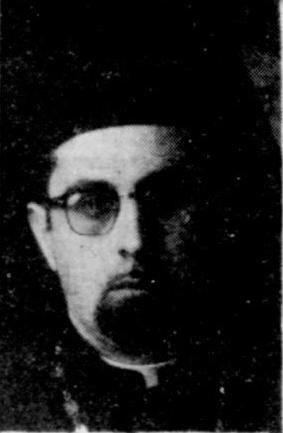
Professor Basil Bensin

February 8, 1973: St. Vladimir’s Seminary professor Basil Bensin died in North Carolina. Bensin lived an eventful life. Born in Russia in 1881, he met St. Tikhon (then the Bishop of North America) in 1903, when Tikhon was on a visit to St. Petersburg. Tikhon recruited Bensin to come to America, taking a position as professor at the first Russian seminary in Minneapolis from 1905-1912. In 1912, he earned a degree in agricultural sciences from the University of Minnesota — a credential which would come in handy later. The seminary moved to Tenafly, NJ, and Bensin continued to teach until the turmoil following the Bolshevik Revolution made seminary life impossible. Bensin moved to Czechoslovakia for a decade before returning to America to work as an agricultural engineer in Alaska. When St. Vladimir’s Seminary was established in 1938, Bensin was one of the original professors, and he remained at SVS until his retirement in 1952. In retirement, Bensin continued his scholarly work, devoting a lot of time to researching the history of Orthodoxy in America. He produced only a few articles on the subject, but there must be valuable material in his notes (which are kept at SVS). (My sources for this information are Bensin’s obituary in St. Vladimir’s Theological Quarterly and a short biography at the Hoover Institution website.)

February 9, 1908: Bishop Raphael Hawaweeny ordained Theophan Noli, an Albanian student at Harvard, to the priesthood, on behalf of Russian Archbishop Platon Rozhdestvensky. Two years ago, I wrote about Noli’s first Albanian liturgy, but I erroneously said that Archbishop Platon had performed Noli’s ordination. But apart from that mistake, that old article is still pretty decent, and if you want to know more about Noli, you might check it out.

February 11, 1962: In Damascus, Fr. Michael Shaheen was consecrated as the Antiochian Bishop of Toledo, Ohio. This is a complicated story, and I don’t have time to tell it all here, but the gist of it is this: Since the mid-1930s, the Antiochians in America had been divided into two overlapping jurisdictions — the Archdiocese of New York (led by Metropolitan Antony Bashir) and the Archdiocese of  Toledo (led by Metropolitan Samuel David). Met Samuel had died in 1958, and after a lot of behind-the-scenes machinations, the Antiochian Holy Synod chose Archimandrite Michael Shaheen to replace him. But Shaheen was a priest of the New York — not Toledo — Archdiocese, and although he was consecrated with the title “Bishop of Toledo,” in reality he was to serve merely as an auxiliary to Met Antony. In this way, it was hoped, the two Antiochian jurisdictions would be united at last. But it didn’t work: the Toledo parishes refused to accept Bp Michael unless he denounced Met Antony. In response to the impasse, the Holy Synod changed course, recognizing Toledo as an independent diocese and raising Bp Michael to the rank of Metropolitan. In this way, the Antiochian schism persisted for another 13 years, until Metropolitan Michael accepted a demotion of sorts, recognizing the authority of Bashir’s successor Metropolitan Philip Saliba for the sake of unity.

February 12, 1907: Bishop Platon Rozhdestvensky was elected to the Second State Duma (equivalent to a parliament) in Russia. Within months, he would replace Archbishop Tikhon Bellavin as primate of the Russian Archdiocese in North America.

Fr. Theophan Noli, March 1908

Today in history: the first Albanian liturgy

Fr. Theophan Noli, March 1908

As far as Albanian Orthodox history in America goes, there’s no bigger figure than Metropolitan Theophan — or “Fan” — Noli. He’s best known for his three-plus decades as bishop of the Albanian jurisdiction which ultimately joined the Russian Metropolia (and which is now the Albanian Archdiocese of the OCA). Before that, he was the head of the Orthodox Church in Albania. And for five months in 1924, Metropolitan Theophan served as the Prime Minister of Albania. While he was the primate of an Orthodox Church. It was a crazy time.

Anyway, before all of that, Noli was in the United States. He arrived in 1906, when he was 24 years old. He made his way to Boston, where he enrolled at Harvard University. At the time, the Albanians in Boston attended the city’s Greek parish. According to the 1975 OCA book Orthodox America: 1794-1976, “After a series of problems with the local Greek priest, these Albanian immigrants wanted to have their own Albanian priest and for this task selected Fan Noli.”

In March of 1908, the Russian Archbishop Platon ordained Noli to the priesthood. Just days later, Noli used his own translation of the Divine Liturgy to serve the first-ever Orthodox Liturgy in the Albanian language. Not just the first in America — the first ever, period. In fact, it was Noli who later brought the Albanian-language Divine Liturgy to Albania itself; before that, all the services were in Greek. This landmark Liturgy took place on March 22, 1908 — so, 102 years ago today. Here is the report that appeared in the Boston Globe two days later:

Rev Fan S. Noli, pastor of the Albanian Orthodox diocese of the United States and Canada, conducted the first service ever held in the Albanian tongue in Boston at Knights of Honor hall, 730 Washington st, Sunday evening. More than 500 Albanians were present, and Rev Mr Noli delivered an interesting address in which he explained the aims and progress of the movement in this country.

Rev Mr Noli was born in Adrianople, Turkey, and educated in the Greek high school and the French college in that city. In the two years following his graduation, he was in business in Asia Minor, and this was followed by five years’ newspaper work in Greece and Egypt. He then put in two years as a professor of French and Greek in a school in Egypt. His school work palled on him and he determined to sail for this country.

Shortly after his arrival in Boston, which was his objective point, he became assistant editor of the Albanian weekly newspaper, the Kombi. He found time to study for the priesthood and was ordained March 8, in the Russian cathedral, East 97th st, New York. He is the master of a number of languages, among which are Greek, French, English, Italian, Arabic, Turkish and some German, in addition to his native speech.

Rev Mr Noli said that there are about 30,000 of his countrymen in the United States, and that most of them are communicants of the Greek Orthodox church. Speaking of Albania, a province in Macedonia, he said that its 3,000,000 inhabitants are divided among three religious faiths, Roman Catholicism, the Greek church and Mahometanism. The country has been under Turkish domination since the death of its last king, George Castriot, in 1463. There has never been any religious strife in Albania, but the Turkish government forbids the use of the Albanian language in the schools, and every book and pamphet [sic] written in that tongue is confiscated.

The Greek patriarch anathematized the Albanian translations of the Bible, which were purchased from the Bible society of London, and all these copies were confiscated. In the face of such difficulties it was impossible for national unity, as the leaders were persecuted and condemned to exile or death.

Fr Noli intends to establish churches wherever he finds his countrymen, in this country, Roumania, Russia and Egypt. He has translated the service book into his native tongue, and he intends to render other religious works into Albanian for his people.

I’m a tad skeptical of Noli’s claim that there were 30,000 Albanians in America in 1908. The 1916 Census of Religious Bodies reports 410 Albanian Orthodox in two churches. By 1926, there were 1,993 parishioners in nine parishes, and in 1936, those numbers had grown to 3,137 people in 13 congregations.

Noli traveled to Albania in 1913, where he served the first Albanian-language church service in Albania itself. With the onset of World War I, he returned to the US, eventually becoming the official administrator of the Albanian parishes under the Russian Archdiocese. When the war ended, Noli again went to Albania, where he became deeply involved in politics. In 1923, he was consecrated a bishop, the new head of the Albanian Orthodox Church. He became Prime Minister of Albania the next year, but was soon expelled from the country. In 1932, he returned to the US and headed the Albanian Archdiocese until his death on March 13, 1965.

Language in American Orthodoxy, 1916 (reposted from 8/21/09)

To our New Calendar readers: Christ is born!

The following article was originally published on August 21, 2009. If you’re interested, you might check out the comments to that original posting. We’ll be back with brand-new material on Monday, December 28.

As you might expect, most American Orthodox parishes in 1916 used foreign languages. From that year’s Census of Religious Bodies, conducted by the U.S. Census Bureau, we find the following unsurprising information:

  • Both of the Albanian parishes used exclusively Albanian.
  • The four Bulgarian parishes used Bulgarian and Slavonic.
  • The 87 Greek parishes used exclusively Greek.
  • Both of the Romanian parishes used exclusively Romanian and Slavonic.
  • 166 of the 169 Russian parishes used exclusively Slavonic. Of the other three, two used a combination of Slavonic and English, and one used exclusively English.
  • 11 of the 12 Serbian parishes used exclusively Slavonic and/or Serbian. One Serbian parish used exclusively English.

In total, there were 276 parishes in the United States in 1916, not counting the Syrians. 272 of those 276 (98.55%) worshipped entirely in foreign languages, and just two used English only.

None of this should come as a surprise. The vast majority of American Orthodox Christians in 1916 were either immigrants, or the children of immigrants. And the vast majority of American Orthodox clergy were also immigrants, most of whom had been educated and ordained in the Old World.

Now we come to the Syrians… and as we’ve seen before, the Syrians are an outlier. This is what the 1916 Census has to say:

Of the 25 organizations, 13, with 4,361 members, reported services conducted in English only; and 12, with 7,230 members, reported services conducted in foreign languages alone or with English. Of these, 4 organizations, with 1,230 members, reported the use of Arabic alone or with English; 5, with 2,900 members, Arabic, Greek, and English; and 3, with 3,100 members, Arabic, Greek, Russian, and English. In 1906 all the organizations then represented reported the Syro-Arabic language only.

This is stunning. Ten years earlier, in 1906, the Syrians were like everybody else, worshipping exclusively in their native tongue. In 1916, everybody else was pretty much the same — 98.55% foreign. But in just a decade, the Syrians had changed dramatically. By 1916, at least 21 of the 25 Syrian parishes (84%) used at least some English in their church services, and over half (13 of 25) were entirely in English.

How on earth did this happen? I don’t have a clear answer; however, there is one clue. In 1905, an Episcopal priest named Ingram Irvine converted to Orthodoxy. He was ordained by Ss. Tikhon and Raphael, took the name “Fr. Nathaniel,” and for about two years, he served in the Russian Mission. His purpose was “English work.” He wrote articles in English, published a couple of small books, and conducted an English-language Vespers service on Sunday nights. He also helped St. Tikhon with English-language administrative work, and advised him on Anglican-Orthodox relations.

Irvine is one of my favorite figures in American Orthodox history, and we’ll talk about him in great detail in the future, but for now, it’s enough to know that he transferred to St. Raphael’s jurisdiction after St. Tikhon returned to Russia in 1907. And Irvine’s transfer also meant the transfer of the “English work.” Now, his English articles appeared in the otherwise all-Arabic Al Kalimat (The Word). He made it his special mission to reach out to the English-speaking children of Arabic immigrants to America. He taught Sunday School, ghostwrote letters for St. Raphael, and generally promoted the use of English in the Syrian Mission. He did this at the direction and with the encouragement of St. Raphael; when St. Raphael died in 1915, Irvine wrote, “With Bishop Raphael’s death ended the initiatory Chapter of English Orthodox Church work in America.”[*]

I don’t think Irvine alone was responsible for the great proliferation of English in the Syrian Mission in the years 1906-1916, but he must have played a major role. Just thinking out loud, another factor may have been the weaker national identification with Orthodoxy among the Syrians. What I mean is this: to be a Russian, a Greek, or a Serb was to be Orthodox. National identity and religious affiliation were intimately intertwined, to the point that they were one and the same. But it was not so among the Syrians. They came, not from their own nation-state, but from the Ottoman Empire. And they also came from a region of great religious pluralism — back in Syria, they lived alongside Melkites, Maronites, Muslims, and Druze. In other words, while Slavonic, Greek, and Serbian culture (and language) was closely identified with Orthodoxy, the same could not be said of Syro-Arab culture and language. And it’s possible (though I can’t prove it) that this distinction was a major factor in the spread of English among the Syrians, while the rest of American Orthodoxy was still firmly attached to foreign languages.

Finally, Fr. John Erickson offered this comment upon seeing the language data:

In light of the very large number of parishes St Raphael’s Syrian mission that used only English or predominantly English, another question that might be interesting to explore would be the extent to which, in the years immediately following, the “Antacky” advocated the use of Arabic or otherwise resorted to identity politics.

At present, I don’t have any idea whether the Russy-Antacky divide involved language, but it is a question I will have to explore (and if anyone wants to help, please let me know!)
____________________________________________________________
[*] Ingram N.W. Irvine (Fr. Nathaniel), “Bishop Raphael, In His Relation to the English Work of the Archdiocese of North America,” Russian Orthodox American Messenger 19:5 (March 15, 1915), 72.

Language in American Orthodoxy, 1916

As you might expect, most American Orthodox parishes in 1916 used foreign languages. From that year’s Census of Religious Bodies, conducted by the U.S. Census Bureau, we find the following unsurprising information:

  • Both of the Albanian parishes used exclusively Albanian.
  • The four Bulgarian parishes used Bulgarian and Slavonic.
  • The 87 Greek parishes used exclusively Greek.
  • Both of the Romanian parishes used exclusively Romanian and Slavonic.
  • 166 of the 169 Russian parishes used exclusively Slavonic. Of the other three, two used a combination of Slavonic and English, and one used exclusively English.
  • 11 of the 12 Serbian parishes used exclusively Slavonic and/or Serbian. One Serbian parish used exclusively English.

In total, there were 276 parishes in the United States in 1916, not counting the Syrians. 272 of those 276 (98.55%) worshipped entirely in foreign languages, and just two used English only.

None of this should come as a surprise. The vast majority of American Orthodox Christians in 1916 were either immigrants, or the children of immigrants. And the vast majority of American Orthodox clergy were also immigrants, most of whom had been educated and ordained in the Old World.

Now we come to the Syrians… and as we’ve seen before, the Syrians are an outlier. This is what the 1916 Census has to say:

Of the 25 organizations, 13, with 4,361 members, reported services conducted in English only; and 12, with 7,230 members, reported services conducted in foreign languages alone or with English. Of these, 4 organizations, with 1,230 members, reported the use of Arabic alone or with English; 5, with 2,900 members, Arabic, Greek, and English; and 3, with 3,100 members, Arabic, Greek, Russian, and English. In 1906 all the organizations then represented reported the Syro-Arabic language only.

This is stunning. Ten years earlier, in 1906, the Syrians were like everybody else, worshipping exclusively in their native tongue. In 1916, everybody else was pretty much the same — 98.55% foreign. But in just a decade, the Syrians had changed dramatically. By 1916, at least 21 of the 25 Syrian parishes (84%) used at least some English in their church services, and over half (13 of 25) were entirely in English.

How on earth did this happen? I don’t have a clear answer; however, there is one clue. In 1905, an Episcopal priest named Ingram Irvine converted to Orthodoxy. He was ordained by Ss. Tikhon and Raphael, took the name “Fr. Nathaniel,” and for about two years, he served in the Russian Mission. His purpose was “English work.” He wrote articles in English, published a couple of small books, and conducted an English-language Vespers service on Sunday nights. He also helped St. Tikhon with English-language administrative work, and advised him on Anglican-Orthodox relations.

Irvine is one of my favorite figures in American Orthodox history, and we’ll talk about him in great detail in the future, but for now, it’s enough to know that he transferred to St. Raphael’s jurisdiction after St. Tikhon returned to Russia in 1907. And Irvine’s transfer also meant the transfer of the “English work.” Now, his English articles appeared in the otherwise all-Arabic Al Kalimat (The Word). He made it his special mission to reach out to the English-speaking children of Arabic immigrants to America. He taught Sunday School, ghostwrote letters for St. Raphael, and generally promoted the use of English in the Syrian Mission. He did this at the direction and with the encouragement of St. Raphael; when St. Raphael died in 1915, Irvine wrote, “With Bishop Raphael’s death ended the initiatory Chapter of English Orthodox Church work in America.”[*]

I don’t think Irvine alone was responsible for the great proliferation of English in the Syrian Mission in the years 1906-1916, but he must have played a major role. Just thinking out loud, another factor may have been the weaker national identification with Orthodoxy among the Syrians. What I mean is this: to be a Russian, a Greek, or a Serb was to be Orthodox. National identity and religious affiliation were intimately intertwined, to the point that they were one and the same. But it was not so among the Syrians. They came, not from their own nation-state, but from the Ottoman Empire. And they also came from a region of great religious pluralism — back in Syria, they lived alongside Melkites, Maronites, Muslims, and Druze. In other words, while Slavonic, Greek, and Serbian culture (and language) was closely identified with Orthodoxy, the same could not be said of Syro-Arab culture and language. And it’s possible (though I can’t prove it) that this distinction was a major factor in the spread of English among the Syrians, while the rest of American Orthodoxy was still firmly attached to foreign languages.

Finally, Fr. John Erickson offered this comment upon seeing the language data:

In light of the very large number of parishes St Raphael’s Syrian mission that used only English or predominantly English, another question that might be interesting to explore would be the extent to which, in the years immediately following, the “Antacky” advocated the use of Arabic or otherwise resorted to identity politics.

At present, I don’t have any idea whether the Russy-Antacky divide involved language, but it is a question I will have to explore (and if anyone wants to help, please let me know!)
____________________________________________________________
[*] Ingram N.W. Irvine (Fr. Nathaniel), “Bishop Raphael, In His Relation to the English Work of the Archdiocese of North America,” Russian Orthodox American Messenger 19:5 (March 15, 1915), 72.

Go to Top