Posts Tagged ‘Antiochian’

11
Mar

St. Raphael and the Episcopalians in 1910

   Posted by: Matthew Namee    in Saints

St. Raphael Hawaweeny

At the turn of the last century, relations between the Orthodox and Anglican Churches were quite warm. They cooled a bit in 1905, when St. Tikhon ordained the former Episcopal priest Ingram Nathaniel Irvine to the Orthodox priesthood, but even so, many on both sides of the dialogue felt that full union would eventually happen.

In England in 1896, a body was formed called the “Anglican and Eastern Orthodox Churches Union.” A dozen years later, in 1908, a group of High Church Episcopalians decided to establish an American branch of the organization. Several Orthodox leaders attended the first meeting in New York City, including the Syrian Bishop Raphael Hawaweeny and two of his clergy, the Fr. Benedict Turkevich (representing the Russian Archdiocese), and Fr. Methodios Korkolis (representing the Greeks). During the meeting, St. Raphael was elected to be the Orthodox Vice President.

The Episcopalians had an ambitious agenda: they wanted the Orthodox to recognize their holy orders as valid; indeed, they wanted to be recognized as a Local Church, just as “Orthodox” as Russia or Antioch. The Orthodox, and St. Raphael in particular, had much more modest goals. They wanted to promote friendly dialogue, with initiatives such as seminarian exchanges.

All the while, St. Raphael faced a monumentally difficult pastoral situation. His flock was scattered across North America, and many lived far away from any Orthodox church, Syrian or otherwise. In 1909, the Episcopalians suggested that he have the Anglican Book of Common Prayer translated into Arabic, so that the Syrians could worship with the Episcopalians. Raphael responded that it would be better for the Episcopalians to buy some Orthodox service books for their churches, so that the Syrians could use them if they visited.

In June of 1910, Raphael went even further, granting formal permission for his people to seek the ministrations of Episcopal clergymen in the event that no Orthodox priest was available. Here is his letter, which I am reprinting from the Journal of the Proceedings of the One Hundred and Ninth Annual Convention of the Protestant Episcopal Church in the Diocese of New Hampshire (November 1910):

Right Reverend and Reverend Brothers:—

I thank God for the great work which is being done by our Union, in the way of promoting fellowship and a better understanding between the Holy Orthodox and Anglican Churches.

I assure you also of my full appreciation of all the kindnesses and courtesies extended to me and my people.

Now, in order that all complications may be avoided in the matter of mixed Services, that is, when a Syrian Orthodox may desire to have any Sacrament performed by a Bishop or Priest of the Anglican Communion in North America, I offer briefly some of our rules, as Orthodox Catholics, which, if possible, I beg to have enforced.

However, in this matter I am only speaking for myself personally, as an Orthodox Bishop, and in no way binding my brother Orthodox Bishops in North America. I speak alone for the Syrian people.

First:—It is against our Law to marry two brothers to two sisters.

Second:—It is equally contrary to the same law to marry a man to a deceased wife’s sister, and vice versa.

Third:—We do not permit marriage within the fourth degree of consanguinity.

Fourth:—Civil Divorces are not acknowledged by the Orthodox Church, unless for causes she sanctions; and, therefore, no civilly divorced person can be reunited in wedlock to another party, unlets divorced by the Church, as well as by the State.

Fifth:—The Orthodox Church requires that a child shall be baptized by a Trine Immersion in the water, and be immediately afterwards Chrismated.

Inasmuch as there is a variance between your and our Churches in these matters, I suggest that, before any marriage Service is performed for Syrians desiring the services of the Protestant Episcopal Clergy, where there is no Orthodox Priest, that the Syrians shall first procure a license from me, their Bishop, giving them permission, and that, where there is a resident Orthodox Priest, that, the Episcopal Clergy may advise them to have such Service performed by him.

Again, in the case of Holy Baptism, that, where there is no resident Orthodox Priest, that the Orthodox law in reference to the administra

tion of the Sacrament be observed, namely immersion three times, with the advice to the parents and witnesses that, as soon as possible, the child shall be taken to an Orthodox Priest to receive Chrismation, which is absolutely binding according to the Law of the Orthodox Church.

Furthermore, when an Orthodox Layman is dying, if he confesses his sins, and professes that he is dying in the full communion of the Orthodox Faith, as expressed in the Orthodox version of the Nicene Creed, and the other requirements of the said Church, and desires the Blessed Sacrament of the Body and Blood of Christ, at the hands of an Episcopal Clergyman, permission is hereby given to administer to him this Blessed Sacrament, and to be buried according to the Rites and Ceremonies of the Episcopal Church. But, it is recommended that, if an Orthodox Service Book can be procured, that the Sacraments and Rites be performed as set forth in that Book.

And now I pray God that He may hasten the time when the Spiritual Heads of the National Churches, of both yours and ours, may take our places in cementing the Union between the Anglican and Orthodox Churches, which we have so humbly begun; then there will be no need of suggestions, such as I have made, as to how, or by whom, Services shall be performed; and, instead of praying that we “all may be one” we shall know that we are one in Christ’s Love and Faith.

Raphael, Bishop of Brooklyn.

Not long after issuing this letter, St. Raphael did an about-face, withdrawing from the Anglican and Eastern Orthodox Chruches Union altogether, and instructing his people to disregard his previous letter. We’ll discuss those events in the near future.

Tags: , , , , , , ,

1
Mar

95 years ago: the death of St. Raphael

   Posted by: Matthew Namee    in Saints

The funeral of St. Raphael Hawaweeny, Brooklyn, 1915

This past Saturday was February 27, the 95th anniversary of the death of St. Raphael Hawaweeny, the great Syrian Bishop of Brooklyn. His death set off more than a week of commemorations in the Syrian Orthodox community. Telegrams immediately went out to Syrian parishes all over the country. In fact, the news spread so quickly that the Kearney Daily Hub was able to run a notice in time for its evening publication, the very day of St. Raphael’s death. “Rev. [Nicola] Yanney was in receipt of a telegram this afternoon announcing the death of Bishop Raphael, head of the Syrian church,” the paper reported.

Yanney and his fellow Syrian clergy had to make hasty arrangements to travel to Brooklyn for the funeral, and the visiting Antiochian Metropolitan Germanos Shehadi rushed back from Montreal. The Russian Bishop Alexander Nemolovsky hurried to Brooklyn to serve a Divine Liturgy. A solemn procession escorted St. Raphael’s body from his home to the cathedral, where it would lay in state until the funeral on March 7. In the meantime, clergy began a round-the-clock reading of the Bible, never leaving the saint’s body unattended. The community sprung into action, convincing the Board of Health to grant them special permission to bury their bishop in a crypt within his cathedral.

It must have been a painful and poignant time and place to be an Orthodox Christian. Bishop Raphael’s orphaned flock would splinter in the years to come, but at the beginning of March, 1915, they were completely united by the death of their beloved bishop.

Tags: , , , , , , , , , , ,

22
Feb

An Antiochian priest in Jamaica, 1910

   Posted by: Matthew Namee    in Firsts

Syrian-owned store in downtown Kingston, Jamaica, in the early 1900s

It is well known that, at the turn of the last century, thousands of Syrians/Lebanese made the trip across the Atlantic to New York. What is less well known, at least here in the US, is that many Syrian emigrants went to other parts of the New World, including South America, Mexico, and the Caribbean. A lot of these travelers found their way to Jamaica, which, to this day, has a sizeable Syrian contingent.

Unlike the Syrians in the US, however, these Syro-Jamaicans didn’t obtain a permanent Orthodox priest, or establish a functioning Orthodox community. They stuck together as an ethnic group, but in terms of their religion, they eventually became absorbed into the existing Anglican church of Jamaica.

That said, the Syro-Jamaicans did receive occasional pastoral visits from Orthodox clergy. In 1913-14, Fr. Raphael Morgan, the first black Orthodox priest in America (who was serving under the Church of Greece at the time), visited Jamaica and served the Divine Liturgy (aboard a Russian ship) for the Syrians he met. But he wasn’t the first Orthodox clergyman to visit Jamaica. Three years earlier, in August of 1910, a priest named Fr. Antonio Michael came to the island. Here is an account of his visit, from the Kingston Gleaner (8/4/1910):

It will be remembered that during last year the [Anglican] Archbishop addressed a meeting of Syrians on the Rectory Lawn. Since that time many of the Syrians have been worshiping with us regularly. A step towards closer fellowship was taken on July 17th, when the Rector, taking advantage of the visit to Jamaica of a priest of the Greek Orthodox Church, arranged a special service for Syrians. The priest in question, Father Antonio Michael came with authority from the Patriarch of Antioch to visit the Syrians scattered through these Islands.

Having inspected the Patriarch’s letter the Rector invited Father Antonio to celebrate the Holy Eucharist at the Altar of the Kingston Parish Church. The invitation was accepted and accordingly on Sunday we were privileged to witness a fine illustration of the friendly relations which exist between the Anglican and the Greek Orthodox Church.

At 8 a.m. the Rector celebrated and Father Antonio sat in the Sanctuary in his robes. At 9 a.m. Father Antonio celebrated for the Syrians in the presence of a large congregation of Jamaicans, following the Eastern rite, the Rector being present within the Sanctuary. The services lasted altogether two hours and a half, but many remained to the end, though the Syrians’ service being in Arabic was difficult to follow for those not acquainted with the language. To those who knew something of the Eastern rite it was full of interest. At the close of the service Father Antonio commended the Syrians to the pastoral care of the Rector.

Father Antonio concluded his address on the Gospel for the day in these words:

“May you live together in peace and love. I raise my heart and hands to God Almighty asking Him to be with every one of you. May He prosper you in all your undertakings. May He bless the Island of Jamaica and grant to His Majesty King George V. strength, wisdom and length of days; to His Excellency the Governor and to all associated with him in the Government of this Island, knowledge and understanding. I pray that our Heavenly Father may keep and bless the Archbishop and the Ministers of the Holy Church especially Mr. Ripley who has allowed me to have this service to-day. O God, guard Thy children from all dangers ghostly [spiritually] and bodily. May they grow in grace and in the knowledge of our Lord Jesus Christ and finally of His great mercy obtain everlasting life. Amen.”

Clearly, Fr. Antonio did not plan to remain in Jamaica, and he saw nothing wrong with commending the Orthodox people there to the care of the Anglican clergy. As I said, the next Orthodox priest (that I’m aware of) to visit Jamaica was Fr. Raphael Morgan. While he was under the Church of Greece, most of the other Orthodox clergymen to visit Jamaica in the early 20th century were Antiochians. However, no permanent priest was ever assigned to for the Syrian community, and today, the descendants of those Syrians are predominantly Anglican.

Tags: , , , , , ,

19
Feb

Antiochian.org interview

   Posted by: Matthew Namee    in Historiography, SOCHA

I was recently interviwed by Virginia Nieuwsma of Antiochian.org, the official website of the Antiochian Archdiocese. They ran the interview today, and you can read it by clicking here.

Tags: , ,

16
Feb

St. Raphael’s consecration: a newly-discovered photo

   Posted by: Matthew Namee    in Firsts, Saints

Photo of St. Raphael's consecration, from the Brooklyn Daily Eagle (3/14/1904)

St. Raphael was consecrated Bishop of Brooklyn on March 13, 1904. I wrote about this event in July, and my article was accompanied by a small photo of Raphael — the only known surviving photograph of his consecration. That is, until now. 

Last month, I stumbled upon an issue of the Brooklyn Daily Eagle from March 14, the day after the consecration. It included the above image. The small photo I posted in July appears to be just a cropped version of this larger original.

In its March 14 report on the event, the New York Sun wrote, 

… The candidate was led by Bishop Tikhon and Bishop Innocent to the holy gate. Here he was gowned in the vestments of his rank and crowned with the golden crown of the bishopric. These vestments and the crown were the personal gift of the Czar. 

At this point the photograph fiend, who apparently respects religion no more than any other material for a subject, startled the congregation and the clergy by exploding a flashlight cartridge. The building was soon filled with smoke, making the rest of the ceremony very indistinct for some time. 

I don’t think this Daily Eagle photo is the same as the image that resulted from the “photograph fiend’s” flash. That disruptive photo (for lack of a better designation) was taken during the ceremony. The Daily Eagle shot, on the other hand, doesn’t seem to include St. Tikhon, who (as the main consecrator) presumably would have been right next to Raphael when the disruptive photo was taken. In the Daily Eagle photo, we see that Raphael is standing with his back to the iconostasis, surrounded by a throng of people. I could be wrong, but it sure looks to me like the photo was taken after the consecration, when everyone was coming up to receive a blessing from the new bishop.

Whatever the case, in an era of mostly posed photographs, this is a rare action shot from a truly historic event.

UPDATE: In the comments, Fr. Andrew Damick pointed out that the mustachioed priest standing behind St. Raphael is none other than St. Alexander Hotovitzky, dean of the Russian cathedral.

Tags: , , , , ,

15
Feb

Today in history: the death of Metropolitan Antony Bashir

   Posted by: Matthew Namee    in Uncategorized

Archdeacon Antony Bashir, Metropolitan Gerasimos Messara, and Archimandrite Victor Abo-Assaley upon their arrival in America in 1922

I haven’t done a great deal of research on Metropolitan Antony Bashir, and as a result, I’ve written very little about him on this website. That said, he is a hugely important figure in American Orthodox history. Today, February 15, marks the 44th anniversary of his death, in 1966.

Bashir arrived in America in 1922, as a 24-year-old archdeacon. He and Archimandrite Victor Abo-Assaley were accompanying the Antiochian Metropolitan Gerasimos Messara, who was ostensibly coming to the US to attend a convention of the Episcopal Church in Portland, Oregon. Soon, however, another agenda emerged: the establishment of an Antiochian Archdiocese in America. At that point, there were two factions of Arab Orthodox in America — the Russy, who were loyal to the Russian-backed Abp Aftimios Ofiesh; and the Antacky, who followed the rogue Antiochian Metropolitan Germanos Shehadi. Although he was from the Patriarchate of Antioch, Met Germanos was not supported that Church.

Into this chaos came Met Gerasimos Messara and his two lieutenants. It’s a long story which we’ll tell another day, but suffice it to say that, by 1924, Fr. Victor Abo-Assaley was consecrated as the first official Antiochian bishop for America. Bashir had been ordained shortly after his arrival in the US, in 1922. He spent two years in Mexico; I’m not sure why. I know he did translation work, but why would a young priest disappear to Mexico? Anyway, he ended up back in America, serving as a parish priest in Indiana.

In 1933-34, a remarkable thing happened: all of the many Arab Orthodox episcopal claimants suddenly vanished. Well, not exactly vanished, but, as a friend once put it, “God wiped the slate clean.” The first to go was Bp Emmanuel Abo-Hatab, the leader of the Russy faction, who died in May of 1933 (ironically, Met Germanos Shehadi officiated at his funeral). Abp Aftimios Ofiesh, who had previously led the Russy group and then sort of drifted off into his own little world, effectively ended his episcopate by marrying a young girl a couple of months after Abo-Hatab’s death. The same year, Met Germanos Shehadi finally left the country, returning to Syria, where he soon died. Abp Victor Abo-Assaley hung on the longest, dying in September 1934. And just to make things complete, Bp Sophronios Beshara, who said that he had inherited Ofiesh’s (already dubious) claims, also died in ‘34.

So suddenly, what had been an incredibly complex ecclesiastical quagmire morphed into a claim-free simplicity. In 1935, the now-leaderless (and thus at least nominally “united”) Antiochians held elections for a new hierarch. The top two vote-getters were the still-young (37-year-old) Archimandrite Antony Bashir, and a Toledo archimandrite named Samuel David. Bashir got the most votes, but a strong minority favored Samuel David.

To put it plainly, both men were consecrated as bishops on the very same day in 1936, Bashir in New York, David in Toledo. The story is so complicated that I won’t even try to explain it. Bottom line, the American Antiochians were still hopelessly divided, with the result being the establishment of two overlapping Antiochian Archdioceses, one based out of New York, the other Toledo. This “Toledo-New York schism” would last until the 1970s.

Metropolitan Antony Bashir

As for Bashir, he was a fascinating man. Intellectually brilliant, he was an accomplished translator and scholar. He was a strong proponent of Orthodox unity in America, and was one of the driving forces behind the formation of the short-lived Federated Orthodox Greek Catholic Primary Jurisdictions in America (or, more palatably, “the Federation). As we’ve discussed here already, the Federation was essentially a proto-SCOBA body. When it collapsed in 1944, Bashir kept it alive on life support. Into the 1950s, he was still listed as the head of the Federation, even though it did not, as a practical matter, exist at all. When SCOBA was formed in the early 1960s, Bashir was again a central player.

He also advocated the use of English in church services. Under Bashir, the convert priest Fr. Michael Gelsinger gained a great deal of influence, and numerous converts joined the Antiochian Archdiocese. Bashir founded the modern-day Word Magazine (the original Al-Kalimat having ceased publication long before; in reality, the two publications are totally distinct aside from their names). He started SOYO, the Archdiocesan youth group, as well as the Western Rite Vicariate. Many of the most distinct features of the Antiochian Archdiocese today can be traced to Bashir.

Bashir died in Boston on February 16, 1966, a month shy of his 68th birthday.

I don’t think Metropolitan Antony Bashir was a saint, by any means. But if there is ever a Hall of Fame for American Orthodoxy, he would certainly belong in it.

Tags: , ,

25
Jan

“Oh foolish parent, who hath bewitched you!”

   Posted by: Matthew Namee    in Early Converts

Fr. Ingram Nathaniel Irvine

If you are a regular reader of this website, you already know about Fr. Ingram Nathaniel Irvine. Briefly, for those unfamiliar with him: Irvine was a longtime Episcopal priest who was defrocked by his bishop — unjustly, so he said. St. Tikhon agreed, and, in 1905, Tikhon ordained Irvine to the Orthodox priesthood. He put Irvine in charge of “English work,” and Irvine spent the rest of his days as a zealous proponent of the use of English in American Orthodox worship. St. Raphael recognized the value of Irvine’s work, and he soon commissioned Irvine to write English-language articles in Al-Kalimat (The Word, the official magazine of Raphael’s Syrian Mission). Today, I am reprinting one of those articles, which was probably written in 1907. In it, Irvine speaks with great boldness to the Syrian parents in America, exhorting them to bring up their children in the Orthodox faith and send them to Orthodox Sunday Schools. Reading this article, it is easy to see why Irvine was such a polarizing figure. It also provides a glimpse into the challenges facing people like Irvine and St. Raphael, as they tried to preserve the Syrian people in the Orthodox faith.

I write to night specially to the Holy Orthodox Parents of the United States. I address you personally as if I sat with you in your homes surrounded by your children and I plead with you to hearken unto my words.

And first I ask you: Do you teach your children to pray, to believe and to obey?

You answer me that “such work appertains unto the Church.”

There was a time when parents taught their children to pray. I do not mean just to lisp off a few petitions with the Lord’s Prayer to Almighty God but to hold daily communion with God. To meditate upon His attributes, to come to Him with cares. To tell Him the heart aches. To ask his forgiveness, – His help and His guidance.

There was a time also when parents taught their children the Creed and explained to them the meaning of the Articles therein.

There was a time when they taught their children how to obey not only at home but the Officers of the State and those of the Holy Church who are higher than the State.

But there came a time when parents became careless in these respects and the result was that, the Church had to open Sunday Schools.

The Sunday School is without any doubt, one of the most blessed and useful institutions of the Church of God today. It takes the place of negligent, ignorant and God-forgetting parents. It is one of the merciful provisions of the Church of God to teach and feed the Lambs of Jesus Christ’s Fold who are left neglected by thoughtless, sinful and rebellious parents.

I am using very, very strong language, but if I could use stronger so as to pierce the consciences of parents I would be willing to do so at any risk.

In the Holy Orthodox Church all parents are married according to the law of God. You are not joint parties to a secular contract to be severed at the will of either or both. You are united “for better for worse, for richer for poorer, in sickness and in health, until death do you part”. And you are married to “increase, replenish and multiply the earth”. You are therefore responsible for both the mental, spiritual and physical training of your children. God Almighty will hold you eternally responsible for the loss of one soul you have brought into this sinful world. You cannot cast your children off like the cuckoo or the ostrich. You are bound before God and man to see that your offspring are brought up in the love and fear of God and respectful toward the Civil Authorities as well as toward their parents – the father and mother who have brought them into this sinful world. And without a shadow of doubt it is your duty to teach them to love and respect God’s Holy

Church in which alone they have a promise of Eternal Life through Jesus Christ our Lord and only God.

Now the priests of God’s Church who are the stewards of His mysteries have, because of the neglect of parents to thoroughly instruct their children, adopted the method of instruction known as Sunday School Teaching. When the Church speaks she ought to be heard. She studies every age and knows its needs. She knows what is the best method of being assured that her children are well instructed in a knowledge of God. Thus it is that she demands, as a loving duty on your part, to send your children to Sunday School.

Well, you say that you like to take them visiting or to the Park or some where else on Sunday afternoon. You cannot, you say, take them during the week, for it would be taking you away from your business. Strange excuse! You do not want to rob yourself out of a Dollar but you do not care whether you rob God out of the souls of your children for whom He shed His Precious Blood upon the Cross.

You make it a point to send them to Day School, so that they may not lose a mark but come out with high earthly honors, yet you do not consider the fact that their souls may go down to the darkest abyss of Hell because you have taught them to dishonor God’s Sabbath and neglect His Holy Church.

Oh, foolish parent, who hath bewitched you! What demon is it which has blinded your eyes, dulled your understanding and filled you with unnatural love for your children? Do you think that love only means the satisfying of the eye, the ear, the palate and the body? Alas, these are the last to be thought of. I do not say that you must not make your children happy and take good care of them. Far from this. They ought to be treasured as jewels. But Oh, remember the words:

Tis not the whole of life to live

Nor all of death to die.

Yes, and those other words;

“I have another life to live without which life

This life is incomplete.”

The Holy Church has both lives in view. But she impresses the needs of preparation for the next world’s life, for

As man lives so shall he die:

And as he dies so shall he be

All through the years of Eternity.

But we will take it for granted that you send your children to Sunday School and that they are much pleased with the reception and instruction which they receive there. Which Sunday School is it? You belong to the Holy Orthodox Eastern Catholic Church? “Yes,” you say. Well then do you think that if your children go to a Roman Catholic, Protestant Episcopal, Methodist, Baptist, Presbyterian, Maronite, Lutheran, Congregational or what other Religious Body you thus may select that they are instructed in the Doctrine,

Discipline and Worship of the Church to which you belong? Why you are wild to think so. If you want your children to grow up in your Faith, the Faith of the Holy Martyrs of the first eight Centuries you will never have them do so unless they are sent to their own Sunday School.

Now please understand me. I am not saying one word against those great churches. They are all trying to lead people to God their own way. May the Holy Sprit guide them aright. But I am sure if I were a minister of any one of those churches, I would teach them all about the church to which I belonged, and not one word about any other. I am perfectly honest in this. I would not throw stones at other churches, but I would take mighty good care to help make my Sunday School children love my Church.

You must remember, that your duty lies in this direction, namely to send your children to your own Sunday School. If you are away from the care of a Priest, just club together as Orthodox Catholics and form a Sunday School.

Encourage the children. Do everything for them which will enable them to see that you love both their souls and bodies.

As I will have something further to say unto you on this matter of Sunday Schools I will now close.

Praying to God to guide you aright,

I am,

Lovingly yours,

Ingram N.W. Irvine.

Tags: , , , ,

15
Jan

Protestant missions among Syrian Orthodox in Boston

   Posted by: Matthew Namee    in Uncategorized

Exactly 100 years ago — January 15, 1910 – the following article appeared in the Boston Globe:

GREEKS OBSERVE NEW YEAR.

Services Held in City Churches and Gifts are Exchanged.

The members of the Orthodox Greek church celebrated their new year yesterday. The observation of the day included prayers in the two churches in the city, the exchange of gifts among the members of the faith and jollifications in the evening.

Among the people of the Orthodox Greek faith in Boston are Russians, Syrians and a few Armenians. Services were held at the church of the Annunciation on Winchester st and the Syrian mission on Edinboro st. In the former edifice Rev Nestor Souslides officiated, while Rev P.S. Sailer conducted the services for the Syrians.

When I read that article, I was confused, because I knew that Fr. George Maloof was the priest of Boston’s Syrian church (St. George) from 1900 to 1920. Who, then, was Rev. P.S. Sailer? A bit of digging revealed that this Rev. Sailer was not Orthodox at all, but Protestant. He’s listed in the 1911 Quadrenniel Book and Christian Annual, published by the “Christian Church (American Christian Convention),” which I think is the same thing as (or a predecessor to) the “Disciples of Christ” denomination.

These particular Protestants seem to have been proselytizing among the Syrian Orthodox of Boston. I found this in the September 8, 1910 issue of Herald of Gospel Liberty, a “Christian Church” publication:

The work among the Syrians is a little more than one year old. It began with seven little girls and now has an enrollment of seventy-five. The scarcity of teachers for this work is the greatest handicap.

There is great need of the influence of a Christian home, a Christian family to live in the Syrian belt, the wife to visit in the homes, have classes for women and children and teach home making.

This need has been recently met. Dr. White, a practicing physician among the Syrians, has been associated with our Chinese mission in Boston for some years. She will give at least three hours a day to our work, more if possible, working mainly among the Syrians during the week. She will hold mothers’ meetings on week days, lecturing on hygiene and sanitation, teaching the mothers how to prepare wholesome food for their children, warning them of the dangers of the “little mother” evil, call at their homes to teach them personal home making. She will teach in both the Syrian and Chinese Sunday-school. Her acquaintance with the needs, customs and habits of this portion of the foreign population will make her an invaluable assistant. This will slightly increase the cost of the Boston work.

Two nights each week are devoted to teaching Syrian men to read and write. Twenty-five men attend these classes. Rev. P.S. Sailer, the devoted pastor, is meeting their great needs as fast as it is possible with the care of two churches.

Were these Protestants holding special services for the Julian Calendar New Year? It sure looks that way. Initially, I was confused by the Boston Globe’s statement that Sailer will be serving at “the Syrian mission on Edinboro st.” This confused me, because the actual Syrian Orthodox church was located at 38 Edinboro. (See the parish history.) Most likely, these Protestants set up their “Syrian mission” in the heart of the Syrian neighborhood, right down the street from the Orthodox church.

On the face of it, these Protestant efforts seem noble — helping immigrants get established in America, teaching them English, etc. But they were usually part of a broader agenda to convert the Orthodox immigrants to Protestantism. After all, Sailer wasn’t just teaching English; he was conducting church services for the Syrians. By setting up shop on Edinboro Street, these particular Protestants were just doors away from their Orthodox “competition.” And you’ll notice that the Syrian Orthodox New Year’s services aren’t mentioned by the Boston Globe — only Sailer’s “Syrian” services are brought up. This little nugget provides a tiny glimpse into one of the many the challenges facing Orthodoxy in America a century ago.

Tags: , , , , ,

12
Jan

The First Orthodox Liturgy in Boston

   Posted by: Matthew Namee    in Firsts

St. Paul's Episcopal Cathedral, site of the first Orthodox liturgy in Boston

Not too long ago, I wrote about Fr. Christopher Jabara, an Antiochian priest who visited America in 1893-94. Jabara preceded St. Raphael Hawaweeny, but he wasn’t the first Antiochian priest to come to the United States. That title, I believe, belongs to Fr. Constantine Tarazy.

Tarazy was a celibate priest (possibly an archimandrite) from Damascus, and he arrived in America in 1892. He doesn’t appear to have been sent by the Patriarchate of Antioch, or anything — he seems to have come on his own initiative. In June of 1893, he celebrated what appears to be the first Orthodox liturgy in Boston. From the Boston Globe (6/27/1893):

Rev. Constantin Terzis of Damascus, a priest of the Greek Orthodox Church, celebrated mass in the parish rooms connected with St. Paul’s Episcopal church, Tremont st., Sunday morning. This is perhaps the first time such an event has been witnessed in Boston. The ritual is like that of the “high church” Episcopal service. Dr. Terzis is an Arabian, and has been a professor in theology at Athens, Greece. He is quite an elderly man and unmarried.

Tarazy tried to start a church in New York, but the Syrian community was too small to support it. He eventually returned to Syria, where he later became a bishop.

Fr. Christopher Jabara paid a visit to Boston in 1894, but he was speaking with Unitarians about his strange religious ideas, not ministering to the local Orthodox population. I’m not sure when the next Orthodox liturgy in Boston took place, but I suspect it was celebrated by a visiting Greek priest in 1895 or so.

Tags: , , , , ,

11
Jan

American Orthodox demographics, 1906-1936

   Posted by: Matthew Namee    in Statistics

Every ten years, from 1906 to 1936, the US Census Bureau compiled a Census of Religious Bodies. These censuses are gold mines of information on early American Orthodoxy. Also, unlike so many of the inflated numbers that you’re likely to see floating around, the census data is reliable. With its considerable resources, the Census Bureau was able not only to work with the jurisdictions themselves, but to contact individual parishes for precise information. The result is a thorough, well-researched, and generally unbiased collection of statistics and other information.

What can we learn from the censuses? Loads of things. For instance, we can track the growth of the various Orthodox groups and jurisdictions in the United States:

The Russian spike in 1916 was most likely caused by Uniate conversions. Overall, the Orthodox population grew from about 130,000 in 1906 to almost 350,000 thirty years later:

  • 1906: 129,606
  • 1916: 249,840
  • 1926: 259,394
  • 1936: 348,025

As you can see, the 1916-1926 period was rather stagnant; in fact, aside from the Albanians and Romanians, every jurisdiciton declined in that period. World War I probably had something to do with it, as well as the new immigration quotas imposed by the US government in 1924. It’s also likely that the various jurisdictional schisms of the 1920s – Russy-Antacky, Royalist-Venizelist, Metropolia-Living Church — affected the ability of the Census Bureau to collect data. (That is, there were probably more Orthodox than were reported in 1926.)

One of the things I’ve found most interesting about the census data are the gender ratios. In 1906, men represented 85% of all American Orthodox Christians. That is, for every woman, there were almost six men. Here are the percentages of women in each year:

  • 1906: 15%
  • 1916: 28%
  • 1926: 40%
  • 1936: 46%

By 1936, every group was between 42 and 51 percent female. For most of this period, the Greeks were the most overwhelmingly male jurisdiction (with female percentages from 1906-36 of 6, 17, 34, and 43 percent). Until ‘36, the Syrians were the most balanced group, with 40% women in 1906, and 45, 49, and 47 percent in the years that followed.

The Serbian male population actually declined considerably from 1906-26, due most likely to the Balkan Wars and then World War I, but the female population (not just the percentage) increased dramatically:

  • 1906: 2,228 women (14%)
  • 1916: 3,301 women (23%)
  • 1926: 6,421 women (47%)

The census also kept data on Sunday schools. In 1906, there were just 7 Sunday schools in all of American Orthodoxy. By 1916, there were 162 (of which 126 were Russian). The Russians actually closed a lot of their Sunday schools in the next decade (dropping to 90), but the Greeks and Romanians added a lot more, pushing the total number up to 198 by 1926. By 1936, there were 294 Orthodox Sunday schools in the United States, of which 129 were Greek and 101 were Russian.

I’ve barely scratched the surface of what’s available in the censuses. In the future, we’ll continue to unpack the data.

Tags: , , , , , , , , , , ,

8
Jan

100 Years Ago Today: January 8, 1910

   Posted by: Matthew Namee    in Saints

Interior of St. Nicholas Russian Orthodox Cathedral in New York City, as it looked in the early 1900s.

If you were living in New York City exactly one hundred years ago, you could have read the following article in the Tribune, one of New York’s many newspapers:

GREEK CHRISTMAS

Prayers Offered for Czar at Cathedral of St. Nicholas.

Christmas was celebrated in New York yesterday by ten thousand Russians, Greeks and Syrians, in accordance with the Julian calendar, which is thirteen days later than the Gregorian calendar. The observation of the day was almost purely religious, and services were held in two Orthodox Greek churches and two Greek Catholic churches in Manhattan.

As there are no seats in the Greek orthodox churches, one thousand Russians stood for two hours in the Cathedral of St. Nicholas, in East 97th street, while the liturgy was chanted and a sermon delivered by the pastor, the Rev. A. Hotovitsky. The service closed with a prayer for the safety of Nicholas II, Czar of Russia.

For those who attended these services and those at the branch of the Cathedral at No. 347 East 14th street, where the pastor is the Rev. Peter J. Popoff, the day ended six weeks of fasting. The home celebrations, which began after the services, consisted of elaborate feasts. Among those who attended the branch church were twelve Russian immigrants, the members of two families, who left Ellis Island in the morning. Consequently it was their first Christmas Day in the new land. They will stay at the Russian Immigrants’ Home, which is under the charge of the Rev. Mr. Popoff, until employment is found for them.

Two hundred Syrians gathered in the St. Nicholas Greek Orthodox Church, in Pacific street, Brooklyn, at midnight, to begin the observation of the day. A low and a high mass were celebrated during the morning. In the Syrian quarter business was dropped for a day of devotion and festivity.

Rev. A. Hotovitsky is, of course, St. Alexander. He presided at the Russian cathedral because the archbishop, Platon, was visiting Russia at the time. I’m pretty sure St. Raphael was in Brooklyn at this point (as opposed to traveling), so he would have served at the Syrian cathedral. Oddly, especially given the title of the article (“Greek Christmas”), the Tribune makes no mention of the actual Greek churches in New York, which were also celebrating Christmas that day.

Tags: , , , , , , ,

5
Jan

The Trial of St. Raphael, Part 1

   Posted by: Matthew Namee    in Saints

St. Raphael Hawaweeny

It’s a funny thing — slander, that is. Once it’s out there, you can’t take it back. Good men — saints — have been accused of the most heinous crimes imaginable, and been completely innocent. At the same time, bad men have been accused of the same crimes, and been guilty. Ultimately, as an historian, it’s difficult to determine innocence or guilt. We piece the story together based on the evidence that has survived, and we try to get a sense of the characters involved. In this case, the accused was Raphael Hawaweeny, the great Syrian Bishop of Brooklyn. I am quite confident that the charges against him were trumped-up, and that he did nothing wrong. But I base that conclusion not only on the evidence of the case itself, and not only on his subsequent acquittal in open court, but also on everything I know about him as a person. I trust him, because he proved himself, time and again, to be trustworthy. The accusations against him are completely out of character, and we know more than a little about his character.

This is a messy story, but it has to be told. To start, I’m going to turn to the capable reporters of three New York newspapers. We’ll begin with the New York Tribune (8/28/1905), the most straightforward version of the story:

Threats of murder have been sent in anonymous letters to several members of the Syrian colony of New-York as a result of a bitter controversy which has been carried on for weeks in the columns of two of the Syrian newspapers of the city. The Rev. Raphael Hawaweeney, of No. 320 Pacific-st., Brooklyn, who recently became the Bishop of the Orthodox Greek Church of the Syrians in Brooklyn, has been dragged into the controversy and accused of inciting a movement for bloodshed. He and his friends declare that he has preached only peace and has advised against violence.

A formal appeal to Police Commissioner McAdoo for protection has been made by Syrian merchants who have received threatening letters, and who have been arming themselves and avoiding going into the streets alone for fear of being murdered. In the appeal to Mr. McAdoo it is declared that Bishop Hawaweeney recently called a meeting of members of his church and asked them to defend him against attacks in one of the Syrian newspapers, telling them that he was to be regarded as a grand duke, to be defended by his people, and that, if necessary, some of them must be ready to lay down their lives for him. It is said in the appeal that some of the young men of his congregation laid their knives on a table in the church, in accordance with an Oriental custom, and swore that they would defend the bishop with the last drop of their blood.

Bishop Hawaweeny said yesterday to a Tribune reporter that nothing of the kind happened, but that he attended a meeting of his congregation to counsel the members against violence, telling them to pay no attention to the attacks on him, as he forgave all his enemies. The trouble, he said, grew out of a circular sent to the six Syrian newspapers of the city by a newly formed society of fifteen men, known as the Champagne Glasses Society, and in reality a drinking club, demanding that the editors and publishers stop publishing paid articles attacking business or social rivals. The circular led to a clash between “Al Hoda,” a daily Syrian paper, published by N.A. Mokazel, and “Meraat-ul-Gharb,” a weekly paper, edited by N.M. Diab. The latter declared in his paper that “Al Hoda” referred to the bishop in certain of its alleged slanderous articles. The bishop was asked by friends of “Al Hoda” to stop the controversy, but he said it was none of his business. N.N. Maloof, a Syrian merchant, had a talk with the bishop in an effort to patch up peace, and “Meraat-ul-Gharb” published an account of the conference, which led Mr. Maloof to insert some signed articles in “Al Hoda,” demanding an explanation from the bishop.

Talks with members of the Syrian colony yesterday disclosed the fact that the newspaper controversy had excited them greatly and had led to a religious fight in which Roman Catholics and members of the Orthodox Greek Church had become involved. Mr. Mokazel said he had been accused of publishing a book attacking the Virgin Mary. A book which he thought was harmless, written by his brother-in-law, was printed at the office of “Al Hoda,” he said, and it created some hostile comment. His life had been threatened in an anonymous letter. His character had been assailed by a friend of Bishop Hawaweeney in an article by published in a paper believed to be under the bishop’s control, he said, and the bishop had declined to stop the attack.

Syrians in the city said yesterday that some articles in “Al Hoda” and “Meraat-ul-Gharb” were indecent. They said they had forbidden the women of their families to read the papers as a result of the controversy.

Mokazel, the editor of Al Hoda, was a real piece of work. In an interview with the the New York Times (8/28/1905), he openly slandered St. Raphael, in one of those classic bits of slander-while-denying-that-you’re-slandering:

He [Raphael] asserts that his morality has been attacked. I say nothing about his private life — his wine, his card playing. I have not put it in my paper. I respect his church and wish my church to be respected. I am a Roman Catholic. I have heard that the Bishop has said he would crush me, do me bodily and moral injury. He has called together his congregation and appointed a committee of six desperate men to take vengeance upon me and others. Well, I am willing to die for the truth.

And Raphael denied the allegations:

I am a man of peace. I have nothing to do with newspapers. I have been dragged into this controversy without a move on my part. Mr. Mokarzel has attacked my character. But far from urging my congregation to vengeance, I went to their meeting to tell them they must forgive as I forgive and do no violence. Mr. Mokarzel respects nobody. This attack against me comes from a society of freelivers with whom he is in sympathy. They call themselves Jamiat-Al-Alodh, which means “Champagne Glass Club.” These ruffians they say I have hired are poor men whom I have helped to a living.

Likewise, he told the New York Sun (8/27/1905),

There is in New York a Turkish society known as Jamiat-Al-Akdh. The literal translation of that is “Champagne Glass Society.” Its members do not like me because I would not indorse [sic] certain ideas of theirs, and they attacked me in the columns of a newspaper called Al Hoda. On Wednesday of this week members of my congregation met in the basement of St. Nicholas Church, of which I am in charge, and expressed their indignation at the slurs cast upon me. There was no display of arms and no one vowed to avenge the wrongs that had been done me. I am surprised that any one should believe that I would countenance anything unchristian. It is absurd. I am the Bishop of the Orthodox Greek Church in America and my paths do not lead my into politics.

That all happened at the end of August, 1905. Three weeks later, there was an explosion.

Tags: , , , , , , ,

30
Dec

Protestant hymns in Orthodox churches

   Posted by: Matthew Namee    in Early Converts, Westernization

I’ve been looking through a borrowed copy of Fr. Michael Gelsinger’s Orthodox Hymns in English, published by the Antiochian Archdiocese in 1939. This is a significant work, and Gelsinger’s hymns are still used to this day. I’ll write more about this book in the future, but I found the following paragraph, from the Introduction, to be especially interesting:

Other religions in America have hymnbooks containing six hundred or more melodies; Orthodoxy in English, though rightfully heir to the grandest and richest score of music in existence, would only with difficulty command as many as fifty melodies. Our lack of Orthodox hymns that can be sung in English has already encouraged the use of substitutes: rumor tells of Parishes that use Protestant hymnbooks, — in one case, at least, the Billy Sunday collection; and in another a book of “Pentecostal Hymns.” Can we calmly face a future which might add “Brighten the Corner Where You Are” and “Beautiful Isle of Somewhere” to the treasures of Orthodox devotion?

No, Gelsinger answers: “It is, of course, as unthinkable as it is unnecessary that we should permit any such development.” His answer? Translate Orthodox music from all the traditions — Greek, Russian, Antiochian, Bulgarian, Romanian, etc. — into the English language.

Every tradition of our Orthodox music should find a home in every Parish in America; for American Orthodoxy inherits the music of every national Orthodox Church abroad. It is usual to say that our children will all be Americans together; but that is only one face of the truth. It is equally true that each of our children as an Orthodox Christian is as much Russian as he is Greek, as much Greek as he is Syrian, as much Syrian as he is Bulgarian or Rumanian: for he is the rightful heir of everything Orthodox that has ever entered this country.

Here, Gelsinger sounds a lot like Fr. Ingram Nathaniel Irvine and Fr. Leonid Turkevich before him, and like countless people today. But back in 1939, Gelsinger’s views were pretty cutting-edge. They had a substantial influence on the development of American Orthodoxy in the decades that followed.

Tags: , , , , , ,

To our New Calendar readers: Christ is born!

The following article was originally published on August 21, 2009. If you’re interested, you might check out the comments to that original posting. We’ll be back with brand-new material on Monday, December 28.

As you might expect, most American Orthodox parishes in 1916 used foreign languages. From that year’s Census of Religious Bodies, conducted by the U.S. Census Bureau, we find the following unsurprising information:

  • Both of the Albanian parishes used exclusively Albanian.
  • The four Bulgarian parishes used Bulgarian and Slavonic.
  • The 87 Greek parishes used exclusively Greek.
  • Both of the Romanian parishes used exclusively Romanian and Slavonic.
  • 166 of the 169 Russian parishes used exclusively Slavonic. Of the other three, two used a combination of Slavonic and English, and one used exclusively English.
  • 11 of the 12 Serbian parishes used exclusively Slavonic and/or Serbian. One Serbian parish used exclusively English.

In total, there were 276 parishes in the United States in 1916, not counting the Syrians. 272 of those 276 (98.55%) worshipped entirely in foreign languages, and just two used English only.

None of this should come as a surprise. The vast majority of American Orthodox Christians in 1916 were either immigrants, or the children of immigrants. And the vast majority of American Orthodox clergy were also immigrants, most of whom had been educated and ordained in the Old World.

Now we come to the Syrians… and as we’ve seen before, the Syrians are an outlier. This is what the 1916 Census has to say:

Of the 25 organizations, 13, with 4,361 members, reported services conducted in English only; and 12, with 7,230 members, reported services conducted in foreign languages alone or with English. Of these, 4 organizations, with 1,230 members, reported the use of Arabic alone or with English; 5, with 2,900 members, Arabic, Greek, and English; and 3, with 3,100 members, Arabic, Greek, Russian, and English. In 1906 all the organizations then represented reported the Syro-Arabic language only.

This is stunning. Ten years earlier, in 1906, the Syrians were like everybody else, worshipping exclusively in their native tongue. In 1916, everybody else was pretty much the same — 98.55% foreign. But in just a decade, the Syrians had changed dramatically. By 1916, at least 21 of the 25 Syrian parishes (84%) used at least some English in their church services, and over half (13 of 25) were entirely in English.

How on earth did this happen? I don’t have a clear answer; however, there is one clue. In 1905, an Episcopal priest named Ingram Irvine converted to Orthodoxy. He was ordained by Ss. Tikhon and Raphael, took the name “Fr. Nathaniel,” and for about two years, he served in the Russian Mission. His purpose was “English work.” He wrote articles in English, published a couple of small books, and conducted an English-language Vespers service on Sunday nights. He also helped St. Tikhon with English-language administrative work, and advised him on Anglican-Orthodox relations.

Irvine is one of my favorite figures in American Orthodox history, and we’ll talk about him in great detail in the future, but for now, it’s enough to know that he transferred to St. Raphael’s jurisdiction after St. Tikhon returned to Russia in 1907. And Irvine’s transfer also meant the transfer of the “English work.” Now, his English articles appeared in the otherwise all-Arabic Al Kalimat (The Word). He made it his special mission to reach out to the English-speaking children of Arabic immigrants to America. He taught Sunday School, ghostwrote letters for St. Raphael, and generally promoted the use of English in the Syrian Mission. He did this at the direction and with the encouragement of St. Raphael; when St. Raphael died in 1915, Irvine wrote, “With Bishop Raphael’s death ended the initiatory Chapter of English Orthodox Church work in America.”[*]

I don’t think Irvine alone was responsible for the great proliferation of English in the Syrian Mission in the years 1906-1916, but he must have played a major role. Just thinking out loud, another factor may have been the weaker national identification with Orthodoxy among the Syrians. What I mean is this: to be a Russian, a Greek, or a Serb was to be Orthodox. National identity and religious affiliation were intimately intertwined, to the point that they were one and the same. But it was not so among the Syrians. They came, not from their own nation-state, but from the Ottoman Empire. And they also came from a region of great religious pluralism — back in Syria, they lived alongside Melkites, Maronites, Muslims, and Druze. In other words, while Slavonic, Greek, and Serbian culture (and language) was closely identified with Orthodoxy, the same could not be said of Syro-Arab culture and language. And it’s possible (though I can’t prove it) that this distinction was a major factor in the spread of English among the Syrians, while the rest of American Orthodoxy was still firmly attached to foreign languages.

Finally, Fr. John Erickson offered this comment upon seeing the language data:

In light of the very large number of parishes St Raphael’s Syrian mission that used only English or predominantly English, another question that might be interesting to explore would be the extent to which, in the years immediately following, the “Antacky” advocated the use of Arabic or otherwise resorted to identity politics.

At present, I don’t have any idea whether the Russy-Antacky divide involved language, but it is a question I will have to explore (and if anyone wants to help, please let me know!)
____________________________________________________________
[*] Ingram N.W. Irvine (Fr. Nathaniel), “Bishop Raphael, In His Relation to the English Work of the Archdiocese of North America,” Russian Orthodox American Messenger 19:5 (March 15, 1915), 72.

Tags: , , , , , , , , , , , , , ,

 
In recent weeks, traffic to our website has increased exponentially. I’m continually amazed by the numbers of people interested in American Orthodox history. Normally, we publish new material here virtually every weekday. However, today and tomorrow are busy days — Christmas Eve and Christmas Day – for those of us on the New Calendar, and I won’t have a new article ready until Monday, December 28. But rather than leave the website without updates, we’ll be re-posting some articles that originally appeared this summer. Given how many new visitors we have, this will be the first time many of you have seen them.
 
The article below was originally published on July 10, 2009. If you’re interested, you might check out the comments to that original posting.

Only known surviving photo from St Raphael's consecration service, published in the Syracuse Telegram on March 17, 1904.

Only known surviving photo from St Raphael's consecration service, published in the Syracuse Telegram on March 17, 1904.

St Raphael was consecrated Bishop of Brooklyn on March 13, 1904, by St Tikhon and Bishop Innocent of Alaska (not to be confused with the earlier St Innocent). What follows is a little article I wrote on the consecration. My plan is to include the article in a book I hope to publish on the early history of American Orthodoxy.

The first thing to know about Bishop Raphael’s consecration is the crowd – the enormous, crushing crowd. Two thousand people – some worshippers, some sightseers – were crammed like sardines into the cathedral on Brooklyn’s Pacific Street. Throw in a generous portion of incense and hundreds of burning candles, and the place was one hot, dense mass of humanity. “There were half-smothered cries of women and children,” one newspaper reported.[i] As you might expect, at least three women fainted and had to be carried out of the building.[ii]

Adding to the chaos were the newspaper photographers, one of whom chose to take a picture at the moment of consecration. From the New York Sun: “[T]he photograph fiend, who apparently respects religion no more than any other material for a subject, startled the congregation and the clergy by exploding a flashlight cartridge. The building was soon filled with smoke, making the rest of the ceremony very indistinct for some time.”[iii]

Anyway, it was quite a ceremony. No less than four canonized saints participated – Raphael, Tikhon, Alexis Toth, and Alexander Hotovitzky. Afterwards, there was a big dinner, attended by a lot of people (between 150 and 500; the newspapers don’t agree, though I’m inclined to believe the smaller figure). It was a fast day, but that didn’t stop the feasters from having an impressive menu. From the New York Tribune: “The menu was vegetables, oysters and lobsters, Damascus artichokes, fried fish, lettuce salad, peas a la Syriene, cabbages a la Turque; desserts, mishabbak, cornstarch; fruits, apples and oranges; Turkish coffee.”[iv] Presumably no one left hungry.

As far as the general public was concerned, the consecration was a decidedly Russian affair. The newspapers referred to it as being at the Tsar’s orders, and at the celebratory dinner, the Tsar was toasted and the Russian national anthem was sung. One of the first public acts of the new Bishop Raphael was to visit the Russian ambassador in Washington.[v]

These facts did not please the local Greeks one bit. They saw it as an act of Russian imperial expansion, and it contributed to the growing Greek fear that Russian Church aimed to spread its influence across Orthodoxy worldwide. The Greek consul in New York chose not to attend the consecration, and his absence itself made headlines.[vi] A few weeks later, on Holy Friday, Bishop Tikhon tried to visit Holy Trinity, one of the Greek churches in New York. Fr. John Erickson writes, “He was barred from entering by its angry trustees, who feared a Russian takeover of their parish properties.”[vii]

The Greeks may not have been happy with the consecration, but the Episcopalians certainly were. Bishop Tikhon invited his good friend, the Episcopal Bishop Charles Grafton of Fond-du-Lac, Wisconsin to attend. That fact alone means little; non-Orthodox religious leaders are often invited to witness such events. But Grafton’s invitation was different, at least in the eyes of the Episcopalians themselves. Supposedly, Bishop Tikhon’s invitation included a request that Grafton actually participate in the ceremony as the third consecrator, along with Tikhon and Innocent![viii] In reality, it is highly unlikely that Tikhon actually intended for Grafton to be one of the consecrators. Such an act would require full communion between the Orthodox and the Episcopalians, and, as later events would prove, Tikhon was unwilling to unilaterally declare such a union. He had great respect for the Episcopalians and Grafton in particular, and he may even have privately believed in the legitimacy of their holy orders, but he by no means would have permitted Grafton to actually participate in the service.

In any case, Grafton proved unable to come due to illness, but a delegation of other Episcopalians came in his stead. Some of Grafton’s representatives were allowed to stand in the altar itself during the ceremony, just as was Bishop Tikhon and his delegation at the “Fond-du-Lac Circus” a few years earlier.

Of course, Raphael’s consecration meant the most to his own Syrian flock. They now had a bishop, and officially, they were now a vicariate of the Russian Diocese. Unofficially, though, things were much less clear. While making clear that Raphael was a bishop of the Russian Church, Patriarch Meletios of Antioch felt it his “most important duty” to bestow his blessing on the consecration, and he said that he and the rest of the Antiochian Holy Synod “still consider him as a member of our body.”[ix] For his part, Bishop Tikhon, while also affirming Raphael’s membership in the Russian Church, stated his “certitude” that Raphael “would never break the most intimate spiritual ties with his mother Church of Antioch,” and he asked the Patriarch to guide and advise the new bishop.[x]

Bishop Raphael himself was rather ambiguous when he spoke to his flock about his jurisdictional allegiance. He said that his consecration was “by the order and permission of Melatois [sic], the Patriarch of Antioch”[xi] and that “Patriarch Melatois [sic] counted the new parish of Brooklyn, New York, as one of the parishes of Antioch.” He went on to say that Patriarch Meletios declared that he “had instituted the new diocese as one of the dioceses pertaining to the See of Antioch and thus it is in actuality, notwithstanding its nominal allegiance to the Russian Holy Synod.”[xii]

After Raphael’s death, such ambiguities would become points of serious contention among his orphaned flock. But in 1904, they were of little significance; the important fact was that the Syro-Arabs now had their own bishop, who would prove to be among the greatest American Orthodoxy has yet seen.


[i] “Crowd Uncontrollable,” Boston Globe (March 14, 1904), 5.

[ii] “New Bishop of Greek Church Consecrated,” New York Times (March 14, 1904), 9. Also cf. “Third Russian Bishop,” Washington Post (March 14, 1904), 1.

[iii] “New Bishop Consecrated,” New York Sun (March 14, 1904), 10. Also cf. “Ordain Raphael Bishop,” New York Tribune (March 14, 1904), 3.

[iv] New York Tribune (March 14, 1904).

[v] Cf. “Social and Personal,” Washington Post (March 17, 1904), 7 and “In Society,” Washington Times (March 17, 1904), 6.

[vi] Cf. “Greeks Angry at the Czar,” New York Sun (March 15, 1904), 12 and “Fear Russian Rule of Church,” New York Tribune (March 15, 1904), 6.

[vii] Erickson, Orthodox Christians in America, 73.

[viii] C. Lewis Leicester, “What Might Have Been,” The Christian East 13:2 (Summer 1932), 79-80. Quoted in Andre G. Issa, The Life of Raphael Hawaweeny, Bishop of Brooklyn: 1860-1915 (unpublished M.Div. thesis, St. Vladimir’s Orthodox Theological Seminary, May 1991), 46.

[ix] Patriarch Meletios to Bishop Tikhon (March 11/24, 1904), translated from the Russian by Fr. John Meyendorff in “Notes and Comments: The Patriarch of Antioch and North America in 1904,” St. Vladimir’s Theological Quarterly 33:1 (1989), 83-86.

[x] Bishop Tikhon to Patriarch Meletios (April 1904), reprinted in Issa, 49-50.

[xi] Al-Kalimat (The Word) 1, 2, reprinted in “Hanna et al v. Malick et al, 223 Mich. 100, 193 N.W. 798 (June 4, 1923), Northwestern Reporter 193, 802.

[xii] Al-Kalimat 3, 95-96, reprinted in “Hanna v. Malick.” An alternate translation renders this statement, “And so it is indeed, though in name it belongs to the Russian Holy Synod.” Issa, 62.

Tags: , , , , , , , , , , , ,

11
Dec

To shave or not to shave?

   Posted by: Matthew Namee    in Westernization

For three tumultuous decades — 1907 to 1938 — Fr. Basil Kerbawy was the dean of St. Nicholas Syrian Orthodox Cathedral in Brooklyn. Apparently, in 1911, he was having some issues related to his beard, and things got so bad that he wrote to William Gaynor, the mayor of New York. I can’t resist reprinting their correspondence. Here is Kerbawy’s original letter, which got picked up by the newspapers (my copy is from the Columbus Enquirer-Sun of Georgia, 4/29/1911):

Most Honored Sir — I want to know if it is a crime to wear a beard? I suppose that this may appear to be a foolish question to you, but to me it means a great deal. I am the pastor of St. Nicholas Greek Orthodox church on Pacific street, Brooklyn, and my profession calls for the wearing of a beard. When I got out on the street the boys and young men mistake me for a Jewish rabbi and insult and assault me.

They often throw decayed vegetables at me. If I were a rabbi, would that be an excuse for loafers to assault and insult me? I am a citizen and as such should be protected from assault.

I have borne the insults and assaults patiently up to last Saturday night, when an incident occured that made me lose all patience. I was alighting from a car at Seventy-third street and Thirteenth avenue, Brooklyn, when a little loafer hit me with a decayed vegetable, which I believe was a more than ripe tomato. This exhausted my patience. I went for the lad, who, luckily for him, escaped.

Hoping that you will do what you can for me and gain for me the protection I deserve, I am sir,

Very respectfully,

BASIL M. KERBAWY.

The mayor didn’t take long to reply. On April 12, 1911, he wrote to Kerbawy,

Reverend and Dear Sir: Your letter informing me that as you walk about the city visiting the homes of your parishioners people apply opprobrious names to you, and throw empty cans and rubbish at you, and otherwise assault you, on account of your beard, is at hand. You ask me, “Is it a crime in the City of New York to wear a beard”? No, it is not. I wear one myself and nobody ever takes any notice of it. How is it they take notice of your beard? Have you trimmed it in some particular way, contrary to the Scriptures? For you know the Scriptures say, “Ye shall not round the corners of your heads, neither shalt thou mar the corners of thy beard.”

Yes, if they assault you, and throw cans at you, you have a right to defend yourself to the last extremity; but if you find it necessary I will have a detective go around with you for a few days until we arrest some of those who are wronging you. Are you certain that it is your beard which is the cause of the trouble?

Kerbawy actually took the mayor up on his offer of a detective. From the New York World (via the Washington Post, 4/28/1911):

The clergyman will be a striking figure with his tall, shiny hat and ruddy face almost hidden by the luxuriance of his black beard. It is not of such a length, being very neat in its trimming, but it is so abundant that only mere patches of the priest’s red cheeks show above it. Softly behind Father Kerbawy will tread a sleuth ready to promptly pounce upon the first person long the way who shies sticks, stones, objurgation, tomato, or even a spitball at the worthy priest.

Kerbawy’s reply to the mayor? “It was very kind of the mayor to give such prompt attention to my case. I shall probably write to let him know that my whiskers are trimmed in full accordance with the Scriptures.”

(Alas, I don’t have a good picture of Kerbawy, so I can’t show you his beard, which one newspaper described as being of the “lace curtain” variety. I’ve said it before, but if newspapers today wrote like they did a century ago, they wouldn’t be a dying industry.)

St. Raphael upon his arrival to America in 1895

St. Raphael upon his arrival to America in 1895

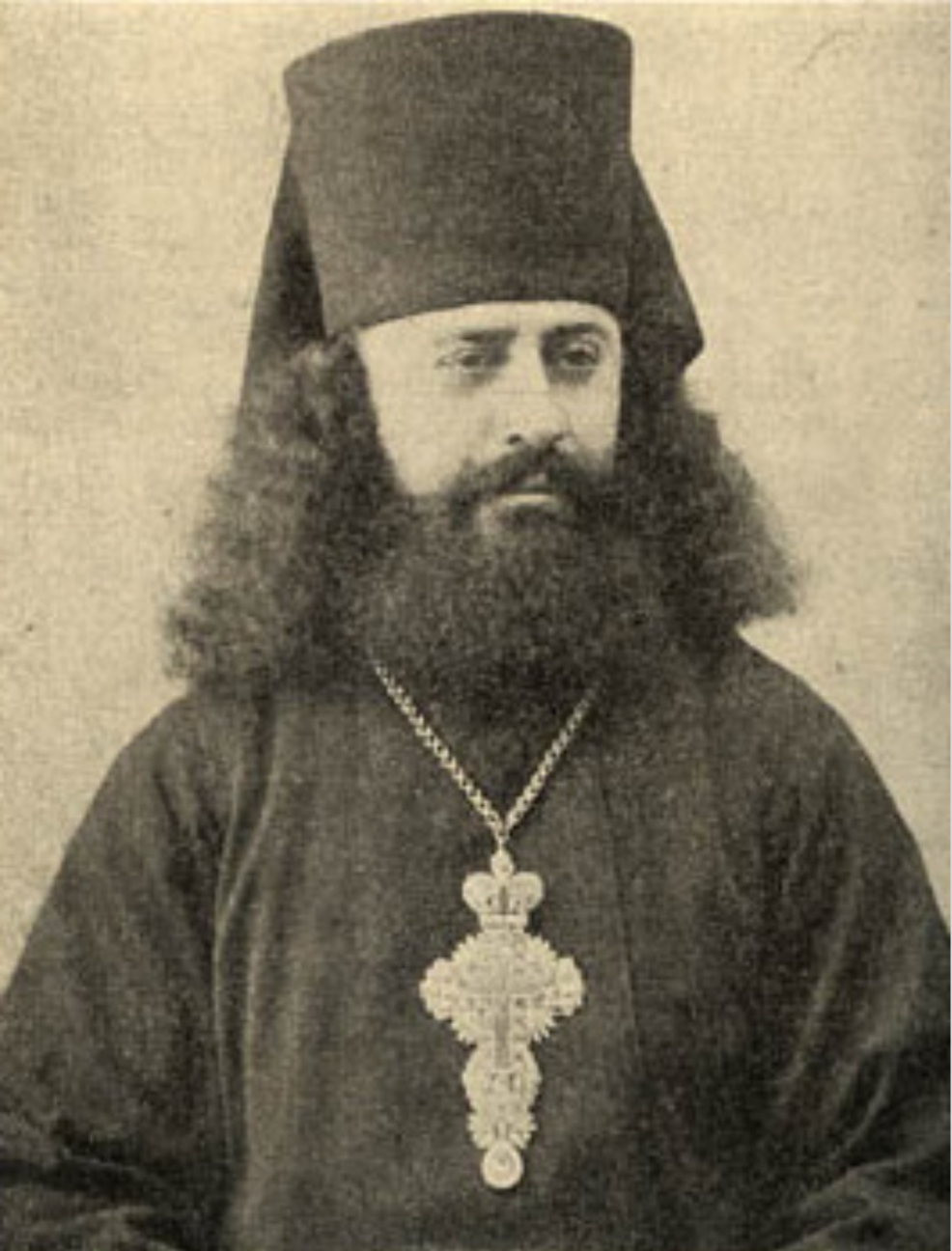
Of course, Kerbawy’s bishop was St. Raphael Hawaweeny, who, in 1895, had arrived in America with a bushy beard and a rather wild head of hair (see above).

St. Raphael Hawaweeny and Archdeacon (later Bishop) Emmanuel Abo-Hatab

St. Raphael Hawaweeny and Archdeacon (later Bishop) Emmanuel Abo-Hatab, 1913

But, as we saw on Monday, Raphael soon changed his appearance, cutting his hair, trimming his beard, and, outside of the church, trading his cassock for a suit and collar. In 1904, he told the New York Sun (5/22/1904), “I do not wish to attract attention by any peculiarities. There is no reason why I should be so extreme.” By the end of his life, St. Raphael looked like any other respectable gentleman a hundred years ago.

Fr. Joseph Stephanko with his wife Anna

Fr. Joseph Stephanko with his wife Anna

In the early 20th century, beardless faces were much more common among Russian priests than among their Greek counterparts, who tended to have full beards until around the 1920s. But not all the Russians were thrilled with clean-shaven clergymen. Fr. Joseph Stephanko, pastor of Ss. Peter & Paul Church in Passaic, New Jersey, dared to pick up a razor in 1913. A Russian-language newspaper in Jersey City accused Stephanko of “making void the Orthodox faith because he shaved himself.” The priest responded by filing a $25,000 libel suit against the paper (New York Times, 8/20/1914). A couple of years later, he was awarded $1,000 — a fraction of his original demand, but still a healthy chunk of change in the 1910s.

Tags: , , , , , , , , , , , , , , ,

7
Dec

Cassocks or Collars?

   Posted by: Matthew Namee    in Westernization

St. Raphael Hawaweeny and Archdeacon (later Bishop) Emmanuel Abo-Hatab

St. Raphael Hawaweeny and Archdeacon (later Bishop) Emmanuel Abo-Hatab

It’s a common debate within American Orthodoxy: should our priests wear cassocks, or should they wear suits and collars like their Roman Catholic and Protestant counterparts?

One side rightly argues that cassocks are the traditional and virtually universal style of dress for Orthodox clergy. The other side just as correctly points out that even some American saints wore suits and collars. As with so many issues, both camps can cite historical precedent. This is from a New York Sun article shortly after St. Raphael’s consecration (5/22/1904):

The Bishop is only 42 years old. He is a handsome man, with piercing black eyes, a black beard and hair just tinged with gray, which is brushed back from his high forehead in long curling locks. He wears a costume which resembles the cassock of a Roman Catholic priest indoors, and a plain gold cross suspended around his neck by a golden chain. He has a democratic spirit, however, and has cut his long hair, which used to flow down over his shoulders to a more conventional length, and refuses to wear his pontificals in the street.

“I do not wish to attract attention by any peculiarities,” he says. “There is no reason why I should be so extreme.”

In the photo above, you can see St. Raphael and his archdeacon, the future Bishop Emmanuel Abo-Hatab, both wearing suits and holding their hats. Both men have closely-cropped beards and short hair.

That said, St. Raphael did not impose his own preferences on his clergy. For instance, check out the impressive beard on his priest, Archimandrite Meletios Karroum, printed in the Boston Globe (9/18/1904):

Archimandrite Meletios Karroum, 1904

Archimandrite Meletios Karroum, 1904

Very generally, in the early 1900s, Russian clergy tended to be more “Westernized” in their appearance. Photos of St. John Kochurov from his time in America depict him with no facial hair at all. A lot of early Russian priests had only moustaches or goatees, and many wore suits. Take a look at this photo of St. Alexander Hotovitzky, from 1913:

St. Alexander Hotovitzky at the Conference on Faith and Order, 1913

St. Alexander Hotovitzky at the Conference on Faith and Order, 1913

Fr. Stephanos Macronis, San Francisco, 1911

Fr. Stephanos Macronis, San Francisco, 1911

Meanwhile, Greek clergy tended to be more traditional in their dress. As best I can tell, until the 1920s, Greek priests in America typically wore cassocks and sported full beards. In the ’20s, a general trend towards Americanization (pews, organs, etc) in Greek churches began, and it seems like collars and shaved faces became popular at about the same time.

More broadly, I would emphasize that diversity in clergy appearance has been pretty standard throughout American Orthodox history. Also, whatever their personal preferences, saints like Raphael did not impose their own views on their clergy. Flexibility, it seems, is generally to be preferred.

Tags: , , , , , , , , , , , , , , ,

2
Dec

Bashir, the Federation, and SCOBA

   Posted by: Matthew Namee    in Inter-Orthodox

Meeting of bishops to "reorganize" the Federation. This led to the creation of SCOBA in 1960.

Meeting of bishops to "reorganize" the Federation. This led to the creation of SCOBA in 1960.

On today’s episode of the American Orthodox History podcast, I interviewed SOCHA executive director Fr. Oliver Herbel on the subject of the “Federated Orthodox Greek Catholic Primary Jurisdictions,” a 1943 attempt to create a national, pan-Orthodox organization.

The Federation is to SCOBA what the League of Nations was to the United Nations. Both the Federation and the League of Nations were missing a crucial player: the Federation lacked the involvement of the Russian Metropolia (today’s OCA), while the League of Nations didn’t include the United States. Both SCOBA and the UN were essentially trying to do the same things as their predecessor organizations, but they were obviously more successful and long-lasting.

Metropolitan Antony Bashir was the head of the Antiochian Archdiocese of New York, and he was one of the most enthusiastic supporters of the Federation. Even after it was basically defunct in 1944, Bashir tried to keep it going, at least on paper. In the 1955 and 1956 Yearbooks of American Churches, for instance, Bashir is listed as the President of the Federation, even though it has been non-functioning for more than a decade. In a 1961 publication commemorating Bashir’s 25th anniversary as Metropolitan, we find this sentence: “In March of 1960, he spearheaded the reorganization of the Federation into the much stronger Conference of Orthodox Bishops of the Americas, which he now serves as Vice-President.”

In a way, then, the Federation was SCOBA.

UPDATE (12/3/09): Fr. James Early sent an email asking if I could identify the people in the above photo; in particular, he asked whether the “right-most suit-wearing hierarch” was Metropolitan Antony Bashir. Here is my reply:

Metropolitan Antony is indeed the right-most suit-wearing hierarch, standing near the center of the picture. However, I don’t know who most of the other men are. Certainly, the bishop in the white hat is Metropolitan Leonty Turkevich, and I assume the bishop in between Antony and Leonty is Archbishop Michael Konstantinides of the Greek Archdiocese. Abp Michael died on July 13, 1958, so if he’s in the photo, we can be sure it was taken before that date. His successor, Abp Iakovos, is not in the photo, which further suggests a date of 1958 or earlier.

I doubt that all of the individuals in the photo are bishops. In fact, it may be that Bashir is the left-most bishop in the photo, as all the men to the left of him look like priests. 

UPDATE (12/23/09): According to Fr. Alexander Lebedeff in the comments (below), the second man from the left is Fr. George Grabbe, Chancellor of the ROCOR Synod of Bishops. Fr. Alexander writes, “The ROCOR had been very involved in the precursor of SCOBA, and participated in the organizational meetings of SCOBA, as well. The ROCOR withdrew when informed that the Bishop in charge of the Moscow Patriarchal parishes in America would be invited to join SCOBA. That did not occur, but the ROCOR never returned to the table.”

UPDATE: (2/23/10): I have just received an email from Fr. Demetrius T. Dogias, in which he identifies several other individuals in this photo. According to Fr. Demetrius, the man standing at the far left is Bishop (later Metropolitan) Germanos Polyzoides. The fifth man from the left (that is, the man standing to the left of Met Antony Bashir) is Bp Demetrios of Olympus, who, at the time, was Chancellor of the Greek Archdiocese. The fourth man from the right (that is, the man with his head down, next to Met Leonty Turkevich) is Bp Bohdan, of the Ukrainian Archdiocese associated with the Ecumenical Patriarchate. Fr. Demetrius also offered this background information on the Greek Archbishop Michael, who is in the center of the photo (in between Bashir and Turkevich):

It may interest you to know that Archbishop Michael, also in the Dec. 2 picture, had studied in Kiev and that one of his teachers was the later Metropolitan Anastassy of the Russian Chuch Outside Russia.  Michael went to London as the priest at the St. Sophia Cathedral, and was granted the extremely rare title of Great (or “Grand”) Archimandrite.  He then was elected Metropolitan of Corinth in Greece, from which position he was elected Archbishop of North and South America.

Many thanks to Fr. Demetrius for providing all this information. We can now identify quite a few of the individuals in the photo. Here it is again, with numbers to make the identification easier:

Click on the photo to see a larger image. Here are the people we’ve identified so far:

1. Bp Germanos Polyzoides of Nyssa, Greek Archdiocese
2. Fr. George Grabbe, ROCOR Chancellor
5. Bp Demetrios of Olympus, Greek Archdiocese Chancellor
6. Met Antony Bashir, Antiochian Archdiocese
7. Abp Michael Konstantinides, Greek Archdiocese
8. Met Leonty Turkevich, Russian Metropolia
9. Bp Bohdan, Ukrainian Archdiocese

As more identifications come in, I’ll continue to update this article. And once again, thanks to all those who have sent in identifications so far.

Tags: , , , , , , , , ,

30
Nov

The first Syrians in America

   Posted by: Matthew Namee    in Firsts

In 1878, the Arbeelys immigrated to the United States. They were the first Syro-Arab family to come to America; or, at the very least, they were the first prominent Syrians in America. Najeeb Arbeely founded the first Arab-American newspaper, Kawkab America, and he also held the post of immigration inspector at Ellis Island. His brother Abraham was instrumental in bringing St. Raphael Hawaweeny to the United States.

A couple of years after their arrival in this country, Abraham did an extensive interview with the St. Louis Globe-Democrat (7/22/1880). It’s long, but it’s also extremely interesting, so I’m reprinting the whole thing here:

“A native of Syria — of Damascus?”

“Yes; Dr. A.J.A. Arbeely;” and the person addressed bowed with Oriental grace, as he made himself known to the reporter.

“When did you arrive?”

“This morning,” answered the Doctor.

“Are you connected with the Syrian family that arrived in New York a couple of years ago?”

“The same; the party was composed of my father and mother, five brothers — I am the eldest — and sister. They are all in Tennessee now except my mother. She is dead.” And as he conveyed this last item of information the Doctor took off the red turban he wore, and bowed his head a moment in reverie. Then he continued: “The family are in Maryville, Tennessee. I have been in Texas eighteen months practicing medicine. My younger brother is also a doctor in practice in Tennessee.”

“Tell me about your coming to this country.”

“Well, you see we are Christians — my father being a Doctor of Divinity in the Greek Church, as well as a Doctor of Medicine — and we were subjected to great persecution at the hands of the Turks.”

“You were converts, then?”

“No; the family had always been Christian, that is, as far back as we have any record. My ancestors, as Christians, ante-dated the invasion of the Turks. My father, prior to coming here, was employed for many years in teaching the Syrian language to the missionaries from America. He had incurred the displeasure and hostility of the Turkish authorities. We were in the massacre of Christians in Damascus in 1860 — I was only 10 years old then — but my father, although hunted like a wild beast, succeeded in makign his escape. The murderous Turks made several other attempts upon his life, but a kind Providence protected him so that not a hair of his head was harmed. The Mohammedan persecution finally became so great that my father resolved to leave the land of our nativity, and upon consultation with the American missionaries he concluded to emigrate to America. In the summer of 1878, during the Parish Exposition, a passport was obtained for the entire family to visit the Exposition, and they started, but stayed only a few days in Paris, and then came to the United States, landing in New York in September. They spent a month in that city, but concluding that the weather would be too severe for them they went to Maryville, East Tennessee, and settled. Thus the first Syrian family that ever emigrated to this country came and took up their residence under the aegis of the stars and stripes.”

“Is it not difficult to leave Damascus — to emigrate — or are the Turks glad enough to get rid of Christians?”

“The Sultan and the Turkish Pasha (Governor) at Damascus look with great disfavor upon emigration of Syrians, and so many obstacles have to be overcome by emigrants that very few leave indeed, and thus it happens that we are the only Syrians in America. Passports are withheld, and as no one is allowed to leave there without these documents, the disfavor amounts to really a prohibition. That’s the reason no other family of that nationality has ever come to this country before. Our friends are very anxious to come, and thus establish a Syrian colony  here in America, but such a scheme was then impracticable. We promised to look the country over, however, and if possible find a suitable locality.”

“How much have you done already in this direction? Missouri, you see, is making an effort to induce immigration.”

“Well, the difficulty is to find a section suitable in every respect. The great obstacle is the climate. It is too changeable and uneven in those localities I have visited — a marked contrast to Damascus, where the climate is always even. Still we may yet find a suitable locality. We went to Texas in 1878, and it was hard getting along at first, as we could not speak English very well, as you observe I can now. When we arrived at Austin, Texas, I concluded to stop there for a time and see how the country agreed with me. My father went on and visited different parts of the State, but found nothing that suited him, so he returned to his home in Tennessee, where he has resided since. I practiced medicine at Austin for the past eighteen months, when I was called home suddenly by my mother’s death, and coming by the way of Kansas City, where I stopped for a few days, I arrived in St. Louis yesterday, as stated.”

“How do you like the country, generally?”

“It is magnificent — all the parts I have visited — except in respect to climate; and St. Louis is simply magnificent, if the weather could be always like this.”

“You liked Texas?”

“Very much. The people were very kind to me, and assisted me to a large practice. I shall probably return there. Kansas City I also greatly admired, and the professional brethren and others placed me under many obligations for courtesies. I wish I had time to visit all the medical institutions here and meet the doctors, but I shall have to go home in a day or two.”

“What is your school of medicine?”

“Oh, I am regular, as you call it here, or old school. I have several diplomas: one granted by the Syrian Protestant College, located at Beirut, chartered by the State of New York, and, therefore, an American institution. After receiving the parchment I was obliged to go through a very severe examination by the Sultan’s head medicine man, at the Royal Medical College at Constantinople, before I could practice my profession, as the other college is not recognized by the Government.”

He was awarded a diploma from the Royal College, and both of the documents are decorated with seals, indicating their authenticity.

And then the Doctor took his turn at interviewing.

“Are you the religious editor?”

“Not often; why?”

“Because I wonder when I read the Globe-Democrat every day in Texas, how it ever got so much religious matter. Is that the reason why it is called the great religious daily?”

“Yes, and because it is so thoroughly orthodox.”

“I notice that. I am orthodox myself. My father, besides being a Greek ecclesiastic, is very intimate with the Greek Patriarch at Antioch. Oh, yes, we are orthodox. I have letters from a number of clergymen, as well as doctors.”

And here the Doctor showed a number.

“Wasn’t there some talk of uniting the Anglican Church — Protestant Episcopal in America — with the Greek Church?”

“I believe there was some effort in that direction, and there is very little difference between them. Indeed, we are in accord with most evangelical bodies, and I have some very kindly reflections of the Presbyterians.”

“Isn’t there a Greek Church in New York, with which the Episcopal Church is in accord?”

“I believe they agree. But my father could tell you much better of these things than me, as the greater part of his sixty years of life has been spent in that direction.”

The Doctor was then entreated to explain somewhat of the Arabic tongue, and did so to the great interest of his auditors. He incidentally remarked that he believed the Oriental way of writing from right to left more proper and convenient than the English method, from left to right. The Arabic alphabet has twenty-nine letters, with only three vowels and a like number of accents. The Doctor contrasted it with the Greek, with which he is also familiar, and pointed out the differences. His sketch of the Syrian people was very interesting, and, if he is a specimen, they are a fine type of manhood, tall and dignified in appearance. His complexion is dark — olive rather than swarthy — and hair very black. Red heads are rare in Syria.

The population of Damascus he estimated at 150,000, of which about three-fourths are Mohammedan, about 25,000 Christians and the balance Jews. The latter are chiefly bankers or brokers. The Christians are not generally wealthy, and mostly engaged in weaving and the manufacture of damask. The Turks, many of them, live in opulence. There is no inter-marrying between Turk and Christian, or Hebrew and Christian. The Ottoman Government is represented by a Pasha, or Governor, who is a very enlightened man, but the people other than the Turks are not in favor of the Government, and covet independence. The future of Turkey, the Doctor thinks, will be just what the great Powers choose to make it. The Turks are a hindrance to Christian civilization, and must sooner or later be blotted out. Nothing but the jealousy of the Powers prevented them taking the territory, and eventually they will probably assume a protectorate over it. Perhaps Great Britain or France will eventually get Damascus. Further alluding to the manners and customs of his people, the Doctor spoke of prolonged religious fasts among the Turks, at times.

“What do you think of Dr. Tanner?”

“Oh (laughing), I hardly know what to think about his feat. I have been reading your paper every day about it and am much interested. I hardly think he can succeed. It doesn’t seem in accordance with nature. But he may. In this great country I don’t allow myself to be surprised at anything.”

Dr. Arbeely goes hence to Louisville, and from there to Knoxville, Tenn., and a visit to his family. He will probably return West via St. Louis.

A few things… I don’t know who “Dr. Tanner” is, though Arbeely’s comments have piqued my curiosity. His remarks about the fate of Turkey are almost prophetic, coming nearly four decades before the end of World War I. Also, what he says about religious persecution in Turkey is certainly accurate, but it shouldn’t be assumed that the later Syro-Arab immigrants — the “Ellis Islanders,” if you will — were fleeing such persecution. Most of the immigrants in the 1890-1920 period (including my own family) came to the US principally in search of prosperity and opportunity, rather than religious freedom.

The Arbeelys ultimately ended up back in New York, where, as I said earlier, Najeeb Arbeely became an immigration inspector and newspaper editor, and Abraham organized the Syro-Arab Orthodox and worked to bring St. Raphael to America.

Tags: , , , , , , , ,

24
Nov

Fr. Christopher Jabara, the ultra-ecumenist

   Posted by: Matthew Namee    in Uncategorized

I always laugh a little bit when I hear people complain about Orthodox involvement in things like the World Council of Churches. It’s not that I support such involvement — my position on modern ecumenical relations really isn’t relevant here — but I laugh because I can’t imagine what the present-day anti-ecumenists among us would say about what was going on at the turn of the last century.

For instance, can you imagine what would happen if the World Council of Churches was expanded to include Muslims, Hindus, and Buddhists? And if Orthodox bishops and priests were some of the main participants? That’s what happened at the Chicago World’s Fair in 1893, where the “Parliament of Religions” tried to serve as a veritable United Nations for religion.

Fr. Christopher Jabara, 1894

Fr. Christopher Jabara, 1894

In the future, we’ll talk in detail about the Orthodox involvement in this event. For now, though, I’d like to focus on one of the Orthodox attendees in particular — the Antiochian archimandrite Fr. Christopher Jabara, who held the most extreme views of any of the Orthodox who were present.

For a number of years, Jabara had been the head of the Antiochian metochion (representation church) in Moscow. During this period, Jabara happened to meet with the Ecumenical Patriarch, and he helped arrange for an Antiochian student to attend the Patriarchal seminary at Halki. That student? A young monk named Raphael Hawaweeny.

A decade later, Jabara ran into problems in Russia. Apparently, he started talking about all religions being the same — particularly Christianity and Islam. This incurred the ire of the Metropolitan of Moscow, who ran him out of the country. His replacement as head of the metochion? Deacon Raphael Hawaweeny.

I’m not sure exactly where Jabara went after that, but by the end of 1892, he was in New York — one of the first Antiochian priests to come to America. He was carrying credentials from the Patriarch of Antioch (or at least, that’s what he said; unless we can inspect them, we can’t really be certain). The local Syro-Arab Orthodox, who were just glad to see an Antiochian priest, welcomed Jabara, and they set up a temporary chapel at Cedar and Washington Streets in New York City. At some point along the way, Jabara authored a book entitled, The Unity of Faith and the Harmony of Religions. The next year, the Parliament of Religions met in Chicago, and Jabara was there. Among other things, he said,

My brothers and sisters in the worship of God! All the religions now in this general and religious congress are parallel to each other in the sight of the whole world. Every one of these religions has supporters who prefer their own to other religions, and they might bring some arguments or reasons to convince others of the value and truth of their own form of religion.

Therefore, I think that a committee should be selected from the great religions to investigate the dogmas and to make a full and perfect comparison, and, approving the true one, to announce it to the people. This is easy to do in America, and especially in Chicago, as here the means for realization may be found.

First, there is full religious liberty; second, there is great progress in all branches of science; third, there is presence of great learning; fourth, wealth and benevolence; fifth, the piety of the American people in general and their energy in so many things useful to humanity, making this country a refuge to all nations.

Columbus discovered America for the whole world and discovered a home for the oppressed of all nations. As Columbus discovered America, so must Americans show the people of all nations a new religion in which all hearts may find rest.

That wasn’t all. Jabara told the Globe reporter,

I think and believe that when the gospels and the Koran, which are really one, are reconciled and the two great peoples, Christians and Mahometans, are also reconciled, the whole world will come into unity and all differences fade away.

All the human kind will become brethren in worshipping the true God and following Christ, the savior of the world, and I, as a servant of religion during all my life, have come from far away Damascus on my own account and in my poverty pray, in the name of God the omnipresent, that the people may consider my ideas on the unity of religion, especially between the sacred books.

Needless to say, the Syro-Arabs ran Jabara out of New York. There’s a story, probably apocryphal, that when Jabara returned to the chapel, his key didn’t work — somebody had already changed the locks. (This story is printed in the Antakya Press life of St. Raphael.)

Jabara stayed in America, and, as I said, he was in Boston in March of 1894. But he wasn’t there to minister to the Orthodox of the city; according to the Globe, he “came to Boston especially as a center of Unitarianism where the tenets of religion and the principles of his mission can be sifted and appreciated.”

Eventually, Jabara left the US, traveling to Egypt. An American Protestant named John Henry Barrows met him there in 1896-97, and wrote this account:

Two other men, who were present at the Parliament, I unexpectedly met at the Sunday services in the American Mission. One of them is Christophora Jibara, formerly Archimandrite of Damascus. He is still very active and earnest in what he deems his chief mission, persuading Christians to give up the doctrine of the Trinity, which prevents, as it seems to him, their coming into any union with Mohammedans and Jews. He believes that Christ is the Son of God and wrought a gospel of redemption. Jibara is a master of several languages, and I tried in vain to persuade him to employ his powers of speech in preaching a positive gospel, instead of smiting all his life at a dogma which has worn out many hammers.

I don’t know what happened to Jabara after 1897. The last traces I’ve found of him are from 1901, when Gerasimos Messara, the Metropolitan of Beirut, wrote a reply to an open letter by Jabara. (I don’t have copies of either Jabara’s letter or Met. Gerasimos’ reply; all I’ve found is this Google Books reference.)

With Jabara out of the picture, the Syro-Arabs in America still needed a priest. In 1895, they finally got one. His name? Fr. Raphael Hawaweeny.

Tags: , , , , , , , , , , ,