Posts tagged Antony Bashir

GVF-NYC-1947d

Florovsky Visits America

0


Sixty-five years ago today, on Holy Monday, April 7, 1947—the feast of Annunciation (O.S.)—an important event in the history of Orthodoxy in America occurred, with the first visit of Father Georges Florovsky to the United States. As with so many key turns in his ecclesiastical trajectory, Florovsky’s coming to America was occasioned by his intense involvement in the ecumenical movement.

The general plan to establish a World Council of Churches (WCC) had been agreed upon at the meeting of the Faith and Order Movement in Edinburgh, 1937, where Florovsky was present together with Fr. Sergii Bulgakov. While Florovsky himself had at this point yet no official standing as an Orthodox representative within Faith and Order, he was on this occasion elected to the “Committee of Fourteen,” composed of seven representatives of Faith and Order and seven of Life and Work, whose task it was to organize the future World Council of Churches. Given that the Orthodox representative for Life and Work was Metropolitan Germanos (Strinopoulos) of Thyateira and Great Britain, it was felt that the other Orthodox representative should be a non-Greek. The likely candidate was Fr. Sergii Bulgakov, who was both senior to Florovsky and had also been involved in Faith and Order since its inception at the Lausanne Assembly of August 1927.

Bulgakov, however, had recently drawn controversy for his sophiological teaching. And of the two, Florovsky had the greater facility with the English language. In all likelihood for these reasons, both the Orthodox and the Anglicans and American Episcopalians, who were responsible for funding much of the scholarly and ecumenical activity of the Orthodox centered at the Institute St. Serge (Paris), chose Florovsky instead, considering him the more trustworthy representative of Orthodox theology. According to Florovsky’s own unpublished account, it was Metropolitan Antony Bashir, also present at Edinburgh, who informed him of this decision. The reason Antony gave is interesting: it was because the “American Orthodox” wanted him.

The preparation of the World Council of Churches, however, was deferred by the Second World War. Florovsky was in Geneva at the outbreak of the war, unable to return to Paris, and therefore spent the whole of World War II in exile: in Yugoslavia (December 1939 to October 1944), serving as a chaplain and religion teacher at two high schools for Russian boys and girls; and then finally in Prague, teaching English and engaged in extensive pastoral work among the Russian emigres. Only in December 1945 was he able to return to Paris and resume his pre-war scholarly and ecumenical activities, commuting frequently throughout 1946 and 1947 to Geneva for meetings in preparation for the WCC. It was at this point that the stage was set also for his visit to the U.S. A meeting of the provisional committee of the WCC was planned to be held in America, Spring 1947. As a member of the committee, Florovsky was invited.

Other developments were taking place during this same time that would be determinative both for Florovsky’s future and that of Orthodoxy in America. In November 1946, the Seventh All American Church Sobor of the Russian Orthodox Greek Catholic of America (the “Metropolia”) was held in Cleveland, Ohio. At the request of Metropolitan Theophilus (Pashkovsky), plans were drawn up for the re-formation of St. Vladimir’s Seminary (founded in 1938) into a real theological academy, on the model of the four pre-revolutionary Russian academies. At the suggestion of the historian George Fedotov, a colleague from St. Serge who had come to teach at St. Vladimir’s in 1945, Florovsky was named as the choice for professor of dogmatics and patrology.

The meeting of the provisional committee was held in Buck Hill Falls, Pennsylvania, on April 22-25, 1947. There it was announced that the first Assembly of the World Council of Churches would be held at Amsterdam from August 22 to September 5, 1948, having as its general theme “Man’s Disorder and God’s Design.” It is perhaps indicative of Florovsky’s influence that, already at this point, the WCC’s general secretary W. A. Visser’t Hooft emphasized to the press that the WCC was not to be understood as a “super-church” which would dictate to its member bodies, but only “an expression of the desire of the Churches to obey the will of their common Lord,” involving “not . . . the denial of the confessional heritage of the churches,” but rather “the attempt to manifest that unity which has actually been given to churches that take their confessions seriously” (“Progress Report for the World Council: Provisional Committee Holds First Meeting in United States,” Federal Church Bulletin, Vol. XXX, No. 5, May 1947, 6-7).

       Following the conclusion of the provisional committee meeting, Florovsky traveled to New York in May 1947 to discuss the possibility of his coming to teach at St. Vladimir’s. The seminary was at this time housed in a cottage owned by General Theological Seminary (Episcopal Church USA), and had only a dozen students and limited faculty and resources. Florovsky spent most of his visit with Metropolitan Theophilus. The result of their conversations was that Florovsky agreed to accept appointment to the faculty, with the tacit understanding that he would later take up the deanship. Theophilus and Florovsky saw eye to eye both on the need to develop high-level theological education for clergy and to introduce the English language into teaching and church services. Almost exactly a year after Florovsky’s visit, on April 2, 1948, the Metropolitan Council of the Russian Orthodox Greek Catholic Church of America sent a letter to the American consulate in Paris requesting the entry of Florovsky and his wife into the US under non-quota status. Florovsky would later become a naturalized American citizen in 1954.

After his visit to Pennsylvania and New York in spring 1947, Florovsky returned to Europe. The First Assembly of the World Council of Churches took place in Amsterdam on August 22 to September 4, 1948, with some 14,000 persons present. Here, together with his friend the Anglican priest Michael Ramsey (who would become Archbishop of Canterbury in 1961) and the Swiss Reformed theologian Karl Barth, with whom he shared a common resistance to political pragmatism in ecumenical relations, Florovsky emerged as the leading theological voice. He was at this time elected also to the executive committee of the WCC.

Just ten days after Amsterdam, on September 15, 1948, Florovsky left Europe for good, arriving in New York by boat on September 21 to begin teaching at St. Vladimir’s. A year later, Florovsky took over the acting deanship from Bishop John Shahovskoy, and in 1950, he was officially made dean. He was to remain in that capacity until 1955. During his tenure at St. Vladimir’s, Florovsky raised academic standards and introduced the English language, placing the seminary on the map as an important center of theological education and injecting a crucial missionary dimension to its outlook.

Florovsky’s 1947 visit to America was therefore an event which both foreshadowed and helped to prepare two important developments in Orthodoxy and the Christian world at large: first, the formation of the World Council of Churches, and the presence of a powerful Orthodox theological voice within it; and second, the development of an articulate and missionary-minded Orthodox theology on American soil.

Photographs of Florovsky’s arrival in New York Harbor on April 7, 1947, published in The New York Times and Newsweek have a certain strangeness and wonder about them, marking the distance from his time and situation and our own. That the visit of any theologian—not to mention, Orthodox—would be considered worthy of feature in a major news source bespeaks a bygone age when Christian churches and theology still wielded a certain recognized cultural authority. That epoch gasped its last some time after the media excitement of the Second Vatican Council (1962-65). It is perhaps significant that, with the sole and recent exception of Pope Benedict XVI, no theologian has appeared on the cover of Time magazine since the April 20, 1962, feature of Karl Barth. It is hard to imagine a photograph of any leading Orthodox theologian today being featured within the pages of Time, Newsweek, or The New York Times, as Florovsky himself was in the 1940s and ’50s.

The modern ecumenical movement was itself conceived initially as a missionary response to an era of intense secularization. Doubtless, it was spurred on also by a humanitarian reaction to two massive wars, in which men of different countries equally confessing the name of Christ spilled one another’s blood over nationalist interests. Yet the early ecumenical movement came to birth nevertheless with a hope and confidence among some Christian leaders that a soundly Christocentric theology might matter still, and be heard by more than a few. With all their crucial differences, leading ecumenical figures of this period such as Florovsky and Barth were united at least in their attempt to respond to “man’s disorder,” not with humanitarian bromides regarding “tolerance” and “diversity,” or demi-Marxist clarions to class struggle, identity politics, and statist social planning, but with a word about creation, sin and redemption: the good news of Christ and his Church.

In “The Church and Her Responsibility,” a paper written for the Faith and Order Study Commission “The Universal Church in God’s Design” in March 1947, just a month before his visit to America, Florovsky stressed that the primary work of the Church was the proclamation of the Gospel, aimed precisely towards conversion—a ministry of the Word consummated in the ministry of the sacraments. This mission required that the Church avoid equally two temptations: sectarianism and secularization. The message of the Gospel is a word of judgment upon the world, but a saving judgment. The Church exists in the world as an antinomical and heterogeneous body, in a state of opposition, but also reformation of the world. As Florovsky said in his speech at Amsterdam, August 1948:

…the real strength of the Christian position is precisely in its ‘otherness.’ For indeed, Christianity is ‘not of this world’ and is not merely one of the elements of the worldly fabric. … the strength of Christianity is rooted in its opposition to everything Christless. No secular allies would ever help the Christian cause, whatever name they bear. As Christians we have but one Heavenly Ally, Our Lord Jesus Christ, to whom all power has been given in Heaven and on earth, even in this perplexed and rebellious world of ours. For this very reason, Christians can and should never admit any other authority, even in secular affairs. Christ is the Lord and Master of history, not only of our souls. Again this gives ultimate priority to the theological issue. For our practical disagreements inevitably bring us back to the diversity of our interpretations of the Divine message and the Divine solution of our human tragedy and fall. (Florovsky, “Determinations and Distinctions: Ecumenical Aims and Doubts,” Sobornost, No. 4, Series 3, Winter 1948, 126-132, at 132)

It is dangerous to posit simple causes in the complex chain of historical events. Yet the marked wane in the cultural authority of theology and of churches themselves that became apparent only two decades or so after the Amsterdam Assembly did coincide with a certain “failure of nerve” on the part of theologians and pastors—a hesitance to address the culture at large with such robust evangel. Many preferred instead to adjust the content of their message in the attempt to be “relevant” to ever more radical forces of secularization.

Already at the meeting of the provisional committee of the WCC at Buck Hill Falls, Pennsylvania, in April 1947, Dr. J. Hutchinson Cockburn, former moderator of the Church of Scotland, had noted how “anti-Christian forces” had become so strong that the Christian tradition “no longer dominates the European scene.” “If Christ is to be enthroned over the lives of men in Europe,” he added, “it will only be by the reviving of the Church by the Grace of God and the work of the Holy Spirit. Of this revival the churches are the appointed instruments. It is Christian civilization that is at stake, not merely in Europe but also in Britain and in the United States” (“Progress Report for the World Council: Provisional Committee Holds First Meeting in United States,” Federal Church Bulletin, Vol. XXX, No. 5, May 1947, 6-7). Cockburn’s diagnosis remains even more true today. Yet it is a sad fact how many professed theologians and Christian leaders, even among the Orthodox, respond to it with sophisticated cynicism, chameleon-like compromise and defeat.

Images of Florovsky’s arrival in New York Harbor on April 7, 1947, Holy Monday—a day when many Orthodox in America celebrated the feast of the Annunciation, and all were preparing to follow after Christ to his sacred Passion in the city—show the Russian priest-theologian flanked by Cockburn and Visser’t Hooft aboard the deck of the Queen Elizabeth dressed in his riassa, cigarette visible between his fingertips, his long uncut hair blowing crazily in the wind, the expression on his face so confident as almost to radiate joy. It was precisely his spirit of confidence—confidence in the truth of Christ and his Church, and in the legacy and task of Orthodox theology—combined with magnanimity towards divided brethren, in hope of their eventual recovery, that made Florovsky’s example so singularly important for his time and context. Much depends upon the revival of that same spirit in our own.

(In addition to the articles cited and several unpublished sources, this essay relies upon Andrew Blane, “A Sketch of the Life of Georges Florovsky,” in Georges Florovsky: Russian Intellectual—Orthodox Churchman, St. Vladimir’s Seminary Press, 1993, pp. 73-91.)

Federation 'reorganization'

This week in American Orthodox history (March 12-18)

0

This week is a busy one:

March 14, 1767: Philip Ludwell III, the first Orthodox convert in American history, died in London. Decades earlier, in 1738, Ludwell had joined the Orthodox Church in London. He was just 22 at the time, and was a rising star in the Virginia aristocracy. Remarkably, the Russian Holy Synod gave him permission to bring a portion of the Eucharist back to Virginia. In 1762, Ludwell brought his three daughters to England to be received into the Church as well. Of course, we would know none of this were it not for the exceptional research and writing done by Nicholas Chapman, whose articles we’re proud to feature here at OrthodoxHistory.org. Click here to read Nicholas’ first article on Ludwell, and here to read about Ludwell’s landmark translation of an Orthodox catechism. And if you find Ludwell as fascinating as I do, I would highly recommend that you invest $4.95 to download Nicholas Chapman’s recent lecture on Ludwell. (And for $9.95, you get a CD of the lecture, a copy of Ludwell’s portrait, and the Ludwell family book plate.) I rarely encourage our readers to buy stuff, but trust me: this is worth it.

St. Alexis Toth

March 14, 1853: Chronologically, after Ludwell, the most important American Orthodox convert has to be St. Alexis Toth, who was born in the Austro-Hungarian Empire 159 years ago this week (most of my sources say March 14, but Wikipedia has his birthday as March 18). Originally a Greek Catholic (“Uniate”) priest, Toth was assigned to serve a Carpatho-Rusyn parish in Minneapolis in 1889. But the local Roman Catholic archbishop didn’t want Toth’s “kind” — that is, Greek Catholics — in his diocese, and the two men clashed immediately. In 1891, Toth and his Minneapolis congregation joined the Russian Orthodox Church. Dozens and dozens of Uniate parishes followed suit over the next two decades, and Toth was one of the chief advocates of Uniate conversion to Orthodoxy. He died in 1909 and was canonized by the OCA in 1994.

March 13, 1868: Fr. Nicholas Kovrigin was sent on a pastoral visit to San Francisco, establishing the first foothold of the Russian Church in the contiguous United States. It all started back in the 1850s, when San Francisco’s growing Orthodox community organized into a mutual aid society. In the early 1860s, Russian ships visited the area, and some local Orthodox children — including the future Fr. Sebastian Dabovich — were baptized by a Russian navy chaplain. But there wasn’t a Russian parish until Kovrigin came along later in the decade. His visit was precipitated by the arrival, late in 1867, of the renegade Ukrainian priest Agapius Honcharenko, who moved to the Bay Area and tried to start some kind of hybrid Protestant/Orthodox parish. The Orthodox people seem to have realized that they needed to get an actual, legitimate Orthodox priest in their city, so they sent a formal request to the bishop in Alaska, who responded by sending Kovrigin for a visit. Initially, it was just that — a visit — but later in 1868, Kovrigin was formally assigned to be the pastor of a new parish in San Francisco. Unfortunately, Kovrigin seems not to have been made of the strongest moral fiber, and he ran into all sorts of trouble, ultimately being suspected of foul play in the death of his superior, cathedral dean Fr. Paul Kedrolivansky. Kovrigin was finally sent away in 1879, by the newly arrived Bishop Nestor Zass. On a more positive note, despite many trials and tribulations (and name changes), the San Francisco parish has survived to this day, and is now Holy Trinity, a cathedral of the OCA.

March 15, 1896: Archimandrite Theoclitos Triantafilides celebrated the first Divine Liturgy in Galveston, Texas. I’ve written about Fr. Theoclitos recently: he was one of only three Greek priests to serve under the Russian Mission. Previously, he had been the tutor to the future king of Greece and the future Tsar Nicholas II of Russia. His Galveston parish was multiethnic, composed of Serbs, Greeks, Syrians, Russians, Copts, and American converts. To this day, his old parish of Saints Constantine and Helen venerates him as a holy man. To learn more about Fr. Theoclitos, read this article by Mimo Milosevich.

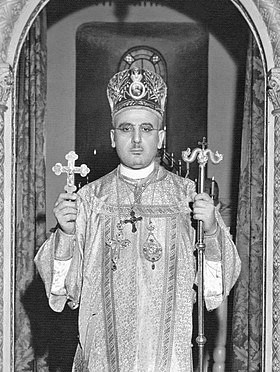
March 15, 1898: The future Antiochian Metropolitan Antony Bashir was born in Douma, in what was then the Ottoman Empire and what is now Lebanon. Bashir led the Antiochian Archdiocese of New York from 1936 until his death in 1966. This was the era of the “New York-Toledo” schism, when the Antiochians in America were divided into competing archdioceses (one based in New York and the other in Toledo, Ohio). Bashir was a major proponent of pan-Orthodox cooperation and the proliferation of English in church services.

March 13, 1904: Archimandrite Raphael Hawaweeny was consecrated to the episcopacy by Archbishop Tikhon Bellavin and Bishop Innocent Pustynsky. This was the first episcopal consecration in American Orthodox history. Technically, St. Raphael was a vicar bishop under St. Tikhon, the Russian Archbishop of North America, and St. Raphael’s “diocese” was actually a vicariate for Syro-Arabs. Reality was considerably more complicated, and St. Raphael basically functioned as a mostly independent diocesan bishop with ties to both the Russians and the Patriarchate of Antioch. (As he put it, his diocese was a diocese of Antioch, “notwithstanding its nominal allegiance to the Russian Holy Synod.”) He served as bishop until his death in 1915.

March 12, 1914: Fr. Alexander Hotovitzky, dean of St. Nicholas Russian Orthodox Cathedral in New York, returned to Russia after nearly two decades of service in America. He went on to suffer under the Communists, died a martyr’s death, and has since been canonized a saint.

Bishop Nicholai Velimirovich

March 18, 1956: The exiled Serbian bishop Nicholai Velimirovich died at St. Tikhon’s Monastery in South Canaan, Pennsylvania. He had first come to America in the 1910s, as a representative of the Serbian Church. After World War II, Bishop Nicholai returned to the United States as a refugee, and he went on to teach at several Orthodox seminaries in the US. I feel like I should have a lot to say about Bishop Nicholai — who, after all, was canonized in 2003 and is famous for his prolific writings (most notably the Prologue from Ochrid), but to be honest, I don’t really know all that much about the man. There are a couple of informative biographical articles online, but I should note that both are written from a somewhat hagiographic (as opposed to a strictly historical) perspective. Click here for one published in The Orthodox Word, and click here for one from the periodical Orthodox America.

March 16, 1960: The Standing Conference of Canonical Orthodox Bishops in the Americas — better known simply as SCOBA — held its first meeting. SCOBA arose from the ashes of the “Federation,” a 1940s attempt to foster pan-Orthodox cooperation in America. And while many initially thought that SCOBA might lead to the unification of the various jurisdictions, that obviously never happened. In 2010, SCOBA was disbanded and replaced by the Assembly of Bishops. The two organizations are different in many ways, but two are of particular note: (1) SCOBA included on the heads of the jurisdictions, while the Assembly includes every active, canonical bishop in America, and (2) the “Mother Churches” tolerated SCOBA, but the same Mother Churches actually created the Assembly. Along the same lines, SCOBA was a voluntary association, whereas the Assembly is an official ecclesiastical organization with a clear mandate from the Mother Churches. I realize that I didn’t really say much about the first SCOBA meeting, but that’s a story for another day.

March 13, 1965: On the very same day, both Albanian Bishop Theophan Noli and Greek Bishop Germanos Liamadis died. As far as I know, this was the only instance of two American Orthodox bishops dying on the same date.

March 18, 1981: OCA Metropolitan Ireney Bekish died. He had been the Metropolia/OCA primate from 1965 until his retirement in 1977 — so, the period when the OCA received its Tomos of Autocephaly and established its current identity — but I’ve never heard anyone talk of him as a major historical figure. Nobody talks about the era of Ireney, because it really was the era of Fr. Alexander Schmemann, who effectively led the OCA during Ireney’s entire episcopate.

March 16, 2008: ROCOR’s First Hierarch, the revered Metropolitan Laurus Skurla, died, shortly after helping to accomplish the reunion of ROCOR with the Moscow Patriarchate. Met Laurus had led ROCOR for seven years, and while he is most remembered for that tenure, the bulk of his hierarchical career was spent as abbot of Holy Trinity Monastery in Jordanville, New York.

March 13, 2011: Metropolitan Nicholas Smisko of the American Carpatho-Russian Orthodox Diocese (ACROD) died of cancer after more than a quarter-century as primate of ACROD. A year later, his position has yet to be filled. ACROD has established a memorial web page for Met Nicholas; click here to view it.


Metropolitan Orestes Chornock, founding primate of the American Carpatho-Russian Orthodox Diocese, died

This week in American Orthodox history (February 13-19)

1

Metropolitan Orestes Chornock, founding primate of the American Carpatho-Russian Orthodox Diocese, died 35 years ago this week.

February 14, 1872: Grand Duke Alexis of Russia, on a tour of the United States, visited New Orleans and met with representatives of the city’s fledgling Orthodox parish. The Grand Duke presented gifts to the parish, including, most likely, a gold-embossed Gospel book. 130 years later, the parish still has these gifts.

February 14, 1959: The Holy Synod of the Ecumenical Patriarchate elected Fr. James Coucouzis to be the new Greek Archbishop of North and South America. The new primate took the name Iakovos and was the most prominent and influential figure in American Orthodoxy until his retirement in the 1990s.

February 15, 1966: Antiochian Metropolitan Antony Bashir died in Boston at the age of 67. He had led the Antiochian Archdiocese of New York for three decades, and was one of the most important American Orthodox bishops of his time. For more on Bashir, check out the article and podcast I did two years ago.

February 17, 1977: Metropolitan Orestes Chornock, founding primate of the American Carpatho-Russian Orthodox Diocese, died. There is a nice little biography of Met Orestes on the ACROD website; click here to read it.

February 19, 1909: In South Omaha, Nebraska, a Greek man named John Masourides shot and killed policeman Ed Lowery. Two days later, a mass meeting was called to decide how to “rid the city of the undesirable Greeks.” At the close of the meeting, a mob descended on the Greek quarter. They attacked the Greeks, rioted, and destroyed property. The Greeks fled the city. The governor called in the National Guard. Order was restored, but the bigots of South Omaha had accomplished their goal: the Greeks were gone, and most of them would never return. The mass exodus almost wiped out the parish of St. John the Baptist. To learn more, check out this article I wrote in 2010.

Professor Basil Bensin

This week in American Orthodox history (February 6-12)

0

February 6, 1993: Bishop Job Osacky was enthroned as the new OCA Bishop of Chicago, almost exactly ten years after his consecration to the episcopate. Bishop (and later Archbishop) Job went on to become a key advocate for transparency in the recent OCA crisis before his untimely death in 2009.

Professor Basil Bensin

February 8, 1973: St. Vladimir’s Seminary professor Basil Bensin died in North Carolina. Bensin lived an eventful life. Born in Russia in 1881, he met St. Tikhon (then the Bishop of North America) in 1903, when Tikhon was on a visit to St. Petersburg. Tikhon recruited Bensin to come to America, taking a position as professor at the first Russian seminary in Minneapolis from 1905-1912. In 1912, he earned a degree in agricultural sciences from the University of Minnesota — a credential which would come in handy later. The seminary moved to Tenafly, NJ, and Bensin continued to teach until the turmoil following the Bolshevik Revolution made seminary life impossible. Bensin moved to Czechoslovakia for a decade before returning to America to work as an agricultural engineer in Alaska. When St. Vladimir’s Seminary was established in 1938, Bensin was one of the original professors, and he remained at SVS until his retirement in 1952. In retirement, Bensin continued his scholarly work, devoting a lot of time to researching the history of Orthodoxy in America. He produced only a few articles on the subject, but there must be valuable material in his notes (which are kept at SVS). (My sources for this information are Bensin’s obituary in St. Vladimir’s Theological Quarterly and a short biography at the Hoover Institution website.)

February 9, 1908: Bishop Raphael Hawaweeny ordained Theophan Noli, an Albanian student at Harvard, to the priesthood, on behalf of Russian Archbishop Platon Rozhdestvensky. Two years ago, I wrote about Noli’s first Albanian liturgy, but I erroneously said that Archbishop Platon had performed Noli’s ordination. But apart from that mistake, that old article is still pretty decent, and if you want to know more about Noli, you might check it out.

February 11, 1962: In Damascus, Fr. Michael Shaheen was consecrated as the Antiochian Bishop of Toledo, Ohio. This is a complicated story, and I don’t have time to tell it all here, but the gist of it is this: Since the mid-1930s, the Antiochians in America had been divided into two overlapping jurisdictions — the Archdiocese of New York (led by Metropolitan Antony Bashir) and the Archdiocese of  Toledo (led by Metropolitan Samuel David). Met Samuel had died in 1958, and after a lot of behind-the-scenes machinations, the Antiochian Holy Synod chose Archimandrite Michael Shaheen to replace him. But Shaheen was a priest of the New York — not Toledo — Archdiocese, and although he was consecrated with the title “Bishop of Toledo,” in reality he was to serve merely as an auxiliary to Met Antony. In this way, it was hoped, the two Antiochian jurisdictions would be united at last. But it didn’t work: the Toledo parishes refused to accept Bp Michael unless he denounced Met Antony. In response to the impasse, the Holy Synod changed course, recognizing Toledo as an independent diocese and raising Bp Michael to the rank of Metropolitan. In this way, the Antiochian schism persisted for another 13 years, until Metropolitan Michael accepted a demotion of sorts, recognizing the authority of Bashir’s successor Metropolitan Philip Saliba for the sake of unity.

February 12, 1907: Bishop Platon Rozhdestvensky was elected to the Second State Duma (equivalent to a parliament) in Russia. Within months, he would replace Archbishop Tikhon Bellavin as primate of the Russian Archdiocese in North America.

Metropolitan (later Patriarch) Pimen presents the "Tomos of Autocephaly" to then-Bishop Theodosius Lazor in 1970

Our Best Chance Yet: an historical reflection on administrative unity

We’ve tried this before. Over the past century or so, there have been no fewer than five attempts to bring the various ethnic Orthodox jurisdictions in America into some measure of administrative unity. Next week, from May 26-28, we embark upon a sixth effort — an effort which, compared to its predecessors, seems remarkably promising.

St. Tikhon's vision called for overlapping ethnic dioceses united under Russian authority

First, of course, there were the Russians. In the early 20th century, the Russian Archdiocese envisioned itself as the platform for Orthodox unity in America. Its sainted archbishop, Tikhon Bellavin, articulated an innovative vision to deal with the unprecedented diversity of ethnic Orthodox Christians in the New World. He proposed that the Russian Archdiocese be organized, not along territorial lines, but according to ethnicity — a bishop for the Russians, another for the Syrians, another for the Serbs, still another for the Greeks. St. Tikhon realized that the different ethnic groups needed their own ethnic hierarchs, and his first step in implementing this plan was to consecrate St. Raphael Hawaweeny as bishop for the Syrians. Separate, overlapping administrative units were created for the Serbs, and later for other groups (e.g. the Albanians), but St. Tikhon’s overall plan was never fully enacted. The tenuous unity that existed among the Russians, Serbs, and Syrians soon fell apart, and by 1920, any notion of American Orthodox unity under the Russians was dead.

Dead, but not forgotten. When St. Raphael, the Syrian bishop, died in 1915, he left no obvious successor. His flock divided into warring camps, one party favoring continued subordination to the Church of Russia, the other submission to the Patriarchate of Antioch. Eventually, the Russian Archdiocese consecrated Aftimios Ofiesh to be St. Raphael’s replacement. And, whatever else one might say of Archbishop Aftimios, he was nothing if not a visionary. In 1926, he proposed the idea of an autocephalous jurisdiction, the “American Orthodox Catholic Church,” which would transcend ethnicity and embrace all the Orthodox in America. The Russian Metropolia — successor to the Russian Archdiocese, and predecessor to the OCA — granted Archbishop Aftimios his wish in 1927. Archbishop Aftimios went around acting like he was the head of an autocephalous Church, but few paid any attention to him, and even the Russian Metropolia soon withdrew its support. As hopeful an idea as the AOCC might have been, it never had any real chance of uniting all the Orthodox in America.

Gov. Thomas Dewey of New York signs the bill creating the Federation

Archbishop Aftimios effectively destroyed his already fringe jurisdiction in 1933, when he married a girl young enough to be his daughter. But two of his top assistants, the convert priests Michael Gelsinger and Boris Burden, continued to dream of a united American Orthodox Church. They spearheaded a 1943 effort that resulted in the “Federation,” which was to SCOBA what the League of Nations was to the UN. The Federation included the primary Orthodox jurisdictions in America (Greek, New York Antiochian, and Moscow Patriarchal, along with Serbian, Ukrainian, and Carpatho-Russian), with the glaring exceptions of the Russian Metropolia and ROCOR. In its short life — measured in months, as opposed to years — the Federation achieved some modest but still significant accomplishments. It managed to get Orthodoxy recognized by the Selective Service, exempting Orthodox priests from military service and allowing Orthodox Christians in the military to put “Eastern Orthodox” on their dog tags. Just as significantly, the Federation led to the legal incorporation of several jurisdictions. My own Antiochian Archdiocese is still governed by that legislation, from the 1940s.

In the end, though, the Federation fell apart. There were probably dozens of reasons for the failure, but, in my view, the biggest was simply that the bishops involved in the Federation weren’t committed enough to its success. Well, most of them. One man who was deeply committed to the vision of the Federation was the Antiochian Metropolitan Antony Bashir. He kept the Federation going, on paper only, through the whole of the 1950s. In 1960, the Federation was reborn as SCOBA, the Standing Conference of the Canonical Orthodox Bishops in the Americas. The “big three” jurisdictions — Greek, Antiochian, and Russian Metropolia — were led by three larger-than-life figures, Archbishop Iakovos Koukouzis, Metropolitan Antony Bashir, and Metropolitan Leonty Turkevich. Among many, the unification of all the American Orthodox jurisdictions seemed imminent.

Metropolitan (later Patriarch) Pimen presents the "Tomos of Autocephaly" to then-Bishop Theodosius Lazor in 1970

A decade later, though, there was still no administrative unity. The Russian Metropolia had entered into talks with the Moscow Patriarchate, and in April of 1970, Moscow issued a Tomos, granting autocephaly to its formerly estranged American daughter. The Metropolia became the “Orthodox Church in America” — the OCA, and in the words of an official brochure published at the time, “invite[d] all of the national Orthodox church ‘jurisdictions’ in America to join with it in unity.” This marked the fifth major attempt to unify the various jurisdictions.

Today, of course, there is still no administrative unity. Five decades have passed since SCOBA was created, and four since the Patriarchate of Moscow granted autocephaly to the OCA. SCOBA has been useful — it has fostered cooperation, if not actual administrative unity, and its many agencies are doing great work. For its part, the OCA did bring in Romanian, Albanian, and Bulgarian jurisdictions, although in every case the OCA group has a non-OCA counterpart jurisdiction. I think it’s safe to say that, despite the best efforts of many great people, neither SCOBA nor the OCA will be the platform for future administrative unity.

Before we get to Attempt No. 6, we should ask — why did all five past attempts at unity fail? Why could neither the Russian Archdiocese, nor the American Orthodox Catholic Church, nor the Federation, nor SCOBA, nor the OCA, succeed in bringing all the jurisdictions together into a single ecclesiastical entity? The answers, of course, are many and complex, but several common threads are apparent. The Russian Archdiocese, the AOCC, and the OCA were all unilateral efforts, led by a single group which tried to get the others to join it. The Federation and SCOBA were “pan-Orthodox” endeavors, but the leaders lacked a common vision, and, worse, the support of their “Mother Churches.” Yes, the Mother Churches may have granted permission for their American jurisdictions to join SCOBA, but they certainly didn’t share a vision of administrative unity in America.

There are two really big lessons from all these failures: you can’t have unity without getting broad-based support at home, here in North America, and you can’t have unity without the explicit support of the Mother Churches. Never, in the history of Orthodoxy in America, has an attempt at administrative unity had both of these necessities.

Until now. The Episcopal Assembly, which holds its first meeting this coming week, includes every single Orthodox bishop in America — every one. No jurisdictions are left out. And the Episcopal Assembly not only has the blessing of the Mother Churches; it was actually mandated by the Mother Churches. It wasn’t “our” idea, over here, like the Federation and SCOBA were. The Episcopal Assembly was created by the Mother Churches themselves, who essentially told us, “Get your house in order.” And the end goal is clear and explicit: “The preparation of a plan to organize the Orthodox of the Region on a canonical basis.” (Article 5:1:e of the Rules of Operation) This is not just SCOBA Part II. For the first time in history, the Mother Churches are, openly and in unison, calling for us to unite administratively.

There is no guarantee that the Episcopal Assembly will succeed, and if it does, it’s not clear whether that will be in 5 years or 15. But one thing, to me, is certain: all of us — all who share a desire for canonical unity in America — should throw our support and prayers behind the Assembly, and beg the Holy Spirit to guide its work, just as he guided the work of the Ecumenical Councils themselves. Because, make no mistake — this is the best chance we’ve ever had, or may likely have for many decades to come. May it be blessed by God.

[This article was written by Matthew Namee.]

Go to Top