Posts tagged Greek

Metropolitan Leonty visiting Los Angeles (LA Daily News, 7/1/1952)

This week in American Orthodox history (May 14-20)

0

May 17, 1870: The newly ordained convert priest Fr. Nicholas Bjerring celebrated his first Divine Liturgy in St. Petersburg, Russia. He didn’t know Church Slavonic, so he served in German.

May 19, 1884: Archimandrite Stephen Hatherly, a convert priest from England, arrived in Philadelphia. I wrote about Hatherly’s visit almost three years ago. The basic story is this: In 1883, the Russian government closed its chapel, and the priest, Bjerring, became a Presbyterian. Hatherly, a priest under the Ecumenical Patriarchate, heard about these events and asked for permission to make a go at his own New York mission. After getting the all-clear from Russia, he sailed for America in 1884, arriving in Philadelphia on May 19 — this week. But, as I explain in the article, the mission was a failure; the few Orthodox people in New York had little interest in attending a church. Hatherly returned to England disappointed.

One thing I’ve been meaning to do, but haven’t yet, is tell Hatherly’s own story, because it’s phenomenally interesting. He was an exact contemporary of the somewhat better known English convert J.J. Overbeck, an author and editor of the Orthodox Catholic Review. Overbeck wanted to establish a “Western Orthodox Church,” including union with the Church of England, and today he’s regarded as a sort of progenitor of the Western Rite. Hatherly, on the other hand, viewed a full-blown union between Orthodoxy and Anglicanism as unrealistic. Instead, he preferred simply to convert Anglicans to (standard Byzantine Rite) Orthodoxy — something that raised the ire of the Anglican hierarchy, who in turn induced Constantinople to forbid Hatherly from evangelizing his countrymen. On top of all this, Hatherly was an accomplished church musician. As I said, writing an article about his life is on my to-do list.

May 19, 1905: Bishop Tikhon Bellavin, head of the Russian Mission in North America, was elevated to Archbishop by the Holy Synod of Russia.

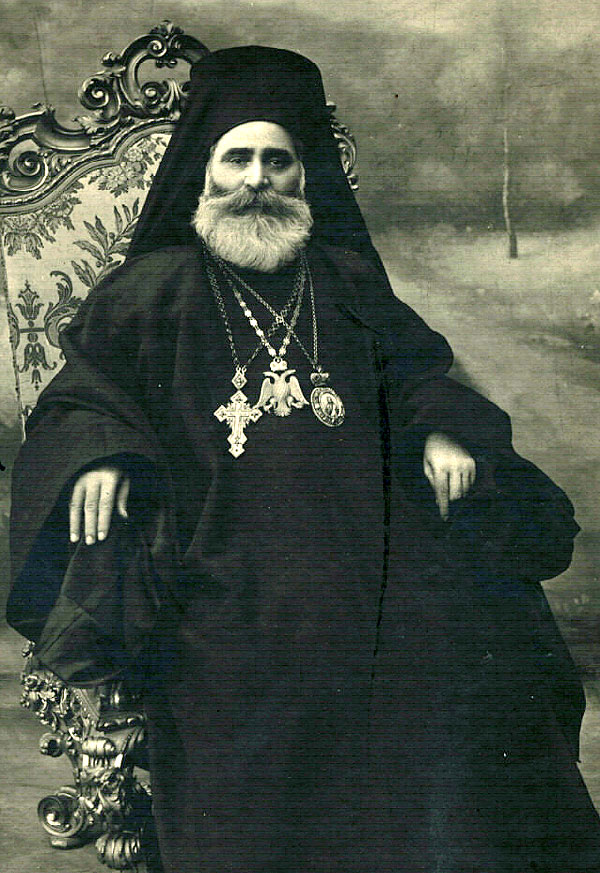
May 17, 1922: Ecumenical Patriarch Meletios Metaxakis issued a tomos, formally establishing the Greek Orthodox Archdiocese of North and South America as a jurisdiction under the Ecumenical Patriarchate. As Archbishop of Athens, the controversial Meletios had been in America from 1918-1921, during which time he organized the Greek Archdiocese and convened its first Clergy-Laity Congress. While in America, Meletios was deposed by the Holy Synod of Greece, but soon after this, he was elected Patriarch of Constantinople. This 1922 tomos thus transferred the GOA from Meletios’ old see (Athens) to his new one (Constantinople).

How could he get away with such unilateral action? Well, back in 1908, the Ecumenical Patriarchate had “transferred” the Greek churches in the “diaspora” (particularly America) from itself to Athens. Which is sort of misleading, because a lot of the Greek churches in America were already under Athens, so the transfer affected only that portion of the Greeks who had been under Constantinople. Anyway, Athens didn’t really do much with America over the next decade, until Meletios, as Archbishop of Athens, came along in 1918. In issuing this 1922 tomos, Meletios was revoking the earlier 1908 transfer. And the GOA has been under Constantinople ever since.

May 14, 1957: Archbishop Jeronim Chernov of Eastern Canada (Russian Metropolia) died.

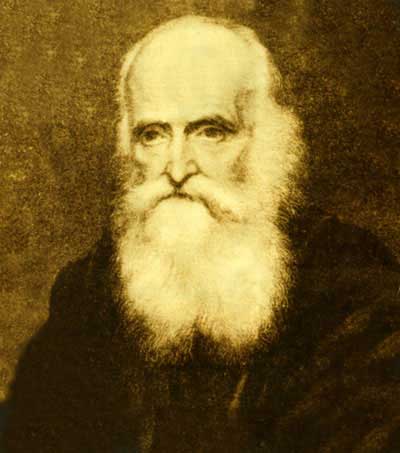
Metropolitan Leonty visiting Los Angeles (LA Daily News, 7/1/1952)

May 14, 1965: Metropolitan Leonty Turkevich, primate of the Russian Metropolia, died. Leonty is one of those giants of American Orthodox history, on par with Tikhon, Iakovos, and Bashir. Many think he’s a saint, and I strongly suspect that they’re right. One of the amazing things about Leonty is that he lived through so much. Originally known as Fr. Leonid, he was a key figure in the Russian Mission dating to the episcopate of St. Tikhon. He ran the seminary, succeeded St. Alexander Hotovitzky as dean of the main cathedral, and generally was the most important priest in the Archdiocese prior to the Russian Revolution.

Then, in 1917, he participated in the monumental All-Russian Sobor — one of the pivotal church councils in Russian history. He made it out of revolutionary Russia and back to the US, where he was, again, probably the key priest in the Russian Metropolia, which rose from the ashes of the Russian Mission. After being widowed, he was almost consecrated a bishop for Aftimios Ofiesh’s American Orthodox Catholic Church experiment, and he ended up becoming the Metropolia’s Bishop of Chicago. When the Metropolia’s primate, Metropolitan Theophilus Pashkovsky, died in 1952, Leonty was elected to be his successor.

Anyway, all that is ridiculously cursory, and I can only fit so much into this article. But Aram Sarkisian, who knows far more about Leonty than I do, will be running a full-length piece here very soon.

May 18, 1970: The Patriarchate of Moscow formally granted autocephaly to the Russian Metropolia in America, which changed its name to the “Orthodox Church in America.” This event reverberated throughout the Orthodox world, and it remains controversial to this day. While everyone recognizes the OCA as fully canonical, only a minority of the world’s Orthodox Churches acknowledge the OCA as an autocephalous Local Church.

May 14, 1972: Tragedy struck at ROCOR’s Holy Trinity Seminary in Jordanville, NY, where one seminarian stabbed another to death. Both men had been studying for the priesthood.

May 15, 1979: Bishop Dionisije Milivojevich, the Serbian Orthodox bishop whose battle with his mother church went all the way to the U.S. Supreme Court, died in Illinois.

May 18, 1985: Fr. John Karastamatis, a Greek priest in Santa Cruz, CA, was brutally murdered. Some of his admirers immediately declared him to have been martyred for the faith, and to this day, you’ll run into lists of saints that include “Hieromartyr John of Santa Cruz.” But the subsequent police investigation revealed that he was killed by the husband of the parish secretary, and at trial, witness testimony made it clear that Karastamatis was not someone who should be venerated as a saint. I don’t want to get into the gory details, mainly because this didn’t happen all that long ago and Karastamatis’ family is still around, but suffice it to say that while his murder was a great tragedy, the calls for his canonization were terribly misplaced.

May 18, 2000: Archbishop Sylvester Haruns of Montreal (OCA) died.

May 14, 2006: Conclusion of the ROCOR All-Diaspora Council, which approved reconciliation between ROCOR and the Moscow Patriarchate.

May 17, 2007: In Moscow, ROCOR signed the Act of Canonical Communion, re-establishing full communion with the Moscow Patriarchate.

May 18, 2008: Another big ROCOR moment — Metropolitan Hilarion Kapral was enthroned as First Hierarch of ROCOR.

Photo from the Abilene (TX) Reporter-News, April 7, 1958

Author & Hollywood screenwriter Elliot Paul converts to Orthodoxy

0

Photo from the Abilene (TX) Reporter-News, April 7, 1958

On March 5, 1958, the New York Times ran the following article:

AUTHOR ADOPTS FAITH

Elliot Paul, in Hospital, Joins Greek Orthodox Church

PROVIDENCE, R.I., March 4 (AP) — Elliot Paul, author, became a member of the Greek Eastern Orthodox Church today in bedside ceremonies at the Veterans Administration Hospital here.

Mr. Paul is seriously ill with arteriosclerosis and heart disease. When he entered the hospital a few weeks ago, he listed his religion as “agnostic.” He was born in Malden, Mass., a member of a Congregational family.

The 68-year-old author said his desire for conversion came from his admiration for Greek Orthodox friends whose faith and warmth appealed to him.

Elliot Paul lived a fascinating life. He worked as a journalist, authored novels, and later wrote ten Hollywood screenplays, most notably Rhapsody in Blue. His friends included the famed novelists James Joyce and Gertrude Stein. He was a huge fan of jazz, moonlighting as a pianist and writing the screenplay for Billie Holliday’s only acting role. Paul was married (and divorced) five times, and, as the Times indicates, he identified as an agnostic until the very end of his life.

And it was the very end — just a month after joining the Church, Paul died of his ailments. His obituary in the Bridgeport Post offers a bit more detail on his conversion: “After his hospitalization, Paul mentioned his desire to enter the church to the hospital Protestant chaplain, Rev. Frank S. Hall. The chaplain notified the Very Rev. John A. Limberakis, pastor of the Greek Orthodox Church of the Annunciation.”

The obituary also re-emphasized that the biggest factor in Paul’s conversion was the faith and love of his Orthodox friends. It’s a reminder that quiet example and loyal friendship can be just as effective as overt evangelization.

Nicholas Bjerring blessing a Russian ship visiting Philadelphia. Photo from the New York Public Library's Digital Gallery.

This week in American Orthodox history (April 30-May 6)

0

Fr. Nicholas Bjerring blessing a Russian ship visiting Philadelphia. Photo from the New York Public Library's Digital Gallery.

May 4, 1793: Empress Catherine the Great of Russia granted the Holy Synod permission to establish an Orthodox mission in “Russian America” (Alaska). The following year, the first eight missionaries, including St. Herman, arrived on Kodiak Island.

May 3, 1870: Nicholas Bjerring, a convert from Roman Catholicism, was received into Orthodoxy by chrismation in St. Petersburg, Russia. He was then ordained a priest and sent to New York, where he established a Russian Orthodox embassy chapel in the city. Bjerring, the first significant Orthodox convert in the United States, served the chapel for 13 years, acting as a kind of religious ambassador to America. But by 1883, the Russian government decided to cease funding the chapel, and Bjerring was offered a teaching position in St. Petersburg. He declined and instead became a Presbyterian minister. At the end of his life, he re-converted to Roman Catholicism.

May 5, 1892: St. Vladimir’s Russian Orthodox Church was established in Chicago. This came just weeks after Annunciation Greek Orthodox Church was founded in Chicago, and it marked the first instance of “overlapping jurisdictions” in the same city — a trend that became ubiquitous in the decades that followed. A few years after this, a young priest named John Kochurov was assigned to the church; in Kochurov’s tenure, the parish name was changed to Holy Trinity, and a magnificent new cathedral (designed by famed architect Louis Sullivan) was constructed. Kochurov eventually returned to Russia and was martyred by the Bolsheviks, and has since been canonized. As for his old parish, it survives today as the seat of the OCA Bishop of Chicago, and is one of the oldest continuously functioning Orthodox parishes in the Western Hemisphere.

May 5, 1902: This was the 10th anniversary of the founding of the Chicago Russian parish, but nobody was celebrating that day, because the church’s quarter-ton bell was stolen. The whole Orthodox community of Chicago — including the Greek parish — searched for the bell, but as best I can tell, it was never recovered. Two years ago, I wrote an article about the bell’s theft; CLICK HERE to read it.

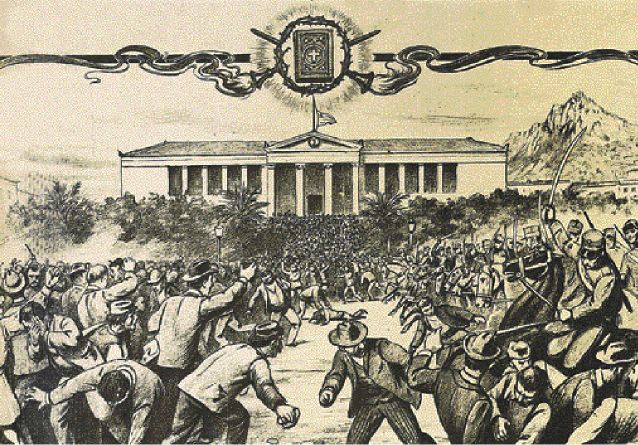
April 30, 1905: Pascha, gunshots, a New York cop, and a mob of Greeks. The short version is that, on Pascha in New York, a Greek man fired a gun in celebration — not exactly a unique occurrence. But a police officer arrested the man and started taking him away, whereupon 500 or so Greeks, who had been in the middle of a Paschal procession, diverted course and followed the officer. The mostly peaceable (but assuredly frightening) mob threw the cop to the ground, freed the prisoner, and then apparently went back to celebrating Pascha. It’s kind of a bizarre story, and I covered it in more detail two years ago. CLICK HERE to read more.

Bishop John Mitropolsky

May 2, 1914: Bishop John Mitropolsky, former Russian Bishop of the Aleutian Islands, died. Bishop John was the man responsible for moving the diocesan headquarters from Alaska to San Francisco. It’s difficult to overstate the importance of this move. I don’t know for sure, but it may be the first time that the official seat of an Orthodox diocese was located outside of the formal diocesan boundaries.

Bishop John learned to speak English and even preached homilies in the language. These were at least partly intended to inform non-Orthodox about the Orthodox Church. Bishop John was also a rather prolific author, writing a five volume account of religious sects in America and a 450-page history of the Ecumenical Councils. He seems to have view his role as twofold — to continue the Alaskan mission, but also to act as a religious ambassador to America. In November 1871, the journal Christian Union ran this note:

Bishop Johannes, of the Russo-Greek Church on the Pacific coast, has ordered the prayer for the President of the United States, contained in the Liturgy of the Episcopal Church, to be used by the Greek Priests. The Russo-Greek Calendar has also been modified so as to make it conform to that of Western Christendom in several essential important points.


I’m not sure what those calendar changes were, but these changes were an obvious attempt to find common ground with the West — particularly the Episcopal Church.

According to Fr. Sebastian Dabovich, who was an adolescent in San Francisco during Bishop John’s tenure, later explained that Bishop John was particularly proud of the Orthodox school he established. The school was for the cathedral parishioners and met on Saturdays. In addition to catechesis and Russian, the Saturday school and other weekday classes taught Scripture, music, mathematics, Greek, and English. Bishop John himself taught seven classes per week. Dabovich was one of the school’s most successful alumni, and he later wrote, “The Right Reverend John loved his school, one might say, with a singular love.”

Bishop John was reassigned to a post in Russia in 1877, and he died in 1914, at the age of 77.

May 5, 1916: Agapius Honcharenko, one of the strangest men in American Orthodox history, died in Hayward, CA. We’ve talked about Honcharenko quite a bit on this site, and I did a podcast on him a few years ago.

May 4, 1945: On Holy Friday, St. Vasily Martysz was brutally murdered in Poland. As a young priest, he had served in America from 1901 to 1912. The Orthodox Church of Poland canonized St. Vasily in 2003. To learn more, read this life of St. Vasily, written by Fr. Michael Oleksa.

May 6, 1967: Theodosius Lazor was consecrated Bishop of Alaska in the Russian Metropolia. A few years later, the young bishop represented the Metropolia in Moscow, where he formally received the Tomos of Autocephaly from the Moscow Patriarchate. This created the “Orthodox Church in America,” and in 1977, Theodosius was elected the jurisdiction’s primate. He served as Metropolitan until 2002.

May 6, 2006: A landmark All-Diaspora Council of the Russian Orthodox Church Outside of Russia opened. This council went on to formally approve the reconciliation between ROCOR and the Moscow Patriarchate, which had been estranged for decades.


This week in American Orthodox history (April 23-29)

0

April 29, 1900: Holy Trinity Greek Orthodox Church in Lowell, MA split into two factions. Here’s what I wrote about that schism in my paper, “The Myth of Past Unity”:

[O]ne portion of the parish wanted to discharge their priest, Fr. Nathaniel Sideris, and “hire” another. “We have the right to tell a priest that he is no longer needed and to engage another priest,” one parish leader explained. Other parishioners were appalled at such an approach. “Our complaint,” said the leader of the opposition, “is that the people upstairs are conducting the affairs of a Greek church different from anything to which we have been accustomed, and we do not consider it right. The bishop of the Greek church in Athens alone has the power to assign a priest.”

In the paper, I went on to observe that while one group wanted total independence from the hierarchy and the other recognized the authority of the Church of Greece, neither side said a word about Tikhon, the Russian bishop in America. Of course, that’s because the Lowell Greeks didn’t consider themselves to be under Tikhon — a fact that is perhaps unsurprising today, but which, a couple of years ago, contradicted the commonly held belief that all Orthodox in America recognized Russian authority prior to the Bolshevik Revolution.

April 28, 1901: St. Tikhon, the Russian bishop, celebrated the Divine Liturgy at Holy Trinity Greek Orthodox Church in Chicago. At least, that’s what some modern sources say; I can’t find any references to the event in the Chicago Tribune, although the newspaper covered a lot of other Orthodox happenings in that era. If anyone has more information, please let me know.

April 27, 1903: St. Alexis Toth, one of the leading priests in the Russian Diocese, was awarded the “Order of St. Vladimir” and received a miter. Toth, of course, had been a Uniate Greek Catholic priest until his conversion to Orthodoxy in 1891. He went on to spearhead the conversion of tens of thousands of former Uniates into the Russian Diocese, until his death in 1909.

April 23, 1917: St. George Syrian Orthodox Church in Worcester, MA became the first official “Antacky” parish, declaring its loyalty to Metropolitan Germanos Shehadi. Informally, the Russy-Antacky schism began immediately after St. Raphael died in 1915, when his priests disagreed on whether to acknowledge the authority of Antioch or Russia. But the Worcester declaration marked the formal beginning of the schism, which divided the Arab Orthodox in America until the mid-1930s.

April 27, 1922: The Holy Synod of Russia named the refugee Metropolitan Platon Rozhdestvensky as the temporary head of the Russian Archdiocese of North America. Soon enough, the Russian Church (under Soviet pressure) changed course and condemned Platon, who led the Russian Archdiocese to declare its independence from Moscow.

April 25, 1926: Archimandrite Mardarije Uskokovic was consecrated in Belgrade to be the first Serbian bishop for America. According to this article, the original plan was for Bishop Nicholai Velimirovich of Ochrid to lead a new Serbian diocese in America, with Archimandrite Mardarije as his administrative assistant. But Bishop Nicholai’s flock in Serbia apparently protested, and Nicholai himself recommended that Mardarije be consecrated in his stead. Thus, in 1923, Mardarije was appointed administrator of the Serbian churches in America, and three years later, he was elevated to the episcopacy.

Bishop Mardarije’s greatest legacy may be his founding of St. Sava Monastery in Libertyville, Illinois. He died in 1935.

April 29, 1933: Archbishop Aftimios Ofiesh, of the fringe “American Orthodox Catholic Church,” married a young girl named Mariam Namey (no relation to me) in a civil ceremony in Niagara Falls, NY. This effectively snuffed out any remaining legitimacy Ofiesh had within Orthodoxy.

April 28, 1952: Romanian Bishop Valerian Trifa was consecrated by the Ukrainian Metropolitan John Theodorovich. The trouble was that Theodorovich was a “self-consecrator,” rendering Trifa’s consecration invalid in the eyes of mainstream Orthodoxy. Later, Bishop Valerian was properly consecrated by bishops of the Russian Metropolia.

April 29, 1956: Archbishop Adam Phillipovsky died. He was a colorful character who was, at various times, on seemingly every side of the unending Russian Church disputes of his day.

April 25, 1959: Reginald Wright Kauffman, a noted writer and journalist, died. Kauffman had converted to Orthodoxy four decades earlier in the short-lived convert parish of the Transfiguration in New York. Unlike nearly all of the Transfiguration converts, Kauffman remained Orthodox for the rest of his life.

This week in American Orthodox history (April 16-22)

0

Fr. Demetrios Petrides

Christ is risen! Indeed he is risen!

April 17, 1907: Fr. Demetrios Petrides arrived in America from Greece. He went immediately to Philadelphia, taking charge of Evangelismos (Annunciation) Greek Orthodox Church in the city. One of his first acts was to write a letter to the Ecumenical Patriarchate recommending that a catechumen, Robert Morgan, be received into the Church and ordained a priest. This took place in August, and Morgan became the first black Orthodox priest in America. Petrides went on to have a distinguished, eventful, and admirable career in Philadelphia and, later, Atlanta, before dying of diabetes in 1917.

April 19, 1934: Archbishop Victor Abo-Assaly, the first primate of the Antiochian Archdiocese of North America, died. Abp Victor, then an archimandrite, had come to America ten years earlier, as part of a delegation from the Patriarchate of Antioch. The delegation’s task was to organize the divided Arab Orthodox in America into a single jurisdiction. This led to the founding of the Antiochian Archdiocese, but it failed to produce unity. In addition to Abp Victor, the following hierarchs claimed a piece of the Antiochian pie in America:

  • Metropolitan Germanos Shehadi, erstwhile leader of the “Antacky” faction. He had come to America on a fundraising trip back in 1914, but when St. Raphael died the next year, Germanos decided to stick around and try to lead Raphael’s flock. Only a strong minority faction followed him, and this support virtually evaporated in 1924, when the Patriarchate authorized Victor’s consecration and the creation of a legitimate Antiochian Archdiocese.
  • Archbishop Aftimios Ofiesh, former head of the “Russy” faction of Arab Orthodox who pledged loyalty to the Russians. Originally, the battle was Germanos v. Aftimios, but in the late 1920s, Aftimios created his own “autocephalous church” and fell out of favor with the Russian bishops. A handful of parishes seem to have remained loyal to Aftimios, but most switched over to:
  • Bishop Emmanuel Abo-Hatab, Aftimos’ former auxiliary and, before that, the archdeacon to St. Raphael. When the Russian Metropolia pulled its support for Aftimios, Emmanuel jumped to the Metropolia himself, taking over Aftimios’ title as bishop for the Syro-Arabs.

Anyway, in the span of about a year, three of the four claimants were dead, and the fourth (Aftimios) married a young girl, which removed the last shreds of legitimacy he had in the eyes of mainstream Orthodox people. The Antiochians in America were finally in a position to unite… but of course, it wasn’t that simple, and in 1936, they re-divided into “New York” and “Toledo” factions. About which, wait just a moment…

April 20, 1934: The early 1930s witnessed a lot of deaths of prominent Orthodox churchmen in America. Just one day after Abp Victor died, Metropolitan Platon Rozhdestvensky, the longtime primate of the Russian Metropolia, himself died. Platon had first come to America way back in 1907, as the successor to St. Tikhon as head of the Russian Archdiocese. He returned to Russia in 1914, but after the Bolshevik Revolution, Platon just kind of showed up in America again, this time as a refugee. The Russian Archdiocese already had a primate — Abp Alexander Nemolovsky — but Platon hung around for a while, until the embattled Alexander moved to Europe. Platon was Alexander’s natural successor, and it was under Platon that the Archdiocese morphed into what became known as the “Metropolia” — a de facto independent jurisdiction.

Platon’s second American tenure was filled with endless legal battles with John Kedrovsky, an “archbishop” of the Soviet-backed Living Church. The Metropolia lost its cathedral, and ultimately had to accept the charity of the Episcopalians, who offered worship space in one of their churches. By the end of Platon’s life, any notion of the Russian Church as the platform for Orthodox unity in America was a faint memory.

April 19, 1936: Exactly two years to the day after Abp Victor died, his successor was consecrated. Or rather successors, plural. On the very same day, two men, representing two Antiochian factions, were consecrated in different cities. Metropolitan Antony Bashir was consecrated in New York and took charge of the largest portion of the Antiochians. Meanwhile, in Toledo, Ohio, several Russian Metropolia bishops consecrated Metropolitan Samuel David. So now, instead of the “Russy” and “Antacky” factions, you had the “New York” and “Toledo” Archdioceses. This division persisted for almost 40 more years.

Go to Top