Posts tagged Jamaica
30 Year Anniversary of Bob Marley’s Death
In honor of the 30th anniversary of the passing of Bob Marley, who finished his life as a member of the Ethiopian Orthodox Church (his baptism was just six months before his death), we’re reposting this piece we posted last year featuring the program from his funeral in Jamaica. Memory eternal!
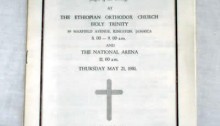
Journey To Orthodoxy yesterday ran a piece about the conversion of reggae artist Bob Marley to the Ethiopian Orthodox Tewahedo Church (a non-Chalcedonian church very similar to but not currently in communion with the [Eastern] Orthodox Church). It’s worth a read. We thought it might also be of interest to see this primary source document pictured above which also witnesses to his 1980 baptism—at which he took the name Berhane Selassie (“Light of the Trinity”)—and subsequent burial in 1981 by the Ethiopian Orthodox in Jamaica.
The image we found is a little small, so here’s the full text for those whose eyes (zoom capability) might not be quite up to the task:
FOR THE
HON. ROBERT NESTA MARLEY, O.M.
(BOB MARLEY – BERHANE SELASSIE)
(Light of the Trinity)
AT
THE ETHIOPIAN ORTHODOX CHURCH
HOLY TRINITY
89 MAXFIELD AVENUE, KINGSTON, JAMAICA
8.00—9.00 a.m.
AND
THE NATIONAL ARENA
11.00 a.m.
THURSDAY, MAY 21, 1981
OFFICIATING:
HIS EMINENCE, ABOUNA YESSEHAQ
ARCHBISHOP OF THE ETHIOPIAN ORTHODOX CHURCH
IN THE WESTERN HEMISPHERE
Assisted by Priests and Deacons of the Ethiopian Orthodox Church in Jamaica
SERVICE WILL BE PERFORMED IN GEEZ, AMHAIRIC AND ENGLISH
Addition for the 30th anniversary: Below is some footage from his funeral and the events surrounding it. Ethiopian Orthodox clergy are visible at several points.
Source of the Week: Bob Marley’s funeral program
Journey To Orthodoxy yesterday ran a piece about the conversion of reggae artist Bob Marley to the Ethiopian Orthodox Tewahedo Church (a non-Chalcedonian church very similar to but not currently in communion with the [Eastern] Orthodox Church). It’s worth a read. We thought it might also be of interest to see this primary source document pictured above which also witnesses to his 1980 baptism—at which he took the name Berhane Selassie (“Light of the Trinity”)—and subsequent burial in 1981 by the Ethiopian Orthodox in Jamaica.
The image we found is a little small, so here’s the full text for those whose eyes (zoom capability) might not be quite up to the task:
FOR THE
HON. ROBERT NESTA MARLEY, O.M.
(BOB MARLEY – BERHANE SELASSIE)
(Light of the Trinity)
AT
THE ETHIOPIAN ORTHODOX CHURCH
HOLY TRINITY
89 MAXFIELD AVENUE, KINGSTON, JAMAICA
8.00—9.00 a.m.
AND
THE NATIONAL ARENA
11.00 a.m.
THURSDAY, MAY 21, 1981
OFFICIATING:
HIS EMINENCE, ABOUNA YESSEHAQ
ARCHBISHOP OF THE ETHIOPIAN ORTHODOX CHURCH
IN THE WESTERN HEMISPHERE
Assisted by Priests and Deacons of the Ethiopian Orthodox Church in Jamaica
SERVICE WILL BE PERFORMED IN GEEZ, AMHAIRIC AND ENGLISH
An Antiochian priest in Jamaica, 1910
It is well known that, at the turn of the last century, thousands of Syrians/Lebanese made the trip across the Atlantic to New York. What is less well known, at least here in the US, is that many Syrian emigrants went to other parts of the New World, including South America, Mexico, and the Caribbean. A lot of these travelers found their way to Jamaica, which, to this day, has a sizeable Syrian contingent.
Unlike the Syrians in the US, however, these Syro-Jamaicans didn’t obtain a permanent Orthodox priest, or establish a functioning Orthodox community. They stuck together as an ethnic group, but in terms of their religion, they eventually became absorbed into the existing Anglican church of Jamaica.
That said, the Syro-Jamaicans did receive occasional pastoral visits from Orthodox clergy. In 1913-14, Fr. Raphael Morgan, the first black Orthodox priest in America (who was serving under the Church of Greece at the time), visited Jamaica and served the Divine Liturgy (aboard a Russian ship) for the Syrians he met. But he wasn’t the first Orthodox clergyman to visit Jamaica. Three years earlier, in August of 1910, a priest named Fr. Antonio Michael came to the island. Here is an account of his visit, from the Kingston Gleaner (8/4/1910):
It will be remembered that during last year the [Anglican] Archbishop addressed a meeting of Syrians on the Rectory Lawn. Since that time many of the Syrians have been worshiping with us regularly. A step towards closer fellowship was taken on July 17th, when the Rector, taking advantage of the visit to Jamaica of a priest of the Greek Orthodox Church, arranged a special service for Syrians. The priest in question, Father Antonio Michael came with authority from the Patriarch of Antioch to visit the Syrians scattered through these Islands.
Having inspected the Patriarch’s letter the Rector invited Father Antonio to celebrate the Holy Eucharist at the Altar of the Kingston Parish Church. The invitation was accepted and accordingly on Sunday we were privileged to witness a fine illustration of the friendly relations which exist between the Anglican and the Greek Orthodox Church.
At 8 a.m. the Rector celebrated and Father Antonio sat in the Sanctuary in his robes. At 9 a.m. Father Antonio celebrated for the Syrians in the presence of a large congregation of Jamaicans, following the Eastern rite, the Rector being present within the Sanctuary. The services lasted altogether two hours and a half, but many remained to the end, though the Syrians’ service being in Arabic was difficult to follow for those not acquainted with the language. To those who knew something of the Eastern rite it was full of interest. At the close of the service Father Antonio commended the Syrians to the pastoral care of the Rector.
Father Antonio concluded his address on the Gospel for the day in these words:
“May you live together in peace and love. I raise my heart and hands to God Almighty asking Him to be with every one of you. May He prosper you in all your undertakings. May He bless the Island of Jamaica and grant to His Majesty King George V. strength, wisdom and length of days; to His Excellency the Governor and to all associated with him in the Government of this Island, knowledge and understanding. I pray that our Heavenly Father may keep and bless the Archbishop and the Ministers of the Holy Church especially Mr. Ripley who has allowed me to have this service to-day. O God, guard Thy children from all dangers ghostly [spiritually] and bodily. May they grow in grace and in the knowledge of our Lord Jesus Christ and finally of His great mercy obtain everlasting life. Amen.”
Clearly, Fr. Antonio did not plan to remain in Jamaica, and he saw nothing wrong with commending the Orthodox people there to the care of the Anglican clergy. As I said, the next Orthodox priest (that I’m aware of) to visit Jamaica was Fr. Raphael Morgan. While he was under the Church of Greece, most of the other Orthodox clergymen to visit Jamaica in the early 20th century were Antiochians. However, no permanent priest was ever assigned to for the Syrian community, and today, the descendants of those Syrians are predominantly Anglican.
Fraudulent “Chaldean” fundraisers in America
As I’ve probably said a hundred times now, America is a frontier region for Orthodoxy. This was especially the case at the turn of the last century, when the chaotic nature of the American Orthodox scene provided ample opportunity for imposter priests to make a good living on unwitting Orthodox immigrants. I’m sure we’ll discuss various examples of this phenomenon in the future. Today, I’m going to talk about two fundraising “monks” from, apparently, Kurdistan.
This report appeared in a number of newspapers (including the Baltimore Sun and the Washington Post) on November 6, 1900:
Two priests of the Greek Church, Fathers Simeon and Joseph Nathan, from the Monastery of Oyos Caralambos, of Kurdistan, were ordered deported by the immigration authorities today. They are said to have come to this country by commission of Bishop Laveneu, the head of their order, to raise funds for the Church. Having very little money they were excluded as likely to become public charges. They said that they had passports from the authorities in Greece.
Frs. Simeon and Joseph appear to have been non-Chalcedonians of some sort or another. From later reports, it seems that they had previously visited India, Ceylon (Sri Lanka), and Japan. They then reached the Pacific Coast of the US, where they met the Episcopal Bishop of Olympia, Washington. They traveled across the country (stopping in St. Paul, Minnesota, among other places), and eventually found their way to New York City. They claimed to be raising money for an orphanage. From the Gleaner (Kingston, Jamaica, 10/30/1902):
It seems that they church to which they belong was destroyed at the time of the Armenian massacres by the Turks and their mission is to raise funds to establish a new church, and also an orphanage in connection with it, for the support of fifty orphans whose parents perished in that terrible affair.
After being deported from the US, these “Chaldeans” went to Haiti, and in the fall of 1902, they came to Jamaica. The Gleaner newspaper encouraged readers to contribute money, pointing out that the fundraisers had a letter of recommendation from (among others) the Anglican Archbishop of the West Indies. This effort appears to have been successful, and even the Acting Governor of Jamaica made a donation. After leaving Jamaica in November 1902, the “Chaldean agents” went to Colon and collected still more money.
It was only after they were long gone that the Gleaner received a letter of warning from Anglican representatives in Persia. From the December 5, 1902 issue of the newspaper:
We ask your permission to warn your readers against all persons coming from this country to England for begging purposes, whether they call themselves Assyrians, Chaldeans, Nestorians, Armenians, or by any other name. Many of the most worthless of these Christians have learnt to travel to Europe to beg nominally, in most cases, for some school or other institution, but in reality for themselves. Many persons in England have been deceived by them, even those universally known to be most astute, and the amount of money that has been wasted in this way is most lamentable.
The letter went on to comment that these fraudulent fundraisers displayed “a wonderful versatility in their religion. They will one day be Baptists, the next Anglican, the third Roman Catholics, and the fourth Orthodox Easterns. No religion comes amiss to them, if they can make money by it.”
Many years later, in 1914, other Chaldean fundraisers — or perhaps the same ones — surfaced in America. St. Raphael Hawaweeny found it necessary to publish this notice in the Russian Archdiocese’s Vestnik magazine:
For a long time already, various “collectors” with counterfeit documents, written in various languages, are traveling around North America… They claim to be Syrian or Orthodox Syrian-Arabs while they are Chaldeans and Nestorians by religion… Many times I warned my Syrian compatriots… now I found out that those “collectors” act among the Russian clergy… so I warn you… that those who do not have the papers with my signature and seal are tricksters. Raphael, Bishop of Brooklyn.
[I found this in Fr. Andrew Kostadis' 1999 St. Vladimir's Seminary thesis, Pictures of Missionary Life, page 39. The ellipses are in Kostadis' text.]
We’ll probably never know the true origins of these Chaldeans, or what became of them. But they were just two of many fake, or at least unauthorized, individuals who claimed to be Orthodox clergymen in America.
The Sorcerer on the Golden Horn

The following is a translation from the French of the article “Un Conquete du Patriarcat Oecumenique,” from Échos d’Orient, Volume 11, 1908, concerning Fr. Raphael (Robert Josias) Morgan, the first black Orthodox priest in America. The article uses his middle name “Josias.”
The translation was done using Google Translate with a little cleaning afterward. A few pf the phrases made sense neither to Google nor to me, but I tried my best with my rudimentary French. Corrections are welcome. This article was originally spotted by Matthew Namee.
A CONQUEST OF THE ECUMENICAL PATRIARCHATE The Church of Constantinople recorded last summer a resounding conquest, which has made local headlines for days in the newspapers and halls of the capital. An American clergyman, a native of the English Antilles [the West Indies], a negro of the finest black, the Reverend Robert Morgan, after a few weeks of living on the shores of the Golden Horn, has had the singular grace of seeing the light of Tabor and being admitted into Orthodoxy. His [prior] baptism worthless, like all unbelievers who live outside the Orthodox Church, the said negro, a robust fellow of about thirty-five years, was plunged three times from head to toe in the font of purification, and came out white, one of the flock of the great Church of Christ. After which, the neophyte, wishing to obtain the sacred order of priesthood that he was only supposed to have before, was ordained priest by Mgr. Joachim Phouropolos, a Metropolitan expelled from Monastir [present day Bitola, FYROM - edited thanks to comment!], who recited the prayers of the Pontifical in English. Since then, the ex-Reverend Morgan, now become Father Josias Morgan, said Mass in the Byzantine rite in the English language [emphasis in original].
This is how this this actually happened. It is understandable that this is of public interest in Constantinople, which really lacks entertainment.
I saw Father Josias, and one summer morning I mounted with him the green and sunny shores of the Bosphorus. At the pier of the Chirket, with the wide sleeves of his rasso, in his kamilafki all brand new, and with his booming voice, he attracted the attention of all, to the delight of the Greeks, proud of their booty, and to the great amusement of young Ottoman officers accustomed to seeing people of color in the company of Turkish women. Having gone to see an Englishman of my acquaintance, I told him of my meeting. I now literally transcribe the brief dialogue that ensued between us:
- “M. G…, I saw this morning, one of your compatriots.”
- “Where was this?”
- “On the boat Chirket.”
- “Where is he from?”
- “I think he is from Jamaica.”
- “Introduce him to me, so I may make his acquaintance,” said my friend who has long lived in this island.
- “I will do so, but I must warn you that he is a negro.”
- “Oh! Well, don’t introduce me.”
- “I should add he became a Greek priest.”
- “A Greek priest! You are confused and this must be a sorcerer.”
- “I’ve never seen a negro sorcerer, but I know enough of the dress of Orthodox priests such that there is no error on my part.”
- “You’re right, after all; this does not surprise me.”
- “What! I am surprised by this very much.”
- “The negroes are very religious.”
- “Really?”
- “Indeed, yes, they have so much religion that they change it every week.”
My friend was wrong. Many weeks have passed since our conversation, and Father Josias remained faithful to the Orthodox Church. He left Constantinople for Philadelphia in the United States in the first days of November, carrying 28 Turkish lira (a lira is worth about 23 francs) which was given by the holy synod for his travel expenses.
What will he do in his country? Certainly, [he will] found an Orthodox church of negroes. But what else? That’s what we know, and in fact, the first goal was good enough [et d'ailleurs le premier but suffit - edited thanks to Facebook comment!]. It seems, however, that the Reverend Morgan had intended, embracing Orthodoxy, to be consecrated bishop. The Holy Synod declined, and I think it was wrong. The ordination of a bishop of color would have rendered invaluable services.
Firstly, being an American and a member of the Ecumenical Patriarchate, said Morgan would have exercised jurisdiction over all the Greeks settled in America. Hence a great advantage would be obtained by the Phanar over the Church of Athens. At the same time, the latter took their revenge. Indeed, if the Greeks of America continue to ask for a bishop, they will want a white [one], of course. They are a people of such a taste and wit as never to accept a negro bishop, even were he the eunuch of Queen Candace [of Ethiopia]. From the day they would have imposed Morgan as Bishop on them, they would have returned to the motherland; which contrasts with Athens on the question of emigration, which furnished to Cabinet Theotokis ten thousand conscripts who lack the necessary annual [pay] [et fournissait au Cabinet Theotokis les dix mille conscrits nécessaires qui lui manquent annuellement].
It is really unfortunate that the Church of Constantinople had not thought of all these advantages and has left the negro Morgan unconsecrated as bishop.
Update: It should be noted that the posting of this historical article should in no way be construed as an endorsement of the opinions expressed therein.