Posts tagged Jerusalem

Jerusalem’s Abp Panteleimon in America, 1924-1931

On October 19, I wrote about Archbishop Panteleimon of Neapolis (today’s Nablus), a bishop of the Jerusalem Patriarchate who was active in America in the 1920s. Since then, thanks to help from some readers, I’ve learned more about Abp Panteleimon’s later years in America. Here’s an update.

Abp Panteleimon seems to roughly parallel the Antiochian Metropolitan Germanos Shehadi. Both came to America for specific, temporary purposes (Germanos to raise money, Panteleimon to attend an Episcopal Church conference and also to raise money). Both were initially quite popular and well-received. Both developed a liking for America, and decided to stick around indefinitely. Both attracted some parishes to join them. Germanos was opposed by the Syro-Arab leadership under the Russian Mission, as well as the later leadership of the Antiochian Archdiocese. Panteleimon was opposed by the Greek Archdiocese and the representatives of the Ecumenical Patriarchate. And finally, both ultimately left the US in the early 1930s.

On March 12, 1924, Ecumenical Patriarch Gregory I wrote to Patriarch Damian of Jerusalem, explaining that Abp Panteleimon was meddling in the affairs of the Greek Archdiocese in America. Later that year, on September 5, the Greek Bishop Philaret of Chicago complained to his superior, Abp Alexander, that Panteleimon had come to Chicago and was “trespassing on canonical territory.” Shortly after this, in November, Panteleimon assisted the Antiochian Metropolitan Zacharias of Hauran in consecrating Abp Victor Abo-Assaly to be the first head of the new Antiochian Archdiocese.

For the rest of the 1920s, Panteleimon caused one problem after another for the leaders of the Greek Archdiocese, and successive Ecumenical Patriarchs asked Jerusalem to recall him. At one point, reference was made to a “dependency of the Jerusalem Patriarchate in New York”; this seems to refer to Panteleimon’s metochion (embassy church).

By the late ’20s, Abp Panteleimon was in Canada. On February 23, 1929, leaders of an Episcopal church in Montreal wrote to the Greek Abp Alexander:

We expect to proceed against the emissaries of Panteleimon at any moment, and hope to secure their punishment and deportation. Panteleimon himself will never again be permitted to enter this country, being now known to the Canadian Department of Immigration as an imposter and fraud one, who took part in securing large sums of money in Montreal by false pretenses.

The story wasn’t over, though. In 1930, both Abp Alexander and the Ecumenical Patriarch were trying to arrange for Panteleimon to leave North America. By November, the representatives of the Ecumenical Patriarchate seem to have hit upon a solution: Panteleimon could be assigned to the Jerusalem Patriarchate’s metochion in Constantinople, thus removing him from America and offering him a comfortable alternative. Finally, in January of 1931, the Patriarch of Jerusalem recalled Panteleimon.

But in March, Panteleimon was still in America, apparently requesting funds in order to leave the country. The new Greek Archbishop, Athenagoras, worked with the Greek Ambassador, and they came up with the money: 100 British pounds, a small price to pay to get rid of what by 1931 was quite a migrane for the Greek Archdiocese.

At long last, on August 14, Abp Athenagoras sent a telegram to the Greek Ambassador, informing him that Panteleimon “is immediately departing from the United States.” Panteleimon initially planned to go, not to the Jerusalem Patriarchate, but to the Patriarchate of Alexandria. This switch was said to be for “personal reasons.” (Interestingly enough, the Patriarch of Alexandria was none other than former Ecumenical Patriarch Meletios Metaxakis, the founder of the Greek Archdiocese of America.) In the end, Panteleimon doesn’t seem to have actually gone to Egypt; as best I can tell, he returned to the Jerusalem Patriarchate. I can’t find any traces of him after 1931.

Most of this information comes from Paul Manolis’ three-volume collection of primary sources, The History of the Greek Church in America in Acts and Documents. Unfortunately, most of the documents are in Greek, which I can’t read, so I’m relying mainly on the short English summaries provided by Manolis at the beginning of each document. The gist, however, is clear enough: Abp Panteleimon, who came to the US as a sort of religious ambassador / fundraiser, ended up contributing his share to the jurisdictional chaos that was American Orthodoxy in the 1920s.

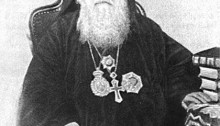
Abp Panteleimon of Neapolis (Jerusalem Patriarchate), presenting a portion of the True Cross to President Warren G. Harding in 1922

Abp Panteleimon & the Jerusalem Patriarchate in America

Abp Panteleimon of Neapolis (Jerusalem Patriarchate), presenting a portion of the True Cross to President Warren G. Harding in 1922

Abp Panteleimon of Neapolis (Jerusalem Patriarchate), presenting a portion of the True Cross to President Warren G. Harding in 1922

When most people think of the Jerusalem Patriarchate in America, they think of the controversial jursidiction that spung up in the past decade or so, which included ethnic Palestinians and some former clergy of Ss. Peter and Paul (Antiochian) in Ben Lomond, California. This jurisdiction received a bishop in 2002, but it was dissolved just last year by an agreement between the Patriarchs of Jerusalem and Constantinople.

But the history of the Jerusalem Patriarchate in America goes back long before the 21st century — all the way back to 1922 (and, in some respects, even earlier). In a 1905 report (translated by Fr. Andrew Kostadis in his 1999 St. Vladimir’s Seminary thesis Pictures of Missionary Life), St. Tikhon wrote to the Russian Holy Synod,

[I]t is difficult to trust the Greeks: although they have parishes in America, some are dependent upon the Synod of Athens, some on the Patriarchate of Constantinople, and some on Jerusalem (quite a weak dependence!), and, according to the politics characteristic of Greeks, they would hardly wish to be under any kind of subjection to the Russian hierarchy.

I’m not sure which specific Greek parishes were tied to Jerusalem; it couldn’t have been more than a few, as almost all Greek churches at the time had connections with either Constantinople or Athens.

Seventeen years later, in 1922, a hierarch of the Jerusalem Patriarchate arrived in America. He was Archbishop Panteleimon of Neapolis, and he came, initially, as the Patriarchate’s representative to the conference of the Episcopal Church, held in Portland, Oregon. (This conference was a pretty big deal, and lots of major Orthodox figures attended, but that is a story for another day.)

Abp Panteleimon got to Portland in early September, and he served the Divine Liturgy at the Greek church there. After the conference, he remained in the US, mostly with the goal of raising money for the Holy Land. Panteleimon told one newspaper (Bridgeport Telegram, 11/12/1923),

The World War and the Russian revolution are the chief reasons why the Eastern Orthodox church is unable to carry out its sacred trust as it should and endeavors to. Whereas 10,000 pilgrims from the steppes of Russia came to Jerusalem to place their life savings in our coffers each year to enable us to keep from harm the places and keep alive the memory of Our Lord, not one comes to Jerusalem today.

Abp Panteleimon also explained that the Jerusalem Patriarchate had land holdings in Russia, Turkey, and Romania, and in each case the governments of those states confiscated the land. This virtually cut off the Patriarchate’s revenue stream. (Incidentally, this highlights some of the ripple effects of the Bolshevik takeover in Russia. Its impact was felt all over the Orthodox world.)

The Washington Post (12/28/1922) reported that the Abp Panteleimon had just met with President Harding. The Archbishop made Harding a “Knight of the Order of the Holy Sepulcher,” and, most significantly, gave him a splinter of wood from the True Cross, “imbedded in wax, and inclosed in a gold box set with diamonds.”

Actually, Abp Panteleimon seems to have made a habit of awarding people with pieces of the Cross. In addition to the one he gave President Harding, he handed out at least five or six other pieces to various people. One went to the promient Episcopal Bishop William Manning, another to a Chicago merchant named A. Theodoracoplos, and another to a Washington lawyer named Soterios Nicholson. According to the Chicago Heights Star (4/12/1923), Panteleimon gave the relics “in recognition of the aid given by the people of the United States in relieving the distress of the Greek people who were murdered, outraged and rendered homeless by the Turks.”

As an Orthodox Christian, this is a little shocking. The True Cross is one of the most priceless relics we have, and the idea of it being used as a thank-you gift is a bit unsettling. I don’t doubt that the recipients were worthy of some sort of honor, but why not just give them a medal, or an icon, or something? Why the Cross of Christ?

Anyway, Abp Panteleimon appears to have established a metochion (basically, an embassy church)  in the US. I’m not sure where this metochion was; possibly New York City, though it may have been in Washington, DC, since the Archbishop spent a lot of time in that city. While in America, Abp Panteleimon convinced a young Greek man named John Nicholaides to be ordained a priest. This man later returned to Greece and went on to become a great Athonite ascetic, Elder Joachim of St. Anne’s Skete.

The last traces I have of Abp Panteleimon are from 1924, and he was certainly gone by 1930 at the latest. (That’s when the Ecumenical Patriarchate reorganized the Greek Archdiocese.) I’d be very interested to learn more about Abp Panteleimon and his metochion, if anyone out there has any information.

Also, it would be interesting to know what happened to the pieces of the Cross distributed by Abp Panteleimon. Is President Harding’s piece still in the White House, or did it go to his family? What about the pieces given to the aforementioned Mr. Theodoracoplos of Chicago, or Soterios Nicholson of Washington, or Peter Vanech of Stamford, Connecticut?

As you can see, there’s a lot left to be learned about Abp Panteleimon.

Fr. Raphael Morgan

The First Black Orthodox Priest in America

Fr Raphael Morgan

On today’s episode of the American Orthodox History podcast, we’re running a lecture I gave at the Brotherhood of St Moses the Black conference in Indianapolis at the end of May. The subject is Fr Raphael Morgan, the first black Orthodox priest in America. The text of the lecture is below. Also, later this year, St. Vladimir’s Theological Quarterly will be publishing a paper I wrote on Fr Raphael.

(more…)

Go to Top