Posts Tagged ‘language’

11
Mar

St. Raphael and the Episcopalians in 1910

   Posted by: Matthew Namee    in Saints

St. Raphael Hawaweeny

At the turn of the last century, relations between the Orthodox and Anglican Churches were quite warm. They cooled a bit in 1905, when St. Tikhon ordained the former Episcopal priest Ingram Nathaniel Irvine to the Orthodox priesthood, but even so, many on both sides of the dialogue felt that full union would eventually happen.

In England in 1896, a body was formed called the “Anglican and Eastern Orthodox Churches Union.” A dozen years later, in 1908, a group of High Church Episcopalians decided to establish an American branch of the organization. Several Orthodox leaders attended the first meeting in New York City, including the Syrian Bishop Raphael Hawaweeny and two of his clergy, the Fr. Benedict Turkevich (representing the Russian Archdiocese), and Fr. Methodios Korkolis (representing the Greeks). During the meeting, St. Raphael was elected to be the Orthodox Vice President.

The Episcopalians had an ambitious agenda: they wanted the Orthodox to recognize their holy orders as valid; indeed, they wanted to be recognized as a Local Church, just as “Orthodox” as Russia or Antioch. The Orthodox, and St. Raphael in particular, had much more modest goals. They wanted to promote friendly dialogue, with initiatives such as seminarian exchanges.

All the while, St. Raphael faced a monumentally difficult pastoral situation. His flock was scattered across North America, and many lived far away from any Orthodox church, Syrian or otherwise. In 1909, the Episcopalians suggested that he have the Anglican Book of Common Prayer translated into Arabic, so that the Syrians could worship with the Episcopalians. Raphael responded that it would be better for the Episcopalians to buy some Orthodox service books for their churches, so that the Syrians could use them if they visited.

In June of 1910, Raphael went even further, granting formal permission for his people to seek the ministrations of Episcopal clergymen in the event that no Orthodox priest was available. Here is his letter, which I am reprinting from the Journal of the Proceedings of the One Hundred and Ninth Annual Convention of the Protestant Episcopal Church in the Diocese of New Hampshire (November 1910):

Right Reverend and Reverend Brothers:—

I thank God for the great work which is being done by our Union, in the way of promoting fellowship and a better understanding between the Holy Orthodox and Anglican Churches.

I assure you also of my full appreciation of all the kindnesses and courtesies extended to me and my people.

Now, in order that all complications may be avoided in the matter of mixed Services, that is, when a Syrian Orthodox may desire to have any Sacrament performed by a Bishop or Priest of the Anglican Communion in North America, I offer briefly some of our rules, as Orthodox Catholics, which, if possible, I beg to have enforced.

However, in this matter I am only speaking for myself personally, as an Orthodox Bishop, and in no way binding my brother Orthodox Bishops in North America. I speak alone for the Syrian people.

First:—It is against our Law to marry two brothers to two sisters.

Second:—It is equally contrary to the same law to marry a man to a deceased wife’s sister, and vice versa.

Third:—We do not permit marriage within the fourth degree of consanguinity.

Fourth:—Civil Divorces are not acknowledged by the Orthodox Church, unless for causes she sanctions; and, therefore, no civilly divorced person can be reunited in wedlock to another party, unlets divorced by the Church, as well as by the State.

Fifth:—The Orthodox Church requires that a child shall be baptized by a Trine Immersion in the water, and be immediately afterwards Chrismated.

Inasmuch as there is a variance between your and our Churches in these matters, I suggest that, before any marriage Service is performed for Syrians desiring the services of the Protestant Episcopal Clergy, where there is no Orthodox Priest, that the Syrians shall first procure a license from me, their Bishop, giving them permission, and that, where there is a resident Orthodox Priest, that, the Episcopal Clergy may advise them to have such Service performed by him.

Again, in the case of Holy Baptism, that, where there is no resident Orthodox Priest, that the Orthodox law in reference to the administra

tion of the Sacrament be observed, namely immersion three times, with the advice to the parents and witnesses that, as soon as possible, the child shall be taken to an Orthodox Priest to receive Chrismation, which is absolutely binding according to the Law of the Orthodox Church.

Furthermore, when an Orthodox Layman is dying, if he confesses his sins, and professes that he is dying in the full communion of the Orthodox Faith, as expressed in the Orthodox version of the Nicene Creed, and the other requirements of the said Church, and desires the Blessed Sacrament of the Body and Blood of Christ, at the hands of an Episcopal Clergyman, permission is hereby given to administer to him this Blessed Sacrament, and to be buried according to the Rites and Ceremonies of the Episcopal Church. But, it is recommended that, if an Orthodox Service Book can be procured, that the Sacraments and Rites be performed as set forth in that Book.

And now I pray God that He may hasten the time when the Spiritual Heads of the National Churches, of both yours and ours, may take our places in cementing the Union between the Anglican and Orthodox Churches, which we have so humbly begun; then there will be no need of suggestions, such as I have made, as to how, or by whom, Services shall be performed; and, instead of praying that we “all may be one” we shall know that we are one in Christ’s Love and Faith.

Raphael, Bishop of Brooklyn.

Not long after issuing this letter, St. Raphael did an about-face, withdrawing from the Anglican and Eastern Orthodox Chruches Union altogether, and instructing his people to disregard his previous letter. We’ll discuss those events in the near future.

Tags: , , , , , , ,

As we’ve discussed previously, in July of 1920, an all-convert, all-English Orthodox parish was founded in New York City. Called the Church of the Transfiguration, the parish was led by the newly-converted Fr. Patrick Mythen. But it was the fulfillment of a long-held dream of the elderly Fr. Ingram Nathaniel Irvine, who served as the assistant priest.

The church held its first services on Sunday, July 18, 1920. Six days later, the New York Times ran an article on the parish under the headline, “Americanizing a Church.” The Church of the Transfiguration was, according to the article, part of a broader initiative, supported by Archbishop Alexander Nemolovsky, to “Americanize” the Russian Archdiocese. He had apparently commissioned a fresh English translation of the Divine Liturgy. English was the primary language of instruction in the Russian seminary in Tenafly, New Jersey, and Orthodox Christians in America were encouraged to obtain US citizenship.

Bolshevik sympathizers allegedly poisoned a chalice later consumed by an elderly Fr. Ingram Nathaniel Irvine

On Saturday, July 31, someone reportedly broke into the church. Mythen told the Times (8/16/1920) that, oddly enough, nothing at all was taken. This was surprising — the burglars could have stolen the holy vessels made of gold and silver, and expensive clergy vestments, but they didn’t. From the Times:

The priests were puzzled by the objectless burglary, but on the following day, when he drank the sacramental wine from the chalice at the end of the service, Canon Ingram N.W. Irvine became conscious of an agonizing pain in his mouth, throat and stomach. Believing that in some manner the chalice had been filled with acid instead of wine, he acted immediately to save his own life. By his promptness he escaped without serious injury, though he was very sick for a day or more. Canon Irvine is 70 years old.

Immediately after this incident an investigation was made of the receptacle containing the wine intended for sacramental purposes, but not yet consecrated. The wine there was found to be perfectly pure and fresh.

The priests then considered they had found the explanation of the burglary. One or more persons, who hated the Orthodox Church, had forced an entrance into the church in order to put poison in the chalice in the hope of killing a priest.

Fr. Patrick Mythen connected this alleged poisoning to other recent incidents. He told the Times, “In addition to this certain other churches have been attacked and broken into within the last few weeks, and other priests assaulted. One Roman Catholic priest of Greek nationality was bound and beaten. An Orthodox priest in Bayonne was also attacked by three men, but the priest being of very powerful physique, seized the man with the revolver so quickly that when the weapon was discharged, the assassin shot himself. The man was taken into custody by the United States Secret Service and found to be an anarchist.”

The Orthodox leaders, and the Times, thought that all this was connected to the Americanization program that the Russian Archdiocese was instituting. Bolshevik sympathizers, who hated both America and Orthodoxy, supposedly found the mingling of the two to be intolerable. The Times article from which I’ve been quoting is actually all about another incident, which took place on August 15 (and which I’ll discuss in another post).

Now, about the Fr. Ingram Nathaniel Irvine poisoning — They checked the container that held the unconsecrated wine, and it was clean. So, the poison was presumably put in the chalice itself. But if that were the case, wouldn’t someone else have gotten sick, too? Then again, it was pretty common then for people to take communion only a few times a year. Combine that with the fact that the Church of the Transfiguration was a tiny, new place, and it’s entirely possible that there were no lay communicants that day. On the other hand, the church had several attached priests who probably would have partaken. Why would Irvine have been the only one affected? There are two possibilities: one, Irvine may have been the only celebrant that day, and thus the only one to partake of the Eucharist. Two, it’s possible that the poison would only cause problems if consumed in large quantities. If the other priests only took a few sips, and Irvine finished the whole chalice, it may well have only affected Irvine.

So, was Irvine really poisoned? We will probably never know for sure. I’m confident that he wasn’t a liar, but I’m just as confident that he could be a bit melodramatic at times. I’m inclined to believe him when he says he was poisoned, but the circumstances are rather odd. It would be great to see the police report of the incident, but I don’t know if one has survived.

Another thing — note the statement that Irvine “acted immediately to save his own life.” It sure sounds like he forced himself to expel — vomit — what he had just consumed. That is, he intentionally threw up the Eucharist. I realize that he thought it was filled with acid, and that he was protecting his life. And he probably took measures to ensure that what he had just expelled was disposed of in a proper manner. But still, while I fully understand his actions, I find them rather shocking as well.

Irvine was back in church on August 19, preaching a sermon on the Feast of the Transfiguration. He died the following January — 5 1/2 months after being poisoned. That said, I don’t think there was any connection between the poisoning and his death. He regained his health pretty quickly after the poisoning incident, and, according to his obituary, he died of heart disease.

Tags: , , , , , , , ,

26
Jan

The First English-Speaking Parish

   Posted by: Matthew Namee    in Early Converts, Firsts, Westernization

For a while now, I have been meaning to write about the first all-English Orthodox parish in America, founded in New York City in 1920. Today, I’m going to give a brief introduction to that parish, and the main characters involved. This is hardly the whole story; it really is just an introduction.

To start — well, you know about Fr. Ingram Nathaniel Irvine, who converted to Orthodoxy in 1905. (If you don’t know about Irvine, you can read our earlier posts about him, or listen to two podcasts I did on Ancient Faith Radio.)

So Irvine converted in 1905, and he remained an Orthodox priest until his death, in January 1921. During that time, in both the Russian and Syrian Missions, he was a strong advocate of the use of English in American Orthodox worship. He felt that, for Orthodoxy to survive and thrive in America, it was imperative that it, to some extent, “Americanize.” (This is the term that was used at the time.)

For most of Irvine’s Orthodox career, there were not many converts. Irvine spent a lot of his time working with Orthodox young people, and interacting with Episcopalians, but he didn’t actually bring a lot of people into the Church. Late in his life, however, things started to change. An Episcopal priest named James Grattan Mythen converted to Orthodoxy in 1920. He was immediately ordained a priest by Abp Alexander Nemolovsky, and he took the name, “Fr. Patrick.”

Mythen would prove to be the first of a surprisingly large number of convert priests to enter the Russian Archdiocese in the early 1920s. Irvine was quite old by this point, in his early 70s at a time when most people didn’t live past 60. He was not really capable, physically, of running his own church. But Mythen was young — just 37 at the time of his conversion — and he became the leader of a group of convert clergy.

Within a very short period of time, Mythen was joined by the following men:

  • Dr. Geoffrey A. Lang, ordained Fr. Stephen
  • Robert F. Hill, ordained Fr. Antony
  • Fr. Paul Ihmsen
  • Dr. George Gelsinger, ordained Fr. Michael
  • Royce M. Burden, ordained Fr. Boris
  • Arthur W. Johnson, ordained Fr. Kyrill
  • Sgt. William H. Schneider, ordained Fr. A. (not sure what it stood for)

Irvine didn’t know all of these men; several of them came along after he had already died. And Irvine doesn’t seem to have been the main person driving this enterprise; Mythen was. Abp Alexander put an enormous amount of trust in Mythen. For a while, in the early 1920s and before Metropolitan Platon took over the Russian Archdiocese, Mythen basically ran the whole Archdiocesan operation, even signing ordination certificates (a task properly done by a bishop). Needless to say, Mythen supplanted the aging (and then deceased) Irvine as the leader of the English Department of the Russian Archdiocese.

And in 1920, the newly-converted-and-ordained Mythen became the rector of the “American Orthodox Catholic Church of the Transfiguration,” the first all-English, all-convert parish in history. The church was located at St. Vladimir’s Immigrant Home, 233 East 17th Street in New York City. The first services were held on July 18, 1920. This is part of an article from the New York Times (7/17/1920):

In the establishment of this English-speaking church by the Russian hierarchy the efforts of fifteen years of the Rev. Dr. Ingram N.W. Irvine, a canon of the local Russian Cathedral, have been realized.

Archbishop Tikhon, who was head of the Russian Church in America for several years, favored such a move, but he was recalled to Russia before he could organize such a branch. Appeal was then made to Archbishop Nemoloski, who agreed that an English mission would fill a need. Abbot Patrick (James Gratton Mithen), who came here from England three months ago, was designated as rector of the new branch. Dr. Irvine will be the associate rector. He and Abbot Patrick are major canons.

The other two members of the staff are minor canons. The first vicar is Canon Stephen, who came to America with Canon Patrick, and the second vicar is Canon Paul, who was ordained a priest of the Russian Church in Pittsburgh by Bishop Stephen of the Uno-Russian Diocese of Pittsburgh. He is a brother of Max Ihmsen, a newspaper editor. Dr. Irvine is Professor of the English Department in the Russian Seminary, Tenafly, N.J., and Canon Paul is his assistant.

A few things… One, I find the whole “canon,” “vicar,” language to be slightly amusing, borrowed as it is from the Episcopal Church. Is a “major canon” supposed to be an archpriest, in this context? I don’t know. I’m not aware of Irvine having ever been raised to archpriest, but it is possible.

Two, while Mythen did travel from England to the US, he was only in England for a few months. We’ll talk about his life in a separate post in the future, but he was born in Baltimore and was an American citizen. Like Irvine, Mythen was of Irish ancestry, but was an Anglican clergyman. He was very involved in politics and art — he was a vocal proponent of women’s suffrage and of Irish independence, and he moonlighted as a playwright. One of his allies in the Irish independence movement was Geoffrey Lang (aka Fr. Stephen), who, along with Mythen, helped run a group called Protestant Friends of Irish Freedom.

Fr. Paul Ihmsen — I’m not certain, but I think his given name was Charles. His brother Max, the newspaper editor, was a major figure in the newspaper industry of the early 20th century. He was a protégé of William Randolph Hearst, with titles ranging from “political manager” to “henchman.” He then went to California and ran the Los Angeles Examiner, and on the side, he became a pioneering apple farmer. The Ihmsens came from an old, prominent German family from Pittsburgh.

Another priest in these early years was Fr. Antony (Robert) Hill, who happens to be the second black priest in American Orthodox history, after Fr. Raphael Morgan. Hill was Orthodox for a very short time; he soon joined the upstart “African Orthodox Church,” about which, more in the future.

The other clergy I mentioned above — Gelsinger, Burden, etc. — came along later, after the Church of the Transfiguration had closed. And close it did, very soon — the New York Times has advertisements for the church through November 1920, but nothing afterwards. The church’s few months of existence were eventful, though. Two prominent literary figures, T. Everett Harre and Reginald Wright Kauffman (both, apparently, friends of Mythen), converted to Orthodoxy. In August, Irvine was apparently poisoned, allegedly by Bolshevik sympathizers. And in September, Abp Alexander raised Mythen (who was unmarried) to the rank of archimandrite. We will discuss all of these events, and the history of the broader English-speaking mission, in future articles.

Tags: , , , , , , , , , , , , ,

Archimandrite Theoclitos Triantafilides is one of the most remarkable figures in American Orthodox history. An ethnic Greek, he served as tutor to the future Tsar Nicholas II and went on to establish the multiethnic parish of Ss. Constantine and Helen in Galveston, Texas, under the Russian Mission. His story has been mostly untold, until now. The following article, by Milivoy Jovan Milosevich, is the fullest and best work yet done on the life of Fr. Theoclitos and the history of Ss. Constantine and Helen Church. It originally appeared on the Galveston Orthodox Community website, which is run by Fr. Serge Veselinovich, the current pastor of Ss. Constantine and Helen. SOCHA has received permission to reprint the article here at OrthodoxHistory.org.   

Archimandrite Theoclitos Triantafilides

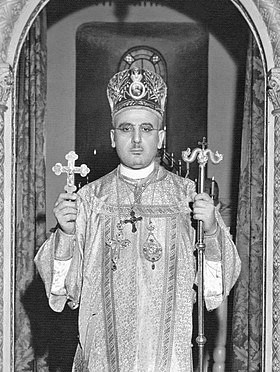
This picture of the Right Reverend, Most Venerable Archimandrite, Fr. Theoclitos Triantafilides is the only one I am aware of. He was the first Orthodox Priest in Texas. The picture did hang with Honor in the Church Congregation Hall of Saints Constantine and Helen Church in Galveston, Texas. It has been saved from “Hurricane IKE’s Destruction” (September 12, 2008), and will hang there again when the new hall is constructed soon. I live in Galveston, and I have been a part of the Church congregation since Baptism. My Mother was baptized by Arch. Fr. Theoclitos and was very proud to tell people of that fact until her death in 2001. I have studied everything I can find on this wonderful Priest over the years, including his Last Will, the Galveston Daily News archives, Immigration Records, the Rosenberg Public Library of Galveston, the Church records (Slavonic, long-hand written in Cyrillic), the Internet and greatly on the local “folklore” stories told of him.   

IT’S HAS BEEN SAID….   

His father was an Athenian Greek. When the first outbreaks of Greek Independence from the Ottoman Empire started on the Peloponnese Peninsula, his father, a fisherman crossed onto the peninsula to join the forces of famed Greek General Theodoros Kolokotronis, also an Athenian. Eight years later, when Independence was achieved (with great help from the Allied Russian, English and French Forces); he settled in Egio (one of the oldest cities in the Balkans), Peloponnese Peninsula, Greece.   

Born in November of 1833, young Theodoros was named for the famed Greek General. They called him “Theos” and he celebrated his Name Day each September 22nd (Julian Calendar in the 1800’s), on the Feast Day of St. Hierotheos, the Student of Saint Paul, the Apostle, who in 53 A.D. became the First Bishop of Athens. Theodorus grew up fishing with his father, and spending time around the port; while his mother (a native of the Peloponnese Peninsula) pushed him to the Church. The era after Greek Independence was wrought with economic problems and the Armenians and Bulgarians had replaced the Ottomans as bankers and merchants, allowing our young Theos to become ever more acquainted with other cultures. Two-thirds of the population had vanished and the land was devastated.   

His early schooling was in the Church of Panagia Trypiti that is built inside a cavity of the cliff just 150 stair steps above the Port of Egio and he helped the Priests with all their duties, occasionally traveling into the local mountains to visit Agia Lavras Monastery, about 20 miles south and up in the mountains. Greek Independence had started there with Bishop Germanos Declaring Independence with his blessing of the troops. Later the Ottomans burned the Monastery, but it was reconstructed with help from the Russian Orthodox Church. Many of the Icons there were gifts from the Russian Monastery Panteleimon on Holy Mt Athos and the Be-jeweled Gospel in the Monastery was printed, signed and given by Catherine the Great of Russia. History and multi-ethnic cultures literally surrounded him. As a young adult, he was Tonsured a Monk and was given the name Theoclitos. He soon traveled to Mt Athos where he was accepted as a resident of the Panteleimon Monastery, where he became fluent in Slavonic and studied Russian language and customs; and made regular visits to the Serbian Monastery Hilandar learning the Serbian language and customs. He had become fascinated with languages.   

He was invited to complete a formal education and become a teacher at the Slavic Greek Latin Academy and Theological Seminary at Holy Trinity – St. Sergius Monastery, better known today as the Moscow Theological Academy, just outside Moscow, Russia. After under-graduate, a Graduate Degrees in Theology and a few years of teaching; he was called upon by the new Danish born King of Greece, George I, to tutor his son Prince George. Later, the King’s brother-in-law, Tsar Alexander III of Russia called upon him to tutor the Royal Family’s 6 children specifically in other Orthodox cultures including the Greek language. So, he became a Greek cultural teacher to the future Tsar Nicholas II of Russia, who was Canonized a Martyr Saint of the Russian Orthodox Church in 1991. It is also said, Fr. Theoclitos was one of the 30 or so clergyman serving at the wedding of Nicholas II and Alexandra Fyodorovna, who was Canonized a Martyr Saint of the Russian Orthodox Church in 2000. The Parishioners of Galveston would later call him, “The Priest of Three Kings.”   

It is known that with the outset of the American Civil War, a group of multi-ethnic Orthodox Christians were having regular prayer meetings in Galveston, as early as 1861, and they called themselves “the Parish of S.S. Constantine and Helen.” Galveston is a seaport, and its citizens were accustomed to our Eastern European and Mediterranean People. Our Eastern Orthodox Christians were always around the port. There were those that came, returned home and came back again. The first known Serbian in America lived in Galveston for a long time; his name was Djordje Sagic (aka: Djordje Ribar and/or George Fisher). He came to Texas in the late 1820’s after “jumping ship” (because of indentured servitude) in Philadelphia, and became the first Port Director of the Port of Galveston under the Mexican Government. He then became a Major in the Texas Revolutionary Army under General Sam Houston. He served in public office as City Councilman in Houston, Texas and Justice of the Peace in Harris County after the Texas Revolution. Sagic had studied for the Priesthood in Karlovci Serbia, but left the seminary to join the last efforts of the first Serbian uprising against the Ottoman Empire in 1813, lead by Serbian leader, Karageorge Petrovitch. He left the area in 1850 to ultimately retire in San Francisco, California as a Justice of the Peace and retained the status of the Official Greek Government Consul there until his death, in 1873. He knew 13 languages.   

The First known Greek in Galveston participated in the Parish Church group. He called himself only by the name of Captain Nicholas. Captain Nicholas joined the notorious Privateer Jean Lafitte in New Orleans, when Lafitte sailed for Galveston, as Capitan of Lafitte’s prize schooner the Mirabella. Captain Nicholas sailed away from Galveston with Lafitte after burning everything they left behind. Captain Nicholas returned to Galveston after Lafitte’s death, becoming a farmer on west Galveston Island and recounting old pirate stories at the waterfront. He lived more than 100 years and is believed to have died in the Hurricane of 1900. Some have said that with Lafitte came the first of many nationalities to Galveston, but I am unable to corroborate any other Orthodox Christians. During the late 1880’s and early 1890’s these Orthodox Christian Serbian, Russian, Greek, Bulgarian, and Arab (Lebanese) immigrants to Galveston had organized and started gathering moneies for a church. Aside from the religious group, they each started several individual nationalistic groups. Each had separately written many petitions to their former Bishops back home for a Parish Priest and had received only denials; justified by the facts of distance and costs, but these denials were in some cases including the suggestion that they petition the Russian Orthodox Mission Diocese in North America. So the culture in Galveston was ripe for the addition of an Eastern European & Mediterranean Priest of Arch. Fr. Theoclitos’ stature.   

Nicholas II became Tsar of Russia on November 26, 1894. The Romanov Royal Family had created and supported the Russian Orthodox Mission into North America through Alaska since 1794. At that time, because of the Romanov family’s truly un-matched wealth, the Russian Mission into America was the only Orthodox jurisdiction on the continent prior to 1922.   

So, the Slavs, headed by Risto Vukovich; and the Greeks headed by Athurs Menutis gathered and decided to petition the Russian Mission Diocese. They sent three telegrams written in Cyrillic and signed by Vukovich, Christo Chuk, and Milosh Porobich which explained the diversity of the parishioners to; (1) the Holy Synod of the Russian Orthodox Church, (2) Tsar Nicholas II personally, and (3) His Grace Bishop Nicholas in Sitka, Alaska. A short time later the parish board received a telegram personally from Tsar Nicholas II, stating his acceptance of their plea. The Tsar had a large Gospel Printed, all the Vestments and Liturgical necessities including a signed Antimins, and all the Icons for an Iconostas painted and assembled including the icon to be used for the name day of the future Church (His own Namesake, Saint Nicholas); and he chose his teacher Fr. Theoclitos to go to Galveston, telling him “Let there be an Orthodox Church in Galveston.”   

By this time, Fr. Theoclitos was 61 years of age, and was a well traveled man and spoke more than a dozen languages: Greek, Russian, Serbian, Slavonic, Latin, Bulgarian, Arabic, Hebrew, Danish; and some Spanish, English, French, German, and Romanian. The Ambassador of Russia to the United States acquired US Citizenship for him even before he left Russia. Prior to leaving Russia, Fr. Theoclitos was given the heavy cross he always wore by Tsar Nicholas II and he was elevated to the rank of Right Reverend Archimandrite, because he would soon be the Priestly leader of a flock of Christians so far away with little known chance of a visiting Bishop anytime soon. His journey to the far off land of Galveston, Texas began with six companions. With him were; the Very Reverend Archimandrite Raphael Hawaweeny (Glorified a Saint in March of 2000 by the Orthodox Church in America) and his three Deacons Constantine Abu-Adal, Istvan Moldowanyi and John Shamie (later Shamie was a Priest in Galveston); and Archimandrite Fr. Theoclitos’ two Russian Deacons, Theodore Pashkowsky and Joakim Zubkowsky, and his Romanian Deacon Pavel Grepashewsky; and Fr. Peter I. Popoff. The first leg of the trip was by train to Berlin, serving liturgy there at the Russia Embassy Church; then on to the Port of Bremen. Next leg was by passenger ship to Southampton for a change of ships, then on to New York aboard the passenger ship, S.S Havel out of South Hampton, as a United States Citizen. Only 82 passengers sailed that day. Although a group of Priests were at the port of New York to greet them on the Morning of November 14, 1895, they were required by customs to spend one night in Quarantine. The next morning, they were joined in New York by Bishop Nicholas Ziorov of the Russian Orthodox Mission in America to consecrate the First Arab-Syrian Orthodox Church in America under the Russian Mission’s jurisdiction, and to install Archimandrite Raphael as Pastor, with his three deacons. A few days later, Arch. Fr. Theoclitos, his three Deacons; and Fr. Popoff traveled with Bishop Nicholas by train to Washington D.C., then to western Pennsylvania, where Fr. Popoff was to serve and then on to Kansas City. At this point, it was decided that only the Romanian Deacon Grepashewsky would travel to Galveston with Arch. Fr. Theoclitos; and Bishop Nicholas and the other two Deacons would go on to San Francisco. Arch. Fr. Theoclitos stopped in Hartshorne, American Indian Territory, Oklahoma to have Liturgy for a group of Russian Miners, just outside of Tulsa, Oklahoma before reaching Galveston.   

The distances from Galveston to either San Francisco or New York are about 1600 miles. Although his rightful rank was high, which gave him the right to consecrate his own chapel including the right to wear a Mitre (Crown, but with a flat, not standing Cross on top) and carry a Pastoral Staff (Bishop’s Staff); he lived his life in Galveston as a meager Monk, teacher, and Pastoral Priest. The Church Congregation never paid Arch. Fr. Theoclitos, because he received his pay directly from the Tsar (1500 rubels a month and 500 rubels as expenses; about $120 total, at that time) until Arch. Fr. Theoclitos passed away in 1916, a year and a half before Tsar Nicholas II and his Family were murdered.   

The Trustees of The Existing Congregation Board (Chris Vucovich, Chris Chuoke, Athurs Menutis and Mitchael Mihaloudski) formally received their State Corporation Papers on January 13, 1895 and subsequently purchased a 43’ wide x 120’ deep property that is at 4107 Avenue L, Galveston, Texas on December 15, 1895. They started to build a rectangular wood frame Orthodox styled Church, and when Arch. Fr. Theoclitos arrived, in January of 1896, he directed the finishing of the Church. The congregation was astonished to be blessed with an Archimandrite and a Deacon, not just a Priest, and best of all he was somewhat of a linguist.   

In Galveston, all properties faced either North-west or South-east, so they had chosen property that leaves our Church unusually facing South-east. And, although the Icon of Saint Nicholas was placed in the Iconostas to Honor Tsar Nicholas II as the Patron of the Church; it was Arch. Fr. Theoclitos’ decision to use the name S. S. Constantine and Helen Church, because the congregation that started on its own should be remembered. Bishop Nicholas was invited and he accepted; and the Consecration of our church occurred on June 3rd 1896, the feast day of Sts Constantine and Helen. Arch. Fr. Theoclitos’ decision on the name of the Church, was not unusual with him. He was known to have baptized children with names other than their parents had asked for. My mother’s name was to be Ruza, Serbian for Rose, but he baptized her as Sophia which her parents accepted without question, and gave my mother and others an unusual lifelong connection to their Archimandrite. But then, his guidance and decisions were always accepted by his congregation. There have never been any questions of his guidance that were ever passed down through the years even though we Eastern Europeans have always loved a good argument. He had services in the Slavonic, Greek and Arabic languages. It was as though his congregation was standing with a Saint.   

In 1897, Arch. Fr. Theoclitos purchased a 36 plot track in the Lake View Cemetery as a gift to his Congregation. He buried his flock in the next consecutive plot, without regard to couples or children or any Relationship, because he saw them as one congregational family.   

In early 1897, Bishop Nicholas replaced Deacon Grepashewsky with a young Russian Monk, Fr. Mikhail Kurdinovski to allow Arch. Fr. Theoclitos time to travel and invited Arch. Fr. Theoclitos to San Francisco to speak in the Greek language on the mounting losses of the Cretan insurgents in their revolution against Ottoman rule. Bishop Nicholas had to be acutely aware that his Archimandrite was the highest ranking Greek born Clergyman in America. While in route, we know that he also served Liturgy again in Oklahoma; and in Denver, Colorado. After his sermon in San Francisco he was asked to traveled with Fr. (later, Archimandrite) Sebastian Dabovich (currently being considered for Canonization as a Saint), to Portland, Oregon and Seattle, Washington, where they served Liturgy in Slavonic, Greek and Arabic in both cities. He again traveled to San Francisco in 1898, to participate in the installation of Bishop Tikhon Bellavin, as the new Bishop, replacing Bishop Nicholas of the Aleutians and Alaska (Diocesan name was changed in 1900 to Diocese of the Aleutians and North America). Although little is known about it, Bishop Tikhon visited our parish in 1899, for the first of two visits.   

It’s known that Arch. Fr. Theoclitos traveled extensively on the Gulf Coast going as far east as Mobile, Alabama, as far south as Corpus Christi, Texas, and into the interior north to Ft. Worth, San Antonio, San Angelo and Austin Texas, performing Marriages and Baptisms and serving Liturgy where ever he found our Orthodox Christians. In 1897, The Wiemar, Texas newspaper had an article about him; where he borrowed the local Catholic Church in LaGrange, Texas to perform the wedding of a Greek Couple. The writer (obviously Protestant) posted the short article that follows.   

Weimar Mercury, 29 Jan 1898: “LaGrange, Tex., Jan. 25, –Married today, Mr, Abraham John to Miss Zeche Nemer, both Greek, at the Catholic Church by Rev. Theoclitos (Archimandrite of the Orthodox Church), Galveston, Tex. A very large crowd attended the ceremonies, which were ’somewhat of a novelty,’ no such ceremonies having ever been performed here.”   

Our Church Board additionally purchased a like adjoining property west of the Church doubling the size of the property in early 1900. But, in his 66th year, on September 8th 1900, Galveston Island was hit by the greatest natural disaster in United States history when the massive Hurricane of 1900 came ashore. The Island was almost totally destroyed (est. of 8,000 to 12,000 deaths of a population of 30,000, which included 24 members of the congregation. Arch. Fr. Theoclitos and Fr. Mikhail spent 30 hrs in the church praying and giving refuge to parishioners and neighbors that sought safety in the church. After the storm had passed, the Church structure was still standing although it had floated to the west about 10 feet partially onto the additional property just purchased. Those that were with him in the church believed Arch. Fr. Theoclitos and his church had truly saved their lives. The congregation gathered and raised the Church, repaired the damage and early in 1902 petitioned Bishop Tikhon, who had since moved the headquarters of the Diocese to New York, to visit and Re-consecrate their repaired Church. Bishop Tikhon accepted and arrived shortly before services on June 3rd 1903. This event made Arch. Fr. Theoclitos and his congregation’s church not only patronized by, but also consecrated by future Saints of Orthodoxy. By order of Tsar Nicholas II, Bishop Tikhon bestowed on Arch. Fr. Theoclitos the Royal Honors of (1) the Order Of St. Vladimir and (2) the Order of St. Anne (in his picture, the ribbon and cross like medallion around the neck to his right side is the order of St. Vladimir, the ribbon and medallion around the neck to his left side is the Order of St. Anne and the necklet with the large medallion was awarded him upon attaining his Graduate Degree in Theology from the Moscow Theological Academy.   

While in Galveston, Bishop Tikhon visited the cemetery, and became aware that it was filling fast. As a gift to the Congregation, Bishop Tikhon,who was later made Patriarch of Moscow, purchased 27 additional plots next to the original cemetery track. Arch. Fr. Theoclitos and the Church continued with a new influx of immigrants coming to Galveston each year, even purchasing another 21’ to the west of the Church. Although he did keep constant communications with the Diocese, it is not clear whether he ever met with Archbishop Platon of New York, who replaced Bishop Tikhon.   

He was known to include the Romanov Royal Family each week in the Liturgy, as: (1) word of Tsar Nicholas II’s son, Alexander’s affliction with hemophilia began to spread, (2) World War I was building and (3) talk of revolution against the Tsar was in the news from time to time. Also, because of our multi-ethnic culture in Galveston, the shot by Serbian Gavrilo Princip that assassinated Archduke Franz Ferdinand and his wife Sophie, (believed to be the shot that started World War I, was heard loudly in our Church making the War and the assassination more than an important issue.   

On weekly trips to the business district, the neighborhood children would gather on the church steps and wait for his return. He would always have a large bag full of fruit and the latest sweets for them, saving a large portion for his parish children. He became acquainted with many people during his years in Galveston and was thought of respectfully, while they became somewhat enchanted with his customary meager but stoic Orthodox Monastic ways. He was a constant visitor to St. Mary’s Infirmary (the local Catholic Hospital) and John Sealy Hospital at the University of Texas Medical Branch. Following his heart, as the Apostle St. Paul guided him through his Name Day St. Hierotheos, he was known to give Confession, Baptizism and Communion to anyone who professed to be Christian. He truly became a friend to many families, who felt his visits to their loved ones in the hospital made those loved ones better. He converted to Orthodoxy many of these families: the Dambido family, the Matthews family and the Lelirra family to name a few.   

In 1911, the Galveston-Houston Inter-Urban Train was instituted, allowing many of our Orthodox Christians in Houston (50 miles north and largely Greek and Lebanese) an ease of access to Galveston for Sunday Liturgy. The trains were one or multiple electric cars that ran from downtown Houston to downtown Galveston, and you could get on or off at any time. So, our members could get off, then on again, less than 800 feet north of the Church on the main road into Galveston. It was still a 75 minute trip, one way, but it was an inexpensive way for our Houston parishioners to get to church from time to time. It was later discontinued in 1936.   

And then, in his 81st year, the Island was hit by another devastating Hurricane in August of 1915. Again, Arch. Fr Theoclitos and others prayed in the Church. This storm was even more tenuous for them, but never was anyone in the church lost in any storm. The Church floated to the north about 50 feet into the street, and the front wall was torn open and the Gospel given by Tsar Nicholas II was found by parishioner George Mandich another 200 feet away in the city cemetery across from the Church, miraculously with very little water damage. The congregation repaired the Church and moved it back into place with mule and muscle.   

The parish again, needed more future graves. This time, as a religious benevolent society, they purchased their own private Cemetery in the western part of the city, about a quarter mile from the other cemetery. The land was far larger (would easily accommodate about 300 graves) and would meet their needs for long years into the future. But they also divided it into two sections, the Greeks to one side, and the Serbians and other Slavs on the other.   

Later in the following year, the Church was hit by the loss of their 21 year life with Arch. Fr. Theoclitos, just short of his 83rd year, on October 22nd 1916. He had become gravely ill six weeks before. He somehow knew his time was near, and had the Diocese notified of his illness, and he asked parish leaders to find a way for them to bury him under the Altar of the Church. It was his belief that his grave would, by its nature, cause the Church to continue at the location for centuries into the future. He passed to his Creator at 8:15 in the evening, in St. Mary’s Infirmary Hospital. With the help of Church leaders, his body was prepared by Malloy & Sons Funeral Home, but the parishioners then took the body to the church and stood vigil over his remains continually, until his Funeral. The New Archbishop Evdokim of New York ordered his Diocesan Secretary, Archpriest Fr. Peter I. Popoff (who had been one of Arch. Fr. Theoclitos’ companions on the trip from Russia), and two others of his Diocesan Council members; Fr. Louniky Kraskoff of Denver, Colorado (whom he had visited with on trips to San Francisco) and Hieromonk Fr. Paul Chubaroff of Hartshorne, Oklahoma to immediately travel to Galveston so that Our Beloved Archimandrite would be religiously cared for. They finally arrived in Galveston six days later, on the morning of October 28th. Hierarchical Funeral Services were held that afternoon at 2:00 P.M. During the six week wait, the Parish Board had received permission from the County Judge to place his remains under the Church’s Altar and workers prepared the Concrete Vault that was required by the Judge for his casket to be encased, where it remains today. As Arch. Fr. Theoclitos requested in his will, his Cross and Medals were all taken to Archbishop Evdokim by Archpriest Popoff.
+Memory Eternal+   

In the following years our Church was served by numerous short-term or as they were called in those days, traveling Priests. In 1929, the parishioners, spear-headed by Petar B. Kovacevich, built a wood frame Hall (32’ X 75’) with a parish home above, in hopes of having a Priest and his family, stay in Galveston. It helped, but, in 1933, our Greek brethren gathered and purchased their own Church, The Assumption of The Virgin Mary Greek Orthodox Church. Our parishes have helped each other thru the years, whenever either was without a Priest or there was a time of need, as our Arch. Fr. Theoclitos would expect of us.   

The Hierarchs of the Church in those years were Archbishop Alexander, Metropolitan Platon, and Metropolitan Theophilus.   

In 1934, Fr. Alexis Revera and his family arrived in Galveston and stayed for 27 years. In 1948, the parish decided it was time for the Church to receive some upgrades, mainly in the form of cosmetics. Wing additions were added to the elevated Altar area, the interior was totally painted, Stain Glass windows were added, hard wood flooring, a new roof coving, and the old siding was covered with a light brown brick; work was completed in 1949. The parish petitioned the Diocese, and in 1950, the newly elected Metropolitan Leonty, traveled to our fare city to re-consecrate the Church. Air-conditioning was added in the 1960.   

In 1962, it had become apparent that the community was almost totally made up of Serbians. Metropolitan Leonty and Bishop Dionisije (right) of the Serbian Diocese met and sealed an agreement that put our beloved Church under the Serbian Diocese, while the Russian Diocese would receive under its control the Church in Billings, Montana, which was started by Serbian Bishop Nikolai (Canonized a Saint by the Serbian Orthodox Synod in 2003,) and Archimandrite Fr. Sabatian Dabovich; but had over the years become almost totally Russian. They further agreed to guide these two parishes to remain multi-ethic and services were to be in both English and Slavonic and should include a litany of any other languages when needed for other ethnic parishioners.   

In 1964, the Texas Highway Department was working on plans to expand the street next to the cemetery into a 6 lane highway. They were intending to put an over-pass over the Serbian Section. Two parish leaders, Ilija P. Kovacevich and John N. Milosevich went to the highway department with their plan to move the Serbian Section at the Highway Department’s expense. The Highway Department agreed. So, it became the work of parishioners; lead by local Constable and parishioner Sam Popovich to get every relative of a loved one in the Serbian section to sign the necessary papers. The highway department would provide 6 times the land they were taking and would bare all expenses of exhumation and reburial; where a solid caskets or a vault was not found, the earthen material would be placed in a vault to be transported; and the Priest would attend and be paid for a service of exhumation and re-burial for each grave. The new cemetery is much like a Church with a center aisle and rows of graves to each side; with small side-walks between the rows and an Alter table at the front.   

In 1978 our Parish came under the Jurisdiction of one of its own, Serbian Bishop Christopher. The First American Born Bishop to serve an American Diocese. He was born and raised in Galveston and had been ordained a Priest of the Serbian Orthodox Church in 1949. With his leadership, the congregation has prospered through the past 30 years, with him becoming Metropolitan in 1991.   

Now we have been hit by another devastating Hurricane “IKE,” which came ashore on September 12, 2008. Our Church sustained minor damage with only a few inches of water inside and some wind damage (no doubt that our Arch. Fr. Theoclitos mystically was riding out the storm in his Sanctuary). But our Hall was in 3 feet of water. The old wood frame structure was left structurally unsound. The Parish decided to fix the Church first. We then had the old hall destroyed, and are planning to break ground on a new hall in early 2010. Our Greek Brothers and Sisters didn’t fare as well; their beautiful Church was inundated with 8 feet of sea water. The masonry of the Church and hall structurally survived, but the interiors didn’t make it. They are without a Priest, but have managed to somewhat re-do their Church and are working to completion. During this time, they have attended Liturgy on Sundays with us, and now that their Church is presentable, our priest Fr. Srdjan Veselinovich has liturgy on Saturdays for them.   

In 2009 our parish was placed under the jurisdiction of His Grace, Serbian Bishop Longin, ending an over 40 year schism in the Serbian Orthodox Church in America. Interestingly, His Grace Bishop Longin and Arch. Fr. Theoclitos, both received Graduate Degrees in Theology from the Moscow Theological Academy at Holy Trinity – St. Sergius Monastery (name changed to Zagorsk Monastery in 1930).   

And so, 168 years after the first parish meeting in Galveston, Texas, we beseech Our Archimandrite Father Theoclitos Triantafilides; his friends Archimandrite Saint Raphael Hawaweeny and Archimandrite Sebastian Dabovich; Our Patrons Saints Tsar Nicholas II and Saint Trazistza Alexandra, Our First Metropolitan and Patriarch Saint Tikhon Bellavin, our first Serbian American Bishop Saint Nikolai Velimirovich and all those who with the Saints have guided our Parish in their goodness, to intercede on our behalf for yet another Century of existence.   

From 1895 -2010, the Church-School Congregation of SS. Constantine and Helen was served by the following priests:   

Archimandrite Theoclitos (Greek) 1895-1916
Father Michael Andreades (Greek) 1916-1918
Father John Shamie (Lebanese) 1918-1920
Father George Palamarchuk (Serbian) 1920-1925
Father Marko Dimitrieff (Greek) 1925-1926
Father Pavel Markovich (Serbian) 1927-1928
Father George Milosavljevich (Serbian) 1928-1929
Father Joakim Tkoch (Russian) 1929-1934
Father Alexis Revera (Russian) 1934-1961
Father Damaskin Susjnar (Serbian) 1961-1965
Iguman Mitrofan Kresejovich (Serbian) 1965-1968
Father Jovan Trisich (Serbian) 1968-1969
Father, Dr. Tihomir Pantich (Serbian) 1969-1971
Father Constantine Pazalos (Serbian), (Greek Born) 1971-1982
Father Svetozar Veselinovich (Serbian) 1982-1985
Father Zarko Mirkovich (Serbian) 1985-1987
Father Dragan K. Veleusic (Serbian) 1987-1992
Father Oleg Vifliantsev (Serbian), (Russian Born) 1992-1994
Father Dane Popovich (Serbian) 1994-1994
Father Dejan Tiosavljevich (Serbian) 1994-1995
Father Srdjan Veselinovich (Serbian) 1995-Present   

Fr. Theoclitos performed Marriages and Baptisms, and Celebrated Liturgies in the following locations in America:   

City/Town and Approx. Distance from Galveston   

New York, New York 1416 miles
Washington, D.C. 1213 miles
Hartsborne, Oklahoma 380 miles
Dallas, Texas 269 miles
Ft. Worth, Texas 281 miles
San Angelo, Texas 363 miles
New Braunfels, Texas 199 miles
La Grange, Texas 132 miles
Galveston, Texas 0 miles
Houston, Texas 50 miles
Beaumont, Texas 90 miles
Eagle Lake, Texas 93 miles
Seattle, Washington 1937 miles
Portland, Oregon 1881 miles
San Francisco, California 1686 miles
Denver, Colorado 928 miles
New Orleans, Louisiana 287 miles
Lake Charles, Louisiana 117 miles
Mobile, Alabama 414 miles
Biloxi, Mississippi 362 miles
Port Lavaca, Texas 122 miles
Polacios, Texas 86 miles
Corpus Christi, Texas 181 miles
San Antonio, Texas 216 miles
Waco, Texas 209 miles
Austin, Texas 191 miles
Cameron, Louisana 81 miles
Rockport, Texas 154 miles
Indianola, Texas 35 miles
Brazos, Texas 60 miles
Sabine, Texas 75 miles   

Approximate total missionary miles of work: over 25,000 by train or horse and buggy. 31 locations in 11 States in 21 Years.   

Extreme Post Script:   

In retrospect, this writer remains in awe, that The Right Reverend, Most Venerable Archimandrite Father Theoclitos Triantafilides may truly be “The Forgotten” First Greek-American saint. He was the answer to our predecessors’ every prayer. He traveled extensively on a global basis to serve the religious needs of many. He provided the “Connecting Link” for our multi-ethnic American lives, and through the teachings of Orthodoxy and his God-Given Art of Language, he lead us on the path of Saint Paul, the Apostle, past the ever separating ethnic divide.

Tags: , , , , , , , , , , , , , , , , ,

30
Dec

Protestant hymns in Orthodox churches

   Posted by: Matthew Namee    in Early Converts, Westernization

I’ve been looking through a borrowed copy of Fr. Michael Gelsinger’s Orthodox Hymns in English, published by the Antiochian Archdiocese in 1939. This is a significant work, and Gelsinger’s hymns are still used to this day. I’ll write more about this book in the future, but I found the following paragraph, from the Introduction, to be especially interesting:

Other religions in America have hymnbooks containing six hundred or more melodies; Orthodoxy in English, though rightfully heir to the grandest and richest score of music in existence, would only with difficulty command as many as fifty melodies. Our lack of Orthodox hymns that can be sung in English has already encouraged the use of substitutes: rumor tells of Parishes that use Protestant hymnbooks, — in one case, at least, the Billy Sunday collection; and in another a book of “Pentecostal Hymns.” Can we calmly face a future which might add “Brighten the Corner Where You Are” and “Beautiful Isle of Somewhere” to the treasures of Orthodox devotion?

No, Gelsinger answers: “It is, of course, as unthinkable as it is unnecessary that we should permit any such development.” His answer? Translate Orthodox music from all the traditions — Greek, Russian, Antiochian, Bulgarian, Romanian, etc. — into the English language.

Every tradition of our Orthodox music should find a home in every Parish in America; for American Orthodoxy inherits the music of every national Orthodox Church abroad. It is usual to say that our children will all be Americans together; but that is only one face of the truth. It is equally true that each of our children as an Orthodox Christian is as much Russian as he is Greek, as much Greek as he is Syrian, as much Syrian as he is Bulgarian or Rumanian: for he is the rightful heir of everything Orthodox that has ever entered this country.

Here, Gelsinger sounds a lot like Fr. Ingram Nathaniel Irvine and Fr. Leonid Turkevich before him, and like countless people today. But back in 1939, Gelsinger’s views were pretty cutting-edge. They had a substantial influence on the development of American Orthodoxy in the decades that followed.

Tags: , , , , , ,

To our New Calendar readers: Christ is born!

The following article was originally published on August 21, 2009. If you’re interested, you might check out the comments to that original posting. We’ll be back with brand-new material on Monday, December 28.

As you might expect, most American Orthodox parishes in 1916 used foreign languages. From that year’s Census of Religious Bodies, conducted by the U.S. Census Bureau, we find the following unsurprising information:

  • Both of the Albanian parishes used exclusively Albanian.
  • The four Bulgarian parishes used Bulgarian and Slavonic.
  • The 87 Greek parishes used exclusively Greek.
  • Both of the Romanian parishes used exclusively Romanian and Slavonic.
  • 166 of the 169 Russian parishes used exclusively Slavonic. Of the other three, two used a combination of Slavonic and English, and one used exclusively English.
  • 11 of the 12 Serbian parishes used exclusively Slavonic and/or Serbian. One Serbian parish used exclusively English.

In total, there were 276 parishes in the United States in 1916, not counting the Syrians. 272 of those 276 (98.55%) worshipped entirely in foreign languages, and just two used English only.

None of this should come as a surprise. The vast majority of American Orthodox Christians in 1916 were either immigrants, or the children of immigrants. And the vast majority of American Orthodox clergy were also immigrants, most of whom had been educated and ordained in the Old World.

Now we come to the Syrians… and as we’ve seen before, the Syrians are an outlier. This is what the 1916 Census has to say:

Of the 25 organizations, 13, with 4,361 members, reported services conducted in English only; and 12, with 7,230 members, reported services conducted in foreign languages alone or with English. Of these, 4 organizations, with 1,230 members, reported the use of Arabic alone or with English; 5, with 2,900 members, Arabic, Greek, and English; and 3, with 3,100 members, Arabic, Greek, Russian, and English. In 1906 all the organizations then represented reported the Syro-Arabic language only.

This is stunning. Ten years earlier, in 1906, the Syrians were like everybody else, worshipping exclusively in their native tongue. In 1916, everybody else was pretty much the same — 98.55% foreign. But in just a decade, the Syrians had changed dramatically. By 1916, at least 21 of the 25 Syrian parishes (84%) used at least some English in their church services, and over half (13 of 25) were entirely in English.

How on earth did this happen? I don’t have a clear answer; however, there is one clue. In 1905, an Episcopal priest named Ingram Irvine converted to Orthodoxy. He was ordained by Ss. Tikhon and Raphael, took the name “Fr. Nathaniel,” and for about two years, he served in the Russian Mission. His purpose was “English work.” He wrote articles in English, published a couple of small books, and conducted an English-language Vespers service on Sunday nights. He also helped St. Tikhon with English-language administrative work, and advised him on Anglican-Orthodox relations.

Irvine is one of my favorite figures in American Orthodox history, and we’ll talk about him in great detail in the future, but for now, it’s enough to know that he transferred to St. Raphael’s jurisdiction after St. Tikhon returned to Russia in 1907. And Irvine’s transfer also meant the transfer of the “English work.” Now, his English articles appeared in the otherwise all-Arabic Al Kalimat (The Word). He made it his special mission to reach out to the English-speaking children of Arabic immigrants to America. He taught Sunday School, ghostwrote letters for St. Raphael, and generally promoted the use of English in the Syrian Mission. He did this at the direction and with the encouragement of St. Raphael; when St. Raphael died in 1915, Irvine wrote, “With Bishop Raphael’s death ended the initiatory Chapter of English Orthodox Church work in America.”[*]

I don’t think Irvine alone was responsible for the great proliferation of English in the Syrian Mission in the years 1906-1916, but he must have played a major role. Just thinking out loud, another factor may have been the weaker national identification with Orthodoxy among the Syrians. What I mean is this: to be a Russian, a Greek, or a Serb was to be Orthodox. National identity and religious affiliation were intimately intertwined, to the point that they were one and the same. But it was not so among the Syrians. They came, not from their own nation-state, but from the Ottoman Empire. And they also came from a region of great religious pluralism — back in Syria, they lived alongside Melkites, Maronites, Muslims, and Druze. In other words, while Slavonic, Greek, and Serbian culture (and language) was closely identified with Orthodoxy, the same could not be said of Syro-Arab culture and language. And it’s possible (though I can’t prove it) that this distinction was a major factor in the spread of English among the Syrians, while the rest of American Orthodoxy was still firmly attached to foreign languages.

Finally, Fr. John Erickson offered this comment upon seeing the language data:

In light of the very large number of parishes St Raphael’s Syrian mission that used only English or predominantly English, another question that might be interesting to explore would be the extent to which, in the years immediately following, the “Antacky” advocated the use of Arabic or otherwise resorted to identity politics.

At present, I don’t have any idea whether the Russy-Antacky divide involved language, but it is a question I will have to explore (and if anyone wants to help, please let me know!)
____________________________________________________________
[*] Ingram N.W. Irvine (Fr. Nathaniel), “Bishop Raphael, In His Relation to the English Work of the Archdiocese of North America,” Russian Orthodox American Messenger 19:5 (March 15, 1915), 72.

Tags: , , , , , , , , , , , , , ,

16
Dec

Orthodoxy in Colonial Virginia (Part 2)

   Posted by: Nicholas Chapman    in American South, Early Converts, Firsts

On the latest episode of our American Orthodox History podcast, Nicholas Chapman recounts the almost incredible story of Orthodox Christianity in colonial Virginia. Last month, we published Nicholas’ first article on the subject. Below, he continues his series.

On July 4, 1789, after nearly five years of service, Thomas Jefferson was coming to the end of his time as US minister plenipotentiary to France. It was the eve of what would come to be known as the French revolution, but this did not prevent Jefferson from hosting a celebration to mark the recently won independence of the United States. The party was attended by many of Jefferson’s closest friends in Paris, including John Paradise, the son in law of Philip Ludwell III.

John Paradise was by any account a remarkable man: an extraordinarily gifted linguist with a talent for friendship which brought him into contact with almost all the great men of his day. English was probably only his seventh language and by all accounts he never spoke it well! He was, however, able to converse freely in Greek, Italian, Turkish and Arabic amongst others and almost certainly knew Russian. He used his gifts to teach Thomas Jefferson classical Greek whilst visiting him in Paris.

John Paradise was also an Orthodox Christian. His father, Peter Paradise, had been the British Consul in Salonika (Thessalonica) and his mother was half Greek. It is possible that his paternal grandfather was also both English and Orthodox, making John Paradise a third generation English Orthodox at the time of his birth at Salonika in April 1743. His father, Peter, had contacts with monks from Mt. Athos during his years in Salonika and it is not known whether it was these, or his marriage, that had brought him to the Church.

After his early years in Greece, John was sent to the University of Padua (modern day Italy) and ultimately to Oxford to complete his education. At some point in the 1760’s it seems that the Paradises met Philip Ludwell and his three daughters in London. On April 20, 1766 they are all recorded as partaking of the sacrament of Holy Communion at the Russian Orthodox Church in London. When Philip Ludwell III died less than a year later, Peter Paradise became one of the legal guardians of Ludwell’s three daughters. When Frances died less than a year after her father and Hannah (the eldest daughter) married in March 1769, Lucy Ludwell went to live at Peter Paradise’s London home. Barely two months later Lucy married Peter’s son John.

Portrait of Benjamin Franklin, commissioned by Philip Ludwell III in 1762

Portrait of Benjamin Franklin, commissioned by Philip Ludwell III in 1762

Philip Ludwell III’s London house was also a home for an extended Virginian family including three of his sister Hannah’s children: Alice, Arthur and William Lee. It was William who was to marry the eldest Ludwell daughter in March 1769. She was also his first cousin. Close to the Ludwell house in Cecil St. was the London home of Benjamin Franklin, who at that time was on his second extended visit to England.  Franklin was one of the early members of the Royal Society, to which John Paradise would subsequently be elected.  Philip Ludwell III was very proud of the inventive achievements of his fellow countryman and in 1762 commissioned a portrait of Franklin.  This became Franklin’s preferred painting of himself.

Franklin was an intimate of the Ludwell household and on his return to America he sent his “best wishes to Miss Ludwell and the other ladies.”  This familial contact with Franklin was to prove vital for John Paradise and Lucy Ludwell Paradise. The division of the Virginian estates of Philip Ludwell III after his death was to prove complex and made even more so by the outbreak of war between the American colonies and the British Empire. By that time Franklin was the first US minister plenipotentiary to France. In this capacity John and Lucy Ludwell Paradise visited him in Paris in 1779. Through his office John Paradise was to be granted US citizenship in October 1780, whilst the War of Independence was still raging. It can be said therefore that one of the first (and perhaps the first) naturalized American citizen was an Orthodox Christian, a member of the Russian Orthodox Church of mixed English and Greek ethnicity!

It was not until September of 1787 that John and Lucy Ludwell Paradise were finally able to travel to their estates in Virginia. During their time in America they were able to spend four days at Mt. Vernon with General George and Martha Washington. Washington’s diary for Sunday, December 30, 1787 records that at around eleven o’clock that day “Mr. Paradise and his Lady, lately from England but now of Williamsburgh , came in on a visit.” Sadly, we have no detail of the conversation that was exchanged during their stay, although it is known that Washington suspended the normal conduct of his affairs during their visit, which was not his normal practice. As John Paradise was on intimate terms with the two most important representatives of the United States overseas (John Adams and Thomas Jefferson) and personally acquainted with so many other persons of note, it is not difficult to think that Washington would have found his visit of immense interest.

Barely two months after their visit to Mt. Vernon, the Paradises were to receive the shocking news of the death of their daughter Philippa, aged only thirteen, in London. So it was, that shortly afterward, they were to return to London. Here it was that they met the newly appointed Russian priest, the Rev. Yakov Smirnov, who was to become Lucy’s cherished spiritual father. John Paradise was to work very closely with Fr. Smirnov is 1791 in a concerted public campaign to persuade British public opinion against war with Russia. For his service in this respect Paradise was awarded a pension of £150 p.a. by the Russian Empress Catherine the Great, a substantial sum for its time.

It also seems likely that Paradise recruited the assistance of Frederick North, the future Earl Guildford, whose father Lord North was British Prime Minister during the American War of Independence. The young North was secretly baptized as an Orthodox Christian in Corfu in 1791 and at the same time was composing and publishing sonnets in praise of Catherine the Great! When John Paradise died in 1795 he left Frederick North some of his most precious possessions, thereby indicating the closeness of the relationship they must have enjoyed during his lifetime.

I have only briefly skimmed the facts of John Paradise’s life and adventures here. There is more to be written. But it must be of considerable interest that a man who was clearly an active Orthodox Christians was on intimate terms with the first three Presidents of the United States. James Boswell in his famous “Life of Johnson” penned the best obituary of him. He wrote: “John Paradise (1743 1795). Son of the British Consul at Salonica and a native woman of that country. He was distinguished by his learning and a very general acquaintance with accomplished persons of almost all nations” (Boswell’s Life of Johnson, vol. IV, p. 364, note 2).

Nicholas Chapman, Yonkers, NY, December 14, 2009

Tags: , , , , , , , , , , , , , , ,

30
Nov

The first Syrians in America

   Posted by: Matthew Namee    in Firsts

In 1878, the Arbeelys immigrated to the United States. They were the first Syro-Arab family to come to America; or, at the very least, they were the first prominent Syrians in America. Najeeb Arbeely founded the first Arab-American newspaper, Kawkab America, and he also held the post of immigration inspector at Ellis Island. His brother Abraham was instrumental in bringing St. Raphael Hawaweeny to the United States.

A couple of years after their arrival in this country, Abraham did an extensive interview with the St. Louis Globe-Democrat (7/22/1880). It’s long, but it’s also extremely interesting, so I’m reprinting the whole thing here:

“A native of Syria — of Damascus?”

“Yes; Dr. A.J.A. Arbeely;” and the person addressed bowed with Oriental grace, as he made himself known to the reporter.

“When did you arrive?”

“This morning,” answered the Doctor.

“Are you connected with the Syrian family that arrived in New York a couple of years ago?”

“The same; the party was composed of my father and mother, five brothers — I am the eldest — and sister. They are all in Tennessee now except my mother. She is dead.” And as he conveyed this last item of information the Doctor took off the red turban he wore, and bowed his head a moment in reverie. Then he continued: “The family are in Maryville, Tennessee. I have been in Texas eighteen months practicing medicine. My younger brother is also a doctor in practice in Tennessee.”

“Tell me about your coming to this country.”

“Well, you see we are Christians — my father being a Doctor of Divinity in the Greek Church, as well as a Doctor of Medicine — and we were subjected to great persecution at the hands of the Turks.”

“You were converts, then?”

“No; the family had always been Christian, that is, as far back as we have any record. My ancestors, as Christians, ante-dated the invasion of the Turks. My father, prior to coming here, was employed for many years in teaching the Syrian language to the missionaries from America. He had incurred the displeasure and hostility of the Turkish authorities. We were in the massacre of Christians in Damascus in 1860 — I was only 10 years old then — but my father, although hunted like a wild beast, succeeded in makign his escape. The murderous Turks made several other attempts upon his life, but a kind Providence protected him so that not a hair of his head was harmed. The Mohammedan persecution finally became so great that my father resolved to leave the land of our nativity, and upon consultation with the American missionaries he concluded to emigrate to America. In the summer of 1878, during the Parish Exposition, a passport was obtained for the entire family to visit the Exposition, and they started, but stayed only a few days in Paris, and then came to the United States, landing in New York in September. They spent a month in that city, but concluding that the weather would be too severe for them they went to Maryville, East Tennessee, and settled. Thus the first Syrian family that ever emigrated to this country came and took up their residence under the aegis of the stars and stripes.”

“Is it not difficult to leave Damascus — to emigrate — or are the Turks glad enough to get rid of Christians?”

“The Sultan and the Turkish Pasha (Governor) at Damascus look with great disfavor upon emigration of Syrians, and so many obstacles have to be overcome by emigrants that very few leave indeed, and thus it happens that we are the only Syrians in America. Passports are withheld, and as no one is allowed to leave there without these documents, the disfavor amounts to really a prohibition. That’s the reason no other family of that nationality has ever come to this country before. Our friends are very anxious to come, and thus establish a Syrian colony  here in America, but such a scheme was then impracticable. We promised to look the country over, however, and if possible find a suitable locality.”

“How much have you done already in this direction? Missouri, you see, is making an effort to induce immigration.”

“Well, the difficulty is to find a section suitable in every respect. The great obstacle is the climate. It is too changeable and uneven in those localities I have visited — a marked contrast to Damascus, where the climate is always even. Still we may yet find a suitable locality. We went to Texas in 1878, and it was hard getting along at first, as we could not speak English very well, as you observe I can now. When we arrived at Austin, Texas, I concluded to stop there for a time and see how the country agreed with me. My father went on and visited different parts of the State, but found nothing that suited him, so he returned to his home in Tennessee, where he has resided since. I practiced medicine at Austin for the past eighteen months, when I was called home suddenly by my mother’s death, and coming by the way of Kansas City, where I stopped for a few days, I arrived in St. Louis yesterday, as stated.”

“How do you like the country, generally?”

“It is magnificent — all the parts I have visited — except in respect to climate; and St. Louis is simply magnificent, if the weather could be always like this.”

“You liked Texas?”

“Very much. The people were very kind to me, and assisted me to a large practice. I shall probably return there. Kansas City I also greatly admired, and the professional brethren and others placed me under many obligations for courtesies. I wish I had time to visit all the medical institutions here and meet the doctors, but I shall have to go home in a day or two.”

“What is your school of medicine?”

“Oh, I am regular, as you call it here, or old school. I have several diplomas: one granted by the Syrian Protestant College, located at Beirut, chartered by the State of New York, and, therefore, an American institution. After receiving the parchment I was obliged to go through a very severe examination by the Sultan’s head medicine man, at the Royal Medical College at Constantinople, before I could practice my profession, as the other college is not recognized by the Government.”

He was awarded a diploma from the Royal College, and both of the documents are decorated with seals, indicating their authenticity.

And then the Doctor took his turn at interviewing.

“Are you the religious editor?”

“Not often; why?”

“Because I wonder when I read the Globe-Democrat every day in Texas, how it ever got so much religious matter. Is that the reason why it is called the great religious daily?”

“Yes, and because it is so thoroughly orthodox.”

“I notice that. I am orthodox myself. My father, besides being a Greek ecclesiastic, is very intimate with the Greek Patriarch at Antioch. Oh, yes, we are orthodox. I have letters from a number of clergymen, as well as doctors.”

And here the Doctor showed a number.

“Wasn’t there some talk of uniting the Anglican Church — Protestant Episcopal in America — with the Greek Church?”

“I believe there was some effort in that direction, and there is very little difference between them. Indeed, we are in accord with most evangelical bodies, and I have some very kindly reflections of the Presbyterians.”

“Isn’t there a Greek Church in New York, with which the Episcopal Church is in accord?”

“I believe they agree. But my father could tell you much better of these things than me, as the greater part of his sixty years of life has been spent in that direction.”

The Doctor was then entreated to explain somewhat of the Arabic tongue, and did so to the great interest of his auditors. He incidentally remarked that he believed the Oriental way of writing from right to left more proper and convenient than the English method, from left to right. The Arabic alphabet has twenty-nine letters, with only three vowels and a like number of accents. The Doctor contrasted it with the Greek, with which he is also familiar, and pointed out the differences. His sketch of the Syrian people was very interesting, and, if he is a specimen, they are a fine type of manhood, tall and dignified in appearance. His complexion is dark — olive rather than swarthy — and hair very black. Red heads are rare in Syria.

The population of Damascus he estimated at 150,000, of which about three-fourths are Mohammedan, about 25,000 Christians and the balance Jews. The latter are chiefly bankers or brokers. The Christians are not generally wealthy, and mostly engaged in weaving and the manufacture of damask. The Turks, many of them, live in opulence. There is no inter-marrying between Turk and Christian, or Hebrew and Christian. The Ottoman Government is represented by a Pasha, or Governor, who is a very enlightened man, but the people other than the Turks are not in favor of the Government, and covet independence. The future of Turkey, the Doctor thinks, will be just what the great Powers choose to make it. The Turks are a hindrance to Christian civilization, and must sooner or later be blotted out. Nothing but the jealousy of the Powers prevented them taking the territory, and eventually they will probably assume a protectorate over it. Perhaps Great Britain or France will eventually get Damascus. Further alluding to the manners and customs of his people, the Doctor spoke of prolonged religious fasts among the Turks, at times.

“What do you think of Dr. Tanner?”

“Oh (laughing), I hardly know what to think about his feat. I have been reading your paper every day about it and am much interested. I hardly think he can succeed. It doesn’t seem in accordance with nature. But he may. In this great country I don’t allow myself to be surprised at anything.”

Dr. Arbeely goes hence to Louisville, and from there to Knoxville, Tenn., and a visit to his family. He will probably return West via St. Louis.

A few things… I don’t know who “Dr. Tanner” is, though Arbeely’s comments have piqued my curiosity. His remarks about the fate of Turkey are almost prophetic, coming nearly four decades before the end of World War I. Also, what he says about religious persecution in Turkey is certainly accurate, but it shouldn’t be assumed that the later Syro-Arab immigrants — the “Ellis Islanders,” if you will — were fleeing such persecution. Most of the immigrants in the 1890-1920 period (including my own family) came to the US principally in search of prosperity and opportunity, rather than religious freedom.

The Arbeelys ultimately ended up back in New York, where, as I said earlier, Najeeb Arbeely became an immigration inspector and newspaper editor, and Abraham organized the Syro-Arab Orthodox and worked to bring St. Raphael to America.

Tags: , , , , , , , ,

23
Nov

Orthodoxy in Colonial Virginia

   Posted by: Nicholas Chapman    in American South, Early Converts

A note from Matthew Namee: What follows is a first glimpse of what is, I am confident, the most exciting research currently being done on the subject of American Orthodox history. As I’ve been telling others, my own research is pretty interesting stuff, but Nicholas Chapman’s work blows mine out of the water. Nicholas is a native of England, but he now lives in New York, where he works for the presses of both St. Vladimir’s and Holy Trinity (Jordanville) seminaries. I hope to interview Nicholas for my American Orthodox History podcast in the near future, and his article below is only the first of many.

It will come as a surprise to many, if not all Orthodox Christians in America, to learn that the story of their Church here begins not in 1794 but in 1738. Not in Russian Alaska, but rather British Virginia. Furthermore, what began in 1738 was not a mere blip on the radar, a passing moment of no historical import. Otherwise, how could it be that the daughter of a man described as “renowned in early Virginia history “(Annette Gordon-Reed: The Hemingses of Monticello) would write to President Thomas Jefferson early in his second term of office (Aug 27, 1805) “With the blessing of God I am now in good health, and with my priest’s blessing and command who is the Rev. Mr. Smirnov.”

Where does this story begin and who are its principal characters? Where are there descendants today and what became of their heritage of Orthodox faith and life that lasted for at least sixty/seventy years? My early research is only beginning to answer some of these questions, whilst posing many more.

Let’s begin with Colonel Philip Ludwell III, a third generation Virginian. He was the man who in 1753 gave George Washington his commission in the army and they exchanged frequent correspondence. Ludwell was a cousin of Washington’s wife, Martha. He was also a relative of Confederate General Robert E Lee and Presidents William Henry Harrison and Benjamin Harrison, amongst many other distinguished figures of American history. His grandfather, Philip Ludwell I was the first British Governor of the Carolinas and his father, Philip Ludwell II a member of the Virginia House of Burgesses and Rector of the College of William and Mary. (The second oldest college in the USA and its first University.) Ludwell’s English manservant, John Wayles, was the father in law of Thomas Jefferson and the father of Jefferson’s African American mistress, Sally Hemings!

When, where and why did Colonel Philip Ludwell become Orthodox? He was received in the Russian Orthodox Church in London, on December 31, 1738 (Old style) by Fr. Bartholomew Cassano, a half French, Alexandrian Greek whose wife Elizabeth (nee Burton) is one of the first recorded English converts to Orthodoxy.  Ludwell would have been twenty-two years old at the time. His reception was authorised at a meeting of the Holy Synod of the Church of Russia, who blessed him to take the Holy Gifts back to Virginia and which approved of his translation into English of the “Orthodox Confession” written by Peter Moghila, Metropolitan of Kiev, one hundred years earlier.  They also granted him a dispensation to continue attending the Anglican church in Virginia, taking into account his position as “an important Royal official” and recognising that “apart from the Province of Pennsylvania, all religions but Protestantism are banned.”

His extensive business interests seem to have led him to travel frequently between Virginia and London. The London parish register documents his participation in the sacraments of confession and Holy Communion on twelve occasions between August 5 1760 and his death on March 14, 1767. (This is very frequent by the standards of the time when once a year communion was the norm.) On April 3, 1762 (Holy Wednesday) he brought his three daughters to be chrismated and somewhat unusually also stood as their sponsor.

His health began to fail him during 1766 and the register records that on Sunday, September 17, 1766, “The sick Philip Ludwell received Holy Communion in his house during the day.” On February 22, 1767 it states “the sick Mr. Philip Ludwell confessed and received Holy Communion, and was anointed with oil at his home.” Shortly thereafter on March 14, 1767 “Philip Ludwell died at five o’clock in the afternoon” and that the following day the “Canon after the departure of the soul from the body” was read at the church. On March 19, 1767 (the fourth day of Great Lent) his funeral took place. On March 22,1767 he was buried in the crypt of the church of St. Mary Bow. (A small Anglican Church to the east of the City of London, which at that time was a distinct village apart from the city.)

Another hint of the intensity of Ludwell’s commitment to the Church is found in Edward L Bond’s 2004 work Spreading the Gospel in Colonial Virginia. Writing in the context of what Bond describes as  “Private devotional exercise common among some of Virginia’s elite gentleman” he states that “Philip Ludwell  III transcribed from the Greek his own translation of the Liturgy of St. John Chrysostom “The Divine and Holy Liturgy of St. John Chrysostom as it is performed without a Deacon.” ”  Did Ludwell’s so called “private devotion” set him on a path to Orthodoxy? Perhaps it is so.

For now, I have only one clear statement, which is found in a letter written in 1791 by the Russian Ambassador in London, Count Vorontsov to his brother Alexander in St. Petersburg. The relevant passage is actually focusing on John Paradise (of whom there is much more to say.) Vorontsov writes “By a strange coincidence an Englishman, a friend of his (i.e. Paradise’s) father’s, who had some property in Virginia, took it into his head to read in the original all the Fathers of the Church and become convinced that our religion was the only true one; he forsook his own to study it and brought up his only daughter who afterwards married my friend Mr. Paradise.”

As mentioned previously, Ludwell in fact had three daughters, but only one was alive in 1791 and known to Count Vorontsov. All three daughters had been baptized as Orthodox Christians and at least one (Lucy who wrote to Jefferson in 1805) was married in the Church. In my next articles I will turn to their stories and those of the men they married.

Nicholas Chapman, Herkimer, NY, Nov 11, 2009

Tags: , , , , , , , , ,

5
Nov

“Thank you; we have the original.”

   Posted by: Matthew Namee    in Uncategorized

Most of the time, on this website, we talk about the history of Orthodoxy in the Americas. But it’s important to remember that, especially in the 19th century, American Protestant missionaries were traveling in the other direction, going to places like Greece and Syria in an effort to convert Orthodox Christians to Protestantism.

I recently stumbled upon an interesting book, Fair Athens, written by Elizabeth Edmonds in 1881. Edmonds recounted a story that I suspect readers of this website will appreciate:

To send missionaries here [to Greece], with the intention of evangelizing, is futile, and the answer of a Greek peasant to some active Americans bent upon his conversion is quite to the point and conclusive. A copy of the Testament was offered to him, in modern Greek. On the title page he read, “Translated from the original Greek.”

“Thank you,” he said, giving it back; “we have the original.”

Tags: , , ,

21
Oct

St. Tikhon’s Vision, 1905

   Posted by: Matthew Namee    in Inter-Orthodox, Pre-1921 Unity

St. Tikhon, flanked by his two vicars, Bishop Innocent and St. Raphael

St. Tikhon, flanked by his two vicars, Bishop Innocent and St. Raphael

In 1905, the Holy Synod of Russia was preparing for an All-Russian Council. In advance of this, the Synod asked all the diocesan hierarchs of the Russian Church to send in their opinions on various church reform issues. St. Tikhon was among the respondents, and a portion of his reply has become rather famous among American Orthodox Christians. There are a couple of translations of this section of Tikhon’s response; I’ll print one of them here:

The diocese of North America must be reorganized into an Exarchate of the Russian Church in North America. The diocese is not only multi-national; it is composed of several orthodox Churches, which keep the unity of faith, but preserve their peculiarities in canonical structure, in liturgical rules, in parish life. These particularities are dear to them and can perfectly be tolerated on the pan-orthodox scene. We do not consider that we have the right to suppress the national character of the churches here; on the contrary, we try to preserve this character and we confer on them the latitude to be guided by leaders of their own nationality. Thus, the Syrian Church here received a bishop of its own (the Most Rev. Raphael of Brooklyn), who is the second auxiliary to the diocesan bishop of the Aleutian Islands, but is almost independent in his own sphere (the bishop of Alaska having the same position). The Serbian parishes are now organized under one immediate head, who for the time beign is an archimandrite, but who can be elevated to the episcopacy in the nearest future. The Greeks also desire to have their own bishop and are trying to settle the matter with the Synod of Athens. In other words, in North America a whole Exarchate can easily be established, uniting all orthodox national Churches, which would have their own bishops under one Exarch, the Russian Archbishop. Each one of them is independent in his own sphere, but the common affairs of the American Church are decided in a Synod, presided by the Russian Archbishop. Through him a link is preserved between the American Church and the Church of Russia and a certain dependence of the former on the latter. It should be remembered however that life in the New World is different from that of the old; our Church must take this into consideration; a greater autonomy (and possibly autocephaly) should therefore be granted to the Church of America, as compared with the other Metropolitan sees of the Russian Church. The North American Exarchate would comprise: (1) the archdiocese of New York, with jurisdiction over all Russian Churches in the United States and Canada. (2) the diocese of Alaska, for the orthodox inhabitants of Alaska (Russians, Aleutians, Indians, Eskimos). (3) The diocese of Brooklyn (Syrian). (4) the diocese of Chicago (Serbian). (5) a Greek diocese.

That translation comes from St. Vladimir’s Theological Quarterly, in 1975. There was, however, an earlier translation, commissioned by St. Tikhon himself. This earlier version appeared in the Vestnik (the official periodical of the Russian Mission), in March of 1906. There are some notable differences between the two translations. Among them:

  • The 1906 version includes St. Tikhon’s full (and fascinating) response to the Holy Synod, which runs 22 pages. The 1975 version consists only of the section quoted above, thus lacking the context of St. Tikhon’s proposal.
  • The 1906 version says that St. Raphael is “nominally the second vicar”; the 1975 version does not include the word “nominally.”
  • The 1906 version does not include the parenthetical “(autocephaly)”, which the 1975 version has. On this point, the 1975 version appears to be more accurate; I am told by those who can read Russian that the original Russian text does include that parenthetical.
  • The 1906 version, when it mentions a diocese (bishopric) for the Greeks, includes a question mark: “The bishopric (?) of the Greeks.” The 1975 version omits this question mark, which does in fact appear in the original Russian.

Otherwise, the two versions basically agree with each other, aside from the obvious differences in word choice in translation. I don’t know who translated either version — neither the 1906 nor the 1975 version credited anyone.

Needless to say, St. Tikhon’s vision was never fully realized. Fr. Sebastian Dabovich never became bishop for the Serbs, and the Greeks weren’t about to submit to Russian authority. And, as pragmatic as it might have been, St. Tikhon’s proposal was also completely uncanonical, predicated as it was upon overlapping episcopal territories that were a total violation of Orthodox ecclesiology. But St. Tikhon’s vision would inspire two later efforts to form a single American Orthodox jurisdiction — the “American Orthodox Catholic Church” in the 1920s/30s, and, in 1970, the OCA — and it is still hailed by many today as a viable solution to our present jurisdictional situation.

PODCAST NOTE: Today on the American Orthodox History podcast on Ancient Faith Radio, we’re airing Part 2 of my interview with Fr. John Erickson, on the subject of the Russian Mission. In this two-part interview, Fr. John gives us, among other things, the context to understand St. Tikhon’s vision.

Tags: , , , , , , , , , ,

23
Sep

In Defense of Fr. Irvine

   Posted by: Matthew Namee    in Early Converts

“Self righteousness. Self assuredness. Emphasising unity of administration. Not understanding the importance of Church music. The Freemason Conspiracy Theory. Aggressiveness…..”

The other day, I happened upon an online discussion of Fr. Ingram Nathaniel Irvine and his dislike of Isabel Hapgood. One commentator, whom I would credit if I knew his/her real name, said, “I understand that Fr. Nathaniel Irvine is called the ‘Prophet of American Orthodoxy’. Reading his quotes, all I can say is mores the pity for American Orthodoxy.” When asked to clarify, the commentator offered the above list of criticisms: “Self righteousness. Self assuredness. Emphasising unity of administration. Not understanding the importance of Church music. The Freemason Conspiracy Theory. Aggressiveness…..”

I found this response to be intriguing, in that it largely parallels the critiques that many of Irvine’s contemporaries would have offered against him. Was he self-righteous and self-assured? Having read a huge number of his writings (both private and public), I would certainly call him “confident,” but I’m not sure I’d go so far as to say he was those other things. He did stake out a position and fight for it; what’s striking is that he usually turned out to be right.

Take the “emphasizing unity of administration” critique. Nowadays, more and more American Orthodox Christians realize that unity of church administration is extremely important. Shoot, it’s not just American Orthodox Christians — the recent Chambesy decision indicates that the Mother Churches agree, and, frankly, “unity of administration” is enshrined in the ancient canons themselves. Back in Irvine’s day, many (and probably most) American Orthodox Christians would have said that unity of administration was not really important. Ethnic and nationlistic interests were just too strong then, and only a few (such as Irvine and St. Tikhon) really got the picture. I find it odd that someone today would criticize Irvine for emphasizing administrative unity, but it would have been an unsurprising critique a hundred years ago.

“Not understanding the importance of Church music”? Isabel Hapgood certainly would have agreed with that one, but Irvine’s own response to Hapgood shows that his position was rather nuanced. He did, in fact, understand and appreciate the importance of music in the Church, but he didn’t think it should take precedence over missionary and pastoral efforts.

“The Freemason Conspiracy Theory”? I have yet to print Irvine’s entire letter against Aftimios Ofiesh’s consecration, but I can tell you that Irvine speaks from experience, having had problems with a Freemason bishop’s divided loyalties when he was an Episcopal priest. Come to think of it, that’s why Orthodox priests (and laity) are not allowed to be members of secret societies — such societies divide one’s loyalty, which should be to God and the Church.

I particularly like the “aggressiveness” critique, because, of course, Irvine was aggressive. Aren’t all prophets? Prophets speak the hard but necessary word to the people of God, and to people in power. They do so without regard for their personal well-being. This is why I referred to Irvine as a “prophet.” I didn’t mean to equate him with the Biblical prophets, but rather to illustrate (perhaps too dramatically) that he was one of those rare individuals who could see what was wrong and what needed to happen, say what needed to be said, and care not a bit about the negative consequences to himself. Irvine was “loud,” as he himself admitted; at the same time, he spoke “lovingly,” with the aim not simply to attack but to correct. He pushed for the use of English. He rebuked Syrian parents for keeping their children out of church on Sundays, and for letting them attend Protestant and Roman Catholic services rather than Orthodox ones. He spoke out against the beloved Isabel Hapgood when she claimed that a good choir was worth more than twenty “little new parishes,” and he argued against the consecration of Aftimios Ofiesh, who would indeed prove to be unworthy of the episcopate. Irvine may not have been right one hundred percent of the time, but he was right pretty darned often, and you can bet that if he were alive today, he’d be just as vocal and just as polarizing.

Tags: , , , , , , , ,

Last week, I posted Isabel Hapgood’s 1915 article in which she begged Archbishop Evdokim, “Please let us have a splendid choir!” She said, in part, “The Cathedral Choir, propertly constituted large enough, is immensely more important to your Church and Mission in this country than twenty little new parishes.”

The whole article is well worth reading, as it gives a  fascinating insight into Hapgood’s personality. And it was a personality that Fr. Ingram Nathaniel Irvine could not stand one bit. Irvine, who was always ready to defend Orthodoxy against any and all threats, responded forcefully in a lengthy reply to the editor in the next issue of the Vestnik (Messenger, September 23, 1915). I’m reprinting that letter — entitled, “The Choir and the Church” — and afterwards, I’ll offer some comments.

I am sure I would be untrue to both my priesthood and citizenship if I were to remain silent and not respectfully protest against the unchurchly and unpatriotic letter written by Miss Isabella F. Hapgood and published in our official magazine — the Russian Orthodox American Messenger of August 20th (Sept. 2d) of this year.

Miss Hapgood says, “The Cathedral Choir, properly constituted large enough, is immensely more important to your (the Archbishop’s) Church and Mission in this country than twenty little new parishes.” This statement is a gross insult both to the Archbishop and to the whole Orthodox Priesthood in the United States. I refrain from speaking my full mind in reference to the blasphemous insult to the Holy Ghost whose voice is heard in every “little new” parish through the Right Hand of the Incarnation, namely, the Priesthood.

Such a letter, my beloved and learned friend, has already done harm. I noticed this insult to the priesthood myself last Sunday, but since then others have called my attention to the fact, — men outside the Orthodox Church.

Our Archbishop was not called by the Holy Ghost to consecrate Choir Leaders for roving Singing-Bands to help and please new Orthodox churchgoers — “Episcopalians” and Protestants in general to whom Miss Hapgood refers. The thoughtful of such respectable Bodies believe that, he came to America for a different purpose, viz; to oversee and represent the Mother Church of Christendom and perpetuate her Priesthood as well as see that, Houses of Worship were erected all over the land in which the Doctrines of Jesus Christ were preached.

Music is a luxury, but the “Bread of Life,” distributed through “twenty little new parishes,” is a necessity.

Christ and His Holy Apostles went forth, and sent forth their representatives, without Singing Bands to tickle “itching ears,” or please the sensual — Eternal Truths were the Themes then: — “The Kingdom of God is at hand.” — Salvation alone through the Blood of Jesus Csrist [sic]. — Repent and believe the Gospel. Except ye are Baptized, and eat the Flesh and drink the Blood of the Son of God ye shall not have Eternal Life. Today, the Themes are as necessary as ever.

Music is a grand expression of the feelings of the heart, — but it can, even in sacred art, be the generator of sensuality. Every cord [sic] whether minor or otherwise falling upon unconverted ears can suggest to the unsanctified souls the evil passions of this fallen nature. Who dares to deny this? Is our beloved Archbishop to be used as a medium of this world — devised, secular or sensual plans just for the sake of commercialists? I doubt it. He is too true and noble an Ecclesiastic to be misguided by Miss Hapgood in such an important matter. He is too loving a Chief Pastor to “let the falsehood spread that one good choir is worth twenty little new parishes.” Why, Oh, why, was such a letter as that of Miss Hapgood’s published? It is easier to spread an error than to correct it. The evil is done. The Orthodox are made a laughing stock to the pious Christians of both Protestant and Roman bodies. We have elevated Music above the Doctrine of Jesus Christ, – Miss Hapgood’s Musical heresy; — we have done it to the extent, at least, of publishing her letter.

Besides, please remember, Miss Hapgood is a Protestant. We do not desire to be ungracious, but there is not an Orthodox in America who would presume to dictate to Bishop Greer or any of the Protestant Episcopal Hierarchy that they should retard the growth of the parochial system and substitute a Musical propaganda instead.

We have in the United States, and especially connected with St. Nicholas Cathedral, Orthodox ladies capable of doing any thing, that is of any practical use, for the advancement of the Church. It would be ungallant to mention, in print their names, — but I can compare them with the ladies of any other portion of the Church in Christendom. Let us give them a chance to show what they can do. Let no overestimated wings of the outside world lower down upon their talents and over-cloud them. They are extremely modest for the reason that they are not in their native land. Yet I may assure them, as an American citizen, their adopted home needs such lov[e]liness and depth as well as lady-like sensativeness [sic] as are manifested in both them and their daughters who are being raised up in our midst.

But there is another point against, which I am solemnly protesting — Miss Hapgood’s unwarrantable statement as follows: — ["]For the first time in history (I think), America is willing to listen to favorable remarks about Russia.” This, indeed, is not so. Why suggest that, so serious, of which we are doubtful?

America, as a Government “by the people and for the people” has always listened to “favorable remarks about Russia”; — has always looked upon Russia as her sincere friend, and has ever felt grateful to that great Empire for it’s [sic] silent yet impressive influence, in her behalf, at the most crucial times of our national history. Any learned reader of political history will recall what Russia did with her ships and guns, long ago, in solemn silence, in our waters when nations, more akin to us in blood, were only too anxious to see our Union disrupted.

We must draw a vast distinction between jingoists and Americans, between a Judaically subsidized press which has often mis-represented Russia to us and us to Russia, and that of the real thought and writings of intellectual and broadminded citizens. We too, must learn that, when a Unitarian President of the United States signed the abrogation of the Treaty between Russia and this country at the instance of the Judaically-influenced Congressman who was Chairman of the “Committee on Foreign Relations” that that President and that Congressman, as well as that whole Administration, were wiped out politically. And if, today, that Treaty were in existance [sic] the abrogation of it would be voted down in Congress like if it were the suggestion of an evil genius. We Americans love the Slavs. The revelations of despotic acts in their great Empire are no darker pages in history than what is goign on in the United States at this moment under mob law and grafters. We have nothing to boast over Russia. That great and mighty Empire consecrated to the service of the Blessed Trinity may not have stamped on her coins “In  God We Trust” yet her sons and daughters have engraved upon their hearts the love of Jesus Christ and the expansion of His Kingdom which, alas, cannot be said of us as a Nation. When our star is waning Russia’s will be high in its meridian.

A few words more. I love music. But I may add, — never can any church choir equal a great organization such as the “Boston Symphony” or any other body so constituted of thoroughly trained Artists and Professionalists. A church choir is made up of members of mixed ages to lead in devotional exercises. A musical organization, such as Miss Hapgood requests, is for a wholly different matter — purely commercial purposes, however otherwise it may advance the Art of Music. They can neither be compared nor interchanged.

I dare not express my opinion of Miss Hapgood’s egotistical sentence — “I am going to be frank. There is no one else who can tell you (Archbishop) about the American public and the conditions connected with concerts as well as I can.”

I am afraid that our beloved Archbishop will be tempted after we have begun to revere him, to make preparations to leave us. Who would like to stay in a country where there was but one (lady) out of 100,000,000 souls that knows all? Shame, shame, shame on America! Miss Hapgood will have to get another reward from the Tsar. This time it must not be a trifling gold watch and chain but a diadem of gold beset with most precious jewels. By this time, I take it, — several copies of the Messenger are on their road to Russia to prepare the way for the presentation. I beg of the Orthodox ladies not to grow jealous. It is their own fault and in fact the fault of all of us that we are still ignoramuses. Why have we not had a few talents given to us, — one at least?

I remain, my Very Rev. Brother,

Faithfully and Lovingly Yours,

Ingram N.W. Irvine

A couple of comments. In this letter, Irvine juxtaposes a woman he obviously views as snobbish and prideful with the quiet, modest women from the Cathedral. I have no reason to think that Irvine was a misogynist, but he did apparently feel that Hapgood was being quite un-ladylike in her bold approach to the Russian Archbishop. Furthermore, Hapgood bears at least some resemblance to Emma Elliott, Irvine’s former Episcopalian parishioner who used her connections to have Irvine defrocked by his Episcopal bishop in 1900.

There may also have been a touch of jealousy. “Miss Hapgood will have to get another reward from the Tsar,” Irvine sarcastically remarks. He, after all, had given his life to Orthodoxy and was doing thankless work among immigrants, while Hapgood was receiving international acclaim and living comfortably. And it has remained so to this day: Hapgood is practically a household name among American Orthodox Christians, despite not being Orthodox herself, while Irvine, whose work was at least equal in significance, has been almost completely forgotten.

Tags: , , , , , , , , , , , ,

16
Sep

The Prophet of American Orthodoxy

   Posted by: Matthew Namee    in Early Converts, Westernization

Fr. Ingram Nathaniel Irvine, 1905

Fr. Ingram Nathaniel Irvine, 1905

Fr. Ingram Nathaniel Irvine, the great convert priest who was ordained by St. Tikhon in 1905, may well be the most quotable figure in American Orthodox history. You can expect lots of Irvine-related material on this website well into the future, but I thought that today, I might offer some particularly great quotations from the man who was once nicknamed, “The Spurgeon of Brookhaven,” and who, in my opinion, might justifiably be called, “The Prophet of American Orthodoxy.”

On the modern world (1895): “People have to-day lost sight of Scriptural facts and become afraid of the old ritual. [...] I do not care who may criticise me when I say that there cannot be found a more idolatrous age, full of Satanic cunning; an age governed more by loud talk, gold and allurement than by pure Christianity.”

On the Episcopal Church: “The Anglican Church is not the true platform of unity.  She is too political and diplomatic, always compromising for expediency and shading like a chameleon to attract each Protestant Sect. [...] She allows her Bishops in some respects to be more papal than the Pope of Rome and she gives to her laymen the casting vote in Doctrine, Discipline and Worship.”

On the Orthodox Church: “It may without controversy be truly said that she is the parent Church of all Christian Churches, whether they be Roman or Anglican or Protestant, and that as such she ought to take her place in every land, in every city, in every hamlet, so that those Churches which have either added to or taken from the Faith of the first seven General Councils [...] may correct their creeds, articles and charts by her original and scriptural standard of ‘the Faith once for all delivered to the Saints.’”

On the teachings of Orthodoxy: “The Holy Eastern Church says just what she means; and means what she says.”

On his conversion the Orthodox Church: “God the Holy Ghost, on the morning of Whitsunday [Pentecost], 1905, in St. Mary’s Church, Philadelphia, in response to the inquiry of my soul, ‘Lord, what wilt thou have me to do?’ commanded me in an irresistible way, ‘Go and work for the Holy Eastern Church.’ And I was obedient unto the voice.”

On prayer: “Heaven, is nearer to us than Boston is to New York. I can speak from New York through a telephone to a friend in Boston. Why not through prayer – God’s own ancient telephone, never out of order – speak with a friend in a nearer place? Heaven is where Christ is present. The spiritual law of Religion surely is as great as the physical law of Science. To doubt it would be folly.”

On St. Tikhon: “To see the Archbishop celebrate at the Liturgy was an inspiration. In every word, act and posture he was perfect, yet unconscious of self because of his reverent and natural spirit.”

On St. Raphael’s death: “We see him now in his true light, great and good, learned, and, yet humble as a little child, a brave champion for the Orthodox Faith, yet filled with love for all mankind.”

On Orthodox unity in America: “Let it be hoped that, at least here in the United States, where children of parents unfriendly to each other in the old world intermarry and love each other, the sons and daughters of all the Orthodox Confederated Churches of Europe, Asia and Africa may realize that in unity of organization there is strength.”

To negligent Syrian parents: “Oh, foolish parent, who hath bewitched you!  What demon is it which has blinded your eyes, dulled your understanding and filled you with unnatural love for your children?  Do you think that love only means the satisfying of the eye, the ear, the palate and the body? Alas, these are the last to be thought of.”

On translator Isabel Hapgood: “That vixen Miss Hapgood. What a liar – she has damned the Church for years.”

In response to an article by Hapgood: “Our Archbishop was not called by the Holy Ghost to consecrate our Choir Leaders for roving Singing-Bands to help and please new Orthodox churchgoers. Music is a luxury, but the ‘Bread of Life,’ distributed through ‘twenty little new parishes,’ is a necessity.”

On the Old Calendar: “It is a standing protest against the encroachments of Rome on the rights of Christendom and suggests investigation on the part of seekers after Ancient ways and truths amongst Protestants.”

On Freemasonry: “If a Bishop of the Church is a Freemason then every priest had better be a Mason in his Diocese, for otherwise it may follow that a Jew, an Infidel, an Atheist etc. or the lowest saloon keeper, or house of ill fame manager, as a member, would have more influence as a Mason with the Masonic Bishop than the priest who was not a member of the Order.”

On Fr. (later Archbishop) Aftimios Ofiesh: “I will never recognize him as a Bishop. I can not serve God and Mammon in the Episcopate.”

In defense of the use of English: “Here are our thousands of young Orthodox of the parentage of every nationality who are being educated in our public schools and entering into our Mercantile and Professional life. They look upon the language of their parents as only an accomplishment, but not as a medium of either religion, politics or business. Are you and I, as Orthodox going to starve them both soul, mind and body simply because we love too well but not wisely, our mother tongue? I am not fighting for the English language as a tongue. My words would fit any other country with its mother tongue as well as that of North America. I am fighting for a principle and Orthodoxy.”

More on English in the services: “I am convinced that the Russian Holy Orthodox Church in America and every part of the Orthodox Church under her jurisdiction cannot prosper as she and they should unless we use English more freely in her and their services. I venture to say that in the recital of every Liturgy, we ought to have one or more Ektenias, etc. in English and until this is carried into effect we will be losing hundreds of youth as we are now irrespect of claims to the contrary.”

On himself: “From without and within, there may be some who would like to have me brushed aside. Yet be it so, still clearly, fearlessly, loudly but lovingly and respectfully, I proclaim, we need Aggressive Orthodox Catholicity for the Truth’s Sake.”

Tags: , , , , , , , , , , , ,

1
Sep

The Ordination of the Rev. Ingram N.W. Irvine, D.D.

   Posted by: Matthew Namee    in Early Converts

The following article appeared in the English-language supplement to the November 1905 issue of the Russian Orthodox American Messenger, the official publication of the Russian Mission:

The Rev. Ingram N.W. Irvine, D.D., was, on St. Mary’s Day, Nov. 4th, received into the Holy Orthodox Church by our beloved Archbishop the Most Rev. Tikhon, D.D. and on the same day advanced  through the Minor Orders and elevated to the Diaconate. On the following day, Sunday, he was ordained Priest and as[s]igned to his duties at St. Nicholas Cathedral viz; that of Priest in charge of the English work.

The Rev. Dr. Irvine, for over a quarter of a century, was a Priest of the Anglican Church, or as it is known in the U.S. “The Protestant Episcopal Church”. He is a graduate of The General Theological Seminary, Chelsea Square, N.Y. City, and was ordained both Deacon and Priest of the Episcopal Church by the first Bishop of Long Island — the Rt. Rev. Abram Newkirk Littlejohn, D.D., LL.D.

The Rev. Doctor for several years was Rector of St. James Church, Smithtown, Long Island. While as such he became acquainted with the widow of  the “Prince-merchant” and millionaire A.T. Stewart. It was at his suggestion, that Mrs. Stewart gave a building, then being erected for undenominational purposes, as a Cathedral for the Diocese of Long Island and richly endowed both it and several schools.

Dr. Irvine has filled several important pastorates in the Protestant Episcopal Church and has held the positions of Rural Dean and Cathedral Dean.

The following Prelates and Clergy were in the Sanctuary and officiated on the occasion of his ordination to the Holy Orthodox Priesthood — His Grace, Most Reverend Archbishop Tikhon, D.D. of North America and Aleutian Islands, The Right Rev. Bishop Raphael of Brooklyn, N.Y., Very Rev. Fr. A. Hotovitzky, Dean of the Cathedral, Rev. Fr. E. Zotikoff, Rev. Fr. Joanniky, Rev. Fr. Solomonidis, M.D., Rev. A. Kalneff, Deacon.

A number of members of the Protestant Episcopal Church were at the Service. The venerable Hon. Wm. S. Price, who was for fourteen years Chancellor of the P.E. Diocese of Pennsylvania, came with his daughter, Mrs. Brown, from Philadelphia to show by his presence his respect for Dr. Irvine as well as his approval of the act of the Holy Orthodox Church. Another striking character in the Congregation was that of the great army surgeon who ministered to the Martyr-President of the U.S. — Abraham Lincoln, when he was shot in  Ford’s Theater, Washington D.C. at the close of the late Civil War, — we refer to Charles A. Leale, M.D., of 604 Madison Ave. N.Y. who with his daughter Miss Lillian was present. Herbert Noble Esq. one of the most celebrated members of the New York Bar, as well as the Rev. Thomas P. Hughes, D.D., LL.D., and both members of the P.E. Church, were also present. The Congregation was very large and filled every part of the Cathedral. The music under the leadership of Mr. N. Greevsky was well rendered.

Thus passed off a remarkable service which marked an epoch in Church History and which was attended by representatives of all parts of the Church of Christendom, and since it’s [sic] performance has brought out the spontaneous commendation of sober minded Christian scholars.

While this article doesn’t have a listed author, I am certain, based on the writing style, that it was written by Irvine himself. It was the Russian Mission’s introduction to its first “American” convert priest.

No doubt Irvine felt it necessary to defend and justify himself. As soon as news of his impending ordination became public, many Episcopal Church leaders raised an outcry against it, mostly on the grounds that the Russian Church did not, in their view, have the authority to ordain a defrocked Episcopal clergyman to the Orthodox priesthood. We’ll present the Episcopal perspective later; for now, it’s enough to understand that Irvine was probably feeling pretty defensive when he wrote this article.

One of the things that jumps out about this article is at the end, where Irvine refers to the “Church of Christendom.” He wasn’t an adherent of branch theory, exactly, but at the time of his conversion, his ecclesiology wasn’t far from it. In the years that followed, Irvine’s ecclesiology did evolve a bit, becoming more traditionally Orthodox in the process.

Also notable is the involvement of three canonized Orthodox saints — Tikhon, Raphael, and Alexander Hotovitzky. St. Tikhon was the main celebrant who ordained Irvine; St. Raphael assisted; and St. Alexander was Irvine’s sponsor into the priesthood.

Finally, and, in my view, most interestingly, Irvine acknowledges the beginning of “an epoch in Church history.” He certainly knew that Protestants had become Orthodox before him, and he was probably aware of the fact that even other Protestant clergymen had converted to Orthodoxy. But there was something different about Irvine’s ordination. It was such a public affair, involving such a visible figure, that it could not be ignored. But more than that, Irvine was a man with a vision, and he had the support of two great hierarchs, Tikhon and Raphael. His dream was to see the use of English spread in American Orthodoxy, and for Orthodoxy to “penetrate the United States,” to use St. Innocent’s words, and he would spend the rest of his life working towards that goal.

Tags: , , , , , , , , , , ,

25
Aug

St. Innocent’s Vision

   Posted by: Matthew Namee    in Alaska, Saints, Westernization

On October 18, 1867, the Russian Empire formally ceded Alaska to the United States. The next month, St. Innocent was elected Metropolitan of Moscow. Shortly after this, Innocent sent the following letter to the Ober-Procurator (the Tsar’s representative) of the Holy Synod.[*]

Rumor reaching me from Moscow purports that I wrote to someone of my great unhappiness about the sale of our colonies to the Americans. This is utterly false. To the contrary, I see in this event one of the ways of Providence whereby Orthodoxy will penetrate the United States (where even now people have begun to pay serious attention to it). Were I to be asked about this, I would reply:

A. Do not close the American vicariate – even though the number of churches and missions there has been cut in half (i.e., to five).

B. Designate San Francisco rather than New Archangel the residence of the vicar. The climate is incomparably better there, and communications with the colonial churches are just as convenient from there as from New Archangel (if not more so).

C. Subordinate the vicariate to the Bishop of St. Petersburg or some other Baltic diocese, for once the colonies have been sold to the American Government, communications between the Amur and the colonies will end completely and all communications between the headquarters of the Diocese of Kamchatka and the colonies will have to be through St. Petersburg – which is completely unnatural.

D. Return to Russia the current vicar and all clergy in New Archangel (except churchmen) and appoint a new vicar from among those who know the English language. Likewise, his retinue ought to be composed of those who know English.

E. Allow the bishop to augment his retinue, transfer its members and ordain to the priesthood for our churches converts to Orthodoxy from among American citizens who accept all its institutions and customs.

F. Allow the vicar bishop and all clerics of the Orthodox Church in America to celebrate the Liturgy and other services in English (for which purpose, obviously, the service books must be translated into English).

G. To use English rather than Russian (which must sooner or later be replaced by English) in all instruction in the schools to be established in San Francisco and elsewhere to prepare people for missionary and clerical positions.

This is obviously a remarkable vision. St. Innocent calls for an English-speaking bishop and English-language church services, books, and schools. He speaks of “converts to Orthodoxy from among American citizens,” and he foresees the day when “Orthodoxy will penetrate the United States.” The greatest missionary of modern times lays out his plan for an American Orthodox Church, and 140-odd years later, we are still struggling to make real that vision.

Needless to say, the Russian Church did not fully implement St. Innocent’s suggestions. Yes, San Francisco soon replaced Sitka (New Archangel) as the diocesan seat, but the use of English did not become the norm, and converts were few and far between. In fact, outside of Alaska, the Russian Mission established only two parishes in the quarter century following the sale of Alaska, and one of them — Nicholas Bjerring’s New York chapel — was not only not missionary, but decidedly anti-missionary in its focus. Orthodoxy would not begin to “penetrate the United States,” as St. Innocent put it, until the great immigration in the 1890s. And it wouldn’t embrace large numbers of converts until well into the 20th century.

Whatever one’s views on jurisdictional claims, it is clear that the Russian Church missed a golden opportunity when it failed to take St. Innocent’s advice. Had they done so, the immigrants of the 1890s would arrived in America and been met with a well-established Local Orthodox Church, rather than a struggling mission centered in far-off Alaska and with a few outposts on the Pacific Coast.

But in another sense, the Russian Mission itself can’t totally be blamed for its relative failure in the 1867-1892 period. Administering Alaska alone was a massive job for the bishop; spreading Orthodoxy throughout the rest of the continent while simultaneously caring for his Alaskan flock would have been well-nigh impossible. Furthermore, funding was an issue: if the Tsarist government didn’t want to foot the bill for missionary work in the United States, the Russian Church was largely out of luck.

Still, one can’t help but read St. Innocent’s vision and wonder, “What if?” I suppose it’s now up to us, a century and a half later, to make that vision a reality.

____________________________________________________________
[*] Printed in Paul D. Garrett, St. Innocent: Apostle to America (New York: St. Vladimir’s Seminary Press, 1979), 275-277.

Tags: , , , , , , , , ,

21
Aug

Language in American Orthodoxy, 1916

   Posted by: Matthew Namee    in Saints, Statistics, Westernization

As you might expect, most American Orthodox parishes in 1916 used foreign languages. From that year’s Census of Religious Bodies, conducted by the U.S. Census Bureau, we find the following unsurprising information:

  • Both of the Albanian parishes used exclusively Albanian.
  • The four Bulgarian parishes used Bulgarian and Slavonic.
  • The 87 Greek parishes used exclusively Greek.
  • Both of the Romanian parishes used exclusively Romanian and Slavonic.
  • 166 of the 169 Russian parishes used exclusively Slavonic. Of the other three, two used a combination of Slavonic and English, and one used exclusively English.
  • 11 of the 12 Serbian parishes used exclusively Slavonic and/or Serbian. One Serbian parish used exclusively English.

In total, there were 276 parishes in the United States in 1916, not counting the Syrians. 272 of those 276 (98.55%) worshipped entirely in foreign languages, and just two used English only.

None of this should come as a surprise. The vast majority of American Orthodox Christians in 1916 were either immigrants, or the children of immigrants. And the vast majority of American Orthodox clergy were also immigrants, most of whom had been educated and ordained in the Old World.

Now we come to the Syrians… and as we’ve seen before, the Syrians are an outlier. This is what the 1916 Census has to say:

Of the 25 organizations, 13, with 4,361 members, reported services conducted in English only; and 12, with 7,230 members, reported services conducted in foreign languages alone or with English. Of these, 4 organizations, with 1,230 members, reported the use of Arabic alone or with English; 5, with 2,900 members, Arabic, Greek, and English; and 3, with 3,100 members, Arabic, Greek, Russian, and English. In 1906 all the organizations then represented reported the Syro-Arabic language only.

This is stunning. Ten years earlier, in 1906, the Syrians were like everybody else, worshipping exclusively in their native tongue. In 1916, everybody else was pretty much the same — 98.55% foreign. But in just a decade, the Syrians had changed dramatically. By 1916, at least 21 of the 25 Syrian parishes (84%) used at least some English in their church services, and over half (13 of 25) were entirely in English.

How on earth did this happen? I don’t have a clear answer; however, there is one clue. In 1905, an Episcopal priest named Ingram Irvine converted to Orthodoxy. He was ordained by Ss. Tikhon and Raphael, took the name “Fr. Nathaniel,” and for about two years, he served in the Russian Mission. His purpose was “English work.” He wrote articles in English, published a couple of small books, and conducted an English-language Vespers service on Sunday nights. He also helped St. Tikhon with English-language administrative work, and advised him on Anglican-Orthodox relations.

Irvine is one of my favorite figures in American Orthodox history, and we’ll talk about him in great detail in the future, but for now, it’s enough to know that he transferred to St. Raphael’s jurisdiction after St. Tikhon returned to Russia in 1907. And Irvine’s transfer also meant the transfer of the “English work.” Now, his English articles appeared in the otherwise all-Arabic Al Kalimat (The Word). He made it his special mission to reach out to the English-speaking children of Arabic immigrants to America. He taught Sunday School, ghostwrote letters for St. Raphael, and generally promoted the use of English in the Syrian Mission. He did this at the direction and with the encouragement of St. Raphael; when St. Raphael died in 1915, Irvine wrote, “With Bishop Raphael’s death ended the initiatory Chapter of English Orthodox Church work in America.”[*]

I don’t think Irvine alone was responsible for the great proliferation of English in the Syrian Mission in the years 1906-1916, but he must have played a major role. Just thinking out loud, another factor may have been the weaker national identification with Orthodoxy among the Syrians. What I mean is this: to be a Russian, a Greek, or a Serb was to be Orthodox. National identity and religious affiliation were intimately intertwined, to the point that they were one and the same. But it was not so among the Syrians. They came, not from their own nation-state, but from the Ottoman Empire. And they also came from a region of great religious pluralism — back in Syria, they lived alongside Melkites, Maronites, Muslims, and Druze. In other words, while Slavonic, Greek, and Serbian culture (and language) was closely identified with Orthodoxy, the same could not be said of Syro-Arab culture and language. And it’s possible (though I can’t prove it) that this distinction was a major factor in the spread of English among the Syrians, while the rest of American Orthodoxy was still firmly attached to foreign languages.

Finally, Fr. John Erickson offered this comment upon seeing the language data:

In light of the very large number of parishes St Raphael’s Syrian mission that used only English or predominantly English, another question that might be interesting to explore would be the extent to which, in the years immediately following, the “Antacky” advocated the use of Arabic or otherwise resorted to identity politics.

At present, I don’t have any idea whether the Russy-Antacky divide involved language, but it is a question I will have to explore (and if anyone wants to help, please let me know!)
____________________________________________________________
[*] Ingram N.W. Irvine (Fr. Nathaniel), “Bishop Raphael, In His Relation to the English Work of the Archdiocese of North America,” Russian Orthodox American Messenger 19:5 (March 15, 1915), 72.

Tags: , , , , , , , , , , , , ,

8
Jul

What a majestic and refulgent language is the Arabic!

   Posted by: Matthew Namee    in Saints

Archimandrite Raphael upon his arrival in America

Archimandrite Raphael upon his arrival in America

St Raphael—then an archimandrite—arrived in New York City on November 14, 1895. He made quite a first impression, not only on his Syrian Orthodox flock, but on the New York media. On November 19, the following appeared in the New York Sun:

It was a pleasure to listen to the strains of the Arabic language, as sounded by the Archimandrite Raphael in the sermon which he delivered on Sunday last in the Orthodox Greek Church, for the edification of the Christian Arabians and Syrians here resident. What a majestic and refulgent language is the Arabic! How appropriate it is for spiritual exaltation, for holy rapture, for prayer! No wonder that the Moslem believes that it is the language spoken by Allah, the diction of Paradise, the speech of Adam and of the houria [sic].

We should like often to hear the Arabic of Archimandrite Raphael, now stationed for duty in New York.

Tags: , , , , , , ,