Posts tagged New York

New York Tribune, Wednesday, November 23, 1921

Thanksgiving at St. Nicholas Cathedral, 1921

0

New York Tribune, Wednesday, November 23, 1921

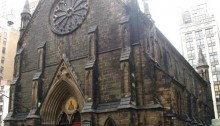
Thanksgiving Day as it is constituted as a civil holiday in the United States (and Canada) is not specifically found on the Orthodox liturgical calendar, but that doesn’t mean that Orthodox Christians in North America have ignored it.  Here’s a notice from the New York Tribune for a Thanksgiving Divine Liturgy held at St. Nicholas Cathedral in 1921, celebrated by Archbishop Alexander Nemolovsky and Archimandrite Patrick Mythen.

From all of us here at SOCHA, Happy Thanksgiving to all who are celebrating today!


Monument to Fr. Methodios Kourkoulis (click to enlarge)

Photo of the week: the monument to Fr. Methodios Kourkoulis

0

Monument to Fr. Methodios Kourkoulis (click to enlarge)

In its early years, Holy Trinity Greek Orthodox Church (later Cathedral) went through priests like a newborn goes through diapers. In the dozen years from its founding in 1892 until 1904, the parish welcomed, and said goodbye to, no fewer than eight pastors. These included some (relatively) big names:

  • Fr. Paisios Ferentinos, the first Greek priest in New York
  • Fr. Kallinikos Dilveis, who went on to found the Greek church in Lowell, Mass. before returning to Greece and becoming a bishop
  • Fr. Panagiotis Phiambolis, who moved to New York after founding the first church in Chicago

But none of those men stuck around for very long, and when Fr. Methodios Kourkoulis took charge of Holy Trinity in 1904, I doubt he was expected to fare any better. But he did — against all odds, Fr. Kourkoulis lasted a whopping 37 years, serving as pastor of Holy Trinity until his death in 1941.

That period, 1904 to 1941, witnessed remarkable, dramatic changes in America in general, and Orthodoxy in particular. When Fr. Kourkoulis arrived, the Greeks were in a state of disarray, with no real hierarchical oversight of any kind. By the time he died, nearly every Greek church in America was part of the Greek Archdiocese, led by Archbishop Athenagoras and a cadre of titular bishops.

I know very little about Fr. Kourkoulis himself. I mean, he was around for everything, but it’s hard to get a clear picture of what sort of person he was. I do know that he was born on the island of Mytilene in the Ottoman Empire in October 1861. He studied in Jerusalem, Athens, and Germany, and was ordained a priest at Lesbos in 1892. He spent the next dozen years as a teacher and missionary in his native Asia Minor, but also, apparently, did the same thing in Egypt, Sudan, Smyrna, and the Holy Land. And we’re not talking about a monastic priest, here — Fr. Kourkoulis was married and had at least two children.

In 1904, he was sent to New York to take charge of Holy Trinity. One writer said of Fr. Kourkoulis, “He laid the solid foundation of the community during the earlier years of his office.” Shortly before his death, the widowed Fr. Kourkoulis was elevated to archimandrite. And, as I said, he died in 1941.

He must have been well loved, considering the remarkable monument erected in his honor. The inscription reads, “For the valuable services rendered as a clergyman for 38 years – this monument is gratefully dedicated.” And it’s just an awesome monument, right? Does any Orthodox clergyman in America have a more striking tombstone?

Anyway, I’d love to learn more about Fr. Kourkoulis. If anyone reading this has more information, please email me at mfnamee [at] gmail [dot] com.

This week in American Orthodox history (Sept. 10-16)

0

September 11, 1893: The World’s Parliament of Religions opened in Chicago. I’ve written quite a bit about the Parliament in past articles, and you can read all of them by clicking here. The super-short version: In conjunction with the Chicago World’s Fair, representatives from every major world religion convened in Chicago for the mother of all ecumenical gatherings.

Among the most impressive figures at the event was a Greek Orthodox archbishop, Dionysius Latas of Zante, one of the best known hierarchs in the Church of Greece. Archbishop Dionysius attracted a lot of press, but the most interesting Orthodox figure at the Parliament was Fr. Christopher Jabara, an Antiochian archimandrite who rejected the doctrine of the Holy Trinity and wanted to create a single world religion. To read more about Jabara, click here.

September 10, 1900: Nicholas Bjerring died in New York. Bjerring had converted from Roman Catholicism to Orthodoxy in 1870. He was immediately ordained a priest in Russia and sent back to America to establish the first Orthodox chapel in New York City. Bjerring’s chapel was one of only three Orthodox houses of worship in the contiguous United States (the others being in San Francisco and New Orleans). And while there was a Russian bishop living in California, Bjerring and his chapel were directly under the Metropolitan of St. Petersburg.

Things didn’t work out all that well. After sputtering along for 13 years, the chapel was closed by the Russian government, and a disenchanted Bjerring converted to Presbyterianism. A few years before he died, Bjerring re-converted to Roman Catholicism, as a layman.

Fr. Demetrios Petrides

September 12, 1912: Fr. Demetrios Petrides arrived in Atlanta to become the priest of Annunciation Greek Orthodox Church. Petrides had been in Philadelphia, where he clashed with a rich Greek tobacco magnate. It’s a crazy story — the millionaire layman wanted Petrides to bow to him and follow his every order, and Petrides flatly refused. The rich guy got Petrides fired from the parish (that was how things worked back then), and Petrides moved to Atlanta. One newspaper dubbed him the “stormy petrel of the cloth,” and he continued his distinguished career until his untimely death from diabetes in 1917.

Another interesting aspect of Petrides’ career is that he was the priest who recommended that the Ecumenical Patriarchate ordain Fr. Raphael Morgan, who became the first black Orthodox priest in America. For a time, Morgan — who had a troubled marriage that ended in divorce — actually lived in Petrides’ house.

September 13, 1921: Two big events on this day: the birth of Fr. Alexander Schmemann, and the opening of the first Clergy-Laity Congress of the Greek Archdiocese.

The Clergy-Laity Congress accomplished the legal incorporation of the Archdiocese, and many date the beginning of the GOA to this date. It’s sort of arbitrary, though — you could pick any number of dates between 1918 and 1922. I think the Congress itself, rather than the act of legal incorporation, is ultimately more historically significant.

As for Fr. Alexander Schmemann, he was one of the most famous and important figures in late 20th century American Orthodoxy. What did he do? What didn’t he do? He’s probably best known for his writings — seminal works like For the Life of the World, The Eucharist, Great Lent, and many, many more. Or maybe he’s best known as a professor and longtime dean of St. Vladimir’s Seminary, where he educated hundreds of future church leaders. Or perhaps it’s his role as a churchman: he played a key role in the establishment of the OCA, and the founding of SCOBA. He attended Vatican II as an observer, and he advised the Evangelical Orthodox Church on its path to conversion to Orthodoxy. After the death of Metropolitan Leonty in 1965, the Metropolia/OCA lacked a dominant hierarchical presence. Schmemann, a married priest, filled that role, and was for the OCA what Archbishop Iakovos was to the Greek Archdiocese, and Metropolitan Philip Saliba was for the Antiochians.

September 11, 1927: Fr. Emmanual Abo-Hatab, former archdeacon to St. Raphael Hawaweeny, was consecrated a bishop for the newly established American Orthodox Catholic Church. The AOCC was led by Archbishop Aftimios Ofiesh, and it was fringe from the beginning. Bishop Emmanuel eventually split from Aftimios and went to the Russian Metropolia, where he succeeded Aftimos as leader of the “Russy” (pro-Russian) faction of the Arab Orthodox in America.

September 14, 1931: Eleanor Roosevelt, wife of New York Governor Franklin Roosevelt, attended the cornerstone-laying ceremony at Holy Trinity Greek Orthodox Cathedral in New York. The ceremony was performed by Archbishop Athenagoras, the new head of the Greek Archdiocese. From the following day’s New York Times:

Mrs. Roosevelt said that the members of the Greek congregations had expressed their worship of God by means of beautiful edifices erected in this city. She added the hope that their fine spirit would be carried on by the new members of these congregations.

Members of the Holy Trinity congregation, whose church was destroyed by fire several years ago, and those of the congregation of the Church Evangelismos [Annunciation] will be amalgamated into one congregation in the new edifice which is expected to be completed in April at a cost of $600,000.

$600 grand in 1931 is equivalent to roughly $8.5 million today — a decent chunk of change in any era, but particularly during the Great Depression.

September 10, 1933: Fr. Benjamin Basalyga was consecrated a bishop in Pittsburgh, for the Russian Metropolia. The 46-year-old bishop was born in a Pennsylvania coal town, and as a child, he was one of the first students at the Russian missionary school in Minneapolis and then at the Minneapolis seminary. Later, he became a hieromonk and served in parishes all over America and Canada, without spending much time in any particular community. For a while in the 1920s, he was the personal secretary to Metropolitan Platon, head of the Russian Metropolia.

After being consecrated, Benjamin served as Bishop of Pittsburgh for about a dozen years, after which he led the Orthodox Church of Japan from 1946 to 1953. He then returned to his see in Pittsburgh for another decade before his death in 1963.

September 11, 1948: Bishop Alexis Panteleyev (or Panteleev), the Russian Metropolia’s Bishop of Alaska, died. I know next to nothing about Bishop Alexis, but I can tell you that he was originally consecrated Bishop of San Francisco in 1927, and served in that post until 1931. In 1934, he became the Bishop of Alaska. Then, in 1945, he was sent by the Metropolia to attend the enthronement of Alexei I, the newly elected Patriarch of Moscow. In this period, there was some hope that Moscow and the Metropolia could reestablish communion. As it turned out, the Metropolia couldn’t accept Moscow’s terms, and reunion didn’t happen.

The next year, though, Bishop Alexis decided to join Moscow himself. He explained his reasoning in this way: “In order to be in unity with the Eastern Orthodox Church, it is necessary for the Russian Orthodox clergy to be under the Patriarch of Moscow.” (New York Times, 4/20/1946) Bishop Alexis died two years later, in 1948.

September 16, 1949: St. John Maximovitch, then the ROCOR Bishop of Shanghai, spoke before the United States Congress. This article is getting a bit long, and St. John’s visit to Congress is really interesting, so I think I’ll save this one for another day.

September 14, 1951: Fr. Demetrios Makris was consecrated a bishop for the Greek Archdiocese, with the title “Bishop of Olympus” (yes, that Olympus). This was back when the GOA had a single Archdiocese composed of a series of “Archdiocesan Districts,” each overseen by a titular bishop but ultimately answerable to the Greek Archbishop. Later, those Districts became Dioceses (and their leaders diocesan bishops), and today they’re Metropolises with Metropolitans. Anyway, Bishop Demetrios was initially assigned to the massive First Archdiocesan District, which included New York, New Jersey, Pennsylvania, Washington DC, and more. Later, he headed up the Districts based in San Francisco and then Boston.

To be honest, I know even less about Bishop Demetrios than I do about Bishop Alexis Panteleyev (above). I’m not even sure when he died, though I’d guess it was in the 1970s (his tenure in Boston ended in 1973). If anyone out there can fill us in, please do.

That’s it for this week. Thanks for reading, and for your patience during this period of irregular output here at SOCHA.

Federation 'reorganization'

This week in American Orthodox history (March 12-18)

0

This week is a busy one:

March 14, 1767: Philip Ludwell III, the first Orthodox convert in American history, died in London. Decades earlier, in 1738, Ludwell had joined the Orthodox Church in London. He was just 22 at the time, and was a rising star in the Virginia aristocracy. Remarkably, the Russian Holy Synod gave him permission to bring a portion of the Eucharist back to Virginia. In 1762, Ludwell brought his three daughters to England to be received into the Church as well. Of course, we would know none of this were it not for the exceptional research and writing done by Nicholas Chapman, whose articles we’re proud to feature here at OrthodoxHistory.org. Click here to read Nicholas’ first article on Ludwell, and here to read about Ludwell’s landmark translation of an Orthodox catechism. And if you find Ludwell as fascinating as I do, I would highly recommend that you invest $4.95 to download Nicholas Chapman’s recent lecture on Ludwell. (And for $9.95, you get a CD of the lecture, a copy of Ludwell’s portrait, and the Ludwell family book plate.) I rarely encourage our readers to buy stuff, but trust me: this is worth it.

St. Alexis Toth

March 14, 1853: Chronologically, after Ludwell, the most important American Orthodox convert has to be St. Alexis Toth, who was born in the Austro-Hungarian Empire 159 years ago this week (most of my sources say March 14, but Wikipedia has his birthday as March 18). Originally a Greek Catholic (“Uniate”) priest, Toth was assigned to serve a Carpatho-Rusyn parish in Minneapolis in 1889. But the local Roman Catholic archbishop didn’t want Toth’s “kind” — that is, Greek Catholics — in his diocese, and the two men clashed immediately. In 1891, Toth and his Minneapolis congregation joined the Russian Orthodox Church. Dozens and dozens of Uniate parishes followed suit over the next two decades, and Toth was one of the chief advocates of Uniate conversion to Orthodoxy. He died in 1909 and was canonized by the OCA in 1994.

March 13, 1868: Fr. Nicholas Kovrigin was sent on a pastoral visit to San Francisco, establishing the first foothold of the Russian Church in the contiguous United States. It all started back in the 1850s, when San Francisco’s growing Orthodox community organized into a mutual aid society. In the early 1860s, Russian ships visited the area, and some local Orthodox children — including the future Fr. Sebastian Dabovich — were baptized by a Russian navy chaplain. But there wasn’t a Russian parish until Kovrigin came along later in the decade. His visit was precipitated by the arrival, late in 1867, of the renegade Ukrainian priest Agapius Honcharenko, who moved to the Bay Area and tried to start some kind of hybrid Protestant/Orthodox parish. The Orthodox people seem to have realized that they needed to get an actual, legitimate Orthodox priest in their city, so they sent a formal request to the bishop in Alaska, who responded by sending Kovrigin for a visit. Initially, it was just that — a visit — but later in 1868, Kovrigin was formally assigned to be the pastor of a new parish in San Francisco. Unfortunately, Kovrigin seems not to have been made of the strongest moral fiber, and he ran into all sorts of trouble, ultimately being suspected of foul play in the death of his superior, cathedral dean Fr. Paul Kedrolivansky. Kovrigin was finally sent away in 1879, by the newly arrived Bishop Nestor Zass. On a more positive note, despite many trials and tribulations (and name changes), the San Francisco parish has survived to this day, and is now Holy Trinity, a cathedral of the OCA.

March 15, 1896: Archimandrite Theoclitos Triantafilides celebrated the first Divine Liturgy in Galveston, Texas. I’ve written about Fr. Theoclitos recently: he was one of only three Greek priests to serve under the Russian Mission. Previously, he had been the tutor to the future king of Greece and the future Tsar Nicholas II of Russia. His Galveston parish was multiethnic, composed of Serbs, Greeks, Syrians, Russians, Copts, and American converts. To this day, his old parish of Saints Constantine and Helen venerates him as a holy man. To learn more about Fr. Theoclitos, read this article by Mimo Milosevich.

March 15, 1898: The future Antiochian Metropolitan Antony Bashir was born in Douma, in what was then the Ottoman Empire and what is now Lebanon. Bashir led the Antiochian Archdiocese of New York from 1936 until his death in 1966. This was the era of the “New York-Toledo” schism, when the Antiochians in America were divided into competing archdioceses (one based in New York and the other in Toledo, Ohio). Bashir was a major proponent of pan-Orthodox cooperation and the proliferation of English in church services.

March 13, 1904: Archimandrite Raphael Hawaweeny was consecrated to the episcopacy by Archbishop Tikhon Bellavin and Bishop Innocent Pustynsky. This was the first episcopal consecration in American Orthodox history. Technically, St. Raphael was a vicar bishop under St. Tikhon, the Russian Archbishop of North America, and St. Raphael’s “diocese” was actually a vicariate for Syro-Arabs. Reality was considerably more complicated, and St. Raphael basically functioned as a mostly independent diocesan bishop with ties to both the Russians and the Patriarchate of Antioch. (As he put it, his diocese was a diocese of Antioch, “notwithstanding its nominal allegiance to the Russian Holy Synod.”) He served as bishop until his death in 1915.

March 12, 1914: Fr. Alexander Hotovitzky, dean of St. Nicholas Russian Orthodox Cathedral in New York, returned to Russia after nearly two decades of service in America. He went on to suffer under the Communists, died a martyr’s death, and has since been canonized a saint.

Bishop Nicholai Velimirovich

March 18, 1956: The exiled Serbian bishop Nicholai Velimirovich died at St. Tikhon’s Monastery in South Canaan, Pennsylvania. He had first come to America in the 1910s, as a representative of the Serbian Church. After World War II, Bishop Nicholai returned to the United States as a refugee, and he went on to teach at several Orthodox seminaries in the US. I feel like I should have a lot to say about Bishop Nicholai — who, after all, was canonized in 2003 and is famous for his prolific writings (most notably the Prologue from Ochrid), but to be honest, I don’t really know all that much about the man. There are a couple of informative biographical articles online, but I should note that both are written from a somewhat hagiographic (as opposed to a strictly historical) perspective. Click here for one published in The Orthodox Word, and click here for one from the periodical Orthodox America.

March 16, 1960: The Standing Conference of Canonical Orthodox Bishops in the Americas — better known simply as SCOBA — held its first meeting. SCOBA arose from the ashes of the “Federation,” a 1940s attempt to foster pan-Orthodox cooperation in America. And while many initially thought that SCOBA might lead to the unification of the various jurisdictions, that obviously never happened. In 2010, SCOBA was disbanded and replaced by the Assembly of Bishops. The two organizations are different in many ways, but two are of particular note: (1) SCOBA included on the heads of the jurisdictions, while the Assembly includes every active, canonical bishop in America, and (2) the “Mother Churches” tolerated SCOBA, but the same Mother Churches actually created the Assembly. Along the same lines, SCOBA was a voluntary association, whereas the Assembly is an official ecclesiastical organization with a clear mandate from the Mother Churches. I realize that I didn’t really say much about the first SCOBA meeting, but that’s a story for another day.

March 13, 1965: On the very same day, both Albanian Bishop Theophan Noli and Greek Bishop Germanos Liamadis died. As far as I know, this was the only instance of two American Orthodox bishops dying on the same date.

March 18, 1981: OCA Metropolitan Ireney Bekish died. He had been the Metropolia/OCA primate from 1965 until his retirement in 1977 — so, the period when the OCA received its Tomos of Autocephaly and established its current identity — but I’ve never heard anyone talk of him as a major historical figure. Nobody talks about the era of Ireney, because it really was the era of Fr. Alexander Schmemann, who effectively led the OCA during Ireney’s entire episcopate.

March 16, 2008: ROCOR’s First Hierarch, the revered Metropolitan Laurus Skurla, died, shortly after helping to accomplish the reunion of ROCOR with the Moscow Patriarchate. Met Laurus had led ROCOR for seven years, and while he is most remembered for that tenure, the bulk of his hierarchical career was spent as abbot of Holy Trinity Monastery in Jordanville, New York.

March 13, 2011: Metropolitan Nicholas Smisko of the American Carpatho-Russian Orthodox Diocese (ACROD) died of cancer after more than a quarter-century as primate of ACROD. A year later, his position has yet to be filled. ACROD has established a memorial web page for Met Nicholas; click here to view it.


This week in American Orthodox history (February 27-March 4)

0

March 2, 1865: Fr. Agapius Honcharenko served the first public Orthodox Divine Liturgy in New York. Way back in 2009, I wrote a pair of articles about that liturgy; click here and here to read them. What I wasn’t aware of at the time was that Honcharenko had celebrated the Divine Liturgy at least once in New York prior to March 2 — on January 6, which was Christmas (December 25) according to the Orthodox calendar in the 19th century. But the March 2 liturgy was the first public liturgy. Rev. Morgan Dix, rector of Trinity Episcopal Church and one of the most prominent Episcopalian clergymen of his day, wrote of the liturgy in his journal, “This 2nd. day of Lent was a memorable one, because the Liturgy of the Eastern Church was sung in Trinity Chapel, at 11 A.M. This never occurred before so far as I have heard, in any Anglican Church. Bishop Potter was to have been there, but backed out, and went down to S. Paul’s instead, to the noon day communion.”

Photo of Barbara MacGahan, 1893

February 28, 1904: Barbara MacGahan died in New York. A native of Russia, MacGahan was the widow of a famous American war correspondent, and she became a renowned journalist in her own right. She was the principal founder of St. Nicholas Russian Orthodox Church (later Cathedral) in New York City, and she played an important role in the Russian Mission until her death. In MacGahan’s day, a disproportionate number of the Orthodox in America were men. And the status of women in turn-of-the-century America was certainly far more restricted than it is today. I mean, today, we don’t bat an eyelash at the thought of a woman chairing a parish council, but such a thing was probably inconceivable more than a century ago. It was in that world that MacGahan became a major player in the Russian Mission, right at the time when it was expanding beyond its original focus of Alaska. Barbara MacGahan may have been the most influential woman in the early history of American Orthodoxy.

February 28, 1914: The choir of New York’s St. Nicholas Russian Orthodox Cathedral performed at the White House for President Woodrow Wilson. Some of the robes worn by the choir members at this event have survived, and are held at the OCA archives in Syosset, NY.

February 27, 1915: St. Raphael Hawaweeny, the Syrian Bishop of Brooklyn, died. What can be said of St. Raphael that has not already been said? How about this quotation from Rev. T.J. Lacey, a notable Episcopalian priest who had a strong affinity for the Orthodox Church:

Bishop Raphael was a master-builder. He laid strong enduring foundations, gathering a large constituency and acquiring valuable property for the congregation. He was a man of wide education and keen intelligence, a master of many languages. He possessed rare gifts of administration, and was unselfishly devoted to the spiritual and material welfare of his people. His death, in 1915, deprived the Syrian Church of a strong leader.

February 28, 1937: The Ukrainian Orthodox Bishop Bohdan Spylka was consecrated by the Greek Archbishop Athenagoras Spyrou.

UPDATE: In the original version of this post, I said that Fr. Alexander Hotovitzky returned to Russia on February 27, 1914 (so, the day before his cathedral choir performed at the White House). But my fellow SOCHA director Aram Sarkisian informed me that this was incorrect — actually, Hotovitzky was present at the White House concert, and he left for Russia on March 12. The reason for the error is that March 12 is February 27 according to the Old Calendar. We’ll make note of Hotovitzky’s departure in a couple of weeks, when we get to the actual anniversary.

Also, I originally said that the choir concert was on February 29 (the date reported by other sources), but as Aram points out, 1914 was not a leap year. The concert actually took place on February 28.

Go to Top