Posts Tagged ‘newspapers’

9
Mar

A Greek bishop in America in 1893 (Part 2)

   Posted by: Matthew Namee    in Firsts

Archbishop Dionysius Latas of Zante (Chicago Tribune, 9/12/1893)

Last week, I introduced Archbishop Dionysius Latas of Zante, a Greek hierarch who visited America in 1893. When we left his story, he had arrived in New York City and was en route to Saratoga Springs, where the Episcopalian Bishop Henry Potter had invited him. We’ll pick up the story there.

Abp Dionysius arrived in Saratoga Springs just as another international visitor, a Sikh Maharajah, was leaving the resort town. “Since the Maharajah’s departure the reigning foreign favorite has been the Archbishop of Greece,” the New York Times reported (8/6/1893). The paper went on, “The distinguished prelate is as approachable as his recent predecessor in Saratoga, and all who meet him find him most companionable. He is a man of fine physique, with a strong, intellectual face. He speaks excellent English and fluent French, which latter language he likes to use.”

By all accounts, the 57-year-old archbishop had a great time. “He has a keen eye,” the Times said, “which twinkles with humor.” He gave the New York Mail and Express his initial impressions of America (quoted in the New Orleans Picayune, 8/7/1893):

My impression of your country? Well, I started long before the date of meeting in Chicago, because I was so anxious to see America, and the longer I stay here the more I congratulate myself on this resolve. There is just one way to sum up my ideas as impressed upon me by this great city [New York City], and that is you Americans travel along much quicker than we do in Europe. Your rate of progress has not only enabled you to catch up in the comparatively short existence that the United States has enjoyed, but you have outdistanced us.

Within a few days, Abp Dionysius had made his way to Washington, DC, where he hoped to meet President Grover Cleveland. As it turned out, Cleveland was out of town. A Washington Post reporter caught up with Abp Dionysius, and observed that he had “a jolly face, a hearty laugh, and although he cannot always understand questions in English, he is quite communicative” (8/12/1893). He had decided to write a book about his experiences in America, and aimed to publish it upon his return to Greece. The Post reporter watched as the archbishop’s “scribe” (presumably his deacon) copied his Greek text.

Here are some more of Abp Dionysius’ observations, courtesy of the Post:

“It is very hot here,” said the archbishop, as he mopped his perspiring forehead. It was hot enough for him in his native land, he added, but there he spent his time in the country. He thought the country the best place in America as well, and with evident delight told of his visit to the Catskills in company with Bishop Potter of New York.

The archbishop spoke in high terms of America and Americans, and he evidently meant what he said. He had been impressed by the hospitality and “good heart” of the people in this country.

“Americans and Englishmen are different,” he said. “The Englishman is like this,” and then he drew in his head and put on a stiff, gloomy, and morose expression, which was comical in the extreme. “But the American,” he continued, changing his mood, “is always this way,” and the archbishop burst into a hearty laugh to illustrate what he meant.

“How long will you be in America?” he was asked.

“Perhaps three months,” was the reply, and the perhaps possibly meant if he did not go broke before that time, for he added that it cost a great deal more to travel here than elsewhere, and explained that what took a franc across the ocean requires a dollar here.

From Washington, Abp Dionysius returned to New York and then departed for Chicago, to attend the World’s Parliament of Religions.

Tags: , , , , , , , ,

8
Mar

Source of the week: Schmemann on Vatican II

   Posted by: Matthew Namee    in OCA

Fr. Alexander Schmemann in 1963

Fr. Alexander Schmemann was one of the observers at Vatican II, the landmark 1960s council of the Roman Catholic Church. His reaction to the event is priceless — Schmemann took the “opportunity to thank God” that he was Orthodox. Here’s the story, from the New York Times (11/16/1963):

A Russian Orthodox theologian-observer at the second session of the Vatican Council said Thursday that the gathering in Rome was “sobering from the Orthodox point of view.”

The Rev. Dr. Alexander Schmemann, dean of St. Vladimir’s Theological Seminary in Tuckahoe, N.Y., said that he had “no doubt the actions of the council thus far are good for the Roman Church itself.” But, he added, “the reality, unfortunately, is that they are far from ecumenity.”

Dr. Schmemann delivered his report on the council at the quadrennial sobor, or convocation, of the Russian Orthodox Greek Catholic Church in America. The sobor, at the Holy Virgin Protection Cathedral, 59 East Second Street, ended yesterday.

Dr. Schmemann, who was also vice chairman of the sobor, emphasized that he had not gone to Rome as an official delegate for his denomination but rather as a special guest.

He explained that the Moscow Patriarchate of Russian Orthodoxy had several official delegates at the council, as had the Russian Orthodox Church Outside Russia. The Russian Orthodox Greek Catholic Church severed administrative relations with the Moscow Patriarchate in 1924 and regarded the Russian Orthodox Church Outside Russia as a splinter group.

In his report to his denomination, Dr. Schmemann said he did not bear “any bad will” to Roman Catholicism. But, he said, considering the actions of the council in their ecumenical aspect, he had “opportunity to thank God” that he was Orthodox.

Dr. Schmemann’s objections to the council’s discussions were based on the Roman Catholic view of the papacy. “What builds a wall between the Roman Church and Eastern Orthodoxy is the doctrine of papal infallibility,” he said.

“There may be democritization going on,” the theologian added, “but so much of the Catholic Church is built on reverence of the Pope.”

He said that even the collegiality of the bishops was defined purely in its relationship with the papacy.

“In 17 lines of definition of the bishop in the schema on the church,” he went on, “the word ‘pope’ appears four or five times.

“In Eastern Orthodoxy it is our understanding that teaching about the Pope should be balanced with teachings about the bishops.”

Now, I’m no expert on Vatican II or Orthodox-Roman Catholic relations in general, so I don’t really have any commentary to add. But I stumbled upon this article in my collection and thought it might be of interest to others, so I figured I’d publish it here.

Tags: , , , , ,

4
Mar

A Greek bishop in America in 1893

   Posted by: Matthew Namee    in Firsts

Sketch of Archbishop Dionysius Latas of Zante, published in the New York Tribune (8/1/1893)

In 1893, the World’s Fair was held in Chicago. In conjunction with the Fair, something called the “World’s Parliament of Religions” was held from September 11-27. This was a remarkable gathering, which brought together not only Christian leaders of various denominations, but people of every religious stripe — Jews, Muslims, Hindus, Buddhists, etc. It seems to have been more of a spectacle than anything substantive, although, as we’ve discussed previously, the crazy Antiochian archimandrite Christopher Jabara thought that perhaps the Parliament could come up with a brand-new, global religion. His hopes were unfulfilled.

Anyway, besides Jabara, at least two other Orthodox leaders gave speeches at the Parliament — Fr. Panagiotis Phiambolis of Chicago’s new Greek church, and Archbishop Dionysius Latas of Zante (Zakynthos). Latas was by far the most significant Orthodox figure at the gathering, and from the time of his arrival in America, he was a media sensation. He also happens to have been the first non-Russian Orthodox hierarch to set foot in the New World. This is the first of several articles that will chronicle his visit to America.

Latas arrived in America at the end of July, and on August 1, the New York newspapers ran stories about him. Here’s a brief biography, from the New York Tribune:

Dionysius Latas was born in Zante in 1836. At an early age he attended the Greek Seminary in Jerusalem, where he remained for ten years, afterward spending four years at the University of Athens. Later he studied for a year in the University of Strasburg, before the annexation to Germany, and three years at the universities of Berlin, Leipsic and other German universities, and then spent some time in England. From 1870 to 1884 he was the eloquent preacher of Athens, when he became Archbishop.

Latas was thus about 57 when he came to the United States. He was accompanied by his deacon, Homer Peratis, and one of their first stops was the new Greek church in New York. “I preached yesterday in the little Greek church in this city,” Latas told the New York Times (8/1/1893), “and it reminded me of the little churches I preached in years ago when I was an Archimandriti.”

Not to go off on too much of a tangent, but Latas was a very, very popular preacher when he was an archimandrite in Athens. I have a letter from a Protestant visitor to Athens in 1870 — so, just at the outset of Latas’ preaching career. This letter, written by a certan Rev. Dr. Goodwin of First Congregational Church in Chicago, was published in the New York Evangelist (7/21/1870), and provides a glimpse into the sort of figure the young (34-year-old) Latas was:

The chief sensation of Athens just now is a priest named Dionysius Latos, and among the mummeries dinning the ear on every side during these festivities, it was refreshing to find one service that was an exception. This young priest was originally one of the candle-snuffers, a lad of no education, and with no apparent gifts, except a fine rich voice. Promoted because of this to assist in the chorals, he somehow obtained leave to talk or preach, and astonished every one, and greatly captivated the people by his eloquence. He speedily acquired a wide notoriety, and won many friends. Among them was a rich Athenian, who proposed to him to spend three years in the schools of Germany and France, at his expense. He accepted the offer, spent time in diligent application, and has just returned, and is creating the highest enthusiasm.

I went on Friday morning to hear him preach, and found the church literally packed. And the Greek churches having no seats, admit of such a crowding as is entirely unknown to American audiences. There was no getting near the main entrance, the throng extending into the street. I found a side door, however, to the women’s gallery, and there at last succeeded, by climbing upon a pile of boards, in getting a view of the preacher and his congregation. Below me was a sea of men’s faces, all upturned toward a man of fine intellectual features, and searching dark eyes, and who in the black gown and round brimless hat or high stiff fez of a Greek priest, stood in a pulpit projecting from one of the columns near the middle of the church.

I was impressed at once with the earnestness of the preacher’s face and manner. There was that in the kindling of the eye, the tone of the voice, and the sweep of the hand even, that witnessed unmistakably to the preacher’s deep conviction of the truth and importance of his words. One could not look and listen without a conscious sympathy in response It would have been no common privilege to hear the language of Socrates and Demosthenes spoken, and that in their own Athens, with the distinctness and grace and fervor which marked the speaker’s utterance. Certainly there was a rhythm and music and richness about it that I had never imagined, and that seemed to thrill and move the people somewhat as did the great orators in those earlier days.

But when in the course of a fervent passage my ears caught in Greek the words, “Ye men of Athens,” and then following the whole discourse of Paul from Mars Hill, in the very words he used, and under the very shadow of the spot where he stood, I felt as if centuries were suddenly rolled back, and not a Greek priest, but a greater than he, and a greater than Demosthenes or Plato were there before me, preaching in this wonderful language Christ and Him crucified. I could only now and then understand a word, but caught enough to divine that the theme of the discourse was the love of God as revealed in the life and death of Jesus Christ.

The preacher continued for a full hour and a half, closing with many quotations of Scripture and with much impassioned eloquence, and the people stood eager to the end. It is believed here by those who know Latos intimately, that he is in every respect heartily in sympathy with evangelical religion. And the hope is warmly cherished that he will prove to the Greek Church in Athens far more than Pere Hyacinthe to the Latin Church in Paris — a fearless and mighty apostle of the truth, that cannot be cajoled from his purpose by flatteries, nor silenced by threats.

Latas was a genuine sensation, and as a bishop, he remained a prominent figure in the Church of Greece. He spoke out against anti-Semitism, advocated (as did so many in those days) dialogue with the Episcopalians, and was skeptical that any sort of union would happen with Rome. When he came to the United States, he was warmly welcomed by the various Episcopalian bishops that he encountered. Immediately upon his arrival, he was invited by Bishop Henry Potter to join him at Saratoga Springs. We’ll pick up the Latas story there.

Tags: , , , , , , , ,

1
Mar

95 years ago: the death of St. Raphael

   Posted by: Matthew Namee    in Saints

The funeral of St. Raphael Hawaweeny, Brooklyn, 1915

This past Saturday was February 27, the 95th anniversary of the death of St. Raphael Hawaweeny, the great Syrian Bishop of Brooklyn. His death set off more than a week of commemorations in the Syrian Orthodox community. Telegrams immediately went out to Syrian parishes all over the country. In fact, the news spread so quickly that the Kearney Daily Hub was able to run a notice in time for its evening publication, the very day of St. Raphael’s death. “Rev. [Nicola] Yanney was in receipt of a telegram this afternoon announcing the death of Bishop Raphael, head of the Syrian church,” the paper reported.

Yanney and his fellow Syrian clergy had to make hasty arrangements to travel to Brooklyn for the funeral, and the visiting Antiochian Metropolitan Germanos Shehadi rushed back from Montreal. The Russian Bishop Alexander Nemolovsky hurried to Brooklyn to serve a Divine Liturgy. A solemn procession escorted St. Raphael’s body from his home to the cathedral, where it would lay in state until the funeral on March 7. In the meantime, clergy began a round-the-clock reading of the Bible, never leaving the saint’s body unattended. The community sprung into action, convincing the Board of Health to grant them special permission to bury their bishop in a crypt within his cathedral.

It must have been a painful and poignant time and place to be an Orthodox Christian. Bishop Raphael’s orphaned flock would splinter in the years to come, but at the beginning of March, 1915, they were completely united by the death of their beloved bishop.

Tags: , , , , , , , , , , ,

25
Feb

A Greek church in San Francisco, 1903

   Posted by: Matthew Namee    in Inter-Orthodox, Pre-1921 Unity


Holy Trinity Greek Orthodox Church community, San Francisco, December 1910

From its founding in 1868, the Russian cathedral in San Francisco was a multiethnic community. In particular, Greeks and Serbs were an integral part of the church, and, at various times, there was an ethnic Greek (Fr. Kallinikos Kanellas) and an ethnic Serb priest (Fr. Sebastian Dabovich) serving the parish.

By 1903, however, the Greeks of San Francisco wanted their own church. From the San Francisco Call (1/8/1903):

While the Greek members of Bishop Tikhon’s flock have nothing but the kindest feelings toward their spiritual director and the church which has sheltered and fostered the faith of their own land, they find the Russian language, in which the church services are now conducted, a decided impediment in the way of a proper and beneficial appreciation of the good Bishop’s ministrations.

There were about 2,000 Greeks in the city at this point, and they got together and formed an association, with the aim of establishing their own, Greek-speaking church. By the end of the year, all the arrangements were in place, and Holy Trinity Church was born. (Yes, they adopted the same name as the Russian parish which they were leaving.) The community hired Fr. Constantine Tsapralis to be their priest. On November 16, Fr. Sebastian Dabovich, who was serving at the Russian cathedral, sent the following report to his bishop, St. Tikhon:

It is my duty to report to your Grace that the Greek Community in San Francisco has begun building a new church in San Francisco on a plot of land purchased south of Market Street. They ordered a priest by mail for themselves who arrived and was present today at Divine Liturgy at the Cathedral church (he was standing in the altar). This priest (married) in the rank of sakellarios, Father Constantine . . .[Tsapralis, or Chaprales] has his credentials from his Bishop, Ambrose of the Diocese of Salaris [probably, Fr. Sebastian is mistaken, it could be "Salamis"] (in the Kingdom of Greece), in the jurisdiction of the Holy Synod in Athens. He has a Holy Antimension that was given to him (he says) to celebrate Liturgy in the United States of North America. He was here with two Orthodox Greeks known to me.

On December 12, Tikhon sent a brief reply: “May God grant them all success.”

(Both Dabovich’s letter and Tikhon’s response may be found in the incomparable archive of Holy Trinity OCA Cathedral.)

As Dabovich said, Fr. Constantine Tsapralis was a married priest. In 1904, he sent for his wife and son. Tsapralis was born in about 1869, so at this point, he was in his mid-30s. Despite this, he and his wife went on to have four more children, the last of them when Fr. Constantine was in his mid-50s.

The Holy Trinity Greek Church website has a profile of Tsapralis, which includes several descriptions and vignettes. Tsapralis is described as “durable,” having pastored the parish through many difficult times, including the devastating 1906 earthquake and various schisms in the decades that followed. He’s also described as “kind and compassionate,” “a good teacher,” and “gentle with children.” Here is one story about Tsapralis:

In 1913, a Greek man named Prantikos was convicted of murder. Fr. Tsapralis was asked to go to San Quentin to administer the last rights before Prantikos was hung for his crime. The event, described in the San Francisco Call Bulletin, said that Fr. Tsapralis was reading prayers on the way to the gallows. He was described as a strong, tall man. On the gallows, his knees buckled and he wavered at the sight before him. The prison chaplain put his arm around him to support him because he was worried that he might fall through the gallows. Fr. Tsapralis continued reading prayers and he witnessed the hanging. The prison chaplain later described him as a kind, gentle soul.

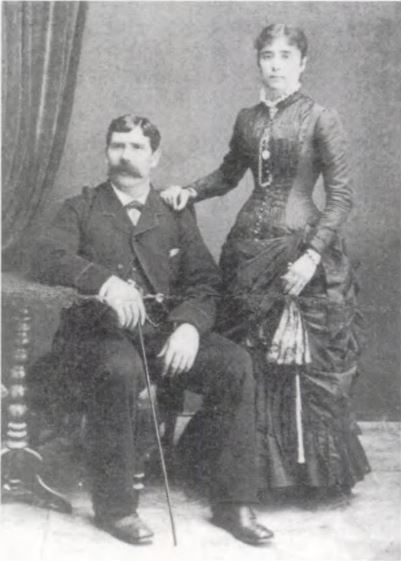
Fr. Constantine Tsapralis and his wife Eleni, circa 1905

I found another story about Tsapralis that doesn’t appear on the Holy Trinity website. For several years in the early 1900s, Tsapralis had owned and operated a candy store, which has also been described as a “saloon.” If it really was a saloon (in the sense that we understand it), this would be uncanonical — an Orthodox priest is expressly forbidden from operating a drinking establishment. Eventually, Tsapralis sold the place… to his wife! The Morning Oregonian (11/18/1911) reported, “But before selling he neglected to liquidate a bill of $300 for a soda fountain and other fixtures in the shop. A collection agency sued, and, securing judgment, had an execution issued against the candy store.” The sheriff came and siezed store property, but Mrs. Tsapralis protested, arguing that the store was her property, not her husband’s. The case went to court, and Fr. Constantine admitted having owned the store. I don’t know how the case turned out.

Anyway, after Fr. Constantine’s wife died, he was raised to the rank of archimandrite. He served the Holy Trinity community for more than three decades, finally stepping down in 1936. He died in 1942, at the age of 73.

Tags: , , , , , , , , , ,

22
Feb

An Antiochian priest in Jamaica, 1910

   Posted by: Matthew Namee    in Firsts

Syrian-owned store in downtown Kingston, Jamaica, in the early 1900s

It is well known that, at the turn of the last century, thousands of Syrians/Lebanese made the trip across the Atlantic to New York. What is less well known, at least here in the US, is that many Syrian emigrants went to other parts of the New World, including South America, Mexico, and the Caribbean. A lot of these travelers found their way to Jamaica, which, to this day, has a sizeable Syrian contingent.

Unlike the Syrians in the US, however, these Syro-Jamaicans didn’t obtain a permanent Orthodox priest, or establish a functioning Orthodox community. They stuck together as an ethnic group, but in terms of their religion, they eventually became absorbed into the existing Anglican church of Jamaica.

That said, the Syro-Jamaicans did receive occasional pastoral visits from Orthodox clergy. In 1913-14, Fr. Raphael Morgan, the first black Orthodox priest in America (who was serving under the Church of Greece at the time), visited Jamaica and served the Divine Liturgy (aboard a Russian ship) for the Syrians he met. But he wasn’t the first Orthodox clergyman to visit Jamaica. Three years earlier, in August of 1910, a priest named Fr. Antonio Michael came to the island. Here is an account of his visit, from the Kingston Gleaner (8/4/1910):

It will be remembered that during last year the [Anglican] Archbishop addressed a meeting of Syrians on the Rectory Lawn. Since that time many of the Syrians have been worshiping with us regularly. A step towards closer fellowship was taken on July 17th, when the Rector, taking advantage of the visit to Jamaica of a priest of the Greek Orthodox Church, arranged a special service for Syrians. The priest in question, Father Antonio Michael came with authority from the Patriarch of Antioch to visit the Syrians scattered through these Islands.

Having inspected the Patriarch’s letter the Rector invited Father Antonio to celebrate the Holy Eucharist at the Altar of the Kingston Parish Church. The invitation was accepted and accordingly on Sunday we were privileged to witness a fine illustration of the friendly relations which exist between the Anglican and the Greek Orthodox Church.

At 8 a.m. the Rector celebrated and Father Antonio sat in the Sanctuary in his robes. At 9 a.m. Father Antonio celebrated for the Syrians in the presence of a large congregation of Jamaicans, following the Eastern rite, the Rector being present within the Sanctuary. The services lasted altogether two hours and a half, but many remained to the end, though the Syrians’ service being in Arabic was difficult to follow for those not acquainted with the language. To those who knew something of the Eastern rite it was full of interest. At the close of the service Father Antonio commended the Syrians to the pastoral care of the Rector.

Father Antonio concluded his address on the Gospel for the day in these words:

“May you live together in peace and love. I raise my heart and hands to God Almighty asking Him to be with every one of you. May He prosper you in all your undertakings. May He bless the Island of Jamaica and grant to His Majesty King George V. strength, wisdom and length of days; to His Excellency the Governor and to all associated with him in the Government of this Island, knowledge and understanding. I pray that our Heavenly Father may keep and bless the Archbishop and the Ministers of the Holy Church especially Mr. Ripley who has allowed me to have this service to-day. O God, guard Thy children from all dangers ghostly [spiritually] and bodily. May they grow in grace and in the knowledge of our Lord Jesus Christ and finally of His great mercy obtain everlasting life. Amen.”

Clearly, Fr. Antonio did not plan to remain in Jamaica, and he saw nothing wrong with commending the Orthodox people there to the care of the Anglican clergy. As I said, the next Orthodox priest (that I’m aware of) to visit Jamaica was Fr. Raphael Morgan. While he was under the Church of Greece, most of the other Orthodox clergymen to visit Jamaica in the early 20th century were Antiochians. However, no permanent priest was ever assigned to for the Syrian community, and today, the descendants of those Syrians are predominantly Anglican.

Tags: , , , , , ,

16
Feb

St. Raphael’s consecration: a newly-discovered photo

   Posted by: Matthew Namee    in Firsts, Saints

Photo of St. Raphael's consecration, from the Brooklyn Daily Eagle (3/14/1904)

St. Raphael was consecrated Bishop of Brooklyn on March 13, 1904. I wrote about this event in July, and my article was accompanied by a small photo of Raphael — the only known surviving photograph of his consecration. That is, until now. 

Last month, I stumbled upon an issue of the Brooklyn Daily Eagle from March 14, the day after the consecration. It included the above image. The small photo I posted in July appears to be just a cropped version of this larger original.

In its March 14 report on the event, the New York Sun wrote, 

… The candidate was led by Bishop Tikhon and Bishop Innocent to the holy gate. Here he was gowned in the vestments of his rank and crowned with the golden crown of the bishopric. These vestments and the crown were the personal gift of the Czar. 

At this point the photograph fiend, who apparently respects religion no more than any other material for a subject, startled the congregation and the clergy by exploding a flashlight cartridge. The building was soon filled with smoke, making the rest of the ceremony very indistinct for some time. 

I don’t think this Daily Eagle photo is the same as the image that resulted from the “photograph fiend’s” flash. That disruptive photo (for lack of a better designation) was taken during the ceremony. The Daily Eagle shot, on the other hand, doesn’t seem to include St. Tikhon, who (as the main consecrator) presumably would have been right next to Raphael when the disruptive photo was taken. In the Daily Eagle photo, we see that Raphael is standing with his back to the iconostasis, surrounded by a throng of people. I could be wrong, but it sure looks to me like the photo was taken after the consecration, when everyone was coming up to receive a blessing from the new bishop.

Whatever the case, in an era of mostly posed photographs, this is a rare action shot from a truly historic event.

UPDATE: In the comments, Fr. Andrew Damick pointed out that the mustachioed priest standing behind St. Raphael is none other than St. Alexander Hotovitzky, dean of the Russian cathedral.

Tags: , , , , ,


Fr. Nicholas Bjerring in his New York chapel

On the morning of Sunday, February 9, 1873 — that is, 137 years ago today — a crowd assembled in Holy Trinity Russo-Greek Chapel in New York City. The priest, Fr. Nicholas Bjerring, gave an address on “Unbelief and the Indifference in Religion.” The whole speech was printed in the next day’s New York Times. It is one of the few full Bjerring homilies that has survived, and it is reprinted below in full:

The subject about which, by the grace of God, I intend to speak to-day, is the perversion of this age in which the enemies of God and of man confuse the minds, corrupt the morals, undermine religion, and, rending asunder all bonds, seek to overthrow Divine and human order. It is the spiritual blindness of so many who attack Christianity, preach vice under the name of virtue, allow themselves everything with lawless audacity, proudly disregarding every authority, mislead the innocent, who poison the spirits and murder the souls. It is the deadly unbelief and the religious indifference which denies everything Divine and holy, the indifference, which is lukewarm and cold toward all that is good — this it is that troubles my heart and fills my soul with pain.

The greatest evil in the world is unbelief, the apostacy from God. This apostacy from God is the continual source of corruption. This is a law of the eternal justice. For the man who falls from God and recognizes infidelity is nothing more holy; for him ceases everything that religion highly esteems — family, property, father-land. A nation in which skepticism gains the dominion is sure to meet perdition. Unbelief undermines all foundations of society, till finally regarding neither divine nor human authority it seeks seeks to upset everything existing. Thus teaches the history of all times.

Was it not during the rule of the Commune in Paris, as if there the angel of the Apocalypse had opened the abyss from which ascends scorpions? Was it not the lot of the Prince of Darkness to plunder and murder; was it not a picture of unspeakable misery, which there unfolded itself under the red, blood-steeped banner? God permitted for a short time of t his unlimited rule, in order to remind the nations again into what abyss apostacy from God does lead, and how everywhere, at all times, the truth of the law of eternal justice does stand, that unbelief is the source of all evil, and the end of corruption. “The letter killeth, but the spirit giveth life.” This eternal truth appears very clearly, when one considers more closely the watchwords and phrases of unbelief, and compares with them the deeds which were seen as the last consequences of the same in the days of the Parisian Commune.

The devil is only the ape of God; he knows no other inducements to allure to his kingdom than the promises which the Lord has made to His believers, only that he explains them in his way, and thus turns the divine truth into a lie. Man was created in the image of God, and “ye shall be as God,” were the words of the first temptation of the serpent, but it led, through sin, to corruption. To the Son of God was promised dominion over the world, and the devil endeavored to seduce Him through the promise of “all the kingdoms of the world, and their glory.” The same value have the promises of the Internationalists and the communists. They incite men to their service through all that which God has named as the prize in His service.

“Liberty” is the first watchword that resounds from the ranks of these enemies of order and government, and the glorious liberty of the children of God is also the reward of those who follow the Gospel. But the evangelical liberty is freedom from slavery of sin, from the power of death; it is the sonship of God. The liberty at which the Internationalists aim is the despising [of] the commandments of God, the self-willed separating from His ordinances upon earth, as Church authority, family — these all are instituted to bring man into the service of God, or to preserve him in the same.

“Equality” proclaims the Internationale to its adherents eager after unjust good and enjoyment, and agreeably falls the word upon the ear of the envious multitude. The equality of men is also the doctrine of Christianity. All men are equal before God; all were created alike in His image; to all has appeared the same salvation. The equality of the Commune is the claim alike to the enjoyments of the world, possession, power, and the gratification of the passions. The desire after this equality is the opposite of the commandment, “Thou shalt not covet.” The motives are envy, disloyalty, and indolence, and the way to satisfaction is the putting aside of every authoritative order, the plundering of those who hold possessions, and the emancipation of the flesh.

“Fraternity” is the third word upon the red flag — the beautiful battle-cry also of the Christian. The children of God are brethren, and are to be of one mind and soul, and to communicate among themselves that there be none among them that lacketh. The common love of man becomes among Christians brotherly love, and the standing salutation of the Apostle, “Beloved brethren,” is the language of every Christian heart. But what does the Commune understand by “fraternity”? The answer was given to the world in the howling of rage and murder, of petroleurs and petroleuses, even the names of which point to crime, because only the Commune had invented them.

The abuse of those words shows us that words in themselves are dead, and receive life only by the spirit that enters into them. “Liberty! Equality! Fraternity!” Only Christianity gives us the true meaning of these words, and never have the greatest philosophers of the world so highly spoken about the relations of men to each other as Christ has taught and His Church proclaims. The Christian Church with her doctrines and sacraments is, in this respect, to become the leader. She is the medium whereby the Divine life is communicated to each human being, in order to complete the Divine image in him and to unite him most intimately with God. Continually must we cherish the desire to be more and more in unity with the eternal, infinite Deity; and this bond of men with God will then also unite mankind into one family, and make them beloved children of God. That is the meaning of liberty, equality, and fraternity, in the Christian sense.

If we look around us, we cannot fail at the same time to perceive how religious indifference in so many families has also disturbed the Christian life. That faithful, pious mind, that strong trust in God, that content, experienced in former times, have severally disappeared. Acquisition, gain, employment are often the first items in the home, but the last is religion. Prayer has disappeared — nothing more is known of a lifting up of the soul to God. The cares of the body reign over all — religious indifference rules the home. Business flourishes, the master of the house is esteemed, the lady of the house is courted by society, but are we not deceived? The good fortune of such a family is only in appearance, and treacherous, because it is without a foundation. How will it be there when the plays of misfortune and sadness appear? How will it be there when the blessings of this world forsake such a house, for God’s blessing was never sought? Even if the children are so educated as to understand how to acquire with skill the goods of this world, can they endure the trials which life imposes upon them? Will they approve themselves in the hour of temptation, when sin with her seductions approaches near; when the excitement of vice decked with flowers misguides them, when the advantage of chrime blinds them? Surely not.

On the contrary, the certain end of an education without religion and the fear of God, will be that they do not approve themselves. And suppose it were not so; suppose God suffered such a family and their children’s good fortune until the end in the full enjoyment of earthly goods, because their whole heart was attached to them, yet this end must be at the last. Then such a family shall know by experience that they have sowed to the earth, also reaped only from the earth, for heaven they have done nothing, and shall also receive nothing. How often one meets in families a lukewarmness which stifles all Christian life. The faith is dead, the will without power; cold and indolent is the exercise of religion, the life spirit is vanished away. But the exterior practice of religion is nothing without a union with the inner, spiritual. The spirit giveth life, but the flesh profiteth nothing.

However many lights may be burning here in this chapel, and however beautiful the robes of the clergy appear, that will be of no avail either to me or to those that are present, if we are not converted unto repentance. Let us above all not forget prayer, this bond which joins in a mystical manner mankind to God, and the Saviour, who for us all died on the cross, will, let us hope, have mercy on us. For we are all bought with the blood of Christ; we are all to attain to the possession and the vision of God, to drink of the well-spring of eternal love and bliss. May we not forget this final object, but when we celebrate upon our terrestrial pilgrimage the Christian mysteries may we, looking for that heavenly home and spirit, exclaim: “O God, grant us that we may yet be filled with the enjoyment of thy Divinity, whose presence we here celebrate in the reception of thy body and blood.” Amen.

Tags: , , , , ,

As we’ve discussed previously, in July of 1920, an all-convert, all-English Orthodox parish was founded in New York City. Called the Church of the Transfiguration, the parish was led by the newly-converted Fr. Patrick Mythen. But it was the fulfillment of a long-held dream of the elderly Fr. Ingram Nathaniel Irvine, who served as the assistant priest.

The church held its first services on Sunday, July 18, 1920. Six days later, the New York Times ran an article on the parish under the headline, “Americanizing a Church.” The Church of the Transfiguration was, according to the article, part of a broader initiative, supported by Archbishop Alexander Nemolovsky, to “Americanize” the Russian Archdiocese. He had apparently commissioned a fresh English translation of the Divine Liturgy. English was the primary language of instruction in the Russian seminary in Tenafly, New Jersey, and Orthodox Christians in America were encouraged to obtain US citizenship.

Bolshevik sympathizers allegedly poisoned a chalice later consumed by an elderly Fr. Ingram Nathaniel Irvine

On Saturday, July 31, someone reportedly broke into the church. Mythen told the Times (8/16/1920) that, oddly enough, nothing at all was taken. This was surprising — the burglars could have stolen the holy vessels made of gold and silver, and expensive clergy vestments, but they didn’t. From the Times:

The priests were puzzled by the objectless burglary, but on the following day, when he drank the sacramental wine from the chalice at the end of the service, Canon Ingram N.W. Irvine became conscious of an agonizing pain in his mouth, throat and stomach. Believing that in some manner the chalice had been filled with acid instead of wine, he acted immediately to save his own life. By his promptness he escaped without serious injury, though he was very sick for a day or more. Canon Irvine is 70 years old.

Immediately after this incident an investigation was made of the receptacle containing the wine intended for sacramental purposes, but not yet consecrated. The wine there was found to be perfectly pure and fresh.

The priests then considered they had found the explanation of the burglary. One or more persons, who hated the Orthodox Church, had forced an entrance into the church in order to put poison in the chalice in the hope of killing a priest.

Fr. Patrick Mythen connected this alleged poisoning to other recent incidents. He told the Times, “In addition to this certain other churches have been attacked and broken into within the last few weeks, and other priests assaulted. One Roman Catholic priest of Greek nationality was bound and beaten. An Orthodox priest in Bayonne was also attacked by three men, but the priest being of very powerful physique, seized the man with the revolver so quickly that when the weapon was discharged, the assassin shot himself. The man was taken into custody by the United States Secret Service and found to be an anarchist.”

The Orthodox leaders, and the Times, thought that all this was connected to the Americanization program that the Russian Archdiocese was instituting. Bolshevik sympathizers, who hated both America and Orthodoxy, supposedly found the mingling of the two to be intolerable. The Times article from which I’ve been quoting is actually all about another incident, which took place on August 15 (and which I’ll discuss in another post).

Now, about the Fr. Ingram Nathaniel Irvine poisoning — They checked the container that held the unconsecrated wine, and it was clean. So, the poison was presumably put in the chalice itself. But if that were the case, wouldn’t someone else have gotten sick, too? Then again, it was pretty common then for people to take communion only a few times a year. Combine that with the fact that the Church of the Transfiguration was a tiny, new place, and it’s entirely possible that there were no lay communicants that day. On the other hand, the church had several attached priests who probably would have partaken. Why would Irvine have been the only one affected? There are two possibilities: one, Irvine may have been the only celebrant that day, and thus the only one to partake of the Eucharist. Two, it’s possible that the poison would only cause problems if consumed in large quantities. If the other priests only took a few sips, and Irvine finished the whole chalice, it may well have only affected Irvine.

So, was Irvine really poisoned? We will probably never know for sure. I’m confident that he wasn’t a liar, but I’m just as confident that he could be a bit melodramatic at times. I’m inclined to believe him when he says he was poisoned, but the circumstances are rather odd. It would be great to see the police report of the incident, but I don’t know if one has survived.

Another thing — note the statement that Irvine “acted immediately to save his own life.” It sure sounds like he forced himself to expel — vomit — what he had just consumed. That is, he intentionally threw up the Eucharist. I realize that he thought it was filled with acid, and that he was protecting his life. And he probably took measures to ensure that what he had just expelled was disposed of in a proper manner. But still, while I fully understand his actions, I find them rather shocking as well.

Irvine was back in church on August 19, preaching a sermon on the Feast of the Transfiguration. He died the following January — 5 1/2 months after being poisoned. That said, I don’t think there was any connection between the poisoning and his death. He regained his health pretty quickly after the poisoning incident, and, according to his obituary, he died of heart disease.

Tags: , , , , , , , ,

3
Feb

The Mysterious Death of Fr. Paul Kedrolivansky

   Posted by: Matthew Namee    in Uncategorized

The location of Fr. Paul Kedrolivansky's skull wound, based on the surviving portion of the autopsy report. Image courtesy of Richard Green.

On today’s episode of my American Orthodox History podcast on Ancient Faith Radio, I tell the story of Fr. Paul Kedrolivansky’s suspicious death. For the whole story, you’ll want to listen to the podcast. There are quite a few characters involved, and I thought it might be helpful to provide a brief introduction to each of them here:

Archpriest Paul Kedrolivansky: Dean of St. Alexander Nevsky Cathedral in San Francisco from 1870 to 1878. There was no Russian bishop in America from 1877 to 1879, so at the time of his death, Kedrolivansky was the highest-ranking Orthodox clergyman in the Alaskan Diocese.

Priest Nicholas Kovrigin: Assistant priest of the Cathedral. Kovrigin was actually the founding pastor of the church, back in 1868, but Kedrolivansky was soon assigned to be dean. In what must have been an awkward arrangement, Kovrigin was made his assistant. Kovrigin was repeatedly accused of being a corrupt philanderer, and in 1879, Bishop Nestor basically kicked him out of the Alaskan Diocese.

Mindeleff: Kedrolivansky’s roommate, with whom he went drinking on the night of his fatal injury.

Mr. Rosenthal: Owner of a tobacco shop, one of the places Kedrolivansky visited on his last night. Rosenthal said that Kedrolivansky had exhibited an official-looking document, and claimed that Fr. Nicholas Kovrigin “would give $10,000 to have it from him.”

Dr. Stivers: The police surgeon. He tried to save Kedrolivansky’s life, but it was too late. He also said that Kedrolivansky was almost certainly the victim of murder, and not an accident. On the basis of Dr. Stivers’ testimony, the coroner’s jury declared the death to be murder by person or persons unknown.

Vladimir Welitsky: The Russian consul in San Francisco. From the very beginning, Welitsky insisted that Kedrolivansky’s death was just an accident, not murder. He also downplayed the importance of the “$10,000 document,” which he claimed to have translated.

Gustave Niebaum: Head of the Alaska Commercial Company. Niebaum’s company had previously accused Kedrolivansky of transporting contraband. After Welitsky returned to Russia, Niebaum became the acting Russian consul. He accused Kedrolivansky’s widow of having an extramarital affair, thereby driving her husband to drink and thus to his (accidental) death. Alexandra Kedrolivansky sued Niebaum for defamation of character; the case went to the California Supreme Court, and Mrs. Kedrolivansky won.

Elizabeth Kedrolivansky: Widow of Fr. Paul. As I said above, Gustave Niebaum accused Mrs. Kedrolivansky of having an affair and driving her husband to drink. She later won a defamation lawsuit against Niebaum.

Detective Jehu: San Francisco police detective. He was investigating the Kedrolivansky case, and found three witnesses who claimed to have seen Kedrolivansky fall and hit his head on the ground. On the basis of this testimony, the police declared the death to be an accident, and they closed the case.

Chief John Kirkpatrick: Chief of the San Francisco police. Kirkpatrick wrote a letter to Consul Welitsky, explaining the conclusions of the police.

Bishop Nestor Zass: Bishop of the Alaskan Diocese from 1879 to 1882. Upon arriving in America, Bp Nestor immediately expelled Fr. Nicholas Kovrigin from his diocese. In 1882, Bp Nestor died at sea.

Bishop Vladimir Sokolovsky: Bishop of the Alaskan Diocese from 1888 to 1891. Bp Vladimir’s tenure was occupied by almost constant scandal. While he was nowhere near America when Kedrolivansky died, Bp Vladimir accused the Alaska Commercial Company and a man named Amosov of killing Kedrolivansky.

Amosov: A mysterious man who some later claimed had murdered Kedrolivansky. It’s not clear whether Amosov even existed in reality, much less whether he was guilty of murder.

Also, for the record, I am going to reprint the description of Kedrolivansky’s wound. This was printed in the San Francisco Examiner on May 23, 1889. It is all that survives of the original autopsy report.

The autopsy disclosed the fact that the scalp of deceased was very thick and strongly adherent, and on the whole of the left side there was a large amount of suffused blood. On the left side was found a fracture of the skull, commencing in the temporal bone, running upward and slightly backward into the parietal bone, being three inches in length; thence at right angles backward half an inch; thence downward and slightly backward two inches; thence at right angles forward one and three-fourth inches intersecting the first line described, leaving a detached piece pressing upon the brain. This portion of the skull was quite thin. From the point of intersection there was a fracture running across the temporal bone and ending in the median line of the frontal bone at a distance of about four and a half inches. There was also a fracture from the lower corner of the detached piece running backward across the parietal bone a distance of about half an inch. The brain directly under the fracture was lacerated and a brain clot weighing four ounces was found. The brain was in a healthy condition.

Kedrolivansky’s death remains an unsolved mystery. Was it an accident, or murder? If murder, then, by whom, and why? We may never know.

Tags: , , , , , , , , , , ,

L to R: Future Metropolitan Germanos Polyzoides, Bp Alexander Demoglou, Met Platon Rozhdestvensky, Patriarch-elect Meletios Metaxakis, Abp Alexander Nemolovsky, Bp Aftimios Ofiesh, and Archdeacon Vsevolod Andronoff

Back in July, Fr. Andrew wrote about the above photo, which depicts a gathering of American Orthodox bishops in the early 1920s: Greeks Meletios and Alexander, Russians Platon and Alexander, and Syrian Aftimios. At the time of Fr. Andrew’s original post, no one knew exactly when this photo was taken, or what occasion brought all these hierarchs together. Fr. Andrew wrote, 

This photograph was found in the archives of the Library of Congress. As yet, there have been no official documents that have surfaced detailing what this 1921 meeting must have entailed. It might have been only a courtesy call, with a photo op at the end. 

Fr. Andrew went on to observe that, based on the photo, the other bishops appear to have regarded Metaxakis as “first in seniority among them.” To read the rest of Fr. Andrew’s post, click here

Why am I bringing all this up again? Becasue I believe I now know when and where this photo was taken, and why all these bishops were in the same place. On December 9, 1921, Abp Meletios Metaxakis was elected Patriarch of Constantinople. He was in New York at the time, having been deposed from his previous position as Archbishop of Athens. With Bp Alexander Demoglou, Metaxakis had come to the US to organize the Greek-American churches into a unified archdiocese. The New York Times (12/10/1921) announced that one of Metaxakis’ first acts as Patriarch would be to appoint Alexander as bishop of North and South America. 

The Times also reported, “This morning at 10 o’clock the Most Rev. Alexander, Archbishop of the Aleutian Islands and North America for the Russian Church, will formally call upon the Patriarch-elect and officially present the felicitations of the 100,000 Russians who are in the Western Hemisphere, who are his spiritual subjects.” 

The Russian goodwill towards Metaxakis’ election was not limited to Abp Alexander Nemolovsky. Archimandrite Patrick Mythen, the powerful convert priest, hastily organized a special ceremony. December 19 was the St. Nicholas day, the patronal feast of the Russian cathedral in New York. Invitations were sent out, in the names of both Met Platon and Abp Alexander. Besides the two Russian and two Greek bishops, the guest list included the Syrian Bp Aftimios and four Episcopalian hierarchs. Representatives of the new African Orthodox Church were also present, as well as the “Hungarian prelate [...] Bishop Stephan of Pittsburgh.” I think this was Bp Stephen Dzubay, a former Uniate who converted to Orthodoxy in 1916 and became the Russian Archdiocese’s Bishop of Pittsburgh. (Dzubay returned to Roman Catholicism in 1924.) 

After the Divine Liturgy, there was a buffet luncheon for the clergy at the neighboring parish house. The above photo must have been taken during or after this luncheon. Here is another, nearly identical photo, which appeared in the New York Evening Telegram on December 20, 1921: 

This photo, of the December 19, 1921 gathering of Orthodox bishops, appeared in the New York Evening Telegram the following day.

Comparing the two photos, it’s quite clear that they were taken at the same event, probably within moments of one another. The Evening Telegram photo doesn’t include the non-bishops, Polyzoides and Andronoff, but it’s possible that they were just cropped out before publication.

The event itself, the pan-Orthodox liturgy, is evidence of the rather friendly (or at least cordial) relations between the Greek and Russian hierarchy in 1921. Speaking to the Evening Telegram (12/19/1921), Fr. Patrick Mythen expressed what must have been on the minds of the Russian bishops as well: that Metaxakis’ election as Ecumenical Patriarch marked the first time since the fall of Constantinople that the Patriarch was elected without the consent of the Turkish sultan. He would thus be “politically free and will rule the Church as a priest and not as a politician.” Mythen meant that Metaxakis would not be bound to the Turkish state, but I’m sure many today would find his words ironic, Metaxakis being the controversial Church politican that he was.

Tags: , , , , , , , , , , , , , , , ,

26
Jan

The First English-Speaking Parish

   Posted by: Matthew Namee    in Early Converts, Firsts, Westernization

For a while now, I have been meaning to write about the first all-English Orthodox parish in America, founded in New York City in 1920. Today, I’m going to give a brief introduction to that parish, and the main characters involved. This is hardly the whole story; it really is just an introduction.

To start — well, you know about Fr. Ingram Nathaniel Irvine, who converted to Orthodoxy in 1905. (If you don’t know about Irvine, you can read our earlier posts about him, or listen to two podcasts I did on Ancient Faith Radio.)

So Irvine converted in 1905, and he remained an Orthodox priest until his death, in January 1921. During that time, in both the Russian and Syrian Missions, he was a strong advocate of the use of English in American Orthodox worship. He felt that, for Orthodoxy to survive and thrive in America, it was imperative that it, to some extent, “Americanize.” (This is the term that was used at the time.)

For most of Irvine’s Orthodox career, there were not many converts. Irvine spent a lot of his time working with Orthodox young people, and interacting with Episcopalians, but he didn’t actually bring a lot of people into the Church. Late in his life, however, things started to change. An Episcopal priest named James Grattan Mythen converted to Orthodoxy in 1920. He was immediately ordained a priest by Abp Alexander Nemolovsky, and he took the name, “Fr. Patrick.”

Mythen would prove to be the first of a surprisingly large number of convert priests to enter the Russian Archdiocese in the early 1920s. Irvine was quite old by this point, in his early 70s at a time when most people didn’t live past 60. He was not really capable, physically, of running his own church. But Mythen was young — just 37 at the time of his conversion — and he became the leader of a group of convert clergy.

Within a very short period of time, Mythen was joined by the following men:

  • Dr. Geoffrey A. Lang, ordained Fr. Stephen
  • Robert F. Hill, ordained Fr. Antony
  • Fr. Paul Ihmsen
  • Dr. George Gelsinger, ordained Fr. Michael
  • Royce M. Burden, ordained Fr. Boris
  • Arthur W. Johnson, ordained Fr. Kyrill
  • Sgt. William H. Schneider, ordained Fr. A. (not sure what it stood for)

Irvine didn’t know all of these men; several of them came along after he had already died. And Irvine doesn’t seem to have been the main person driving this enterprise; Mythen was. Abp Alexander put an enormous amount of trust in Mythen. For a while, in the early 1920s and before Metropolitan Platon took over the Russian Archdiocese, Mythen basically ran the whole Archdiocesan operation, even signing ordination certificates (a task properly done by a bishop). Needless to say, Mythen supplanted the aging (and then deceased) Irvine as the leader of the English Department of the Russian Archdiocese.

And in 1920, the newly-converted-and-ordained Mythen became the rector of the “American Orthodox Catholic Church of the Transfiguration,” the first all-English, all-convert parish in history. The church was located at St. Vladimir’s Immigrant Home, 233 East 17th Street in New York City. The first services were held on July 18, 1920. This is part of an article from the New York Times (7/17/1920):

In the establishment of this English-speaking church by the Russian hierarchy the efforts of fifteen years of the Rev. Dr. Ingram N.W. Irvine, a canon of the local Russian Cathedral, have been realized.

Archbishop Tikhon, who was head of the Russian Church in America for several years, favored such a move, but he was recalled to Russia before he could organize such a branch. Appeal was then made to Archbishop Nemoloski, who agreed that an English mission would fill a need. Abbot Patrick (James Gratton Mithen), who came here from England three months ago, was designated as rector of the new branch. Dr. Irvine will be the associate rector. He and Abbot Patrick are major canons.

The other two members of the staff are minor canons. The first vicar is Canon Stephen, who came to America with Canon Patrick, and the second vicar is Canon Paul, who was ordained a priest of the Russian Church in Pittsburgh by Bishop Stephen of the Uno-Russian Diocese of Pittsburgh. He is a brother of Max Ihmsen, a newspaper editor. Dr. Irvine is Professor of the English Department in the Russian Seminary, Tenafly, N.J., and Canon Paul is his assistant.

A few things… One, I find the whole “canon,” “vicar,” language to be slightly amusing, borrowed as it is from the Episcopal Church. Is a “major canon” supposed to be an archpriest, in this context? I don’t know. I’m not aware of Irvine having ever been raised to archpriest, but it is possible.

Two, while Mythen did travel from England to the US, he was only in England for a few months. We’ll talk about his life in a separate post in the future, but he was born in Baltimore and was an American citizen. Like Irvine, Mythen was of Irish ancestry, but was an Anglican clergyman. He was very involved in politics and art — he was a vocal proponent of women’s suffrage and of Irish independence, and he moonlighted as a playwright. One of his allies in the Irish independence movement was Geoffrey Lang (aka Fr. Stephen), who, along with Mythen, helped run a group called Protestant Friends of Irish Freedom.

Fr. Paul Ihmsen — I’m not certain, but I think his given name was Charles. His brother Max, the newspaper editor, was a major figure in the newspaper industry of the early 20th century. He was a protégé of William Randolph Hearst, with titles ranging from “political manager” to “henchman.” He then went to California and ran the Los Angeles Examiner, and on the side, he became a pioneering apple farmer. The Ihmsens came from an old, prominent German family from Pittsburgh.

Another priest in these early years was Fr. Antony (Robert) Hill, who happens to be the second black priest in American Orthodox history, after Fr. Raphael Morgan. Hill was Orthodox for a very short time; he soon joined the upstart “African Orthodox Church,” about which, more in the future.

The other clergy I mentioned above — Gelsinger, Burden, etc. — came along later, after the Church of the Transfiguration had closed. And close it did, very soon — the New York Times has advertisements for the church through November 1920, but nothing afterwards. The church’s few months of existence were eventful, though. Two prominent literary figures, T. Everett Harre and Reginald Wright Kauffman (both, apparently, friends of Mythen), converted to Orthodoxy. In August, Irvine was apparently poisoned, allegedly by Bolshevik sympathizers. And in September, Abp Alexander raised Mythen (who was unmarried) to the rank of archimandrite. We will discuss all of these events, and the history of the broader English-speaking mission, in future articles.

Tags: , , , , , , , , , , , , ,

21
Jan

Theophany in American Orthodox history

   Posted by: Matthew Namee    in American South

The latest episode of my American Orthodox History podcast is up over at Ancient Faith Radio. In it, I discuss the feast of Theophany, focusing on several historical celebrations of the feast, including the famous annual celebration at the Greek cathedral in Tarpon Springs, Florida. In the podcast, I read from a number of old newspaper articles. Here’s something that I didn’t get a chance to read — a brief notice about an occasion when the cross was lost in the water. From the St. Petersburg (FL) Evening Independent (1/6/1930):

Tarpon Springs, Jan. 6. — (Special to The Independent) — Ietroheos Aehanaffion, swarthy Greek diver of this city, for the third successive time today recovered the cross thrown into the water in observance of Epiphany. It was the fifth time that this diver has recovered the cross in the last several years.

Though the cross was recovered, it was lost again when the ceremony was repeated for the benefit of the Pathe news cameramen, and had not been found at a late hour today.

A crowd estimated at between 15,000 and 25,000 greeted the 27th observance of Epiphany here.

For more on Theophany, be sure to read the article on the 1910 Serbian celebration in Kansas City, posted here a couple of days ago. To listen to the podcast, just click here.

Tags: , , , , , ,

Archimandrite Theoclitos Triantafilides is one of the most remarkable figures in American Orthodox history. An ethnic Greek, he served as tutor to the future Tsar Nicholas II and went on to establish the multiethnic parish of Ss. Constantine and Helen in Galveston, Texas, under the Russian Mission. His story has been mostly untold, until now. The following article, by Milivoy Jovan Milosevich, is the fullest and best work yet done on the life of Fr. Theoclitos and the history of Ss. Constantine and Helen Church. It originally appeared on the Galveston Orthodox Community website, which is run by Fr. Serge Veselinovich, the current pastor of Ss. Constantine and Helen. SOCHA has received permission to reprint the article here at OrthodoxHistory.org.   

Archimandrite Theoclitos Triantafilides

This picture of the Right Reverend, Most Venerable Archimandrite, Fr. Theoclitos Triantafilides is the only one I am aware of. He was the first Orthodox Priest in Texas. The picture did hang with Honor in the Church Congregation Hall of Saints Constantine and Helen Church in Galveston, Texas. It has been saved from “Hurricane IKE’s Destruction” (September 12, 2008), and will hang there again when the new hall is constructed soon. I live in Galveston, and I have been a part of the Church congregation since Baptism. My Mother was baptized by Arch. Fr. Theoclitos and was very proud to tell people of that fact until her death in 2001. I have studied everything I can find on this wonderful Priest over the years, including his Last Will, the Galveston Daily News archives, Immigration Records, the Rosenberg Public Library of Galveston, the Church records (Slavonic, long-hand written in Cyrillic), the Internet and greatly on the local “folklore” stories told of him.   

IT’S HAS BEEN SAID….   

His father was an Athenian Greek. When the first outbreaks of Greek Independence from the Ottoman Empire started on the Peloponnese Peninsula, his father, a fisherman crossed onto the peninsula to join the forces of famed Greek General Theodoros Kolokotronis, also an Athenian. Eight years later, when Independence was achieved (with great help from the Allied Russian, English and French Forces); he settled in Egio (one of the oldest cities in the Balkans), Peloponnese Peninsula, Greece.   

Born in November of 1833, young Theodoros was named for the famed Greek General. They called him “Theos” and he celebrated his Name Day each September 22nd (Julian Calendar in the 1800’s), on the Feast Day of St. Hierotheos, the Student of Saint Paul, the Apostle, who in 53 A.D. became the First Bishop of Athens. Theodorus grew up fishing with his father, and spending time around the port; while his mother (a native of the Peloponnese Peninsula) pushed him to the Church. The era after Greek Independence was wrought with economic problems and the Armenians and Bulgarians had replaced the Ottomans as bankers and merchants, allowing our young Theos to become ever more acquainted with other cultures. Two-thirds of the population had vanished and the land was devastated.   

His early schooling was in the Church of Panagia Trypiti that is built inside a cavity of the cliff just 150 stair steps above the Port of Egio and he helped the Priests with all their duties, occasionally traveling into the local mountains to visit Agia Lavras Monastery, about 20 miles south and up in the mountains. Greek Independence had started there with Bishop Germanos Declaring Independence with his blessing of the troops. Later the Ottomans burned the Monastery, but it was reconstructed with help from the Russian Orthodox Church. Many of the Icons there were gifts from the Russian Monastery Panteleimon on Holy Mt Athos and the Be-jeweled Gospel in the Monastery was printed, signed and given by Catherine the Great of Russia. History and multi-ethnic cultures literally surrounded him. As a young adult, he was Tonsured a Monk and was given the name Theoclitos. He soon traveled to Mt Athos where he was accepted as a resident of the Panteleimon Monastery, where he became fluent in Slavonic and studied Russian language and customs; and made regular visits to the Serbian Monastery Hilandar learning the Serbian language and customs. He had become fascinated with languages.   

He was invited to complete a formal education and become a teacher at the Slavic Greek Latin Academy and Theological Seminary at Holy Trinity – St. Sergius Monastery, better known today as the Moscow Theological Academy, just outside Moscow, Russia. After under-graduate, a Graduate Degrees in Theology and a few years of teaching; he was called upon by the new Danish born King of Greece, George I, to tutor his son Prince George. Later, the King’s brother-in-law, Tsar Alexander III of Russia called upon him to tutor the Royal Family’s 6 children specifically in other Orthodox cultures including the Greek language. So, he became a Greek cultural teacher to the future Tsar Nicholas II of Russia, who was Canonized a Martyr Saint of the Russian Orthodox Church in 1991. It is also said, Fr. Theoclitos was one of the 30 or so clergyman serving at the wedding of Nicholas II and Alexandra Fyodorovna, who was Canonized a Martyr Saint of the Russian Orthodox Church in 2000. The Parishioners of Galveston would later call him, “The Priest of Three Kings.”   

It is known that with the outset of the American Civil War, a group of multi-ethnic Orthodox Christians were having regular prayer meetings in Galveston, as early as 1861, and they called themselves “the Parish of S.S. Constantine and Helen.” Galveston is a seaport, and its citizens were accustomed to our Eastern European and Mediterranean People. Our Eastern Orthodox Christians were always around the port. There were those that came, returned home and came back again. The first known Serbian in America lived in Galveston for a long time; his name was Djordje Sagic (aka: Djordje Ribar and/or George Fisher). He came to Texas in the late 1820’s after “jumping ship” (because of indentured servitude) in Philadelphia, and became the first Port Director of the Port of Galveston under the Mexican Government. He then became a Major in the Texas Revolutionary Army under General Sam Houston. He served in public office as City Councilman in Houston, Texas and Justice of the Peace in Harris County after the Texas Revolution. Sagic had studied for the Priesthood in Karlovci Serbia, but left the seminary to join the last efforts of the first Serbian uprising against the Ottoman Empire in 1813, lead by Serbian leader, Karageorge Petrovitch. He left the area in 1850 to ultimately retire in San Francisco, California as a Justice of the Peace and retained the status of the Official Greek Government Consul there until his death, in 1873. He knew 13 languages.   

The First known Greek in Galveston participated in the Parish Church group. He called himself only by the name of Captain Nicholas. Captain Nicholas joined the notorious Privateer Jean Lafitte in New Orleans, when Lafitte sailed for Galveston, as Capitan of Lafitte’s prize schooner the Mirabella. Captain Nicholas sailed away from Galveston with Lafitte after burning everything they left behind. Captain Nicholas returned to Galveston after Lafitte’s death, becoming a farmer on west Galveston Island and recounting old pirate stories at the waterfront. He lived more than 100 years and is believed to have died in the Hurricane of 1900. Some have said that with Lafitte came the first of many nationalities to Galveston, but I am unable to corroborate any other Orthodox Christians. During the late 1880’s and early 1890’s these Orthodox Christian Serbian, Russian, Greek, Bulgarian, and Arab (Lebanese) immigrants to Galveston had organized and started gathering moneies for a church. Aside from the religious group, they each started several individual nationalistic groups. Each had separately written many petitions to their former Bishops back home for a Parish Priest and had received only denials; justified by the facts of distance and costs, but these denials were in some cases including the suggestion that they petition the Russian Orthodox Mission Diocese in North America. So the culture in Galveston was ripe for the addition of an Eastern European & Mediterranean Priest of Arch. Fr. Theoclitos’ stature.   

Nicholas II became Tsar of Russia on November 26, 1894. The Romanov Royal Family had created and supported the Russian Orthodox Mission into North America through Alaska since 1794. At that time, because of the Romanov family’s truly un-matched wealth, the Russian Mission into America was the only Orthodox jurisdiction on the continent prior to 1922.   

So, the Slavs, headed by Risto Vukovich; and the Greeks headed by Athurs Menutis gathered and decided to petition the Russian Mission Diocese. They sent three telegrams written in Cyrillic and signed by Vukovich, Christo Chuk, and Milosh Porobich which explained the diversity of the parishioners to; (1) the Holy Synod of the Russian Orthodox Church, (2) Tsar Nicholas II personally, and (3) His Grace Bishop Nicholas in Sitka, Alaska. A short time later the parish board received a telegram personally from Tsar Nicholas II, stating his acceptance of their plea. The Tsar had a large Gospel Printed, all the Vestments and Liturgical necessities including a signed Antimins, and all the Icons for an Iconostas painted and assembled including the icon to be used for the name day of the future Church (His own Namesake, Saint Nicholas); and he chose his teacher Fr. Theoclitos to go to Galveston, telling him “Let there be an Orthodox Church in Galveston.”   

By this time, Fr. Theoclitos was 61 years of age, and was a well traveled man and spoke more than a dozen languages: Greek, Russian, Serbian, Slavonic, Latin, Bulgarian, Arabic, Hebrew, Danish; and some Spanish, English, French, German, and Romanian. The Ambassador of Russia to the United States acquired US Citizenship for him even before he left Russia. Prior to leaving Russia, Fr. Theoclitos was given the heavy cross he always wore by Tsar Nicholas II and he was elevated to the rank of Right Reverend Archimandrite, because he would soon be the Priestly leader of a flock of Christians so far away with little known chance of a visiting Bishop anytime soon. His journey to the far off land of Galveston, Texas began with six companions. With him were; the Very Reverend Archimandrite Raphael Hawaweeny (Glorified a Saint in March of 2000 by the Orthodox Church in America) and his three Deacons Constantine Abu-Adal, Istvan Moldowanyi and John Shamie (later Shamie was a Priest in Galveston); and Archimandrite Fr. Theoclitos’ two Russian Deacons, Theodore Pashkowsky and Joakim Zubkowsky, and his Romanian Deacon Pavel Grepashewsky; and Fr. Peter I. Popoff. The first leg of the trip was by train to Berlin, serving liturgy there at the Russia Embassy Church; then on to the Port of Bremen. Next leg was by passenger ship to Southampton for a change of ships, then on to New York aboard the passenger ship, S.S Havel out of South Hampton, as a United States Citizen. Only 82 passengers sailed that day. Although a group of Priests were at the port of New York to greet them on the Morning of November 14, 1895, they were required by customs to spend one night in Quarantine. The next morning, they were joined in New York by Bishop Nicholas Ziorov of the Russian Orthodox Mission in America to consecrate the First Arab-Syrian Orthodox Church in America under the Russian Mission’s jurisdiction, and to install Archimandrite Raphael as Pastor, with his three deacons. A few days later, Arch. Fr. Theoclitos, his three Deacons; and Fr. Popoff traveled with Bishop Nicholas by train to Washington D.C., then to western Pennsylvania, where Fr. Popoff was to serve and then on to Kansas City. At this point, it was decided that only the Romanian Deacon Grepashewsky would travel to Galveston with Arch. Fr. Theoclitos; and Bishop Nicholas and the other two Deacons would go on to San Francisco. Arch. Fr. Theoclitos stopped in Hartshorne, American Indian Territory, Oklahoma to have Liturgy for a group of Russian Miners, just outside of Tulsa, Oklahoma before reaching Galveston.   

The distances from Galveston to either San Francisco or New York are about 1600 miles. Although his rightful rank was high, which gave him the right to consecrate his own chapel including the right to wear a Mitre (Crown, but with a flat, not standing Cross on top) and carry a Pastoral Staff (Bishop’s Staff); he lived his life in Galveston as a meager Monk, teacher, and Pastoral Priest. The Church Congregation never paid Arch. Fr. Theoclitos, because he received his pay directly from the Tsar (1500 rubels a month and 500 rubels as expenses; about $120 total, at that time) until Arch. Fr. Theoclitos passed away in 1916, a year and a half before Tsar Nicholas II and his Family were murdered.   

The Trustees of The Existing Congregation Board (Chris Vucovich, Chris Chuoke, Athurs Menutis and Mitchael Mihaloudski) formally received their State Corporation Papers on January 13, 1895 and subsequently purchased a 43’ wide x 120’ deep property that is at 4107 Avenue L, Galveston, Texas on December 15, 1895. They started to build a rectangular wood frame Orthodox styled Church, and when Arch. Fr. Theoclitos arrived, in January of 1896, he directed the finishing of the Church. The congregation was astonished to be blessed with an Archimandrite and a Deacon, not just a Priest, and best of all he was somewhat of a linguist.   

In Galveston, all properties faced either North-west or South-east, so they had chosen property that leaves our Church unusually facing South-east. And, although the Icon of Saint Nicholas was placed in the Iconostas to Honor Tsar Nicholas II as the Patron of the Church; it was Arch. Fr. Theoclitos’ decision to use the name S. S. Constantine and Helen Church, because the congregation that started on its own should be remembered. Bishop Nicholas was invited and he accepted; and the Consecration of our church occurred on June 3rd 1896, the feast day of Sts Constantine and Helen. Arch. Fr. Theoclitos’ decision on the name of the Church, was not unusual with him. He was known to have baptized children with names other than their parents had asked for. My mother’s name was to be Ruza, Serbian for Rose, but he baptized her as Sophia which her parents accepted without question, and gave my mother and others an unusual lifelong connection to their Archimandrite. But then, his guidance and decisions were always accepted by his congregation. There have never been any questions of his guidance that were ever passed down through the years even though we Eastern Europeans have always loved a good argument. He had services in the Slavonic, Greek and Arabic languages. It was as though his congregation was standing with a Saint.   

In 1897, Arch. Fr. Theoclitos purchased a 36 plot track in the Lake View Cemetery as a gift to his Congregation. He buried his flock in the next consecutive plot, without regard to couples or children or any Relationship, because he saw them as one congregational family.   

In early 1897, Bishop Nicholas replaced Deacon Grepashewsky with a young Russian Monk, Fr. Mikhail Kurdinovski to allow Arch. Fr. Theoclitos time to travel and invited Arch. Fr. Theoclitos to San Francisco to speak in the Greek language on the mounting losses of the Cretan insurgents in their revolution against Ottoman rule. Bishop Nicholas had to be acutely aware that his Archimandrite was the highest ranking Greek born Clergyman in America. While in route, we know that he also served Liturgy again in Oklahoma; and in Denver, Colorado. After his sermon in San Francisco he was asked to traveled with Fr. (later, Archimandrite) Sebastian Dabovich (currently being considered for Canonization as a Saint), to Portland, Oregon and Seattle, Washington, where they served Liturgy in Slavonic, Greek and Arabic in both cities. He again traveled to San Francisco in 1898, to participate in the installation of Bishop Tikhon Bellavin, as the new Bishop, replacing Bishop Nicholas of the Aleutians and Alaska (Diocesan name was changed in 1900 to Diocese of the Aleutians and North America). Although little is known about it, Bishop Tikhon visited our parish in 1899, for the first of two visits.   

It’s known that Arch. Fr. Theoclitos traveled extensively on the Gulf Coast going as far east as Mobile, Alabama, as far south as Corpus Christi, Texas, and into the interior north to Ft. Worth, San Antonio, San Angelo and Austin Texas, performing Marriages and Baptisms and serving Liturgy where ever he found our Orthodox Christians. In 1897, The Wiemar, Texas newspaper had an article about him; where he borrowed the local Catholic Church in LaGrange, Texas to perform the wedding of a Greek Couple. The writer (obviously Protestant) posted the short article that follows.   

Weimar Mercury, 29 Jan 1898: “LaGrange, Tex., Jan. 25, –Married today, Mr, Abraham John to Miss Zeche Nemer, both Greek, at the Catholic Church by Rev. Theoclitos (Archimandrite of the Orthodox Church), Galveston, Tex. A very large crowd attended the ceremonies, which were ’somewhat of a novelty,’ no such ceremonies having ever been performed here.”   

Our Church Board additionally purchased a like adjoining property west of the Church doubling the size of the property in early 1900. But, in his 66th year, on September 8th 1900, Galveston Island was hit by the greatest natural disaster in United States history when the massive Hurricane of 1900 came ashore. The Island was almost totally destroyed (est. of 8,000 to 12,000 deaths of a population of 30,000, which included 24 members of the congregation. Arch. Fr. Theoclitos and Fr. Mikhail spent 30 hrs in the church praying and giving refuge to parishioners and neighbors that sought safety in the church. After the storm had passed, the Church structure was still standing although it had floated to the west about 10 feet partially onto the additional property just purchased. Those that were with him in the church believed Arch. Fr. Theoclitos and his church had truly saved their lives. The congregation gathered and raised the Church, repaired the damage and early in 1902 petitioned Bishop Tikhon, who had since moved the headquarters of the Diocese to New York, to visit and Re-consecrate their repaired Church. Bishop Tikhon accepted and arrived shortly before services on June 3rd 1903. This event made Arch. Fr. Theoclitos and his congregation’s church not only patronized by, but also consecrated by future Saints of Orthodoxy. By order of Tsar Nicholas II, Bishop Tikhon bestowed on Arch. Fr. Theoclitos the Royal Honors of (1) the Order Of St. Vladimir and (2) the Order of St. Anne (in his picture, the ribbon and cross like medallion around the neck to his right side is the order of St. Vladimir, the ribbon and medallion around the neck to his left side is the Order of St. Anne and the necklet with the large medallion was awarded him upon attaining his Graduate Degree in Theology from the Moscow Theological Academy.   

While in Galveston, Bishop Tikhon visited the cemetery, and became aware that it was filling fast. As a gift to the Congregation, Bishop Tikhon,who was later made Patriarch of Moscow, purchased 27 additional plots next to the original cemetery track. Arch. Fr. Theoclitos and the Church continued with a new influx of immigrants coming to Galveston each year, even purchasing another 21’ to the west of the Church. Although he did keep constant communications with the Diocese, it is not clear whether he ever met with Archbishop Platon of New York, who replaced Bishop Tikhon.   

He was known to include the Romanov Royal Family each week in the Liturgy, as: (1) word of Tsar Nicholas II’s son, Alexander’s affliction with hemophilia began to spread, (2) World War I was building and (3) talk of revolution against the Tsar was in the news from time to time. Also, because of our multi-ethnic culture in Galveston, the shot by Serbian Gavrilo Princip that assassinated Archduke Franz Ferdinand and his wife Sophie, (believed to be the shot that started World War I, was heard loudly in our Church making the War and the assassination more than an important issue.   

On weekly trips to the business district, the neighborhood children would gather on the church steps and wait for his return. He would always have a large bag full of fruit and the latest sweets for them, saving a large portion for his parish children. He became acquainted with many people during his years in Galveston and was thought of respectfully, while they became somewhat enchanted with his customary meager but stoic Orthodox Monastic ways. He was a constant visitor to St. Mary’s Infirmary (the local Catholic Hospital) and John Sealy Hospital at the University of Texas Medical Branch. Following his heart, as the Apostle St. Paul guided him through his Name Day St. Hierotheos, he was known to give Confession, Baptizism and Communion to anyone who professed to be Christian. He truly became a friend to many families, who felt his visits to their loved ones in the hospital made those loved ones better. He converted to Orthodoxy many of these families: the Dambido family, the Matthews family and the Lelirra family to name a few.   

In 1911, the Galveston-Houston Inter-Urban Train was instituted, allowing many of our Orthodox Christians in Houston (50 miles north and largely Greek and Lebanese) an ease of access to Galveston for Sunday Liturgy. The trains were one or multiple electric cars that ran from downtown Houston to downtown Galveston, and you could get on or off at any time. So, our members could get off, then on again, less than 800 feet north of the Church on the main road into Galveston. It was still a 75 minute trip, one way, but it was an inexpensive way for our Houston parishioners to get to church from time to time. It was later discontinued in 1936.   

And then, in his 81st year, the Island was hit by another devastating Hurricane in August of 1915. Again, Arch. Fr Theoclitos and others prayed in the Church. This storm was even more tenuous for them, but never was anyone in the church lost in any storm. The Church floated to the north about 50 feet into the street, and the front wall was torn open and the Gospel given by Tsar Nicholas II was found by parishioner George Mandich another 200 feet away in the city cemetery across from the Church, miraculously with very little water damage. The congregation repaired the Church and moved it back into place with mule and muscle.   

The parish again, needed more future graves. This time, as a religious benevolent society, they purchased their own private Cemetery in the western part of the city, about a quarter mile from the other cemetery. The land was far larger (would easily accommodate about 300 graves) and would meet their needs for long years into the future. But they also divided it into two sections, the Greeks to one side, and the Serbians and other Slavs on the other.   

Later in the following year, the Church was hit by the loss of their 21 year life with Arch. Fr. Theoclitos, just short of his 83rd year, on October 22nd 1916. He had become gravely ill six weeks before. He somehow knew his time was near, and had the Diocese notified of his illness, and he asked parish leaders to find a way for them to bury him under the Altar of the Church. It was his belief that his grave would, by its nature, cause the Church to continue at the location for centuries into the future. He passed to his Creator at 8:15 in the evening, in St. Mary’s Infirmary Hospital. With the help of Church leaders, his body was prepared by Malloy & Sons Funeral Home, but the parishioners then took the body to the church and stood vigil over his remains continually, until his Funeral. The New Archbishop Evdokim of New York ordered his Diocesan Secretary, Archpriest Fr. Peter I. Popoff (who had been one of Arch. Fr. Theoclitos’ companions on the trip from Russia), and two others of his Diocesan Council members; Fr. Louniky Kraskoff of Denver, Colorado (whom he had visited with on trips to San Francisco) and Hieromonk Fr. Paul Chubaroff of Hartshorne, Oklahoma to immediately travel to Galveston so that Our Beloved Archimandrite would be religiously cared for. They finally arrived in Galveston six days later, on the morning of October 28th. Hierarchical Funeral Services were held that afternoon at 2:00 P.M. During the six week wait, the Parish Board had received permission from the County Judge to place his remains under the Church’s Altar and workers prepared the Concrete Vault that was required by the Judge for his casket to be encased, where it remains today. As Arch. Fr. Theoclitos requested in his will, his Cross and Medals were all taken to Archbishop Evdokim by Archpriest Popoff.
+Memory Eternal+   

In the following years our Church was served by numerous short-term or as they were called in those days, traveling Priests. In 1929, the parishioners, spear-headed by Petar B. Kovacevich, built a wood frame Hall (32’ X 75’) with a parish home above, in hopes of having a Priest and his family, stay in Galveston. It helped, but, in 1933, our Greek brethren gathered and purchased their own Church, The Assumption of The Virgin Mary Greek Orthodox Church. Our parishes have helped each other thru the years, whenever either was without a Priest or there was a time of need, as our Arch. Fr. Theoclitos would expect of us.   

The Hierarchs of the Church in those years were Archbishop Alexander, Metropolitan Platon, and Metropolitan Theophilus.   

In 1934, Fr. Alexis Revera and his family arrived in Galveston and stayed for 27 years. In 1948, the parish decided it was time for the Church to receive some upgrades, mainly in the form of cosmetics. Wing additions were added to the elevated Altar area, the interior was totally painted, Stain Glass windows were added, hard wood flooring, a new roof coving, and the old siding was covered with a light brown brick; work was completed in 1949. The parish petitioned the Diocese, and in 1950, the newly elected Metropolitan Leonty, traveled to our fare city to re-consecrate the Church. Air-conditioning was added in the 1960.   

In 1962, it had become apparent that the community was almost totally made up of Serbians. Metropolitan Leonty and Bishop Dionisije (right) of the Serbian Diocese met and sealed an agreement that put our beloved Church under the Serbian Diocese, while the Russian Diocese would receive under its control the Church in Billings, Montana, which was started by Serbian Bishop Nikolai (Canonized a Saint by the Serbian Orthodox Synod in 2003,) and Archimandrite Fr. Sabatian Dabovich; but had over the years become almost totally Russian. They further agreed to guide these two parishes to remain multi-ethic and services were to be in both English and Slavonic and should include a litany of any other languages when needed for other ethnic parishioners.   

In 1964, the Texas Highway Department was working on plans to expand the street next to the cemetery into a 6 lane highway. They were intending to put an over-pass over the Serbian Section. Two parish leaders, Ilija P. Kovacevich and John N. Milosevich went to the highway department with their plan to move the Serbian Section at the Highway Department’s expense. The Highway Department agreed. So, it became the work of parishioners; lead by local Constable and parishioner Sam Popovich to get every relative of a loved one in the Serbian section to sign the necessary papers. The highway department would provide 6 times the land they were taking and would bare all expenses of exhumation and reburial; where a solid caskets or a vault was not found, the earthen material would be placed in a vault to be transported; and the Priest would attend and be paid for a service of exhumation and re-burial for each grave. The new cemetery is much like a Church with a center aisle and rows of graves to each side; with small side-walks between the rows and an Alter table at the front.   

In 1978 our Parish came under the Jurisdiction of one of its own, Serbian Bishop Christopher. The First American Born Bishop to serve an American Diocese. He was born and raised in Galveston and had been ordained a Priest of the Serbian Orthodox Church in 1949. With his leadership, the congregation has prospered through the past 30 years, with him becoming Metropolitan in 1991.   

Now we have been hit by another devastating Hurricane “IKE,” which came ashore on September 12, 2008. Our Church sustained minor damage with only a few inches of water inside and some wind damage (no doubt that our Arch. Fr. Theoclitos mystically was riding out the storm in his Sanctuary). But our Hall was in 3 feet of water. The old wood frame structure was left structurally unsound. The Parish decided to fix the Church first. We then had the old hall destroyed, and are planning to break ground on a new hall in early 2010. Our Greek Brothers and Sisters didn’t fare as well; their beautiful Church was inundated with 8 feet of sea water. The masonry of the Church and hall structurally survived, but the interiors didn’t make it. They are without a Priest, but have managed to somewhat re-do their Church and are working to completion. During this time, they have attended Liturgy on Sundays with us, and now that their Church is presentable, our priest Fr. Srdjan Veselinovich has liturgy on Saturdays for them.   

In 2009 our parish was placed under the jurisdiction of His Grace, Serbian Bishop Longin, ending an over 40 year schism in the Serbian Orthodox Church in America. Interestingly, His Grace Bishop Longin and Arch. Fr. Theoclitos, both received Graduate Degrees in Theology from the Moscow Theological Academy at Holy Trinity – St. Sergius Monastery (name changed to Zagorsk Monastery in 1930).   

And so, 168 years after the first parish meeting in Galveston, Texas, we beseech Our Archimandrite Father Theoclitos Triantafilides; his friends Archimandrite Saint Raphael Hawaweeny and Archimandrite Sebastian Dabovich; Our Patrons Saints Tsar Nicholas II and Saint Trazistza Alexandra, Our First Metropolitan and Patriarch Saint Tikhon Bellavin, our first Serbian American Bishop Saint Nikolai Velimirovich and all those who with the Saints have guided our Parish in their goodness, to intercede on our behalf for yet another Century of existence.   

From 1895 -2010, the Church-School Congregation of SS. Constantine and Helen was served by the following priests:   

Archimandrite Theoclitos (Greek) 1895-1916
Father Michael Andreades (Greek) 1916-1918
Father John Shamie (Lebanese) 1918-1920
Father George Palamarchuk (Serbian) 1920-1925
Father Marko Dimitrieff (Greek) 1925-1926
Father Pavel Markovich (Serbian) 1927-1928
Father George Milosavljevich (Serbian) 1928-1929
Father Joakim Tkoch (Russian) 1929-1934
Father Alexis Revera (Russian) 1934-1961
Father Damaskin Susjnar (Serbian) 1961-1965
Iguman Mitrofan Kresejovich (Serbian) 1965-1968
Father Jovan Trisich (Serbian) 1968-1969
Father, Dr. Tihomir Pantich (Serbian) 1969-1971
Father Constantine Pazalos (Serbian), (Greek Born) 1971-1982
Father Svetozar Veselinovich (Serbian) 1982-1985
Father Zarko Mirkovich (Serbian) 1985-1987
Father Dragan K. Veleusic (Serbian) 1987-1992
Father Oleg Vifliantsev (Serbian), (Russian Born) 1992-1994
Father Dane Popovich (Serbian) 1994-1994
Father Dejan Tiosavljevich (Serbian) 1994-1995
Father Srdjan Veselinovich (Serbian) 1995-Present   

Fr. Theoclitos performed Marriages and Baptisms, and Celebrated Liturgies in the following locations in America:   

City/Town and Approx. Distance from Galveston   

New York, New York 1416 miles
Washington, D.C. 1213 miles
Hartsborne, Oklahoma 380 miles
Dallas, Texas 269 miles
Ft. Worth, Texas 281 miles
San Angelo, Texas 363 miles
New Braunfels, Texas 199 miles
La Grange, Texas 132 miles
Galveston, Texas 0 miles
Houston, Texas 50 miles
Beaumont, Texas 90 miles
Eagle Lake, Texas 93 miles
Seattle, Washington 1937 miles
Portland, Oregon 1881 miles
San Francisco, California 1686 miles
Denver, Colorado 928 miles
New Orleans, Louisiana 287 miles
Lake Charles, Louisiana 117 miles
Mobile, Alabama 414 miles
Biloxi, Mississippi 362 miles
Port Lavaca, Texas 122 miles
Polacios, Texas 86 miles
Corpus Christi, Texas 181 miles
San Antonio, Texas 216 miles
Waco, Texas 209 miles
Austin, Texas 191 miles
Cameron, Louisana 81 miles
Rockport, Texas 154 miles
Indianola, Texas 35 miles
Brazos, Texas 60 miles
Sabine, Texas 75 miles   

Approximate total missionary miles of work: over 25,000 by train or horse and buggy. 31 locations in 11 States in 21 Years.   

Extreme Post Script:   

In retrospect, this writer remains in awe, that The Right Reverend, Most Venerable Archimandrite Father Theoclitos Triantafilides may truly be “The Forgotten” First Greek-American saint. He was the answer to our predecessors’ every prayer. He traveled extensively on a global basis to serve the religious needs of many. He provided the “Connecting Link” for our multi-ethnic American lives, and through the teachings of Orthodoxy and his God-Given Art of Language, he lead us on the path of Saint Paul, the Apostle, past the ever separating ethnic divide.

Tags: , , , , , , , , , , , , , , , , ,

19
Jan

Blessing the Kansas River, 1910

   Posted by: Matthew Namee    in Uncategorized

The original home of St. George Serbian Orthodox Church in Kansas City, Kansas, sat on the banks of the Kansas (Kaw) River.


For Orthodox Christians on the Old Calendar, today is the feast of Theophany. I’m hoping to air a whole podcast on Theophany very soon, but in the meantime, I thought I’d reprint an article about a Theophany celebration that took place one hundred years ago. 

I live in Kansas, and the first Orthodox parish in my home state was St. George Serbian Church, founded in Kansas City, Kansas in 1904. A few days after the feast of Theophany in 1910, the parish priest, Fr. John Markovich, blessed the waters of the Kansas (or Kaw) River. The following report appeared in the Kansas City Star (1/23/1910): 

The waters of the Kaw River are to be blessed as are the waters of the Danube and the rivers of Servia. The ceremony will take place at 11 o’clock this morning on the Central Avenue Bridge. The Rev. John Markovich, rector of the Servian Orthodox Church in Kansas City, Kas., will officiate. 

The ceremony is performed on what is known as the Feast of the Three Kings, in commemoration of the visit of the Magi to the infant Jesus in the manger. This feast was last Thursday, but as the members of the church were at work in the factories it was decided to celebrate today. 

In Servia and countries where the Greek branch of the Catholic Church holds sway the rivers are blessed each year. From these rivers is drawn the water used in the rites of the church. The little church of St. George at 37 North First Street, Kansas City, Kas., stands near the Kaw River, and from that stream is drawn the water used for its rites. Hence the Kaw, like the rivers of the Old World, is to be blessed on the Feast of the Three Kings. 

The Servian societies of St. George and St. Jovan will meet at the church at 10:30 o’clock this morning and march to the river. When the center of the stream is reached the priest will bless the water. Then he will lower a bucket and draw up water which he will distribute among church members. 

The Kaw is not “blue” like the Danube, nor clear like the mountain streams of Servia, but to the members of the little church in the Servian colony along its banks its muddy waters will be just as sacred as those of the rivers in their native land. 

As you can see, the reporter has confused the Orthodox feast of Theophany, which celebrates Christ’s baptism, with the Western Epiphany celebration of the Three Kings. The next day, the Kansas City Times (the sister newspaper of the Star), ran an article on the blessing of the river: 

In the midst of traffic the quaint rites of a ceremony handed down from the Middle Ages were observed on the Central Avenue Bridge in Kansas City, Kas., yesterday when the Kaw River was blessed as the Danube and the rivers of Servia have been blessed since Christianity was preached in the days of chivalry. 

Three hundred Servians gathered around a little altar on the lower floor of the bridge. They stood with bowed heads while a priest in vestments of silk brocaded with silver, like those worn on similar occasions centuries ago, performed the ceremony in the same way that it was done then. 

Trolley cars rushed along the elevated structure above them, the smoke of the packing houses formed a background and the whistle of a switch engine in the railroad yards a hundred feet away prevented the people from hearing all that the priest said. But the altar boys chanted, the censor was swung and drops of water were sprinkled upon the heads of the parishioners. 

The priest was Father John Markovich, pastor of the Servian Orthodox Church of Kansas City, Kas. The people were the parishioners of the little church of St. George at 37 South First Street, and the ceremony was a part of the services held in observance of the Feast of the Three Kings, in commemoration of the visit of the wise men to the infant Jesus. In Servia the Danube and other rivers flowing through the principality are blessed every year. Instead of the clear waters of the “Blue Danube,” the people of St. George’s Church now see every day the muddy waters of the Kaw. They work in the packing houses all week and so the feast, which was last Thursday, was not celebrated until yesterday. 

The Servian societies of St. George and St. Jovan met at 10 o’clock yesterday morning at the church, held services and led by a band marched to the Central Avenue Bridge. First in the procession came two altar boys in white surplices, one carrying a silver crucifix and the other a censor. They were followed  by the Rev. Father Markovich, dressed in the silk, silver brocaded vestments of the church brought over from the Old Country. In the middle of the bridge he took the crucifix from the altar boy, turned east, north, west and south, making the sign of the cross in each direction, and he made a prayer blessing the waters of the river. A bucket was lowered and brought up filled with water. The choir boys chanted while he cast a few drops in each direction. The people came one by one and kissed the cross. Then the priest sprinkled a few drops of what was now holy water on each bowed head and blessed each parishioner. 

Since the custom was inaugurated in Servia in the Middle Ages it has been the belief that after a river has been blessed its waters will not overflow or do any harm, but will bring prosperity to the people living along its banks. 

The Kansas City Serbs were obviously trying, as best they could, to maintain their Orthodox traditions in a rather strange land — a land with not only a muddy river and a traffic-filled bridge, but jobs that didn’t allow for a festal day off. They made do by observing the feast a few days late. 

I especially like the idea, most clearly expressed at the end of the first article, that, by blessing the waters, the Kaw becomes just as sacred as any river in Serbia (or, for that matter, the Jordan itself). In a very special way, Theophany takes America, a foreign land for Orthodoxy, and blesses it, makes it holy. It sends the message that, even though we may not have two thousand years of history and saints and ancient churches in our country, we too are Orthodox, and salvation can be accomplished here just as much as it can be in a traditionally “Orthodox” land.

Tags: , , , , ,

15
Jan

Protestant missions among Syrian Orthodox in Boston

   Posted by: Matthew Namee    in Uncategorized

Exactly 100 years ago — January 15, 1910 – the following article appeared in the Boston Globe:

GREEKS OBSERVE NEW YEAR.

Services Held in City Churches and Gifts are Exchanged.

The members of the Orthodox Greek church celebrated their new year yesterday. The observation of the day included prayers in the two churches in the city, the exchange of gifts among the members of the faith and jollifications in the evening.

Among the people of the Orthodox Greek faith in Boston are Russians, Syrians and a few Armenians. Services were held at the church of the Annunciation on Winchester st and the Syrian mission on Edinboro st. In the former edifice Rev Nestor Souslides officiated, while Rev P.S. Sailer conducted the services for the Syrians.

When I read that article, I was confused, because I knew that Fr. George Maloof was the priest of Boston’s Syrian church (St. George) from 1900 to 1920. Who, then, was Rev. P.S. Sailer? A bit of digging revealed that this Rev. Sailer was not Orthodox at all, but Protestant. He’s listed in the 1911 Quadrenniel Book and Christian Annual, published by the “Christian Church (American Christian Convention),” which I think is the same thing as (or a predecessor to) the “Disciples of Christ” denomination.

These particular Protestants seem to have been proselytizing among the Syrian Orthodox of Boston. I found this in the September 8, 1910 issue of Herald of Gospel Liberty, a “Christian Church” publication:

The work among the Syrians is a little more than one year old. It began with seven little girls and now has an enrollment of seventy-five. The scarcity of teachers for this work is the greatest handicap.

There is great need of the influence of a Christian home, a Christian family to live in the Syrian belt, the wife to visit in the homes, have classes for women and children and teach home making.

This need has been recently met. Dr. White, a practicing physician among the Syrians, has been associated with our Chinese mission in Boston for some years. She will give at least three hours a day to our work, more if possible, working mainly among the Syrians during the week. She will hold mothers’ meetings on week days, lecturing on hygiene and sanitation, teaching the mothers how to prepare wholesome food for their children, warning them of the dangers of the “little mother” evil, call at their homes to teach them personal home making. She will teach in both the Syrian and Chinese Sunday-school. Her acquaintance with the needs, customs and habits of this portion of the foreign population will make her an invaluable assistant. This will slightly increase the cost of the Boston work.

Two nights each week are devoted to teaching Syrian men to read and write. Twenty-five men attend these classes. Rev. P.S. Sailer, the devoted pastor, is meeting their great needs as fast as it is possible with the care of two churches.

Were these Protestants holding special services for the Julian Calendar New Year? It sure looks that way. Initially, I was confused by the Boston Globe’s statement that Sailer will be serving at “the Syrian mission on Edinboro st.” This confused me, because the actual Syrian Orthodox church was located at 38 Edinboro. (See the parish history.) Most likely, these Protestants set up their “Syrian mission” in the heart of the Syrian neighborhood, right down the street from the Orthodox church.

On the face of it, these Protestant efforts seem noble — helping immigrants get established in America, teaching them English, etc. But they were usually part of a broader agenda to convert the Orthodox immigrants to Protestantism. After all, Sailer wasn’t just teaching English; he was conducting church services for the Syrians. By setting up shop on Edinboro Street, these particular Protestants were just doors away from their Orthodox “competition.” And you’ll notice that the Syrian Orthodox New Year’s services aren’t mentioned by the Boston Globe — only Sailer’s “Syrian” services are brought up. This little nugget provides a tiny glimpse into one of the many the challenges facing Orthodoxy in America a century ago.

Tags: , , , , ,

13
Jan

Fraudulent “Chaldean” fundraisers in America

   Posted by: Matthew Namee    in Uncategorized

As I’ve probably said a hundred times now, America is a frontier region for Orthodoxy. This was especially the case at the turn of the last century, when the chaotic nature of the American Orthodox scene provided ample opportunity for imposter priests to make a good living on unwitting Orthodox immigrants. I’m sure we’ll discuss various examples of this phenomenon in the future. Today, I’m going to talk about two fundraising “monks” from, apparently, Kurdistan.

This report appeared in a number of newspapers (including the Baltimore Sun and the Washington Post) on November 6, 1900:

Two priests of the Greek Church, Fathers Simeon and Joseph Nathan, from the Monastery of Oyos Caralambos, of Kurdistan, were ordered deported by the immigration authorities today. They are said to have come to this country by commission of Bishop Laveneu, the head of their order, to raise funds for the Church. Having very little money they were excluded as likely to become public charges. They said that they had passports from the authorities in Greece.

Frs. Simeon and Joseph appear to have been non-Chalcedonians of some sort or another. From later reports, it seems that they had previously visited India, Ceylon (Sri Lanka), and Japan. They then reached the Pacific Coast of the US, where they met the Episcopal Bishop of Olympia, Washington. They traveled across the country (stopping in St. Paul, Minnesota, among other places), and eventually found their way to New York City. They claimed to be raising money for an orphanage. From the Gleaner (Kingston, Jamaica, 10/30/1902):

It seems that they church to which they belong was destroyed at the time of the Armenian massacres by the Turks and their mission is to raise funds to establish a new church, and also an orphanage in connection with it, for the support of fifty orphans whose parents perished in that terrible affair.

After being deported from the US, these “Chaldeans” went to Haiti, and in the fall of 1902, they came to Jamaica. The Gleaner newspaper encouraged readers to contribute money, pointing out that the fundraisers had a letter of recommendation from (among others) the Anglican Archbishop of the West Indies. This effort appears to have been successful, and even the Acting Governor of Jamaica made a donation. After leaving Jamaica in November 1902, the “Chaldean agents” went to Colon and collected still more money.

It was only after they were long gone that the Gleaner received a letter of warning from Anglican representatives in Persia. From the December 5, 1902 issue of the newspaper:

We ask your permission to warn your readers against all persons coming from this country to England for begging purposes, whether they call themselves Assyrians, Chaldeans, Nestorians, Armenians, or by any other name. Many of the most worthless of these Christians have learnt to travel to Europe to beg nominally, in most cases, for some school or other institution, but in reality for themselves. Many persons in England have been deceived by them, even those universally known to be most astute, and the amount of money that has been wasted in this way is most lamentable.

The letter went on to comment that these fraudulent fundraisers displayed “a wonderful versatility in their religion. They will one day be Baptists, the next Anglican, the third Roman Catholics, and the fourth Orthodox Easterns. No religion comes amiss to them, if they can make money by it.”

Many years later, in 1914, other Chaldean fundraisers — or perhaps the same ones — surfaced in America. St. Raphael Hawaweeny found it necessary to publish this notice in the Russian Archdiocese’s Vestnik magazine:

For a long time already, various “collectors” with counterfeit documents, written in various languages, are traveling around North America… They claim to be Syrian or Orthodox Syrian-Arabs while they are Chaldeans and Nestorians by religion… Many times I warned my Syrian compatriots… now I found out that those “collectors” act among the Russian clergy… so I warn you… that those who do not have the papers with my signature and seal are tricksters. Raphael, Bishop of Brooklyn.

[I found this in Fr. Andrew Kostadis' 1999 St. Vladimir's Seminary thesis, Pictures of Missionary Life, page 39. The ellipses are in Kostadis' text.]

We’ll probably never know the true origins of these Chaldeans, or what became of them. But they were just two of many fake, or at least unauthorized, individuals who claimed to be Orthodox clergymen in America.

Tags: , , , , , , ,

12
Jan

The First Orthodox Liturgy in Boston

   Posted by: Matthew Namee    in Firsts

St. Paul's Episcopal Cathedral, site of the first Orthodox liturgy in Boston

Not too long ago, I wrote about Fr. Christopher Jabara, an Antiochian priest who visited America in 1893-94. Jabara preceded St. Raphael Hawaweeny, but he wasn’t the first Antiochian priest to come to the United States. That title, I believe, belongs to Fr. Constantine Tarazy.

Tarazy was a celibate priest (possibly an archimandrite) from Damascus, and he arrived in America in 1892. He doesn’t appear to have been sent by the Patriarchate of Antioch, or anything — he seems to have come on his own initiative. In June of 1893, he celebrated what appears to be the first Orthodox liturgy in Boston. From the Boston Globe (6/27/1893):

Rev. Constantin Terzis of Damascus, a priest of the Greek Orthodox Church, celebrated mass in the parish rooms connected with St. Paul’s Episcopal church, Tremont st., Sunday morning. This is perhaps the first time such an event has been witnessed in Boston. The ritual is like that of the “high church” Episcopal service. Dr. Terzis is an Arabian, and has been a professor in theology at Athens, Greece. He is quite an elderly man and unmarried.

Tarazy tried to start a church in New York, but the Syrian community was too small to support it. He eventually returned to Syria, where he later became a bishop.

Fr. Christopher Jabara paid a visit to Boston in 1894, but he was speaking with Unitarians about his strange religious ideas, not ministering to the local Orthodox population. I’m not sure when the next Orthodox liturgy in Boston took place, but I suspect it was celebrated by a visiting Greek priest in 1895 or so.

Tags: , , , , ,

8
Jan

100 Years Ago Today: January 8, 1910

   Posted by: Matthew Namee    in Saints

Interior of St. Nicholas Russian Orthodox Cathedral in New York City, as it looked in the early 1900s.

If you were living in New York City exactly one hundred years ago, you could have read the following article in the Tribune, one of New York’s many newspapers:

GREEK CHRISTMAS

Prayers Offered for Czar at Cathedral of St. Nicholas.

Christmas was celebrated in New York yesterday by ten thousand Russians, Greeks and Syrians, in accordance with the Julian calendar, which is thirteen days later than the Gregorian calendar. The observation of the day was almost purely religious, and services were held in two Orthodox Greek churches and two Greek Catholic churches in Manhattan.

As there are no seats in the Greek orthodox churches, one thousand Russians stood for two hours in the Cathedral of St. Nicholas, in East 97th street, while the liturgy was chanted and a sermon delivered by the pastor, the Rev. A. Hotovitsky. The service closed with a prayer for the safety of Nicholas II, Czar of Russia.

For those who attended these services and those at the branch of the Cathedral at No. 347 East 14th street, where the pastor is the Rev. Peter J. Popoff, the day ended six weeks of fasting. The home celebrations, which began after the services, consisted of elaborate feasts. Among those who attended the branch church were twelve Russian immigrants, the members of two families, who left Ellis Island in the morning. Consequently it was their first Christmas Day in the new land. They will stay at the Russian Immigrants’ Home, which is under the charge of the Rev. Mr. Popoff, until employment is found for them.

Two hundred Syrians gathered in the St. Nicholas Greek Orthodox Church, in Pacific street, Brooklyn, at midnight, to begin the observation of the day. A low and a high mass were celebrated during the morning. In the Syrian quarter business was dropped for a day of devotion and festivity.

Rev. A. Hotovitsky is, of course, St. Alexander. He presided at the Russian cathedral because the archbishop, Platon, was visiting Russia at the time. I’m pretty sure St. Raphael was in Brooklyn at this point (as opposed to traveling), so he would have served at the Syrian cathedral. Oddly, especially given the title of the article (“Greek Christmas”), the Tribune makes no mention of the actual Greek churches in New York, which were also celebrating Christmas that day.

Tags: , , , , , , ,

7
Jan

Old Calendar Christmas

   Posted by: Matthew Namee    in Uncategorized

Today, of course, is Christmas for those Orthodox Christians on the Old (Julian) Calendar. Until the 1920s, all of Orthodoxy used the Old Calendar, and of course that included all the Orthodox in America. As we’ve discussed, the American media thought that this was thoroughly fascinating, and newspapers often ran articles on “Greek” or “Russian” Christmas. One thing that I’ve noticed, in reading these Christmas accounts, is the diversity of traditions among the Orthodox in various parts of the country.

The Philadelphia Inquirer (12/24/1905) commented on the East-West calendar difference, and then pointed out another distinction:

In the [Western denominations] both the time immediately preceding and the period following Christmas Day are times of feasting. In the Greek Church, on the contrary, the forty days preceding Christmas are set aside as a time of fasting, just as Lent precedes Easter. In the local church the communicants are not required to strictly observe this rule. All that is asked is that they observe the week preceding Christmas as a time of fasting.

I suspect that this laxness in fasting was pretty common in American Orthodox parishes. But people didn’t just universally ignore the fast. The Washington Times (1/7/1912) notes, “Since December Greeks abstained from eating meat.” With the arrival of Christmas, the DC Greeks began to feast, going from house to house. “The most humble peanut vendor is privileged by this custom to enter the home of the wealthiest man in the city and cannot be turned away.”

Children, of course, have always been prominent in Christmas celebrations. On Christmas Eve in the Russian church in Wilkes-Barre, PA, the priest, St. Alexis Toth, held a special event for the children of the parish. From the Wilkes-Barre Times (1/7/1907):

A large Christmas tree, prettily decorated and lighted, had been erected on the platform and after several hymns had been sung the treat consisting of candy and fruit for each child had been distributed by Father Toth, there were several more hymns, including the rendition of “America” in English.

It’s not clear, from the newspaper, whether the Christmas tree was actually inside the temple, or in some other part of the building.

While some Orthodox exchanged gifts on Christmas Day, others waited until Old Calendar New Year’s Day. From the Galveston Daily News (1/8/1913):

Christmas among the members of the Greek Orthodox Church is purely a religious festival. Unlike the Yuletide celebrations of the other Christian churches, it contains no elements of feasting or gift giving. The Greek New Year, which is to be celebrated on Jan. 13, is in commemoration of the circumcision of the Child Christ and is the day of feasting and giving of gifts among the members of the faith. Places of business are closed and every child of the Greeks, rich or poor, great or obscure, is remembered with presents.

The giving is observed in a peculiar form. Santa Claus is not known by name, but the children are told that the “ghost” has come down the chimney and brought the candies, sweets and presents that make them happy. Every child is remembered without any exception, and the parents cloak their giving unselfishly, letting the child believe that the gifts came direct from God, as the ghost who brings them is supposed to be the Holy Spirit.

I’m curious; do any of our readers know about this tradition — both the giving of gifts on New Year’s Day and the Holy Spirit coming down the chimney?

Tags: , , , , , , ,