Posts tagged OCA

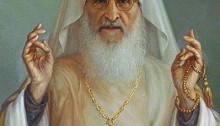
Photo from the consecration of Bishop Victor Abo-Assaly, first primate of the Antiochian Archdiocese.

This week in American Orthodox history (Nov. 5-11)

0

Photo from the consecration of Bishop Victor Abo-Assaly, first primate of the Antiochian Archdiocese.

November 8, 1894: Memorial services for Tsar Alexander III of Russia were held in New York and Washington, DC. The New York memorial was held in Holy Trinity Greek church, because there was no Russian church in the city. In Washington, President Grover Cleveland attended the service, which was led by Bishop Nicholas Ziorov. A couple of years ago, I wrote an article about these memorials; click here to read it.

November 9, 1897: Fr. Sebastian Dabovich officiated at the marriage of his niece Ella to Theodore Pashkovsky, who later became dean of the Russian cathedral in San Francisco. After Ella died, Fr. Theodore was consecrated a bishop (taking the name “Theophilus”), and he ultimately became primate of the Russian Metropolia from 1934 until his death in 1950.

The Pashkovskys had a son, Boris, who shortened his last name to “Pash” and went on to live a rather remarkable life himself. He worked security on the Manhattan Project — in fact, he was one of two sons of Orthodox bishops on the project, the other being the son of Metropolitan Leonty Turkevich — and after World War II, he negotiated to have the Japanese Orthodox Church placed under the jurisdiction of the Russian Metropolia in America.

November 8, 1900: Bishop Tikhon Bellavin, along with Fr. John Kochurov and Fr. Sebastian Dabovich, attended the consecration of an Episcopalian bishop in Fond du Lac, Wisconsin. The gathering became known as the “Fond du Lac Circus,” and, honestly, it’s high time that this event gets a full article of its own. I’ll add it to the to-do list.

November 9, 1902: Bishop Tikhon consecrated St. Nicholas Syrian Orthodox Church in Brooklyn, NY. He was assisted by Archimandrite Raphael Hawaweeny, head of the Syro-Arab Mission in North America.

November 5, 1905: Ingram Irvine, a convert from the Episcopal Church, was ordained an Orthodox priest by Archbishop Tikhon at St. Nicholas Russian Orthodox Cathedral in New York. Irvine had been an Episcopalian priest for a quarter century before being defrocked by his bishop for “conduct unbecoming a clergyman.” His ordination to the Orthodox priesthood sent shockwaves through the Episcopal Church.

I used to write about Irvine all the time here at Orthodox History, but not so much lately. Why, you ask? Because Aram Sarkisian (and, to a lesser extent, I) came upon some really important sources on Irvine — sources that don’t present him in a particularly good light. We’re still getting some things translated, and until Aram has a chance to present those findings, it’s a little difficult for me to say much about Irvine. In any case, my perspective on Irvine has changed quite a lot because of these new sources, and I’m much more inclined to think that the Episcopalians who disliked him had good reasons for doing so.

November 11, 1908: James Chrystal, a Protestant minister, died in Jersey City, NJ. Many years earlier, in 1869, Chrystal had traveled to Greece, converted to Orthodoxy, and been ordained a priest by the celebrated Archbishop Alexander of Syra. But Chrystal soon repudiated Orthodoxy because of his opposition to icons, and for the rest of his life, he held out hope that the Orthodox would abandon their “idolatry.” For more on Chrystal, check out my podcast and article on him and his fellow convert-turned-apostate, Nicholas Bjerring.

November 5, 1913: At a convention in Chicago, the Serbian Orthodox clergy in America formally requested to be transferred from the jurisdiction of the Russian Church to that of the Serbian Church. Nothing official happened until after World War I and the Bolshevik Revolution, but the wheels were in motion to create a separate Serbian jurisdiction in America.

Incidentally, this fact is one of the many pieces of evidence against the notion that the Bolshevik Revolution caused the subsequent jurisdictional chaos in America. The Serbs — along with the Greeks, Syrians, and others — were already either not part of the Russian Mission, or openly talking about leaving it, well before 1917.

November 9, 1924: Archimandrite Victor Abo-Assaly was consecrated in Worcester, MA to be the first primate of the brand-new Antiochian Archdiocese of North America.

November 6, 1954: Robert Royster, a Baptist convert to Orthodoxy, was ordained to the priesthood by the BIshop Bogdan, head of the Ukrainian jurisdiction under the Ecumenical Patriarchate. Royster took the name “Fr. Dmitri,” and he was just one of many American converts that Bishop Bogdan ordained. In his important 1973 book The Quest for Orthodox Church Unity in America, Fr. Seraphim Surrency wrote,

Bp Bogdan ordained over a dozen native converts to the Orthodox priesthood without requiring any theological training, and as might be expected the results were disastrous (an exception was Fr. Dmitry Royster who later transferred his allegiance to the Russian Metropolia and was consecrated Bishop in 1969).

Of course, the Metropolia morphed into the OCA in 1970, and Dmitri became one of its most prominent bishops. In 1977, he received by far the most votes in the election for a new OCA Metropolitan, but he was just shy of two-thirds, which meant that the names of both Dmitri and the distant runner-up — Theodosius Lazor — were submitted to the Holy Synod for consideration. In spite of Dmitri’s high vote total, the Synod quickly elected Theodosius as Metropolitan. The next year, Dmitri took over the fledgling OCA Diocese of the South, which he led until his retirement in 2009. Dmitri died in 2011.

And just to make quick plug: the best, most balanced and well-researched treatment of Dmitri that I’ve ever seen is Fr. Peter Robichau’s recent St. Vladimir’s Seminary thesis, From District to Diocese: An Examination of the Founding and Missionary Methods of the OCA Diocese of the South. It’s not published, but I hope Fr. Peter turns it into one or more articles in the future. If you happen to be at SVS, it’s worth a look.

November 8, 1979: Matushka Olga Michael of Alaska died. Many people today consider her to be a saint, and you can find icons and even an akathist service to her on the internet. For more on Matushka Olga, check out Kevin Wigglesworth’s 2008 article published in The Canadian Journal of Orthodox Christianity, and available online. The article leans more toward hagiography than history, but you’ll get a good sense of why so many people admire her.

Once again, my apologies for the lack of new material over the past couple of months. We do have some really fascinating material in the pipeline, and I’m trying to get my “This week” series back on track, so stay tuned. – Matthew Namee

Schmemann_1

Fr. Alexander Schmemann in Detroit, 1962

0

Recently, I was alerted to several photographs of a visit Fr. Alexander Schmemann made to Detroit in the winter of 1962.  Today would have been Fr. Alexander’s ninety-first birthday, so I thought this to be as good an opportunity as any to share these pictures with our readers.

1962 was a turning point in the history of Orthodox theological education in North America, and in turn was a major transition for Fr. Alexander as well.  As our readers surely know, Fr. Alexander is best known for his involvement with St. Vladimir’s Orthodox Theological Seminary.  Fr. Alexander arrived at the seminary as a faculty member in 1951, and was part of the institution’s growth into one of the major centers of Orthodox thought and scholarship in the western hemisphere by the end of the decade.  By 1962, the seminary had grown to the extent that it was prepared to move into a permanent facility, the now-familiar campus in Crestwood, New York.  The move to Crestwood also marked Fr. Alexander’s move to the position of seminary dean.

The two photographs shown here show Fr. Alexander at the cusp of these major developments, speaking at what appears to be either an event sponsored by the Federated Russian Orthodox Clubs (FROC, now the FOCA) or the Detroit Council of Orthodox Christian Churches (COCC), who have organized evening vespers services in Orthodox parishes around the Detroit area each Sunday evening during Lent since the late 1950s.  The venue appears to be Holy Ghost Carpatho-Russian Orthodox Church, a parish founded in 1919, which in the 1960s was under the jurisdiction of the Metropolia, and subsequently the OCA (though later it was a part of ROCOR, and now is a parish of the Patriarchate of Bulgaria).

The early 1960s were a transformative time in the history of the Metropolia, with St. Vladimir’s Seminary and its faculty playing a key role.  Fr. Alexander was instrumental in the early meetings of the Standing Council of Canonical Orthodox Bishops in America (SCOBA), which held its first meetings in 1960, and was an Orthodox observer to the Second Vatican Council (Vatican II), when it opened its sessions in 1962.

This era found the Metropolia, especially Fr. Alexander and his colleagues at St. Vladimir’s, interested in the jurisdictional trajectory of the canonical chaos which defined Orthodoxy in America in the wake of the Russian Revolution of 1917.  Amongst the early academic explorations of the movement towards the granting of autocephaly to the Metropolia in 1970 was the publication of Alexander Bogolepov’s Toward an American Orthodox Church in 1963, early, tense encounters between the Metropolia and the Church of Russia that same year, and Fr. Alexander’s three-part exploration of the problems facing Orthodoxy in North America, which appeared in the St. Vladimir’s Seminary Quarterly in 1964.

When Fr. Alexander came to Detroit on a winter’s evening in 1962, he was at the cusp of a truly transformative decade in his own career.  On November 30, 1962, following the institution’s move to its new Crestwood campus, Fr. Alexander was appointed to the position of Seminary Dean, replacing Metropolitan Leonty.  For the Life of the World, the book for which he is perhaps best known, was published the next year, which was followed by a string of similarly seminal works of Orthodox thought in the West, including The Historical Road of Eastern Orthodoxy (1963), Introduction to Liturgical Theology (a reworking of his doctoral dissertation, first published in English in 1966), Great Lent (1969), and an edited anthology of modern Russian religious thought, Ultimate Questions (1964).

Of course, far removed from a Detroit church fellowship hall in 1962, the culmination of this decade of constant productivity was the granting of autocephaly to the Metropolia by the Patriarchate of Moscow in 1970.  This was a process of intense negotiations (what he would later term “a meaningful storm”), in which Fr. Alexander was intimately involved at nearly every stage.


This week in American Orthodox history (Sept. 10-16)

0

September 11, 1893: The World’s Parliament of Religions opened in Chicago. I’ve written quite a bit about the Parliament in past articles, and you can read all of them by clicking here. The super-short version: In conjunction with the Chicago World’s Fair, representatives from every major world religion convened in Chicago for the mother of all ecumenical gatherings.

Among the most impressive figures at the event was a Greek Orthodox archbishop, Dionysius Latas of Zante, one of the best known hierarchs in the Church of Greece. Archbishop Dionysius attracted a lot of press, but the most interesting Orthodox figure at the Parliament was Fr. Christopher Jabara, an Antiochian archimandrite who rejected the doctrine of the Holy Trinity and wanted to create a single world religion. To read more about Jabara, click here.

September 10, 1900: Nicholas Bjerring died in New York. Bjerring had converted from Roman Catholicism to Orthodoxy in 1870. He was immediately ordained a priest in Russia and sent back to America to establish the first Orthodox chapel in New York City. Bjerring’s chapel was one of only three Orthodox houses of worship in the contiguous United States (the others being in San Francisco and New Orleans). And while there was a Russian bishop living in California, Bjerring and his chapel were directly under the Metropolitan of St. Petersburg.

Things didn’t work out all that well. After sputtering along for 13 years, the chapel was closed by the Russian government, and a disenchanted Bjerring converted to Presbyterianism. A few years before he died, Bjerring re-converted to Roman Catholicism, as a layman.

Fr. Demetrios Petrides

September 12, 1912: Fr. Demetrios Petrides arrived in Atlanta to become the priest of Annunciation Greek Orthodox Church. Petrides had been in Philadelphia, where he clashed with a rich Greek tobacco magnate. It’s a crazy story — the millionaire layman wanted Petrides to bow to him and follow his every order, and Petrides flatly refused. The rich guy got Petrides fired from the parish (that was how things worked back then), and Petrides moved to Atlanta. One newspaper dubbed him the “stormy petrel of the cloth,” and he continued his distinguished career until his untimely death from diabetes in 1917.

Another interesting aspect of Petrides’ career is that he was the priest who recommended that the Ecumenical Patriarchate ordain Fr. Raphael Morgan, who became the first black Orthodox priest in America. For a time, Morgan — who had a troubled marriage that ended in divorce — actually lived in Petrides’ house.

September 13, 1921: Two big events on this day: the birth of Fr. Alexander Schmemann, and the opening of the first Clergy-Laity Congress of the Greek Archdiocese.

The Clergy-Laity Congress accomplished the legal incorporation of the Archdiocese, and many date the beginning of the GOA to this date. It’s sort of arbitrary, though — you could pick any number of dates between 1918 and 1922. I think the Congress itself, rather than the act of legal incorporation, is ultimately more historically significant.

As for Fr. Alexander Schmemann, he was one of the most famous and important figures in late 20th century American Orthodoxy. What did he do? What didn’t he do? He’s probably best known for his writings — seminal works like For the Life of the World, The Eucharist, Great Lent, and many, many more. Or maybe he’s best known as a professor and longtime dean of St. Vladimir’s Seminary, where he educated hundreds of future church leaders. Or perhaps it’s his role as a churchman: he played a key role in the establishment of the OCA, and the founding of SCOBA. He attended Vatican II as an observer, and he advised the Evangelical Orthodox Church on its path to conversion to Orthodoxy. After the death of Metropolitan Leonty in 1965, the Metropolia/OCA lacked a dominant hierarchical presence. Schmemann, a married priest, filled that role, and was for the OCA what Archbishop Iakovos was to the Greek Archdiocese, and Metropolitan Philip Saliba was for the Antiochians.

September 11, 1927: Fr. Emmanual Abo-Hatab, former archdeacon to St. Raphael Hawaweeny, was consecrated a bishop for the newly established American Orthodox Catholic Church. The AOCC was led by Archbishop Aftimios Ofiesh, and it was fringe from the beginning. Bishop Emmanuel eventually split from Aftimios and went to the Russian Metropolia, where he succeeded Aftimos as leader of the “Russy” (pro-Russian) faction of the Arab Orthodox in America.

September 14, 1931: Eleanor Roosevelt, wife of New York Governor Franklin Roosevelt, attended the cornerstone-laying ceremony at Holy Trinity Greek Orthodox Cathedral in New York. The ceremony was performed by Archbishop Athenagoras, the new head of the Greek Archdiocese. From the following day’s New York Times:

Mrs. Roosevelt said that the members of the Greek congregations had expressed their worship of God by means of beautiful edifices erected in this city. She added the hope that their fine spirit would be carried on by the new members of these congregations.

Members of the Holy Trinity congregation, whose church was destroyed by fire several years ago, and those of the congregation of the Church Evangelismos [Annunciation] will be amalgamated into one congregation in the new edifice which is expected to be completed in April at a cost of $600,000.

$600 grand in 1931 is equivalent to roughly $8.5 million today — a decent chunk of change in any era, but particularly during the Great Depression.

September 10, 1933: Fr. Benjamin Basalyga was consecrated a bishop in Pittsburgh, for the Russian Metropolia. The 46-year-old bishop was born in a Pennsylvania coal town, and as a child, he was one of the first students at the Russian missionary school in Minneapolis and then at the Minneapolis seminary. Later, he became a hieromonk and served in parishes all over America and Canada, without spending much time in any particular community. For a while in the 1920s, he was the personal secretary to Metropolitan Platon, head of the Russian Metropolia.

After being consecrated, Benjamin served as Bishop of Pittsburgh for about a dozen years, after which he led the Orthodox Church of Japan from 1946 to 1953. He then returned to his see in Pittsburgh for another decade before his death in 1963.

September 11, 1948: Bishop Alexis Panteleyev (or Panteleev), the Russian Metropolia’s Bishop of Alaska, died. I know next to nothing about Bishop Alexis, but I can tell you that he was originally consecrated Bishop of San Francisco in 1927, and served in that post until 1931. In 1934, he became the Bishop of Alaska. Then, in 1945, he was sent by the Metropolia to attend the enthronement of Alexei I, the newly elected Patriarch of Moscow. In this period, there was some hope that Moscow and the Metropolia could reestablish communion. As it turned out, the Metropolia couldn’t accept Moscow’s terms, and reunion didn’t happen.

The next year, though, Bishop Alexis decided to join Moscow himself. He explained his reasoning in this way: “In order to be in unity with the Eastern Orthodox Church, it is necessary for the Russian Orthodox clergy to be under the Patriarch of Moscow.” (New York Times, 4/20/1946) Bishop Alexis died two years later, in 1948.

September 16, 1949: St. John Maximovitch, then the ROCOR Bishop of Shanghai, spoke before the United States Congress. This article is getting a bit long, and St. John’s visit to Congress is really interesting, so I think I’ll save this one for another day.

September 14, 1951: Fr. Demetrios Makris was consecrated a bishop for the Greek Archdiocese, with the title “Bishop of Olympus” (yes, that Olympus). This was back when the GOA had a single Archdiocese composed of a series of “Archdiocesan Districts,” each overseen by a titular bishop but ultimately answerable to the Greek Archbishop. Later, those Districts became Dioceses (and their leaders diocesan bishops), and today they’re Metropolises with Metropolitans. Anyway, Bishop Demetrios was initially assigned to the massive First Archdiocesan District, which included New York, New Jersey, Pennsylvania, Washington DC, and more. Later, he headed up the Districts based in San Francisco and then Boston.

To be honest, I know even less about Bishop Demetrios than I do about Bishop Alexis Panteleyev (above). I’m not even sure when he died, though I’d guess it was in the 1970s (his tenure in Boston ended in 1973). If anyone out there can fill us in, please do.

That’s it for this week. Thanks for reading, and for your patience during this period of irregular output here at SOCHA.

Turkevich_Metr_Leonty (c1950)

Met. Leonty: A Life in Moments

0

As Matthew pointed out in his post yesterday, this week marks the 47th anniversary of the death of one of the truly  great Orthodox churchmen of the 20th century, Metropolitan Leonty Turkevich.  With an ecclesiastical career in the United States spanning from 1906 to 1965, there are few figures in the history of Orthodoxy in America who can claim such longevity, much less a comparable length of time spent at the heights of church administration.  From his first assignment in America, as Dean of the North American Russian Orthodox Theological Seminary in Minneapolis, Minnesota, to his last, as Metropolitan of All-America and Canada of what was then the Russian Metropolia, Leonty served as a key figure in nearly every moment and institution of note for nearly six decades.

Met. Leonty Turkevich

When Matthew asked me to write a piece about Leonty, I kept coming back to a single moment at the end of his life, a story for which there is a rare corroboration of accounts from multiple sources (one from the Moscow Patriarchate, the other from the Metropolia) that each give a unique picture of who Leonty was, and how his personality, longevity, and the weight of his institutional memory impacted those around him.

In early 1963, at the height of the Cold War, the National Council of Churches invited a delegation from the Church of Russia to visit the United States for a goodwill visit to acquaint the American religious establishment with leaders of the living, breathing Church behind the Iron Curtain.  Led by Archbishop Nikodim Rotov of Yaroslavl, head of the Patriarchate’s Department of External Relations, a side benefit of the delegation would be an opportunity for an informal assessment the true situation of the tensions between the Metropolia and the Patriarchal Exarchate as it existed on the ground, if not possible dialogue. Through the formation of the Exarchate in 1933, a longstanding lawsuit over control of St. Nicholas Cathedral in New York City, and stalled negotiations following the decision of the 7th All-American Sobor to renew the Metropolia’s administrative ties with Moscow in 1946, a bitter period of animosity between two jurisdictions with a shared history had dominated both local and national church life for decades.  Aside from an informal meeting in 1961 at a World Council of Churches meeting in New Delhi, by 1963, no formal or significant dialogue between the two parties had occurred for over a decade.

As he would recall over a decade later, one evening in March of 1963, Fr. Alexander Schmemann, Dean of St. Vladimir’s Seminary, received a telephone call from an Episcopalian acquaintance announcing that Nikodim and the delegation wished to visit the seminary, and would be arriving on campus within a few hours.  Schmemann quickly dispatched a call to Metropolitan Leonty to ask for permission to receive the delegation.  Leonty quietly replied, “receive them with love.”  The visit went well, and Schmemann arranged for Nikodim to meet with Leonty several days later over dinner at the Metropolia’s Chancery in Syosset.

Schmemann recalled the elderly Leonty descended the Chancery stairs that evening dressed in his trademark white cassock, “so majestic… and yet so simple and joyful, so obviously the head of the Church to which he had given his entire life.”  After dinner, Leonty rose to give an informal speech, in part a narrative of his ministry in America, as well as an expression of what the events meant for the future of Orthodoxy in North America.  His was an institutional memory that stretched back to the administration of Bishop Tikhon Belavin, the bishop who had invited the young Fr. Leonid Turkevich to the United States in 1906 to oversee the Minneapolis Seminary, which Turkevich repaid in turn by personally nominating his former bishop for the office of Patriarch of Moscow on the floor of the All-Russian Sobor eleven years later.  In fact, it is likely many of the events he described that evening occurred before the relatively young Nikodim (born in 1929) was even alive.  According to Schmemann, Leonty’s words movingly expressed his love for the Church of Russia, yet also his firm belief in the future of the Church in America. (Constance Tarasar, ed. Orthodox America, 1794-1976. Syosset, 1975. 262-3.)

Met. Nikodim Rotov

Several years later, Nikodim would recall the events of the Syosset dinner to Archimandrite Serafim Surrency, a priest who served as an assistant to Metropolitan John Wendland (then head of the Patriarchal Exarchate) at St. Nicholas Cathedral in New York City.  Surrency describes the elderly Leonty asking Nikodim firmly and directly, how he viewed Leonty and the other bishops of the Metropolia.  Though Nikodim was clearly moved by his meeting with Leonty, and the momentum of the evening would carry into several more informal dialogues between the Metropolia and the Patriarchate (especially Nikodim) in the ensuing years, reality dictated he reply “as kindly as he could:”

“Your Eminence, forgive me, but I have no choice but to regard you and your bishops as schismatics.”  According to Surrency, “…tears welled in the eyes of the aged Metr. Leonty.”  (Archimandrite Serafim Surrency. The Quest for Orthodox Church Unity in America. New York, 1973. 78.)

As a historian, this moment in a lifetime of truly monumental moments offers a good entry point by which we can understand the broader picture and historical narrativity of Leonty’s impact in America.  His role as a priest in the highest levels of diocesan administration, theological education, and publication shows the ambitious vision of the pre-Revolution North American Diocese to serve a rapidly growing, geographically expansive flock, and the extent to which the Revolution would fundamentally change this trajectory.  Leonty’s episcopal career (and the process by which he became a bishop) is a lens by which we can explore the deep divisions of the jurisdictional fracture of Orthodoxy in America in the wake of the rise of Bolshevism.  And in his final years, his hospitality and dialogue with Abp. Nikodim put in motion a series of sometimes tense, yet ultimately fruitful meetings leading to the granting of Autocephaly to the Metropolia in 1970, forming what is now the Orthodox Church in America.

In the months to come, I hope to further explore this dynamic figure, exploring how his roles within the Church found him intimately involved in some of the most controversial and heated moments Orthodoxy has seen on the North American continent, yet whose demeanor, deep spirituality, and kind and quiet disposition found him almost universally revered even in the face of discord.

Metropolitan Leonty visiting Los Angeles (LA Daily News, 7/1/1952)

This week in American Orthodox history (May 14-20)

0

May 17, 1870: The newly ordained convert priest Fr. Nicholas Bjerring celebrated his first Divine Liturgy in St. Petersburg, Russia. He didn’t know Church Slavonic, so he served in German.

May 19, 1884: Archimandrite Stephen Hatherly, a convert priest from England, arrived in Philadelphia. I wrote about Hatherly’s visit almost three years ago. The basic story is this: In 1883, the Russian government closed its chapel, and the priest, Bjerring, became a Presbyterian. Hatherly, a priest under the Ecumenical Patriarchate, heard about these events and asked for permission to make a go at his own New York mission. After getting the all-clear from Russia, he sailed for America in 1884, arriving in Philadelphia on May 19 — this week. But, as I explain in the article, the mission was a failure; the few Orthodox people in New York had little interest in attending a church. Hatherly returned to England disappointed.

One thing I’ve been meaning to do, but haven’t yet, is tell Hatherly’s own story, because it’s phenomenally interesting. He was an exact contemporary of the somewhat better known English convert J.J. Overbeck, an author and editor of the Orthodox Catholic Review. Overbeck wanted to establish a “Western Orthodox Church,” including union with the Church of England, and today he’s regarded as a sort of progenitor of the Western Rite. Hatherly, on the other hand, viewed a full-blown union between Orthodoxy and Anglicanism as unrealistic. Instead, he preferred simply to convert Anglicans to (standard Byzantine Rite) Orthodoxy — something that raised the ire of the Anglican hierarchy, who in turn induced Constantinople to forbid Hatherly from evangelizing his countrymen. On top of all this, Hatherly was an accomplished church musician. As I said, writing an article about his life is on my to-do list.

May 19, 1905: Bishop Tikhon Bellavin, head of the Russian Mission in North America, was elevated to Archbishop by the Holy Synod of Russia.

May 17, 1922: Ecumenical Patriarch Meletios Metaxakis issued a tomos, formally establishing the Greek Orthodox Archdiocese of North and South America as a jurisdiction under the Ecumenical Patriarchate. As Archbishop of Athens, the controversial Meletios had been in America from 1918-1921, during which time he organized the Greek Archdiocese and convened its first Clergy-Laity Congress. While in America, Meletios was deposed by the Holy Synod of Greece, but soon after this, he was elected Patriarch of Constantinople. This 1922 tomos thus transferred the GOA from Meletios’ old see (Athens) to his new one (Constantinople).

How could he get away with such unilateral action? Well, back in 1908, the Ecumenical Patriarchate had “transferred” the Greek churches in the “diaspora” (particularly America) from itself to Athens. Which is sort of misleading, because a lot of the Greek churches in America were already under Athens, so the transfer affected only that portion of the Greeks who had been under Constantinople. Anyway, Athens didn’t really do much with America over the next decade, until Meletios, as Archbishop of Athens, came along in 1918. In issuing this 1922 tomos, Meletios was revoking the earlier 1908 transfer. And the GOA has been under Constantinople ever since.

May 14, 1957: Archbishop Jeronim Chernov of Eastern Canada (Russian Metropolia) died.

Metropolitan Leonty visiting Los Angeles (LA Daily News, 7/1/1952)

May 14, 1965: Metropolitan Leonty Turkevich, primate of the Russian Metropolia, died. Leonty is one of those giants of American Orthodox history, on par with Tikhon, Iakovos, and Bashir. Many think he’s a saint, and I strongly suspect that they’re right. One of the amazing things about Leonty is that he lived through so much. Originally known as Fr. Leonid, he was a key figure in the Russian Mission dating to the episcopate of St. Tikhon. He ran the seminary, succeeded St. Alexander Hotovitzky as dean of the main cathedral, and generally was the most important priest in the Archdiocese prior to the Russian Revolution.

Then, in 1917, he participated in the monumental All-Russian Sobor — one of the pivotal church councils in Russian history. He made it out of revolutionary Russia and back to the US, where he was, again, probably the key priest in the Russian Metropolia, which rose from the ashes of the Russian Mission. After being widowed, he was almost consecrated a bishop for Aftimios Ofiesh’s American Orthodox Catholic Church experiment, and he ended up becoming the Metropolia’s Bishop of Chicago. When the Metropolia’s primate, Metropolitan Theophilus Pashkovsky, died in 1952, Leonty was elected to be his successor.

Anyway, all that is ridiculously cursory, and I can only fit so much into this article. But Aram Sarkisian, who knows far more about Leonty than I do, will be running a full-length piece here very soon.

May 18, 1970: The Patriarchate of Moscow formally granted autocephaly to the Russian Metropolia in America, which changed its name to the “Orthodox Church in America.” This event reverberated throughout the Orthodox world, and it remains controversial to this day. While everyone recognizes the OCA as fully canonical, only a minority of the world’s Orthodox Churches acknowledge the OCA as an autocephalous Local Church.

May 14, 1972: Tragedy struck at ROCOR’s Holy Trinity Seminary in Jordanville, NY, where one seminarian stabbed another to death. Both men had been studying for the priesthood.

May 15, 1979: Bishop Dionisije Milivojevich, the Serbian Orthodox bishop whose battle with his mother church went all the way to the U.S. Supreme Court, died in Illinois.

May 18, 1985: Fr. John Karastamatis, a Greek priest in Santa Cruz, CA, was brutally murdered. Some of his admirers immediately declared him to have been martyred for the faith, and to this day, you’ll run into lists of saints that include “Hieromartyr John of Santa Cruz.” But the subsequent police investigation revealed that he was killed by the husband of the parish secretary, and at trial, witness testimony made it clear that Karastamatis was not someone who should be venerated as a saint. I don’t want to get into the gory details, mainly because this didn’t happen all that long ago and Karastamatis’ family is still around, but suffice it to say that while his murder was a great tragedy, the calls for his canonization were terribly misplaced.

May 18, 2000: Archbishop Sylvester Haruns of Montreal (OCA) died.

May 14, 2006: Conclusion of the ROCOR All-Diaspora Council, which approved reconciliation between ROCOR and the Moscow Patriarchate.

May 17, 2007: In Moscow, ROCOR signed the Act of Canonical Communion, re-establishing full communion with the Moscow Patriarchate.

May 18, 2008: Another big ROCOR moment — Metropolitan Hilarion Kapral was enthroned as First Hierarch of ROCOR.

Go to Top