Posts tagged Philadelphia
The Historical Reality of Greek Orthodoxy in America
Last week, I was privileged to speak at the Greek Archdiocese Clergy-Laity Congress in Atlanta. I gave the same talk on two days, July 5 and 6. Below, we’ve published the text of my lecture. A couple of things, up front: first, I didn’t include footnotes, because this was just the text I personally used in delivering the talk. And second, I make several references to Atlanta and Georgia, because that’s where I was speaking. Also, please forgive any typos or other errors; I know that there are a few, and I haven’t fixed all of them.
I’ve been asked to speak about Orthodoxy in the United States in the late 19th and early 20th centuries. Of course, this was the Ellis Island era, the time when hundreds of thousands of people flocked to the United States from Eastern Europe and the Mediterranean. It’s when many of your ancestors came here; it’s also when my own ancestors came here, from what was then the Ottoman Empire and what is today Lebanon. Of course, besides the Greeks and the Syrians and Lebanese, there were also lots of Serbs, Romanians, Carpatho-Rusyns, and Bulgarians. These were largely Orthodox people, coming to the United States from all over the Orthodox world, and bringing with them their ancestral faith. And while these people spoke different languages and had different local traditions, they all shared that Orthodox faith. Because they came here and preserved their faith – because of that, we have Orthodoxy in America today. My goal here today is to give you a sense of what it was like back then – what it was like to be an Orthodox Christian in late 19th/early 20th century America.
In 1890, only two Orthodox parishes existed in the entire United States of America: a Russian cathedral in San Francisco and a semi-independent Greek church in New Orleans. Of course, there was a significant Russian Orthodox presence in Alaska, but at that time Alaska was just a territory, not a state, and it was both geographically and culturally disconnected from the US mainland.
The church in New Orleans was founded in 1865 by a group of Orthodox people led by a Greek cotton merchant named Nicolas Benachi. This was a multi-ethnic parish, and besides Greeks, it included Antiochians and Slavs among its members. The U.S. Census of 1890 describes it as a part of the Church of Greece, “in connection with the consulate of Greece in New Orleans.” The first priest to visit New Orleans – he wasn’t the parish priest, but he visited and served the first liturgy there – he was a strange character named Fr. Agapius Honcharenko. This man was an itinerant Ukrainian of questionable credentials who was visiting New York in 1865 when he was contacted by the New Orleans parish. He certainly was not connected to the Russian Church; he actually claimed that the Tsarist government had put a price on his head for his involvement in revolutionary activities. Honcharenko had some sort of connection with the Church of Greece, but not long after his visit to New Orleans, he left Orthodoxy altogether and tried to start his own Protestant sect in California.
The New Orleans parish itself was a really interesting community. Before they had actually organized themselves as a parish, they raised their own Orthodox militia regiment to fight on the Confederate side of the Civil War. Later on, from 1881 to 1901, the community had a priest from Bulgaria. Until 1906, most of the church records were kept in English. It was only later that Greek became the dominant language.
After I finished preparing this talk, I learned of some very exciting developments happening with the New Orleans parish. After Hurricane Katrina, the parishioners were cleaning out the church, and someone stumbled onto bunch of old documents, tucked away in some long-forgotten cupboard or closet. As it turns out, these were the sacramental records kept by the parish priests in New Orleans, dating back to the earliest years of the parish. The papers were soaking wet, and right now, the parish is having them restored. They show that the parish had members of all different ethnic groups, and in particular, a lot of Antiochians. And these people weren’t just concentrated in the city of New Orleans – they were in small towns all over Louisiana, and probably beyond. We’re just now beginning to get a glimpse of what life was like in the first Orthodox parish in the contiguous United States. There are plans to digitize the documents, and there’s even talk of building an Orthodox museum in New Orleans, to house the hundreds of documents and artifacts the community has accumulated over the past century and a half. Anyone interested in Orthodox history or Greek history will want to keep an eye on what’s going on in New Orleans.
The other really old parish, the San Francisco cathedral, was founded in 1868 under Russian authority. Just like New Orleans, San Francisco had a multi-ethnic Orthodox community. That community largely consisted of Greeks and Serbs, and in 1867, they formally requested that the Russian bishop in Alaska send them a priest. Soon after this, the Russian bishop moved his own residence down to San Francisco.
The San Francisco parish seemed almost cursed with turmoil. In 1879, the dean of the cathedral was apparently murdered, and one of the prime suspects was his assistant priest. A few years later, the Russian bishop drowned at sea; this appears to have been a suicide brought on by a physical ailment. In the late 1880s and early 1890s, the cathedral community was rocked by scandal. The new bishop, Vladimir, was accused of all kinds of horrific crimes. The cathedral itself burned to the ground, and many people suspected arson. Eventually, Bishop Vladimir was recalled to Russia, and by the end of the decade – by the end of the 1890s – the bishop in San Francisco was an outstanding man, Tikhon Bellavin, who was respected by all the different ethnic groups in the community. Bishop Tikhon went on to become Patriarch of Moscow. He suffered under the Communists, and in 1988, he was canonized a saint.
Now, as I mentioned, the New Orleans and San Francisco parishes were the only churches in the United States in 1890. They were outposts, really; there wasn’t much in the way of established Orthodoxy in America, outside of the Russians and Orthodox natives in Alaska. But after 1890, things began to change really rapidly. On the one hand, as I said before, thousands of Orthodox immigrants were arriving in the United States. And at the same time, entire parishes of Eastern Rite Catholics were converting, en masse, to Orthodoxy.
These Eastern Catholics were from the Austro-Hungarian Empires, and their ancestors had been Orthodox, but in the preceding centuries, they had left the Orthodox Church and joined the Roman Catholics. When they came to the United States, they were not very well-received by the Roman Catholic hierarchy in America. The big moment came in 1889. An Eastern Catholic priest named Alexis Toth had just arrived in Minneapolis, Minnesota, to take over pastoral care of the Eastern Catholics in the area. And as was the standard procedure, when he got to Minneapolis, he presented himself to the local Roman Catholic archbishop, a man named John Ireland.
Archbishop Ireland was absolutely livid that Toth had come to Minneapolis. Ireland shouted at Toth, “I have already written to Rome protesting against this kind of priest being sent to me.” Toth said, “What kind of priest do you mean?” And Ireland said, “Your kind.” And then he continued, “I do not consider either you or this bishop of yours Catholic. […] I shall grant you no permission to work there.” Later on, Toth said, “The Archbishop lost his temper, I lost mine just as much.”
Unwelcomed by the Roman Catholics, Toth began to look into other options. At this point – and here, we’re talking right around 1890 – there wasn’t much in the way of Orthodoxy in America, as we’ve seen. Toth eventually contacted the Russian bishop in San Francisco, and his entire Eastern Catholic parish in Minneapolis converted to Orthodoxy. Toth himself became a leading proponent of Eastern Catholic conversions to Orthodoxy. Tens of thousands of Eastern Catholics joined the Russian Orthodox Church in America over the next several decades. The core of the growing Russian Archdiocese – and the core of what we know today as the OCA – consisted of these former Eastern Catholic parishes. The significance of the Eastern Catholic conversions cannot be overstated – this was a major, major development.
Of course, at the same time that this was happening – literally, at exactly the same time – thousands of people who were already Orthodox were coming to the United States from Eastern Europe and the Mediterranean. And these people were also starting their own Orthodox churches.
One of the most interesting of these early communities was in Chicago. In the 1880s – so, even before the big immigration started – Chicago had a growing Orthodox population. By 1888, there were about a thousand Orthodox in the city. Most of them were Greeks and Serbs, and despite the fact that they weren’t Russian, they petitioned the nearest bishop – who was Russian – to send them a priest. In 1888, the Russian bishop responded to their petition by asking them to hold a meeting, to figure out if there was enough interest to support a church. The main speakers at the meeting were a Greek, a Montenegrin, and a Serb. The Greek man was George Brown, who had come to America as a young man, and had fought in the American Civil War. George Brown gave a short speech, and it’s short enough that I’ll read most of it to you now, exactly as the Chicago Tribune reported it the next day:
“Gentlemans,” he said, “Union is the strength. Let everybody make his mind and have no jealousy. I have no jealousy. I am married to a Catholic woman but I hold my own. Let us stick like brothers. If our language is two, our religion is one. The priest he make the performance in both language. We have our flags built. It is the first Greek flags raised in Chicago. We will surprise the Americans. Let us stick like brothers.”
The meeting ended with everybody wanting to start an Orthodox church, and they agreed that the services could be done in both Greek and Slavonic. The Russian Bishop Vladimir traveled east from San Francisco for a visit later that year, but unfortunately, this was the same Bishop Vladimir who became embroiled in a series of horrible scandals. One of Vladimir’s strongest opponents in San Francisco was a Montenegrin who happened to be the brother of one of the leaders of the Chicago community. So the Chicago Orthodox were hearing all these horrible things about Bishop Vladimir, and they decided they wanted nothing more to do with the man. They put out feelers to numerous other Orthodox churches – the Serbian Church, the Ecumenical Patriarchate, and the Church of Greece.
Eventually, the Church of Greece sent a priest named Fr. Panagiotis Phiambolis, and in 1892 Phiambolis established the first Orthodox parish of any kind in Chicago. But this was not a multi-ethnic parish, like San Francisco and New Orleans. This parish was specifically for Greek people. The Chicago Tribune reported that the new Greek church “wants no one but those of Hellenic blood among its members” Almost exactly one month after the Greek church began in Chicago, the Russians established their own church. By now, I should note, Bishop Vladimir had been recalled to Russia, and was replaced by Bishop Nicholas.
So now in 1892, there were two Orthodox parishes in the city of Chicago – one Greek, one Russian. This was the first time in our history that two Orthodox churches, answering to different ecclesiastical authorities, coexisted in the same US city. But there’s a flip side to all of this. Despite the fact that they had separated based on language and ethnicity, they still got along with each other. In 1894, the Chicago Greek and Russian priests concelebrated the Divine Liturgy at the Russian church to commemorate the one hundredth anniversary of the Russian mission to Alaska. When the Russian Tsar Alexander III died the following month, a memorial was served by both the Greek and Russian priests at the Greek church, which was simultaneously dedicating its new building. When the new Russian bishop, Nicholas, visited Chicago in later that year, the local Greek priest, Phiambolis, participated in the hierarchical Liturgy at the Russian church. Later on, in 1902, the church bell was stolen from the Russian parish, and the Greek priest invited his Russian counterpart to come to the Greek church and ask the Greek parishioners for help. The two churches, Greek and Russian, then held a joint meeting of both parishes, to organize an effort to find the bell.
On the Pacific Coast, Orthodox communities began to organize themselves in places like Portland, Oregon, and Seattle, Washington. In both Portland and Seattle, there was a lot of diversity among the Orthodox, with Greeks, Serbs, Antiochians, and Russians all in the same community. And in both Portland and Seattle, these diverse Orthodox populations affiliated themselves with the Russian Church. Seattle is a really interesting story, because, while it was under the Russian Church, the parish itself was named after St. Spyridon, who of course is a Greek saint. How did that happen? Well, the land for the church was donated by a Greek family, and because of that, they got to choose the name. Church services were in Greek, Slavonic, and English, and one of the prerequisites for being the pastor in Seattle was an ability to work in multiple languages.
Seattle’s multi-ethnic community didn’t last forever. By 1917, there were over two thousand Greeks in Seattle, and they decided they needed their own Greek church. But there weren’t any hard feelings. People said that they were just happy that there were enough Orthodox in Seattle for two churches.
Fr. Michael Andreades was of the early priests of that original multi-ethnic Seattle parish. Andreades was Greek, but he had been educated in Russia, and he was under the Russian bishop in San Francisco. He was one of several ethnic Greek priests who served under the Russian diocese. This was certainly not the norm for Greek clergy in America, but it definitely was not unheard of.
Another of these Greek priests was Fr. Theoclitos Triantafilides. His father was an Athenian who fought in the Greek War for Independence, and then afterwards moved to the Peloponnese. That’s where Triantafilides himself was born. As a young man, Triantafilides went to Mount Athos and was tonsured a monk. He became affiliated with the Russian monastery of St. Panteleimon, on Mount Athos, and from there, he went to Russia itself, where he studied at the Moscow Theological Academy. This is where things get really interesting. Triantafilides was asked by King George I of Greece to come to Greece and tutor the king’s young son, Prince George. Then the Russian Tsar, Alexander III, asked Triantafilides to return to Russia and tutor his children, including the future Tsar Nicholas II. Triantafilides was actually one of the priests who served at the wedding of Nicholas II and his wife Alexandra.
So how did Triantafilides go from the royal courts of Greece and Russia to the United States? Well, in Galveston, Texas – which was a major seaport in the 19th century – there was another one of those multi-ethnic Orthodox communities. The Greeks and Serbs of Galveston got together and petitioned the Russian Church to send them a priest. Tsar Nicholas II himself answered their petition by sending them his old tutor, Triantafilides, who by this time was in his early sixties.
Triantafilides was the priest in Galveston for over 20 years, until his death in 1916. But he didn’t just take care of the Galveston parish. He took responsibility for the Orthodox people living throughout the Gulf Coast, traveling thousands of miles by horse and by train. His parish, which was named Ss. Constantine and Helen, eventually came to be predominantly Serbian, and many years after his death, the church switched from the Russian to the Serbian jurisdiction. But to this day, they continue to venerate their original Greek priest, sent by the Russian Tsar.
But Fr. Theoclitos Triantafilides was not the first prominent Greek priest in America. That title belongs to Fr. Kallinikos Kanellas, who arrived in San Francisco in the early 1890s. Kanellas came to the US from India, where he had been the priest of the Greek Orthodox church in Calcutta. He initially came to America just for a visit, but he was a sickly man, and he became ill, which forced him to stay for awhile. He became affiliated with the multiethnic Russian cathedral in San Francisco. Of course, with so many Greeks there, having a Greek priest would have been particularly helpful. Like so many of his fellow priests, Kanellas traveled all over the country. He actually seems to have been the first Orthodox priest to visit this state – Georgia – when he baptized a Greek child in Savannah in 1891.
In 1892, a new Russian bishop took over in San Francisco, and he released Kanellas, who then traveled to the eastern part of the United States. Around 1902 or 1903, Kanellas was asked to become the priest of the Greek church in Birmingham, Alabama, which was under the Church of Greece. He spent the next eight years there. The Greek-American Guide described him as “a very sympathetic and reverend old man.” He was one of the only Orthodox priests in the entire American South, so like Triantafilides, he traveled quite a bit. One of the places he visited was Atlanta. Kanellas eventually became the first priest of the Greek church in Little Rock, Arkansas, and he remained there until his death in 1921.
Priests like Andreades, Triantafilides, and Kanellas were not Russian, but they all spent time serving in the Russian diocese. The reverse didn’t happen – Russian priests didn’t serve under the Church of Greece. But there is a fascinating story that I must tell you – because not all of the Greek priests were, in fact, Greek.
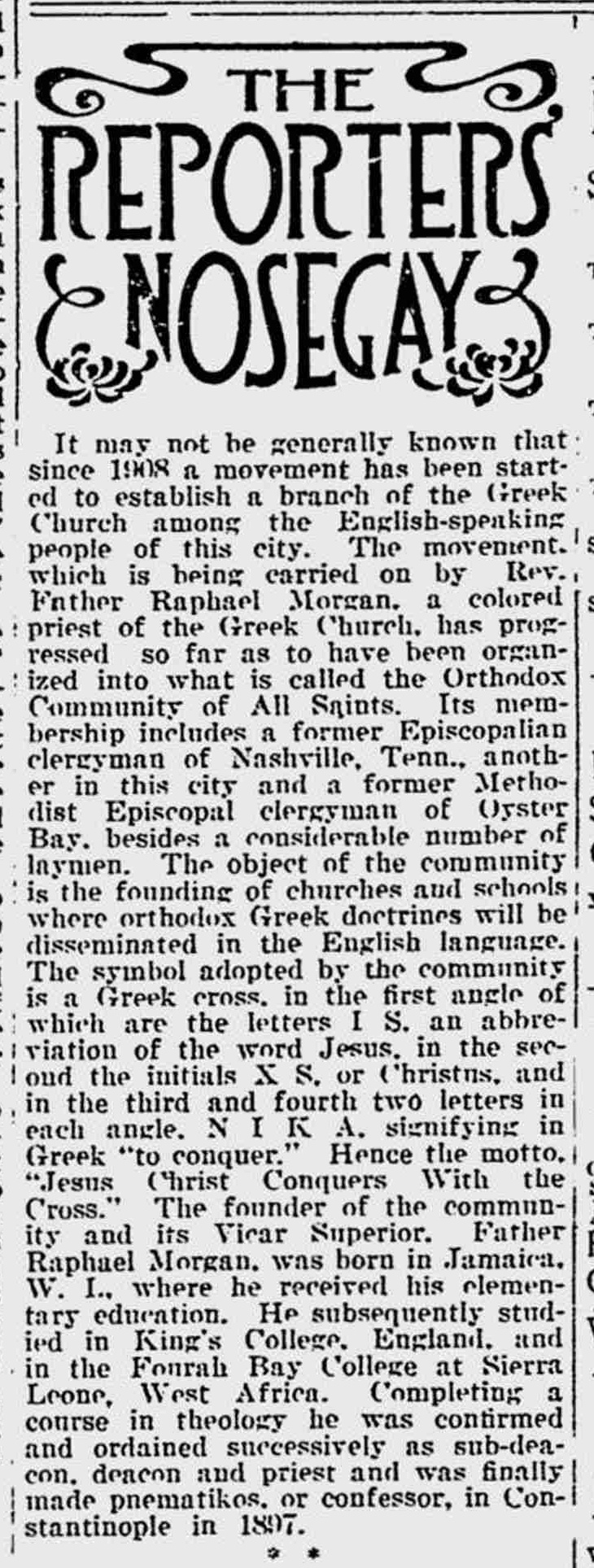
Just after the turn of the twentieth century, a man named Robert Morgan began to attend the Greek church in Philadelphia. The curious thing about Robert Morgan is that he was a black Episcopalian deacon from Jamaica. In 1907, he traveled to Constantinople, and was ordained an Orthodox priest. He was sent back to Philadelphia, and I’ll quote directly here, “to carry the light of the Orthodox faith among his racial brothers.” Morgan took the name “Fr. Raphael,” but unfortunately, he wasn’t very successful in his missionary work. Aside from his own family, there’s no clear evidence that he converted anyone else to Orthodoxy. But the startling fact remains that at the beginning of the twentieth century, the Ecumenical Patriarchate initiated a mission to convert black Americans to Orthodoxy.
Now, as I said, Fr. Raphael Morgan was attached to the Greek church in Philadelphia. When he went to the Ecumenical Patriarchate to be ordained, he had two letters in his possession. One was from the Greek community of Philadelphia, which supported Morgan’s ordination, and said that if he failed to establish a black Orthodox church, he was welcome to be the assistant priest at their parish. The other letter was from the parish priest in Philadelphia, a remarkable man named Fr. Demetrios Petrides.
Petrides was born on Samos in the mid-1860s. He was a married priest, with children, but his wife died before he came to America. Back in Greece, Petrides’ daughter fell in love with a young man, John Janoulis, and they wanted to get married. Petrides approved, but the Janoulis’ father wanted his son to get an education, rather than get married. So Janoulis was disowned by his father, and Petrides took the couple under his wing. The young Janoulis left for America to earn money, which of course was common practice at the time, and then Fr. Demetrios was asked by the Church of Greece to become the new priest in Philadelphia. He arrived in 1907, and brought along his daughter, reuniting her with her husband. Just a couple of months after he arrived in America, Petrides wrote his letter, recommending that Robert Morgan be ordained a priest. For a while, Morgan actually lived in the Petrides family home.
Like so many of his fellow priests, Petrides traveled throughout his region of the country, ministering to the Orthodox people he found who didn’t have a priest. One time, he went to Ithaca, New York, to do a baptism. After the service, unbeknownst to Petrides, a 16-year-old Greek girl had advertised that she would go into a “spirit trance.” Greeks had traveled from all over to witness the spectacle. Petrides caught wind of what was going on, and he burst into the room, stopped the girl’s trance, and told the people that spiritualism is against the teachings of the Orthodox Church. This was the sort of man he was – completely unafraid to stand up for what was right, no matter what.
It was this gumption that got Petrides run out of Philadelphia. The Philadelphia church was dominated by a rich layman, Constantine Stephano, who was a millionaire cigarette manufacturer. Stephano and Petrides did not get along. Things came to a head in 1912, when Stephano sent the following message to Petrides – this is almost unbelievable. It said,
“Constantine Stephano commands you to appear at his office every evening at sunset and salaam low upon entering his presence. Then you are to stand erect, with folded arms, with your eyes cast downward, awaiting a word from Stephano before sitting down or otherwise changing your position. If you are not asked to be seated you are to remain in this position until Stephano leaves his office, and when he passes through the door you are to salaam low again and depart with bowed head.”
Stephano was obviously trying to humiliate Petrides, and Petrides would have none of it. He responded, “I will not thus humiliate myself before this maker of cigarettes.” Now, in the early twentieth century, Greek parishes in America had only a loose connection to the church authorities in Athens or Constantinople. As a practical matter, the parishes were run by lay boards of trustees, which would hire and fire priests at will. Constantine Stephano arranged for Petrides to be ousted from the Philadelphia church, by the slim margin of seven votes.
But, characteristically, Petrides left with his head held high. In September of 1912, newspapers in Georgia began reporting that a daring Greek priest was coming to Atlanta. One newspaper called Petrides “the stormy petrel of the cloth.” Another paper said that he was famous for his “lambasting of the rich Greeks who loved money for the sake of power.” He was warmly welcomed by the Greeks in Atlanta, who seemed to have a good idea of the sort of priest they were getting.
But Petrides was not simply focused on his fellow Greeks. At the turn of the twentieth century, there was a very active dialogue taking place between the Orthodox and the Episcopalians. This led to the creation of a group called the “Anglican and Eastern Orthodox Churches Union.” The Orthodox members of the group included clergy from various ethnic backgrounds, including Antiochians, Russians, and Greeks. For several years in the teens, Fr. Demetrios Petrides was the organization’s Greek representative. He thus was engaged in this national inter-Christian dialogue, and he was also cooperating with his fellow Orthodox of different ethnicities.
As the teens wore on, Petrides developed diabetes, and in the days before insulin, that was a death sentence. He died in September of 1917. Annunciation Cathedral here in Atlanta should be very proud to claim Fr. Demetrios Petrides as one of its first priests. He was a significant historical figure, and an outstanding pastor.
We’re nearly at the end of this talk, and I’ve basically just told you a series of stories. So what’s the point – are there any common threads, or lessons to be learned, from this admittedly limited look at early Greek Orthodox history in America? I think there are, and I’ll just touch on them very briefly here at the end.
First and foremost, it should be clear that Greek Orthodoxy in America did not develop in a vacuum, somehow separated from the rest of Orthodoxy in America. Most of the earliest communities of Orthodox Christians here were multi-ethnic. This was largely a matter of practicality: there simply weren’t enough people in each individual group to start forming separate ethnic parishes. In many places – San Francisco, New Orleans, Chicago, Seattle, Galveston – there was a clear sense that, for Orthodox Christians to survive in America, they needed each other. They needed – we still need – to work together to build up Orthodoxy in our local communities. No matter what we’d like to think, we’re simply too small, too weak, to thrive on our own, without each other. And just as in those early parishes, cooperation and a unified effort does not imply the abolishment of our individual identities. I will always be Lebanese, just as so many of you will always be Greek. Working together, on a practical level, does not have to mean a compromise of our heritage. It didn’t a hundred years ago, and it does not now.
I’d like to close with the words of that Greek veteran of the Civil War, George Brown, the early leader of Chicago’s Orthodox community: “Union is the strength. Let everybody make his mind and have no jealousy. Our religion is one. We will surprise the Americans. Let us stick like brothers.” Thank you.
[This article was written by Matthew Namee.]
“The Stormy Petrel of the Cloth”
We’ve spent a lot of time on this website talking about Fr. Raphael Morgan, the first black Orthodox priest in America. Morgan was attached to the Greek church in Philadelphia. When he went to the Ecumenical Patriarchate to be ordained in 1907, he had two letters in his possession. One was from the Greek community of Philadelphia, which supported Morgan’s ordination, and said that if he failed to establish a black Orthodox church, he was welcome to be the assistant priest at their parish. The other letter was from the parish priest in Philadelphia, a remarkable man named Fr. Demetrios Petrides.
Petrides was born on Samos in the mid-1860s. He was a married priest, with children, but his wife died before he came to America. Back in Greece, Petrides’ daughter fell in love with a young man, John Janoulis, and they wanted to get married. Petrides approved, but Janoulis’ father wanted his son to get an education, rather than get married. (I think there was also a bit of a wrong-side-of-the-tracks dynamic at work here, too.) The pair got married, Janoulis was disowned by his father, and Petrides took the couple under his wing. Janoulis went to America to earn money, which of course was common at the time, and then Petrides was asked by the Church of Greece to become the new priest in Philadelphia. He arrived in 1907, and brought along his daughter, reuniting her with her husband. Just a couple of months after he arrived in America, Petrides wrote his letter, recommending that Robert Morgan be ordained a priest. For a while, Morgan actually lived in Petrides’ home.
Like so many of his fellow priests, Petrides traveled throughout his region of the country, ministering to the Orthodox people he found who didn’t have a priest. One time, he went to Ithaca, New York, to do a baptism. After the service, unbeknownst to Petrides, a 16-year-old Greek girl had advertised that she would go into a “spirit trance.” Greeks had traveled from all over to witness the spectacle. Petrides caught wind of what was going on, and he burst into the room, stopped the girl’s trance, and told the people that spiritualism is against the teachings of the Orthodox Church. This was the sort of man he was – completely unafraid to stand up for what was right, no matter what.
It was this gumption that got Petrides run out of Philadelphia. Like a lot of early Greek communities, the Philadelphia church was dominated by a rich layman — in this case, Constantine Stephano, a millionaire cigarette manufacturer. Stephano and Petrides did not get along. Things came to a head in 1912, when Stephano sent the following message to Petrides – this is almost unbelievable. It said,
Constantine Stephano commands you to appear at his office every evening at sunset and salaam low upon entering his presence. Then you are to stand erect, with folded arms, with your eyes cast downward, awaiting a word from Stephano before sitting down or otherwise changing your position. If you are not asked to be seated you are to remain in this position until Stephano leaves his office, and when he passes through the door you are to salaam low again and depart with bowed head.
Stephano was obviously trying to humiliate Petrides, and Petrides would have none of it. He responded, “I will not thus humiliate myself before this maker of cigarettes.” Now, as you all probably know, in the early twentieth century, Greek parishes in America had only a loose connection to the church authorities in Athens or Constantinople. As a practical matter, the parishes were run by all-powerful boards of trustees, which would hire and fire priests at will. Constantine Stephano arranged for Petrides to be ousted from the Philadelphia church, by the slim margin of seven votes.
But, characteristically, Petrides left with his head held high. In September of 1912, newspapers in Georgia began reporting that a daring Greek priest was coming to Atlanta. One newspaper called Petrides “the stormy petrel of the cloth.” Another paper said that he was famous for his “lambasting of the rich Greeks who loved money for the sake of power.” He was warmly welcomed by the Greeks in Atlanta, who seemed to have a good idea of the sort of priest they were getting.
But Petrides was not simply focused on his fellow Greeks. At the turn of the twentieth century, there was a very active dialogue taking place between the Orthodox and the Episcopalians. This led to the creation of a group called the “Anglican and Eastern Orthodox Churches Union.” The group’s Orthodox members included clergy from various ethnic backgrounds, including Antiochians, Russians, and Greeks. For several years in the teens, Fr. Demetrios Petrides was the group’s Greek representative. He thus was engaged in this national inter-Christian dialogue, and he was also cooperating with his fellow Orthodox of different ethnicities.
As the teens wore on, Petrides developed diabetes, and in the days before insulin, that was a death sentence. He died in September of 1917.
Several of the early Greek priests in America were notable, significant historical figures, and Fr. Demetrios Petrides is no exception. But he was more than that — he was a courageous priest, who, time and again, did what he thought was right, regardless of the potential consequences. Practically every time I find information about Petrides, it has something to do with him standing up for his principles — supporting his son-in-law who had been disowned by his father, mentoring the first black priest in America, breaking up the “spirit trance” spectacle in Ithaca, rebuking a corrupt millionaire in Philadelphia.
In many ways, Petrides reminds me of his fearless contemporary, Fr. Ingram Nathaniel Irvine, the great convert priest in the Russian Archdiocese. And even more so than Irvine, Petrides has been almost totally forgotten since his untimely death. That is largely a function of a general ignorance of the history of Greek Orthodoxy in America prior to the foundation of the Greek Archdiocese. But Petrides is, in my view, one of the greatest Greek priests who ever served in America, and we would do well to preserve his memory, and learn from his courage.
Fr. Raphael Morgan against Marcus Garvey

Marcus Garvey
Marcus Garvey was a widely influential black nationalist from Jamaica. He promoted black pride and championed the “back to Africa” movement. In 1916, when he was just 29 years old and at the outset of his public career, he visited the United States and embarked on a 38-state speaking tour. Not all of the black Americans who attended his lectures liked what they heard. Among those unhappy with Garvey was Fr. Raphael Morgan, the first black Orthodox priest in America. As we’ve discussed in the past, Morgan was born in Jamaica, and in 1916, he was living in Philadelphia, affiliated with the city’s Greek Orthodox church. In response to Garvey’s speeches, Morgan and some associates addressed the following letter to the editors of the Jamaican newspapers:
Philadelphia, U.S.A.
September 19, 1916
The Editor, Dear Sir, –
We the undersigned Jamaicans, residents of the United States for several years beg your permission to call to your attention and the public of Jamaica a matter affecting the welfare of Jamaicans at home and abroad.
Under the caption of Journalist and President of the Universal Negro Improvement Association, Jamaica, W.I., one Marcus Garvey, Jr., is giving an extended series of lectures in this Country, pertaining to the social and economic conditions of Jamaica.
We, having attended his lectures, found them to be pernicious, misleading, and derogatory to the prestige of the Government and the people.
Among the many assertions of the speaker are the following: –
1. Governmental misrule, causing economic depression, poverty, and misery with their detrimental consequences.
2. The falsity and hypocrisy of the existing social condition between the white and black races – to wit:
Absorption by inter-marriage of the intellectually superior and advanced blacks with whites, with the view of estranging and nullifying their usefulness to their race.
Result – Acquiescence, arrogance, and unapproachableness, on the part of these blacks who inter-marry. The white wife tires. There is an ultimate separation. Wife returns to her native land. Husband in Jamaica contributes to her support abroad.
3. The Governmental and Commercial interests connive to keep the scale of wage so low that the labouring classes are unable to meet the necessary demands to sustain their needsand wants. The girls of Jamaica are resorting to vice and immorality through lack of industrial opportunities and poor economic conditions. Praedial larceny is rampant and the jails are filled[.] Education is restricted and limited to the children of the poorer classes causing intellectual deficiency to the masses.
4. He drew a deplorable picture of the prejudice of the Englishman in Jamaica against the blacks, portraying hypocrisy and deceit of his attitude towards the blacks, and stated his preference for the prejudice of the American to that of the Englishman.
Mr. Editor, the above are only a few of the damaging statements being disseminated by the aforesaid Marcus Garvey, Jr., among the American public.
Further details would be a repetition of the demoralising utterances of the speaker.
The bad effects of these lectures on the minds of the American public are deplorable and are causing great indignation among Jamaicans here, who feel greatly humiliated.
Thanking you for space and hoping through this medium Jamaicans will be enlightened on the seriousness of this matter. We are,
Father Raphael, O.C.G., Priest-Apostolic, the Greek Orthodox Catholic Church, Dr. Uriah Smith, Ernest P. Duncan, Ernest K. Jones, H.S. Boulin, Phillip Hemmings, Joseph Vassal, Henry H. Harper, S.C. Box, Aldred Campbell, Hubert Barclay, John Moore, Victor Monroe, Henry Booth and many others.
This letter was published in the Kingston Gleaner (10/4/1916) and the Jamaica Times (10/7/1916). A month later, Marcus Garvey issued a reply. According to the Gleaner (11/14/1916), “Mr. Garvey said that the letter which is a concoction and a gross fabrication, was written by his enemies in Jamaica and sent to Philadelphia to be transmitted to the Gleaner, for the purpose of prejudicing him in the eyes of the Government and those who have always wished him well in his efforts in Jamaica, as well as with the intention of interfering with his success in America.”
The original letter, by Morgan and friends, raises all sorts of questions. Take, for instance, the letters after Morgan’s name — “O.C.G.” From other sources, we know that this stands for “Order of the Cross of Golgotha,” a body of which Morgan was the “founder and superior.” But what, exactly, was the Order of the Cross of Golgotha? Roman Catholicism has all sorts of religious “orders,” but the concept is exceedingly rare among the Orthodox. I suspect, but cannot prove, that Morgan may have created the Order for black Americans. Were the other 13 signers of the Garvey letters members of this Order? Was its membership restricted to Orthodox Christians, or did Morgan welcome non-Orthodox to join? Was its establishment blessed by the Church of Greece — of which Morgan was a priest — or was Morgan operating independently? The whole Order is almost a complete mystery.
Could Morgan’s fellow signers provide clues, both about the Order and about Morgan’s whereabouts after 1916? Many of the signers seem to have been working-class people. Here are a few of them, with ages and occupations from the 1910 or 1920 Censuses:
- Ernest K. Jones, 37, construction worker
- Philip Hemmings, 43, sailor
- Henry H. Harper, 29, waiter
- John Moore, 51, contractor
- Henry Booth, 32, laborer
I found another signer, Hubert Barclay, on an Ellis Island passenger manifest dated March 31, 1915 (i.e., about 18 months prior to the Garvey letter). Barclay, a 42-year-old coachman, was coming to the US from Jamaica. He was born in Chapelton, Clarendon, Jamaica — the same town as Fr. Raphael Morgan. The two men probably grew up together.
H.S. Boulin was the owner of a black doll company in Harlem. And while he signed the 1916 letter against Garvey, he eventually became one of Garvey’s closest confidants. Unbeknownst to Garvey, though, Boulin was also Agent P-138 — a spy for J. Edgar Hoover’s new Federal Bureau of Investigation. Here’s some background on Boulin, from Robert A. Hill’s multivolume collection of Garvey documents:
Born in Kingston, Jamaica, in 1873, Herbert Simeon Boulin served in the British army from 1902 until 1907. After spending most of his term of service in Africa, he returned to Jamaica in 1907. In 1908 he visited Philadelphia, where he decided to make his home. He opened up a school for teaching shorthand, but it soon failed. Afterward, he worked as a laborer at a local shipyard and then as an employee of the Pinkerton Detective Agency between 1915 and 1920. In January 1920 Boulin became a U.S. citizen. In July 1920 he was hired by the Bureau of Investigation to investigate the Garvey movement. After J. Edgar Hoover sent him a letter terminating his services in August 1921, Boulin opened his own detective agency, promoting his services by advertising his status as a former employee of the Department of Justice.
Boulin infiltrated Garvey’s organization, funneling information back to FBI headquarters. I’d guess that Boulin met Morgan in 1908, upon his arrival in Philadelphia. It’s entirely possible that there is information on Morgan — by way of Boulin — in the FBI archives.
Philip Hemmings also became close with Garvey, although in his case, he was no secret agent. In 1920, he was one of the signers of Garvey’s famous “Declaration of Rights of the Negro Peoples of the World.” Another signer of the 1920 Declaration was a man named George Alexander McGuire. Of course, we’ve talked about McGuire before — he was a black Episcopal priest from the West Indies, and he almost certainly knew Fr. Raphael Morgan. Later, in 1921, he established a noncanonical body called the “African Orthodox Church.” McGuire and Marcus Garvey eventually had a falling-out, but the African Orthodox Church spread to Africa itself, and the group in Africa ultimately joined the canonical Orthodox Patriarchate of Alexandria.
The 1916 letter against Marcus Garvey is the last thing I’ve found on Fr. Raphael Morgan. After that, Morgan vanishes from the historical record. His end is one of the great mysteries of American Orthodox history.
Calendar issues in early American Orthodoxy
One of the most obvious practical issues facing early Orthodox Christians in America was the difference between the Church calendar — the “Julian” calendar — and the civil (“Gregorian”) calendar. In the 19th century, twelve days separated the two calendars; after the turn of the century, the difference was thirteen days. And since the “New Calendar” wasn’t adopted by any of the world’s Orthodox Churches until the 1920s, the calendar discrepancy was something that every American Orthodox Christian dealt with.
Fr. Theodore Prussianos, pastor of Evangelismos (Annunciation) Greek Orthodox Church in Philadelphia, 1905
Newspaper reporters were amused by the difference, and every year, there would be a spate of articles on the “Russian Christmas,” or the “Greek New Year.” For instance, here’s something from the Philadelphia Inquirer (12/24/1905):
When the thousands of children of this city upon whom the favor of good old St. Nicholas will fall this year have lost the keen delight first occasioned by the sight of their toys there will be about three hundred little ones who will still be wondering what Christmas morn will bring forth. There will also be about one thousand adults who have not yet satisfied their inclination for gift-giving.
It will not be until the seventh day of January that Christmas Day will dawn for these people.
It is due to the fact that they are communicants of the Greek Orthodox Church that their Christmas is so belated in comparison with that of the Western churches, the difference in time — thirteen days — being caused by the Greek Church’s adherence to the Julian calendar. All the Western churches use the Gregorian calendar, it having been adopted early in the eighteenth century.
Even before a portion of global Orthodoxy adopted the New Calendar in the 1920s, some American Orthodox people thought that a change should be made. On Pascha in 1906, Greek laborers in Gurley, Arkansas got into a fight over ”whether the modern or the Greek Church calendar should be observed in celebrating the Christian festival.” The fight turned into a drunken riot, and it got so bad that the National Guard had to be called in. At least seven men died, and many more were injured. (Cf. New York Times, 4/17/1906.)
Fortunately, the calendar issue didn’t always lead to such turmoil. The Greeks in Columbia, South Carolina peacefully took matters into their own hands. From The State (1/8/1915):
Yesterday was Christmas day, under the Julian calendar, which is that retained by the Greek Orthodox church, but the Greek colony in Columbia, comprising upwards of 100 persons, lacking a church, did not observe the day. Louis Malloy, proprietor of a restaurant, said that he and his fellow countrymen in Columbia had adopted the Gregorian calendar and therefore their Christmas is December 24.
Fr. Ingram Nathaniel Irvine
I should emphasize, both the chaos in Arkansas and the unilateral lay action in Columbia were anomalies; the vast majority of American Orthodox kept strictly to the Julian Calendar. In 1917, Fr. Ingram Nathaniel Irvine drafted an article on the calendar issue. I don’t think it was ever published; I found a handwritten copy in the OCA archives, and I’ve never seen it anywhere else.
It is very inconvenient, for the members of the Holy Orthodox Church to be observing the Great Festivals and fasts on days other than those on which Christians who belong to the Western Patriarchate and Protestantism observe. Many faithful sons of Orthodoxy have lost their positions because they have kept Fasts and Festivals on days which have not coincided with those of their Western brethren. Work would not wait for them and therefore, others stepped into their “jobs.” In many respects it takes a martyr to be a member of the Holy Orthodox Church in America – especially in the City of Greater New York.
The Holy Orthodox Church observes what is known as the Julian Calendar. The Roman Church and all Protestant Bodies, on the other hand, observe the Gregorian. At present there is (since 1901) thirteen days difference. That is, the Gregorian Calendar runs ahead of the Julian and unless some conclusion is universally accepted as to the best method of correcting the whole Calendar the difference will become greater as the years come and go.
Who is at fault for this divergency? Historians will not lay the blame on the Orthodox. Rome has ever been the transgressor in such matters. Her assumption of the doctrine of “supremacy” has given her the idea that all Christendom must bow before her. Four hundred years ago the Orthodox Church had little consideration in the minds of the West. Protestantism even worried more over Papal doctrines, interval abuses and superstitions than about the ancient ways and unblemished truths kept sacredly in the bosom of the Holy Orthodox Church of the East.
It may, indeed, be inconvenient for the Orthodox Church members in the West to go by the Julian Calendar and while Western Christians may count their Eastern brethren archaic in their observations yet the keeping of the Julian Calendar here in the West serves a good purpose. It is a standing protest against the encroachments of Rome on the rights of Christendom and suggests investigation on the part of seekers after Ancient ways and truths amongst Protestants.
So, according to Irvine, the calendar difference could actually be a blessing in disguise, providing an opportunity for evangelism. He then went into considerable detail about the differences between the two calendars, and why Rome was wrong to have arbitrarily changed things. He then concluded:
According to this mode of reckoning, and because of the Church of the West’s disregard under the Roman Pope Gregory XIII in the 16th Century of the Canons of the General Council of Niece, there is sometimes several weeks difference between the two Churches in holding Easter. This creates confusion and is destructive to the Faith.
Again: — Whose fault is it? Surely it is not that of the Holy Orthodox Church. Being the Mother Church of Christendom she must protect the Canons of the General Councils which are binding upon all Christians. The Western Church is only a part of the Catholic Church, in fact her disobedient child.
For the information of inquirers it may be added that, Easter will fall on the same day for both Churches in the years 1916, ’22, ’30, ’36, ’39, ’42, ’43, etc., etc. In the intervening years there will be from one to several weeks apart in the observance of the Blessed Day – the greatest of Feasts which ought to bring us all together to the Empty Tomb of our One Lord and Risen Saviour. Whose fault is it that we are divided?
Of course, in the end, most of the Orthodox in America did switch to the New Calendar (with only the Paschal cycle remaining on the Old). That change, which was first implemented in 1924, is a story for another day.
Robert Josias Morgan visits Russia, 1904
It’s been a while since we talked about Robert Josias Morgan, the black Episcopal deacon who became an Orthodox priest in 1907, taking the name “Fr. Raphael.” In the past, I’ve mentioned that, prior to his conversion to Orthodoxy, Morgan visited Russia in 1904. Upon his departure, he wrote a letter, which was reprinted in the October/November 1904 English supplement to the Vestnik (Russian Orthodox American Messenger), the official publication of the Russian Archdiocese in America. Here is the text of that letter:
I, Robert Josias Morgan, a legally consecrated cleric of the American Episcopal Church, find it necessary to make it publicly known, that I am not a Bishop, as it was announced in some magazines and daily papers…
… I am not a Bishop, but a legally consecrated deacon. I came to Russia in no way to represent anything, and I was not sent by anybody. I came as a simple tourist, chiefly with the object to see the churches and the monasteries of this country, to enjoy the ritual and the service of the holy Orthodox Church, about which I heard so much abroad. And I am perfectly satisfied with everything I saw and witnessed.
The piety and the fear of God amongst the Russian clergy, both superior and lower, and of the lay people in general are too great to be spoken of. I like Russia, and as to the people I have simply grown to love them for their gentleness, their politeness, their amiability and kindness. It would seem as if the Christian religion penetrated the whole life of the people. This can be observed both in the private home life and the social life. You have but to go to Church in this country, and you immediately see, that there is nothing too valuable for the people to be offered to God. Note how they pray, how patiently they stand through the long Church services…
Now, having spent here about a month, I leave your country with a feeling of profound gratitude and take back to North America all the good impressions I received here. And when there I shall speak boldly and loudly about the brotherly feelings entertained here in the bosom of the holy Orthodox Church towards its Anglican sister of North America, and about the prayers which are offered here daily for the union of all the Catholic Christendom.
My constant humble prayer is for the union of all Churches, and especially the union of the Anglican faith with the Orthodox Church of Russia. I solicited the Metropolitans and the Bishops to grant me their blessing in regard to this prayer and obtained it. Now I pray daily and eagerly for a better mutual understanding between the character and their union. God grant a blessing to this cause and a hearing to our prayers and supplications. Let us solicit the prayers of the Saints. Let us seek the intercession of the holy Mother of God. Virgin Mary, pray for us!
In conclusion I must say, that my stay in Russia did me personally much good: I feel now firmer and stronger spiritually than I did before I came.
God bless the holy Catholic and Apostolic Church of this country! God bless the Emperor and all the reigning family! God grant them a long life, peace and prosperity!
I am sincerely yours in God and in the name of Mary,
Robert Josias Morgan.
Years later, he told the Kingston Gleaner (7/22/1913) that he had visited Russia on two occasions, and both times was “received and entertained at the Great Monasteries of the Russian Orthodox Church in Odessa, St. Petersburg, Moscow, and Kieff. He was also present at the anniversary service of the Coronation of the present Czar [Nicholas II] and at the Requiem High Mass said for the repose of the soul of the late Emperor [Alexander III], at which time, as special guest at the Kremlin Palace, his photographs appeared in the leading journals and magazines of Russia, Europe and other countries.”
As I’ve noted elsewhere, it’s odd that Morgan didn’t join the Russian Church in America, but instead traveled all the way to Constantinople for ordination, and affiliated himself with the Greek churches. In Morgan’s day, the Greeks had no resident bishop in America, whereas the Russians had three. The Russians had a multiethnic diocese with seminary and a monastery, and very close relations with the Episcopalians. They also had just received Fr. Ingram Nathaniel Irvine, who began promoting the use of English in church services. The Greeks, meanwhile, were much less organized, had no national structure or institutions, and were almost exclusively focused on Greek immigrants. In Philadelphia, where Morgan was based, the Russians had a parish, and one of the priests there was Fr. Sebastian Dabovich, an American-born Serb who spoke perfect English and was friends with Fr. Irvine. And yet, Morgan went with the Greeks and not the Russians.
Originally, I had thought that perhaps Morgan had developed a good relationship with the Greek priest in Philadelphia, Fr. Demetrios Petrides, who wrote a letter of recommendation to the Ecumenical Patriarchate on Morgan’s behalf in 1907. Petrides was an outstanding priest and was very involved in dialogue with the Episcopalians, which might have drawn Morgan to him. But Morgan started attending the Philadelphia Greek church before Petrides even came to America, so that can’t have been the reason.
There must have been some reason why Morgan joined the Greeks and not the Russians, but I can’t come up with it. It’s one of the many mysteries of Morgan’s life.


