Posts Tagged ‘Roman Catholic Church’

21
Jun

Fr. Ingram Nathaniel Irvine on ecumenism in 1907

   Posted by: Matthew Namee    in Early Converts, Westernization

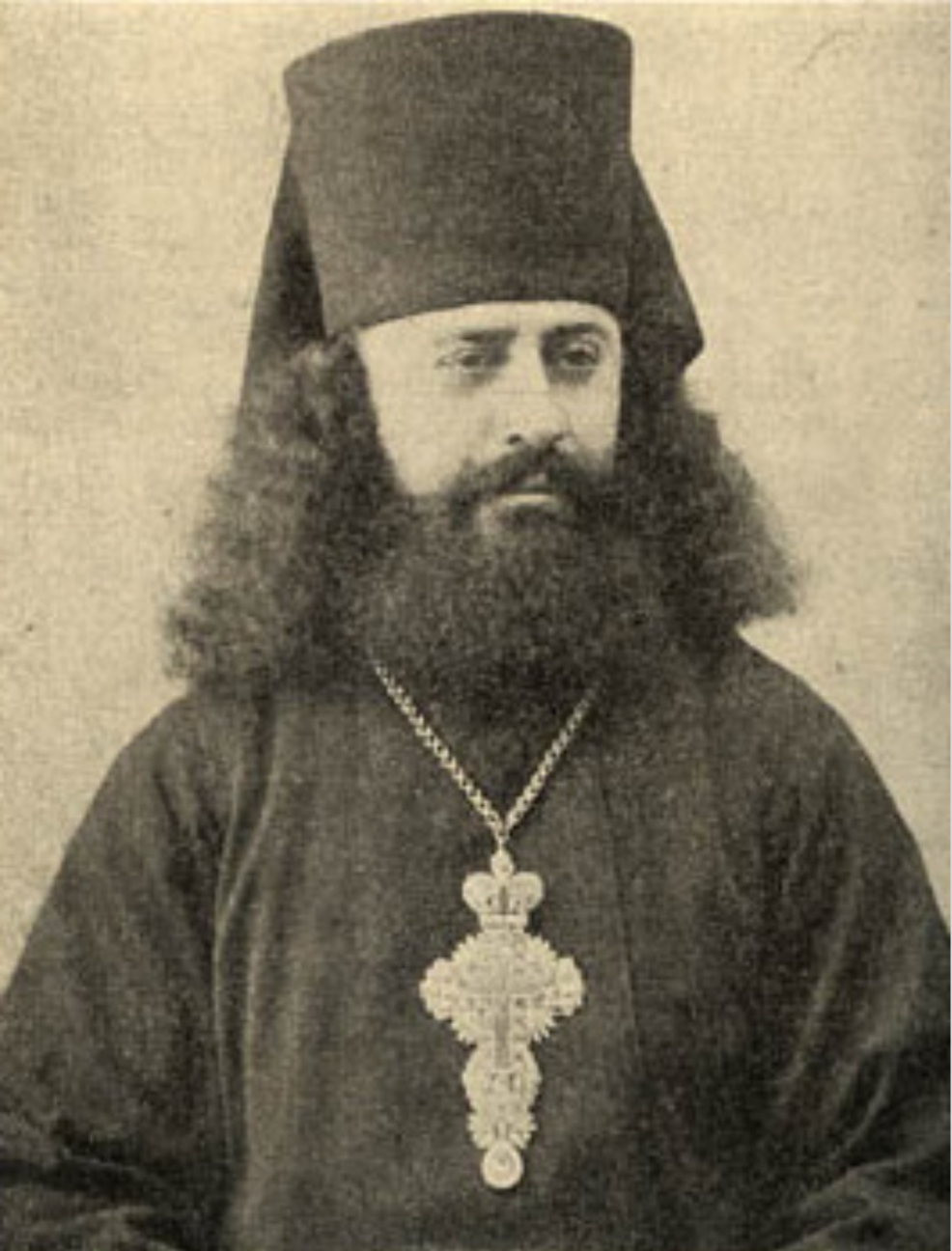
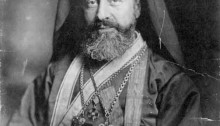
Fr. Ingram Nathaniel Irvine

Recently, I happened to revisit an essay by Fr. Ingram Nathaniel Irvine, published in St. Raphael’s Al Kalimat (The Word) magazine. I don’t have the precise date, but I think it was written in 1907. The whole article is on the subject of “Church Unity” — what, today, we would call “ecumenism.”

Irvine’s ecclesiology is interesting. Focusing just on his terminology, it is easy to mistakenly think that he has a rather “liberal” position on ecumenism. He speaks of Orthodoxy as being a “portion of the Church of Christ,” and he makes multiple references to the “undivided Church,” which implies that the Church was “divided” after 1054. But, when reading this sort of thing, it is essential to remember that Irvine was the product of late 19th century Anglicanism. While his underlying ecclesiology is indeed Orthodox, his vocabulary retains traces of Anglican ecclesiology, which can lead to confusion.

As a practical matter, Irvine was uncompromising. Unity, in Irvine’s view, meant that other Christian bodies had to conform to the Orthodox standard. The Orthodox Church, writes Irvine, is “the only one which has a right to dictate conditions of Unity if any approachment should be made to her.” Irvine flatly rejected any notion of papal supremacy: “The Church of Christ will never be brought together either under the lash of the Roman Curia or by the wiles of the need of an earthly universal, visible head, or on the ground of Papal claims to a Divine right of existence.” In fact, Irvine was so opposed to any compromise with Rome that he actually considered the fall of Constantinople, while tragic, to be ultimately providential:

We regard the destruction of the Eastern Empire by the Turk and Mahamadon as a providence of God to protect the Holy Eastern Church from the influence which might have been brought to bear upon her by the West. He knew what the result would be if there would not have remained any portion of His Holy Church steadfast “in the Apostles’ doctrine, fellowship and in breaking of bread, and in the prayers.” There would have been left no part of His Church true to Antiquity if the East had followed in the wake of the West in adding new doctrines or accepting those which had been proclaimed from time to time by Rome.

It is Orthodoxy, declares Irvine, which is the “Mother Church of Christendom,” and has alone “neither added to nor taken from ‘the Faith once for all delivered unto the Saints.’” Irvine continues:

The chief factor in the unity of Christendom, therefore, is the Holy Orthodox Eastern Catholic Church. This Church is free from all the entanglements of Rome; free from the perplexing questions of the Anglican Reformation or the Continental Protestant Revolution. She has had neither hand nor part in any of these. Rome, of course, will still hold on to her presumptions. She will still blindly hold herself up as the centre of Catholicity and Christianity, but her stand in this matter will, as it is now apparent, be passed by; for as the dismembered portions of Western Christianity come together they will ask the question Where can the Ancient Faith be found unchanged and unadulterated? And learned and reasonable men will say as they have already said “it can be found alone in the Holy Eastern Church.”

According to Irvine, the Orthodox Christians in the West — and particularly in the United States — have a particularly serious responsibility. First, says Irvine, the Orthodox in America must remain true to the Church, “and under no circumstances whatever be induced to either join the Church of Rome, the Anglican Church or any Protestant Church.” Furthermore, Orthodoxy must adapt, externally, to its new home in America. Speaking as a Westerner, Irvine writes, “We want to see the Eastern Church in the dress of the language of England and America. We can never study her well in either Slavonic, Greek or in Syrian Arabic or in any other foreign language.” This leads to Irvine’s second point:

We want, therefore, the Holy Orthodox people to build Churches for their English speaking children and place at those altars priests who can speak the English language and look upon the Christians of the English speaking world as friends who are enquiring after “the truth as it is in Jesus.”

Finally, says Irvine, “We need here a class of priests of the Holy Orthodox Church who, however dear their native land may seem to be to them, and however great the temptation in a financial way, should regard the building up of the Holy Eastern Church in the United States and the proclaiming of her Ancient Faith and practices a greater duty than going home.” In other words, American Orthodoxy needs missionary, rather than mercenary, priests.

Especially at this early stage of his Orthodox career, Irvine viewed himself as a bridge between Western and Eastern Christianity. He closes his article with an anecdote about a recent Divine Liturgy at St. Nicholas Cathedral in New York. Bishop Innocent Pustynsky of Alaska (not to be confused with the earlier St. Innocent) was the celebrant, and was assisted by Irvine and the cathedral dean St. Alexander Hotovitzky. An Episcopalian priest, Rev. Dr. Calbreth Perry, was allowed to stand in the sanctuary, wearing his Anglican vestments, and while he in no way concelebrated or communed with the Orthodox clergy, he was clearly treated with great honor. For Irvine, Perry’s presence was especially important. Perry had been Irvine’s Sunday School teacher, and was representative of those in the Episcopal Church who were not upset by Irvine’s Orthodox “reordination” in 1905.

Irvine argues that he — Irvine — is “the one man who could well explain the position of the Holy Eastern Church to a congregation of Anglican Priests. There ought to be such a gathering.” He goes on, “Both sides now, surely understand that there was never intercommunion and that, therefore, the reordination of Dr. Irvine was no offence but God’s way of giving a terrific shock to the dreadful sin of schism. May the effect of that shock raise us all up to the real sense of our duty.” To Irvine, that “duty” is the “reunion” of Christendom, which is nothing less than the conversion of other Christian groups to Orthodoxy, whether individually or institutionally.

Tags: , , , , , , , , , , , ,

15
Jun

Isabel Hapgood: Syro-Arabians in the United States (1899)

   Posted by: Matthew Namee    in Saints

Editor’s note: Regular readers of this website are no doubt familiar with Isabel Hapgood, the Episcopalian translator of the Orthodox service book from Slavonic into English. (For more on Hapgood and her role in early American Orthodox history, check out my recent podcast.) Today, we’re reprinting an article Hapgood wrote on the Syro-Arabs (Syrians/Lebanese) in America at the very end of the 19th century. This piece originally appeared in The Independent on February 16, 1899. I have no idea where Hapgood got those population figures, but based on other sources, I’m inclined to think that the actual number of practicing Syrian Orthodox in America was a fraction of the 20,000 claimed in this article. Also, while the Galveston parish did have a number of “Syro-Arabs,” it had a Greek priest and was directly under the Russian Diocese. But really, that’s all quibbling; this article is valuable as a snapshot of the three main Syro-Arab groups in America early in St. Raphael’s American career, at the turn of the last century.

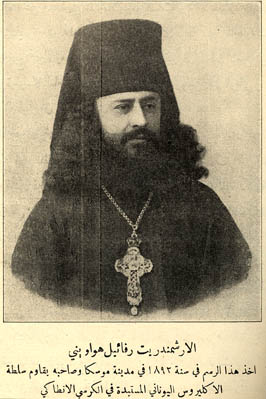
St. Raphael Hawaweeny

Altogether, there are about 60,000 Syro-Arabians in this country, scattered over the United States and Canada. But they are by no means united In their religious beliefs.

The Orthodox, that is to say, those who belong to the Holy Orthodox Catholic Apostolic Church of the East, number about 20,000. They have two churches, one In Galveston, Texas, with one priest; the other at No. 77 Washington street, in this city, with two priests. The rector, the Rev. Archimandrite Raphael, was offered the Bishopric of Beirut several years ago, but he prefers his larger sphere in this country, practically a diocese, all parts of which he visits about once in two years. His assistant. Father Afram (Ephraim), has been here but a few months. Father Raphael is a learned and accomplished monk, who was professor of the Oriental languages for nearly eight years in Russia, first at Kieff, afterward at Moscow and Kazan Ecclesiastical Academies. He speaks Russian fluently, and celebrates the Church services in the Old Church Slavonic, when necessary, as well as in his native Arabic, so that there is a close union of sympathy and mutual help between the Syro-Arabian and the Russian Churches in New York. The Orthodox Syro-Arabians are under the jurisdiction of the Russian Bishop — now the Right Reverend Tikhon, Bishop of the Aleutian Islands and Alaska, whose Episcopal seat is at San Francisco. These Syro-Arabians (whose Liturgy, in Arabic and Greek, is at ten o’clock on Sunday mornings and the mornings of feast days) intend soon to build themselves a church of their own to replace their present inadequate and uncomfortable quarters, temporarily aranged, with church room and dispensary, in one of the ancient dwellinghouses near Rector street.

Next door to thorn, at No. 79 Washington street, is the Church of a second division of the Syro-Arabians — the so-called “Greek Catholics.” They number about 10,000 in this country, and in addition to the church in New York, have one in Chicago, and a priest at each, with two or more who travel about. They depend upon the local Roman Catholic Churches, and are free. Practically, they are Roman Catholics, though the term “Greek Catholic” originally signified those members (or communities) of the Orthodox Eastern Church who were persuaded to recognize the supremacy of the Pope. That was the sole condition required of them, and the compact then made provided for their retaining all their own customs — the Holy Communion in both kinds, the married parish priesthood, and the ancient dogmas without change or alteration. In practice, they have lost nearly everything except their vernacular language in the Church services, and have gradually had imposed upon them the altered and new dogmas of the Roman Church, as is the case with the Uniats In Russia, who stand in the same relation to both the Roman and the Orthodox Eastern Churches. It is to be observed, however, that in the case of the Uniats (who came chiefly from Eastern Austria and Galicia and Southwestern Russia), the effort on the part of the Roman Church to deprive the Uniat congregations in this country of their married priests (it being, obviously, inconvenient to have that striking difference presented to the public to whom explanation of the original compact is not easy) has resulted in the return by the thousand of these Uniats to the bosom of the Holy Orthodox Church of the East. This movement began about eight years ago under the Russian Bishop Vladimir, and has continued, in ever-increasing force, under the recent Bishop, Nikolai, now transferred to the Crimea. The ceremony of reunion with their original Church, the Orthodox, can be quite frequently seen in the Russian Church, 323 Second avenue. It is simple, and consists in renouncing the Pope and the newly-erected dogmas, the repetition of the Creed in the Eastern form, i.e., the Nicene Creed without the filioque clause; confession, swearing allegiance to the Orthodox Church, and participation in the Holy Communion immediately thereafter.

The third division of the Syro-Arabians is the Maronite Church, whose place of worship in New York is at No. 83 Washington street. Their rector here is the Rev. Peter Korkomaz, who has an assistant, and there are three other churches and priests. In this country they number about 30,000. Accounts differ as to their actual number in Syria, and vary from 150,000 (probably a fair average) to 250,000 and 400,000. Owing to a desire to escape from taxation by the Turkish Government, probably, the figures are not easily verified. The Maronites are, at the present day, Roman Catholics, to all intents and purposes. Originally, when the Church of God was one, they, like Rome and the Eastern Church, held the dogmas as stated by the Holy Eastern Church at the present day. But this body of Christians rejected the Sixth Oecumenical Council, and affirmed that there was but one will — the Divine will — in the man Jesus and in Jesus the Son of God; hence their name (with others who held the same view) of Monothelltes. Their Bishop, John Maron (who died in 676 A. D.), became their head when they seceded from the Church, and they derived their name from him, he himself being named after a Saint of the fifth century. After the second Crusade, the Maronites abjured the Monothelite heresy and became formally united to the Roman Church, in the year 1182, but under the same conditions as the Greek Catholics. At the present day, however, they are wholly Roman Catholics, with the exception of, perhaps, two minor particulars: their Church books and services are in the ancient Syriac (Chaldean) language, which the people do not understand—their ordinary language being Arabic; and, legally, their priests are still allowed to marry before ordination, if they so desire, as in the Eastern Church. Practically, very few priests do marry, as the influence of Rome (though not the command, as yet) is exerted against that custom. They have a Patriarch, who resides at Bkirki, about two hours’ journey from Beirut, Syria, and eight Bishops, together with three titular Bishops. About a month ago, the Patriarch, John Peter Hajji, died. The Maronite Bishops assembled at Bkirki to elect another. For three days they passed their time in fervent prayer for the guidance of the Holy Spirit in their election. (If, at the expiration of three days, they cannot agree, the Pope has the right to appoint the new Patriarch.) Their choice fell upon Bishop Elijah Huyk, vicar-resident at Rome. On Sunday, January 22d, all the Syrians of the three Churches here mentioned, with their priests, united in a service for the repose of the Maronite Patriarch’s soul, the service being held in the Maronite Church. The title of the Patriarch, in common with five other dignitaries of the Churches, is Patriarch of Antioch, and the Bishops rule over Aleppo, Tripoli, Damascus, Tyre and other cities. As each nation has (or used to have) its favorite Saints, to whom, in particular, prayers are offered (as in Russia, St. Nicholas, the Wonder Worker, Bishop of Myra), so the Maronites offer their petitions, with special devotion, to the Virgin Mary and St. Joseph. They, like the Greek Catholics, depend upon the Roman Catholic establishment in the United States.

Tags: , , , , , ,

8
Mar

Source of the week: Schmemann on Vatican II

   Posted by: Matthew Namee    in OCA

Fr. Alexander Schmemann in 1963

Fr. Alexander Schmemann was one of the observers at Vatican II, the landmark 1960s council of the Roman Catholic Church. His reaction to the event is priceless — Schmemann took the “opportunity to thank God” that he was Orthodox. Here’s the story, from the New York Times (11/16/1963):

A Russian Orthodox theologian-observer at the second session of the Vatican Council said Thursday that the gathering in Rome was “sobering from the Orthodox point of view.”

The Rev. Dr. Alexander Schmemann, dean of St. Vladimir’s Theological Seminary in Tuckahoe, N.Y., said that he had “no doubt the actions of the council thus far are good for the Roman Church itself.” But, he added, “the reality, unfortunately, is that they are far from ecumenity.”

Dr. Schmemann delivered his report on the council at the quadrennial sobor, or convocation, of the Russian Orthodox Greek Catholic Church in America. The sobor, at the Holy Virgin Protection Cathedral, 59 East Second Street, ended yesterday.

Dr. Schmemann, who was also vice chairman of the sobor, emphasized that he had not gone to Rome as an official delegate for his denomination but rather as a special guest.

He explained that the Moscow Patriarchate of Russian Orthodoxy had several official delegates at the council, as had the Russian Orthodox Church Outside Russia. The Russian Orthodox Greek Catholic Church severed administrative relations with the Moscow Patriarchate in 1924 and regarded the Russian Orthodox Church Outside Russia as a splinter group.

In his report to his denomination, Dr. Schmemann said he did not bear “any bad will” to Roman Catholicism. But, he said, considering the actions of the council in their ecumenical aspect, he had “opportunity to thank God” that he was Orthodox.

Dr. Schmemann’s objections to the council’s discussions were based on the Roman Catholic view of the papacy. “What builds a wall between the Roman Church and Eastern Orthodoxy is the doctrine of papal infallibility,” he said.

“There may be democritization going on,” the theologian added, “but so much of the Catholic Church is built on reverence of the Pope.”

He said that even the collegiality of the bishops was defined purely in its relationship with the papacy.

“In 17 lines of definition of the bishop in the schema on the church,” he went on, “the word ‘pope’ appears four or five times.

“In Eastern Orthodoxy it is our understanding that teaching about the Pope should be balanced with teachings about the bishops.”

Now, I’m no expert on Vatican II or Orthodox-Roman Catholic relations in general, so I don’t really have any commentary to add. But I stumbled upon this article in my collection and thought it might be of interest to others, so I figured I’d publish it here.

Tags: , , , , ,

27
Jan

The Erratic Life of Fr. Patrick Mythen

   Posted by: Matthew Namee    in Early Converts

Fr. Patrick Mythen was an Orthodox Christian for just four years, but in that time, he was one of the most powerful priests in the whole Russian Archdiocese. This period — 1920-1924 — was one of great tumult and trial for the Russian jurisdiction, as it shifted from an archdiocese of the Russian Orthodox Church to a de facto self-governing “Metropolia.” The early ’20s also witnessed the death of Fr. Ingram Nathaniel Irvine, the ordination of a slew of convert priests, the founding of the Greek Archdiocese, and the creation of a body called the “African Orthodox Church.” And Fr. Patrick Mythen was in the middle of all of it.

Mythen was born James Grattan Mythen, in Baltimore, Maryland, in 1883. At least, I’m pretty sure it was Baltimore in 1883; I’ve also seen Boston in 1885, or New Orleans in 1886. I’m confident about the 1883 date, because that’s what Mythen gave, but I’m not 100% sure about the city.

As far as religion went, Mythen was… well, he was confused. His mother, a Roman Catholic, died while giving birth to him. His father was an agnostic Episcopalian, and after being widowed, he married a German Lutheran woman. But, according to Fr. Patrick, his father “lost his mind,” leaving young James to be raised by an uncle. He was brought up in the Episcopal Church, but when he was 14, he visited some of his mother’s relatives in Chicago, who acquainted Mythen with Roman Catholicism.

I think Mythen converted to Roman Catholicism at this point. He decided to become a priest, and at about 14, he entered the Roman Catholic Epiphany College in Baltimore. While he was there, the founder of the school became a Unitarian, of all things. At 17, Mythen moved to Villanova College (now University), where he was scandalized by a professor who focused a great deal of attention on the “bad popes” of history. So Mythen became an Episcopalian again — all while still a teenager.

Over the next decade or so, Mythen continued to bounce back and forth between Rome and Anglicanism. At 21, he enrolled at the Episcopalian General Theological Seminary in New York; when he graduated, he was ordained a deacon and was sent to Santa Fe, New Mexico. But soon he went to Rome and was received back into the Roman Catholic Church… And, just as quickly, he returned to the Episcopal Church and was ordained a priest. For a little while, in his mid-20s, Mythen tried to become an Old Catholic Benedictine monk in the Episcopal diocese of Fond du Lac, Wisconsin (the diocese of Bishop Charles Grafton, who was old friends with St. Tikhon).

From 1912-1914, Mythen was very active in the women’s suffrage movement, participating in marches, speaking at conventions. Then the war came — World War I, of course — and Mythen joined the Navy. Later, he explained his reasoning to the Senate Foreign Relations Committee (8/30/1919):

On Easter Day I preached a sermon in favor of the war, and when the young men of my parish enlisted I felt that I, being unattached, economically responsible for no one, that it was unbecoming of me to be content merely to stand in the pulpit and urge other men to give their lives for the principles which I considered worthy of life giving. And so, with countless numbers of young men of the Nation I enlisted voluntarily, although I was exempt from the draft on account of my clerical profession, and also since I was beyond the draft age. I was content to serve in the ranks in the humblest capacity, feeling that the menial tasks which fell to my lot were noble because even in their small way they were aiding in achieving the high purport of the sacred mission to which our country had committed itself.

By the end of the war, Mythen had become a strong advocate of Irish independence. He pressed his cause with the Senate, saying, “The Irish issue might well be called the acid test of our international honesty.” He went on,

As a Protestant, sir, and a clergyman of the Protestant religion, I resent the implication that Protestantism requires the sustenance of British imperialism to maintain itself in Ireland or elsewhere. Were I convinced that this were a fact, that only through the power of British arms could my religion maintain itself in Ireland, then I would repudiate my religion at once. [...]

I want to say to you, sir, and gentlemen, that as a Protestant Irishman, whose family to-day in Ireland are representatives of the Protestant religion, that we would all gladly have Ireland free under any religious leadership rather than remain, as we are, the only white race still in slavery.

Mythen became the secretary of a group called the Protestant Friends of Irish Freedom, and he toured the country, speaking on behalf of Irish independence. This understandably did not sit well with the Episcopalian hierarchy in America. After all, they were Anglicans, bishops of the Church of England. Pressured to quiet down, Mythen, of course, refused. Instead, he made yet another religious change — he decided to join the Orthodox Church.

I don’t know exactly when he converted to Orthodoxy, but it was sometime between February and July, 1920. In that period, he spent some time in Europe (perhaps Ireland, though he returned to America via England). He came back to America in April, and I would guess that he became Orthodox in May or June. As we discussed yesterday, by July, he was rector of the all-English Church of the Transfiguration in New York.

We’ve covered quite a bit of ground so far, so I’m going to pause here, at the time of Mythen’s conversion to Orthodoxy, and pick up the rest of the story in another article.

Tags: , , , , , ,

21
Dec

Greeks in Florida, 1768

   Posted by: Matthew Namee    in Firsts

Avero House (now St. Photios National Shrine) in St. Augustine, Florida

Avero House (now St. Photios National Shrine) in St. Augustine, Florida

Recently, multiple people have asked me to write about the Greek colony in New Smyrna, Florida in the 1760s. Today, I’m doing just that, but I have to admit, I’ve been rather hesitant. Unlike many of the subjects I tackle here at OrthodoxHistory.org, the New Smyrna story is pretty well-known, especially among Greeks, who call it, “Our Plymouth Rock.” Many of you out there could cover this subject better than I can; but, given its significance in the hearts of Greek Americans,  I’ll offer my own take on New Smyrna.

Here’s a very brief version of the story, from an official press release in 2008:

In April of 1768, 1400 pilgrims left their homes in Smyrna, Mani, Crete, Italy, Corsica and Minorca to escape poverty and oppression. They sailed for the New World with Dr. Andrew Turnbull, entrepreneur and servant to the English Crown. He offered hope and freedom in return for seven years of indentured service. Two months later, they arrived in the port of town of St. Augustine. Over 200 of their fellow travelers died en route.

After registering with the harbormaster and taking on additional supplies, they sailed 75 miles south to establish an indigo plantation, calling it New Smyrna. History documents the colonists’ 10-year struggle and the eventual escape of less than 300 survivors who fled on foot to St. Augustine where they found refuge and justice.

First of all, I should point out that only a minority of the New Smyrna colonists were Greek — around 500. Of course, the Greeks were Orthodox, which has led some to claim that the New Smyrna colony — which predates the Russian mission to Alaska by a quarter century — marks the true beginning of Orthodoxy in America. For instance, here’s Ecumenical Patriarch Bartholomew just a couple of months ago:

Our Orthodox Christian faith has lived and thrived in this nation for generations, from the first Greeks who came to New Smyrna in the 18th Century, to the first Orthodox parish in America in New Orleans, which was founded in 1863, and flourishes to this day and which we have just visited for the second time.

And here is Fr. Thomas FitzGerald, in an article on the Greek Archdiocese website: “In our Western Hemisphere, the Orthodox Church has been developing into a valuable presence and distinctive witness for more than two hundred years. The first Greek Orthodox Christians arrived in the New World in 1768, establishing a colony near the present city of St. Augustine, Florida. [...] The next group of Orthodox Christians to emerge on the American Continent were the Russian fur traders in the Aleutian Islands. They, too, made a great contribution.”

As is noted above, when the New Smyrna colony was disbanded, the 200 or so remaining settlers moved to St. Augustine, where they were absorbed into the local community. One of the few surviving bits of information about the colonists in St. Augustine is the fact that they took possession of a building called Avero House. They used this building for prayer and fellowship. In 1965, the Greek Archdiocese purchased Avero House, and in 1982, they converted it into St. Photios National Shrine. It’s now a pilgrimage site and museum.

Statue of Fr. Pedro Camps, Roman Catholic priest of the New Smyrna colony

Statue of Fr. Pedro Camps, Roman Catholic priest of the New Smyrna colony

All of this raises the question, was this the first Orthodox church in America? No, it was not. From Albert Manucy in the Florida Historical Quarterly (Jan. 1977): “[Avero House] became a religious meeting place for Minorcan, Italian, and Greek settlers from their abandoned plantation at New Smyrna, shepherded by their Roman Catholic priest, Pedro Camps.” [Emphasis mine.] Camps established a Roman Catholic church, “San Pedro,” in Avero House. Among the terms used by locals to describe the parish was, “the Greek church.”

Did the New Smyrna Greeks really follow a Roman Catholic priest? Maybe; maybe not. But to say that this place is a landmark for American Orthodox history is misleading. The New Smyrnans did not have an Orthodox priest. They didn’t start an Orthodox parish. Their descendants didn’t go on to make a mark on the later history of Orthodoxy (or Hellenism) in America. The colony is an interesting story, and when that story is told well, it can be riveting. But as far as American Orthodox history goes, it’s largely irrelevant. It can’t be even remotely compared with the Russian fur traders in Alaska, since those traders kept their Orthodox faith, converted native Alaskans, and directly laid the groundwork for future Alaskan Orthodoxy. The New Smyrna Greeks didn’t lay the groundwork for Orthodoxy in America. They are people who happened to be Orthodox.

Is New Smyrna even a significant moment in Greek American history? Is the nickname, “Our Plymouth Rock,” appropriate? I don’t think it is. Plymouth Rock refers, of course, to the arrival of the Mayflower and the subsequent founding of the Plymouth Colony in Massachusetts in 1620. That colony lasted for over 70 years, until it merged with the neighboring Massachusetts Bay Colony in 1691. The descendants of the original colonists now number in the millions, and they include eight US Presidents. The landing of the Mayflower, and the events that followed, played a crucial role in American history in general.

In contrast, New Smyrna lasted only a handful of years, and has virtually nothing to do with later Greek American history. The real “Plymouth Rock” for Greek Americans is not New Smyrna but New York — Ellis Island.

That isn’t to say that the St. Photios Shrine isn’t a worthwhile place. The Baseball Hall of Fame is in Cooperstown, New York, because of a long-debunked myth that Abner Doubleday invented baseball in that town. Even though we now know that the Doubleday story is totally false, there’s no need to move the Hall of Fame. Cooperstown, I’m told, is a great place for the museum, and debunking the Doubleday myth doesn’t imply disrespect to baseball itself.

Likewise, when I say that New Smyrna means next to nothing for American Orthodox history, I don’t mean to disparage Greek Americans, the Greek Archdiocese, or the St. Photios Shrine, which I would love to visit one day. All I am saying is that New Smyrna, while interesting, is not a significant landmark in American Orthodox history. I’m certainly willing to have my mind changed on this, but at the moment, that is my position.

Tags: , , , ,

29
Sep

The tragic story of Fr. Vladimir Alexandrov

   Posted by: Matthew Namee    in Uncategorized

Fr. Vladimir Alexandrov was a priest in the Russian Mission in the late 19th and early 20th century. He began his career in 1896, as the choir director of the multiethnic St. Spiridon Church in Seattle, Washington. After his ordination in 1898 (or ’99), he remained in Seattle as the pastor of the church. It was there, in 1904, that tragedy struck. From the San Jose Evening News (January 28, 1904):

Rev. Vladimir V. Alexandrof, pastor of the Greco-Russian Orthodox church gave his five year old son Nicholas a teaspoonful of strychnine last evening. Three physicians were immediately summoned, but before they could do anything the child died in convulsions. Both Rev. and Mrs. Alexandrof are prostrated over the terrible mistake.

Alexandrof thought he was administering penopeptine in accordance with the physician’s instructions, but picked up the bottle containing strychnine instead. The medicines were in bottles of [the] same size. The Alexandrofs had only two children, and it is a little girl which is left to them. Rev. Sebastian Dabovich of San Francisco has been telegraphed for and will arrive in time to conduct the funeral services next Saturday.

This has to be one of the saddest stories in early American Orthodox history, and it is also illustrative of the pharmaceutical industry at the turn of the century. The Alexandrovs no doubt had strychnine in the house to kill rodents, but it was in the same generic bottle as the actual medicine, and apparently kept in the same place. (Incidentally, I looked up penopeptine, but found no results. Anyone know what it would be used to treat?)

Normally, if a priest takes a life — even by accident — he can’t continue serving at the altar. St. Tikhon, who was the Russian bishop at the time of the tragedy, must have decided to exercise economia in this case. Fr. Alexandrov was a young priest with a family, and he was obviously suffering immensely. Losing his priesthood would have only made things worse.

I haven’t been able to track Alexandrov’s whole career, but he appears to have been transferred to the parish in Allegheny, Pennsylvania. After that he served in, among other places, Ansonia, Connecticut; Chicago (as successor to St. John Kochurov); and San Francisco.

But Fr. Alexandrov’s troubles were far from over. His life reads like a Shakespearean tragedy. In 1917, he was rector of Holy Trinity Cathedral in San Francisco. Upon returning from a trip to Russia, Alexandrov found that his wife had disappeared and $19,000 was missing from his bank account. The culprit in both cases was Fr. Vasily Dvornikoff, Fr. Alexandrov’s assistant priest. Dvornikoff and Mrs. Alexandrov were lovers, and had run off to Buenos Aires, Argentina with all of the Alexandrovs’ money. Fr. Alexandrov sent a public letter to the newspapers:

October 7, 1917.

Mrs. Rose V. Alexandrof, wherever she may be.

Dearest Wife: October first I returned from Russia finding you missing. I know from your letters your desire to join me in Russia. No matter what may have happened to you, please know my absolute faith in your goodness, truthfulness and love for me and children and pay no attention whatsoever to the slandering false stories.

Nobody believed them, as your noble and exemplary record of wifehood and motherhood for twenty years with me, known by many, stands well in your favor, and if you fell victim of prearranged criminal plot of robbery of those whom you and I were helping in their needs and who having robbed you, still, are trying to defame you, please do not for a moment hesitate to communicate with proper authorities and me, as I care so much more for you when you are suffering.

Trust in God’s mercy and help and in my everlasting devotion to you and that soon our hears’ wounds will heal and we will become still happier. My trip to Russia was especially successful. I received special honors for my services to my fatherland in connection with this God-blessed country and have full hope that we shall enjoy life with our dear children better than ever before. My address is 834 Cabrillo street, telephone Pacific 8381, San Francisco, Cal.

REV. ARCHPRIEST VLADIMIR ALEXANDROF.

Dvornikoff was indicted by a grand jury on the charge of grand larceny, and he was arrested upon his arrival in Buenos Aires. Mrs. Alexandrov was with him. (Documents and articles related to the case can be found here.)

So Fr. Alexandrov had lost both his son and his wife, and both in the worst ways possible. I’m not sure exactly what happened to him in the years immediately after 1917, though I suspect he returned to Russia. In 1923, he was made a bishop of the Bolshevik-backed Living Church. He returned to America, and to his old parish, St. Spiridon in Seattle. He was obviously a damaged man, and he became a thorn in the side of the Orthodox community.

In 1932, “Bishop” Alexandrov filed a lawsuit in King County Superior Court, trying to take control of the St. Spiridon church property. Alexandrov won, but the St. Spiridon parishioners stripped the church of everything — icons, holy vessels, etc. Alexandrov was left with an empty church, and essentially no congregation. (For more information, see click here and go to page 6.)

Of course, the Living Church itself wasn’t to last much longer, and in July of 1933, Alexandrov was received into the Roman Catholic Church, which recognized him as a bishop. Here is the New York Times report from July 28, 1933:

SEATTLE, July 28 (AP). — The Most Rev. Vladimir Alexandrof, Seattle Archbishop of the Russian Orthodox Greek Catholic Church, has been made an Archbishop-elect of the Catholic Church.

The reception of the Russian Archbishop into the Catholic Church, with Papal recognition of his rank, was disclosed by The Catholic Northwest Progress and the Right Rev. Mgr. J.G. Stafford, pastor of St. James Cathedral.

Church leaders here said that his request for recognition and the acceptance is the first among fourteen other Russian orthodox priests in America.

Papal recognition of his rank was involved, editors of The Catholic Northwest Progress said. He spent several months at the Franciscan Graymoor Monastery at Garrison, N.Y., for a period of meditation and prayer before he made his profession of the Roman Catholic faith.

The profession was made to the Most. Rev. Peter Bucys, who was delegated by the Holy See to receive it, on June 4. As Archbishop-elect he is now at the head of the Catholic Russian Mission of North America.

The Most. Rev. Alexandrof was married — the Russian clergy is allowed marriage — and he was received into the Catholic clergy under the vows of celibacy, with which many other men, once married, have become priests. He has been separated from his wife for several years.

I’m not sure what happened to Alexandrov after that, but whatever the case, it’s a sad end to a tragic story. One cannot help but think that all of Alexandrov’s troubles began on that awful day in 1904, when he accidentally killed his son.

May God have mercy on his soul.

UPDATE (9/30/09): It appears that Alexandrov died in Baltimore, Maryland on May 20, 1945. The entry just lists his title as “Rev.”, and I’m not sure if he was still a Roman Catholic bishop.

Also, I stumbled upon the 1932 diary of James Wickersham, the then-Congressman from Alaska. It includes the following entry for June 28: “Archbishop Vladimir Alexandrof who claims to own the Russian Church property in Alaska called – I do not care for him – He is a troublesome Soviet agent if I am not mistaken.”

Tags: , , , , , , , , , , , ,