Posts tagged Romanian
This week in American Orthodox history (March 19-25)
0March 25, 1886: The future Greek Archbishop and later Ecumenical Patriarch Athenagoras Spyrou was born. Athenagoras led the Greek Archdiocese from 1930 to 1948, when he was elected Patriarch of Constantinople. He served in that position for nearly a quarter-century, until his death in 1972.
March 25, 1891: St. Alexis Toth and his Greek Catholic parish in Minneapolis joined the Russian Diocese of the Aleutian Islands and Alaska.
March 22, 1892: The French Orthodox convert priest Fr. Vladimir Guettee died. Guettee had been a respected Roman Catholic historian and Jesuit priest, but through his study of history, he came to believe that the Orthodox Church alone had preserved the true faith. He joined the Russian Church, taking the name “Vladimir,” and published a widely read journal on Orthodoxy which reported on American Orthodox events. He also wrote a lengthy refutation of papal claims, which can be read here.
March 25, 1896: The future hieromartyr Fr. Jacob Korchinsky was ordained to the priesthood by Bishop Nicholas Ziorov. Korchinsky’s travels make his fellow circuit-riding priests look wimpy by comparison — Alaska, Canada, Pennsylvania, New Jersey, Ohio, Mexico, Hawaii, the Philippines, Australia, and finally back in his native Odessa (modern Ukraine). At 80, he was executed by the Soviets, and he is now being considered for glorification as a saint. To read more about Korchinsky, check out this article I wrote in 2010.
March 24, 1907: Russian Archbishop Tikhon Bellavin concelebrated his last Divine Liturgy in America, with Bishops Raphael Hawaweeny and Innocent Pustynsky.
March 22, 1908: In Boston, Fr. Theophan Noli celebrated the first-ever liturgy in the Albanian language, anywhere in the world. The service took place in Boston, where Noli was a student at Harvard. To read about that first liturgy in 1908, check out my article from 2010.
March 24, 1918: Almost exactly a decade later, Fr. Theophan Noli was appointed as the administrator of the Albanian Mission under the Russian Archdiocese of North America. Not long afterward, he returned to Albania, became the head of the Albanian Orthodox Church, and finally was elected Prime Minister of Albania. He held that post for five months before he was exiled to America, where he led an Albanian jurisdiction for decades.
March 22, 1925: The former Archimandrite Patrick Mythen died in New York. Two years ago, I wrote about Mythen’s life prior to his conversion to Orthodoxy, and I never got around to telling the rest of the story. So here’s the rest of the story, very briefly: Mythen, an Episcopal priest and former Roman Catholic, converted to Orthodoxy in 1920. Within months, he was elevated to the rank of archimandrite and put in charge of a brand-new project called the American Orthodox Catholic Church of the Transfiguration. This was supposed to be an English-speaking parish for American converts. It didn’t last more than a handful of months, but it included several convert priests, most of whom appear to have been Mythen’s friends. When chaos broke out in the Russian Archdiocese in the early 1920s, Archbishop Alexander Nemolovsky relied more and more heavily on Mythen. According to Mythen’s own claims — the accuracy of which is uncertain — he (Mythen) was given power of attorney for the whole Archdiocese. I’ve heard that he even signed clergy ordination certificates. Within a few years, though, Mythen re-converted to Roman Catholicism. He was found dead in 1925, at the age of just 42.
March 25, 1925: Three days later, a man who could not be more different than Mythen — St. Tikhon, by now the Patriarch of Moscow — died in Russia.
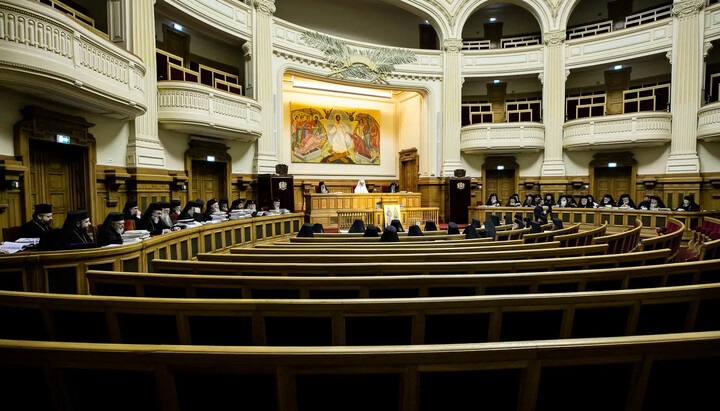
March 24, 1935: Bishop Polycarp Morusca was consecrated in Romania to lead the Romanian Diocese in America. He was enthroned in Detroit a few months later, and over the next several years, he did a lot to organize the Romanian Orthodox of America. In 1939, he returned to Romania to attend a session of the Holy Synod, but World War II broke out, and Bishop Polycarp wasn’t able to return to the United States. In 1947, he notified the American diocese that it had been eliminated from the church budget. He was forced to retire, and future heads of the diocese would have to be approved by Romania’s Communist government. In 1951, the American diocese elected the exiled Bishop Valerian Trifa to be the nominal auxiliary to Bishop Polycarp, but given that Bishop Polycarp hadn’t set foot in America in more than a decade, for all intents and purposes Bishop Valerian was the new head of the diocese. Bishop Polycarp died in Romania in 1958.
March 25, 1943: Governor Thomas Dewey of New York signed into law a bill incorporating the Federated Greek Catholic Primary Jurisdictions of America. The Federation was sort of a primitive version of SCOBA. It included most of the primary Orthodox jurisdictions in America, but there were notable exceptions, including the Russian Metropolia, ROCOR, and the Antiochian Archdiocese of Toledo. In the Federation’s short life — only about a year or so — it achieved some modest but still significant accomplishments. The Federation managed to get Orthodoxy recognized by the Selective Service, exempting Orthodox priests from military service and allowing Orthodox Christians in the military to put “Eastern Orthodox” on their dog tags. It also led to the legal incorporation of several jurisdictions. The Antiochian Archdiocese is still governed by the legislation, from way back in the 1940s. As far as I know, the last meeting of the Federation took place in February 1944, but the Antiochian Metropolitan Antony Bashir kept it going on paper for another 15 or so years, when the dream of the Federation was revived as SCOBA.
March 25, 1998: The renowned church historian Jaroslav Pelikan converted to Orthodoxy. Pelikan was an intellectual giant, a longtime professor at Yale and a prolific writer. He had been well acquainted with Orthodoxy for decades before his conversion, which Fr. John Erickson has described in this way: “In a conversation shortly after his entrance into the Orthodox Church, Jary likened his path to Orthodoxy to that of a pilot who kept circling the airport, looking for a way to land. Orthodox Christians can be thankful that he landed before running out of fuel.” In his later years, Pelikan served as a key member of the St. Vladimir’s Seminary Board of Trustees. He died in 2006. For more on Pelikan, read this 2003 article by Fr. John Erickson. I particularly liked this quote from Pelikan, on being a historian: “Everybody else is an expert on the present. I wish to file a minority report on behalf of the past.”
March 20, 2003: The Orthodox Church of Poland formally glorified St. Vasily Martysz, who had once served in America. To read more about St. Vasily, click here.
March 22, 2009: Archbishop Dmitri Royster of Dallas retired as head of the OCA Diocese of the South.
A Transatlantic Transylvanian: The First Orthodox Priest in the Americas?
1It is generally considered that the first Orthodox clergy to set foot in the Americas were part of the group of Russian monastics who landed in Kodiak, Alaska in September 1794. I have recently come to hold a different view, as whilst researching another story I encountered evidence of an earlier Orthodox clerical presence on the Eastern seaboard of what is now the United States: that of a priest of Tartar descent (A Turkic language people group within the Russian Empire of Mongolian origin), who in 1747 made his way from his native Transylvania (part of present day Romania), via northern continental Europe and England, to the eastern seaboard of North America, landing in the then British colony of Maryland. It was some time towards the end of 1747, some forty-seven years before the Russian hieromonks reached the distant Pacific shores of Alaska.
Unlike the Russian monks, this priest, Fr. Samuel Domien, appears to have had no interest in sharing his Faith with the then predominantly English settlers of the Eastern seaboard. His concern appears to have been scientific, in particular spreading awareness of electricity. It seems to have been this that brought him from Maryland, via New England, to Philadelphia, Pennsylvania, in the winter of 1747/1748. There he was the guest of a somewhat better known figure in early American history – Benjamin Franklin. It is from the pen of Franklin that we have the most substantial account I have yet found of Fr Samuel and his travels. In a letter from Philadelphia dated 18 March 1755, Benjamin Franklin writes to John Lining in Charleston, South Carolina:
All I know of Domien is, that by his own account he was a native of Transylvania, of Tartar descent, but a priest of the Greek Church; he spoke and wrote Latin very readily and correctly. He set out from his own country with an intention of going round the world, as much as possible by land. He traveled through Germany, France, and Holland, to England. Resided some time at Oxford. From England he came to Maryland; thence went to New England; returned by land to Philadelphia; and from hence travelled through Maryland, Virginia, and North Carolina to you. He thought it might be of service to him, in his travels, to know something of electricity. I taught him the use of the tube…He wrote to me from Charleston, that he lived eight hundred miles upon electricity; it had been meat, drink, and clothing to him. His last letter to me was, I think, from Jamaica…. It is now seven years since he was here. *
Franklin goes on to say that he believes it was Domien’s intention to make his way home to Transylvania from Jamaica via Cuba, Mexico, the Phillipines, China, India, Persia and Turkey! Apparently, Domien promised to keep Franklin informed as he traveled but nothing further was ever heard. This led Franklin to conclude that Domien had either died en route or perhaps been imprisoned in New Spain (Modern day Mexico). He concludes to Linings with classic understatement: He was, as you observe, a very singular character.
Domien’s presence in America is confirmed by an advertisements he placed in late 1748 in the South Carolina Gazette to come and see his many wonderful experiments in electricity. The last of these was on December 26, 1748. As at this time America was still on the Julian calendar, then eleven days behind the Gregorian, and this would suggest he probably left Charleston and headed south to Jamaica in early 1749. Thus, in total, he would have spent more than one year traveling throughout what is now the United States.
Is the story of Fr Samuel Domien of any real importance for the history of Orthodoxy in the Americas? I think it is and here’s why: The very existence of Domien and his presence in America nearly half a century before the Russian mission to Kodiak once again illustrates that mainstream America was not completely unknown to the wider Orthodox world of its time, centered as it was in Russia, the Balkans and the Eastern Mediterranean.
At this juncture, I should mention that I am aware of the writings about Domien by Demetrius Dvoichenko-Markov, who published an article A Rumanian Priest in Colonial America in the October 1955 issue of The American Slavic and East European Review. Markov attempts to argue that Franklin did not really understand who Domien was and essentially mistook an eastern rite Catholic for an Orthodox. I do not think that any of the arguments Markov makes stand up to closer examination and will be writing a separate article to address these more closely. Suffice it to say at this point that Markov’s arguments all seem to flow from the assumption that Franklin would not have known the difference between eastern rite Catholic and Orthodox, despite the fact that Franklin’s own words quoted above, but a priest of the Greek Church, seem to fly in the face of this very assumption.
I also think it is too early to say with certainty that Domien did not have any churchly interest whilst in America. Franklin identifies him as a priest of the Greek Church and for him to have done this demonstrates that Domien was not keeping his identity in this regard a secret. Franklin clearly had some awareness of Orthodoxy long before his meeting with Domien. The second edition of Benjamin Franklin’s “Poor Richard Almanack” tell its readers that the year 1733, makes since the Creation by the account of the Eastern Greeks 7241 years.
We also know that by the 1760s Franklin was a friend of Philip Ludwell III of Williamsburg, Virginia, who converted to Orthodoxy at the Russian church in London at the end of 1738. They saw each other regularly whilst both living in London in the early 1760’s, but I have not yet been able to establish if this was when they first met. Ludwell was definitely in Philadelphia in the 1750’s and it is not at all impossible that their friendship went back even earlier than this. As Franklin states that Domien went to Virginia, a visit to the colonial capital of Williamsburg and some interaction with Ludwell cannot be ruled out. Finally, I came across Franklin’s account of Domien whilst researching another interesting figure of pre-revolutionary America who also had contacts with the Orthodox East. But as one of my favorite British comedy shows says: More on that story later.
Nicholas Chapman, Herkimer, NY, March 2, 2012
* Sparks, Jared, The Works of Benjamin Franklin Vol 5, Boston, Tappan & Whittemore, 1837. The quotation is on page 348, within the section “Letters and Papers on Electricity.”
American Orthodox demographics, 1906-1936
Every ten years, from 1906 to 1936, the US Census Bureau compiled a Census of Religious Bodies. These censuses are gold mines of information on early American Orthodoxy. Also, unlike so many of the inflated numbers that you’re likely to see floating around, the census data is reliable. With its considerable resources, the Census Bureau was able not only to work with the jurisdictions themselves, but to contact individual parishes for precise information. The result is a thorough, well-researched, and generally unbiased collection of statistics and other information.
What can we learn from the censuses? Loads of things. For instance, we can track the growth of the various Orthodox groups and jurisdictions in the United States:
The Russian spike in 1916 was most likely caused by Uniate conversions. Overall, the Orthodox population grew from about 130,000 in 1906 to almost 350,000 thirty years later:
- 1906: 129,606
- 1916: 249,840
- 1926: 259,394
- 1936: 348,025
As you can see, the 1916-1926 period was rather stagnant; in fact, aside from the Albanians and Romanians, every jurisdiciton declined in that period. World War I probably had something to do with it, as well as the new immigration quotas imposed by the US government in 1924. It’s also likely that the various jurisdictional schisms of the 1920s – Russy-Antacky, Royalist-Venizelist, Metropolia-Living Church — affected the ability of the Census Bureau to collect data. (That is, there were probably more Orthodox than were reported in 1926.)
One of the things I’ve found most interesting about the census data are the gender ratios. In 1906, men represented 85% of all American Orthodox Christians. That is, for every woman, there were almost six men. Here are the percentages of women in each year:
- 1906: 15%
- 1916: 28%
- 1926: 40%
- 1936: 46%
By 1936, every group was between 42 and 51 percent female. For most of this period, the Greeks were the most overwhelmingly male jurisdiction (with female percentages from 1906-36 of 6, 17, 34, and 43 percent). Until ’36, the Syrians were the most balanced group, with 40% women in 1906, and 45, 49, and 47 percent in the years that followed.
The Serbian male population actually declined considerably from 1906-26, due most likely to the Balkan Wars and then World War I, but the female population (not just the percentage) increased dramatically:
- 1906: 2,228 women (14%)
- 1916: 3,301 women (23%)
- 1926: 6,421 women (47%)
The census also kept data on Sunday schools. In 1906, there were just 7 Sunday schools in all of American Orthodoxy. By 1916, there were 162 (of which 126 were Russian). The Russians actually closed a lot of their Sunday schools in the next decade (dropping to 90), but the Greeks and Romanians added a lot more, pushing the total number up to 198 by 1926. By 1936, there were 294 Orthodox Sunday schools in the United States, of which 129 were Greek and 101 were Russian.
I’ve barely scratched the surface of what’s available in the censuses. In the future, we’ll continue to unpack the data.
Language in American Orthodoxy, 1916 (reposted from 8/21/09)
To our New Calendar readers: Christ is born!
The following article was originally published on August 21, 2009. If you’re interested, you might check out the comments to that original posting. We’ll be back with brand-new material on Monday, December 28.
As you might expect, most American Orthodox parishes in 1916 used foreign languages. From that year’s Census of Religious Bodies, conducted by the U.S. Census Bureau, we find the following unsurprising information:
- Both of the Albanian parishes used exclusively Albanian.
- The four Bulgarian parishes used Bulgarian and Slavonic.
- The 87 Greek parishes used exclusively Greek.
- Both of the Romanian parishes used exclusively Romanian and Slavonic.
- 166 of the 169 Russian parishes used exclusively Slavonic. Of the other three, two used a combination of Slavonic and English, and one used exclusively English.
- 11 of the 12 Serbian parishes used exclusively Slavonic and/or Serbian. One Serbian parish used exclusively English.
In total, there were 276 parishes in the United States in 1916, not counting the Syrians. 272 of those 276 (98.55%) worshipped entirely in foreign languages, and just two used English only.
None of this should come as a surprise. The vast majority of American Orthodox Christians in 1916 were either immigrants, or the children of immigrants. And the vast majority of American Orthodox clergy were also immigrants, most of whom had been educated and ordained in the Old World.
Now we come to the Syrians… and as we’ve seen before, the Syrians are an outlier. This is what the 1916 Census has to say:
Of the 25 organizations, 13, with 4,361 members, reported services conducted in English only; and 12, with 7,230 members, reported services conducted in foreign languages alone or with English. Of these, 4 organizations, with 1,230 members, reported the use of Arabic alone or with English; 5, with 2,900 members, Arabic, Greek, and English; and 3, with 3,100 members, Arabic, Greek, Russian, and English. In 1906 all the organizations then represented reported the Syro-Arabic language only.
This is stunning. Ten years earlier, in 1906, the Syrians were like everybody else, worshipping exclusively in their native tongue. In 1916, everybody else was pretty much the same — 98.55% foreign. But in just a decade, the Syrians had changed dramatically. By 1916, at least 21 of the 25 Syrian parishes (84%) used at least some English in their church services, and over half (13 of 25) were entirely in English.
How on earth did this happen? I don’t have a clear answer; however, there is one clue. In 1905, an Episcopal priest named Ingram Irvine converted to Orthodoxy. He was ordained by Ss. Tikhon and Raphael, took the name “Fr. Nathaniel,” and for about two years, he served in the Russian Mission. His purpose was “English work.” He wrote articles in English, published a couple of small books, and conducted an English-language Vespers service on Sunday nights. He also helped St. Tikhon with English-language administrative work, and advised him on Anglican-Orthodox relations.
Irvine is one of my favorite figures in American Orthodox history, and we’ll talk about him in great detail in the future, but for now, it’s enough to know that he transferred to St. Raphael’s jurisdiction after St. Tikhon returned to Russia in 1907. And Irvine’s transfer also meant the transfer of the “English work.” Now, his English articles appeared in the otherwise all-Arabic Al Kalimat (The Word). He made it his special mission to reach out to the English-speaking children of Arabic immigrants to America. He taught Sunday School, ghostwrote letters for St. Raphael, and generally promoted the use of English in the Syrian Mission. He did this at the direction and with the encouragement of St. Raphael; when St. Raphael died in 1915, Irvine wrote, “With Bishop Raphael’s death ended the initiatory Chapter of English Orthodox Church work in America.”[*]
I don’t think Irvine alone was responsible for the great proliferation of English in the Syrian Mission in the years 1906-1916, but he must have played a major role. Just thinking out loud, another factor may have been the weaker national identification with Orthodoxy among the Syrians. What I mean is this: to be a Russian, a Greek, or a Serb was to be Orthodox. National identity and religious affiliation were intimately intertwined, to the point that they were one and the same. But it was not so among the Syrians. They came, not from their own nation-state, but from the Ottoman Empire. And they also came from a region of great religious pluralism — back in Syria, they lived alongside Melkites, Maronites, Muslims, and Druze. In other words, while Slavonic, Greek, and Serbian culture (and language) was closely identified with Orthodoxy, the same could not be said of Syro-Arab culture and language. And it’s possible (though I can’t prove it) that this distinction was a major factor in the spread of English among the Syrians, while the rest of American Orthodoxy was still firmly attached to foreign languages.
Finally, Fr. John Erickson offered this comment upon seeing the language data:
In light of the very large number of parishes St Raphael’s Syrian mission that used only English or predominantly English, another question that might be interesting to explore would be the extent to which, in the years immediately following, the “Antacky” advocated the use of Arabic or otherwise resorted to identity politics.
At present, I don’t have any idea whether the Russy-Antacky divide involved language, but it is a question I will have to explore (and if anyone wants to help, please let me know!)
____________________________________________________________
[*] Ingram N.W. Irvine (Fr. Nathaniel), “Bishop Raphael, In His Relation to the English Work of the Archdiocese of North America,” Russian Orthodox American Messenger 19:5 (March 15, 1915), 72.
Language in American Orthodoxy, 1916
As you might expect, most American Orthodox parishes in 1916 used foreign languages. From that year’s Census of Religious Bodies, conducted by the U.S. Census Bureau, we find the following unsurprising information:
- Both of the Albanian parishes used exclusively Albanian.
- The four Bulgarian parishes used Bulgarian and Slavonic.
- The 87 Greek parishes used exclusively Greek.
- Both of the Romanian parishes used exclusively Romanian and Slavonic.
- 166 of the 169 Russian parishes used exclusively Slavonic. Of the other three, two used a combination of Slavonic and English, and one used exclusively English.
- 11 of the 12 Serbian parishes used exclusively Slavonic and/or Serbian. One Serbian parish used exclusively English.
In total, there were 276 parishes in the United States in 1916, not counting the Syrians. 272 of those 276 (98.55%) worshipped entirely in foreign languages, and just two used English only.
None of this should come as a surprise. The vast majority of American Orthodox Christians in 1916 were either immigrants, or the children of immigrants. And the vast majority of American Orthodox clergy were also immigrants, most of whom had been educated and ordained in the Old World.
Now we come to the Syrians… and as we’ve seen before, the Syrians are an outlier. This is what the 1916 Census has to say:
Of the 25 organizations, 13, with 4,361 members, reported services conducted in English only; and 12, with 7,230 members, reported services conducted in foreign languages alone or with English. Of these, 4 organizations, with 1,230 members, reported the use of Arabic alone or with English; 5, with 2,900 members, Arabic, Greek, and English; and 3, with 3,100 members, Arabic, Greek, Russian, and English. In 1906 all the organizations then represented reported the Syro-Arabic language only.
This is stunning. Ten years earlier, in 1906, the Syrians were like everybody else, worshipping exclusively in their native tongue. In 1916, everybody else was pretty much the same — 98.55% foreign. But in just a decade, the Syrians had changed dramatically. By 1916, at least 21 of the 25 Syrian parishes (84%) used at least some English in their church services, and over half (13 of 25) were entirely in English.
How on earth did this happen? I don’t have a clear answer; however, there is one clue. In 1905, an Episcopal priest named Ingram Irvine converted to Orthodoxy. He was ordained by Ss. Tikhon and Raphael, took the name “Fr. Nathaniel,” and for about two years, he served in the Russian Mission. His purpose was “English work.” He wrote articles in English, published a couple of small books, and conducted an English-language Vespers service on Sunday nights. He also helped St. Tikhon with English-language administrative work, and advised him on Anglican-Orthodox relations.
Irvine is one of my favorite figures in American Orthodox history, and we’ll talk about him in great detail in the future, but for now, it’s enough to know that he transferred to St. Raphael’s jurisdiction after St. Tikhon returned to Russia in 1907. And Irvine’s transfer also meant the transfer of the “English work.” Now, his English articles appeared in the otherwise all-Arabic Al Kalimat (The Word). He made it his special mission to reach out to the English-speaking children of Arabic immigrants to America. He taught Sunday School, ghostwrote letters for St. Raphael, and generally promoted the use of English in the Syrian Mission. He did this at the direction and with the encouragement of St. Raphael; when St. Raphael died in 1915, Irvine wrote, “With Bishop Raphael’s death ended the initiatory Chapter of English Orthodox Church work in America.”[*]
I don’t think Irvine alone was responsible for the great proliferation of English in the Syrian Mission in the years 1906-1916, but he must have played a major role. Just thinking out loud, another factor may have been the weaker national identification with Orthodoxy among the Syrians. What I mean is this: to be a Russian, a Greek, or a Serb was to be Orthodox. National identity and religious affiliation were intimately intertwined, to the point that they were one and the same. But it was not so among the Syrians. They came, not from their own nation-state, but from the Ottoman Empire. And they also came from a region of great religious pluralism — back in Syria, they lived alongside Melkites, Maronites, Muslims, and Druze. In other words, while Slavonic, Greek, and Serbian culture (and language) was closely identified with Orthodoxy, the same could not be said of Syro-Arab culture and language. And it’s possible (though I can’t prove it) that this distinction was a major factor in the spread of English among the Syrians, while the rest of American Orthodoxy was still firmly attached to foreign languages.
Finally, Fr. John Erickson offered this comment upon seeing the language data:
In light of the very large number of parishes St Raphael’s Syrian mission that used only English or predominantly English, another question that might be interesting to explore would be the extent to which, in the years immediately following, the “Antacky” advocated the use of Arabic or otherwise resorted to identity politics.
At present, I don’t have any idea whether the Russy-Antacky divide involved language, but it is a question I will have to explore (and if anyone wants to help, please let me know!)
____________________________________________________________
[*] Ingram N.W. Irvine (Fr. Nathaniel), “Bishop Raphael, In His Relation to the English Work of the Archdiocese of North America,” Russian Orthodox American Messenger 19:5 (March 15, 1915), 72.