Posts tagged Theoclitos Triantafilides
This week in American Orthodox history (March 12-18)
0This week is a busy one:
March 14, 1767: Philip Ludwell III, the first Orthodox convert in American history, died in London. Decades earlier, in 1738, Ludwell had joined the Orthodox Church in London. He was just 22 at the time, and was a rising star in the Virginia aristocracy. Remarkably, the Russian Holy Synod gave him permission to bring a portion of the Eucharist back to Virginia. In 1762, Ludwell brought his three daughters to England to be received into the Church as well. Of course, we would know none of this were it not for the exceptional research and writing done by Nicholas Chapman, whose articles we’re proud to feature here at OrthodoxHistory.org. Click here to read Nicholas’ first article on Ludwell, and here to read about Ludwell’s landmark translation of an Orthodox catechism. And if you find Ludwell as fascinating as I do, I would highly recommend that you invest $4.95 to download Nicholas Chapman’s recent lecture on Ludwell. (And for $9.95, you get a CD of the lecture, a copy of Ludwell’s portrait, and the Ludwell family book plate.) I rarely encourage our readers to buy stuff, but trust me: this is worth it.
March 14, 1853: Chronologically, after Ludwell, the most important American Orthodox convert has to be St. Alexis Toth, who was born in the Austro-Hungarian Empire 159 years ago this week (most of my sources say March 14, but Wikipedia has his birthday as March 18). Originally a Greek Catholic (“Uniate”) priest, Toth was assigned to serve a Carpatho-Rusyn parish in Minneapolis in 1889. But the local Roman Catholic archbishop didn’t want Toth’s “kind” — that is, Greek Catholics — in his diocese, and the two men clashed immediately. In 1891, Toth and his Minneapolis congregation joined the Russian Orthodox Church. Dozens and dozens of Uniate parishes followed suit over the next two decades, and Toth was one of the chief advocates of Uniate conversion to Orthodoxy. He died in 1909 and was canonized by the OCA in 1994.
March 13, 1868: Fr. Nicholas Kovrigin was sent on a pastoral visit to San Francisco, establishing the first foothold of the Russian Church in the contiguous United States. It all started back in the 1850s, when San Francisco’s growing Orthodox community organized into a mutual aid society. In the early 1860s, Russian ships visited the area, and some local Orthodox children — including the future Fr. Sebastian Dabovich — were baptized by a Russian navy chaplain. But there wasn’t a Russian parish until Kovrigin came along later in the decade. His visit was precipitated by the arrival, late in 1867, of the renegade Ukrainian priest Agapius Honcharenko, who moved to the Bay Area and tried to start some kind of hybrid Protestant/Orthodox parish. The Orthodox people seem to have realized that they needed to get an actual, legitimate Orthodox priest in their city, so they sent a formal request to the bishop in Alaska, who responded by sending Kovrigin for a visit. Initially, it was just that — a visit — but later in 1868, Kovrigin was formally assigned to be the pastor of a new parish in San Francisco. Unfortunately, Kovrigin seems not to have been made of the strongest moral fiber, and he ran into all sorts of trouble, ultimately being suspected of foul play in the death of his superior, cathedral dean Fr. Paul Kedrolivansky. Kovrigin was finally sent away in 1879, by the newly arrived Bishop Nestor Zass. On a more positive note, despite many trials and tribulations (and name changes), the San Francisco parish has survived to this day, and is now Holy Trinity, a cathedral of the OCA.
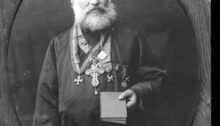
March 15, 1896: Archimandrite Theoclitos Triantafilides celebrated the first Divine Liturgy in Galveston, Texas. I’ve written about Fr. Theoclitos recently: he was one of only three Greek priests to serve under the Russian Mission. Previously, he had been the tutor to the future king of Greece and the future Tsar Nicholas II of Russia. His Galveston parish was multiethnic, composed of Serbs, Greeks, Syrians, Russians, Copts, and American converts. To this day, his old parish of Saints Constantine and Helen venerates him as a holy man. To learn more about Fr. Theoclitos, read this article by Mimo Milosevich.
March 15, 1898: The future Antiochian Metropolitan Antony Bashir was born in Douma, in what was then the Ottoman Empire and what is now Lebanon. Bashir led the Antiochian Archdiocese of New York from 1936 until his death in 1966. This was the era of the “New York-Toledo” schism, when the Antiochians in America were divided into competing archdioceses (one based in New York and the other in Toledo, Ohio). Bashir was a major proponent of pan-Orthodox cooperation and the proliferation of English in church services.
March 13, 1904: Archimandrite Raphael Hawaweeny was consecrated to the episcopacy by Archbishop Tikhon Bellavin and Bishop Innocent Pustynsky. This was the first episcopal consecration in American Orthodox history. Technically, St. Raphael was a vicar bishop under St. Tikhon, the Russian Archbishop of North America, and St. Raphael’s “diocese” was actually a vicariate for Syro-Arabs. Reality was considerably more complicated, and St. Raphael basically functioned as a mostly independent diocesan bishop with ties to both the Russians and the Patriarchate of Antioch. (As he put it, his diocese was a diocese of Antioch, “notwithstanding its nominal allegiance to the Russian Holy Synod.”) He served as bishop until his death in 1915.
March 12, 1914: Fr. Alexander Hotovitzky, dean of St. Nicholas Russian Orthodox Cathedral in New York, returned to Russia after nearly two decades of service in America. He went on to suffer under the Communists, died a martyr’s death, and has since been canonized a saint.
March 18, 1956: The exiled Serbian bishop Nicholai Velimirovich died at St. Tikhon’s Monastery in South Canaan, Pennsylvania. He had first come to America in the 1910s, as a representative of the Serbian Church. After World War II, Bishop Nicholai returned to the United States as a refugee, and he went on to teach at several Orthodox seminaries in the US. I feel like I should have a lot to say about Bishop Nicholai — who, after all, was canonized in 2003 and is famous for his prolific writings (most notably the Prologue from Ochrid), but to be honest, I don’t really know all that much about the man. There are a couple of informative biographical articles online, but I should note that both are written from a somewhat hagiographic (as opposed to a strictly historical) perspective. Click here for one published in The Orthodox Word, and click here for one from the periodical Orthodox America.
March 16, 1960: The Standing Conference of Canonical Orthodox Bishops in the Americas — better known simply as SCOBA — held its first meeting. SCOBA arose from the ashes of the “Federation,” a 1940s attempt to foster pan-Orthodox cooperation in America. And while many initially thought that SCOBA might lead to the unification of the various jurisdictions, that obviously never happened. In 2010, SCOBA was disbanded and replaced by the Assembly of Bishops. The two organizations are different in many ways, but two are of particular note: (1) SCOBA included on the heads of the jurisdictions, while the Assembly includes every active, canonical bishop in America, and (2) the “Mother Churches” tolerated SCOBA, but the same Mother Churches actually created the Assembly. Along the same lines, SCOBA was a voluntary association, whereas the Assembly is an official ecclesiastical organization with a clear mandate from the Mother Churches. I realize that I didn’t really say much about the first SCOBA meeting, but that’s a story for another day.
March 13, 1965: On the very same day, both Albanian Bishop Theophan Noli and Greek Bishop Germanos Liamadis died. As far as I know, this was the only instance of two American Orthodox bishops dying on the same date.
March 18, 1981: OCA Metropolitan Ireney Bekish died. He had been the Metropolia/OCA primate from 1965 until his retirement in 1977 — so, the period when the OCA received its Tomos of Autocephaly and established its current identity — but I’ve never heard anyone talk of him as a major historical figure. Nobody talks about the era of Ireney, because it really was the era of Fr. Alexander Schmemann, who effectively led the OCA during Ireney’s entire episcopate.
March 16, 2008: ROCOR’s First Hierarch, the revered Metropolitan Laurus Skurla, died, shortly after helping to accomplish the reunion of ROCOR with the Moscow Patriarchate. Met Laurus had led ROCOR for seven years, and while he is most remembered for that tenure, the bulk of his hierarchical career was spent as abbot of Holy Trinity Monastery in Jordanville, New York.
March 13, 2011: Metropolitan Nicholas Smisko of the American Carpatho-Russian Orthodox Diocese (ACROD) died of cancer after more than a quarter-century as primate of ACROD. A year later, his position has yet to be filled. ACROD has established a memorial web page for Met Nicholas; click here to view it.
Photo of the week: The funeral of Fr. Theoclitos of Galveston
0Continuing with the theme from Wednesday…

(Click to enlarge) Burial of Fr. Theoclitos Triantafilides of Galveston, TX. Courtesy Ss. Constantine and Helen Orthodox Church.
This photo depicts the burial of Archimandrite Theoclitos Triantafilides, the great priest of Galveston, TX, on October 27, 1916. We actually have several photos of this event — all courtesy of Ss. Constantine and Helen parish — but this one particularly interests me because of the individuals standing on the stairs on the right side of the photo. Look closely, and you’ll see that they are black — possibly Copts or Ethiopians. These Oriental Orthodox Christians were members of Fr. Theoclitos’ flock. In fact, this is the earliest evidence I’ve seen for Copts or Ethiopians attending an Eastern Orthodox parish in America.
In this way, as in so many others, Fr. Theoclitos was decades ahead of his time — today, it’s quite common to meet Copts, Ethiopians, and Eritreans at an Eastern Orthodox church, but that is a relatively recent phenomenon.
Fr. Theoclitos of Galveston on Charity
0Recently, I’ve been working with a group of researchers to document the life of Fr. Theoclitos Triantafilides, the remarkable priest of Galveston, Texas. Fr. Theoclitos was from Greece — his father had fought in the Greek Revolution — and as a young man, Fr. Theoclitos lived on Mount Athos and later studied in Russia. He tutored the children of King George of Greece, and later the children of Tsar Alexander III (including the future Tsar Nicholas II). He was apparently quite close to Nicholas II, and when, in 1895, the Orthodox of Galveston requested a priest, the Tsar sent to them his former tutor. Fr. Theoclitos was already in his mid-60s — quite old for his era — but he served in America for a full two decades before his death in 1916.
The American ministry of Fr. Theoclitos was utterly unique. He was, as I said, an ethnic Greek, but he served under the auspices of the Russian Mission in America. His parish was composed of Greeks, Serbs, Syrians, and even Copts, and today, that parish is a part of the Serbian Church. Fr. Theoclitos was also one of the first Orthodox priests in America (and perhaps the first) to actively proselytize Americans. His parish was truly pan-Orthodox, and he was uniquely capable of ministering to the needs of such a diverse flock.
Until recently, we knew a fair number of facts about Fr. Theoclitos, but nobody, as far as I know, had found any surviving sermons or writings. Just the other day, though, the lead researcher — Mimo Milosevich, from Galveston — discovered the full text of Fr. Theoclitos’ Christmas sermon, given on January 7, 1914 and published in the next day’s issue of the Galveston Daily News.
It’s a short sermon, but it reveals much about the character and vision of the great archimandrite. According to the newspaper, Fr. Theoclitos began by recounting the story of the star, the wise men, their gifts, and King Herod. Then, said the paper, “Father Theoclitos took off his spectacles and used them to gesticulate with, as he preached a fatherly sermon on charity and its relation to happiness.”
My children: Before Jesus came into our world the earth lacked the attributes of sympathetic understanding, which we find necessary to our happiness in this era. The Lord gave us his son, Jesus, to soften us, to give us understanding of human wants, to give us a sense of forgiveness, to teach us that to forgive is our duty, and to teach us charity.
My children, be charitable, open your hearts, for only in charity is there happiness. Make life brighter for your brother and your sister and the candle you light for them will make your light brighter.
God gave us Jesus, and Jesus gave us his all, even his life. We can do no more than emulate him, and in doing that we do all.
Think today of the poor whom he loved, lighten their burdens, even as he did. Open your hearts, oh, my children, even as did Jesus of Bethlehem.
My children, when he came among us he did not ask, “Of what nationality art thou? What is thy belief?” No! He came down among us and was one of us and he ministered to us. Open thy hearts, likewise, my children, and go among the poor and succor them; all the poor, for they are thy brothers and sisters, my children, and they are his people.
My children, many of you are not native to this land and it is well to treasure memories of thine own country, but think that this is a good land, and its people are good to thy people, and you all are his people. Learn to love, be honest, tolerant, forgiving, and charitable.
I pray you Merry Christmas, my children, and many, many years of happiness.
After the sermon, Fr. Theoclitos passed a plate to collect alms for the poor. “The plate was heaped high with bills and coins,” reported the Daily News, “the merry chink-clink-chink of the contributions accenting like tiny cymbals the smooth melody of a beautiful hymn.”
To learn more about Fr. Theoclitos, visit Mimo Milosevich’s website, and listen to his recent lecture.
Early Orthodoxy in Galveston & New Orleans
3In an article about Fr. Stephen Andreades, the first resident priest in New Orleans, I quoted from Understanding the Greek Orthodox Church, by Demetrios J. Constantelos (published 1982). At the time, I had only a Google Books “snippet view” of the book, but I’ve since acquired a copy through interlibrary loan, and I thought I’d publish the section dealing with the early Orthodox communities in Galveston and New Orleans. From pages 129-30:
The earliest Greek Orthodox church in the United States was established in 1862 in the seaport city of Galveston, Texas, and it was named after Saints Constantine and Helen. Even though the church was founded by Greeks, it served the spiritual needs of other Orthodox Christians, such as Russians, Serbians, and Syrians. It passed into the hands of the Serbians, who split with the Greeks. The Greeks then established their own church several decades later; but knowledge of the early years of the Galveston Greek Orthodox community is very limited. Neither the number of Greek Orthodox parishioners there nor the name of the first priest is known. The first known Greek Orthodox priest of this community was an Athenian named Theokletos Triantafylides, who had received his theological training in the Moscow Ecclesiastical Academy and had taught in Russia before joining the North American Russian Orthodox Mission. Versed in both Greek and Slavonic, he was able to minister successfully to all Orthodox Christians.
Knowledge of the second Greek community in the United States is more extensive. It was organized in 1864 in the port city of New Orleans. Like the Galveston community, the second one was also founded by merchants. For three years (1864-1867) services were held irregularly and in different buildings. Then in 1867 the congregation moved to its own church structure, named after the Holy Trinity. It was erected through the generosity of the philanthropist Marinos [sic -- Nicolas] Benakis, who donated the lot and $500, and of Demetrios N. and John S. Botasis, cotton merchants who together contributed $1,000.
The church was located at 1222 Dorgenois Street and for several years it became the object of generosity not only of Greeks but of Syrians, Russians, and other Slavs. In addition to Greeks, the board of trustees included one Syrian and one Slav. Notwithstanding the predominance of Greeks on the board, the minutes were written in English and for a while it served as a pan-Orthodox Church.
The early Holy Trinity Church was a simple wooden rectangular edifice 60 feet long and 35 feet wide. The major icons of the iconostasis were painted by Constantine Lesbios, who completed his work in February of 1872. The name of the first parish priest is unknown, but it is believed that a certain uncanonical clergyman named Agapios Honcharenko, of the Russian Orthodox mission in America, served the community for three years (1864-1867). In 1867 the congregation moved to its permanent church and appointed its first regular priest, Stephen Andreades, who had been invited from Greece. He had a successful ministry from 1867 to 1875, when Archimandrite Gregory Yiayias arrived to replace him.
The New Orleans congregation also acquired its own parish house; a small library, which included books in Greek, Latin, and Slavonic; and a cemetery.
There’s some good information here, although Constantelos cites no sources, and he gets some important facts wrong. Most crucially, Agapius Honcharenko was in no way connected to the Russian Mission in America, which at the time was limited to Alaska and would later regard Honcharenko as an obnoxious heretic. And Honcharenko did not serve the New Orleans parish from 1864-67 — in fact, he was never the parish priest at all. He visited the community in the spring of 1865, remaining for perhaps two weeks. He did celebrate the first Divine Liturgy in New Orleans, but he was not the first parish priest.
That distinction properly belongs to Fr. Stephen Andreades, but Constantelos gets Andreades’ dates wrong. While he did come to New Orleans in 1867, Andreades was gone by 1872 at the latest; we know this because Fr. Gregory Yayas was the priest by that point.
And before I close, a word about Galveston. First of all, I wouldn’t regard the 1860s Galveston community as a full-fledged “parish.” They had no priest, no known permanent building, and no known affiliation with a bishop. I do believe that a group of Orthodox in Galveston met for prayers under the name “Saints Constantine and Helen.” They may even have been visited by an Orthodox priest traveling aboard a Russian steamer, or something like that. But I regard the pre-Triantafilides Galveston community as a “proto-parish.” In fact, I’m beginning to wonder if New Orleans wasn’t also a “proto-parish” all the way up to 1867. As Constantelos correctly notes, it wasn’t until that year that the community got a priest and a building. Perhaps we should push their founding date up a couple of years, from 1864/5 to 1867?
Anyway, the thing I want to emphasize, because I’ll be coming back to it in other posts in the near future, is that Fr. Theoclitos Triantafilides of Galveston may be The Most Interesting Man in American Orthodox History. Before he came to America, he had lived a full life — as a monk on Mount Athos, as a tutor in the employ of the King of Greece, and later as a tutor to the future Tsar Nicholas II. When he came to the United States, Triantafilides was already in his sixties. When you take into account the changes in life expectancy, that’s equivalent to being in your eighties today. And he lived another two decades, tirelessly serving the Galveston community and beyond, traveling throughout the South in service to the scattered Orthodox people, regardless of nationality. He also appears to be one of the earliest American Orthodox priests to evangelize Protestant Americans (i.e. not only Native Alaskans and Carpatho-Rusyn Uniates).
That’s enough for today, but I assure you that we’ll have more on Triantafilides in the future. In the meantime, be sure to check out Mimo Milosevich’s highly informative website and lecture on the great priest of Galveston.
Archimandrite Theoklitos Triantafilides
0Mimo Milosevich has written on Archimandrite Theoklitos Triantafilides (who served in America from 1896 to 1916). Some of his reflections may be read here:
http://sites.google.com/site/theoclitostriantafilides/
Indeed, I consulted Mimo when writing my paper on Greeks serving in the Russian Mission, which I presented at this past year’s SOCHA Symposium. He was very helpful in pointing me to sources and information.
Mimo has dedicated himself to sharing the story of Archimandrite Theoklitos and it’s easy to see why. In an age when missionaries for the Russian Mission were brought over for short stints and when missionaries of any Orthodox background typically moved about from parish to parish, Theoklitos is a sturdy rock. He still went to the “hinterlands,” mostly in Texas, but also in Colorado and spent time in San Francisco reaching out to the Greek community there. He (and others) were ultimately largely unsuccessful in that venture in San Fran, in that the Greeks formed their own parish eventually, but not entirely and his dedication was clear. He served God and God’s people through the Russian Mission. He was able to see his way through the difficult hectic life of a missionary priest at a time when not all could. Indeed, at a time when many laity could not. He accepted canonical order and he loved the people under his care. Barring some unbeknownst event in the Galveston Daily News, he should be included amongst those mentioned as possible Greek saints in America.
All that said, here is a recent talk given by Mimo:
http://www.saintjonah.org/podcasts/stherman2011/galveston_talk.mp3
Please be aware that during the introductory part, before Mimo himself begins speaking, there is a lot of background noise. If you can forebear, you’ll be glad because that quickly goes away and the talk is very nice. We at SOCHA are very glad that Mimo and Fr. John Whiteford (the talk was at his parish) were willing to allow us to share this with our readers.