Archive for the ‘Inter-Orthodox’ Category


Holy Trinity Greek Orthodox Church community, San Francisco, December 1910

From its founding in 1868, the Russian cathedral in San Francisco was a multiethnic community. In particular, Greeks and Serbs were an integral part of the church, and, at various times, there was an ethnic Greek (Fr. Kallinikos Kanellas) and an ethnic Serb priest (Fr. Sebastian Dabovich) serving the parish.

By 1903, however, the Greeks of San Francisco wanted their own church. From the San Francisco Call (1/8/1903):

While the Greek members of Bishop Tikhon’s flock have nothing but the kindest feelings toward their spiritual director and the church which has sheltered and fostered the faith of their own land, they find the Russian language, in which the church services are now conducted, a decided impediment in the way of a proper and beneficial appreciation of the good Bishop’s ministrations.

There were about 2,000 Greeks in the city at this point, and they got together and formed an association, with the aim of establishing their own, Greek-speaking church. By the end of the year, all the arrangements were in place, and Holy Trinity Church was born. (Yes, they adopted the same name as the Russian parish which they were leaving.) The community hired Fr. Constantine Tsapralis to be their priest. On November 16, Fr. Sebastian Dabovich, who was serving at the Russian cathedral, sent the following report to his bishop, St. Tikhon:

It is my duty to report to your Grace that the Greek Community in San Francisco has begun building a new church in San Francisco on a plot of land purchased south of Market Street. They ordered a priest by mail for themselves who arrived and was present today at Divine Liturgy at the Cathedral church (he was standing in the altar). This priest (married) in the rank of sakellarios, Father Constantine . . .[Tsapralis, or Chaprales] has his credentials from his Bishop, Ambrose of the Diocese of Salaris [probably, Fr. Sebastian is mistaken, it could be "Salamis"] (in the Kingdom of Greece), in the jurisdiction of the Holy Synod in Athens. He has a Holy Antimension that was given to him (he says) to celebrate Liturgy in the United States of North America. He was here with two Orthodox Greeks known to me.

On December 12, Tikhon sent a brief reply: “May God grant them all success.”

(Both Dabovich’s letter and Tikhon’s response may be found in the incomparable archive of Holy Trinity OCA Cathedral.)

As Dabovich said, Fr. Constantine Tsapralis was a married priest. In 1904, he sent for his wife and son. Tsapralis was born in about 1869, so at this point, he was in his mid-30s. Despite this, he and his wife went on to have four more children, the last of them when Fr. Constantine was in his mid-50s.

The Holy Trinity Greek Church website has a profile of Tsapralis, which includes several descriptions and vignettes. Tsapralis is described as “durable,” having pastored the parish through many difficult times, including the devastating 1906 earthquake and various schisms in the decades that followed. He’s also described as “kind and compassionate,” “a good teacher,” and “gentle with children.” Here is one story about Tsapralis:

In 1913, a Greek man named Prantikos was convicted of murder. Fr. Tsapralis was asked to go to San Quentin to administer the last rights before Prantikos was hung for his crime. The event, described in the San Francisco Call Bulletin, said that Fr. Tsapralis was reading prayers on the way to the gallows. He was described as a strong, tall man. On the gallows, his knees buckled and he wavered at the sight before him. The prison chaplain put his arm around him to support him because he was worried that he might fall through the gallows. Fr. Tsapralis continued reading prayers and he witnessed the hanging. The prison chaplain later described him as a kind, gentle soul.

Fr. Constantine Tsapralis and his wife Eleni, circa 1905

I found another story about Tsapralis that doesn’t appear on the Holy Trinity website. For several years in the early 1900s, Tsapralis had owned and operated a candy store, which has also been described as a “saloon.” If it really was a saloon (in the sense that we understand it), this would be uncanonical — an Orthodox priest is expressly forbidden from operating a drinking establishment. Eventually, Tsapralis sold the place… to his wife! The Morning Oregonian (11/18/1911) reported, “But before selling he neglected to liquidate a bill of $300 for a soda fountain and other fixtures in the shop. A collection agency sued, and, securing judgment, had an execution issued against the candy store.” The sheriff came and siezed store property, but Mrs. Tsapralis protested, arguing that the store was her property, not her husband’s. The case went to court, and Fr. Constantine admitted having owned the store. I don’t know how the case turned out.

Anyway, after Fr. Constantine’s wife died, he was raised to the rank of archimandrite. He served the Holy Trinity community for more than three decades, finally stepping down in 1936. He died in 1942, at the age of 73.

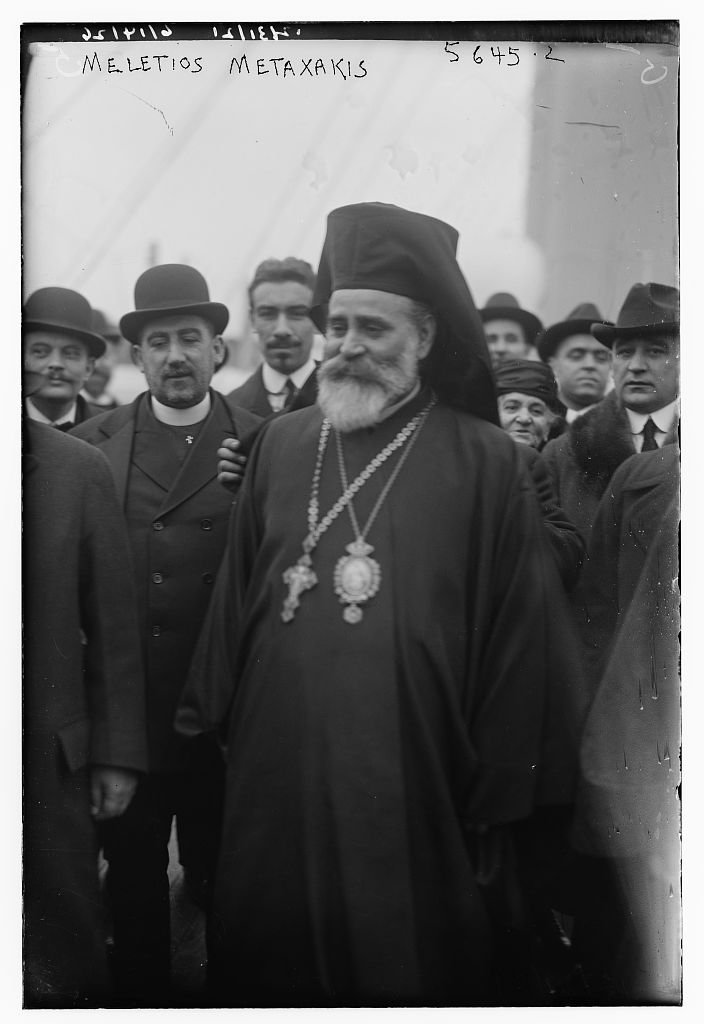
L to R: Future Metropolitan Germanos Polyzoides, Bp Alexander Demoglou, Met Platon Rozhdestvensky, Patriarch-elect Meletios Metaxakis, Abp Alexander Nemolovsky, Bp Aftimios Ofiesh, and Archdeacon Vsevolod Andronoff

Back in July, Fr. Andrew wrote about the above photo, which depicts a gathering of American Orthodox bishops in the early 1920s: Greeks Meletios and Alexander, Russians Platon and Alexander, and Syrian Aftimios. At the time of Fr. Andrew’s original post, no one knew exactly when this photo was taken, or what occasion brought all these hierarchs together. Fr. Andrew wrote, 

This photograph was found in the archives of the Library of Congress. As yet, there have been no official documents that have surfaced detailing what this 1921 meeting must have entailed. It might have been only a courtesy call, with a photo op at the end. 

Fr. Andrew went on to observe that, based on the photo, the other bishops appear to have regarded Metaxakis as “first in seniority among them.” To read the rest of Fr. Andrew’s post, click here

Why am I bringing all this up again? Becasue I believe I now know when and where this photo was taken, and why all these bishops were in the same place. On December 9, 1921, Abp Meletios Metaxakis was elected Patriarch of Constantinople. He was in New York at the time, having been deposed from his previous position as Archbishop of Athens. With Bp Alexander Demoglou, Metaxakis had come to the US to organize the Greek-American churches into a unified archdiocese. The New York Times (12/10/1921) announced that one of Metaxakis’ first acts as Patriarch would be to appoint Alexander as bishop of North and South America. 

The Times also reported, “This morning at 10 o’clock the Most Rev. Alexander, Archbishop of the Aleutian Islands and North America for the Russian Church, will formally call upon the Patriarch-elect and officially present the felicitations of the 100,000 Russians who are in the Western Hemisphere, who are his spiritual subjects.” 

The Russian goodwill towards Metaxakis’ election was not limited to Abp Alexander Nemolovsky. Archimandrite Patrick Mythen, the powerful convert priest, hastily organized a special ceremony. December 19 was the St. Nicholas day, the patronal feast of the Russian cathedral in New York. Invitations were sent out, in the names of both Met Platon and Abp Alexander. Besides the two Russian and two Greek bishops, the guest list included the Syrian Bp Aftimios and four Episcopalian hierarchs. Representatives of the new African Orthodox Church were also present, as well as the “Hungarian prelate [...] Bishop Stephan of Pittsburgh.” I think this was Bp Stephen Dzubay, a former Uniate who converted to Orthodoxy in 1916 and became the Russian Archdiocese’s Bishop of Pittsburgh. (Dzubay returned to Roman Catholicism in 1924.) 

After the Divine Liturgy, there was a buffet luncheon for the clergy at the neighboring parish house. The above photo must have been taken during or after this luncheon. Here is another, nearly identical photo, which appeared in the New York Evening Telegram on December 20, 1921: 

This photo, of the December 19, 1921 gathering of Orthodox bishops, appeared in the New York Evening Telegram the following day.

Comparing the two photos, it’s quite clear that they were taken at the same event, probably within moments of one another. The Evening Telegram photo doesn’t include the non-bishops, Polyzoides and Andronoff, but it’s possible that they were just cropped out before publication.

The event itself, the pan-Orthodox liturgy, is evidence of the rather friendly (or at least cordial) relations between the Greek and Russian hierarchy in 1921. Speaking to the Evening Telegram (12/19/1921), Fr. Patrick Mythen expressed what must have been on the minds of the Russian bishops as well: that Metaxakis’ election as Ecumenical Patriarch marked the first time since the fall of Constantinople that the Patriarch was elected without the consent of the Turkish sultan. He would thus be “politically free and will rule the Church as a priest and not as a politician.” Mythen meant that Metaxakis would not be bound to the Turkish state, but I’m sure many today would find his words ironic, Metaxakis being the controversial Church politican that he was.

Archimandrite Theoclitos Triantafilides is one of the most remarkable figures in American Orthodox history. An ethnic Greek, he served as tutor to the future Tsar Nicholas II and went on to establish the multiethnic parish of Ss. Constantine and Helen in Galveston, Texas, under the Russian Mission. His story has been mostly untold, until now. The following article, by Milivoy Jovan Milosevich, is the fullest and best work yet done on the life of Fr. Theoclitos and the history of Ss. Constantine and Helen Church. It originally appeared on the Galveston Orthodox Community website, which is run by Fr. Serge Veselinovich, the current pastor of Ss. Constantine and Helen. SOCHA has received permission to reprint the article here at OrthodoxHistory.org.   

Archimandrite Theoclitos Triantafilides

This picture of the Right Reverend, Most Venerable Archimandrite, Fr. Theoclitos Triantafilides is the only one I am aware of. He was the first Orthodox Priest in Texas. The picture did hang with Honor in the Church Congregation Hall of Saints Constantine and Helen Church in Galveston, Texas. It has been saved from “Hurricane IKE’s Destruction” (September 12, 2008), and will hang there again when the new hall is constructed soon. I live in Galveston, and I have been a part of the Church congregation since Baptism. My Mother was baptized by Arch. Fr. Theoclitos and was very proud to tell people of that fact until her death in 2001. I have studied everything I can find on this wonderful Priest over the years, including his Last Will, the Galveston Daily News archives, Immigration Records, the Rosenberg Public Library of Galveston, the Church records (Slavonic, long-hand written in Cyrillic), the Internet and greatly on the local “folklore” stories told of him.   

IT’S HAS BEEN SAID….   

His father was an Athenian Greek. When the first outbreaks of Greek Independence from the Ottoman Empire started on the Peloponnese Peninsula, his father, a fisherman crossed onto the peninsula to join the forces of famed Greek General Theodoros Kolokotronis, also an Athenian. Eight years later, when Independence was achieved (with great help from the Allied Russian, English and French Forces); he settled in Egio (one of the oldest cities in the Balkans), Peloponnese Peninsula, Greece.   

Born in November of 1833, young Theodoros was named for the famed Greek General. They called him “Theos” and he celebrated his Name Day each September 22nd (Julian Calendar in the 1800’s), on the Feast Day of St. Hierotheos, the Student of Saint Paul, the Apostle, who in 53 A.D. became the First Bishop of Athens. Theodorus grew up fishing with his father, and spending time around the port; while his mother (a native of the Peloponnese Peninsula) pushed him to the Church. The era after Greek Independence was wrought with economic problems and the Armenians and Bulgarians had replaced the Ottomans as bankers and merchants, allowing our young Theos to become ever more acquainted with other cultures. Two-thirds of the population had vanished and the land was devastated.   

His early schooling was in the Church of Panagia Trypiti that is built inside a cavity of the cliff just 150 stair steps above the Port of Egio and he helped the Priests with all their duties, occasionally traveling into the local mountains to visit Agia Lavras Monastery, about 20 miles south and up in the mountains. Greek Independence had started there with Bishop Germanos Declaring Independence with his blessing of the troops. Later the Ottomans burned the Monastery, but it was reconstructed with help from the Russian Orthodox Church. Many of the Icons there were gifts from the Russian Monastery Panteleimon on Holy Mt Athos and the Be-jeweled Gospel in the Monastery was printed, signed and given by Catherine the Great of Russia. History and multi-ethnic cultures literally surrounded him. As a young adult, he was Tonsured a Monk and was given the name Theoclitos. He soon traveled to Mt Athos where he was accepted as a resident of the Panteleimon Monastery, where he became fluent in Slavonic and studied Russian language and customs; and made regular visits to the Serbian Monastery Hilandar learning the Serbian language and customs. He had become fascinated with languages.   

He was invited to complete a formal education and become a teacher at the Slavic Greek Latin Academy and Theological Seminary at Holy Trinity – St. Sergius Monastery, better known today as the Moscow Theological Academy, just outside Moscow, Russia. After under-graduate, a Graduate Degrees in Theology and a few years of teaching; he was called upon by the new Danish born King of Greece, George I, to tutor his son Prince George. Later, the King’s brother-in-law, Tsar Alexander III of Russia called upon him to tutor the Royal Family’s 6 children specifically in other Orthodox cultures including the Greek language. So, he became a Greek cultural teacher to the future Tsar Nicholas II of Russia, who was Canonized a Martyr Saint of the Russian Orthodox Church in 1991. It is also said, Fr. Theoclitos was one of the 30 or so clergyman serving at the wedding of Nicholas II and Alexandra Fyodorovna, who was Canonized a Martyr Saint of the Russian Orthodox Church in 2000. The Parishioners of Galveston would later call him, “The Priest of Three Kings.”   

It is known that with the outset of the American Civil War, a group of multi-ethnic Orthodox Christians were having regular prayer meetings in Galveston, as early as 1861, and they called themselves “the Parish of S.S. Constantine and Helen.” Galveston is a seaport, and its citizens were accustomed to our Eastern European and Mediterranean People. Our Eastern Orthodox Christians were always around the port. There were those that came, returned home and came back again. The first known Serbian in America lived in Galveston for a long time; his name was Djordje Sagic (aka: Djordje Ribar and/or George Fisher). He came to Texas in the late 1820’s after “jumping ship” (because of indentured servitude) in Philadelphia, and became the first Port Director of the Port of Galveston under the Mexican Government. He then became a Major in the Texas Revolutionary Army under General Sam Houston. He served in public office as City Councilman in Houston, Texas and Justice of the Peace in Harris County after the Texas Revolution. Sagic had studied for the Priesthood in Karlovci Serbia, but left the seminary to join the last efforts of the first Serbian uprising against the Ottoman Empire in 1813, lead by Serbian leader, Karageorge Petrovitch. He left the area in 1850 to ultimately retire in San Francisco, California as a Justice of the Peace and retained the status of the Official Greek Government Consul there until his death, in 1873. He knew 13 languages.   

The First known Greek in Galveston participated in the Parish Church group. He called himself only by the name of Captain Nicholas. Captain Nicholas joined the notorious Privateer Jean Lafitte in New Orleans, when Lafitte sailed for Galveston, as Capitan of Lafitte’s prize schooner the Mirabella. Captain Nicholas sailed away from Galveston with Lafitte after burning everything they left behind. Captain Nicholas returned to Galveston after Lafitte’s death, becoming a farmer on west Galveston Island and recounting old pirate stories at the waterfront. He lived more than 100 years and is believed to have died in the Hurricane of 1900. Some have said that with Lafitte came the first of many nationalities to Galveston, but I am unable to corroborate any other Orthodox Christians. During the late 1880’s and early 1890’s these Orthodox Christian Serbian, Russian, Greek, Bulgarian, and Arab (Lebanese) immigrants to Galveston had organized and started gathering moneies for a church. Aside from the religious group, they each started several individual nationalistic groups. Each had separately written many petitions to their former Bishops back home for a Parish Priest and had received only denials; justified by the facts of distance and costs, but these denials were in some cases including the suggestion that they petition the Russian Orthodox Mission Diocese in North America. So the culture in Galveston was ripe for the addition of an Eastern European & Mediterranean Priest of Arch. Fr. Theoclitos’ stature.   

Nicholas II became Tsar of Russia on November 26, 1894. The Romanov Royal Family had created and supported the Russian Orthodox Mission into North America through Alaska since 1794. At that time, because of the Romanov family’s truly un-matched wealth, the Russian Mission into America was the only Orthodox jurisdiction on the continent prior to 1922.   

So, the Slavs, headed by Risto Vukovich; and the Greeks headed by Athurs Menutis gathered and decided to petition the Russian Mission Diocese. They sent three telegrams written in Cyrillic and signed by Vukovich, Christo Chuk, and Milosh Porobich which explained the diversity of the parishioners to; (1) the Holy Synod of the Russian Orthodox Church, (2) Tsar Nicholas II personally, and (3) His Grace Bishop Nicholas in Sitka, Alaska. A short time later the parish board received a telegram personally from Tsar Nicholas II, stating his acceptance of their plea. The Tsar had a large Gospel Printed, all the Vestments and Liturgical necessities including a signed Antimins, and all the Icons for an Iconostas painted and assembled including the icon to be used for the name day of the future Church (His own Namesake, Saint Nicholas); and he chose his teacher Fr. Theoclitos to go to Galveston, telling him “Let there be an Orthodox Church in Galveston.”   

By this time, Fr. Theoclitos was 61 years of age, and was a well traveled man and spoke more than a dozen languages: Greek, Russian, Serbian, Slavonic, Latin, Bulgarian, Arabic, Hebrew, Danish; and some Spanish, English, French, German, and Romanian. The Ambassador of Russia to the United States acquired US Citizenship for him even before he left Russia. Prior to leaving Russia, Fr. Theoclitos was given the heavy cross he always wore by Tsar Nicholas II and he was elevated to the rank of Right Reverend Archimandrite, because he would soon be the Priestly leader of a flock of Christians so far away with little known chance of a visiting Bishop anytime soon. His journey to the far off land of Galveston, Texas began with six companions. With him were; the Very Reverend Archimandrite Raphael Hawaweeny (Glorified a Saint in March of 2000 by the Orthodox Church in America) and his three Deacons Constantine Abu-Adal, Istvan Moldowanyi and John Shamie (later Shamie was a Priest in Galveston); and Archimandrite Fr. Theoclitos’ two Russian Deacons, Theodore Pashkowsky and Joakim Zubkowsky, and his Romanian Deacon Pavel Grepashewsky; and Fr. Peter I. Popoff. The first leg of the trip was by train to Berlin, serving liturgy there at the Russia Embassy Church; then on to the Port of Bremen. Next leg was by passenger ship to Southampton for a change of ships, then on to New York aboard the passenger ship, S.S Havel out of South Hampton, as a United States Citizen. Only 82 passengers sailed that day. Although a group of Priests were at the port of New York to greet them on the Morning of November 14, 1895, they were required by customs to spend one night in Quarantine. The next morning, they were joined in New York by Bishop Nicholas Ziorov of the Russian Orthodox Mission in America to consecrate the First Arab-Syrian Orthodox Church in America under the Russian Mission’s jurisdiction, and to install Archimandrite Raphael as Pastor, with his three deacons. A few days later, Arch. Fr. Theoclitos, his three Deacons; and Fr. Popoff traveled with Bishop Nicholas by train to Washington D.C., then to western Pennsylvania, where Fr. Popoff was to serve and then on to Kansas City. At this point, it was decided that only the Romanian Deacon Grepashewsky would travel to Galveston with Arch. Fr. Theoclitos; and Bishop Nicholas and the other two Deacons would go on to San Francisco. Arch. Fr. Theoclitos stopped in Hartshorne, American Indian Territory, Oklahoma to have Liturgy for a group of Russian Miners, just outside of Tulsa, Oklahoma before reaching Galveston.   

The distances from Galveston to either San Francisco or New York are about 1600 miles. Although his rightful rank was high, which gave him the right to consecrate his own chapel including the right to wear a Mitre (Crown, but with a flat, not standing Cross on top) and carry a Pastoral Staff (Bishop’s Staff); he lived his life in Galveston as a meager Monk, teacher, and Pastoral Priest. The Church Congregation never paid Arch. Fr. Theoclitos, because he received his pay directly from the Tsar (1500 rubels a month and 500 rubels as expenses; about $120 total, at that time) until Arch. Fr. Theoclitos passed away in 1916, a year and a half before Tsar Nicholas II and his Family were murdered.   

The Trustees of The Existing Congregation Board (Chris Vucovich, Chris Chuoke, Athurs Menutis and Mitchael Mihaloudski) formally received their State Corporation Papers on January 13, 1895 and subsequently purchased a 43’ wide x 120’ deep property that is at 4107 Avenue L, Galveston, Texas on December 15, 1895. They started to build a rectangular wood frame Orthodox styled Church, and when Arch. Fr. Theoclitos arrived, in January of 1896, he directed the finishing of the Church. The congregation was astonished to be blessed with an Archimandrite and a Deacon, not just a Priest, and best of all he was somewhat of a linguist.   

In Galveston, all properties faced either North-west or South-east, so they had chosen property that leaves our Church unusually facing South-east. And, although the Icon of Saint Nicholas was placed in the Iconostas to Honor Tsar Nicholas II as the Patron of the Church; it was Arch. Fr. Theoclitos’ decision to use the name S. S. Constantine and Helen Church, because the congregation that started on its own should be remembered. Bishop Nicholas was invited and he accepted; and the Consecration of our church occurred on June 3rd 1896, the feast day of Sts Constantine and Helen. Arch. Fr. Theoclitos’ decision on the name of the Church, was not unusual with him. He was known to have baptized children with names other than their parents had asked for. My mother’s name was to be Ruza, Serbian for Rose, but he baptized her as Sophia which her parents accepted without question, and gave my mother and others an unusual lifelong connection to their Archimandrite. But then, his guidance and decisions were always accepted by his congregation. There have never been any questions of his guidance that were ever passed down through the years even though we Eastern Europeans have always loved a good argument. He had services in the Slavonic, Greek and Arabic languages. It was as though his congregation was standing with a Saint.   

In 1897, Arch. Fr. Theoclitos purchased a 36 plot track in the Lake View Cemetery as a gift to his Congregation. He buried his flock in the next consecutive plot, without regard to couples or children or any Relationship, because he saw them as one congregational family.   

In early 1897, Bishop Nicholas replaced Deacon Grepashewsky with a young Russian Monk, Fr. Mikhail Kurdinovski to allow Arch. Fr. Theoclitos time to travel and invited Arch. Fr. Theoclitos to San Francisco to speak in the Greek language on the mounting losses of the Cretan insurgents in their revolution against Ottoman rule. Bishop Nicholas had to be acutely aware that his Archimandrite was the highest ranking Greek born Clergyman in America. While in route, we know that he also served Liturgy again in Oklahoma; and in Denver, Colorado. After his sermon in San Francisco he was asked to traveled with Fr. (later, Archimandrite) Sebastian Dabovich (currently being considered for Canonization as a Saint), to Portland, Oregon and Seattle, Washington, where they served Liturgy in Slavonic, Greek and Arabic in both cities. He again traveled to San Francisco in 1898, to participate in the installation of Bishop Tikhon Bellavin, as the new Bishop, replacing Bishop Nicholas of the Aleutians and Alaska (Diocesan name was changed in 1900 to Diocese of the Aleutians and North America). Although little is known about it, Bishop Tikhon visited our parish in 1899, for the first of two visits.   

It’s known that Arch. Fr. Theoclitos traveled extensively on the Gulf Coast going as far east as Mobile, Alabama, as far south as Corpus Christi, Texas, and into the interior north to Ft. Worth, San Antonio, San Angelo and Austin Texas, performing Marriages and Baptisms and serving Liturgy where ever he found our Orthodox Christians. In 1897, The Wiemar, Texas newspaper had an article about him; where he borrowed the local Catholic Church in LaGrange, Texas to perform the wedding of a Greek Couple. The writer (obviously Protestant) posted the short article that follows.   

Weimar Mercury, 29 Jan 1898: “LaGrange, Tex., Jan. 25, –Married today, Mr, Abraham John to Miss Zeche Nemer, both Greek, at the Catholic Church by Rev. Theoclitos (Archimandrite of the Orthodox Church), Galveston, Tex. A very large crowd attended the ceremonies, which were ’somewhat of a novelty,’ no such ceremonies having ever been performed here.”   

Our Church Board additionally purchased a like adjoining property west of the Church doubling the size of the property in early 1900. But, in his 66th year, on September 8th 1900, Galveston Island was hit by the greatest natural disaster in United States history when the massive Hurricane of 1900 came ashore. The Island was almost totally destroyed (est. of 8,000 to 12,000 deaths of a population of 30,000, which included 24 members of the congregation. Arch. Fr. Theoclitos and Fr. Mikhail spent 30 hrs in the church praying and giving refuge to parishioners and neighbors that sought safety in the church. After the storm had passed, the Church structure was still standing although it had floated to the west about 10 feet partially onto the additional property just purchased. Those that were with him in the church believed Arch. Fr. Theoclitos and his church had truly saved their lives. The congregation gathered and raised the Church, repaired the damage and early in 1902 petitioned Bishop Tikhon, who had since moved the headquarters of the Diocese to New York, to visit and Re-consecrate their repaired Church. Bishop Tikhon accepted and arrived shortly before services on June 3rd 1903. This event made Arch. Fr. Theoclitos and his congregation’s church not only patronized by, but also consecrated by future Saints of Orthodoxy. By order of Tsar Nicholas II, Bishop Tikhon bestowed on Arch. Fr. Theoclitos the Royal Honors of (1) the Order Of St. Vladimir and (2) the Order of St. Anne (in his picture, the ribbon and cross like medallion around the neck to his right side is the order of St. Vladimir, the ribbon and medallion around the neck to his left side is the Order of St. Anne and the necklet with the large medallion was awarded him upon attaining his Graduate Degree in Theology from the Moscow Theological Academy.   

While in Galveston, Bishop Tikhon visited the cemetery, and became aware that it was filling fast. As a gift to the Congregation, Bishop Tikhon,who was later made Patriarch of Moscow, purchased 27 additional plots next to the original cemetery track. Arch. Fr. Theoclitos and the Church continued with a new influx of immigrants coming to Galveston each year, even purchasing another 21’ to the west of the Church. Although he did keep constant communications with the Diocese, it is not clear whether he ever met with Archbishop Platon of New York, who replaced Bishop Tikhon.   

He was known to include the Romanov Royal Family each week in the Liturgy, as: (1) word of Tsar Nicholas II’s son, Alexander’s affliction with hemophilia began to spread, (2) World War I was building and (3) talk of revolution against the Tsar was in the news from time to time. Also, because of our multi-ethnic culture in Galveston, the shot by Serbian Gavrilo Princip that assassinated Archduke Franz Ferdinand and his wife Sophie, (believed to be the shot that started World War I, was heard loudly in our Church making the War and the assassination more than an important issue.   

On weekly trips to the business district, the neighborhood children would gather on the church steps and wait for his return. He would always have a large bag full of fruit and the latest sweets for them, saving a large portion for his parish children. He became acquainted with many people during his years in Galveston and was thought of respectfully, while they became somewhat enchanted with his customary meager but stoic Orthodox Monastic ways. He was a constant visitor to St. Mary’s Infirmary (the local Catholic Hospital) and John Sealy Hospital at the University of Texas Medical Branch. Following his heart, as the Apostle St. Paul guided him through his Name Day St. Hierotheos, he was known to give Confession, Baptizism and Communion to anyone who professed to be Christian. He truly became a friend to many families, who felt his visits to their loved ones in the hospital made those loved ones better. He converted to Orthodoxy many of these families: the Dambido family, the Matthews family and the Lelirra family to name a few.   

In 1911, the Galveston-Houston Inter-Urban Train was instituted, allowing many of our Orthodox Christians in Houston (50 miles north and largely Greek and Lebanese) an ease of access to Galveston for Sunday Liturgy. The trains were one or multiple electric cars that ran from downtown Houston to downtown Galveston, and you could get on or off at any time. So, our members could get off, then on again, less than 800 feet north of the Church on the main road into Galveston. It was still a 75 minute trip, one way, but it was an inexpensive way for our Houston parishioners to get to church from time to time. It was later discontinued in 1936.   

And then, in his 81st year, the Island was hit by another devastating Hurricane in August of 1915. Again, Arch. Fr Theoclitos and others prayed in the Church. This storm was even more tenuous for them, but never was anyone in the church lost in any storm. The Church floated to the north about 50 feet into the street, and the front wall was torn open and the Gospel given by Tsar Nicholas II was found by parishioner George Mandich another 200 feet away in the city cemetery across from the Church, miraculously with very little water damage. The congregation repaired the Church and moved it back into place with mule and muscle.   

The parish again, needed more future graves. This time, as a religious benevolent society, they purchased their own private Cemetery in the western part of the city, about a quarter mile from the other cemetery. The land was far larger (would easily accommodate about 300 graves) and would meet their needs for long years into the future. But they also divided it into two sections, the Greeks to one side, and the Serbians and other Slavs on the other.   

Later in the following year, the Church was hit by the loss of their 21 year life with Arch. Fr. Theoclitos, just short of his 83rd year, on October 22nd 1916. He had become gravely ill six weeks before. He somehow knew his time was near, and had the Diocese notified of his illness, and he asked parish leaders to find a way for them to bury him under the Altar of the Church. It was his belief that his grave would, by its nature, cause the Church to continue at the location for centuries into the future. He passed to his Creator at 8:15 in the evening, in St. Mary’s Infirmary Hospital. With the help of Church leaders, his body was prepared by Malloy & Sons Funeral Home, but the parishioners then took the body to the church and stood vigil over his remains continually, until his Funeral. The New Archbishop Evdokim of New York ordered his Diocesan Secretary, Archpriest Fr. Peter I. Popoff (who had been one of Arch. Fr. Theoclitos’ companions on the trip from Russia), and two others of his Diocesan Council members; Fr. Louniky Kraskoff of Denver, Colorado (whom he had visited with on trips to San Francisco) and Hieromonk Fr. Paul Chubaroff of Hartshorne, Oklahoma to immediately travel to Galveston so that Our Beloved Archimandrite would be religiously cared for. They finally arrived in Galveston six days later, on the morning of October 28th. Hierarchical Funeral Services were held that afternoon at 2:00 P.M. During the six week wait, the Parish Board had received permission from the County Judge to place his remains under the Church’s Altar and workers prepared the Concrete Vault that was required by the Judge for his casket to be encased, where it remains today. As Arch. Fr. Theoclitos requested in his will, his Cross and Medals were all taken to Archbishop Evdokim by Archpriest Popoff.
+Memory Eternal+   

In the following years our Church was served by numerous short-term or as they were called in those days, traveling Priests. In 1929, the parishioners, spear-headed by Petar B. Kovacevich, built a wood frame Hall (32’ X 75’) with a parish home above, in hopes of having a Priest and his family, stay in Galveston. It helped, but, in 1933, our Greek brethren gathered and purchased their own Church, The Assumption of The Virgin Mary Greek Orthodox Church. Our parishes have helped each other thru the years, whenever either was without a Priest or there was a time of need, as our Arch. Fr. Theoclitos would expect of us.   

The Hierarchs of the Church in those years were Archbishop Alexander, Metropolitan Platon, and Metropolitan Theophilus.   

In 1934, Fr. Alexis Revera and his family arrived in Galveston and stayed for 27 years. In 1948, the parish decided it was time for the Church to receive some upgrades, mainly in the form of cosmetics. Wing additions were added to the elevated Altar area, the interior was totally painted, Stain Glass windows were added, hard wood flooring, a new roof coving, and the old siding was covered with a light brown brick; work was completed in 1949. The parish petitioned the Diocese, and in 1950, the newly elected Metropolitan Leonty, traveled to our fare city to re-consecrate the Church. Air-conditioning was added in the 1960.   

In 1962, it had become apparent that the community was almost totally made up of Serbians. Metropolitan Leonty and Bishop Dionisije (right) of the Serbian Diocese met and sealed an agreement that put our beloved Church under the Serbian Diocese, while the Russian Diocese would receive under its control the Church in Billings, Montana, which was started by Serbian Bishop Nikolai (Canonized a Saint by the Serbian Orthodox Synod in 2003,) and Archimandrite Fr. Sabatian Dabovich; but had over the years become almost totally Russian. They further agreed to guide these two parishes to remain multi-ethic and services were to be in both English and Slavonic and should include a litany of any other languages when needed for other ethnic parishioners.   

In 1964, the Texas Highway Department was working on plans to expand the street next to the cemetery into a 6 lane highway. They were intending to put an over-pass over the Serbian Section. Two parish leaders, Ilija P. Kovacevich and John N. Milosevich went to the highway department with their plan to move the Serbian Section at the Highway Department’s expense. The Highway Department agreed. So, it became the work of parishioners; lead by local Constable and parishioner Sam Popovich to get every relative of a loved one in the Serbian section to sign the necessary papers. The highway department would provide 6 times the land they were taking and would bare all expenses of exhumation and reburial; where a solid caskets or a vault was not found, the earthen material would be placed in a vault to be transported; and the Priest would attend and be paid for a service of exhumation and re-burial for each grave. The new cemetery is much like a Church with a center aisle and rows of graves to each side; with small side-walks between the rows and an Alter table at the front.   

In 1978 our Parish came under the Jurisdiction of one of its own, Serbian Bishop Christopher. The First American Born Bishop to serve an American Diocese. He was born and raised in Galveston and had been ordained a Priest of the Serbian Orthodox Church in 1949. With his leadership, the congregation has prospered through the past 30 years, with him becoming Metropolitan in 1991.   

Now we have been hit by another devastating Hurricane “IKE,” which came ashore on September 12, 2008. Our Church sustained minor damage with only a few inches of water inside and some wind damage (no doubt that our Arch. Fr. Theoclitos mystically was riding out the storm in his Sanctuary). But our Hall was in 3 feet of water. The old wood frame structure was left structurally unsound. The Parish decided to fix the Church first. We then had the old hall destroyed, and are planning to break ground on a new hall in early 2010. Our Greek Brothers and Sisters didn’t fare as well; their beautiful Church was inundated with 8 feet of sea water. The masonry of the Church and hall structurally survived, but the interiors didn’t make it. They are without a Priest, but have managed to somewhat re-do their Church and are working to completion. During this time, they have attended Liturgy on Sundays with us, and now that their Church is presentable, our priest Fr. Srdjan Veselinovich has liturgy on Saturdays for them.   

In 2009 our parish was placed under the jurisdiction of His Grace, Serbian Bishop Longin, ending an over 40 year schism in the Serbian Orthodox Church in America. Interestingly, His Grace Bishop Longin and Arch. Fr. Theoclitos, both received Graduate Degrees in Theology from the Moscow Theological Academy at Holy Trinity – St. Sergius Monastery (name changed to Zagorsk Monastery in 1930).   

And so, 168 years after the first parish meeting in Galveston, Texas, we beseech Our Archimandrite Father Theoclitos Triantafilides; his friends Archimandrite Saint Raphael Hawaweeny and Archimandrite Sebastian Dabovich; Our Patrons Saints Tsar Nicholas II and Saint Trazistza Alexandra, Our First Metropolitan and Patriarch Saint Tikhon Bellavin, our first Serbian American Bishop Saint Nikolai Velimirovich and all those who with the Saints have guided our Parish in their goodness, to intercede on our behalf for yet another Century of existence.   

From 1895 -2010, the Church-School Congregation of SS. Constantine and Helen was served by the following priests:   

Archimandrite Theoclitos (Greek) 1895-1916
Father Michael Andreades (Greek) 1916-1918
Father John Shamie (Lebanese) 1918-1920
Father George Palamarchuk (Serbian) 1920-1925
Father Marko Dimitrieff (Greek) 1925-1926
Father Pavel Markovich (Serbian) 1927-1928
Father George Milosavljevich (Serbian) 1928-1929
Father Joakim Tkoch (Russian) 1929-1934
Father Alexis Revera (Russian) 1934-1961
Father Damaskin Susjnar (Serbian) 1961-1965
Iguman Mitrofan Kresejovich (Serbian) 1965-1968
Father Jovan Trisich (Serbian) 1968-1969
Father, Dr. Tihomir Pantich (Serbian) 1969-1971
Father Constantine Pazalos (Serbian), (Greek Born) 1971-1982
Father Svetozar Veselinovich (Serbian) 1982-1985
Father Zarko Mirkovich (Serbian) 1985-1987
Father Dragan K. Veleusic (Serbian) 1987-1992
Father Oleg Vifliantsev (Serbian), (Russian Born) 1992-1994
Father Dane Popovich (Serbian) 1994-1994
Father Dejan Tiosavljevich (Serbian) 1994-1995
Father Srdjan Veselinovich (Serbian) 1995-Present   

Fr. Theoclitos performed Marriages and Baptisms, and Celebrated Liturgies in the following locations in America:   

City/Town and Approx. Distance from Galveston   

New York, New York 1416 miles
Washington, D.C. 1213 miles
Hartsborne, Oklahoma 380 miles
Dallas, Texas 269 miles
Ft. Worth, Texas 281 miles
San Angelo, Texas 363 miles
New Braunfels, Texas 199 miles
La Grange, Texas 132 miles
Galveston, Texas 0 miles
Houston, Texas 50 miles
Beaumont, Texas 90 miles
Eagle Lake, Texas 93 miles
Seattle, Washington 1937 miles
Portland, Oregon 1881 miles
San Francisco, California 1686 miles
Denver, Colorado 928 miles
New Orleans, Louisiana 287 miles
Lake Charles, Louisiana 117 miles
Mobile, Alabama 414 miles
Biloxi, Mississippi 362 miles
Port Lavaca, Texas 122 miles
Polacios, Texas 86 miles
Corpus Christi, Texas 181 miles
San Antonio, Texas 216 miles
Waco, Texas 209 miles
Austin, Texas 191 miles
Cameron, Louisana 81 miles
Rockport, Texas 154 miles
Indianola, Texas 35 miles
Brazos, Texas 60 miles
Sabine, Texas 75 miles   

Approximate total missionary miles of work: over 25,000 by train or horse and buggy. 31 locations in 11 States in 21 Years.   

Extreme Post Script:   

In retrospect, this writer remains in awe, that The Right Reverend, Most Venerable Archimandrite Father Theoclitos Triantafilides may truly be “The Forgotten” First Greek-American saint. He was the answer to our predecessors’ every prayer. He traveled extensively on a global basis to serve the religious needs of many. He provided the “Connecting Link” for our multi-ethnic American lives, and through the teachings of Orthodoxy and his God-Given Art of Language, he lead us on the path of Saint Paul, the Apostle, past the ever separating ethnic divide.

 
In recent weeks, traffic to our website has increased exponentially. I’m continually amazed by the numbers of people interested in American Orthodox history. Normally, we publish new material here virtually every weekday. However, today and tomorrow are busy days — Christmas Eve and Christmas Day – for those of us on the New Calendar, and I won’t have a new article ready until Monday, December 28. But rather than leave the website without updates, we’ll be re-posting some articles that originally appeared this summer. Given how many new visitors we have, this will be the first time many of you have seen them.
 
The article below was originally published on July 10, 2009. If you’re interested, you might check out the comments to that original posting.

Only known surviving photo from St Raphael's consecration service, published in the Syracuse Telegram on March 17, 1904.

Only known surviving photo from St Raphael's consecration service, published in the Syracuse Telegram on March 17, 1904.

St Raphael was consecrated Bishop of Brooklyn on March 13, 1904, by St Tikhon and Bishop Innocent of Alaska (not to be confused with the earlier St Innocent). What follows is a little article I wrote on the consecration. My plan is to include the article in a book I hope to publish on the early history of American Orthodoxy.

The first thing to know about Bishop Raphael’s consecration is the crowd – the enormous, crushing crowd. Two thousand people – some worshippers, some sightseers – were crammed like sardines into the cathedral on Brooklyn’s Pacific Street. Throw in a generous portion of incense and hundreds of burning candles, and the place was one hot, dense mass of humanity. “There were half-smothered cries of women and children,” one newspaper reported.[i] As you might expect, at least three women fainted and had to be carried out of the building.[ii]

Adding to the chaos were the newspaper photographers, one of whom chose to take a picture at the moment of consecration. From the New York Sun: “[T]he photograph fiend, who apparently respects religion no more than any other material for a subject, startled the congregation and the clergy by exploding a flashlight cartridge. The building was soon filled with smoke, making the rest of the ceremony very indistinct for some time.”[iii]

Anyway, it was quite a ceremony. No less than four canonized saints participated – Raphael, Tikhon, Alexis Toth, and Alexander Hotovitzky. Afterwards, there was a big dinner, attended by a lot of people (between 150 and 500; the newspapers don’t agree, though I’m inclined to believe the smaller figure). It was a fast day, but that didn’t stop the feasters from having an impressive menu. From the New York Tribune: “The menu was vegetables, oysters and lobsters, Damascus artichokes, fried fish, lettuce salad, peas a la Syriene, cabbages a la Turque; desserts, mishabbak, cornstarch; fruits, apples and oranges; Turkish coffee.”[iv] Presumably no one left hungry.

As far as the general public was concerned, the consecration was a decidedly Russian affair. The newspapers referred to it as being at the Tsar’s orders, and at the celebratory dinner, the Tsar was toasted and the Russian national anthem was sung. One of the first public acts of the new Bishop Raphael was to visit the Russian ambassador in Washington.[v]

These facts did not please the local Greeks one bit. They saw it as an act of Russian imperial expansion, and it contributed to the growing Greek fear that Russian Church aimed to spread its influence across Orthodoxy worldwide. The Greek consul in New York chose not to attend the consecration, and his absence itself made headlines.[vi] A few weeks later, on Holy Friday, Bishop Tikhon tried to visit Holy Trinity, one of the Greek churches in New York. Fr. John Erickson writes, “He was barred from entering by its angry trustees, who feared a Russian takeover of their parish properties.”[vii]

The Greeks may not have been happy with the consecration, but the Episcopalians certainly were. Bishop Tikhon invited his good friend, the Episcopal Bishop Charles Grafton of Fond-du-Lac, Wisconsin to attend. That fact alone means little; non-Orthodox religious leaders are often invited to witness such events. But Grafton’s invitation was different, at least in the eyes of the Episcopalians themselves. Supposedly, Bishop Tikhon’s invitation included a request that Grafton actually participate in the ceremony as the third consecrator, along with Tikhon and Innocent![viii] In reality, it is highly unlikely that Tikhon actually intended for Grafton to be one of the consecrators. Such an act would require full communion between the Orthodox and the Episcopalians, and, as later events would prove, Tikhon was unwilling to unilaterally declare such a union. He had great respect for the Episcopalians and Grafton in particular, and he may even have privately believed in the legitimacy of their holy orders, but he by no means would have permitted Grafton to actually participate in the service.

In any case, Grafton proved unable to come due to illness, but a delegation of other Episcopalians came in his stead. Some of Grafton’s representatives were allowed to stand in the altar itself during the ceremony, just as was Bishop Tikhon and his delegation at the “Fond-du-Lac Circus” a few years earlier.

Of course, Raphael’s consecration meant the most to his own Syrian flock. They now had a bishop, and officially, they were now a vicariate of the Russian Diocese. Unofficially, though, things were much less clear. While making clear that Raphael was a bishop of the Russian Church, Patriarch Meletios of Antioch felt it his “most important duty” to bestow his blessing on the consecration, and he said that he and the rest of the Antiochian Holy Synod “still consider him as a member of our body.”[ix] For his part, Bishop Tikhon, while also affirming Raphael’s membership in the Russian Church, stated his “certitude” that Raphael “would never break the most intimate spiritual ties with his mother Church of Antioch,” and he asked the Patriarch to guide and advise the new bishop.[x]

Bishop Raphael himself was rather ambiguous when he spoke to his flock about his jurisdictional allegiance. He said that his consecration was “by the order and permission of Melatois [sic], the Patriarch of Antioch”[xi] and that “Patriarch Melatois [sic] counted the new parish of Brooklyn, New York, as one of the parishes of Antioch.” He went on to say that Patriarch Meletios declared that he “had instituted the new diocese as one of the dioceses pertaining to the See of Antioch and thus it is in actuality, notwithstanding its nominal allegiance to the Russian Holy Synod.”[xii]

After Raphael’s death, such ambiguities would become points of serious contention among his orphaned flock. But in 1904, they were of little significance; the important fact was that the Syro-Arabs now had their own bishop, who would prove to be among the greatest American Orthodoxy has yet seen.


[i] “Crowd Uncontrollable,” Boston Globe (March 14, 1904), 5.

[ii] “New Bishop of Greek Church Consecrated,” New York Times (March 14, 1904), 9. Also cf. “Third Russian Bishop,” Washington Post (March 14, 1904), 1.

[iii] “New Bishop Consecrated,” New York Sun (March 14, 1904), 10. Also cf. “Ordain Raphael Bishop,” New York Tribune (March 14, 1904), 3.

[iv] New York Tribune (March 14, 1904).

[v] Cf. “Social and Personal,” Washington Post (March 17, 1904), 7 and “In Society,” Washington Times (March 17, 1904), 6.

[vi] Cf. “Greeks Angry at the Czar,” New York Sun (March 15, 1904), 12 and “Fear Russian Rule of Church,” New York Tribune (March 15, 1904), 6.

[vii] Erickson, Orthodox Christians in America, 73.

[viii] C. Lewis Leicester, “What Might Have Been,” The Christian East 13:2 (Summer 1932), 79-80. Quoted in Andre G. Issa, The Life of Raphael Hawaweeny, Bishop of Brooklyn: 1860-1915 (unpublished M.Div. thesis, St. Vladimir’s Orthodox Theological Seminary, May 1991), 46.

[ix] Patriarch Meletios to Bishop Tikhon (March 11/24, 1904), translated from the Russian by Fr. John Meyendorff in “Notes and Comments: The Patriarch of Antioch and North America in 1904,” St. Vladimir’s Theological Quarterly 33:1 (1989), 83-86.

[x] Bishop Tikhon to Patriarch Meletios (April 1904), reprinted in Issa, 49-50.

[xi] Al-Kalimat (The Word) 1, 2, reprinted in “Hanna et al v. Malick et al, 223 Mich. 100, 193 N.W. 798 (June 4, 1923), Northwestern Reporter 193, 802.

[xii] Al-Kalimat 3, 95-96, reprinted in “Hanna v. Malick.” An alternate translation renders this statement, “And so it is indeed, though in name it belongs to the Russian Holy Synod.” Issa, 62.

Meeting of bishops to "reorganize" the Federation. This led to the creation of SCOBA in 1960.

Meeting of bishops to "reorganize" the Federation. This led to the creation of SCOBA in 1960.

On today’s episode of the American Orthodox History podcast, I interviewed SOCHA executive director Fr. Oliver Herbel on the subject of the “Federated Orthodox Greek Catholic Primary Jurisdictions,” a 1943 attempt to create a national, pan-Orthodox organization.

The Federation is to SCOBA what the League of Nations was to the United Nations. Both the Federation and the League of Nations were missing a crucial player: the Federation lacked the involvement of the Russian Metropolia (today’s OCA), while the League of Nations didn’t include the United States. Both SCOBA and the UN were essentially trying to do the same things as their predecessor organizations, but they were obviously more successful and long-lasting.

Metropolitan Antony Bashir was the head of the Antiochian Archdiocese of New York, and he was one of the most enthusiastic supporters of the Federation. Even after it was basically defunct in 1944, Bashir tried to keep it going, at least on paper. In the 1955 and 1956 Yearbooks of American Churches, for instance, Bashir is listed as the President of the Federation, even though it has been non-functioning for more than a decade. In a 1961 publication commemorating Bashir’s 25th anniversary as Metropolitan, we find this sentence: “In March of 1960, he spearheaded the reorganization of the Federation into the much stronger Conference of Orthodox Bishops of the Americas, which he now serves as Vice-President.”

In a way, then, the Federation was SCOBA.

UPDATE (12/3/09): Fr. James Early sent an email asking if I could identify the people in the above photo; in particular, he asked whether the “right-most suit-wearing hierarch” was Metropolitan Antony Bashir. Here is my reply:

Metropolitan Antony is indeed the right-most suit-wearing hierarch, standing near the center of the picture. However, I don’t know who most of the other men are. Certainly, the bishop in the white hat is Metropolitan Leonty Turkevich, and I assume the bishop in between Antony and Leonty is Archbishop Michael Konstantinides of the Greek Archdiocese. Abp Michael died on July 13, 1958, so if he’s in the photo, we can be sure it was taken before that date. His successor, Abp Iakovos, is not in the photo, which further suggests a date of 1958 or earlier.

I doubt that all of the individuals in the photo are bishops. In fact, it may be that Bashir is the left-most bishop in the photo, as all the men to the left of him look like priests. 

UPDATE (12/23/09): According to Fr. Alexander Lebedeff in the comments (below), the second man from the left is Fr. George Grabbe, Chancellor of the ROCOR Synod of Bishops. Fr. Alexander writes, “The ROCOR had been very involved in the precursor of SCOBA, and participated in the organizational meetings of SCOBA, as well. The ROCOR withdrew when informed that the Bishop in charge of the Moscow Patriarchal parishes in America would be invited to join SCOBA. That did not occur, but the ROCOR never returned to the table.”

UPDATE: (2/23/10): I have just received an email from Fr. Demetrius T. Dogias, in which he identifies several other individuals in this photo. According to Fr. Demetrius, the man standing at the far left is Bishop (later Metropolitan) Germanos Polyzoides. The fifth man from the left (that is, the man standing to the left of Met Antony Bashir) is Bp Demetrios of Olympus, who, at the time, was Chancellor of the Greek Archdiocese. The fourth man from the right (that is, the man with his head down, next to Met Leonty Turkevich) is Bp Bohdan, of the Ukrainian Archdiocese associated with the Ecumenical Patriarchate. Fr. Demetrius also offered this background information on the Greek Archbishop Michael, who is in the center of the photo (in between Bashir and Turkevich):

It may interest you to know that Archbishop Michael, also in the Dec. 2 picture, had studied in Kiev and that one of his teachers was the later Metropolitan Anastassy of the Russian Chuch Outside Russia.  Michael went to London as the priest at the St. Sophia Cathedral, and was granted the extremely rare title of Great (or “Grand”) Archimandrite.  He then was elected Metropolitan of Corinth in Greece, from which position he was elected Archbishop of North and South America.

Many thanks to Fr. Demetrius for providing all this information. We can now identify quite a few of the individuals in the photo. Here it is again, with numbers to make the identification easier:

Click on the photo to see a larger image. Here are the people we’ve identified so far:

1. Bp Germanos Polyzoides of Nyssa, Greek Archdiocese
2. Fr. George Grabbe, ROCOR Chancellor
5. Bp Demetrios of Olympus, Greek Archdiocese Chancellor
6. Met Antony Bashir, Antiochian Archdiocese
7. Abp Michael Konstantinides, Greek Archdiocese
8. Met Leonty Turkevich, Russian Metropolia
9. Bp Bohdan, Ukrainian Archdiocese

As more identifications come in, I’ll continue to update this article. And once again, thanks to all those who have sent in identifications so far.

Gov. Thomas Dewey of New York signs the bill creating the Federation

Gov. Thomas Dewey of New York signs the bill creating the Federation


In conjunction with the recent podcast concerning the Federated Orthodox Greek Catholic Primary Jurisdictions in America, I thought I would publish a special, extra entry for Frontier Orthodoxy. I still plan on writing two additional columns this month. For this entry, however, I wish to provide a basic timeline of the Federated Orthodox Greek Catholic Primary Jurisdictions in America (FOGCPJA). This timeline may be useful when listening to the recent podcast on American Orthodox History over at Ancient Faith Radio.

I also wish to note that I failed to make an important connection within the interview itself. Near the beginning of the podcast, I mentioned the difficulties Fr. Boris Burden had with Metropolitan Platon. I meant to return to this later to note that the tense relationship between the two may have also been a factor that excluded the Metropolia from membership. It was not the only factor, as I mentioned the FOGCPJA’s requirement that each jurisdiction be under a Mother Church/Patriarch, but it may well have played a role. Metropolitan Benjamin (Moscow Patriarchate) relied quite heavily on Fr. Boris Burden.

I should further note that Phillies’s membership in the Masons may not have been as ill received since Archbishop Athenagoras and Metropolitan Antony were also Masons. Although Masonic membership would have likely concerned Fr. Boris Burden, it is possible that Metropolitan Benjamin showed some restraint in this regard.

Timeline

Fall of 1942 (September or October): The Selective Service attempted to draft Fr. John Gelsinger. When that happened, Fr. John Gelsinger, and his father, Fr. Michael Gelsinger, contacted George E. Phillies, a family friend and local attorney in Buffalo, New York.

October 9, 1942: Phillies appealed to the federal authorities, via General Lewis B. Hershey, having gone before the local and state selective service boards. The response from Washington D.C. was that they needed to see proof of an organized Orthodox Church in America. In response to this, the hierarchs of the four primary jurisdictions met.

Fr. Michael Gelsinger (New York Syrian) and Fr. Boris Burden (Moscow Patriarchate) were the instrumental people behind the movement. Fr. Michael received commitments from Archbishop Antony Bashir and Archbishop Athenagoras and Fr. Boris Burden convinced Metropolitan Benjamin and the Bishop Dionisije, the Serbian bishop.

At the subsequent hearing at the Pentagon, Bishop Germanos, an auxiliary bishop of Constantinople, was the only testifying witness. U.S. Senator James Mead (NY, hometown of Buffalo) and Representative James Wadsworth (NY) also appealed on behalf of the Orthodox Church.

December 8, 1942: Major Simon P. Dunkle signed the paperwork instructing the selective service of New York to recognize Fr. John Gelsinger as a priest and providing Orthodox the Opportunity to enlist as Orthodox. Orthodox priests were granted the opportunity to serve as chaplains.

Phillies hailed this as the first time the four primary jurisdictions had provided a united front in America. He quickly built upon this momentum to pursue another venture: amending New York state law for religious corporations. He did this because his reading of the laws of New York convinced him that it was possible the Roman Catholic Church might claim sole legal right to the terms Greek, Catholic, and Orthodox. He also had found no legal incorporation of an Orthodox Church (jurisdiction) that would mitigate this. Individual parishes had incorporated, but the only large scale incorporations were Roman Catholic, such as the Greek Catholic incorporation in Pennsylvania.

February 10, 1943: George E. Phillies wrote to Gov. Dewey, recommending that the hierarchs visit and Dewey replies by stating they should do so after the signing.

February 19, 1943: Charles J. Tobin, secretary of the New York State Catholic Welfare Committee, wrote to State Senator Charles Burney, objecting to the proposed legislation, claiming that only Rome could use the terms Catholic or Greek Catholic.

February 25, 1943: Rev. Philemon Tarnavsky (chancellor of the diocese of Philadelphia) also wrote to Gov. Dewey and agreed with Tobin. He objected to the use of the word Catholic, which he said was linked to the Holy See in Rome. He even noted that the word Orthodox is also used by Greek Catholics, questioning whether Orthodox should use it as a self designation. Rev. Turnavsky was a Greek Catholic himself.

March 5, 1943: Episcopal diocese of Western New York wrote to support the bill (Rt. Rev. Bp Cameron J. Davis)

March 8, 1943: Phillies asked “Charlie” [Burney] for a moving picture crew and claimed there were five million Orthodox in America.

March 10, 1943: Tobin wrote to consul of the governor to object again. He included the assessment of Monsignor Tarnavsky.

March 15, 1943: Memorandum by Phillies stated the purpose(s), excluded the Metropolia, responded to Roman Catholic critics, and noted that the FOGCPJA was set up to parallel the federal/state division in the United States of America.

March 25, 1943: Governor Thomas Dewey signed the bill.

August 2, 1943: The Buffalo Evening News called Phillies the “lay head,” noted that he had dual membership in the GOC and the PEC, and was a Mason.

August 8, 1943: Concelebration.

August 22, 1943: Divine Liturgy in Kleinhans Hall (GOC too small). Archbishop Athenagoras presided, with Metropolitan Antony and Bishop Bogdan assisting (Ukrainian). By this time, the Ukrainians and Carpatho-Russians who were under Constantinople were participating in the FOGCPJA. A small internal disagreement ensued, because Frs. Boris Burden and Michael Gelsinger thought the service should have been in a larger non-Orthodox church building rather than one that was strictly secular.

Bishop Dionisije was bothered by the fact that the Carpatho-Russians and Ukrainians were under Constantinople and had other unnamed concerns. He soon quit participating.

October 3, 1943: At a meeting in Bayonne, NJ, the officers of the FOGCPJA passed the “Bayonne Resolution.” This resolution stated all officers of the Federation must be Orthodox, with no sacramental participation in non-Orthodox churches. Another problem that arose was that the Federal Council of Churches of Christ in America had received a letter (likely sent by Phillies) asking for membership.

October 7, 1943: Articles signed by the bishops and the Federation is legally incorporated. Archbishop Athenagoras had been chosen as the presiding hierarch. Fr. Peter Horton-Billard was chosen as secretary, replacing Fr. Boris Burden. Phillies remained the elected chancellor.

October 8, 1943: Burden called the elections “conditional.”

November 1, 1943: Russians threatened to leave over concerns with Phillies.

December 18, 1943: Marriage served jointly by Fr. E Wolkodoff, a Metropolia priest, and PE priest J. Coseby. Metropolitan Benjamin suspended the priest. At this point, the Federation was suspended.

February 2, 1944: Meeting: 1) no “lay head” 2) hierarchs are the leaders 3) Orthodox cannot be communicants elsewhere 4) “chancellor” means “legal advisor” and nothing more. Metropolitan Benjamin also said he had the support of Patriarch Sergius.

Around this same time, Patriarch Sergius wrote to Metropolitan Benjamin, offering permission to be active in the Federation, but Metropolitan Benjamin and Fr. Boris Burden were preparing to renege on the FOGCPJA.

Early October 1944: Metropolitan Benjamin said Phillies was no longer the chancellor. Phillies claimed he was.

November, 1944: Russians officially pulled out. By early 1945, the FOGCPJA was basically dead, though Metropolitan Antony Bashir kept it alive on paper.

According to some sources, Archimandrite Kallinikos Kanellas was the first ethnic Greek priest to serve in America. And those sources may be right, depending on your definition of “Greek.” The only other candidates would be from the Greek church in New Orleans. Fr. Stephen Andreades was the priest in the late 1860s, and Fr. Gregory Yayas served there from 1872-74; considering their names, both were almost certainly Greeks of one sort or another. Archimandrite Misael Karydis (or Kalitski) was the priest from 1881-1901, but he was reportedly from Bulgaria. In any event, Kanellas was one of the very first Greek priests in America.

I don’t know anything about Kanellas’ early life. I do know that, before he came to the United States, Kanellas had spent some time in India. From 1880 to 1886, he was the rector of the Greek church in Calcutta (the origins of which dated to the 1700s; see this fascinating history for more information). He first shows up in the US in 1889, as one of the priests of the Russian cathedral in San Francisco. He seems to be the first of several non-Russian priests brought over to America to serve in the Russian Diocese — “client clergy,” as Fr. John Erickson has called them. Soon, he would be followed by people like Fr. Ambrose Vretta, Fr. Theoklytos Triantafilides, Fr. Sebastian Dabovich, Fr. Raphael Hawaweeny, and Fr. Michael Andreades. But Kanellas seems to have been the original.

I’m not sure what Kanellas was doing from 1886 to 1889, but I suspect he might have been in Russia. This would explain his connection to the Russian Diocese in America.

Kanellas appears to have been trusted by Bishop Vladimir Sokolovsky, who appointed him to serve on the Alaskan Spiritual Consistory, the group of clergy which ran many of the day-to-day affairs of the diocese. He was particularly useful in ministering to ethnic Greeks. In 1891, he made a cross-country missionary trip. He stopped in Savannah, Georgia, and baptized a Greek child. The Columbus Enquirer-Sun (6/24/1891) reported that the child’s father spent $650, which presumably included transportation and lodging costs. The paper said that the amount “includes a handsome fee.” $650 seems outrageous, though. I checked an online inflation calculator, and it estimated that $650 in 1891 is equivalent to over $15,000 in 2008.

From Savannah, Kanellas went to New York City, where he baptized the daughter of Anthony Ralli (who was possibly connected with the well-known Ralli Brothers merchant firm). The New York Sun (6/26/1891) said that Kanellas had a “patriarchal beard and jewelled gown.”  According to one account, he actually had to bring his own baptismal font — can you imagine taking one of those on a train?

I’ve seen some references to Kanellas having served in Chicago. That’s a bit of a puzzler… In July 1891, the Chicago Inter Ocean (7/11/1891) reported that a certain Archimandrite Lininas, “who presides over a temple in San Francisco,” was visiting Chicago and holding services for the Orthodox there. I haven’t been able to find evidence of this Fr. Lininas being in San Francisco, and it’s very possible that this was actually Kanellas, on his way back from New York to California. However, the Inter Ocean says that Fr. Lininas “is a finely educated gentleman, speaking German, Russian, and French fluently, but his English is best understood through an interpreter.” So according to the paper, he didn’t speak Greek (which, if true, means he wasn’t Kanellas).

In 1892, amid much turmoil and scandal, Bp Vladimir was recalled to Russia and replaced with Bishop Nicholas Ziorov. On July 1 (June 19 Old Style), the members of the Spiritual Consistory (of which Kanellas was apparently no longer a member) wrote to the new bishop,

Today, the Archimandrite Kallinikos was informed that he has to leave the Mission as of July 1. He replied that he has nowhere to go. In accordance with Your Grace’s will, we deemed it was better to say nothing in reply: Your Grace has ordered not to drive him out.

Obviously, something was up, but I don’t know what. The 1893 San Francisco city directory  doesn’t list Kanellas among the cathedral clergy, so he didn’t stick around much longer. And for the next 18 years, I can’t figure out he was. I’m pretty sure he stayed in America, and by at least 1911 (and probably earlier), he was pastor of the Greek church in Birmingham, Alabama. In the 1913 book Greeks in America, Thomas Burgess, writing about the Birmingham church, said,

Of its former pastor, says the “Greek-American Guide,” “The Rev. Arch. Kallinikos Kanellas is a very sympathetic and reverend old man of whom it is possible to say that of the Greek clergy in America he is the most—shall we say ‘disinterested’? The Greek word is a dandy, (literally, ‘not loving of riches’). Plutarch used to use that word.

In 1913, Kanellas moved to Annunciation Greek Orthodox Church in Little Rock, Arkansas. He spent the rest of his life there. This is from Annunciation’s parish history:

Father Kallinikos Kanellas was brought to Little Rock on a permanent basis in 1913, and services were held in an upstairs meeting hall near 9th and Main Streets for the next eight years. This hall included a small chapel for Liturgies and Sacraments such as weddings, baptisms, etc., as well as a place for social gatherings. Incidentally, research indicates that Father Kanellas probably was the first Orthodox priest of Greek ancestry to come to the United States. When Father Kanellas became seriously ill, young Theo Polychron visited him daily, bringing soup from his little café. Father died in 1921 and is buried at Oakland Cemetery where most of the early Greek immigrants were also interred.

As  you can see, Kanellas’ story has a lot of missing pieces. I suspect a lot of the gaps could be closed by a letter Kanellas wrote to Archbishop Meletios Metaxakis on March 16, 1918, in which he gave an account of his career in both the Russian Diocese and the Greek communities in America. That letter appears on page 333 of Paul Manolis’ History of the Greek Church in America in Acts and Documents… unfortunately, though, I can’t read Greek, so for now, I don’t know what the letter says. If any of you out there can read Greek and are interested in Kanellas, email me at mfnamee [at] gmail [dot] com.

Recently, there has been an interesting and lengthy discussion in the comments section on our website, regarding the extent of the territory of the Russian Diocese of the Aleutian Islands and Alaska in the 19th century. Let me try to briefly outline my position in this debate.

Russia sold Alaska to the United States in 1867. However, under the terms of the treaty, the Russian Church retained its property in Alaska, and there continued to be an Orthodox presence. At the time of the sale, Alaska was a part of the “Diocese of Kamchatka and the Kurile and Aleutian Islands.” This included Siberia, where the diocesan bishop lived. An auxiliary bishop (at the time, Bp Paul Popov) was based in Sitka (then called “New Archangel”) and administered the Alaskan part of the diocese.

In the wake of the 1867 sale, several significant things happened. Bp Paul was recalled to Russia, and he was replaced with Bp John Mitropolsky. The diocesan structure itself was reorganized; the American part of the diocese was lopped off and turned into its own diocese, the Diocese of the Aleutian Islands and Alaska. This would remain the name of the diocese until the 20th century. Also, a church was established in San Francisco — the first Russian Orthodox church in the contiguous United States — and the bishop’s residence was moved there.

Another important development in this period was the establishment of the chapel in New York City, with Fr. Nicholas Bjerring assigned as priest. This chapel primarily served the Russian and Greek embassies and the few Orthodox in the city. It also functioned as a sort of showpiece, displaying Orthodox ritual to Americans. As we’ve discussed, many hoped that the Orthodox and Episcopal Churches would unite, and Bjerring’s chapel was very much like a metochion (representation church, or embassy church), aimed at fostering ecumenical dialogue.

Significantly, the New York chapel was not a part of the Aleutian Diocese. In the 1879 and 1880 reports on the state of the diocese, nine parishes are listed. Both lists include San Francisco, but neither include New York. Bjerring only dealt with the Aleutian Diocese bishops on rare occasions, when they happened to be passing through New York, traveling between Russia and San Francisco. Bjerring and his chapel appear to have been directly under the Metropolitan of St. Petersburg, and Bjerring made regular visits to the Russian capital during his career in the church.

From an official standpoint, the territory of the Aleutian Diocese included only the Aleutian Islands and Alaska, as the name suggested. This is what also appeared on the Bishop’s certification of Bp Nestor Zass (1879-82), and it actually caused problems when he tried to purchase property in California (see this letter).

Obviously, the diocese claimed some jurisdiction outside its official territory, since it had the cathedral in San Francisco. But it didn’t extend from sea to shining sea; if it did, the New York chapel probably would have been included. And even if you ignore the issue of the New York chapel, there’s the simple fact that the diocese included no parishes east of California until the 1890s.

When did things change? Officially, the diocese became the Archdiocese of the Aleutian Islands and North America in 1905, under St. Tikhon. But there’s evidence that the name change predates 1905. In his “Account of the State of the Diocese of the Aleutians for 1900,” St. Tikhon wrote that the name was changed in 1900, at his suggestion.

Bishop Nicholas Ziorov (1891-98)

Bishop Nicholas Ziorov (1891-98)

That was when the name changed, but I’ve seen references from the time of Bp Nicholas Ziorov (1891-98) which say that the diocese includes all of North America. According to the 1906 Census of Religious Bodies (page 261), the territory was extended sometime during Bp Nicholas’ tenure:

[...] Bishop Nicholas, whose stay was noted for [...] the enlarging of the eparchy to include the Eastern states of the United States, and Canada, opening thus a new period in the history of the Russian Orthodox Church in the United States.

Here is what I think happened. In 1867, or 1870, or even 1890, there were hardly any Orthodox Christians in North America, outside of Alaska, and there wasn’t any clear indication that this state of affairs was going to change in the future. The idea of American Orthodoxy, if it existed at all, was focused on union with the Episcopalians, which would make the Episcopal Church the “American Orthodox Church” (which is how lots of Episcopalians already viewed themselves). So the bishop of the Aleutian Diocese tended to his Orthodox flock in Alaska (with a few hundred in California), and didn’t much bother with the rest of the United States. The New York chapel naturally fell under the authority of the Metropolitan of St. Petersburg, the highest-ranking bishop in the Russian Church.

Then, in the 1890s, thanks in large part to the convert priest St. Alexis Toth, entire Uniate parishes began joining the Orthodox Church. St. Alexis, when he was in Minneapolis, had sought out the Bp Vladimir in San Francisco, and the bishop quite naturally took responsibility for these new converts. When Toth moved on to Pennsylvania, and then other Northeastern Uniate parishes began to convert, the Russian bishop (by now Bp Nicholas) suddenly had churches stretching across the continent. The New York chapel had long since been closed, so Bp Nicholas opened a new church in the city. Within only a few years, the center of the diocese began to shift from the Pacific to the Atlantic.

Apparently, the Russian Holy Synod enlarged the diocese sometime during this period (1891-98), and they made it official in 1900, when St. Tikhon was bishop.

Were the Russians no longer concerned about what the Episcopalians thought? I don’t think it was that. After all, they weren’t inviting Episcopalians to join the Orthodox Church (at least, not until the conversion of Ingram Irvine in 1905). The Uniates were “theirs,” in a way; they were seen as “Russians” who should really be Orthodox, and as such, the Episcopalians would have had no problem with the Russian bishop taking responsibility for them. Until the Uniate conversions, the Russian bishop really had no justification, in the eyes of the Episcopalians, for claiming any sort of jurisdiction in America, but once the Uniates began to convert, he had obvious responsibilities.

Certainly, Bishops Nicholas and Tikhon saw themselves as having jurisdiction over all of America. But before that, America was a sort of Orthodox no-man’s land — say, like Antarctica. The Russian Church was most definitely the first Orthodox Church to stake an explicit claim to all of America, but they staked that claim in the 1890s at the very earliest.

Back in June, I gave a paper at St. Vladimir’s Seminary entitled, “The Myth of Past Unity and the Origins of Jurisdictional Pluralism in American Orthodoxy.” The unwieldy title notwithstanding, the premise of my paper was simple: that the commonly-held story of a unified American Orthodoxy which fragmented after the Russian Revolution is, quite simply, not accurate. In fact, administrative division has been part and parcel of Orthodox life in the United States from the very beginning.

In my latest American Orthodox History podcast on Ancient Faith Radio, I interviewed our own Fr. Andrew Damick on the “American Orthodox Catholic Church,” which was an attempt, in the late 1920s and early 1930s, to form a single American Orthodox jurisdiction. This is part of my miniseries on past attempts at administrative unity.

In that interview, Fr. Andrew explained that it was from the American Orthodox Catholic Church (henceforth, “AOCC”) that the “myth of past unity” originated. Until the AOCC came along in 1927, nobody, so far as I can tell, ever claimed that all of American Orthodoxy was administratively united prior to 1917. Sure, from time to time, Russian church leaders would claim that everyone should have been under their authority. That was the ideal, but it was obvious enough to everyone at the time that the ideal wasn’t being lived out in practice. It was only later, with the advent of the AOCC, that people started saying that administrative unity had been a fact prior to 1917.

Who first made this claim? As best I can tell, it was Fr. Boris Burden, one of the leading priests in the AOCC. In 1927, Burden wrote,

The advent of Greek-speaking Orthodox Catholics followed this establishment of the Russian Hierarchy by many years, and the early Greek churches and faithful were naturally and canonically under the protection and care of the Orthodox Catholic jurisdiction thus established by the Russian Holy Synod for all American Orthodox residents. [...]

For nearly fifty years after the Russian Hierarchy in America had thus established the first Greek church in this country [in New Orleans,] Greek churches and faithful continued to increase and multiply under the care and authority of the Russian Bishops of America. [...]

We have viewed the history of all these [ethnic groups] in outline down to the period just preceding the World War and seen them, at that time, united solidly under one Hierarchy of the Church in America established for them by the Russian Holy Synod.

Burden wrote that in the first issue of the Orthodox Catholic Review, the short-lived official publication of the AOCC. I won’t bother to refute Burden’s assertions here, since I’ve done that elsewhere. But it’s worth noting that Burden himself only converted to Orthodoxy in the early 1920s, so he wasn’t personally around during the supposed period of blissful unity.

A couple years after Burden’s article in the Orthodox Catholic Review, the head of the AOCC, Archbishop Aftimios Ofiesh, propounded the myth in a series of letters to Archbishop Alexander Demoglou, who was the head of the Greek Archdiocese. These letters appear in Volume II of Paul Manolis’ The History of the Greek Church in America in Acts and Documents. On January 15, 1929, Aftimios wrote,

[...] I secured from the Synod of Russian Bishops in America, who alone exercise the sole and exclusive canonical jurisdiction and authority in America held solely by the Patriarchate of Moscow from 1764 to 1927, the right and authority to establish and conduct an independent American Orthodox Church.

Aftimios repeatedly referred to the “sole and exclusive” canonical authority of the Russian Church in America, which established the AOCC, but at the same time he spoke of the AOCC itself as the “sole canonical jurisdiction” in America. He said that, for 130 years, the Russian Church had “undisputed [...] administration over all Orthodox people in America.”

Aftimios repeated his claims in another letter, dated February 14. Echoing Fr. Boris Burden, he wrote, “[I]n 1860 the first Greek-speaking church was dedicated in the United States with its Greek Priest [...] under and by the sole and exclusive Russian canonical authority and all without ever a word of protest or claim of jurisdiction on the part of Constantinople.” He went on to say that “the first intimation of any Constantinopolitan claim of American jurisdiction” came in the 1908 Tomos of the Ecumenical Patriarchate, in which the EP gave over its authority in America to the Church of Greece. Aftimios continued:

In characterizing any claim to Orthodox jurisdiction in America other than the Russian as recent, uncanonical, and unhistorical no offence is intended — only the truth is stated plainly and the foundation of the true American jurisdiction derived from the Russian Bishops set forth in essential contrast to others. All others not derived from the Russian Bishops are recent, because they have appeared only during the last twenty years of more than a hundred and fifty years of American Orthodoxy, uncanonical, because they deliberately ignore the Sacred Canons [...] and unhistorical, because they ignore the fact of a long Orthodox history in America under Russian Jurisdiction still continuing and still canonically excluding their claims.

Archbishop Alexander was not impressed. On February 23, he wrote to Aftimios, “[A]s long as Alaska was a Russian territory, the Russians had jurisdiction in their own house, but it makes a great difference thence to jump to Canada, to the United States, etc.”

That logic is reasonable; unfortunately, Alexander had a claim of his own to make. He went on, “The jurisdiction over all Orthodox in the Diaspora, including the whole Western Hemisphere, which includes Alaska as well, being no more a Russian territory, belongs undisputably to the Oecumenical Patriarchate of Constantinople.”

A few days later, in another letter, Alexander said,

It is not true that any group of Greeks in America did ever willingly recognize the asserted Russian jurisdiction in America. [...] And not only the Greeks, but also the most important sections of other Orthodox nationalities in America, did and do reject Russian jurisdiction. [...]  Thus, your assertion that the Russian Church and its creations in America were universally accepted by the Orthodox people in America, and that they “governed the whole North American Province undisputedly, peacefuly and without opposition”, falls to pieces.

Basically, what we have here are dueling claims to exclusive jurisdiction, with Alexander appealing to Canon 28 of Chalcedon, and Aftimios holding to what might be called the “flag-planting theory.” And, to support his claims, Aftimios also espoused the myth of past unity, saying that not only did Russia have rightful jurisdiction in America, but that everyone — Greeks included — acknowledged it.

How did the leaders of the AOCC come up with this rendition of history? It makes sense that a newcomer like Fr. Boris Burden might not know the true story, but Aftimios Ofiesh had been in America since 1905. He certainly knew full well that there were numerous Greek and other Orthodox parishes which had no connection at all to the Russian Mission well before the First World War.

I suspect what was really happening was spin, pure and simple. The legitimacy of the AOCC depended entirely upon the legitimacy of the Russian Mission in America. If the Russian Mission wasn’t the “sole and exclusive canonical authority” in the New World, then the mission of the AOCC was in jeopardy. That explains why Aftimios would hold to the flag-planting theory, but why bother concocting an obviously false story about everyone actually being under one jurisdiction until 1917?

Well, really, Abp Alexander was right, partly: it was one thing for the Russians to claim Alaska, but to jump from there to Canada, Florida, and all points in between was another matter entirely. To really secure his claim that the Russians were the rightful authority, Aftimios (and Burden) had to act like everyone — the EP included — accepted this reality. He had to act like the very notion that America was up for grabs was, itself, a novel concept. Then, he could make another jump and claim that he, as head of the AOCC, held  “sole and exclusive canonical authority” over all of America.

Nobody really believed Aftimios when he made that claim, but the broader myth of unity has hung around a lot longer, all the way up to the present.

ONE MORE THING: A couple of disclaimers, here at the end… I am not saying that the Russian Mission was not the rightful canonical authority in America. I’m not saying that they were, either; as I’ve said before, the question of what was is different than the question of what should have been.

Also, I promised I wouldn’t refute the myth of unity here, but I realized that using the term “myth” might cause some controversy, so I feel like I should justify myself. Here is my point:

  • American Orthodoxy didn’t really exist prior to 1890. There was Alaskan Orthodoxy, and there were parishes in San Francisco and New Orleans, but the United States proper just didn’t have a significant Orthodox presence until after 1890.
  • As soon as Orthodox parishes started popping up in the US after 1890, there was jurisdictional pluralism. This is a well-documented fact.

Thus, the “myth of unity” is a myth in multiple senses. One definition of “myth” is as follows:

A traditional or legendary story, usually concerning some being or hero or event, with or without a determinable basis of fact or a natural explanation.

Whether you agree with my conclusions or not, the “myth of unity” fits this definition. It is a commonly held simplification of our past. Of course, “myth” also has negative connotations, as in, a false story, a fiction. An alternate definition of the word is, “an unproved or false collective belief that is used to justify a social institution.” I would argue that the “myth of unity” fits this category as well. It is based in truth — in the ideal of the Russian Mission — but it isn’t accurate, and it is often used as a bludgeon with which some American Orthodox Christians beat others over the head.

Bishop Vladimir Sokolovsky visited Chicago in 1888 and again in 1891.

Bishop Vladimir Sokolovsky visited Chicago in 1888 and again in 1891, but was unable to start a parish.

Back in June, I did one of my first podcasts on an attempt, in 1888, to form a multiethnic parish in Chicago. Here are the basics:

By 1888, there were about a thousand Orthodox Christians living in Chicago, most of them Greeks and Serbs / Montenegrins. A few years earlier, they had organized themselves into an Orthodox society and petitioned the Church of Russia to send a priest and form a parish. There actually was no Russian bishop in America for much of the 1880s, so it wasn’t until Bishop Vladimir’s arrival in 1888 that the Chicago community got some attention from the hierarchy. In May, Vladimir wrote to the lay leaders in Chicago and asked them to call a meeting to determine just how many people were interested in starting a church, and just how much money they might be able to contribute. One of the highlights of the meeting was a speech by Greek leader George Brown, who said, “We will surprise the Americans. Let us stick like a brothers.” Bishop Vladimir himself came to Chicago in October, serving the first known Orthodox liturgy in the city, at No. 85 Fifth Avenue.

For some reason, despite the promise of the May 1888 meeting, no parish was formed. The reasons for this failure aren’t clear. A few years later, the Chicago Inter Ocean (7/11/1891) reported,

An effort was made some time ago to organize here to build a church or temple, as there are fully 2,000 of the faith residing here, but under the name of the Grecian Brotherhood Association it failed, as the Russians, Servians, and Slavonians would not come in under that title.

The Inter Ocean goes on to explain that, in June 1891 (so, three years after the initial meeting), a new organization was created, called the “Grecian, Slavonian, and Russian Orthodox Association.” This seems to have happened in conjunction with another visit by Bishop Vladimir to Chicago that spring. Hierarchical services were celebrated in Gazzolo’s Hall, at 82 West Madison Street. From the Chicago Tribune (6/1/1891):

Before the service a meeting had been held, at which it was decided to make application to the Holy Synod [...] for license to organize a church. The synod must consent to this before a church can organize. [...] There is little doubt that the license will be granted.

A nine-man committee was appointed to obtain the necessary signatures, and it wisely included three Russians, three Greeks, and three Serbs. Everyone hoped that the parish could be founded in time for the World’s Fair, which would be held in Chicago in 1893.

A couple months later, in July, an Archimandrite Lininas, from the Russian Cathedral in San Francisco, made a follow-up visit to Chicago. The aforementioned George Brown, one of the Greek leaders of the society, told a newspaper that the community had been promised a priest “as soon as they have erected a church.” I must say, it’s an odd approach, requiring the laity to construct a building before giving them a priest.

No building was erected, and no priest was sent. Throughout most of his episcopate in America, Bishop Vladimir was embroiled in a horrific scandal in San Francisco. Early on, his cathedral was burned to the ground (and some whispered that it was arson). Rumors swirled that funds had been embezzled. The accusations against Vladimir himself were the worst — he was charged by his detractors with sexually assaulting numerous young boys. To this day, it’s not clear whether these accusations were true or false.

More to the point of this story, the scandals in San Francisco had major ripple effects in Chicago. A Montenegrin named Gopchevich was one of the key players in the Chicago Orthodox community, and his brother happened to be one of Bishop Vladimir’s mortal enemies in San Francisco. In the fall of 1891, the Orthodox society met to discuss the crisis. From the Inter Ocean (11/2/1891):

Personal opinions vary. However, Bishop Vladimir had intended to establish the church here, but the local society has determined to remain entirely independent of Vladimir, and has sent a petition to the Russian Government and to the head of the Greek Church in Constantinople for a priest.

As it happened, Bishop Vladimir was on his way out, replaced by Bishop Nicholas Ziorov. In March of 1892, the new bishop and his entourage passed through Chicago on their way to San Francisco. Some of the leading Chicago Orthodox figures met with the group, and there was again talk of forming a multiethnic parish. But the very next month, Fr. Panagiotis Peter Phiambolis came to Chicago under the authority of Athens, and he founded a Greek church. The next month, Fr. Ambrose Vretta was sent by the Russian authorities to establish a Russian church.

St. Tikhon, flanked by his two vicars, Bishop Innocent and St. Raphael

St. Tikhon, flanked by his two vicars, Bishop Innocent and St. Raphael

In 1905, the Holy Synod of Russia was preparing for an All-Russian Council. In advance of this, the Synod asked all the diocesan hierarchs of the Russian Church to send in their opinions on various church reform issues. St. Tikhon was among the respondents, and a portion of his reply has become rather famous among American Orthodox Christians. There are a couple of translations of this section of Tikhon’s response; I’ll print one of them here:

The diocese of North America must be reorganized into an Exarchate of the Russian Church in North America. The diocese is not only multi-national; it is composed of several orthodox Churches, which keep the unity of faith, but preserve their peculiarities in canonical structure, in liturgical rules, in parish life. These particularities are dear to them and can perfectly be tolerated on the pan-orthodox scene. We do not consider that we have the right to suppress the national character of the churches here; on the contrary, we try to preserve this character and we confer on them the latitude to be guided by leaders of their own nationality. Thus, the Syrian Church here received a bishop of its own (the Most Rev. Raphael of Brooklyn), who is the second auxiliary to the diocesan bishop of the Aleutian Islands, but is almost independent in his own sphere (the bishop of Alaska having the same position). The Serbian parishes are now organized under one immediate head, who for the time beign is an archimandrite, but who can be elevated to the episcopacy in the nearest future. The Greeks also desire to have their own bishop and are trying to settle the matter with the Synod of Athens. In other words, in North America a whole Exarchate can easily be established, uniting all orthodox national Churches, which would have their own bishops under one Exarch, the Russian Archbishop. Each one of them is independent in his own sphere, but the common affairs of the American Church are decided in a Synod, presided by the Russian Archbishop. Through him a link is preserved between the American Church and the Church of Russia and a certain dependence of the former on the latter. It should be remembered however that life in the New World is different from that of the old; our Church must take this into consideration; a greater autonomy (and possibly autocephaly) should therefore be granted to the Church of America, as compared with the other Metropolitan sees of the Russian Church. The North American Exarchate would comprise: (1) the archdiocese of New York, with jurisdiction over all Russian Churches in the United States and Canada. (2) the diocese of Alaska, for the orthodox inhabitants of Alaska (Russians, Aleutians, Indians, Eskimos). (3) The diocese of Brooklyn (Syrian). (4) the diocese of Chicago (Serbian). (5) a Greek diocese.

That translation comes from St. Vladimir’s Theological Quarterly, in 1975. There was, however, an earlier translation, commissioned by St. Tikhon himself. This earlier version appeared in the Vestnik (the official periodical of the Russian Mission), in March of 1906. There are some notable differences between the two translations. Among them:

  • The 1906 version includes St. Tikhon’s full (and fascinating) response to the Holy Synod, which runs 22 pages. The 1975 version consists only of the section quoted above, thus lacking the context of St. Tikhon’s proposal.
  • The 1906 version says that St. Raphael is “nominally the second vicar”; the 1975 version does not include the word “nominally.”
  • The 1906 version does not include the parenthetical “(autocephaly)”, which the 1975 version has. On this point, the 1975 version appears to be more accurate; I am told by those who can read Russian that the original Russian text does include that parenthetical.
  • The 1906 version, when it mentions a diocese (bishopric) for the Greeks, includes a question mark: “The bishopric (?) of the Greeks.” The 1975 version omits this question mark, which does in fact appear in the original Russian.

Otherwise, the two versions basically agree with each other, aside from the obvious differences in word choice in translation. I don’t know who translated either version — neither the 1906 nor the 1975 version credited anyone.

Needless to say, St. Tikhon’s vision was never fully realized. Fr. Sebastian Dabovich never became bishop for the Serbs, and the Greeks weren’t about to submit to Russian authority. And, as pragmatic as it might have been, St. Tikhon’s proposal was also completely uncanonical, predicated as it was upon overlapping episcopal territories that were a total violation of Orthodox ecclesiology. But St. Tikhon’s vision would inspire two later efforts to form a single American Orthodox jurisdiction — the “American Orthodox Catholic Church” in the 1920s/30s, and, in 1970, the OCA — and it is still hailed by many today as a viable solution to our present jurisdictional situation.

PODCAST NOTE: Today on the American Orthodox History podcast on Ancient Faith Radio, we’re airing Part 2 of my interview with Fr. John Erickson, on the subject of the Russian Mission. In this two-part interview, Fr. John gives us, among other things, the context to understand St. Tikhon’s vision.

In 1927, Fr. Boris Burden wrote the following:

The Church of the Holy Trinity in New Orleans, La., claims to have been the first Greek church in the United States. On the occasion of its dedication in 1860 Alexander II, Czar of Russia, sent to its Greek Priest, the Reverend Father Michael, a gold-embossed Book of Gospels in token of his imperial pleasure over the beginning of Greek-speaking churches within the American diocese of the spiritual jurisdiction of the Holy Synod of the Orthodox Church in Russia. For nearly fifty years after the Russian Hierarchy in America had thus established the first Greek church in this country Greek churches and faithful continued to increase and multiply under the care and authority of the Russian Bishops of America.[1]

This quotation (and, frankly, Burden’s whole article) is fraught with inaccuracies. Unfortunately, Burden had a pretty significant influence on later thinking about American Orthodox history, so his errors have become, in many places, conventional wisdom.

  • The New Orleans Greek church was not dedicated in 1860. It appears to have been dedicated around 1866; in any event, it was the late 1860s.
  • The “Reverend Father Michael” (aka Fr. Michel Kalitski, Fr. Michael Karydis, or Archimandrite Misael — all, apparently, the same person) didn’t become the pastor of the church until about 1881.
  • The Russian Church certainly didn’t found the New Orleans parish.
  • The claim that Greek parishes, for the next half-century, ”increased” and “multiplied” under “the care and authority of the Russian Bishops of America” just doesn’t hold water. The next Greek parish, period, was founded in New York in 1892, under the Church of Greece. The overwhelming majority of Greek people, parishes, and clergy were completely independent of the Russian bishops.

Anyway, my point is not really to pick apart Fr. Boris Burden’s 82-year-old essay. No, I want to focus on one aspect in particular: the “gold-embossed Book of Gospels.”

The first traces that I can find of this Gospel Book date to 1872. That year, the Russian Grand Duke Alexis was touring the United States, and in February, he visited New Orleans. Among those greeting him upon his arrival were representatives of Holy Trinity Church, among them Nicolas Benachi, the Greek Consul. From the Daily Picayune, a New Orleans newspaper (February 15, 1872):

Mr. Benachi took occasion to add a few remarks on their behalf, praying His Highness to think his mother, the Empress of Russia, for the kind solicitude she had manifested for their Church, and the rich presents which she had bestowed upon the tiny edifice, situated on Dorgenois Street, near the corner of Ursulines; and also to express to the Empress the wishes of thee Greek and Russian congregation of New Orleans for the welfare and prosperity of the Imperial family of Russia.[2]

The Gospel Book appears to have been one of the gifts sent by the Empress — that is, the Tsarina, rather than the Tsar. But the text isn’t really clear on when she sent the book. Was the parish thanking the Grand Duke for a gift sent prior to his visit, or were they thanking him for a gift that he himself had brought, on that trip, on his mother’s behalf?

In any event, the Gospel Book was far from the only gift sent by the Empress. A travel guide from 1885 mentions that the parish had a “rare Madonna and child, brought from the far-off shrine of St. Petersburg.”[3] Another 1885 book describes an icon “of Christ partaking of the sacrament; around it in Russian: ‘He who takes the sacrament never dies.’”[4] A 1904 guide to New Orleans says, “The ornaments on the altar were presented by the late Empress of Russia.”[5]

When I spoke with the current pastor of Holy Trinity several months ago, he confirmed that the parish still possesses a Gospel Book and old icons from Russia; these are almost certainly the same items that were present in 1872. I’d love to get some photos of those things, particularly photos of any inscriptions that might appear. (If anybody out there can help, let me know!) That might help us better understand when the items were sent, and what exactly they meant to the sender and the recipients.
____________________________________________________________
[1] Hieromonk Boris (Burden), “The Holy Eastern Orthodox Catholic and Apostolic Church in North America,” Orthodox Catholic Review 1:1 (1927), 10.
[2] His Imperial Highness Grand Duke Alexis in the United States of America During the Winter of 1871-72 (Cambridge, MA: Riverside Press, 1872), 216-218. This was taken directly from the February 15, 1872 issue of the New Orleans Daily Picayune.
[3] Lydia Strawn, “The North, Central and South American Exposition, New Orleans. Opens November 10th, 1885. Closes April 1st, 1886.” In Pen Points from the American Exposition, Presented by the Illinois Central R.R. (Chicago: R.R. Donnelley & Sons, 1885), 10.
[4] Historical Sketch Book and Guide to New Orleans and Environs (New York: Will H. Coleman, 1885), 121.
[5] The Picayune’s Guide to New Orleans (New Orleans: The Picayune, 1904), 58-59.

Alexander and Aftimios (both not yet archepiscopal rank) in 1921, 2nd from left and 2nd from right, respectively

Alexander and Aftimios (both not yet archepiscopal rank) in 1921, 2nd from left and 2nd from right, respectively

In the late 1920s, after Abp. Aftimios Ofiesh (the successor to St. Raphael in the see of Brooklyn and the subject of my M.Div. thesis and possible future book) had in 1927 established, with the blessing of the Russian Metropolia, the so-called “American Orthodox Catholic Church,” he engaged in something of a debate via correspondence with Abp. Alexander Demoglou, the Greek archbishop for America. In the debate, he repeatedly made the claim that the Russians had for 130 years had jurisdiction in America, and that since 1927 his new autocephalous jurisdiction was the sole canonical authority for the United States, as the rightful successor to the Russian presence. He also asserted that all Orthodox in America had accepted Russian authority prior to the 1921-22 establishment of the Greek Archdiocese.

Alexander’s replies to Aftimios are consistent in asserting the now-infamous interpretation of Chalcedon Canon 28, namely, that the Ecumenical Patriarchate has jurisdiction in the “diaspora.” He also writes that Alaska, while it was Russian territory, rightly belonged to Moscow, but that it is another thing entirely to “jump” from there to Canada and the U.S.

As I was re-reading some of this correspondence, I was interested in note one element of Alexander’s arguments (quoted here verbatim from a March 4, 1929, letter to Aftimios [*]):

The Canons, which you mis-quote, do not apply in the case of the Orthodox Church in America. They regard certain provinces, particularly rural localities, outside the defined limits of established Patriarchates or autocephalous Churches or Metropolises. How could it be otherwise, since, in accordance with Canon 28 of the Fourth Oecumenical Council, (and as you confess in your letter) the Oecumenical Patriarhate (or as you rather contemtuously prefer to call it the Constantinople Patriarchate and the Constantinopolitan Bishops) “has the primary right to assert jurisdiction over the faithful in the Diaspora”, (which includes American as well). Such being the case, it makes no difference if our Russian brethren attempted to impose their ecclesiastical rule in a territory canonically accorded to the Oecumenical Patriarchate, no matter if these attempts lasted for 3, 30 or 130 years. Te lawful incumbent does not thereby lose his rights to the pretenders. The Russians were all this time conscious of their precarious un-canonical standing, and that is why they exercized, during the Tsarist Regime immense political pressure to bear upon the Oecumenical Patriarchate to force it to accept and recognize the Russian claims over the Orthodox in America. In selfdefense, the Patriarchate temporarily conceded the Churches of America to the Church of Greece. You are, no doubt, familiar with the sinister designs of the overthrown Tsarist Regime of Russia, and, especially, of the then powerful Pan-Slavistic Society, seeking to promulgate, under the cloak of religion, the abortive ends of the oppressing Tsarist Russian Imperialism. Being of Syrian descent, you must of course be aware of their intrigues in connection with the Patriarchates of Antioch and Jerusalem, with Mt. Athos and so on. Likewise, American Orthodoxy felt the weight of similar designs and intrigues. Therefore, you are not supposed to be taken by surprise, when we speak of Tsarist pressure.

This was new to me. I had heard of pressure from the Turkish government on Constantinople due to Greek priests in America engaging in anti-Turkish activities, but this is the first time I’ve read about there also being “Tsarist pressure.” No doubt this fell on fairly deaf ears, since the Tsarist government was looked upon by many Arab Orthodox Christians in the Middle East as a benefactor.

Alexander goes on in the same letter to rebut Aftimios’s claim that all Orthodox in America previously accepted Russian rule:

It is not true that any group of Greeks in America did ever willingly recognize the asserted Russian jurisdiction in America. On the contrary, it is historically true, that they fought staunchly these baseless claims, especially in 1907, when the Russian Church tried to legalize their pretentions by legislative act with the legislature of the State of New York. The Greeks rose as one man and happily annulled these designs. It is also a contravention of the true for you to assert that, at the time I came to this country, “I found one of your Syrian Priests (presumably the Rev. Joseph Xanthopoulos) in charge of a Parish of Greek people under your jurisdiction.” The Greek Communities of Wilkesbarre, Pa, and Scranton, Pa., where the said Priest has served, belonged always to the Greek Church. And not only the Greeks, but also the most important sections of other Orthodox nationalities in America, did and do reject the Russian jurisdiction. We had in the past, and, espesially after the war, we have numerous national Orthodox Churches in America, like the Serbian, Rumanian, etc. which ignore entirely the Russian authority and are under the direct jurisdiction of their respective Churches in Serbia, Rumania, etc. The same is true and even more so with the Syrian Church, where, perhaps the majority of the Syrian Orthodox in this country, opposed and still oppose you and your Russian superiors. There are more than one schisms in your own Church. Some remain faithful to the Patriarchate of Antioch and to its representative in America, Bishop Victor; others recognize the Metropolitan of Selefkia Germanos; still others are “independent”. Thus, your assertion that the Russian Church and its creations in America were universally accepted by the Orthodox people in America, and that they “governed the whole North American Province undisputedly, peacefuly and without opposition”, falls to pieces. I believe, one is justified to add here, without malice: My brother, before attempting to put in order your neighbor’s house, first, put in order your own household.

He also later writes that in 1921, the Russian-American hierarchy recognized his own jurisdiction:

…your superior prelates of the Russian jurisdiction, by an official communication of theirs, as far back as 1921, “look to me and to my Canonical Superiors as the head in America North and South of the interests of the Hellenic members of our faith” and “until further action by the Oecumenical Patriarchate at Constantinople … are in full Communion with me, as the only valid and Canonical head of the Hellenic Mission for care of the spiritual interests of citizens and former citizens of the Kingdom of Greece” etc.

That’s a particularly curious admission on the part of the Russians! Not only do they admit some sort of jurisdiction to Alexander, but they definite it as a “Mission” and particularly on ethnic/national terms. As you might imagine, Aftimios’s reply to this comment is that it was just a temporary “permission” granted by the Russians, though that doesn’t much square with their language of “until further action by the Oecumenical Patriarchate at Constantinople.”

In any event, the 1920s and 1930s remain, for me, one of the most fascinating periods in the history of Orthodoxy in America.

[*]Manolis, Paul. The History of the Greek Church in America: In Acts and Documents. Berkeley: Ambelos Press, 2003, pp. 1551-57.

L to R:  G. Polis, Bp. Alexander (Demoglou), Metr. Platon (Rozhdestvensky), Abp. Meletios (Metaxakis), Abp. Alexander (Nemolovsky), Bp. Aftimios (Ofiesh), Adn. Vsevolod (Andronoff)

L to R: G. Polis, Bp. Alexander (Demoglou), Metr. Platon (Rozhdestvensky), Abp. Meletios (Metaxakis), Abp. Alexander (Nemolovsky), Bp. Aftimios (Ofiesh), Adn. Vsevolod (Andronoff)

Few photos from the early 20th century history of American Orthodoxy are so rich in significance as this one. This was taken during the 1921 visit of then-deposed Abp. Meletios (Metxakis) of Athens to America, beginning the process of founding the Greek Archdiocese. He came traveling with Bp. Alexander (Demoglou), who would become the first Greek Archbishop of America. Meletios and Alexander did a remarkable amount of work toward uniting the Greek parishes in America, which were numerous by this time and deeply divided along political lines, with factions supporting either the Greek monarchy or the Venizelist democratizers. Meletios was later elected as Ecumenical Patriarch in November of this same year.

1921 also saw the arrival in America of Metr. Platon (Rozhdestvensky), who had previously been the Russian primate in America but had returned to Russia and now subsequently fled back to America as a refugee. His see was in Odessa, but with the encroachment of the Red Army, he abandoned it and was later popularly acclaimed as primate again in America (a status later denied him by Patriarch St. Tikhon, though possibly under duress from the Soviets). He and Abp. Alexander Nemolovsky flank Meletios. Alexander was the Russian primate in America at the time, though he would later resign in 1922 and return to Europe. In 1923, Platon was acclaimed primate.

To the right of Alexander stand Bp. Aftimios (Ofiesh), the successor to St. Raphael Hawaweeny in the see of Brooklyn as head of the Syro-Arab diocese under the Russians. By this time, the Syrians were already deeply divided, with a rogue faction being led by Metr. Germanos (Shehadi), a renegade bishop who had abandoned his own archdiocese in Lebanon. In 1927, with the imprimatur of Platon, Aftimios founded the American Orthodox Catholic Church, the first attempt at an autocephalous church for America. When Platon eventually distanced himself from the project, Aftimios repudiated the former’s authority and declared that he had had no right to be acclaimed primate, since he was so without the patriarch’s sanction.

Next to Aftimios is Archdeacon Vsevelod (Andronoff), who was the cathedral deacon at the Russian cathedral in New York.

Who G. Polis is (far left) is not clear, but he appears in several photographs from Meletios’s time in New York. He may have been a prominent local layman accompanying the bishop in his travels.

This photograph was found in the archives of the Library of Congress. As yet, there have been no official documents that have surfaced detailing what this 1921 meeting must have entailed. It might have been only a courtesy call, with a photo op at the end. Whatever it may have included, it’s at least clear who is regarded as the senior cleric among them (Meletios), despite his status at the time as having been deposed from the see of Athens. (Update: This last sentence should not be misconstrued to suggest that they regarded Meletios as having jurisdiction in America, just that they recognized him as canonical and, it would seem, as the first in seniority among them.)


Only known surviving photo from St Raphael's consecration service, published in the Syracuse Telegram on March 17, 1904.

Only known surviving photo from St Raphael's consecration service, published in the Syracuse Telegram on March 17, 1904.


St Raphael was consecrated Bishop of Brooklyn on March 13, 1904, by St Tikhon and Bishop Innocent of Alaska (not to be confused with the earlier St Innocent). What follows is a little article I wrote on the consecration. My plan is to include the article in a book I hope to publish on the early history of American Orthodoxy.

The first thing to know about Bishop Raphael’s consecration is the crowd – the enormous, crushing crowd. Two thousand people – some worshippers, some sightseers – were crammed like sardines into the cathedral on Brooklyn’s Pacific Street. Throw in a generous portion of incense and hundreds of burning candles, and the place was one hot, dense mass of humanity. “There were half-smothered cries of women and children,” one newspaper reported.[i] As you might expect, at least three women fainted and had to be carried out of the building.[ii]

Adding to the chaos were the newspaper photographers, one of whom chose to take a picture at the moment of consecration. From the New York Sun: “[T]he photograph fiend, who apparently respects religion no more than any other material for a subject, startled the congregation and the clergy by exploding a flashlight cartridge. The building was soon filled with smoke, making the rest of the ceremony very indistinct for some time.”[iii]

Anyway, it was quite a ceremony. No less than four canonized saints participated – Raphael, Tikhon, Alexis Toth, and Alexander Hotovitzky. Afterwards, there was a big dinner, attended by a lot of people (between 150 and 500; the newspapers don’t agree, though I’m inclined to believe the smaller figure). It was a fast day, but that didn’t stop the feasters from having an impressive menu. From the New York Tribune: “The menu was vegetables, oysters and lobsters, Damascus artichokes, fried fish, lettuce salad, peas a la Syriene, cabbages a la Turque; desserts, mishabbak, cornstarch; fruits, apples and oranges; Turkish coffee.”[iv] Presumably no one left hungry.

As far as the general public was concerned, the consecration was a decidedly Russian affair. The newspapers referred to it as being at the Tsar’s orders, and at the celebratory dinner, the Tsar was toasted and the Russian national anthem was sung. One of the first public acts of the new Bishop Raphael was to visit the Russian ambassador in Washington.[v]

These facts did not please the local Greeks one bit. They saw it as an act of Russian imperial expansion, and it contributed to the growing Greek fear that Russian Church aimed to spread its influence across Orthodoxy worldwide. The Greek consul in New York chose not to attend the consecration, and his absence itself made headlines.[vi] A few weeks later, on Holy Friday, Bishop Tikhon tried to visit Holy Trinity, one of the Greek churches in New York. Fr. John Erickson writes, “He was barred from entering by its angry trustees, who feared a Russian takeover of their parish properties.”[vii]

The Greeks may not have been happy with the consecration, but the Episcopalians certainly were. Bishop Tikhon invited his good friend, the Episcopal Bishop Charles Grafton of Fond-du-Lac, Wisconsin to attend. That fact alone means little; non-Orthodox religious leaders are often invited to witness such events. But Grafton’s invitation was different, at least in the eyes of the Episcopalians themselves. Supposedly, Bishop Tikhon’s invitation included a request that Grafton actually participate in the ceremony as the third consecrator, along with Tikhon and Innocent![viii] In reality, it is highly unlikely that Tikhon actually intended for Grafton to be one of the consecrators. Such an act would require full communion between the Orthodox and the Episcopalians, and, as later events would prove, Tikhon was unwilling to unilaterally declare such a union. He had great respect for the Episcopalians and Grafton in particular, and he may even have privately believed in the legitimacy of their holy orders, but he by no means would have permitted Grafton to actually participate in the service.

In any case, Grafton proved unable to come due to illness, but a delegation of other Episcopalians came in his stead. Some of Grafton’s representatives were allowed to stand in the altar itself during the ceremony, just as was Bishop Tikhon and his delegation at the “Fond-du-Lac Circus” a few years earlier.

Of course, Raphael’s consecration meant the most to his own Syrian flock. They now had a bishop, and officially, they were now a vicariate of the Russian Diocese. Unofficially, though, things were much less clear. While making clear that Raphael was a bishop of the Russian Church, Patriarch Meletios of Antioch felt it his “most important duty” to bestow his blessing on the consecration, and he said that he and the rest of the Antiochian Holy Synod “still consider him as a member of our body.”[ix] For his part, Bishop Tikhon, while also affirming Raphael’s membership in the Russian Church, stated his “certitude” that Raphael “would never break the most intimate spiritual ties with his mother Church of Antioch,” and he asked the Patriarch to guide and advise the new bishop.[x]

Bishop Raphael himself was rather ambiguous when he spoke to his flock about his jurisdictional allegiance. He said that his consecration was “by the order and permission of Melatois [sic], the Patriarch of Antioch”[xi] and that “Patriarch Melatois [sic] counted the new parish of Brooklyn, New York, as one of the parishes of Antioch.” He went on to say that Patriarch Meletios declared that he “had instituted the new diocese as one of the dioceses pertaining to the See of Antioch and thus it is in actuality, notwithstanding its nominal allegiance to the Russian Holy Synod.”[xii]

After Raphael’s death, such ambiguities would become points of serious contention among his orphaned flock. But in 1904, they were of little significance; the important fact was that the Syro-Arabs now had their own bishop, who would prove to be among the greatest American Orthodoxy has yet seen.


[i] “Crowd Uncontrollable,” Boston Globe (March 14, 1904), 5.

[ii] “New Bishop of Greek Church Consecrated,” New York Times (March 14, 1904), 9.  Also cf. “Third Russian Bishop,” Washington Post (March 14, 1904), 1.

[iii] “New Bishop Consecrated,” New York Sun (March 14, 1904), 10. Also cf. “Ordain Raphael Bishop,” New York Tribune (March 14, 1904), 3.

[iv] New York Tribune (March 14, 1904).

[v] Cf. “Social and Personal,” Washington Post (March 17, 1904), 7 and “In Society,” Washington Times (March 17, 1904), 6.

[vi] Cf. “Greeks Angry at the Czar,” New York Sun (March 15, 1904), 12 and “Fear Russian Rule of Church,” New York Tribune (March 15, 1904), 6.

[vii] Erickson, Orthodox Christians in America, 73.

[viii] C. Lewis Leicester, “What Might Have Been,” The Christian East 13:2 (Summer 1932), 79-80. Quoted in Andre G. Issa, The Life of Raphael Hawaweeny, Bishop of Brooklyn: 1860-1915 (unpublished M.Div. thesis, St. Vladimir’s Orthodox Theological Seminary, May 1991), 46.

[ix] Patriarch Meletios to Bishop Tikhon (March 11/24, 1904), translated from the Russian by Fr. John Meyendorff in “Notes and Comments: The Patriarch of Antioch and North America in 1904,” St. Vladimir’s Theological Quarterly 33:1 (1989), 83-86.

[x] Bishop Tikhon to Patriarch Meletios (April 1904), reprinted in Issa, 49-50.

[xi] Al-Kalimat (The Word) 1, 2, reprinted in “Hanna et al v. Malick et al, 223 Mich. 100, 193 N.W. 798 (June 4, 1923), Northwestern Reporter 193, 802.

[xii] Al-Kalimat 3, 95-96, reprinted in “Hanna v. Malick.” An alternate translation renders this statement, “And so it is indeed, though in name it belongs to the Russian Holy Synod.” Issa, 62.

19
Jun

“Sometimes make a claim…”

   Posted by: Fr. Andrew S. Damick Tags: , , ,

Ss. Tikhon of Moscow, John Kochurov and Fr. Sebastian Dabovich at the consecration of Episcopal bishop R.H. Weller

Ss. Tikhon of Moscow (right) & John Kochurov (3rd from right), with Fr. Sebastian Dabovich (2nd from right) at the consecration of Episcopal bishop R.H. Weller, 1900

One of the topics which has drawn together the founding members of SOCHA has been the question of the nature of Orthodox administrative unity in late 19th and early 20th century America.  This is perhaps one of the most fascinating questions being asked in the study of Orthodox history in America.  Is it really the case that all Orthodox in America looked to the Russian archdiocese for leadership prior to the revolution in 1917 (or, alternately, prior to the founding of the Greek Archdiocese in 1921-22)?  The evidence most often seems to point away from the affirmative.

Here’s a bit I discovered recently from the 1919 Journal of the General Convention of the Protestant Episcopal Church:

The first of the Orthodox Churches to establish its work with full organization of Bishop, Priests and Deacons was the Russian. They therefore sometimes make a claim of jurisdiction over the other Orthodox churches in this country which the various Orthodox bodies do not seem willing to grant. Of course with such matters we have very little to do. We might claim that we are the original Orthodox body in this country holding jurisdiction, and that all the others who come are simply our welcome guests whom we are pleased to befriend and aid in ministering to people of their own church, race and language with co-ordinate jurisdiction.

The Episcopalians were much interested in Orthodoxy at the time and maintained fairly close relations with all the jurisdictions in America, including inviting their clergy to Episcopal conventions, giving monetary aid, lending church buildings, etc., mainly in hopes of receiving recognition for their sacerdotal orders.  This quote is interesting in that it not only includes the comment from the Episcopalians suggesting themselves as the original American Orthodox body, but it also quite fascinatingly notes that the Russians “sometimes make a claim of jurisdiction over the other Orthodox churches in this country which the various Orthodox bodies do not seem willing to grant.”

Of particular amusement is the offhand remark in the wit common even in official writing of the early 20th century: “Of course with such matters we have very little to do.”