Uncategorized

Convention of the Russian Orthodox Catholic Mutual Aid Society, May 15-21, 1910

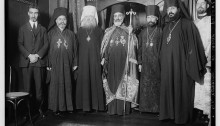
Group photo from the 1910 Convention of the Russian Orthodox Catholic Mutual Aid Society

0
Convention of the Russian Orthodox Catholic Mutual Aid Society, May 15-21, 1910

Convention of the Russian Orthodox Catholic Mutual Aid Society, May 15-21, 1910

I recently received the above photo in an email from Deacon Steven Kroll, who offered the following details:

Over the past several months I have been traveling up to Hartshorn, OK to serve alongside the priest who is caring for the remainder of the the faithful at Sts. Cyril & Methodius. This month I took my iPad with the intention of photographing several items around the church (old ledgers & metrical books, icons, and photograph in the church hall. One of these photographs in particular I want to share with you. Its from 1910 and there are quite a few orthodox clergymen in the photo, as well as a bishop’s portrait at the top of the photo. I was hoping you could take a look at it and see if you can identify any of the clergy by sight. The priest near the center seated in the front row resembles pictures I’ve seen on your website of Alexander Hotovitzky. The bishop at the top reminds me of St. Raphael of Brooklyn, but you may know better.
As the photo itself indicates, it was taken during the convention of the Russian Orthodox Catholic Mutual Aid Society, held from May 15-21, 1910. Right off the bat, I can say with confidence that the black-bearded bishop in the front row is Bishop Alexander Nemolovsky, future head of the Russian Archdiocese. I agree with Deacon Steven that Fr. Alexander Hotovitzky, the future martyr, is sitting to the left of Bishop Alexander. No idea who the bishop is in the big photo at the top, though. It’s definitely not St. Raphael Hawaweeney.

Thanks very much to Deacon Steven for passing this along. If any of our readers can identify some of the people in this photo, let me know and I’ll update this post.

Update: According to Fr. David Mastroberte, over on our Facebook page, the priest to the left of Fr. Alexander Hotovitzky is Fr. Peter Kohanik, who served in the Russian Archdiocese for many years.

Antiochian clergy collage

Amazing photo collage of Antiochian priests, circa 1920

0
Antiochian clergy collage

[Click to enlarge]

First of all, I’m really sorry for my extended absence from this website. Beginning in December, my life went pretty crazy — first the end of law school, then studying for the bar exam, and then moving and starting my legal career. Unfortunately, I’ve had no time at all for historical research.

Right in the middle of this chaos, I received a really awesome email from Fr. Timothy Ferguson, an Antiochian priest in Boston. He had discovered a photo collage of Syrian/Antiochian priests from the late 1910s/early 1920s — 21 clergymen in all. The collage is posted above, and here’s a list of the clergy depicted (and I’m retaining the spelling provided by Fr. Timothy’s sources):

Center:

  • Archbishop +Aftimious, Bishop of Brooklyn, Syrian Orthodox Mission in North America (Center)
  • V. Rev. Basil M. Kerbawy, Dean of the Clergy (Left of Bishop)
  • Rt. Rev. Emmanual Abu Hattab (Right of Bishop)

From Top Left:

  • Rev. Daniel Tanoos Jerguis
  • Rev. Eli El Hamati
  • Rev. Ayoub Salloom
  • Rev. Antonious Abu Alan Farah

Across the Bottom, Left to Right:

  • Rev. Sliman Boulos
  • Rev. Theodore Yanni
  • Rev. Yousef Kacere
  • Rev. Abraham Zaine
  • Rev. Hanna Hakim
  • Rev. Abdallah Khoury
  • Rev. Constantine Dawani
  • Rev. Philipous Abu Assaley Shaheen

From the Top Right:

  • Rev. Mousa Abi Haider
  • Rev. Elias Fraij
  • Rev. Michael El Khoury Saba
  • Rev. Solomon Faireny

Insert Below Fr. Kerbawy:

  • Rev. Sophronious Beshara

Insert Below Fr. Abu Hattab:

  • Rev. George Kattouf

Not Pictured:

  • Rev. Solomon Merighe
  • Rev. Simion Issa
  • Rev. George Dow Maloof
  • Rev. Yousef Elia
  • Rev. Basil Mahfouz

Many thanks to Fr. Timothy Ferguson for sharing his amazing find!

Patriarch Meletios Metaxakis

A Snapshot of Interwar Orthodoxy: The Ecumenical Patriarchate

1

Yesterday, we began publishing a series of excerpts from Matthew Spinka’s 1935 article on worldwide Orthodoxy in the years following World War I, originally published in the journal Church History.Spinka’s article is a succinct and quite balanced summary of the state of affairs in global Orthodoxy in a very chaotic period. From the standpoint of Orthodoxy in America, it helps a great deal to understand just what the Orthodox climate was like in this era. As I noted yesterday, this was precisely the time when national ethnic jurisdictions were being established in North America. A better understanding of the global Orthodox situation will help us to put the American situation in its proper context.

What follows is the section of Spinka’s article dealing with the Ecumenical Patriarchate.


To begin, then, with the group of Greek churches, we may first of all turn our attention to the patriarchate of Constantinople, the lineal descendant and heir of the Byzantine church. But this body, which had survived the fall of the Byzantine Empire and despite the prolonged misery and degradation suffered under the Turkish reign, had exercised ecclesiastical and civil sway over territories co-extensive with the Turkish Empire, scarcely escaped a total destruction when the new nationalist Turkey was set up by Mustapha Kemal Pasha. When the Kemalists refused to accept the Sevres treaty and in the end raised a standard of revolt even against the sultan himself, Greece, under the leadership of King Constantine, ventured to attack the embattled hosts of the Turkish nationalists, a megalomaniacal venture which ended in a complete fiasco and cost the king his throne. The Greeks of the patriarchate remained loyal to Venizelos, thus antagonizing King Constantine; but despite this, they could not altogether refrain from following with patriotic pride or solicitude the fortunes of the Greek armies in Anatolia. Although Turkish subjects, they held commemorative services for the fallen, collected contributions for the war cause, and openly espoused the Hellenic “grand idea” of restoration of the Byzantine Empire.

Patriarch Meletios Metaxakis

It was under these conditions that the patriarchal see, vacant since 1918, was filled in 1921 by the election of the former Archbishop of Athens, Meletios. But the new patriarch’s enthusiastic espousal of the Hellenic cause made his tenure of the patriarchal see quite impossible. After the debacle of the Greek armies in the disastrous battle of the Sakaria River in the autumn of 1922, Meletios’ situation became desperate. The victorious Turkish nationalists openly announced their intention of wholly abusing the ecumenical patriarchate, regarding it as a perpetual source of anti-Turkish agitation. At the Lausanne Conference in 1923, the British commissioner, Sir Horace Rumbold, had to exert all his diplomatic ingenuity to forestall the radical measure insisted upon by the Turks. In the end, the patriarchate was permitted to exist, but it was shorn of all the civil jurisdiction over the Greek community which it had exercised for the past four centuries, and its functions were restricted to purely ecclesiastical ones. But in the matter of Patriarch Meletios’ deposition, the Turkish delegation remained adamant. He had to go.

Beside these measures, the Lausanne Conference adopted a plan of forcible exchange of population between Turkey and Greece, from which none but the Greeks established in Constantinople and its immediate environs prior to October, 1918, were exempted. The exodus of the Christian population of Asia Minor in the wake of the defeated Greek armies as well as the forcible expulsion of the rest, in accordance with the population exchange measure, had a disastrous effect upon the ecumenical patriarchate; in fact it all but ruined it. Only four metropolitanates out of forty-one survived the measure, some of the ruined sees having been among the most ancient and celebrated, with traditions which went back to the times of Paul. The Orthodox population of Asia Minor and Thrace, which in 1914 had numbered 1,800,000, was reduced to between thirteen and twenty per cent (the church claiming 350,000, but the official Turkish count reporting 250,000). Even this number is continually dwindling, for the Greek population is moving out of Turkey. Thus the numerical strength of the ecumenical patriarchate has been so radically reduced that it now ranks among the smallest of the Orthodox communions.

The present patriarch, Photius II, who was elected in 1930, was able to establish a precarious modus vivendi with the Turkish government. Just because of the great diminution of the power and extent of the ecumenical patriarchate within Turkey, it strives with great earnestness to preserve for itself the traditional privileges inherent in its honorific status as the “primus inter pares” among the Eastern Orthodox communions. In this endeavor it has often exceeded its authority in acting as judge and arbiter in the various disputes or administrative changes which have taken place among the different Orthodox communions, over which, strictly speaking, it has no jurisdiction.


Next, we’ll publish Spinka’s discussion of the other “Greek churches” — the Church of Greece and the Church of Cyprus.

A Snapshot of Interwar Orthodoxy: Introduction

0

In the June 1935 issue of the journal Church History, Matthew Spinka of the Chicago Theological Seminary published a 20-page article entitled, “Post-War Eastern Orthodox Churches.” The “War” he was referring to was, of course, World War I, and his article offers a succinct and quite balanced snapshot of the state of the world’s various Orthodox Churches in the years immediately following the war. I’m going to publish a series of excerpts of the article, beginning with the Spinka’s introductory comments.

Of course, this period — 1918 to the mid-1930s — was the era in which the various ethnic jurisdictions were firmly established in America. It’s a critical period in American Orthodox history, and it helps to understand the global context of that time.


From the downfall of the Byzantine Empire in 1453, the center of Eastern Orthodoxy slowly shifted from the Byzantine church, which suffered a tragic deterioration under the rule of the Turk, to the Empire of the Russian Orthodox tsars. Before the World War, the predominant role in numbers and resources as well as in spiritual and theological leadership was played by the church of Russia. Out of a total of some 144 millions of Orthodox adherents, the Russian membership comprised about 110 millions. By reason of its wealth and of the generous financial aid which it freely dispensed to the rest of the needy Orthodox communions, Russia exercised a far reaching, in some instances controlling, influence among them. Moreover, Russian Slavophil[e] thought has affected all Orthodox communions and has exercised a dominant theological influence over them.

The World War has produced another radical regrouping of the separate units of the Orthodox churches, and has once more shifted the center of gravity, this time from Russia to the Balkan peninsula. In accordance with an unwritten law in which the Erastian principle, so characteristic of Eastern churches, finds its expression, each independent political unit is accorded an autonomous or autocephalous ecclesiastical status. Accordingly, the creation of new states or expansion of the already existing ones has resulted in the organization of nine new Orthodox communions, while some formerly independent organizations have lost their separate existence and have been incorporated into larger national bodies. The net result of the various changes has been that the total number of Orthodox communions has considerably increased: there are at present twenty-one autocephalous or autonomous Orthodox bodies, instead of the fifteen which existed before the War.

In order to divide the subject in some logical fashion, one might conveniently group the Greek churches together, for they in reality form a self-conscious whole; the so-called Melkite group may be treated separately [ed. note: here he refers to the Churches of Alexandria, Antioch, and Jerusalem, rather than the Melkite Catholics who are in communion with Rome], the Russian church, and its successional ecclesiastical groups, form a separate group by reason of their historical sequence and territorial propinquity. The Balkan churches likewise form a convenient grouping.


Next time, I’ll publish Spinka’s discussion of what he calls the “Greek churches” — that is, the Ecumenical Patriarchate, the Church of Greece, and the Church of Cyprus.

Photius Kavasales Fisk

Two Greek youths come to America in 1823

0

Photius Kavasales Fisk (image from the biography by Lyman Hodge)

Years ago, on an online database, I came across an article titled “The Two Greek Youth” and published in the April 1823 issue of The Guardian, or Youth’s Religious Instructor, a short-lived American magazine. According to the article, Protestant missionaries brought these two boys over from Malta to study at the Cornwall School in Connecticut.

One of the boys, Anastasius Karavelles (age 11) was the son of an Orthodox priest. Anastasius was born at Zante (Zakynthos), but the family moved to Malta when he was a small child. The other boy, Photius Kavasales, was a 15-year-old orphan who had lost almost his entire family (parents and six siblings) to the plague in Smyrna nine years earlier. He lived in a hospital for a few years, and when he was about 11 he was sent to live with an uncle in Malta. This uncle gave the Protestant missionaries permission to bring Photius to America.

According to the magazine, the boys both knew Greek, Italian, and Maltese, and before starting classes at the Cornwall School, they planned to spent time in Salem, Mass. and study English. The brief magazine article closed with a fundraising plea: “It may be proper to add, that their only dependence for support is upon the charity of the public — it is hoped that a generous sympathy will be felt for them, not only upon their own account, but on account of their oppressed and bleeding nation.”

Ah, yes, that’s right — this was smack-dab in the middle of the Greek War of Independence. Malta had become a part of the British Empire in 1819, but even so, the war in Greece must have placed some part in the boys’ (and their guardians’) thinking.

In any event, I always wondered, what happened to those boys? Is it even possible to find out, nearly 200 years after the fact, what became of a couple of Greek foreign exchange students from the 1820s?

To my surprise, it was kind of ridiculously easy. Do a quick Google search for “Photius Kavasales,” and you’ll find an act of the United States Congress dated May 3, 1848, authorizing the change of Navy chaplain Kavasales’ name to “Photius Fisk.”

Why Fisk? Because a certain Rev. Pliny Fisk was young Photius’ patron. In 1891, a biography of Photius Kavasales Fisk was published, written by Lyman F. Hodge, and it’s chock-full of information, including a lengthy letter from Rev. Fisk himself. (The entire book is available on Google Books.)

Apparently, Rev. Fisk was working as a missionary at Malta when, in the summer of 1822, he ran into the teenage Photius and invited him to attend the mission’s Sunday School. Photius turned out to be a star student, and Fisk invited him to come to America and receive a full education. Photius’ uncle agreed, and everything was arranged.

As all this was happening, one of the local Orthodox priests, Fr. John Karavelles, asked about the possibility of sending his son Anastasius to America as well. Of course, the Protestants thought this was a fabulous idea, and both boys were signed up. Here’s how Lyman Hodge describes what happened next, in his biography of Photius:

Having been .associates and playmates from the time that Photius came to the island, the boys had become fast friends; and Mr. Fisk had promised that they should be kept together, and should be instructed in the same schools. But, in order to unite them in still closer and more endearing relationship to each other, they were made brothers, through the impressive ceremonies of the Greek Church. Clad in his sacerdotal robes, the priest, after an appropriate address to the two boys, bound them together with a girdle, and laying his sacred hands upon their heads, he solemnly pronounced them brothers, and declared that the bonds of relationship were indissoluble.

This rare and little known ceremony, called “adelphopoiesis,” is a sacramental rite to make two men brothers. That’s what the term literally means, and it’s how the ceremony has been used in the Orthodox Church from time immemorial. Not too long ago, a Yale historian came up with the idea that adelphopoiesis wasn’t actually about making men brothers, but rather that it was a rite of same-sex marriage. This theory had the lovely features of lacking any historical foundation whatsoever and simultaneously appealing to modern trends, so it’s gotten some unwarranted attention, but it’s been successfully rebutted by both Orthodox and secular scholars.

Anyway, Photius and Anastasius were made brothers, and they sailed for America. After completing their studies, both young men returned to Greece. Anastasius remained there, but Photius loved America and soon returned. He became a Congregationalist clergyman, eventually changed his name to Photius Fisk in honor of his patron, and had all kinds of interesting adventures that you can read about in Lyman Hodge’s book.

After Photius returned to America, he didn’t see Anastasius again for almost half a century. The two were briefly reunited when Photius visited Greece in 1871. Anastasius had done quite well for himself: according to the Biographical Record of the Alumni of Amherst College, after returning to Greece he had studied law, become a judge, and worked as director of telegraphs at Syra, Greece. After the visit, Anastasius wrote a touching letter to Photius:

I received with the greatest pleasure your portrait and the Park Street views. I am very sad that I have not been able to fulfil my promise to you to go to Athens. I am a slave to a miserable salary, and consequently not free to do according to my wishes. We are not brothers by necessity, but by our own choice and circumstances. We left Malta when boys together, and with the same hopes ventured the great ocean of chance to find a home and happiness. Fortunately, we are both safe from the danger of destitution in this life. We had the happiness to see each other, separated as we had been by oceans. We may see each other again,— God knows. The early impressions of our boyhood have been indelibly fixed upon our minds and hearts. We have loved each other truly and fraternally. My dear Photius, remember me ever, as I will remember you. If idolatry is a sin, I will commit that sin in remembering you always; and, seeing your portrait, I will love you sincerely to the end of my life.

Mrs. Karavelles and my children desire to unite with me in expressing their sincere thanks to you for the love you bear to me, and participate in this proffered love. Please write to me how long you intend to remain in Athens, and if you intend to come again to Syra.

I remain yours, truly and sincerely,

A. Karavelles.

Photius died in February 1890, at the age of about 83. I’m not sure when Anastasius died, but it was before Photius; the aforementioned book on Amhearst College alumni was published in 1883, and Anastasius had already been dead for “several years.”


Go to Top