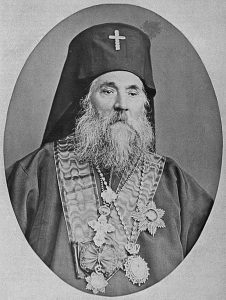
Posts tagged 1872
Early priests in New Orleans
Holy Trinity Church in New Orleans was the first organized Orthodox parish in the contiguous United States. Despite that fact, precious little is known about its early history. The first priest to visit New Orleans was the infamous Fr. Agapius Honcharenko, but, contrary to popular belief, Honcharenko was not actually the parish priest. He was only in town for a short visit, after which he returned to New York and then moved to the San Francisco Bay area.
The actual first pastor of Holy Trinity seems to have been Archimandrite Stephen Andreades. He was there as early as December 1867, when he gave a homily which was translated into Russian and published the following March in Honcharenko’s Alaska Herald. I haven’t seen the homily itself, but according to Fr. Alexander Doumouras (St. Vladimir’s Theological Quarterly, 1967), “In this sermon Fr. Andreades stated that he had been ‘invited from Greece’ to come to America and serve the parish in New Orleans. He did not state who invited him and who appointed him.”
I don’t know when Andreades left Holy Trinity, but I do know that, by 1872, Fr. Gregory Yayas was the parish priest. I’ve seen all sorts of spellings for Yayas’ name, including, “the Right Reverend Father Gregorio Therodidasme von Giagias.” I’ve only found one account of Yayas, from Elizabeth Brooks’ Prominent Women of Texas (1896). In the chapter on Mrs. V.O. King, we find the following:
The Greek became to her [Mrs. King] a familiar tongue, but only as it was spoken twenty-five hundred years ago. A new ambition seized her; the modern or Romaic Greek must be acquired. The design was scarcely formed before events were so ordered as to favor its accomplishment. Her husband removed to New Orleans to practice his profession [medicine], where, very soon, he made the acquaintance of Father Gregorio, priest of the newly-organized Greek Church in that city. The Reverend gentleman was a scholarly man and deeply cultured in both the modern and Hellenic literature of his country, but he knew not one word of English and he was thrown among people who knew not one word of Greek. When Mrs. King, therefore, proposed that he should become her teacher in the colloquial forms of his language, he was not loth to accept the charge. As the years went by, the interest of both pupil and preceptor daily grew with the progress they made, and when this relation ceased they talked together in his native tongue as freely as Greek might discuss with Greek the school of Plato in the grove of Academus.
Yayas’ tenure appears to have been rather brief, 1872 to 1874 or ’75. As best I can tell, Andreades and Yayas were the first ethnic Greek priests to serve in America.
Yayas did not have an immediate successor. It wasn’t until 1881 that Holy Trinity received a new priest. Archimandrite Misael Karydis (or Michael Kalitski, or Karidis, or Karidas, etc.) was from Philippopolis, Bulgaria, and was born sometime in the 1840s. The Chicago Herald (5/31/1886) described him as “a stout, florid-faced man, with long, wavy hair, a high forehead and thick moustache and chin beard.” The Biloxi Daily Herald (6/7/1901) said that he “resembled the pictures of the patriarchs of old, with his long flowing snowy white beard.”
Karydis was a pretty colorful figure, and in some upcoming posts, I’ll discuss his career and his tragic death.
Plans for a New York church in the 1870s
Immediately upon Fr. Nicholas Bjerring’s arrival in New York City in 1870, news spread that the Russian Church planned to construct a great temple in the city, on the corner of 51st Street and Lexington Avenue. This is from the Christian Advocate journal (6/29/1871):
A magnificent structure is about to be erected by the Russian government on Lexington Avenue for the devotions of the members of the Greek faith in this city and country. The designs will arrive here in a few days from St. Petersburg, when the work will at once be commenced. When finished the church will have cost between $500,000 and $600,000.
Half a million dollars in 1871 works out to something close to $9 million today. I’ve seen other references putting the figure at $200,000 to $300,000, but regardless, it was a pretty big chunk of change, and I have a little trouble believing that the Russian government was really going to foot that kind of bill for a representation church. In 1866, estimates out of Russia put the total cost of the proposed church at $20,000, or a little over $350,000 in modern terms, which sounds a lot more reasonable.

Konstantin Katakazi (Catacazy), Russian ambassador to the United States
Already, the Russian ambassador, Konstantin Katakazi (or Catacazy), had spent $20,000 to purchase the necessary land. When Grand Duke Alexis arrived in America for his famous visit in the fall of 1871, he brought with him plans for the building.
Everything looked like it was going smoothly, until the next summer. From the New York Times (7/22/1872):
The site was purchased by him [Catacazy] for $17,000 in currency. When the deed came to be made out Catacazy desired that $20,000 should be inserted, instead of the amount actually to be paid. There was some difficulty experienced in getting this done, but the intriguing diplomat at last succeeded. By paying the increased cost of revenue-stamps, and possibly using some other inducements, the character of which are not stated. Then he drew on his Government for $20,000 in gold to pay for the site. These facts became known to or suspected by some of the Russians in New-York, who had an interest in the matter, and through them it was made known to the Russian Foreign office. When Catacazy was tried on his return, this was one of the charges which his own Government placed before the Commission for investigation, and it was fully proved.
It might just be a coincidence, but this report ran on exactly the same day that the same newspaper reported on Bjerring’s return to New York after a lengthy visit to Russia. Whether through Bjerring or some other channel, in the summer of 1872, the Russian government figured out that Ambassador Catacazy was skimming money. He had other issues as well (check out his Wikipedia entry), and he was soon exiled to a lowly post in Paris.
As you might expect, plans to build the New York church ground to a halt. But the Russian government still owned the land on Lexington Avenue, and two years later, the plans were revived. From the Baltimore Sun (9/17/1874):
The Russian chapel in New York being too small to accommodate the members of the Greek Church in that city, Russian subjects there have represented to the imperial government the need of a new church edifice for their use, and plans for a structure to cost $85,000 have been sent to St. Petersburg for approval. About $35,000 in aid of the project has already, it is understood, been obtained from various sources, Mr. Ross Winans, of Baltimore, having given $10,000. A plot of ground for such a church was purchased for the Russian government three years ago.
Who, you might be wondering, was Mr. Ross Winans? Well, from his Wikipedia entry, he was one of the first American multi-millionaires, an “inventor, mechanic, and builder of locomotives and railroad machinery.” Also, there’s this:
The Winans engine designs impressed a Russian delegation, and he was asked by the Czar to build the Imperial railroad from Moscow to St. Petersburg. Winans sent his two sons, as well as engineer George W. Whistler to Russia for several years for that project. Winans may have sold as much or more equipment in Russia as he did in the United States. Winans’ son returned to build a Russian style estate in Baltimore, named Alexandrofsky.
So Ross Winans had some serious ties to Russia and the Russian government, and also some serious capital at his disposal. The New York Orthodox, for their part, had apparently scaled back their ambitious plans, reducing the proposed cost of the church from several hundred thousand dollars down to $85K (around $1.6 million today).
Despite that encouraging report, the church was never built. I’m not sure what happened. Even on the eve of the New York chapel’s dissolution in 1882, there were still reports that the Russian government planned to construct a great edifice in the city, but of course they never materialized.
Not everyone realized this. In their 1871 Annual Cyclopaedia, D. Appleton & Company said this:
The first building in the United States designed expressly for a Greek church was erected in the city of New York, during 1871. It is on Lexington Avenue, between Fifty-first and Fifty-second Streets. The cost, about $260,000, is defrayed by the Russian Treasury in St. Petersburg. The church is attached to the Russian legation in the United States, but is directly under the supervision of the Metropolitan at St. Petersburg, and is not in anyway connected with the diocese of the resident Greek bishop at San Francisco.
They were wrong, of course; when that statement was written, the New York church was only in its earliest planning stages. What’s especially interesting about this Appleton’s reference is the assertion that the New York chapel was under the direct authority of the Metropolitan of St. Petersburg, rather than the Bishop of the Aleutian Islands and Alaska.
In any event, it’s not clear precisely why the plans for the church never came to fruition. Perhaps the money just couldn’t be raised — after all, New York’s Orthodox community was small and generally not wealthy. Perhaps the Catacazy scandal made the Russian government think twice about investing in a New York church. Perhaps the Russian Church changed its mind about the need for a great building in New York. The answer is out there somewhere, probably in some church archive back in Russia.
Also, what happened to the Lexington Avenue property? By all accounts, the Russian government had already bought the land.
As with so many of the stories we recount here at OrthodoxHistory.org, this one ultimately leaves us with more questions than answers.
The New Orleans Gospel Book
In 1927, Fr. Boris Burden wrote the following:
The Church of the Holy Trinity in New Orleans, La., claims to have been the first Greek church in the United States. On the occasion of its dedication in 1860 Alexander II, Czar of Russia, sent to its Greek Priest, the Reverend Father Michael, a gold-embossed Book of Gospels in token of his imperial pleasure over the beginning of Greek-speaking churches within the American diocese of the spiritual jurisdiction of the Holy Synod of the Orthodox Church in Russia. For nearly fifty years after the Russian Hierarchy in America had thus established the first Greek church in this country Greek churches and faithful continued to increase and multiply under the care and authority of the Russian Bishops of America.[1]
This quotation (and, frankly, Burden’s whole article) is fraught with inaccuracies. Unfortunately, Burden had a pretty significant influence on later thinking about American Orthodox history, so his errors have become, in many places, conventional wisdom.
- The New Orleans Greek church was not dedicated in 1860. It appears to have been dedicated around 1866; in any event, it was the late 1860s.
- The “Reverend Father Michael” (aka Fr. Michel Kalitski, Fr. Michael Karydis, or Archimandrite Misael — all, apparently, the same person) didn’t become the pastor of the church until about 1881.
- The Russian Church certainly didn’t found the New Orleans parish.
- The claim that Greek parishes, for the next half-century, ”increased” and “multiplied” under “the care and authority of the Russian Bishops of America” just doesn’t hold water. The next Greek parish, period, was founded in New York in 1892, under the Church of Greece. The overwhelming majority of Greek people, parishes, and clergy were completely independent of the Russian bishops.
Anyway, my point is not really to pick apart Fr. Boris Burden’s 82-year-old essay. No, I want to focus on one aspect in particular: the “gold-embossed Book of Gospels.”
The first traces that I can find of this Gospel Book date to 1872. That year, the Russian Grand Duke Alexis was touring the United States, and in February, he visited New Orleans. Among those greeting him upon his arrival were representatives of Holy Trinity Church, among them Nicolas Benachi, the Greek Consul. From the Daily Picayune, a New Orleans newspaper (February 15, 1872):
Mr. Benachi took occasion to add a few remarks on their behalf, praying His Highness to think his mother, the Empress of Russia, for the kind solicitude she had manifested for their Church, and the rich presents which she had bestowed upon the tiny edifice, situated on Dorgenois Street, near the corner of Ursulines; and also to express to the Empress the wishes of thee Greek and Russian congregation of New Orleans for the welfare and prosperity of the Imperial family of Russia.[2]
The Gospel Book appears to have been one of the gifts sent by the Empress — that is, the Tsarina, rather than the Tsar. But the text isn’t really clear on when she sent the book. Was the parish thanking the Grand Duke for a gift sent prior to his visit, or were they thanking him for a gift that he himself had brought, on that trip, on his mother’s behalf?
In any event, the Gospel Book was far from the only gift sent by the Empress. A travel guide from 1885 mentions that the parish had a “rare Madonna and child, brought from the far-off shrine of St. Petersburg.”[3] Another 1885 book describes an icon “of Christ partaking of the sacrament; around it in Russian: ‘He who takes the sacrament never dies.’”[4] A 1904 guide to New Orleans says, “The ornaments on the altar were presented by the late Empress of Russia.”[5]
When I spoke with the current pastor of Holy Trinity several months ago, he confirmed that the parish still possesses a Gospel Book and old icons from Russia; these are almost certainly the same items that were present in 1872. I’d love to get some photos of those things, particularly photos of any inscriptions that might appear. (If anybody out there can help, let me know!) That might help us better understand when the items were sent, and what exactly they meant to the sender and the recipients.
____________________________________________________________
[1] Hieromonk Boris (Burden), “The Holy Eastern Orthodox Catholic and Apostolic Church in North America,” Orthodox Catholic Review 1:1 (1927), 10.
[2] His Imperial Highness Grand Duke Alexis in the United States of America During the Winter of 1871-72 (Cambridge, MA: Riverside Press, 1872), 216-218. This was taken directly from the February 15, 1872 issue of the New Orleans Daily Picayune.
[3] Lydia Strawn, “The North, Central and South American Exposition, New Orleans. Opens November 10th, 1885. Closes April 1st, 1886.” In Pen Points from the American Exposition, Presented by the Illinois Central R.R. (Chicago: R.R. Donnelley & Sons, 1885), 10.
[4] Historical Sketch Book and Guide to New Orleans and Environs (New York: Will H. Coleman, 1885), 121.
[5] The Picayune’s Guide to New Orleans (New Orleans: The Picayune, 1904), 58-59.