Posts tagged Nicola Yanney

New document on life of Fr. Nicola Yanney

0
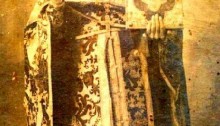
Fr. Nicola Yanney

Fr. Nicola Yanney

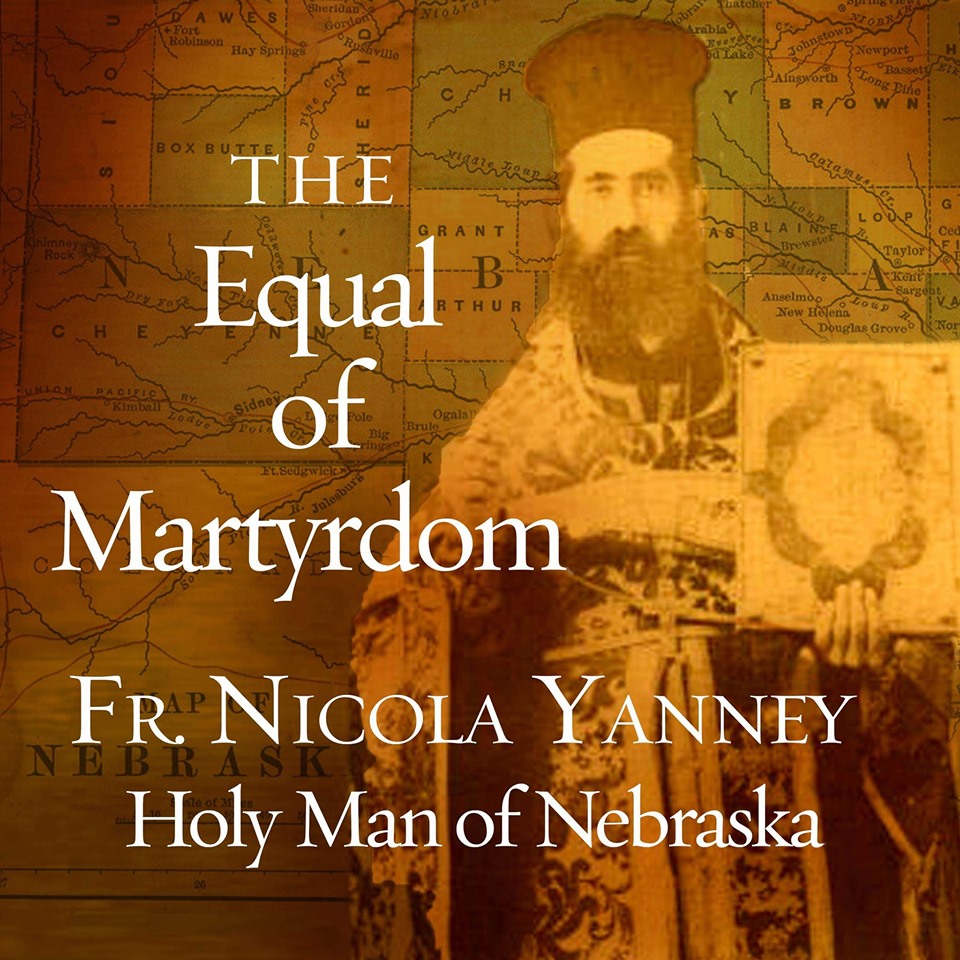
Fr. Nicola Yanney is one of my favorite priests in the history of Orthodoxy in America. He immigrated to America at age 19, in 1892-93, with his new wife. They immediately settled in, of all places, Nebraska. Nine years later, she gave birth to their fifth child — and died in childbirth, leaving Nicola as a 29-year-old widower with five small children. The new baby died soon thereafter. I am 29 and have three kids, and I cannot fathom how painful and overwhelming this must have been for Nicola.

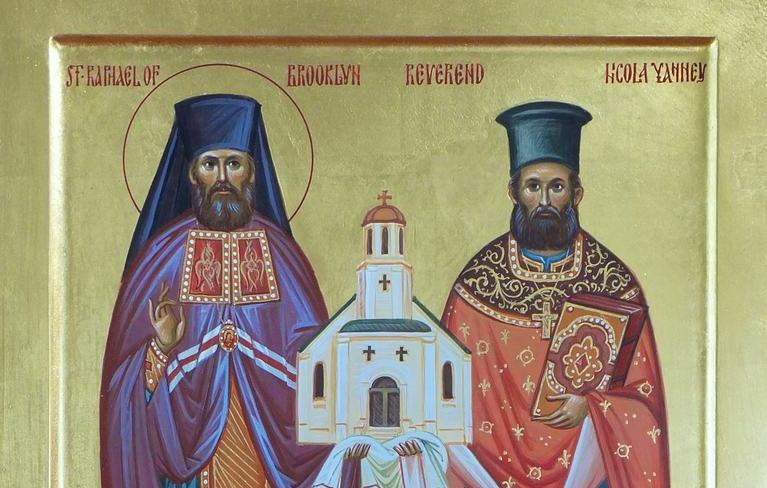
Two years later, the local Antiochian Orthodox community in Kearney, Nebraska asked that Nicola be ordained to serve as their priest. He traveled to Brooklyn, where the newly consecrated Bishop Raphael Hawaweeny educated and ordained him. Fr. Nicola was the first priest ordained by St. Raphael. He might have been the best, too — while continuing to raise his children as a single parent, he traveled all over the middle of the country, visiting Orthodox people in remote areas and performing baptisms, weddings, and funerals. For example, in 1911, he made at least 35 pastoral visits to at least a dozen different states and performed a total of 85 baptisms. That was in addition to serving his own parish in Kearney, and raising his four surviving children without a wife.

The Spanish flu pandemic hit the United States in 1918, and a number of Fr. Nicola’s Kearney parishioners were infected. That didn’t deter Fr. Nicola, though — he continued to minister to them, bringing them communion and hearing their confessions. You can probably guess where this is going: eventually, he caught the flu himself. It led to pneumonia, and he died on October 29, 1918. The cause of death may have been pneumonia brought on by the flu, but in reality it was a tireless devotion to his people. Few Orthodox priests in America have ever died so well.

Anyway, Fr. Nicola’s parish recently published a wonderful 74-page document on their website. It’s part detailed timeline, part photo gallery, and part sacramental registry. Here is how the Kearney priest, Fr. Christopher Morris, described it to me in a recent email:

We are doing some research into the life of Fr. Nicola Yanney. The research is on-going, but we decided to print the information we have right now in the form of a timeline and a list of dates/places that Fr. Nicola visited during his missionary journeys. The list of dates/places was translated from Fr. Nicola’s sacramental records which are in Arabic and in possession of his family. This work was started quite a while ago by a parishioner from Iraq, Bob Suleiman. Bob and Fr. Nicola’s granddaughter, Minnette Steinbrink, began the translation work. But Minnette was soon diagnosed with cancer and died not long afterward. Bob’s health declined and the work stopped (he has since died), probably 12+ years ago. Recently, Fr. Nicola’s great-grandson discovered the baptismal records, and Bob’s wife, Virginia, completed the translations of the baptisms. While poking around through some old notebooks in our church office, I found a notebook that turned out to be Fr. Nicola’s records for funerals and marriages (the notebook had been recycled by another priest 50 years later, but he left Fr. Nicola’s records intact). Virginia Suleiman translated all of these records, as well.
We have also looked through our local newspaper’s archives, two Yanney family histories, and several old church histories written by founding members in order to compile the timeline. We recently found out that there was more than one local paper in Kearney during Fr. Nicola’s time. There is a very detailed description of his account of St. Raphael’s funeral in one of these previously unknown (at least to me) local papers. We will look for archives of this other paper in hopes of finding more about Fr. Nicola. There are also other untranslated materials in possession of the family. And we are hoping to look at some out-of-state local newspapers now that we have a list of dates and times. There you have it!
Fr. Christopher says that they will also be producing hard copies of the document. To download it in PDF, click here. I hope this will lead to further research and inquiry into the life of Fr. Nicola, who was a truly outstanding priest.
Delegates to the 4th All-American Sobor, Detroit, MI, April 1924

This week in American Orthodox history (April 2-8)

0

April 3, 1904: On Palm Sunday, Fr. Nicola Yanney was ordained to the priesthood by St. Raphael Hawaweeny. Fr. Nicola was a young widower living in Kearney, Nebraska. His wife had died during childbirth in 1902, just days before  her husband’s 29th birthday, leaving behind three other children. In August of 1903, the Syrian Orthodox of Kearney decided that they wanted a priest, and they asked the 30-year-old Nicola to take the position. The next year, he went to Brooklyn and studied under the soon-to-be Bishop Raphael. In March 1904, Raphael was consecrated, and a few weeks later, he ordained Fr. Nicola — the first ordination ever performed by St. Raphael. Fr. Nicola was given responsibility for a vast territory; in addition to his regular pastoral duties in Kearney, he visited seven other states in his first eight months on the job. His life was difficult and inspiring — far too much to summarize here. I highly recommend reading the biographical article on Fr. Nicola written by Fr. Paul Hodge and published here at OrthodoxHistory.org.

April 2, 1922: St. Raphael’s remains were interred at Mount Olivet Cemetery in Brooklyn. After his 1915 death, St. Raphael’s body had been placed in a crypt in his Brooklyn cathedral, but a few years later, his successor Bishop Aftimios Ofiesh decided to move the cathedral to a new building, and Raphael’s body was moved to the cemetery. Decades later, it was transferred to the Antiochian Village in Ligonier, PA.

April 2-4, 1924:  [The following was written by Aram Sarkisian] The Russian Orthodox Archdiocese of North America convened in Detroit for the 4th All-American Sobor.  The Sobor opened with a Presanctified Liturgy and Molieben at All Saints Russian Orthodox Church on the city’s east side, but for lack of space moved downtown to the parish house of St. John Episcopal Church for its plenary sessions.

Delegates to the 4th All-American Sobor, Detroit, MI, April 1924

The 4th All-American Sobor was convened for several reasons, much of it having to do with the general turmoil the Archdiocese had experienced in the wake of the Russian Revolutions of 1917.  The most notable of its decisions is the oft-cited “Declaration of Autonomy,” in which the Archdiocese invoked Patriarchal Ukaz #362 of November 1920, in which Patriarch Tikhon gave leeway to dioceses to temporarily govern themselves when communication and regular contact with the authorities in war-torn Russia became insurmountable for normal church life, until such time as normal relations could be established.

In an April 12th telegram to Patriarch Tikhon announcing the decision, it was stated that this action was taken “as a way of self-preservation,” a somewhat imperfect solution to an intensely difficult set of questions facing the church in North America.  And, thus, the jurisdictional body which would become known as the Metropolia was formed, which would in turn receive its autocephaly from Moscow in 1970 and rename itself the Orthodox Church in America.

April 7, 1934: Metropolitan Germanos Shehadi died in Beirut. Met Germanos had come to America twenty years earlier as a visitor, raising funds for an agricultural school in his archdiocese in what is today Lebanon. But then St. Raphael, the Syrian bishop in America, fell ill and died, and the popular Germanos decided to remain in America. The Syrians splintered, and one faction — the “Antacky” — recognized the authority of Germanos. The other group — the “Russy” — favored Bishop Aftimios Ofiesh, who served under the Russian Church. Germanos’ position was pretty shaky, because his own Patriarchate of Antioch refused to bless his work in America and instead ordered him to return to his archdiocese. Germanos held out, but then in 1924, the Patriarchate sent an official delegation to America and established the modern Antiochian Archdiocese of North America. This seriously undermined Germanos’ position, and most of his “Antacky” parishes naturally switched over to the official Antiochian jurisdiction. Germanos hung around in America for another nine years before finally returning to Syria in late 1933. The 62-year-old Germanos soon fell ill and died several months later. In addition to his role in the Russy-Antacky schism, he is most remembered for two things: (1) he briefly oversaw a Ukrainian jurisdiction in Canada, and (2) he was renowned for his beautiful singing voice.

April 7, 1947: Fr. Georges Florovsky arrived in New York aboard the Queen Elizabeth. Later this week, we’ll be publishing an article by Matthew Baker on this event.

This week in American Orthodox history (January 30-February 5)

0

A lot of Antiochian-related events this week:

January 30, 1902: Archimandrite Raphael Hawaweeny, head of the Syro-Arab Orthodox Mission in America, began a pastoral journey to Mexico. Later this week — on February 3 — he made a brief stop in Cuba en route to Mexico’s Yucatan Peninsula. St. Raphael remained in the Yucatan for a month, until March 2. To his great surprise, he found not only Arab Orthodox Christians, but also many Mexican Catholics who were interested in converting to Orthodoxy. Unfortunately, this would be the only visit St. Raphael ever made to Mexico, and the missionary potential there was never realized. Incidentally, I’ve heard that the Mexican newspapers gave St. Raphael quite a bit of publicity, so if anyone reading this has access to Yucatan papers from 1902 (and can read Spanish), please let me know.

January 31, 1938: Metropolitan Samuel David, head of the Antiochian Archdiocese of Toledo, was excommunicated by both the Patriarch of Antioch and the ROCOR Holy Synod. The backstory was this: In 1935, the Arab Orthodox in America were set to elect a new hierarch who would, it was hoped, unite the long-divided factions of Antiochian Orthodoxy in America. The majority voted for Archimandrite Antony Bashir, who was duly consecrated in New York. But a strong minority favored Archimandrite Samuel David of Toledo. That minority found some other bishops to consecrate their man on the very same day that Bashir was consecrated. This division lasted until 1975, when Met Michael Shaheen of Toledo accepted subordination to Met Philip Saliba of New York.

February 1, 1928: The future Greek Archbishop (and Assembly of Bishops President) Demetrios Trakatellis was born in Thessaloniki, Greece. May God grant him many, many more years!

February 2, 1927: The Holy Synod of the Russian Metropolia (today’s OCA) created “The Holy Eastern Orthodox Catholic and Apostolic Church of North America” (more palatably known as the American Orthodox Catholic Church). This body — let’s just call it the AOCC — was led by Bishop Aftimos Ofiesh, who was simultaneously the head of the Metropolia’s Syro-Arab Mission. Whatever the intent of the Metropolia in creating the AOCC in the first place (and that intent is far from clear), Ofiesh himself viewed the AOCC as the vehicle for Orthodox unity in America. The AOCC was always on the fringe in terms of legitimacy, having been the ambiguous creation of the Metropolia, which itself was on shaky canonical footing in that era. (Only a few years earlier, the Metropolia had declared itself independent of the Soviet-influenced Moscow Patriarchate.) It wasn’t long before Ofiesh and his jurisdiction ticked off their Metropolia creators, driving the AOCC even further away from the mainstream. For all intents and purposes, the AOCC experiment ended in 1933, when Ofiesh married a young girl. However, as Fr. Oliver has recently shown, the AOCC did continue on until 1940 in the person of Bishop Sophronios Beshara, its last surviving hierarch. For a lot more on the AOCC, check out my conversation with Fr. Andrew Damick over at Ancient Faith Radio.

Fr. Nicola Yanney

February 5, 1873: The future Fr. Nicola Yanney was born in what is today northern Lebanon. Yanney eventually immigrated to America and settled down in Nebraska. After being widowed at a young age — and with a house full of young children — Yanney was chosen by his fellow Syrian parishioners in Kearney, NE to be their first parish priest. He traveled to Brooklyn and studied for the priesthood under St. Raphael, who had just been consecrated a bishop. In fact, Fr. Nicola was the first priest to be ordained by St. Raphael. Upon returning to Kearney, Fr. Nicola not only shepherded that community, but he was given responsibility for an immense territory — he was essentially responsible for all Arab Orthodox Christians living between Canada on the north and Mexico on the south, the Mississippi on the east and the Rocky Mountains on the west. Roughly speaking, he was the lone priest over all the territory that now comprises the Antiochian Diocese of Wichita and Mid-America. And he was a single parent.

Fr. Nicola was, by all accounts, an outstanding pastor. His end was a testament to his dedication: he died from influenza in 1918. Of course, that was the year of the horrible flu pandemic that killed so many millions. Fr. Nicola’s parishioners were among those dying from the disease, and rather than keep himself safe, Fr. Nicola went to his stricken people, hearing their final confessions and giving them communion. In this way, he caught the flu and soon died. It seems to me that he may be worthy of canonization. (To learn more about Fr. Nicola, read this article by Fr. Paul Hodge.)

Fr. Nicola Yanney

Fr. Nicola Yanney: the first Antiochian priest in Mid-America


Fr. Nicola Yanney

Editor’s note: The following article was written by Fr. Paul Hodge, pastor of St. Thomas Orthodox Church (Antiochian) in Sioux City, Iowa, and former priest of St. George Church in Kearney, Nebraska. It originally appeared in a 2008 commemorative journal, published on the occasion of a diocesan pilgrimage to the grave of Fr. Nicola Yanney, the first Antiochian priest to serve in the Great Plains. Fr. Paul has kindly given us permission to reprint the article here, but he did want me to indicate that “due to the dearth of written family records from Fr. Nicola’s lifetime further research may reveal some inaccuracies regarding certain names and dates, but that all information was correct and verified to the best of my knowledge when the article was written in 2008.”

At his enthronement as the first Bishop of Wichita and the Diocese of Mid-America [Antiochian] on December 15th, 2004 our father in Christ, Bishop BASIL, made the following remarks:

Shortly after his consecration to the sacred episcopacy a century ago – - on March 13th, 1904 — St. Raphael of Brooklyn performed his first priestly ordination, the ordinand being a young widower, Nicola Yanney, a native of the tiny village of Fi’eh in north Lebanon, living with his children on a farm in Gibbon, Nebraska. Father Nicola was ordained [on April 3rd, 1904] for what was then the westernmost parish of St. Raphael’s Diocese, St. George’s Church in Kearney, Nebraska, but he was given pastoral responsibility for an area that is nearly identical to the boundaries of our newly created Diocese of Mid-America. Father Nicola’s parish stretched from the Canadian border in the north, to the Mexican border in the south, and from the Mississippi River in the east, to the Rocky Mountains in the west. It is Fr. Nicola who, as a circuit riding priest headquartered in Kearney, followed the example of his Father-in-Christ, St. Raphael, and visited Orthodox Christians in the scattered towns, villages and isolated farm lands throughout America’s Heartland.

From this, we can already see Fr. Nicola’s life and work are significant to us today. He was our first priest and a progenitor of Orthodoxy in the Heartland. In his life he continued the missionary work of St. Raphael. And if we follow his life and work to the end, we see that he is important to us because of the witness he bore to Christ Jesus in the remarkable circumstances of his repose, as well. Certainly, in these things is the lasting legacy of Fr. Nicola to us in Christ’s Holy Church.

The future priest, Nicola, was born the son of Elias Yanney in Fi’eh al-Koura, north Lebanon, on February 5th, 1873. Although there is little certain record of his youth and family life there, we do know that he married Martha George al-Baik of Qilhat, the nearest village to the ancient Balamand Monastery of Our Lady in north Lebanon, on November 8th, 1892, at the age of nineteen. Soon after, Martha and Nicola immigrated from Ottoman Syria to Omaha, Nebraska.

On October 29th, 1893 the first son of the Yanneys, Elias (known later to his friends and family as “E.K.”) was born when Nicola was twenty years old. Their second child, a daughter named Anna, was born two years later, on the 4th of July, 1895. In that same year, the Yanneys moved from Omaha to Gibbon, Nebraska where they took up residence as farming homesteaders in a two room sod house known as a “soddie.”

Their third child, John, was born May 22nd, 1897 and their fourth child, Moses (known as Mose), was born to them on July 31st, 1899. Less than two months later, in the early autumn of that year, one Archimandrite Raphael Hawaweeny, on a mission trip from the recently established (1895) St. Nicholas Syrian Orthodox Church in Lower Manhattan, New York (relocated to Brooklyn in 1902) paid a visit to the Syrian community in and around Kearney, Nebraska and spent a day at what was very likely the Gibbon homestead of Fr. Nicola, as is recorded in the life of St. Raphael (Antiochian Archdiocese, 2000, pp. 38-39):

… He served Liturgy [in Omaha, Nebraska] on September 17 and then departed for Kearney, Nebraska arriving at midnight on September 20. The entire Arab community gathered to meet him. Exhausted from his travels, with a serious cold, St. Raphael stayed up until 4 A.M. speaking with the people. Too tired and sick to celebrate the Liturgy in the morning, he served the Typica service. In the afternoon he traveled to an outlying ranch [emphasis added], arriving there at 1 A.M. In the morning he celebrated Orthros with the Lesser Blessing of Water. In the evening, he returned to Kearney where he continued to meet with the people. On Sunday, September 24, at 4 A.M., St. Raphael served Liturgy, baptized six and performed a wedding…

The next three years, by the grace of God, were happy and prosperous ones for the Yanney family. But, as the well-known Funeral Idiomelon of St. John of Damascus asks, “What earthly sweetness remaineth unmixed with grief?” The stability of the early life of Nicola Yanney was capsized when, on February 11th, 1902 Martha died in bearing her second daughter, Catherine. Catherine herself died nine days later, compounding the sorrow. Through the kindness and compassion of a neighboring “American” farmer, Martha and Catherine were (and are) buried in a single, unmarked grave in the farmer’s own small, family cemetery outside Gibbon.

Nicola mourned his loss for eighteen months until, in late 1903 — at the invitation of St. Raphael and with the encouragement of the faithful of Kearney, who had just incorporated a church community under the patronage of St. George the Great Martyr — he made a journey to New York to receive training in preparation for ordination to the holy priesthood. He studied for a mere six weeks or soand during that time became a naturalized citizen of the United States of America on February 9th, 1904.

On March 13th, 1904 – the mid-Lenten Sunday of the Adoration of the Precious Cross — Archimandrite St. Raphael was consecrated as an auxiliary bishop to St. Tikhon, head of the North American Archdiocese of the Russian Orthodox Church, and given the title, “Bishop of Brooklyn” and head of the Syro-Arabian Mission. Shortly thereafter, Nicola was tonsured a Taper-bearer and Reader (March 17th, 1904), ordained a Subdeacon (March 20th, 1904), Deacon (April 2nd, 1904), and Priest, on Palm Sunday, April 3rd, 1904 — all at the hand of the newly elevated Bishop, St. Raphael.

Upon returning to Nebraska in 1904, the Yanney household relocated from the vicinity of Gibbon, Nebraska to a home in Kearney, where Fr. Nicola could be close to the center of his parish, the church of St. George. The church building was in Kearney, in a one room schoolhouse purchased from the Kearney Cotton Mill. The building still stands, having been long ago converted to a private residence. As of this writing, it may still be seen on the northeast corner of 11th and H Streets in Kearney.

While the structure of the church building was small, the boundaries of the parish itself were vast, encompassing all of the Great Plains of North and South Dakota, Nebraska, Kansas, as well as the “southwestern states,” as they were then known, of Oklahoma and Texas. Additionally, Fr. Nicola, during the years of his priesthood until his death, would answer the call of communities of Syrian Orthodox Christians as far away as Michigan, Illinois and Kentucky.

Here is a partial list of Fr. Nicola’s pastoral service during the first years of his priesthood, 1904-1905. Listed are just the baptisms performed by Fr. Nicola during that time. Other sacraments and services of the church were celebrated by him on his journeys and duly recorded in his “metric books,” or “Registry of Sacraments.” The data here are taken from those books.

Baptisms, 1904

  • St. Louis, Missouri, 5
  • Omaha, Nebraska, 2
  • Ironwood, Michigan, 5
  • Iron Mountain, Michigan, 2
  • St. Paul, Minnesota, 1
  • LaCrosse, Wisconsin, 3
  • New London, Wisconsin, 3
  • Kearney, Nebraska, 2
  • Bloomington, Illinois, 2
  • Fulton, Kentucky, 2
  • Campbell, Missouri, 2
  • [Gebmond], Missouri, 2
  • Morehouse, Missouri, 1
  • Rugby, North Dakota, 9

Baptisms, 1905

  • Rugby, North Dakota, 1
  • Kearney, Nebraska, 6
  • Ironwood, Michigan, 2
  • Iron Mountain, Michigan, 4
  • New London, Wisconsin, 1
  • Grand Rapids, Michigan, 2
  • Jackson, Michigan, 1
  • Cedar Rapids, Iowa, 6
  • Clinton, Iowa, 1
  • LaCrosse, Wisconsin, 1
  • New London, Wisconsin, 4
  • Rugby, North Dakota, 3
  • Sioux City, Iowa, 2
  • Albany, Iowa, 3
  • Omaha, Nebraska, 3
  • Lexington, Nebraska, 1
  • Kearney, Nebraska, 3
  • Wichita, Kansas, 3
  • Fort Dodge, Iowa, 1
  • Cedar Rapids, Iowa, 1

Among his first duties in 1904, however, was to serve the funeral of his first daughter Anna, who died that year at the age of eight. Years later, Fr. Nicola would again extend the ministry of the Holy Church to his own family when he celebrated the wedding of his son, Elias (E.K.) to Mary Abraham of Ironwood, Michigan.

The end of Fr. Nicola’s priestly ministry and Christian service on this earth came about in this way:

In the year of our Lord, 1918, the world was stricken with an epidemic of influenza, commonly called “the Spanish Flu,” which, it is estimated affected half a billion people across the globe, taking twenty million lives. Most of the dead in this worldwide catastrophe died not from the influenza itself, but from the pneumonia that would often follow the flu virus in the weakened lungs of the afflicted.

Kearney, Nebraska was not spared this suffering. In the optimistic days of the early twentieth century, the city fathers in Kearney, like many other Nebraskan communities, chose not to abide by the quarantine enacted by state authorities. This was perhaps not unreasonable, since in early autumn of 1918 the city had seen relatively few cases of the Flu and even fewer subsequent deaths. But with citizens freely associating at schools, public places and churches, the Flu would strike in a second, much deadlier wave in mid-October. At that time the city was officially quarantined and school classes, church services and other gatherings were outlawed for the sake of public health.

It seems that Fr. Nicola and the faithful of St. George observed this quarantine obediently, and for a few Sundays, as the sickness spread through the town, they all refrained from gathering together for the Liturgy as was their custom. Instead, Fr. Nicola himself “brought the Liturgy” to the homes of the faithful who were suffering and there continued his unflagging service of ministering the Holy Things to Christ’s flock. In this faithful service, Fr. Nicola contracted the Spanish Influenza and after one week of suffering, departed this life on October 29th, 1918. May his memory be eternal!

In closing, here are again words spoken by our father-in-Christ, Bishop BASIL, first bishop of Mid-America at his enthronement at St. George Cathedral in Wichita, Kansas in 2004:

We bless the memory of Father Nicola and his brothers in the sacred priesthood who came after him to minister to Christ’s flock in Mid-America, and we bless the memory of their wives and children and of all the sons and daughters of the Church who first brought Holy Orthodoxy to the Great Plains and witnessed to its Truth by their very lives. God grant that we be found worthy of their sacrifice.

To which words we can add only one: Amen.

[This article was written by Fr. Paul Hodge.]

Funeral of St. Raphael. I'm nearly certain that Fr. Moses Abihider is one of the clergymen in this photo, but I don't know which one. (Click to enlarge.)

95 years ago: The death of St. Raphael

The funeral of St. Raphael Hawaweeny, Brooklyn, 1915

This past Saturday was February 27, the 95th anniversary of the death of St. Raphael Hawaweeny, the great Syrian Bishop of Brooklyn. His death set off more than a week of commemorations in the Syrian Orthodox community. Telegrams immediately went out to Syrian parishes all over the country. In fact, the news spread so quickly that the Kearney Daily Hub was able to run a notice in time for its evening publication, the very day of St. Raphael’s death. “Rev. [Nicola] Yanney was in receipt of a telegram this afternoon announcing the death of Bishop Raphael, head of the Syrian church,” the paper reported.

Yanney and his fellow Syrian clergy had to make hasty arrangements to travel to Brooklyn for the funeral, and the visiting Antiochian Metropolitan Germanos Shehadi rushed back from Montreal. The Russian Bishop Alexander Nemolovsky hurried to Brooklyn to serve a Divine Liturgy. A solemn procession escorted St. Raphael’s body from his home to the cathedral, where it would lay in state until the funeral on March 7. In the meantime, clergy began a round-the-clock reading of the Bible, never leaving the saint’s body unattended. The community sprung into action, convincing the Board of Health to grant them special permission to bury their bishop in a crypt within his cathedral.

It must have been a painful and poignant time and place to be an Orthodox Christian. Bishop Raphael’s orphaned flock would splinter in the years to come, but at the beginning of March, 1915, they were completely united by the death of their beloved bishop.

Go to Top