Posts tagged Russian

Convention of the Russian Orthodox Catholic Mutual Aid Society, May 15-21, 1910

Group photo from the 1910 Convention of the Russian Orthodox Catholic Mutual Aid Society

0
Convention of the Russian Orthodox Catholic Mutual Aid Society, May 15-21, 1910

Convention of the Russian Orthodox Catholic Mutual Aid Society, May 15-21, 1910

I recently received the above photo in an email from Deacon Steven Kroll, who offered the following details:

Over the past several months I have been traveling up to Hartshorn, OK to serve alongside the priest who is caring for the remainder of the the faithful at Sts. Cyril & Methodius. This month I took my iPad with the intention of photographing several items around the church (old ledgers & metrical books, icons, and photograph in the church hall. One of these photographs in particular I want to share with you. Its from 1910 and there are quite a few orthodox clergymen in the photo, as well as a bishop’s portrait at the top of the photo. I was hoping you could take a look at it and see if you can identify any of the clergy by sight. The priest near the center seated in the front row resembles pictures I’ve seen on your website of Alexander Hotovitzky. The bishop at the top reminds me of St. Raphael of Brooklyn, but you may know better.
As the photo itself indicates, it was taken during the convention of the Russian Orthodox Catholic Mutual Aid Society, held from May 15-21, 1910. Right off the bat, I can say with confidence that the black-bearded bishop in the front row is Bishop Alexander Nemolovsky, future head of the Russian Archdiocese. I agree with Deacon Steven that Fr. Alexander Hotovitzky, the future martyr, is sitting to the left of Bishop Alexander. No idea who the bishop is in the big photo at the top, though. It’s definitely not St. Raphael Hawaweeney.

Thanks very much to Deacon Steven for passing this along. If any of our readers can identify some of the people in this photo, let me know and I’ll update this post.

Update: According to Fr. David Mastroberte, over on our Facebook page, the priest to the left of Fr. Alexander Hotovitzky is Fr. Peter Kohanik, who served in the Russian Archdiocese for many years.

St Raphael Hawaweeny & Spanish language Orthodoxy in the Americas

3

St. Raphael Hawaweeny

St Raphael Hawaweeny was a native of Lebanon, who in 1904 became the first Orthodox bishop ordained in the new world. As Bishop of Brooklyn he had oversight over the Syro-Lebanese communities that were beginning to appear in the Americas in the early twentieth century and he worked tirelessly for their growth and consolidation. It has been noted previously by Matthew Namee on this web site that during the years of St Raphael’s ministry until his repose in 1915 there was a dramatic increase in the extent and use of the English language in the liturgical life of these communities.

Last year, whilst I was researching in the National Archives in London, England, I discovered a document that shows that St Raphael’s missionary concerns extended beyond English to the Spanish language. The document I found was a letter (written in Russian) in 1912 from St Raphael to Fr. Eugene Smirnov, the priest of the Russian Embassy church in London. By way of background it should be mentioned that Fr. Eugene had briefly served as a reader at the Russian Orthodox parish in New York in the early 1870’s under Fr Nicholas Bjerring. Fr Eugene maintained an active interest in Orthodox missionary work throughout his life and in particular facilitated considerable support for the development of the church in America by way of both material and financial assistance.

The letter, which is translated in full below, is evidence of the expansive missionary vision of both St Raphael and Fr. Eugene. I am indebted to Dr. Karina Ross of St George Antiochian Orthodox George in Utica for its translation:

Your Blessedness,

Esteemed Father Protopriest!

The box with five hundred copies of St. John’s Liturgy in the Spanish language that you promised to me in your letter from Feb. 13th / 26th of the current year was conveyed to me yesterday from the Russian Cathedral in New York.

I humbly request you to notify of this the deeply respected – apostles of Orthodoxy in the twentieth century in the heterodox West – splendid general V. Vich(?)-Perez and remarkable warrior of Christ G. A. K (can’t make out the surname), (the life and the conversion to Orthodoxy of the former through the latter, your spiritual son, I described in great detail from its account in “Church News” in my Arabic spiritual publication “Al-Khalimat” (“The Word”) last year), and also to let them know of my deepest gratitude and prayerful blessing.

I intend to send out these copies to our Orthodox Syrian Arabs who are living in Spanish language countries in Northern and Central America, in hope that this very beneficial book with (?) mercy will be of great use for the support of Orthodoxy and, quite likely, for its proliferation among Spanish speakers. Let the Lord of Hosts support all those who labour in Christ’s vineyard.

I sincerely thank you, esteemed Father Protopriest, for the love that you have shown me and for your trust in my unworthiness, with deep reverence and sincere gratitude, yours truly.

Perpetually praying for you to Lord Jesus, Raphael, Bishop of Brooklyn.

To His Blessedness

Father Protopriest

Evegenii Smirnov

32 Welbeck St., London

It is my hope that a reader of this article might be able to find and translate the article of St Raphael in Al-Khalimat” (“The Word”) referred to in the letter so that we might learn the identity of the two Spanish language apostles of Orthodoxy in the twentieth century and thus place this document within the wider context in which it obviously belongs. I am not certain to what extent Spanish is currently employed liturgically in any of the Antiochian Orthodox parishes in the USA and whether any evidence exists of its earlier use that St Raphael clearly intended to promote through the distribution of this translation of the Divine Liturgy of St John Chrysostom.

Nicholas Chapman, Herkimer, NY, August 26, 2012

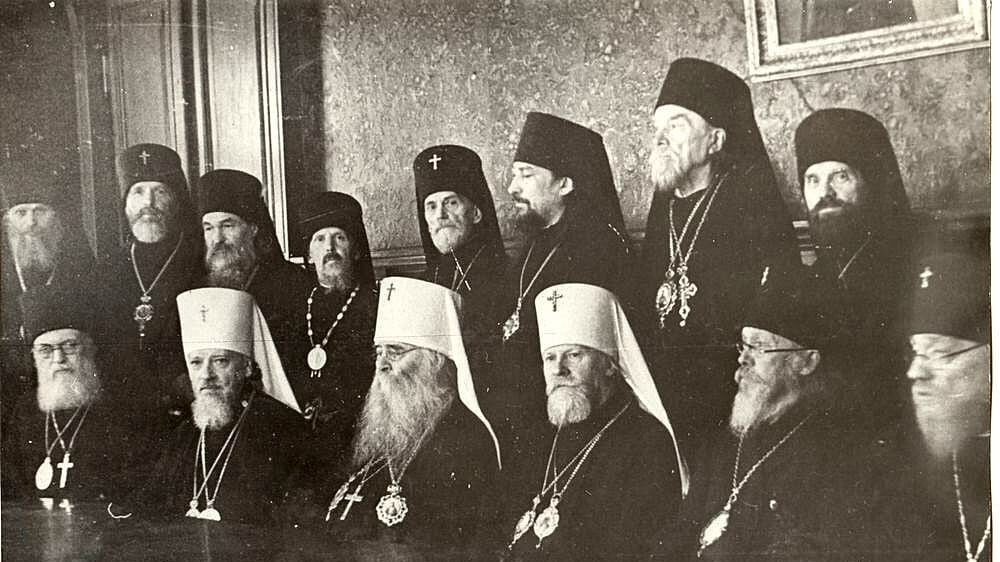
Metropolitan Anastasii Gribanovsky, First Hierarch of ROCOR

May 1964: A Radical Change in the History of the Russian Church Abroad

0

Metropolitan Anastasii Gribanovsky, First Hierarch of ROCOR

The 1964 Council of the Bishops of the Russian Church Abroad (ROCOR) marked a new milestone in its history: on May 27, 1964 Metropolitan Anastasii (Gribanovskii) retired. Bishop Anastasii’s episcopal consecration took place in Moscow in 1906. In 1913 he was appointed to devise rites for the glorification of St. Patriarch Germogen, which was presided by Patriarch Gregory IV of Antioch. In 1915, Anastasii was appointed Bishop of Chisinau and Khotin. He designed the rite of installation of St. Tikhon as Patriarch of Moscow on November 21, 1917. On December 7, 1917, the local council of the Russian Church elected him a member of the Synod of Bishops.

In 1918, after the accession of Bessarabia to Romania, Archbishop Anastasii refused to subordinate to the Romanian Church and was sent out of country by the Romanian military authorities. In 1920 he was appointed by the Supreme Church Administration of the South-East of Russia to Constantinople, which was occupied by the French and British troops, to address ecclesiastical needs of Russian refugees.

Evacuated from the Crimea in November 1920, the Russian Army created their own worldwide network – the Russian All-Military Union – in order to continue the struggle against Bolshevism. The Russian Church Abroad became the Church of this emigration that was traumatized by the civil war. The flock of the Russian Orthodox Church was very anti-communist: one could not expect from them a politically correct attitude toward the Bolsheviks. In 1924, the Ecumenical Patriarchate required Archbishop Anastasii to stop commemorating Patriarch Tikhon in the Divine Liturgy and to abstain from any political rhetoric. Archbishop Anastasii did not fulfill this demand and was suspended.

After his departure from Constantinople in 1924, Archbishop Anastasii was appointed to Jerusalem as an administrator for the Russian Ecclesiastical Mission. There he continued his encounter with Greek Orthodoxy, and he also visited Damascus. In 1927, at the request of Patriarch Damian of Jerusalem, he took part in the consecration of new bishops for the Jerusalem Patriarchate. At that time Palestine was under British mandate. Archbishop Anastasii maintained intensive contacts with the British and took part in joint prayers with the Anglicans. As a result of his labors, the Gethsemane monastic community was founded by former Anglican nuns who had become Orthodox.

In 1936, after the death of Metropolitan Antonii (Khrapovitskii), Anastasii became the second Primate of the Russian Church Abroad. During World War II, he did not escape the illusions prevailing among the flock of the Russian Church Abroad that the Germans, having liberated Russia from Bolshevism, would permit the establishment of an independent Russian state. Metropolitan Anastasii supported Russian Liberation Army of General Andrei Vlasov. Nevertheless, Metropolitan Anastasii’s intuition and caution saved him from calling to the entire flock of the ROCOR to support Drang nach Osten (that is, German expansion into Slavic lands).

In 1950, Metropolitan Anastasii moved to the United States. Here he maintained warm relations with the Greek Archbishop Michael (Konstantinides), whom he had met in Constantinople. In the postwar period, Metropolitan Anastasii had a rigid attitude toward the Moscow Patriarchate. At the ROCOR Council of Bishops in 1959, the decision was made to accept clergymen of the Moscow Patriarchate through repentance. In his so-called last testament, Metropolitan Anastasii called on the faithful to have no public contacts with representatives of the Moscow Patriarchate. Today, those who did not recognize the 2007 reconciliation of the Moscow Patriarchate and the Russian Orthodox Church Abroad refer to this document, pulling the words out of historical context.

In exile, Archbishop Anastasii showed a rare ability to step back from the noise of the dominant trends. At the Pan-Diaspora Council of 1921, he was against the adoption by the council of an appeal for the restoration of the Romanov dynasty, supported by Metropolitan Antonii. He was acutely aware that St. Patriarch Tikhon had a very different experience of life than those Russian bishops who left the country. At the Council of Bishops in 1953, Metropolitan Anastasii spoke out against the glorification of St. John of Kronstadt, believing that it was not the business of the refugee Church to glorify the All-Russian miracle worker. Metropolitan Anastasii was against Russian intervention in the internal affairs of the Greek Orthodox Church, and a Bishop’s Council passed a resolution not to participate in the consecration of the Greek Old Calendarists. This resolution was breached in 1962 by Archbishop Leontii of Chile and Peru.

It became very difficult for Metropolitan Anastasii to head the bishops’ “conclave” of the Russian Church Abroad due to his advanced age, and he summoned a Council of Bishops with the purpose of electing a successor. On May 27, 1964 Metropolitan Anastasii confirmed that he had not changed his mind about retirement. Since Byzantine times, conciliarity was maintained in the Orthodox Church by the confrontation between the “diplomats” and “zealots.” At the time of the Council of Bishops in 1964 there was a sharp confrontation between these two episcopal parties. The leader of “zealots” was St. John (Maximovitch) of Shanghai and San Francisco, and the leader of the “diplomats” was Archbishop Nikon (Rklitskii) of Washington and Florida. The election of a First Hierarch from either of these two factions would have made it extremely difficult for the other party to work with this person. To resolve this crisis, St. John offered to withdraw his candidacy, if Archbishop Nikon would follow suit. The result was that Bishop Philaret (Voznesenskii) became the Primate of the Russian Church Abroad. This opened a new period in ROCOR history. Bishop Philaret had been consecrated only a year earlier, and represented a new generation of leaders. On November 1 at the Synodal Cathedral in New York and later in Utica, New York, the glorification of St. John of Kronstadt took place. The Russian Church Abroad was turning into a self-sufficient entity.

On May 22, 1965, Metropolitan Anastasii died and was buried in Holy Trinity Monastery, Jordanville, NY.

Deacon Andrei Psarev teaches church history at Holy Trinity Russian Orthodox Seminary in Jordanville, NY. He also serves on the SOCHA advisory board and runs the ROCOR Studies website (www.rocorstudies.org).

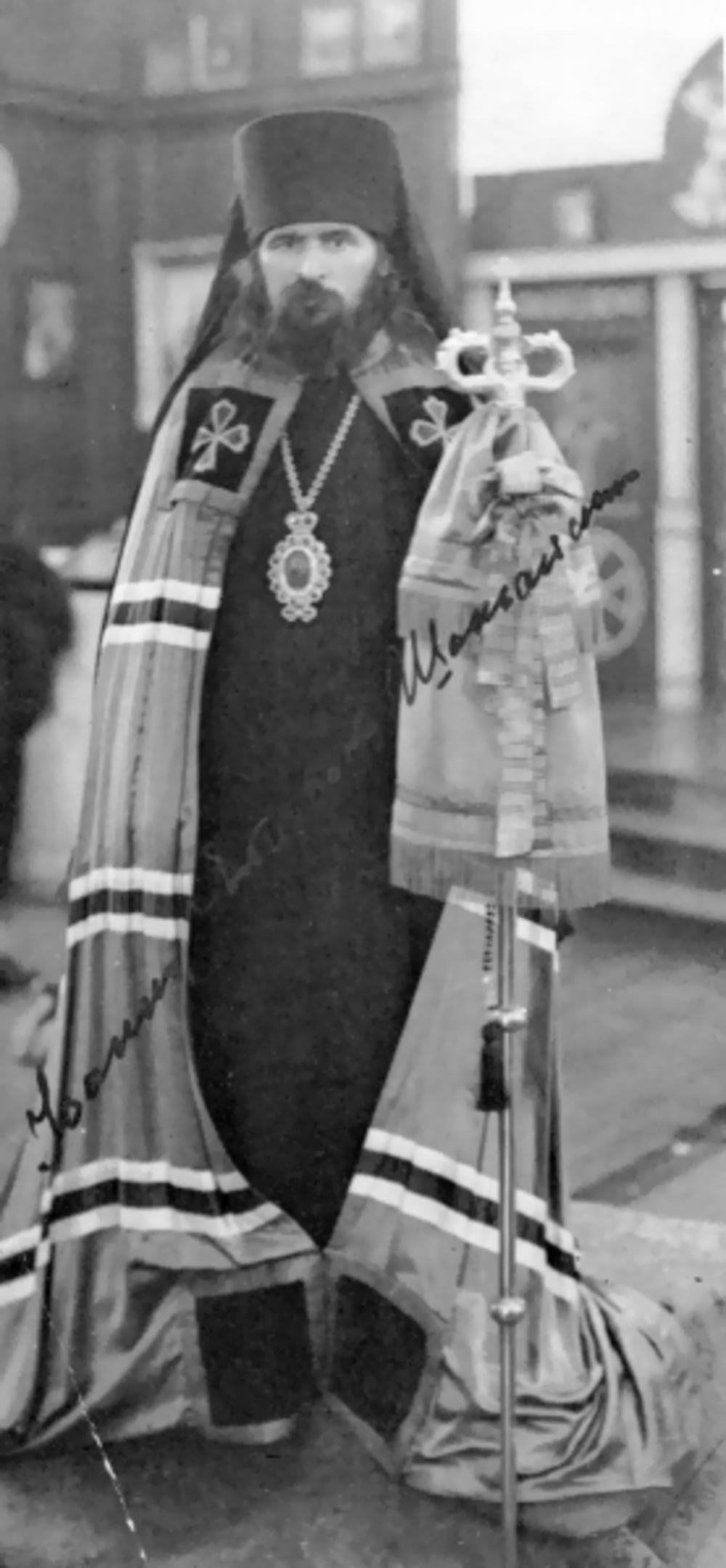
St. Innocent’s first homily as Metropolitan of Moscow

0

Image of St. Innocent from the New York Public Library Digital Gallery

After the death of St. Philaret Drozdov, St. Innocent, the former missionary to Alaska and Siberia, was chosen to be his replacement as Metropolitan of Moscow. Below is his first pastoral address as Metropolitan, given in Moscow’s Dormition (Assumption) Cathedral on May 26, 1868 — 142 years ago today. The address was printed in the English-language Orthodox Catholic Review (Vol. 2, 1868, edited by the English convert J.J. Overbeck).

“Grace to you, and peace from God our Father and the Lord Jesus Christ!”

Thus the Apostles were accustomed, according to the commandment of the Lord, to greet the Churches, and thus also the pastors of the Church following their example greeted their flocks, when entering into spiritual communion with them. By the same law, I also, their most unworthy successor, am emboldened to greet you with these very same words, my brethren, and henceforward beloved brethren and children in the Lord, entering as I am into communion with you.

“Grace to you and peace from God our Father and the Lord Jesus Christ!”

But who am I daring to take upon myself the voice and authority of my predecessors?

A disciple of a distant age, of a distant region, and one who has passed more than half his life in a still more distant land; one, but a humble labourer on a small field of Christ’s; a teacher of infants in faith. And is it for the least of labourers to become a labourer in a great, glorious and ancient vineyard of Christ? Is it for such a teacher to instruct a fold which sends teachers and instruction, ay, teachers of teachers, to all the ends of Russia?

True it is, that I might well say the same in every other place, to which I might have been called; — but the gravity of the question is enhanced in this case by the fact – after whom I am placed here? Who was my predecessor and who am I? No comparison can be made here. Or every comparison will be far from advantageous to me, in some respects against me. I understood all the weight and sadness, bitterness of such comparisons – natural, unavoidable, most just comparisons; they are not idle talk. I understood also how elevated, how difficult are the duties of this position, and it behoves me consequently to decline, at least I might have declined this honour, having besides a visible motive for doing so. But who am I to oppose God – our Heavenly Father, without whose will not even a hair of our head may fall? Who am I to contradict the earthly king whose heart is in the hand of God? Nay, I said to myself: let what the Lord wills be with me: I will go whither I am ordered. And lo! I am come.

Bless me then, O Lord, to enter upon my work. Lord, I am Thine, and I will be Thine for ever and everywhere; do Thou with me as Thou willest in this life and in the life to come, that I may become here but a simple instrument in Thy hands!

O most holy Lady, Mother of God, my aid, — do not deprive me here of Thy help, protection, intercession and prayers. Ye Saints of Christ, Peter, Alexis, Jonas, and Philip, and all ye Saints resting here receive me into your prayers – me, your most unworthy successor. Brethren and fathers! Most especially you, illustrious teachers and fathers. It was not such an unlettered Archpriest it behoved you to have. But bear with me in Christ’s love, — receive me into your family prayers, more especially pray, that false doctrine and carnal wisdom may not creep into the midst of Orthodoxy, on account of my ignorance. … I pray ye all, brethren and children, pray for me, a sinner. “Grace to you, and peace from God our Father and the Lord Jesus Christ!”

St. Innocent served as Metropolitan of Moscow from 1868 until his death in 1879.

Metropolitan Leonty visiting Los Angeles (LA Daily News, 7/1/1952)

This week in American Orthodox history (May 14-20)

0

May 17, 1870: The newly ordained convert priest Fr. Nicholas Bjerring celebrated his first Divine Liturgy in St. Petersburg, Russia. He didn’t know Church Slavonic, so he served in German.

May 19, 1884: Archimandrite Stephen Hatherly, a convert priest from England, arrived in Philadelphia. I wrote about Hatherly’s visit almost three years ago. The basic story is this: In 1883, the Russian government closed its chapel, and the priest, Bjerring, became a Presbyterian. Hatherly, a priest under the Ecumenical Patriarchate, heard about these events and asked for permission to make a go at his own New York mission. After getting the all-clear from Russia, he sailed for America in 1884, arriving in Philadelphia on May 19 — this week. But, as I explain in the article, the mission was a failure; the few Orthodox people in New York had little interest in attending a church. Hatherly returned to England disappointed.

One thing I’ve been meaning to do, but haven’t yet, is tell Hatherly’s own story, because it’s phenomenally interesting. He was an exact contemporary of the somewhat better known English convert J.J. Overbeck, an author and editor of the Orthodox Catholic Review. Overbeck wanted to establish a “Western Orthodox Church,” including union with the Church of England, and today he’s regarded as a sort of progenitor of the Western Rite. Hatherly, on the other hand, viewed a full-blown union between Orthodoxy and Anglicanism as unrealistic. Instead, he preferred simply to convert Anglicans to (standard Byzantine Rite) Orthodoxy — something that raised the ire of the Anglican hierarchy, who in turn induced Constantinople to forbid Hatherly from evangelizing his countrymen. On top of all this, Hatherly was an accomplished church musician. As I said, writing an article about his life is on my to-do list.

May 19, 1905: Bishop Tikhon Bellavin, head of the Russian Mission in North America, was elevated to Archbishop by the Holy Synod of Russia.

May 17, 1922: Ecumenical Patriarch Meletios Metaxakis issued a tomos, formally establishing the Greek Orthodox Archdiocese of North and South America as a jurisdiction under the Ecumenical Patriarchate. As Archbishop of Athens, the controversial Meletios had been in America from 1918-1921, during which time he organized the Greek Archdiocese and convened its first Clergy-Laity Congress. While in America, Meletios was deposed by the Holy Synod of Greece, but soon after this, he was elected Patriarch of Constantinople. This 1922 tomos thus transferred the GOA from Meletios’ old see (Athens) to his new one (Constantinople).

How could he get away with such unilateral action? Well, back in 1908, the Ecumenical Patriarchate had “transferred” the Greek churches in the “diaspora” (particularly America) from itself to Athens. Which is sort of misleading, because a lot of the Greek churches in America were already under Athens, so the transfer affected only that portion of the Greeks who had been under Constantinople. Anyway, Athens didn’t really do much with America over the next decade, until Meletios, as Archbishop of Athens, came along in 1918. In issuing this 1922 tomos, Meletios was revoking the earlier 1908 transfer. And the GOA has been under Constantinople ever since.

May 14, 1957: Archbishop Jeronim Chernov of Eastern Canada (Russian Metropolia) died.

Metropolitan Leonty visiting Los Angeles (LA Daily News, 7/1/1952)

May 14, 1965: Metropolitan Leonty Turkevich, primate of the Russian Metropolia, died. Leonty is one of those giants of American Orthodox history, on par with Tikhon, Iakovos, and Bashir. Many think he’s a saint, and I strongly suspect that they’re right. One of the amazing things about Leonty is that he lived through so much. Originally known as Fr. Leonid, he was a key figure in the Russian Mission dating to the episcopate of St. Tikhon. He ran the seminary, succeeded St. Alexander Hotovitzky as dean of the main cathedral, and generally was the most important priest in the Archdiocese prior to the Russian Revolution.

Then, in 1917, he participated in the monumental All-Russian Sobor — one of the pivotal church councils in Russian history. He made it out of revolutionary Russia and back to the US, where he was, again, probably the key priest in the Russian Metropolia, which rose from the ashes of the Russian Mission. After being widowed, he was almost consecrated a bishop for Aftimios Ofiesh’s American Orthodox Catholic Church experiment, and he ended up becoming the Metropolia’s Bishop of Chicago. When the Metropolia’s primate, Metropolitan Theophilus Pashkovsky, died in 1952, Leonty was elected to be his successor.

Anyway, all that is ridiculously cursory, and I can only fit so much into this article. But Aram Sarkisian, who knows far more about Leonty than I do, will be running a full-length piece here very soon.

May 18, 1970: The Patriarchate of Moscow formally granted autocephaly to the Russian Metropolia in America, which changed its name to the “Orthodox Church in America.” This event reverberated throughout the Orthodox world, and it remains controversial to this day. While everyone recognizes the OCA as fully canonical, only a minority of the world’s Orthodox Churches acknowledge the OCA as an autocephalous Local Church.

May 14, 1972: Tragedy struck at ROCOR’s Holy Trinity Seminary in Jordanville, NY, where one seminarian stabbed another to death. Both men had been studying for the priesthood.

May 15, 1979: Bishop Dionisije Milivojevich, the Serbian Orthodox bishop whose battle with his mother church went all the way to the U.S. Supreme Court, died in Illinois.

May 18, 1985: Fr. John Karastamatis, a Greek priest in Santa Cruz, CA, was brutally murdered. Some of his admirers immediately declared him to have been martyred for the faith, and to this day, you’ll run into lists of saints that include “Hieromartyr John of Santa Cruz.” But the subsequent police investigation revealed that he was killed by the husband of the parish secretary, and at trial, witness testimony made it clear that Karastamatis was not someone who should be venerated as a saint. I don’t want to get into the gory details, mainly because this didn’t happen all that long ago and Karastamatis’ family is still around, but suffice it to say that while his murder was a great tragedy, the calls for his canonization were terribly misplaced.

May 18, 2000: Archbishop Sylvester Haruns of Montreal (OCA) died.

May 14, 2006: Conclusion of the ROCOR All-Diaspora Council, which approved reconciliation between ROCOR and the Moscow Patriarchate.

May 17, 2007: In Moscow, ROCOR signed the Act of Canonical Communion, re-establishing full communion with the Moscow Patriarchate.

May 18, 2008: Another big ROCOR moment — Metropolitan Hilarion Kapral was enthroned as First Hierarch of ROCOR.

Go to Top