Posts tagged San Francisco

Federation 'reorganization'

This week in American Orthodox history (March 12-18)

0

This week is a busy one:

March 14, 1767: Philip Ludwell III, the first Orthodox convert in American history, died in London. Decades earlier, in 1738, Ludwell had joined the Orthodox Church in London. He was just 22 at the time, and was a rising star in the Virginia aristocracy. Remarkably, the Russian Holy Synod gave him permission to bring a portion of the Eucharist back to Virginia. In 1762, Ludwell brought his three daughters to England to be received into the Church as well. Of course, we would know none of this were it not for the exceptional research and writing done by Nicholas Chapman, whose articles we’re proud to feature here at OrthodoxHistory.org. Click here to read Nicholas’ first article on Ludwell, and here to read about Ludwell’s landmark translation of an Orthodox catechism. And if you find Ludwell as fascinating as I do, I would highly recommend that you invest $4.95 to download Nicholas Chapman’s recent lecture on Ludwell. (And for $9.95, you get a CD of the lecture, a copy of Ludwell’s portrait, and the Ludwell family book plate.) I rarely encourage our readers to buy stuff, but trust me: this is worth it.

St. Alexis Toth

March 14, 1853: Chronologically, after Ludwell, the most important American Orthodox convert has to be St. Alexis Toth, who was born in the Austro-Hungarian Empire 159 years ago this week (most of my sources say March 14, but Wikipedia has his birthday as March 18). Originally a Greek Catholic (“Uniate”) priest, Toth was assigned to serve a Carpatho-Rusyn parish in Minneapolis in 1889. But the local Roman Catholic archbishop didn’t want Toth’s “kind” — that is, Greek Catholics — in his diocese, and the two men clashed immediately. In 1891, Toth and his Minneapolis congregation joined the Russian Orthodox Church. Dozens and dozens of Uniate parishes followed suit over the next two decades, and Toth was one of the chief advocates of Uniate conversion to Orthodoxy. He died in 1909 and was canonized by the OCA in 1994.

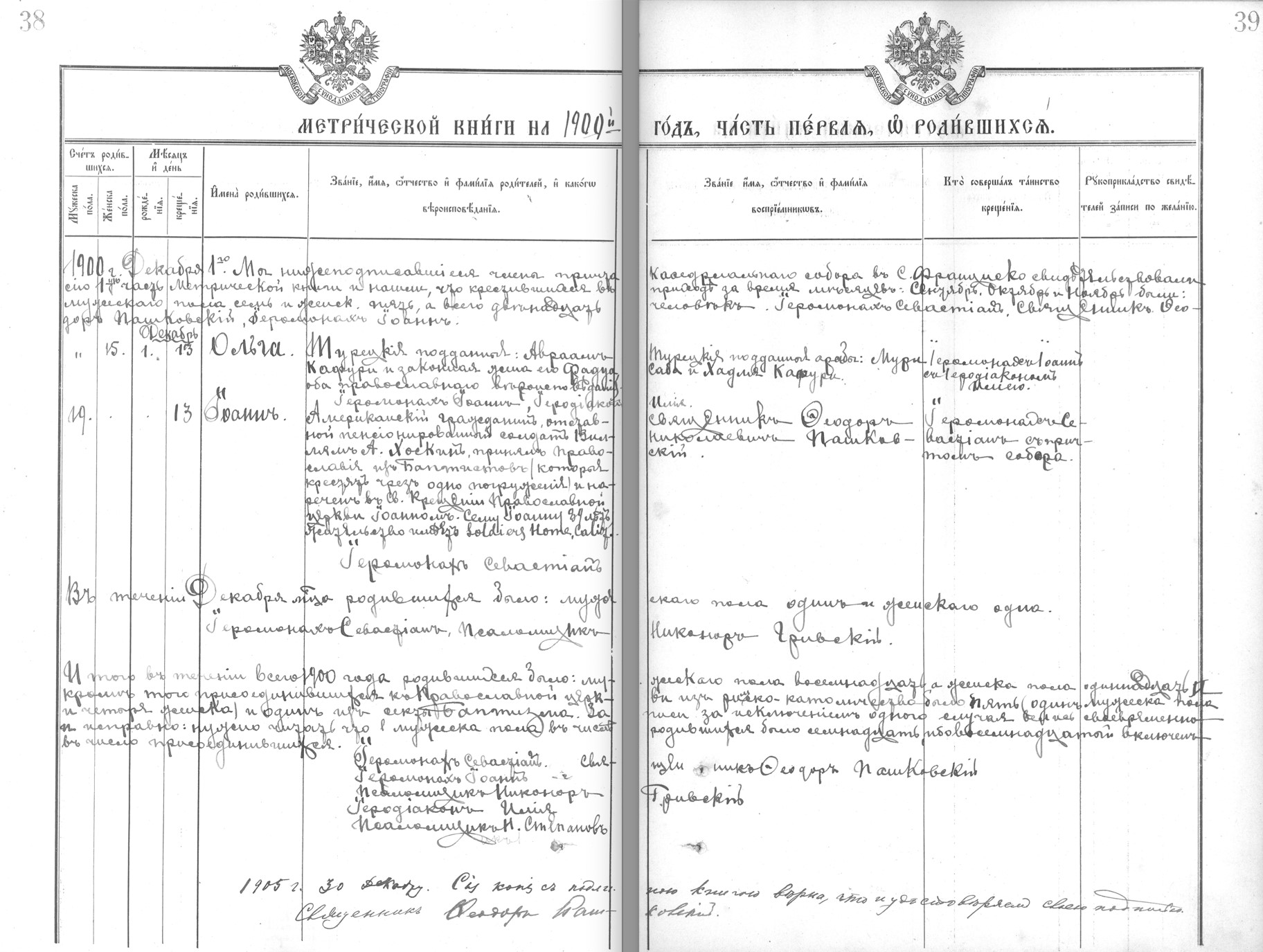
March 13, 1868: Fr. Nicholas Kovrigin was sent on a pastoral visit to San Francisco, establishing the first foothold of the Russian Church in the contiguous United States. It all started back in the 1850s, when San Francisco’s growing Orthodox community organized into a mutual aid society. In the early 1860s, Russian ships visited the area, and some local Orthodox children — including the future Fr. Sebastian Dabovich — were baptized by a Russian navy chaplain. But there wasn’t a Russian parish until Kovrigin came along later in the decade. His visit was precipitated by the arrival, late in 1867, of the renegade Ukrainian priest Agapius Honcharenko, who moved to the Bay Area and tried to start some kind of hybrid Protestant/Orthodox parish. The Orthodox people seem to have realized that they needed to get an actual, legitimate Orthodox priest in their city, so they sent a formal request to the bishop in Alaska, who responded by sending Kovrigin for a visit. Initially, it was just that — a visit — but later in 1868, Kovrigin was formally assigned to be the pastor of a new parish in San Francisco. Unfortunately, Kovrigin seems not to have been made of the strongest moral fiber, and he ran into all sorts of trouble, ultimately being suspected of foul play in the death of his superior, cathedral dean Fr. Paul Kedrolivansky. Kovrigin was finally sent away in 1879, by the newly arrived Bishop Nestor Zass. On a more positive note, despite many trials and tribulations (and name changes), the San Francisco parish has survived to this day, and is now Holy Trinity, a cathedral of the OCA.

March 15, 1896: Archimandrite Theoclitos Triantafilides celebrated the first Divine Liturgy in Galveston, Texas. I’ve written about Fr. Theoclitos recently: he was one of only three Greek priests to serve under the Russian Mission. Previously, he had been the tutor to the future king of Greece and the future Tsar Nicholas II of Russia. His Galveston parish was multiethnic, composed of Serbs, Greeks, Syrians, Russians, Copts, and American converts. To this day, his old parish of Saints Constantine and Helen venerates him as a holy man. To learn more about Fr. Theoclitos, read this article by Mimo Milosevich.

March 15, 1898: The future Antiochian Metropolitan Antony Bashir was born in Douma, in what was then the Ottoman Empire and what is now Lebanon. Bashir led the Antiochian Archdiocese of New York from 1936 until his death in 1966. This was the era of the “New York-Toledo” schism, when the Antiochians in America were divided into competing archdioceses (one based in New York and the other in Toledo, Ohio). Bashir was a major proponent of pan-Orthodox cooperation and the proliferation of English in church services.

March 13, 1904: Archimandrite Raphael Hawaweeny was consecrated to the episcopacy by Archbishop Tikhon Bellavin and Bishop Innocent Pustynsky. This was the first episcopal consecration in American Orthodox history. Technically, St. Raphael was a vicar bishop under St. Tikhon, the Russian Archbishop of North America, and St. Raphael’s “diocese” was actually a vicariate for Syro-Arabs. Reality was considerably more complicated, and St. Raphael basically functioned as a mostly independent diocesan bishop with ties to both the Russians and the Patriarchate of Antioch. (As he put it, his diocese was a diocese of Antioch, “notwithstanding its nominal allegiance to the Russian Holy Synod.”) He served as bishop until his death in 1915.

March 12, 1914: Fr. Alexander Hotovitzky, dean of St. Nicholas Russian Orthodox Cathedral in New York, returned to Russia after nearly two decades of service in America. He went on to suffer under the Communists, died a martyr’s death, and has since been canonized a saint.

Bishop Nicholai Velimirovich

March 18, 1956: The exiled Serbian bishop Nicholai Velimirovich died at St. Tikhon’s Monastery in South Canaan, Pennsylvania. He had first come to America in the 1910s, as a representative of the Serbian Church. After World War II, Bishop Nicholai returned to the United States as a refugee, and he went on to teach at several Orthodox seminaries in the US. I feel like I should have a lot to say about Bishop Nicholai — who, after all, was canonized in 2003 and is famous for his prolific writings (most notably the Prologue from Ochrid), but to be honest, I don’t really know all that much about the man. There are a couple of informative biographical articles online, but I should note that both are written from a somewhat hagiographic (as opposed to a strictly historical) perspective. Click here for one published in The Orthodox Word, and click here for one from the periodical Orthodox America.

March 16, 1960: The Standing Conference of Canonical Orthodox Bishops in the Americas — better known simply as SCOBA — held its first meeting. SCOBA arose from the ashes of the “Federation,” a 1940s attempt to foster pan-Orthodox cooperation in America. And while many initially thought that SCOBA might lead to the unification of the various jurisdictions, that obviously never happened. In 2010, SCOBA was disbanded and replaced by the Assembly of Bishops. The two organizations are different in many ways, but two are of particular note: (1) SCOBA included on the heads of the jurisdictions, while the Assembly includes every active, canonical bishop in America, and (2) the “Mother Churches” tolerated SCOBA, but the same Mother Churches actually created the Assembly. Along the same lines, SCOBA was a voluntary association, whereas the Assembly is an official ecclesiastical organization with a clear mandate from the Mother Churches. I realize that I didn’t really say much about the first SCOBA meeting, but that’s a story for another day.

March 13, 1965: On the very same day, both Albanian Bishop Theophan Noli and Greek Bishop Germanos Liamadis died. As far as I know, this was the only instance of two American Orthodox bishops dying on the same date.

March 18, 1981: OCA Metropolitan Ireney Bekish died. He had been the Metropolia/OCA primate from 1965 until his retirement in 1977 — so, the period when the OCA received its Tomos of Autocephaly and established its current identity — but I’ve never heard anyone talk of him as a major historical figure. Nobody talks about the era of Ireney, because it really was the era of Fr. Alexander Schmemann, who effectively led the OCA during Ireney’s entire episcopate.

March 16, 2008: ROCOR’s First Hierarch, the revered Metropolitan Laurus Skurla, died, shortly after helping to accomplish the reunion of ROCOR with the Moscow Patriarchate. Met Laurus had led ROCOR for seven years, and while he is most remembered for that tenure, the bulk of his hierarchical career was spent as abbot of Holy Trinity Monastery in Jordanville, New York.

March 13, 2011: Metropolitan Nicholas Smisko of the American Carpatho-Russian Orthodox Diocese (ACROD) died of cancer after more than a quarter-century as primate of ACROD. A year later, his position has yet to be filled. ACROD has established a memorial web page for Met Nicholas; click here to view it.


Sketch of Holy Trinity chapel in Portland, OR, founded by Lavrenty Chernov. Image courtesy of St. Nicholas Orthodox Church in Portland.

This week in American Orthodox history (March 5-11)

0

March 10, 1866: The future Archbishop Arseny Chagovtsov was born in Kharkov, in what was then the Russian Empire and what is today Ukraine. A widowed priest, he became a monk and came to America in 1903 to serve in the Russian North American Mission. He was instrumental in the establishment of St. Tikhon’s Monastery in 1906, and in 1908 he was assigned to be the administrator of Russian churches in Canada. Arseny — at this point an archimandrite — returned to Russia in 1910, fled to Serbia after the Revolution, and, in 1926, was chosen to return to Canada as the Bishop of Winnipeg. In 1936, he was apparently shot (I don’t really know about the details of his incident). After this, he retired from the episcopate and ultimately moved to St. Tikhon’s Monastery in Pennsylvania, where he was involved in founding what became St. Tikhon’s Seminary. Archbishop Arseny died in 1945.

Sketch of Holy Trinity chapel in Portland, OR, founded by Lavrenty Chernov. Image courtesy of St. Nicholas Orthodox Church in Portland.

March 10, 1895: Fr. Sebastian Dabovich dedicated Holy Trinity Orthodox chapel in Portland, OR. The small Portland community included Greeks, Syrians, and Russians, among others. The man most responsible for its establishment was a layman named Lavrenty Chernov. An Alaskan Creole, Chernov was born in 1848 and eventually moved to Portland. The ramshackle chapel was used for perhaps a decade, but it eventually fell out of use. In the first decade of the 20th century, the Greeks of Portland began using it for their own church, which was also called Holy Trinity.

March 5-7, 1907: The Russian Archdiocese held its first “All-American Sobor” in Mayfield, PA. A few years ago, OCA archivist Alex Liberovsky gave a nice lecture on the Sobor, which you can read on the OCA website. The Sobor was held concurrently with the convention of the Russian Orthodox Catholic Mutual Aid Society. And while it was called “All-American,” it was a purely “Russian” affair: the other ethnic groups affiliated with the Russian Archdiocese, such as the Syro-Arabs and the Serbs, were not included. That said, the Sobor was a major step for the Russian Mission in America.

March 7, 1915: The funeral for St. Raphael Hawaweeny was held in his Brooklyn cathedral. Something interesting, which I’d never noticed before: St. Raphael was apparently friends with an American named Gary Cronan, who got permission from the New York Heath Administration to have St. Raphael buried in a crypt in St. Nicholas Cathedral. Cronan reportedly built the crypt himself. (My source for this is the unpublished St. Vladimir’s Seminary M.Div. thesis by A. Issa.) St. Raphael actually didn’t rest in the crypt for very long — Bishop Aftimios Ofiesh acquired a new cathedral in 1920, and St. Raphael’s relics were transferred to Mount Olivet Cemetery in 1922. Today they rest at the Antiochian Village in Ligonier, PA. Anyway, I’m really curious to learn more about Gary Cronan.

Back in December, we reprinted Isabel Hapgood’s very good New York Tribune article on Raphael’s death and funeral.

March 6, 1921: Fr. Kallinikos Kanellas, one of the first Greek Orthodox priests in America, died in Little Rock, AR. Kanellas came to America from India, where he had been the priest of the Greek Orthodox church in Calcutta. He initially came to America just for a visit, but he fell ill and was forced to stay for awhile. He became affiliated with the Russian cathedral in San Francisco, which had a very large Greek population. He made at least one major mission trip through the country, visiting Georgia, New York, and Chicago, among other places. He was one of the first Orthodox priests to visit Chicago. In 1892, Bishop Nicholas Ziorov took over the Russian Diocese, and he released Kanellas, who then traveled to the eastern part of the United States. He eventually spent eight years as rector of the Greek church in Birmingham, AL, which was under the Church of Greece. Later, he became the first priest in Little Rock, where he died in 1921. Toward the end of his life, the Greek-American Guide described Kanellas as “a very sympathetic and reverend old man.”

UPDATE: To listen to a podcast based on this article, click here.

St. John Prodromos Greek Orthodox Church, San Francisco

The Third Greek Church of San Francisco

3

St. John Prodromos Greek Orthodox Church, San Francisco

Jim Lucas is the president of the Greek Historical Society of the San Francisco Bay Area, a non-profit corporation based at Annunciation Cathedral in San Francisco. The organization is dedicated to the preservation of Greek history and culture in the San Francisco area.  Jim has been actively researching the history of the Greek community for several years and is writing a book “The Greeks of San Francisco” which will be released at a future date.

The Orthodox faith has had a presence in San Francisco since at least 1857, and the first Russian Orthodox church was founded in 1868. The Greeks that settled in San Francisco during those early years worshipped at the Russian Orthodox Church until Holy Trinity was founded in 1904.

Those of you that live in the San Francisco area are familiar with two Greek churches in San Francisco, Holy Trinity and Annunciation Cathedral. Holy Trinity is the oldest Greek church west of Chicago and Annunciation Cathedral was founded in 1921. Most Greeks are very surprised to learn that there was a third Greek Orthodox Church that existed for a brief period.

In 1908 there was a disagreement over parish council elections and the handling of money at Holy Trinity. The disagreement turned violent on July 12, 1908, when police were called to Holy Trinity (San Francisco Call, 7-13-1908, “War Raged at the Door of the Sanctuary”). A faction led by Ioannis Kapsimalis (former parish council president and Greek Consul) decided to start their own church. They acquired land on Rincon Hill (35 Stanley Place), built a church which they named St. John Prodromos (see photograph). They built offices and a meeting hall which they named the “Alexander the Great Meeting Hall.” They hired Father Constantine Tsapralis as their first priest (There is a common misunderstanding that Fr. Tsapralis’ service at Holy Trinity was continuous from 1903 – 1936 which is not true). The Holy Trinity community in turn hired Fr. Stefanos Macaronis as their next priest.

On December 2, 1909, the factions resolved their differences and St. John Prodromos ceased to exist.  Fr. Tsapralis was rehired by Holy Trinity and Fr. Stefanos Macaronis moved to a parish in Oregon.  From 1910 until Holy Trinity was raised to install a meeting hall  in 1922, this property served as the offices and meeting hall for the community.  There are numerous news articles in the San Francisco Chronicle and San Francisco Call relating to Greek community events that were held at the Alexander the Great Hall. This building was a vital part of Greek community life.

Mr. Peter Bergevin, the owner of the property, passed away at December 27, 1911 at the age of 68. Mr. Bergevin willed the property to Holy Trinity.  On June 23, 1915, a hearing was held regarding Mr. Bergevin’s  estate.  His daughter, Mrs. Adeline Telfer, deeded the property to Holy Trinity on July 20, 1915 pursuant to a court order regarding the estate of her father. (Click here to view the document).

The property was later sold to the State of California to make room for the San Francisco-Oakland Bay Bridge closing this early chapter San Francisco Greek history.

Jim Lucas is the President of the Greek Historical Society of the San Francisco Bay Area and can be reached by email at jim@sanfranciscogreeks.com. More San Francisco Greek historical material can be found at www.sanfranciscogreeks.com.

Fr. Pythagoras Caravellas

From Harvard MD to Orthodox priest: the Fr. Pythagoras Caravellas story

0


Fr. Pythagoras Caravellas


Editor’s note: The following article was written by relatives of Fr. Pythagoras Caravellas, and originally appeared in the 60th anniversary commemorative album for Annunciation Greek Orthodox Cathedral in San Francisco, published in 1996. The article has been reprinted at Annunciation Cathedral’s website, and we present it here courtesy of the San Francisco Bay Area Greek Historical Society. The Society has done outstanding work on the history of Greek Orthodoxy in the region, and its chairman, Jim Lucas, is building a virtual photo album which may be found at this link. The website includes special pages for Fr. Pythagoras Caravellas and St. Sophia/Annunciation Cathedral, where he served as a priest.

We originally ran this article here at OrthodoxHistory.org on August 9, 2010. However, today is the 77th anniversary of Fr. Pythagoras’ repose, and I thought it appropriate to reprint his biography.

Pythagoras Caravellas was born in 1890, in Greece, on the small island of Samos, off the coast of Asia Minor. He was the son of a tobacco and cotton merchant and the youngest of four children.

At the age of 16, he completed his pre-university education at the gymnasium in Karlovassi. His schoolmasters, impressed with the young man’s curiousity and studious inclinations, recommended him for further study at one of the Greek teaching monasteries.

The year that young Pythagoras was cloistered in the mountain monastery, he applied himself diligently to the assigned subjects, religion, science, and the humanities. Perhaps it was the humility with which the monks imparted their wisdom to the young scholars that influenced young Pythagoras to cherish learning. This inspiration was to follow him always.

While under the tutelage of the monks, the Metropolitan of Corfu, Alexander, paid a visit to the monastery. The hierarchy of the Greek Orthodox faith had always taken a personal interest in the education and development of their youth. Alexander was not an exception. A man of deep perception, he was to become the first Archbishop of the Greek Orthodox Church. If his visits to the monasteries were anticipated by the students, a few requested were granted private audiences. The topics that generated the most interest were students’ personal aspirations.

During one of his private conversations with the Metropolitan whom he had known since childhood, Pythagoras confessed his secret hope to continue his education in the United States and perhaps establish a permanent home there. Expecting a small admonishment or to be dissuaded from his ambition, Pythagoras was pleased with the unexpected approval his received. The full impact of this meeting was not to emerge for twelve years, but its immediate result was that Pythagoras entered the Seminary in Athens to study for the priesthood. After a year, he was uncertain as to the wisdom of his action and decided to enroll in the University of Athens.

During the next four years he earned his degree and received his teaching credentials. While attending the university, he made occasional visits to his family in Samos. He also found time to tutor students, work for a tobacconist and take additional courses in English.

In 1911, he made his big decision to go to the United States. He went to Middleboro, Massachusetts, where a small colony of Greeks had settled, to live with his two brothers, Nicholas and Theodore, who had immigrated there two years before. Convinced that their brother was not interested in their restaurant business, they encouraged him to enter Harvard University with an offer to help him financially.

Before leaving Greece, Pythagoras had already decided to become a physician. Realizing how many long years of study lay ahead, he preferred not to accept his brothers’ generous offer. He considered ways in which he would attend school, allow time for studies, and still be able to earn an adequate income necessary for his tuition and living expenses. He would rely on his knowledge of small business accounting to earn his living and soon had a number of shopkeepers and restaurants as clients.

After graduation from Harvard with a degree in medicine in June, 1917, he became engaged to Evangeline Constantine. They were married in November, 1917. His work as a hospital intern offered some degree of fulfillment, but he was restless.

Recalling his year at the monastery and his communications with Archbishop Alexander, Pythagoras sent a letter to the Metropolitan asking for his guidance. The sincere simplicity of the Archbishop’s reply and his words of encouragement to enter the church convinced Pythagoras to give up medicine and to complete his studies in the priesthood.

Through further correspondence with the Metropolitan, Pythagoras learned of the need for Greek priests in the western part of the United States. As waves of Greek immigrants moved westward across the United States, they were dependent upon a small group of itinerant Greek priests for infrequent church services and the administration of religious rites. More Greeks lived and worked in the western states than the number of churches would suggest.

In 1921, Father Pythagoras arrived in San Francisco. At this time, his wife and daughter Theofani (Faye) were living in Chicago and it would be months later before he had the money to bring them to San Francisco. Once more the question of earning a livlihood and attending school was of immediate concern. Through letters of introduction and recommendation, Pythagoras became an assistant professor of Greek at the University of California, and attended the Pacific School of Religion. He supplemented his income writing for the Greek newspaper and the Christian Science Monitor. Soon, Pythagoras and Evangeline became an integral part of the young Greek community. Their resourcefulness and command of English, attracted the older families. They were often called upon to act as witnesses or interpreters in matters concerning immigration or in matters of law affecting members of the community. The more affluent Greeks were enthusiastic with the qualifications of the young couple and gave their wholehearted support for the erection of a church which would have Pythagoras as its priest.

After his graduation from the Pacific School of Religion in 1927, Pythagoras was ordained into the priesthood of the Greek Orthodox religion by the Patriarch of Constantinople, Metaxakis, and Archbishop Alexander, both of who were visiting in San Francisco at the time. The colorful ceremony was held in the new, small white church of St. Sophia. The presence of these eminent prelates in San Francisco created much interest and served to establish the young church of St. Sophia as a unified and integrated religious community.

With the advent of the Russian revolution, the organizational work of the Russian Orthodox Church in America came to an abrupt halt. In the meantime, the royalist-liberal controversy in Greece had divided event the Greek immigrants in America. The church could nor or would not steer a neutral course in the civil war raging between the forces of King Constantine and Premier Venizelos. This partnership, which had its beginnings in 1916, was to shake the church communities of Greece and United States to their foundation. The reaction in the United States was violent.

Reorganization required a degree of cooperation difficult to obtain. Nevertheless, Father Pythagoras managed to steer his congregation away from the repercussions of the political battles in Greece and toward the establishment of a Greek-American community whose growth would be a blending of the cultural heritage of Greece and the democratic principles of their adopted country, America.

Since coming to San Francisco, Father Pythagoras’ family increased by two daughters, Helen and Joan. After his ordination, Father Pythagoras budgeted his family severely. Occasionally, his small salary was supplemented by farmers; gifts of produce, fruit, and fowl. His parish was a poor one, and living became more difficult during the depression when members of his congregation dwelt on the edge of poverty. He administered to their needs, with words of encouragement and guidance. He would officiate at services during his frequent visits to farming communities. He taught the children of the community Greek after their regular school hours. He found time to program social activities for the community in observation of national and religious holidays. He made his rounds at the hospitals giving communion to the sick, the injured, and the dying. He conducted services every Sunday, every Holy Day and in the Greek church this alone is a rigorous and demanding schedule.

In 1931, the physical strain had taken its toll. Father Pythagoras was will with tuberculosis. He was a patient for three years at the California Sanitorium in Belmont. During his confinement, he continued to read avidly and began work for his degree as a Doctor of Divinity. He looked forward to returning to his church and his congregation. In late 1934, the doctors told him that he was cured and that he would soon be going home. On December 6, 1934, he suffered a heart attack and died. He was mourned by Greeks throughout the nation and his body lay in state in the church of St. Sophia for 7 days to afford his many friends the sad privilege of a final farewell.

Fr. Sava Matanovich: the first Serbian Orthodox priest in America

Just a brief note today: I had always assumed that Fr. Sebastian Dabovich was the first Serbian Orthodox priest in America, but apparently he wasn’t. The first Serbian priest in America — and probably the first Serbian priest the California-born Dabovich had ever seen — was Fr. Sava Matanovich. From the 1985 book Sacred Places of San Francisco: “The first Serbian priest to visit America was Father Sava Matanovich, a Montenegrin, who participated in three liturgies in 1875.”

I should note that I don’t know for sure whether someone from Montenegro should be classified as Serbian. Most references I’ve found treat Montenegrins as a subset of Serbs, rather than a distinct group. More importantly, I think (but again, I’m not certain) that in 1875, a priest from Montenegro would have had no quarrel with being called a Serb. The Serbs and Montenegrins in America seem to have totally intermingled. If any of our readers want to correct me on this, please, by all means, do so.

Anyway, the visit of Matanovich is verified by Dabovich himself in his 1897 history of Orthodoxy in California (published in the Vestnik in April 1898):

In 1875 a priest from Montenegro, Father Sabbas Matanovich, arrived in San Francisco. He was received into the Bishop’s house and served two or three Liturgies, but as he was not assigned a position, he went back home after several months. At the present time the honorable Father Matanovich is an archpriest in Cetinje.

I haven’t been able to find any other references to Matanovich’s visit, and I suspect that the 1985 Sacred Places in San Francisco reference used the Dabovich article as its source. It would be interesting to know what other places (if any) Matanovich visited in America. Did he serve liturgies in other cities besides San Francisco? If anyone else turns up anything, please let me know.

This article was written by Matthew Namee. He can be reached at mfnamee [at] gmail [dot] com.

Go to Top