Posts tagged Tikhon Belavin
Fr. Sebastian Dabovich & the mystery of St. Tikhon’s miter
0
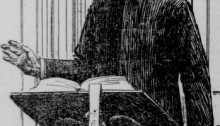
This photo of St. Tikhon's miter appeared in the San Francisco Call on April 22, 1900. The paper reported its value as $2,000. I'm not certain, but this may be the same miter Tikhon gave to Dabovich in 1905.
In 2009, I wrote an article on the miter (crown) which Archbishop Tikhon Bellavin gave to Fr. Sebastian Dabovich at the Dabovich’s elevation to archimandrite in 1905, and which Dabovich later auctioned off to raise money for the Serbian war effort in 1912. Today is the anniversary of Dabovich’s birth, and the miter’s whereabouts remain a mystery, so I thought it would be a good time to run a revised version of that original article.
If you read one of the many articles on the life of Fr. Sebastian Dabovich, you might run across a story about his miter (that is, his archimandrite’s crown). Dabovich had been elevated to archimandrite by St. Tikhon in 1905, and Tikhon gave Dabovich a miter on the occasion. According to Bishop Nicholai Velimirovich, who became friends with Dabovich years after this happened, the crown was worth 1,000 roubles in gold. In 1900, the San Francisco Call claimed that one of Tikhon’s miters (which may or may not be the one he gave to Dabovich) was worth $2,000 — that is, over $50,000 in today’s money.
Bishop Nicholai reported, “But Fr. Dabovich quickly sold that precious gift and gave it to the church towards paying its debts” (quoted in Fr. Damascene Christiansen’s article on Dabovich).
That’s one version of the story. Here’s another, from Fr. George Gray’s Portraits of American Saints: “[Dabovich] sold St. Tikhon’s mitre (which he had been awarded when he was made an archimandrite) and used the money in an attempt to alleviate St. Tikhon’s sufferings at the hands of the communists.”
So Bishop Nicholai has Dabovich selling the miter right after he got it — presumably 1905 or ’06. But the other story puts the sale sometime after the 1917 Bolshevik Revolution.
As it turns out, neither story is accurate — and they’re both off by about half a dozen years. What really happened is this: In 1912, Serbia was in the midst of the Balkan Wars. And although he was born in America, Dabovich was a patriotic Serb. In October, he decided to auction off many of his most valued personal possessions to raise money for the Serbian war effort. Here’s an article about the auction, from the Los Angeles Times (October, 25, 1912):
The Balkan war between the Serbs and Turks, has developed many cases of self-sacrifice among the Serbs in and around Los Angeles, but probably none greater than that of Father Sebastian Dabovitch, bishop of the Orthodox Eastern Catholic Church, who has for two years been working among the Slavs and Greeks of this city, to induce them to higher ideals in living. He has built a small chapel on Boyle Heights and has just begun to get his work on a better fotting, when he feels called upon to sacrifice his personal belongings for the benefit of the hospital work in the Serb army.
At the meeting of the Friday Morning Club this morning, in the Woman’s Clubhouse, the following historic relics will be offered at auction to the highest bidder above the minimum price named:
A bishop’s gorgeous miter, handmade and painted in Russia, by nuns, to be sold to the highest bidder above $100; a jeweled pectoral cross and chain, made by a Serb jeweler in Bosnia, minimum bid. $100; twelve sacred hand-paintings on panels of steel minimum $50 for the set; beautiful icon of the Savior, which belonged to a Russian nobleman, who had it with him in the campaign against Napoleon at Moscow, minimum, $50. Four decorations — Order of St. Sabbas, from the King of Servia; Order of Danilo, from the King of Montenegro; Order of St. Anne, from the Emperor of Russia; a medal from the Emperor of Russia, in memory of Alexander III; minimum bid for all, $25. A handsome medium-size hand-made rug, made by the Christian peasant girls of Macedonia; minimum bid, $50.
These were Dabovich’s most prized possessions, and it must have pained him to auction them off. The whole lot was being offered for a minimum of $375, which works out to a little over $8,000 in today’s money. The minimum of $100 for the miter is roughly $2,000 today. Actually, that suggests that Dabovich’s miter might not be the same one featured in the 1900 San Francisco Call article. I mean, the miter in the Call was valued at $2,000 in 1900; it’s almost inconceivable that the minimum bid a dozen years later would be a measly hundred bucks. Most likely, then, Tikhon gave Dabovich one of his backup miters, or something.
Dabovich wasn’t alone in trying to raise money for the war effort. A few days before the auction, the Greeks and Serbs of Los Angeles had combined to raise a whopping $10,000 — equivalent to $218,000 today.
When I wrote that initial article on Dabovich’s miter, I poked around a bit to see if anyone knew what became of it. My searches turned up nothing: the miter appears to have simply vanished. I can’t imagine that it was ever destroyed, so presumably it’s either in a museum somewhere, or it’s sitting in someone’s private collection. One possible clue is the fact that the auction took place at the Friday Morning Club, which is a distinguished LA-area women’s organization. It still exists — in fact, it’s the oldest women’s club in America — and it’s possible that the club still has some record of who bought the miter. At least, it’s worth checking.
If anyone out there has any idea where the miter is today (or, for that matter, any of the other items Dabovich auctioned off that day) please email me at mfnamee [at] gmail [dot] com.
This week in American Orthodox history (February 20-26)
0February 20, 1874: The future hieromartyr Vasily Martysz was born in Poland. He served in America — first in Alaska, and then in Pennsylvania, Connecticut, New York, and Canada — from 1901 to 1912. He died in 1945 and was canonized by the the Orthodox Church of Poland in 2003. To read a biography of St. Vasily, click here.
February 20, 1900: At the behest of Bishop Tikhon, the Russian Holy Synod officially changed the name of its North American missionary diocese, from “Diocese of the Aleutians and Alaska” to “Diocese of the Aleutians and North America.”
February 21, 1923: Serbian clergy held a meeting in Gary, Indiana, where they formally declared their independence from the Russian Church and their affiliation with the Serbian Church.
February 23, 1934: The Ukrainian Bishop Joseph Zuk died.
February 23, 1984: Archimandrite Serafim Surrency died in New York, at the age of 58. He was a historian, best known for his important work The Quest for Orthodox Church Unity in America (published in 1973). Until recently, Surrency’s book was the source for information on many American Orthodox historical subjects, including the American Orthodox Catholic Church, the Federation, and the early years of SCOBA. And, despite its limitations, the book remains an essential resource. One mystery which Fr. Oliver and I have been trying to solve for years is what became of Surrency’s personal files — we think they’re full of important material, but we don’t know what happened to them after he died.
February 24, 1904: The newly-consecrated Bishop Innocent Pustynsky arrived in America to take up his post as auxiliary bishop of Alaska. As Scott Kenworthy recounted in an interview with me last year, Bishop Tikhon had been trying for years to get an auxiliary to help govern his immense diocese. Eventually, Tikhon just went to Russia and refused to leave until he had a duly consecrated bishop in hand for his return voyage to America. Very soon after Bishop Innocent’s arrival, he and Tikhon consecrated Fr. Raphael Hawaweeny to the episcopate — the first Orthodox consecration in the New World.
February 24, 1931: The newly-elected Archbishop Athenagoras Spyrou arrived in America to take charge of the Greek Archdiocese.
February 25, 1896: The future hieromartyr Alexander Hotovitzky was ordained to the priesthood by Bishop Nicholas Ziorov. Fr. Alexander was assigned as rector of the fledgling St. Nicholas Russian Orthodox Church in New York.
February 26, 1895: Fr. Sebastian Dabovich celebrated the first Orthodox services in the newly established multiethnic chapel in Portland, Oregon. (To read more, check out my 2009 article on early Orthodoxy in Portland.)
Fr. Ilia Zotikov: A Hieromartyr in a File Drawer
0One of the little mysteries I’ve been meaning to research for some time has a bit of a family connection. This past week, I finally had the opportunity to delve into it, and the results were far different than I ever anticipated.
My great-grandparents were married on May 2/15, 1908 at St. Nicholas Russian Orthodox Cathedral in New York City. As someone who specializes in that particular era, and who has focused a lot of research on events and figures at St. Nicholas at the time, it’s always been a bit of a curiosity as to which priest married them. With the number of notable clegymen in and around New York at the time, and being a historian, I just had to know. Last week, while having lunch with my grandmother (their youngest daughter, now 97 years old), I asked if she had their marriage certificate. A few minutes later, she retrieved a rather fascinating set of documents from a file drawer, which included not only the answer to my original question, but also led me to something I think our readers would find interesting.
In 1916, my great-grandparents,who had moved to Detroit, wrote to the cathedral and requested the metrical records for their wedding and the baptisms of the three of their children who were born in New York. In return, they received pre-printed forms designed for this purpose, with the requested information from the metrical books filled in by hand by Vsevolod Andronoff, the cathedral’s deacon, and signed by Fr. Leonid Turkevich (the future Metropolitan Leonty), then the Dean of the Cathedral.

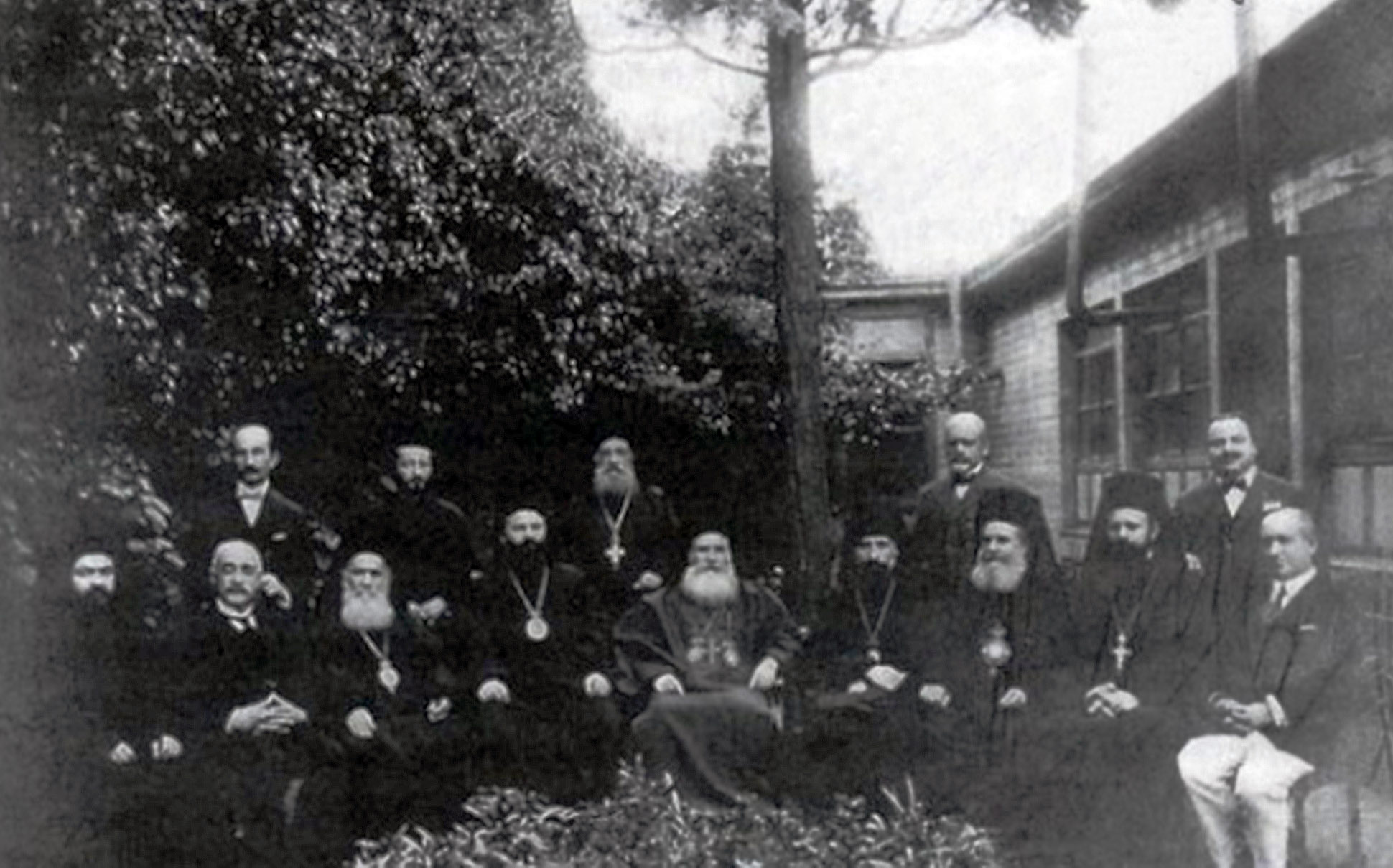
Fr. Alexander Hotovitzky (third from left) and Archimandrite Raphael Hawaweeny (fourth from left) assisting Bp. Tikhon at the blessing of the cornerstone of St. Nicholas Church, New York City, May 22, 1901
In the record for the marriage, I was surprised to find the name of a priest I had never seen before: Fr. Ilia Zotikov. When I got home, I searched through the print and online sources I normally use to find information on priests, and found surprisingly little. Other than the fact that he was in New York at the early part of the 20th century, Zotikov seemed to have fallen into obscurity. Then, like any crafty, 21st-century researcher, I ran a Google search in Russian. Dozens of hits popped up. This is where the story became something quite interesting.
In 1922, Fr. Ilia Zotikov, like untold thousands in his vocation during the Soviet era, was forced into the murky abyss of the Soviet prison system, where his personal and professional lives were interrupted by a dizzying series of arrests, trials, imprisonments, exile, and ultimately, death. Of course, Orthodox Americans are quite familiar with the Hieromartyr Fr. Alexander Hotovitzky, who is depicted and venerated in iconography throughout the world, and whose biography has been published far and wide. This has as much to do with the circumstances of his various trials and ultimate martyrdom in the Gulag in the Soviet Union as his prominence in the North American Diocese during the nearly two decades he served in the United States. Yet the same cannot be said for Zotikov, even though his life, ministry, and subsequent fate were quite similar, and intrinsically tied, to those of Hotovitzky.
Ilia Ivanovich Zotikov was born into a priestly family in Finland in 1863. He was educated at the St. Petersburg Theological Seminary, where his classmates included John Kochurov and Alexander Hotovitzky. In 1895, Zotikov was one of a number of Russian seminarians recruited for service as missionaries in America by Bishop Nicholas Ziorov, Bishop of Alaska and the Aleutians. Zotikov was assigned to be an assistant to Fr. Evtikhy Balanovitch, and both were sent to New York City to start the small parish that would ultimately become St. Nicholas Cathedral.
They arrived in New York with their wives, both named Mary, on April 1, 1895 (NY Sun, 4/2/1895). On May 19th, Bp. Nicholas ordained Zotikov to the priesthood in the parish’s tiny house parlor sanctuary at 323 2nd Avenue (New York Herald, 5/20/1895). When Balanovitch left St. Nicholas in 1896, Zotikov stayed on to assist Balanovitch’s replacement, his seminary classmate Fr. Alexander Hotovitzky, who had been ordained a priest in San Francisco earlier in the year. Together they were instrumental in both the growth of the congregation and the subsequent building of the parish’s new church on 97th Street, which would become the cathedral of the entire North American Diocese in 1905. Hotovitzky became the Cathedral Dean, and Zotikov the Sacristan. It was there that Zotikov officiated the marriage of my great-grandparents in 1908, and where, as my grandmother’s files revealed, Hotovitzky baptized their first daughter two years later.
In the late summer of 1910, Zotikov returned to Russia. For most of the ensuing decade, he served in various parishes in St. Petersburg. In 1919, he was reassigned to Christ the Savior Cathedral in Moscow, where, alongside Hotovitzky, he served as Sacristan of the Cathedral and assistant to Patriarch Tikhon, in a nearly identical arrangement to that at St. Nicholas Cathedral more than a decade before. There, the Patriarch, Hotovitzky, Zotikov, and Cathedral Dean Fr. Nicholas Arseniev were on the front lines of the defense against the repression of the Church by the Bolshevik government. Both Patriarch Tikhon and Fr. Alexander would be arrested and imprisoned multiple times in the early years of Bolshevik rule.

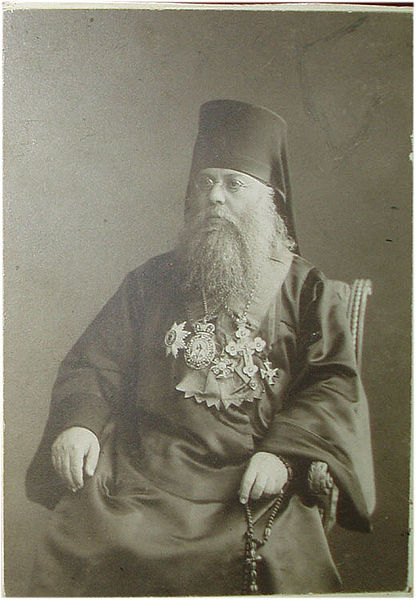
Metropolitan Benjamin of St. Petersburg, a seminary classmate of Frs. Hotovitzky and Zotikov, before the Petrograd Revolutionary Tribunal, June 1922
In early 1922, the Bolshevik government ordered the seizure of all ecclesiastical vessels and objects of value held by the Church. This was met with resistance by clergy and laity alike. The clergy of Christ the Savior Cathedral, led by Hotovitzky, were especially instrumental in resisting the order, and meetings were held at Hotovitzky’s apartment to draft resolutions in opposition. For his participation in these meetings, Zotikov was amongst a group of clergy and laity arrested in the spring of 1922, and was subsequently sent to Butyrki Prison.
In December, Zotikov, Hotovitzky, and others appeared before the Moscow Revolutionary Tribunal. Hotovitzky and two others were given ten-year sentences. Most of the others, Zotikov amongst them, were sentenced to three years’ imprisonment and one year of deprivation of civil rights. Appeals were unsuccessful, but in late 1923, many of the sentences were cut short on amnesty. Zotikov returned to Christ the Savior, and in 1924, was reassigned to the Descent of the Holy Spirit, where he remained for several years. Hotovitzky was left without a parish assignment, instead filling in where he was needed.
Zotikov was arrested again in June 1927. Found to be in possession of the “Solovki Declaration,” a document issued by bishops imprisoned in the Solovki prison camp in opposition to the Soviet government, Zotikov was again imprisoned at Butyrki, put on trial, and sentenced to three years of exile in Vladimir, about 120 miles east of Moscow. There, he became rector of a small cemetery chapel then serving as the cathedral for the entire Diocese of Vladimir following the forced closure of Dormition Cathedral earlier in 1927. By this point in time, Soviet law had restricted the clergy from nearly every aspect of their vocations, leaving priests like Zotikov on dangerous ground as they attempted to perform even the most basic sacramental duties. By 1929, widespread arrests of clergymen were underway.
In 1993, the Journal of the Moscow Patriarchate published an article by Andrei Kozarzhevsky about parish life in Moscow in the 1920s and 1930s, which sheds some light on this period of Zotikov’s life. (Thе article was recently translated into English and published on the Russian website Pravoslavie.ru.) Kozarzhevsky was baptized by Zotikov in 1918, and was well acquainted with both Zotikov and Hotovitzky in his adolescence. As a child, he assisted Zotikov during services in Vladimir, and recalled Zotikov’s third arrest, on October 13th, 1930, for “membership in a counter-revolutionary organization of churchmen,” that being the Church.
On October 19th, 1930, Zotikov was convicted by the OGPU (the arm of the Soviet secret police who spearheaded the repression of religious groups) and was relegated to the notoriously brutal Vladimir Central Prison. On October 23rd, Zotikov was sent for execution. Some sources state both he and Protodeacon Michael Lebedev were shot by a firing squad, though Kozarzhevsky claims he suffered a fatal heart attack on the way to the execution. Regardless, Fr. Ilia Zotikov is considered a Hieromartyr, and is commemorated according to the church calendar with the New Martyrs and Confessors of Russia on January 25/February 7.
Andrei Kozarzhevsky’s recollections of Zotikov do not end with his death. After Fr. Alexander Hotovitzky was martyred in the Gulag in 1937, Kozarzhevsky came into possession of a few of Hotovitzky’s personal effects, including a copy of a poem written by Hotovitzky in New York during the summer of 1910, on the occasion of a “triple event:” The feast of St. Elias, Zotikov’s name-day, and his imminent departure for Russia.
By any measure, it is clear that Zotikov and Hotovitzky (and their wives) were particularly close, a bond which apparently began in seminary, yet was forged largely in America. When Hotovitzky departed for Russia in 1900 to raise money for the building of St. Nicholas Church, it was Zotikov who officiated the service blessing his trip. When the church complex was finished, the Hotovitzkys and Zotikovs were neighbors in its apartments. Mary Hotovitzky and Mary Zotikov later served together on the board of the Cathedral Sisterhood.
Far away from their native land, the two former classmates depended on each other, and continued to do so after they were reunited in Russia, where they ultimately met similar fates in the Gulag. It is no surprise, then, that Fr. Alexander Hotovitzky’s 1910 poem was “dedicated to my best friend Fr. Ilia Zotikov.”
A note on sources: Much of the metrical data for this article, including the particular dates of Fr. Zotikov’s biography, can be found (in Russian) here. Additionally, biographical details and a brief biography of Zotikov can be found in The Holy New Martyrs and Confessors of Central Russia (Vladimir Moss, 2009, 657-8), available for download (along with other similar works) here.
This week in American Orthodox history (January 16-22)
0January 16, 1924: Patriarch Tikhon of Moscow — former Archbishop of North America, and future canonized saint — issued an ukaz removing Metropolitan Platon Rozhdestvensky from his post as primate in America for “public acts of counter-revolution.” Of course, Tikhon was under pressure from the Soviet government. Really, “pressure” is an understatement; I have no doubt that he was compelled to issue that ukaz. Because this ukaz and stuff like it, later in the same year, the Russian Archdiocese declared itself independent from the Moscow Patriarchate.
January 17, 1869: Former Episcopal priest James Chrystal was ordained to the Orthodox priesthood in Syra (Greece). This would have been the eve of Theophany on the Old Calendar. Chrystal had only recently been baptized into the Orthodox Church, and very soon after returning to America, he left Orthodoxy, saying that he couldn’t tolerate the veneration of icons.
January 21, 1957: Greek Archbishop Michael Konstantinides delivered the invocation at President Dwight Eisenhower’s inauguration. This was the first time that an Orthodox bishop was invited to participate in a presidential inauguration. In the years surrounding this event, Orthodoxy came to be recognized by dozens of states as the “fourth major faith,” along with Roman Catholicism, Protestantism (treated as a generic whole, in spite of its myriad divisions), and Judaism.
If you know of another major American Orthodox historical event that occurred between the 16th and 22nd of January, let us know in the comments!
Christmas, the New Calendar, and the Russian Church in 1923
1After reading Matthew Namee’s recent post on the celebration of Christmas according to the New Calendar in Orthodox parishes and jurisdictions in America during the first half of the 20th century, I thought it appropriate to post an article that appeared in the pages of the New York Times on December 25th, 1923.
I think it’s a rather unique picture of what Orthodox life was like in this era, especially given the political overtones of the repression of the Church of Russia, which we see in the first half of the article. With their brothers and sisters in Russia experiencing the initial stages of a rather aggressive anti-religious campaign from the fledgling Bolshevik government, the North American Archdiocese were experiencing crises of their own in the wake of the Russian Revolutions of 1917.
In Russia, the Bolshevik government had instituted the national move to the Gregorian (New) Calendar on February 1/14, 1918 (February 1st became February 14th). The Church of Russia resisted this change, and in discussions of the All-Russian Sobor of 1917-8 (in session as the calendar switch went into effect), determined to retain the Old Calendar.
By 1923, however, this would be tested by the rise to power of the Living Church, a reformist movement that had coalesced out of several radical factions within the Russian Church over the previous two decades. Backed by the Bolshevik government, the Renovationists attempted to force the implementation of the New Calendar, and over time, the calendar issue became a distinct point of differentiation between the so-called “Renovationist” and “Tikhonite” factions within the Church of Russia.
In America, this differentiation, apparently, also resulted in a distinct rejection of the New Calendar within the North American Archdiocese. In December of 1923, the Archdiocese was in the throes of its legal battles with the Living Church-backed John Kedrovsky, who had returned to America in October claiming to be the Archbishop of North America and the Aleutian Islands. With confusing accounts coming out of Russia regarding the status of Patriarch Tikhon, reports of bizarre and troubling attacks against the Church and religious life by the Soviet government, and very real threats of the loss of St. Nicholas Cathedral and other church properties in American courts, the Archdiocese chose to reject the recent decision of the Pan-Orthodox Congress to institute the use of the Revised Julian (or New) Calendar.
Plainly, for many Orthodox Christians in America of Russian descent in this era, the New Calendar was not primarily associated with a Pan-Orthodox Congress, but with Bolshevism and the repression of the beloved Patriarch Tikhon, who was obviously revered in all corners of Orthodox America.
The allowance for the use of the New Calendar within what would become known as the Metropolia would not come until the 13th All-American Sobor in 1967. While some corners of the OCA have almost universally moved to the Revised Julian Calendar, there are yet still many parishes throughout the United States and Canada that will be celebrating the Nativity of Christ two weeks from now. As Matthew outlined the other day, there is similar plurality across the other jurisdictions in America. Yet regardless of when we observe this important day, it is with the same spirit of joy in the birth of Christ.