Posts tagged Aftimios Ofiesh
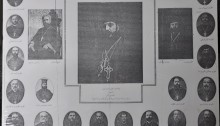
Amazing photo collage of Antiochian priests, circa 1920
0First of all, I’m really sorry for my extended absence from this website. Beginning in December, my life went pretty crazy — first the end of law school, then studying for the bar exam, and then moving and starting my legal career. Unfortunately, I’ve had no time at all for historical research.
Right in the middle of this chaos, I received a really awesome email from Fr. Timothy Ferguson, an Antiochian priest in Boston. He had discovered a photo collage of Syrian/Antiochian priests from the late 1910s/early 1920s — 21 clergymen in all. The collage is posted above, and here’s a list of the clergy depicted (and I’m retaining the spelling provided by Fr. Timothy’s sources):
Center:
- Archbishop +Aftimious, Bishop of Brooklyn, Syrian Orthodox Mission in North America (Center)
- V. Rev. Basil M. Kerbawy, Dean of the Clergy (Left of Bishop)
- Rt. Rev. Emmanual Abu Hattab (Right of Bishop)
From Top Left:
- Rev. Daniel Tanoos Jerguis
- Rev. Eli El Hamati
- Rev. Ayoub Salloom
- Rev. Antonious Abu Alan Farah
Across the Bottom, Left to Right:
- Rev. Sliman Boulos
- Rev. Theodore Yanni
- Rev. Yousef Kacere
- Rev. Abraham Zaine
- Rev. Hanna Hakim
- Rev. Abdallah Khoury
- Rev. Constantine Dawani
- Rev. Philipous Abu Assaley Shaheen
From the Top Right:
- Rev. Mousa Abi Haider
- Rev. Elias Fraij
- Rev. Michael El Khoury Saba
- Rev. Solomon Faireny
Insert Below Fr. Kerbawy:
- Rev. Sophronious Beshara
Insert Below Fr. Abu Hattab:
- Rev. George Kattouf
Not Pictured:
- Rev. Solomon Merighe
- Rev. Simion Issa
- Rev. George Dow Maloof
- Rev. Yousef Elia
- Rev. Basil Mahfouz
Many thanks to Fr. Timothy Ferguson for sharing his amazing find!
The Death of Aftimios Ofiesh
0I had meant to write something about this yesterday, since July 24 marks the anniversary of the death of Aftimios Ofiesh, the sometime Archbishop of Brooklyn, who departed this earthly life in 1966. Aftimios was briefly the leader of the American Orthodox Catholic Church (1927-33), the first attempt to create a united, pan-Orthodox, autocephalous Orthodox Church for North America.
Aftimios has been a special interest of mine for a number of years now, particularly after I heard from the Antiochian priest in Wilkes-Barre, Pennsylvania, that he was buried there. When I heard that, I was in seminary at St. Tikhon’s at the time, and Wilkes-Barre is only about forty-five minutes from the seminary. After having heard his strange tale and being intrigued by his story’s proximity to where I was then living, I set about to find the grave of this tragic archbishop, who is buried next to his wife Mariam, just across the street from the Orthodox cemetery. My intrigue eventually led to my writing my M.Div. thesis on Aftimios.
Aftimios is of course mainly remembered for the act that effectively ended his ecclesiastical career—marrying Mariam Namey. But this successor to the great St. Raphael Hawaweeny in the see of Brooklyn was also a brilliant, energetic churchman, victim not only to his personal failings but also to the ecclesiastical turbulence of his time. Under Aftimios, the fissures that had begun opening during Raphael’s tenure widened into cracks and finally into full-blown schism, as different parties within the Syrian Brooklyn diocese aligned their loyalties with the American Russians, the renegade Antiochian Metropolitan Germanos Shehadi, or with Aftimios himself. This history is complicated, though fascinating.
What I’m remembering today, however, is an encounter I had with Fr. Herbert Nahas, whom I interviewed in the process of writing my thesis. Fr. Herb was one of the last people to visit Aftimios before he died. Following is the portion of my thesis that deals with this encounter and the death of Aftimios at the age of eighty-five:
Shortly before his death, Aftimios was paid a visit by the local Syrian Orthodox priest in Wilkes-Barre, Fr. Herbert Nahas. Nahas had not wished to see Aftimios, mainly because of the disgrace in which Aftimios and Mariam lived and also because doing so would possibly mean stirring up dissension in the parish. However, Nahas had received a letter from Metropolitan Antony (Bashir), the head of the Syrian archdiocese, instructing him to visit Aftimios to see what kind of biographical information could be had regarding the period between his marriage and the current time. There was also a personal connection between Nahas and Aftimios, as the latter had ordained Nahas’ father George.
When Nahas entered the house in Kingston, Aftimios looked up and saw him coming. When the old bishop recognized that the son of one of his priests was entering, he looked at him and bitterly said, “Now you come to see me?” Nahas showed him the letter from Antony, but Mariam, “always a tough woman,” refused to allow Aftimios to speak with him. “You just leave him alone,” she said. The priest left their home without anything to send the metropolitan. This encounter was probably Aftimios’ last contact with the Orthodox Church.
Peace does seem to have come to Aftimios, however:
One evening, shortly before his demise, Mariam asked him if she had spoiled his life. His answer was that he had been saved from a pit of corruption; then slowly looking up with a mirthful smile and laugh as at a secret joke, he quietly said the word “Ob-stack-L” at which Mariam laughed, and he fell silent, reassured.
[The mispronunciation of "obstacle" by Aftimios was the occasion of his first meeting with Mariam. This quotation is from her book about him. -ed.]
Aftimios Ofiesh died on July 24, 1966, at the age of eight-five. His will stipulated that his funeral was to have no flowers, no viewing, no gathering and no religious services of any kind. “No clergy of any denomination” were to have anything to do with his body. He was buried according to his wishes the next day at Maple Hill Cemetery in Hanover Township (near Wilkes-Barre), across the street from the Orthodox cemetery.
Photo of the week: a newlywed archbishop
0
Archbishop Aftimos Ofiesh and his young wife, Mariam, shortly after their wedding on April 29, 1933. Photo from the Brooklyn Daily Eagle (5/8/1933).
In the half-dozen years before his wedding on April 29, 1933, Archbishop Aftimios Ofiesh had moved further and further away from mainstream Orthodoxy, setting himself up as the head of an “autocephalous” jurisdiction called the American Orthodox Catholic Church—which at its inception in 1927 had the official blessing of the Russian Metropolia in America (which would in 1970 become the OCA).
His wedding to the former Mariam Namey (no relation to our own Matthew Namee) essentially represented his final break with any official Orthodox ecclesiastical authorities. Aftimios continued to call himself an archbishop, and he even made occasional visits to Orthodox parishes, but his hierarchical career was effectively over the moment he tied the knot. He also became a pariah in the Syrian community in and around Wilkes-Barre, Pennsylvania, where Mariam was from and where the couple lived (among other places) for years after their wedding.
Before he met Mariam, there were indications that Aftimios had planned to marry, essentially to try to make a point about his opinions on episcopal celibacy—that it was a “man-made” institution that could be abrogated at any time, especially now that he was in the New World. Even though his own synod in the American Orthodox Catholic Church officially agreed with him, they also declared him “retired” in the same message with which they congratulated him on his nuptials.Despite the ideological premeditation of his marriage, when Mariam later recounted their meeting in her biography of her late husband, she described it in endearing, romantic terms. Their marriage lasted until his death thirty-three years later, producing a son named Paul within a couple of years after the wedding.
Aftimios never served as a bishop of the Orthodox Church ever again, although he dressed as one, and members of the Namey family remembered him as Amo Sayidna (“Uncle Master”; sayidna is the Arabic equivalent of the Greek despota or Russian vladyka). His break with Church authorities was so bitter that in his will he stipulated that his funeral and burial were to involve no clergy of any kind. He died in 1966.
Some thoughts on the Russy-Antacky schism
0Yesterday, in my “This week in American Orthodox history” article, I mentioned the following event:
April 23, 1917: St. George Syrian Orthodox Church in Worcester, MA became the first official “Antacky” parish, declaring its loyalty to Metropolitan Germanos Shehadi. Informally, the Russy-Antacky schism began immediately after St. Raphael died in 1915, when his priests disagreed on whether to acknowledge the authority of Antioch or Russia. But the Worcester declaration marked the formal beginning of the schism, which divided the Arab Orthodox in America until the mid-1930s.
According to the parish history in its 1956 “Golden Jubilee” book, the Worcester church issued this declaration: “Just as the Disciples declared themselves dedicated to Christ in Antioch, so the people of Worcester declared themselves dedicated to the Church of Antioch.”
But Germanos wasn’t actually authorized by Antioch — he was acting independently, and Antioch wanted him to return to his see in Syria. So when the Patriarchate of Antioch created its own, official jurisdiction in America under Bishop Victor Abo-Assaly, the Worcester parish switched over, becoming one of the first churches to join the new Antiochian Archdiocese.
As you may recall, the Russy-Antacky schism wasn’t merely a simple two-way split. Well, it was originally — you had the Russy under Bishop (later Archbishop) Aftimios Ofiesh, and the Antacky under Metropolitan Germanos Shehadi. But by the end of the 1920s, four bishops claimed authority over the Arab Orthodox:
- Metropolitan Germanos, who lacked the blessing of Antioch (or anyone else, for that matter), but originally led the Syrians who preferred to be tied to Antioch rather than Russia;
- Archbishop Aftimos, who initially led the Syrians under the Russian Church, but who later formed his own jurisdiction and was disowned by the Russians;
- Archbishop Victor Abo-Assaly, the first primate of the Antiochian Archdiocese, which was formed in 1924; and
- Bishop Emmanuel Abo-Hatab, a former auxiliary to Aftimios, who took over the Russy parishes after the Russian Metropolia rejected Aftimios.
It’s particularly difficult to figure out just who was under whom during this period. The 1924 book The Syrians in America, by Philip Hitti, provides a valuable snapshot of how things looked just before the Antiochian Archdiocese was created. According to a directory at the back of Hitti’s book, the score was 31 priests for Aftimios against 24 for Germanos. (These numbers don’t include the five priests of the separate “English-Speaking Department,” which was also under Aftimios.)
But what happened after 1924? As far as I can tell, there aren’t any hard numbers. We just don’t know, for instance, how many parishes left Germanos for the officially sanctioned Antiochian Archdiocese, nor do we know how many parishes remained under Aftimios after the Russian Metropolia replaced him with Emmanuel. The Census Bureau conducted its decennial Census of Religious Bodies in 1926, but I haven’t been able to find the entry (or entries) for the Syrians/Antiochians, so I don’t know if the Census reflected the complex divisions.
My home parish, St. Mary in Wichita, was founded in 1932, right before the slate was wiped clean by the death of three of the four claimants, and the marriage of Aftimos. Several years ago, Bishop Basil of Wichita asked me under which bishop St. Mary was founded, and I honestly didn’t know. I asked the surviving elders of the parish, and none of them knew, either. It’s indicative of how complex that era was. Eventually, I dug up a newspaper article from 1956 that referenced Archbishop Victor as the founding hierarch, finally settling the question.
It’s possible (probable, even), that as the original claimants (Aftimios and Germanos) were supplanted by Victor and Emmanuel, they continued to visit some of their former parishes in some kind of unofficial capacity. I’ve heard stories about Aftimios showing up at Antiochian churches for years after his marriage. To complicate matters even further, after Aftimios left the scene, one of his associated bishops, Sophronios Beshara of Los Angeles, remained at large for the rest of the 1930s, and he apparently visited parishes and even ordained some priests. So to some extent, even after the Antiochians regrouped in the mid-1930s, you still had four claimants — Metropolitan Antony Bashir of New York and his friend/rival Metropolitan Samuel David of Toledo, plus the fringe holdovers Aftimios and Sophronios.
Suffice it to say that there were a bunch of Arab bishops running around in the 1920s and ’30s, and we don’t have a clear understanding of exactly where to draw the lines. And of course, we’re talking here about just one mid-sized group of ethnic Orthodox people; the much larger Greek and Russian groups were just as divided, as were the Romanians, Ukrainians, and pretty much everyone else. Which is why it’s fair to say that we (well, me, and a lot of other people) understand the 1890-1920 period quite a bit better than we understand 1920-1960. But 1920-1960 is critical to understanding our present situation in America, and it’s a period begging for further study.
This week in American Orthodox history (January 30-February 5)
0A lot of Antiochian-related events this week:
January 30, 1902: Archimandrite Raphael Hawaweeny, head of the Syro-Arab Orthodox Mission in America, began a pastoral journey to Mexico. Later this week — on February 3 — he made a brief stop in Cuba en route to Mexico’s Yucatan Peninsula. St. Raphael remained in the Yucatan for a month, until March 2. To his great surprise, he found not only Arab Orthodox Christians, but also many Mexican Catholics who were interested in converting to Orthodoxy. Unfortunately, this would be the only visit St. Raphael ever made to Mexico, and the missionary potential there was never realized. Incidentally, I’ve heard that the Mexican newspapers gave St. Raphael quite a bit of publicity, so if anyone reading this has access to Yucatan papers from 1902 (and can read Spanish), please let me know.
January 31, 1938: Metropolitan Samuel David, head of the Antiochian Archdiocese of Toledo, was excommunicated by both the Patriarch of Antioch and the ROCOR Holy Synod. The backstory was this: In 1935, the Arab Orthodox in America were set to elect a new hierarch who would, it was hoped, unite the long-divided factions of Antiochian Orthodoxy in America. The majority voted for Archimandrite Antony Bashir, who was duly consecrated in New York. But a strong minority favored Archimandrite Samuel David of Toledo. That minority found some other bishops to consecrate their man on the very same day that Bashir was consecrated. This division lasted until 1975, when Met Michael Shaheen of Toledo accepted subordination to Met Philip Saliba of New York.
February 1, 1928: The future Greek Archbishop (and Assembly of Bishops President) Demetrios Trakatellis was born in Thessaloniki, Greece. May God grant him many, many more years!
February 2, 1927: The Holy Synod of the Russian Metropolia (today’s OCA) created “The Holy Eastern Orthodox Catholic and Apostolic Church of North America” (more palatably known as the American Orthodox Catholic Church). This body — let’s just call it the AOCC — was led by Bishop Aftimos Ofiesh, who was simultaneously the head of the Metropolia’s Syro-Arab Mission. Whatever the intent of the Metropolia in creating the AOCC in the first place (and that intent is far from clear), Ofiesh himself viewed the AOCC as the vehicle for Orthodox unity in America. The AOCC was always on the fringe in terms of legitimacy, having been the ambiguous creation of the Metropolia, which itself was on shaky canonical footing in that era. (Only a few years earlier, the Metropolia had declared itself independent of the Soviet-influenced Moscow Patriarchate.) It wasn’t long before Ofiesh and his jurisdiction ticked off their Metropolia creators, driving the AOCC even further away from the mainstream. For all intents and purposes, the AOCC experiment ended in 1933, when Ofiesh married a young girl. However, as Fr. Oliver has recently shown, the AOCC did continue on until 1940 in the person of Bishop Sophronios Beshara, its last surviving hierarch. For a lot more on the AOCC, check out my conversation with Fr. Andrew Damick over at Ancient Faith Radio.
February 5, 1873: The future Fr. Nicola Yanney was born in what is today northern Lebanon. Yanney eventually immigrated to America and settled down in Nebraska. After being widowed at a young age — and with a house full of young children — Yanney was chosen by his fellow Syrian parishioners in Kearney, NE to be their first parish priest. He traveled to Brooklyn and studied for the priesthood under St. Raphael, who had just been consecrated a bishop. In fact, Fr. Nicola was the first priest to be ordained by St. Raphael. Upon returning to Kearney, Fr. Nicola not only shepherded that community, but he was given responsibility for an immense territory — he was essentially responsible for all Arab Orthodox Christians living between Canada on the north and Mexico on the south, the Mississippi on the east and the Rocky Mountains on the west. Roughly speaking, he was the lone priest over all the territory that now comprises the Antiochian Diocese of Wichita and Mid-America. And he was a single parent.
Fr. Nicola was, by all accounts, an outstanding pastor. His end was a testament to his dedication: he died from influenza in 1918. Of course, that was the year of the horrible flu pandemic that killed so many millions. Fr. Nicola’s parishioners were among those dying from the disease, and rather than keep himself safe, Fr. Nicola went to his stricken people, hearing their final confessions and giving them communion. In this way, he caught the flu and soon died. It seems to me that he may be worthy of canonization. (To learn more about Fr. Nicola, read this article by Fr. Paul Hodge.)