Posts Tagged ‘civil authorities’

3
Feb

The Mysterious Death of Fr. Paul Kedrolivansky

   Posted by: Matthew Namee    in Uncategorized

The location of Fr. Paul Kedrolivansky's skull wound, based on the surviving portion of the autopsy report. Image courtesy of Richard Green.

On today’s episode of my American Orthodox History podcast on Ancient Faith Radio, I tell the story of Fr. Paul Kedrolivansky’s suspicious death. For the whole story, you’ll want to listen to the podcast. There are quite a few characters involved, and I thought it might be helpful to provide a brief introduction to each of them here:

Archpriest Paul Kedrolivansky: Dean of St. Alexander Nevsky Cathedral in San Francisco from 1870 to 1878. There was no Russian bishop in America from 1877 to 1879, so at the time of his death, Kedrolivansky was the highest-ranking Orthodox clergyman in the Alaskan Diocese.

Priest Nicholas Kovrigin: Assistant priest of the Cathedral. Kovrigin was actually the founding pastor of the church, back in 1868, but Kedrolivansky was soon assigned to be dean. In what must have been an awkward arrangement, Kovrigin was made his assistant. Kovrigin was repeatedly accused of being a corrupt philanderer, and in 1879, Bishop Nestor basically kicked him out of the Alaskan Diocese.

Mindeleff: Kedrolivansky’s roommate, with whom he went drinking on the night of his fatal injury.

Mr. Rosenthal: Owner of a tobacco shop, one of the places Kedrolivansky visited on his last night. Rosenthal said that Kedrolivansky had exhibited an official-looking document, and claimed that Fr. Nicholas Kovrigin “would give $10,000 to have it from him.”

Dr. Stivers: The police surgeon. He tried to save Kedrolivansky’s life, but it was too late. He also said that Kedrolivansky was almost certainly the victim of murder, and not an accident. On the basis of Dr. Stivers’ testimony, the coroner’s jury declared the death to be murder by person or persons unknown.

Vladimir Welitsky: The Russian consul in San Francisco. From the very beginning, Welitsky insisted that Kedrolivansky’s death was just an accident, not murder. He also downplayed the importance of the “$10,000 document,” which he claimed to have translated.

Gustave Niebaum: Head of the Alaska Commercial Company. Niebaum’s company had previously accused Kedrolivansky of transporting contraband. After Welitsky returned to Russia, Niebaum became the acting Russian consul. He accused Kedrolivansky’s widow of having an extramarital affair, thereby driving her husband to drink and thus to his (accidental) death. Alexandra Kedrolivansky sued Niebaum for defamation of character; the case went to the California Supreme Court, and Mrs. Kedrolivansky won.

Elizabeth Kedrolivansky: Widow of Fr. Paul. As I said above, Gustave Niebaum accused Mrs. Kedrolivansky of having an affair and driving her husband to drink. She later won a defamation lawsuit against Niebaum.

Detective Jehu: San Francisco police detective. He was investigating the Kedrolivansky case, and found three witnesses who claimed to have seen Kedrolivansky fall and hit his head on the ground. On the basis of this testimony, the police declared the death to be an accident, and they closed the case.

Chief John Kirkpatrick: Chief of the San Francisco police. Kirkpatrick wrote a letter to Consul Welitsky, explaining the conclusions of the police.

Bishop Nestor Zass: Bishop of the Alaskan Diocese from 1879 to 1882. Upon arriving in America, Bp Nestor immediately expelled Fr. Nicholas Kovrigin from his diocese. In 1882, Bp Nestor died at sea.

Bishop Vladimir Sokolovsky: Bishop of the Alaskan Diocese from 1888 to 1891. Bp Vladimir’s tenure was occupied by almost constant scandal. While he was nowhere near America when Kedrolivansky died, Bp Vladimir accused the Alaska Commercial Company and a man named Amosov of killing Kedrolivansky.

Amosov: A mysterious man who some later claimed had murdered Kedrolivansky. It’s not clear whether Amosov even existed in reality, much less whether he was guilty of murder.

Also, for the record, I am going to reprint the description of Kedrolivansky’s wound. This was printed in the San Francisco Examiner on May 23, 1889. It is all that survives of the original autopsy report.

The autopsy disclosed the fact that the scalp of deceased was very thick and strongly adherent, and on the whole of the left side there was a large amount of suffused blood. On the left side was found a fracture of the skull, commencing in the temporal bone, running upward and slightly backward into the parietal bone, being three inches in length; thence at right angles backward half an inch; thence downward and slightly backward two inches; thence at right angles forward one and three-fourth inches intersecting the first line described, leaving a detached piece pressing upon the brain. This portion of the skull was quite thin. From the point of intersection there was a fracture running across the temporal bone and ending in the median line of the frontal bone at a distance of about four and a half inches. There was also a fracture from the lower corner of the detached piece running backward across the parietal bone a distance of about half an inch. The brain directly under the fracture was lacerated and a brain clot weighing four ounces was found. The brain was in a healthy condition.

Kedrolivansky’s death remains an unsolved mystery. Was it an accident, or murder? If murder, then, by whom, and why? We may never know.

Tags: , , , , , , , , , , ,

Archimandrite Theoclitos Triantafilides is one of the most remarkable figures in American Orthodox history. An ethnic Greek, he served as tutor to the future Tsar Nicholas II and went on to establish the multiethnic parish of Ss. Constantine and Helen in Galveston, Texas, under the Russian Mission. His story has been mostly untold, until now. The following article, by Milivoy Jovan Milosevich, is the fullest and best work yet done on the life of Fr. Theoclitos and the history of Ss. Constantine and Helen Church. It originally appeared on the Galveston Orthodox Community website, which is run by Fr. Serge Veselinovich, the current pastor of Ss. Constantine and Helen. SOCHA has received permission to reprint the article here at OrthodoxHistory.org.   

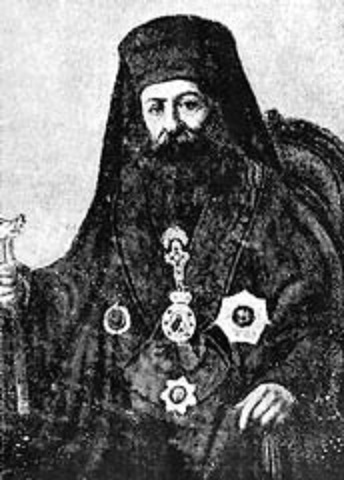
Archimandrite Theoclitos Triantafilides

This picture of the Right Reverend, Most Venerable Archimandrite, Fr. Theoclitos Triantafilides is the only one I am aware of. He was the first Orthodox Priest in Texas. The picture did hang with Honor in the Church Congregation Hall of Saints Constantine and Helen Church in Galveston, Texas. It has been saved from “Hurricane IKE’s Destruction” (September 12, 2008), and will hang there again when the new hall is constructed soon. I live in Galveston, and I have been a part of the Church congregation since Baptism. My Mother was baptized by Arch. Fr. Theoclitos and was very proud to tell people of that fact until her death in 2001. I have studied everything I can find on this wonderful Priest over the years, including his Last Will, the Galveston Daily News archives, Immigration Records, the Rosenberg Public Library of Galveston, the Church records (Slavonic, long-hand written in Cyrillic), the Internet and greatly on the local “folklore” stories told of him.   

IT’S HAS BEEN SAID….   

His father was an Athenian Greek. When the first outbreaks of Greek Independence from the Ottoman Empire started on the Peloponnese Peninsula, his father, a fisherman crossed onto the peninsula to join the forces of famed Greek General Theodoros Kolokotronis, also an Athenian. Eight years later, when Independence was achieved (with great help from the Allied Russian, English and French Forces); he settled in Egio (one of the oldest cities in the Balkans), Peloponnese Peninsula, Greece.   

Born in November of 1833, young Theodoros was named for the famed Greek General. They called him “Theos” and he celebrated his Name Day each September 22nd (Julian Calendar in the 1800’s), on the Feast Day of St. Hierotheos, the Student of Saint Paul, the Apostle, who in 53 A.D. became the First Bishop of Athens. Theodorus grew up fishing with his father, and spending time around the port; while his mother (a native of the Peloponnese Peninsula) pushed him to the Church. The era after Greek Independence was wrought with economic problems and the Armenians and Bulgarians had replaced the Ottomans as bankers and merchants, allowing our young Theos to become ever more acquainted with other cultures. Two-thirds of the population had vanished and the land was devastated.   

His early schooling was in the Church of Panagia Trypiti that is built inside a cavity of the cliff just 150 stair steps above the Port of Egio and he helped the Priests with all their duties, occasionally traveling into the local mountains to visit Agia Lavras Monastery, about 20 miles south and up in the mountains. Greek Independence had started there with Bishop Germanos Declaring Independence with his blessing of the troops. Later the Ottomans burned the Monastery, but it was reconstructed with help from the Russian Orthodox Church. Many of the Icons there were gifts from the Russian Monastery Panteleimon on Holy Mt Athos and the Be-jeweled Gospel in the Monastery was printed, signed and given by Catherine the Great of Russia. History and multi-ethnic cultures literally surrounded him. As a young adult, he was Tonsured a Monk and was given the name Theoclitos. He soon traveled to Mt Athos where he was accepted as a resident of the Panteleimon Monastery, where he became fluent in Slavonic and studied Russian language and customs; and made regular visits to the Serbian Monastery Hilandar learning the Serbian language and customs. He had become fascinated with languages.   

He was invited to complete a formal education and become a teacher at the Slavic Greek Latin Academy and Theological Seminary at Holy Trinity – St. Sergius Monastery, better known today as the Moscow Theological Academy, just outside Moscow, Russia. After under-graduate, a Graduate Degrees in Theology and a few years of teaching; he was called upon by the new Danish born King of Greece, George I, to tutor his son Prince George. Later, the King’s brother-in-law, Tsar Alexander III of Russia called upon him to tutor the Royal Family’s 6 children specifically in other Orthodox cultures including the Greek language. So, he became a Greek cultural teacher to the future Tsar Nicholas II of Russia, who was Canonized a Martyr Saint of the Russian Orthodox Church in 1991. It is also said, Fr. Theoclitos was one of the 30 or so clergyman serving at the wedding of Nicholas II and Alexandra Fyodorovna, who was Canonized a Martyr Saint of the Russian Orthodox Church in 2000. The Parishioners of Galveston would later call him, “The Priest of Three Kings.”   

It is known that with the outset of the American Civil War, a group of multi-ethnic Orthodox Christians were having regular prayer meetings in Galveston, as early as 1861, and they called themselves “the Parish of S.S. Constantine and Helen.” Galveston is a seaport, and its citizens were accustomed to our Eastern European and Mediterranean People. Our Eastern Orthodox Christians were always around the port. There were those that came, returned home and came back again. The first known Serbian in America lived in Galveston for a long time; his name was Djordje Sagic (aka: Djordje Ribar and/or George Fisher). He came to Texas in the late 1820’s after “jumping ship” (because of indentured servitude) in Philadelphia, and became the first Port Director of the Port of Galveston under the Mexican Government. He then became a Major in the Texas Revolutionary Army under General Sam Houston. He served in public office as City Councilman in Houston, Texas and Justice of the Peace in Harris County after the Texas Revolution. Sagic had studied for the Priesthood in Karlovci Serbia, but left the seminary to join the last efforts of the first Serbian uprising against the Ottoman Empire in 1813, lead by Serbian leader, Karageorge Petrovitch. He left the area in 1850 to ultimately retire in San Francisco, California as a Justice of the Peace and retained the status of the Official Greek Government Consul there until his death, in 1873. He knew 13 languages.   

The First known Greek in Galveston participated in the Parish Church group. He called himself only by the name of Captain Nicholas. Captain Nicholas joined the notorious Privateer Jean Lafitte in New Orleans, when Lafitte sailed for Galveston, as Capitan of Lafitte’s prize schooner the Mirabella. Captain Nicholas sailed away from Galveston with Lafitte after burning everything they left behind. Captain Nicholas returned to Galveston after Lafitte’s death, becoming a farmer on west Galveston Island and recounting old pirate stories at the waterfront. He lived more than 100 years and is believed to have died in the Hurricane of 1900. Some have said that with Lafitte came the first of many nationalities to Galveston, but I am unable to corroborate any other Orthodox Christians. During the late 1880’s and early 1890’s these Orthodox Christian Serbian, Russian, Greek, Bulgarian, and Arab (Lebanese) immigrants to Galveston had organized and started gathering moneies for a church. Aside from the religious group, they each started several individual nationalistic groups. Each had separately written many petitions to their former Bishops back home for a Parish Priest and had received only denials; justified by the facts of distance and costs, but these denials were in some cases including the suggestion that they petition the Russian Orthodox Mission Diocese in North America. So the culture in Galveston was ripe for the addition of an Eastern European & Mediterranean Priest of Arch. Fr. Theoclitos’ stature.   

Nicholas II became Tsar of Russia on November 26, 1894. The Romanov Royal Family had created and supported the Russian Orthodox Mission into North America through Alaska since 1794. At that time, because of the Romanov family’s truly un-matched wealth, the Russian Mission into America was the only Orthodox jurisdiction on the continent prior to 1922.   

So, the Slavs, headed by Risto Vukovich; and the Greeks headed by Athurs Menutis gathered and decided to petition the Russian Mission Diocese. They sent three telegrams written in Cyrillic and signed by Vukovich, Christo Chuk, and Milosh Porobich which explained the diversity of the parishioners to; (1) the Holy Synod of the Russian Orthodox Church, (2) Tsar Nicholas II personally, and (3) His Grace Bishop Nicholas in Sitka, Alaska. A short time later the parish board received a telegram personally from Tsar Nicholas II, stating his acceptance of their plea. The Tsar had a large Gospel Printed, all the Vestments and Liturgical necessities including a signed Antimins, and all the Icons for an Iconostas painted and assembled including the icon to be used for the name day of the future Church (His own Namesake, Saint Nicholas); and he chose his teacher Fr. Theoclitos to go to Galveston, telling him “Let there be an Orthodox Church in Galveston.”   

By this time, Fr. Theoclitos was 61 years of age, and was a well traveled man and spoke more than a dozen languages: Greek, Russian, Serbian, Slavonic, Latin, Bulgarian, Arabic, Hebrew, Danish; and some Spanish, English, French, German, and Romanian. The Ambassador of Russia to the United States acquired US Citizenship for him even before he left Russia. Prior to leaving Russia, Fr. Theoclitos was given the heavy cross he always wore by Tsar Nicholas II and he was elevated to the rank of Right Reverend Archimandrite, because he would soon be the Priestly leader of a flock of Christians so far away with little known chance of a visiting Bishop anytime soon. His journey to the far off land of Galveston, Texas began with six companions. With him were; the Very Reverend Archimandrite Raphael Hawaweeny (Glorified a Saint in March of 2000 by the Orthodox Church in America) and his three Deacons Constantine Abu-Adal, Istvan Moldowanyi and John Shamie (later Shamie was a Priest in Galveston); and Archimandrite Fr. Theoclitos’ two Russian Deacons, Theodore Pashkowsky and Joakim Zubkowsky, and his Romanian Deacon Pavel Grepashewsky; and Fr. Peter I. Popoff. The first leg of the trip was by train to Berlin, serving liturgy there at the Russia Embassy Church; then on to the Port of Bremen. Next leg was by passenger ship to Southampton for a change of ships, then on to New York aboard the passenger ship, S.S Havel out of South Hampton, as a United States Citizen. Only 82 passengers sailed that day. Although a group of Priests were at the port of New York to greet them on the Morning of November 14, 1895, they were required by customs to spend one night in Quarantine. The next morning, they were joined in New York by Bishop Nicholas Ziorov of the Russian Orthodox Mission in America to consecrate the First Arab-Syrian Orthodox Church in America under the Russian Mission’s jurisdiction, and to install Archimandrite Raphael as Pastor, with his three deacons. A few days later, Arch. Fr. Theoclitos, his three Deacons; and Fr. Popoff traveled with Bishop Nicholas by train to Washington D.C., then to western Pennsylvania, where Fr. Popoff was to serve and then on to Kansas City. At this point, it was decided that only the Romanian Deacon Grepashewsky would travel to Galveston with Arch. Fr. Theoclitos; and Bishop Nicholas and the other two Deacons would go on to San Francisco. Arch. Fr. Theoclitos stopped in Hartshorne, American Indian Territory, Oklahoma to have Liturgy for a group of Russian Miners, just outside of Tulsa, Oklahoma before reaching Galveston.   

The distances from Galveston to either San Francisco or New York are about 1600 miles. Although his rightful rank was high, which gave him the right to consecrate his own chapel including the right to wear a Mitre (Crown, but with a flat, not standing Cross on top) and carry a Pastoral Staff (Bishop’s Staff); he lived his life in Galveston as a meager Monk, teacher, and Pastoral Priest. The Church Congregation never paid Arch. Fr. Theoclitos, because he received his pay directly from the Tsar (1500 rubels a month and 500 rubels as expenses; about $120 total, at that time) until Arch. Fr. Theoclitos passed away in 1916, a year and a half before Tsar Nicholas II and his Family were murdered.   

The Trustees of The Existing Congregation Board (Chris Vucovich, Chris Chuoke, Athurs Menutis and Mitchael Mihaloudski) formally received their State Corporation Papers on January 13, 1895 and subsequently purchased a 43’ wide x 120’ deep property that is at 4107 Avenue L, Galveston, Texas on December 15, 1895. They started to build a rectangular wood frame Orthodox styled Church, and when Arch. Fr. Theoclitos arrived, in January of 1896, he directed the finishing of the Church. The congregation was astonished to be blessed with an Archimandrite and a Deacon, not just a Priest, and best of all he was somewhat of a linguist.   

In Galveston, all properties faced either North-west or South-east, so they had chosen property that leaves our Church unusually facing South-east. And, although the Icon of Saint Nicholas was placed in the Iconostas to Honor Tsar Nicholas II as the Patron of the Church; it was Arch. Fr. Theoclitos’ decision to use the name S. S. Constantine and Helen Church, because the congregation that started on its own should be remembered. Bishop Nicholas was invited and he accepted; and the Consecration of our church occurred on June 3rd 1896, the feast day of Sts Constantine and Helen. Arch. Fr. Theoclitos’ decision on the name of the Church, was not unusual with him. He was known to have baptized children with names other than their parents had asked for. My mother’s name was to be Ruza, Serbian for Rose, but he baptized her as Sophia which her parents accepted without question, and gave my mother and others an unusual lifelong connection to their Archimandrite. But then, his guidance and decisions were always accepted by his congregation. There have never been any questions of his guidance that were ever passed down through the years even though we Eastern Europeans have always loved a good argument. He had services in the Slavonic, Greek and Arabic languages. It was as though his congregation was standing with a Saint.   

In 1897, Arch. Fr. Theoclitos purchased a 36 plot track in the Lake View Cemetery as a gift to his Congregation. He buried his flock in the next consecutive plot, without regard to couples or children or any Relationship, because he saw them as one congregational family.   

In early 1897, Bishop Nicholas replaced Deacon Grepashewsky with a young Russian Monk, Fr. Mikhail Kurdinovski to allow Arch. Fr. Theoclitos time to travel and invited Arch. Fr. Theoclitos to San Francisco to speak in the Greek language on the mounting losses of the Cretan insurgents in their revolution against Ottoman rule. Bishop Nicholas had to be acutely aware that his Archimandrite was the highest ranking Greek born Clergyman in America. While in route, we know that he also served Liturgy again in Oklahoma; and in Denver, Colorado. After his sermon in San Francisco he was asked to traveled with Fr. (later, Archimandrite) Sebastian Dabovich (currently being considered for Canonization as a Saint), to Portland, Oregon and Seattle, Washington, where they served Liturgy in Slavonic, Greek and Arabic in both cities. He again traveled to San Francisco in 1898, to participate in the installation of Bishop Tikhon Bellavin, as the new Bishop, replacing Bishop Nicholas of the Aleutians and Alaska (Diocesan name was changed in 1900 to Diocese of the Aleutians and North America). Although little is known about it, Bishop Tikhon visited our parish in 1899, for the first of two visits.   

It’s known that Arch. Fr. Theoclitos traveled extensively on the Gulf Coast going as far east as Mobile, Alabama, as far south as Corpus Christi, Texas, and into the interior north to Ft. Worth, San Antonio, San Angelo and Austin Texas, performing Marriages and Baptisms and serving Liturgy where ever he found our Orthodox Christians. In 1897, The Wiemar, Texas newspaper had an article about him; where he borrowed the local Catholic Church in LaGrange, Texas to perform the wedding of a Greek Couple. The writer (obviously Protestant) posted the short article that follows.   

Weimar Mercury, 29 Jan 1898: “LaGrange, Tex., Jan. 25, –Married today, Mr, Abraham John to Miss Zeche Nemer, both Greek, at the Catholic Church by Rev. Theoclitos (Archimandrite of the Orthodox Church), Galveston, Tex. A very large crowd attended the ceremonies, which were ’somewhat of a novelty,’ no such ceremonies having ever been performed here.”   

Our Church Board additionally purchased a like adjoining property west of the Church doubling the size of the property in early 1900. But, in his 66th year, on September 8th 1900, Galveston Island was hit by the greatest natural disaster in United States history when the massive Hurricane of 1900 came ashore. The Island was almost totally destroyed (est. of 8,000 to 12,000 deaths of a population of 30,000, which included 24 members of the congregation. Arch. Fr. Theoclitos and Fr. Mikhail spent 30 hrs in the church praying and giving refuge to parishioners and neighbors that sought safety in the church. After the storm had passed, the Church structure was still standing although it had floated to the west about 10 feet partially onto the additional property just purchased. Those that were with him in the church believed Arch. Fr. Theoclitos and his church had truly saved their lives. The congregation gathered and raised the Church, repaired the damage and early in 1902 petitioned Bishop Tikhon, who had since moved the headquarters of the Diocese to New York, to visit and Re-consecrate their repaired Church. Bishop Tikhon accepted and arrived shortly before services on June 3rd 1903. This event made Arch. Fr. Theoclitos and his congregation’s church not only patronized by, but also consecrated by future Saints of Orthodoxy. By order of Tsar Nicholas II, Bishop Tikhon bestowed on Arch. Fr. Theoclitos the Royal Honors of (1) the Order Of St. Vladimir and (2) the Order of St. Anne (in his picture, the ribbon and cross like medallion around the neck to his right side is the order of St. Vladimir, the ribbon and medallion around the neck to his left side is the Order of St. Anne and the necklet with the large medallion was awarded him upon attaining his Graduate Degree in Theology from the Moscow Theological Academy.   

While in Galveston, Bishop Tikhon visited the cemetery, and became aware that it was filling fast. As a gift to the Congregation, Bishop Tikhon,who was later made Patriarch of Moscow, purchased 27 additional plots next to the original cemetery track. Arch. Fr. Theoclitos and the Church continued with a new influx of immigrants coming to Galveston each year, even purchasing another 21’ to the west of the Church. Although he did keep constant communications with the Diocese, it is not clear whether he ever met with Archbishop Platon of New York, who replaced Bishop Tikhon.   

He was known to include the Romanov Royal Family each week in the Liturgy, as: (1) word of Tsar Nicholas II’s son, Alexander’s affliction with hemophilia began to spread, (2) World War I was building and (3) talk of revolution against the Tsar was in the news from time to time. Also, because of our multi-ethnic culture in Galveston, the shot by Serbian Gavrilo Princip that assassinated Archduke Franz Ferdinand and his wife Sophie, (believed to be the shot that started World War I, was heard loudly in our Church making the War and the assassination more than an important issue.   

On weekly trips to the business district, the neighborhood children would gather on the church steps and wait for his return. He would always have a large bag full of fruit and the latest sweets for them, saving a large portion for his parish children. He became acquainted with many people during his years in Galveston and was thought of respectfully, while they became somewhat enchanted with his customary meager but stoic Orthodox Monastic ways. He was a constant visitor to St. Mary’s Infirmary (the local Catholic Hospital) and John Sealy Hospital at the University of Texas Medical Branch. Following his heart, as the Apostle St. Paul guided him through his Name Day St. Hierotheos, he was known to give Confession, Baptizism and Communion to anyone who professed to be Christian. He truly became a friend to many families, who felt his visits to their loved ones in the hospital made those loved ones better. He converted to Orthodoxy many of these families: the Dambido family, the Matthews family and the Lelirra family to name a few.   

In 1911, the Galveston-Houston Inter-Urban Train was instituted, allowing many of our Orthodox Christians in Houston (50 miles north and largely Greek and Lebanese) an ease of access to Galveston for Sunday Liturgy. The trains were one or multiple electric cars that ran from downtown Houston to downtown Galveston, and you could get on or off at any time. So, our members could get off, then on again, less than 800 feet north of the Church on the main road into Galveston. It was still a 75 minute trip, one way, but it was an inexpensive way for our Houston parishioners to get to church from time to time. It was later discontinued in 1936.   

And then, in his 81st year, the Island was hit by another devastating Hurricane in August of 1915. Again, Arch. Fr Theoclitos and others prayed in the Church. This storm was even more tenuous for them, but never was anyone in the church lost in any storm. The Church floated to the north about 50 feet into the street, and the front wall was torn open and the Gospel given by Tsar Nicholas II was found by parishioner George Mandich another 200 feet away in the city cemetery across from the Church, miraculously with very little water damage. The congregation repaired the Church and moved it back into place with mule and muscle.   

The parish again, needed more future graves. This time, as a religious benevolent society, they purchased their own private Cemetery in the western part of the city, about a quarter mile from the other cemetery. The land was far larger (would easily accommodate about 300 graves) and would meet their needs for long years into the future. But they also divided it into two sections, the Greeks to one side, and the Serbians and other Slavs on the other.   

Later in the following year, the Church was hit by the loss of their 21 year life with Arch. Fr. Theoclitos, just short of his 83rd year, on October 22nd 1916. He had become gravely ill six weeks before. He somehow knew his time was near, and had the Diocese notified of his illness, and he asked parish leaders to find a way for them to bury him under the Altar of the Church. It was his belief that his grave would, by its nature, cause the Church to continue at the location for centuries into the future. He passed to his Creator at 8:15 in the evening, in St. Mary’s Infirmary Hospital. With the help of Church leaders, his body was prepared by Malloy & Sons Funeral Home, but the parishioners then took the body to the church and stood vigil over his remains continually, until his Funeral. The New Archbishop Evdokim of New York ordered his Diocesan Secretary, Archpriest Fr. Peter I. Popoff (who had been one of Arch. Fr. Theoclitos’ companions on the trip from Russia), and two others of his Diocesan Council members; Fr. Louniky Kraskoff of Denver, Colorado (whom he had visited with on trips to San Francisco) and Hieromonk Fr. Paul Chubaroff of Hartshorne, Oklahoma to immediately travel to Galveston so that Our Beloved Archimandrite would be religiously cared for. They finally arrived in Galveston six days later, on the morning of October 28th. Hierarchical Funeral Services were held that afternoon at 2:00 P.M. During the six week wait, the Parish Board had received permission from the County Judge to place his remains under the Church’s Altar and workers prepared the Concrete Vault that was required by the Judge for his casket to be encased, where it remains today. As Arch. Fr. Theoclitos requested in his will, his Cross and Medals were all taken to Archbishop Evdokim by Archpriest Popoff.
+Memory Eternal+   

In the following years our Church was served by numerous short-term or as they were called in those days, traveling Priests. In 1929, the parishioners, spear-headed by Petar B. Kovacevich, built a wood frame Hall (32’ X 75’) with a parish home above, in hopes of having a Priest and his family, stay in Galveston. It helped, but, in 1933, our Greek brethren gathered and purchased their own Church, The Assumption of The Virgin Mary Greek Orthodox Church. Our parishes have helped each other thru the years, whenever either was without a Priest or there was a time of need, as our Arch. Fr. Theoclitos would expect of us.   

The Hierarchs of the Church in those years were Archbishop Alexander, Metropolitan Platon, and Metropolitan Theophilus.   

In 1934, Fr. Alexis Revera and his family arrived in Galveston and stayed for 27 years. In 1948, the parish decided it was time for the Church to receive some upgrades, mainly in the form of cosmetics. Wing additions were added to the elevated Altar area, the interior was totally painted, Stain Glass windows were added, hard wood flooring, a new roof coving, and the old siding was covered with a light brown brick; work was completed in 1949. The parish petitioned the Diocese, and in 1950, the newly elected Metropolitan Leonty, traveled to our fare city to re-consecrate the Church. Air-conditioning was added in the 1960.   

In 1962, it had become apparent that the community was almost totally made up of Serbians. Metropolitan Leonty and Bishop Dionisije (right) of the Serbian Diocese met and sealed an agreement that put our beloved Church under the Serbian Diocese, while the Russian Diocese would receive under its control the Church in Billings, Montana, which was started by Serbian Bishop Nikolai (Canonized a Saint by the Serbian Orthodox Synod in 2003,) and Archimandrite Fr. Sabatian Dabovich; but had over the years become almost totally Russian. They further agreed to guide these two parishes to remain multi-ethic and services were to be in both English and Slavonic and should include a litany of any other languages when needed for other ethnic parishioners.   

In 1964, the Texas Highway Department was working on plans to expand the street next to the cemetery into a 6 lane highway. They were intending to put an over-pass over the Serbian Section. Two parish leaders, Ilija P. Kovacevich and John N. Milosevich went to the highway department with their plan to move the Serbian Section at the Highway Department’s expense. The Highway Department agreed. So, it became the work of parishioners; lead by local Constable and parishioner Sam Popovich to get every relative of a loved one in the Serbian section to sign the necessary papers. The highway department would provide 6 times the land they were taking and would bare all expenses of exhumation and reburial; where a solid caskets or a vault was not found, the earthen material would be placed in a vault to be transported; and the Priest would attend and be paid for a service of exhumation and re-burial for each grave. The new cemetery is much like a Church with a center aisle and rows of graves to each side; with small side-walks between the rows and an Alter table at the front.   

In 1978 our Parish came under the Jurisdiction of one of its own, Serbian Bishop Christopher. The First American Born Bishop to serve an American Diocese. He was born and raised in Galveston and had been ordained a Priest of the Serbian Orthodox Church in 1949. With his leadership, the congregation has prospered through the past 30 years, with him becoming Metropolitan in 1991.   

Now we have been hit by another devastating Hurricane “IKE,” which came ashore on September 12, 2008. Our Church sustained minor damage with only a few inches of water inside and some wind damage (no doubt that our Arch. Fr. Theoclitos mystically was riding out the storm in his Sanctuary). But our Hall was in 3 feet of water. The old wood frame structure was left structurally unsound. The Parish decided to fix the Church first. We then had the old hall destroyed, and are planning to break ground on a new hall in early 2010. Our Greek Brothers and Sisters didn’t fare as well; their beautiful Church was inundated with 8 feet of sea water. The masonry of the Church and hall structurally survived, but the interiors didn’t make it. They are without a Priest, but have managed to somewhat re-do their Church and are working to completion. During this time, they have attended Liturgy on Sundays with us, and now that their Church is presentable, our priest Fr. Srdjan Veselinovich has liturgy on Saturdays for them.   

In 2009 our parish was placed under the jurisdiction of His Grace, Serbian Bishop Longin, ending an over 40 year schism in the Serbian Orthodox Church in America. Interestingly, His Grace Bishop Longin and Arch. Fr. Theoclitos, both received Graduate Degrees in Theology from the Moscow Theological Academy at Holy Trinity – St. Sergius Monastery (name changed to Zagorsk Monastery in 1930).   

And so, 168 years after the first parish meeting in Galveston, Texas, we beseech Our Archimandrite Father Theoclitos Triantafilides; his friends Archimandrite Saint Raphael Hawaweeny and Archimandrite Sebastian Dabovich; Our Patrons Saints Tsar Nicholas II and Saint Trazistza Alexandra, Our First Metropolitan and Patriarch Saint Tikhon Bellavin, our first Serbian American Bishop Saint Nikolai Velimirovich and all those who with the Saints have guided our Parish in their goodness, to intercede on our behalf for yet another Century of existence.   

From 1895 -2010, the Church-School Congregation of SS. Constantine and Helen was served by the following priests:   

Archimandrite Theoclitos (Greek) 1895-1916
Father Michael Andreades (Greek) 1916-1918
Father John Shamie (Lebanese) 1918-1920
Father George Palamarchuk (Serbian) 1920-1925
Father Marko Dimitrieff (Greek) 1925-1926
Father Pavel Markovich (Serbian) 1927-1928
Father George Milosavljevich (Serbian) 1928-1929
Father Joakim Tkoch (Russian) 1929-1934
Father Alexis Revera (Russian) 1934-1961
Father Damaskin Susjnar (Serbian) 1961-1965
Iguman Mitrofan Kresejovich (Serbian) 1965-1968
Father Jovan Trisich (Serbian) 1968-1969
Father, Dr. Tihomir Pantich (Serbian) 1969-1971
Father Constantine Pazalos (Serbian), (Greek Born) 1971-1982
Father Svetozar Veselinovich (Serbian) 1982-1985
Father Zarko Mirkovich (Serbian) 1985-1987
Father Dragan K. Veleusic (Serbian) 1987-1992
Father Oleg Vifliantsev (Serbian), (Russian Born) 1992-1994
Father Dane Popovich (Serbian) 1994-1994
Father Dejan Tiosavljevich (Serbian) 1994-1995
Father Srdjan Veselinovich (Serbian) 1995-Present   

Fr. Theoclitos performed Marriages and Baptisms, and Celebrated Liturgies in the following locations in America:   

City/Town and Approx. Distance from Galveston   

New York, New York 1416 miles
Washington, D.C. 1213 miles
Hartsborne, Oklahoma 380 miles
Dallas, Texas 269 miles
Ft. Worth, Texas 281 miles
San Angelo, Texas 363 miles
New Braunfels, Texas 199 miles
La Grange, Texas 132 miles
Galveston, Texas 0 miles
Houston, Texas 50 miles
Beaumont, Texas 90 miles
Eagle Lake, Texas 93 miles
Seattle, Washington 1937 miles
Portland, Oregon 1881 miles
San Francisco, California 1686 miles
Denver, Colorado 928 miles
New Orleans, Louisiana 287 miles
Lake Charles, Louisiana 117 miles
Mobile, Alabama 414 miles
Biloxi, Mississippi 362 miles
Port Lavaca, Texas 122 miles
Polacios, Texas 86 miles
Corpus Christi, Texas 181 miles
San Antonio, Texas 216 miles
Waco, Texas 209 miles
Austin, Texas 191 miles
Cameron, Louisana 81 miles
Rockport, Texas 154 miles
Indianola, Texas 35 miles
Brazos, Texas 60 miles
Sabine, Texas 75 miles   

Approximate total missionary miles of work: over 25,000 by train or horse and buggy. 31 locations in 11 States in 21 Years.   

Extreme Post Script:   

In retrospect, this writer remains in awe, that The Right Reverend, Most Venerable Archimandrite Father Theoclitos Triantafilides may truly be “The Forgotten” First Greek-American saint. He was the answer to our predecessors’ every prayer. He traveled extensively on a global basis to serve the religious needs of many. He provided the “Connecting Link” for our multi-ethnic American lives, and through the teachings of Orthodoxy and his God-Given Art of Language, he lead us on the path of Saint Paul, the Apostle, past the ever separating ethnic divide.

Tags: , , , , , , , , , , , , , , , , ,

18
Jan

Anti-Greek Riots in Omaha

   Posted by: Matthew Namee    in Online Sources

The original home of St. John the Baptist Greek Orthodox Church, Omaha, Nebraska

The Greeks first arrived in South Omaha, Nebraska, in 1904, brought in as strikebreakers in the local meat-packing industry. That didn’t exactly endear them to the community, but they settled in, and by 1907, over 2,000 Greeks were reportedly living in the city. It wasn’t long before they built a church, dedicated to St. John the Baptist.

On February 19, 1909, a Greek worker named John Masourides shot and killed a respected police officer. For many residents of South Omaha, this was the last straw: the Greeks had to go.

Two days after the incident, a mass meeting was called to decide how to “rid the city of the undesirable Greeks.”At the close of the meeting, a mob descended on the Greek quarter. They attacked the Greeks, rioted, and destroyed property. The Greeks fled the city. The governor called in the National Guard. Order was restored, but the bigots of South Omaha had accomplished their goal: the Greeks were gone, and most of them would never return. The mass exodus almost wiped out the parish of St. John the Baptist.

As if all that wasn’t enough, a year later, the police themselves took revenge by lynching a young Greek named Nicholas Jimikas. He is buried in an unmarked grave in Omaha’s Fort Lawn Cemetery.

Masourides, the Greek man whose shooting of a policeman sparked the riots, was initially convicted of first-degree murder, and sentenced to death. He appealed to the Nebraska Supreme Court, which reversed the decision. In the end, Masourides was convicted of second-degree murder and sentenced to fourteen years in prison, but less than halfway through that sentence, he was furloughed by the governor and then deported. (To read more about the Masourides case, see Masourides v. State in the Northwestern Reporter, volume 125. Also see this page, dedicated to Edward Lowry, the police officer killed by Masourides.)

For more on the Omaha riots, see this US Congressional report from 1916, which gives a lot of details. Also, see a profile of St. John the Baptist church, written by Jim Golding and published in the December 1999 issue of the Greek Archdiocese’s Orthodox Observer. Interestingly, the history on the Omaha parish website makes literally no mention of the 1909 riots and their effects on the parish.

Tags: , , , , , ,

5
Jan

The Trial of St. Raphael, Part 1

   Posted by: Matthew Namee    in Saints

St. Raphael Hawaweeny

It’s a funny thing — slander, that is. Once it’s out there, you can’t take it back. Good men — saints — have been accused of the most heinous crimes imaginable, and been completely innocent. At the same time, bad men have been accused of the same crimes, and been guilty. Ultimately, as an historian, it’s difficult to determine innocence or guilt. We piece the story together based on the evidence that has survived, and we try to get a sense of the characters involved. In this case, the accused was Raphael Hawaweeny, the great Syrian Bishop of Brooklyn. I am quite confident that the charges against him were trumped-up, and that he did nothing wrong. But I base that conclusion not only on the evidence of the case itself, and not only on his subsequent acquittal in open court, but also on everything I know about him as a person. I trust him, because he proved himself, time and again, to be trustworthy. The accusations against him are completely out of character, and we know more than a little about his character.

This is a messy story, but it has to be told. To start, I’m going to turn to the capable reporters of three New York newspapers. We’ll begin with the New York Tribune (8/28/1905), the most straightforward version of the story:

Threats of murder have been sent in anonymous letters to several members of the Syrian colony of New-York as a result of a bitter controversy which has been carried on for weeks in the columns of two of the Syrian newspapers of the city. The Rev. Raphael Hawaweeney, of No. 320 Pacific-st., Brooklyn, who recently became the Bishop of the Orthodox Greek Church of the Syrians in Brooklyn, has been dragged into the controversy and accused of inciting a movement for bloodshed. He and his friends declare that he has preached only peace and has advised against violence.

A formal appeal to Police Commissioner McAdoo for protection has been made by Syrian merchants who have received threatening letters, and who have been arming themselves and avoiding going into the streets alone for fear of being murdered. In the appeal to Mr. McAdoo it is declared that Bishop Hawaweeney recently called a meeting of members of his church and asked them to defend him against attacks in one of the Syrian newspapers, telling them that he was to be regarded as a grand duke, to be defended by his people, and that, if necessary, some of them must be ready to lay down their lives for him. It is said in the appeal that some of the young men of his congregation laid their knives on a table in the church, in accordance with an Oriental custom, and swore that they would defend the bishop with the last drop of their blood.

Bishop Hawaweeny said yesterday to a Tribune reporter that nothing of the kind happened, but that he attended a meeting of his congregation to counsel the members against violence, telling them to pay no attention to the attacks on him, as he forgave all his enemies. The trouble, he said, grew out of a circular sent to the six Syrian newspapers of the city by a newly formed society of fifteen men, known as the Champagne Glasses Society, and in reality a drinking club, demanding that the editors and publishers stop publishing paid articles attacking business or social rivals. The circular led to a clash between “Al Hoda,” a daily Syrian paper, published by N.A. Mokazel, and “Meraat-ul-Gharb,” a weekly paper, edited by N.M. Diab. The latter declared in his paper that “Al Hoda” referred to the bishop in certain of its alleged slanderous articles. The bishop was asked by friends of “Al Hoda” to stop the controversy, but he said it was none of his business. N.N. Maloof, a Syrian merchant, had a talk with the bishop in an effort to patch up peace, and “Meraat-ul-Gharb” published an account of the conference, which led Mr. Maloof to insert some signed articles in “Al Hoda,” demanding an explanation from the bishop.

Talks with members of the Syrian colony yesterday disclosed the fact that the newspaper controversy had excited them greatly and had led to a religious fight in which Roman Catholics and members of the Orthodox Greek Church had become involved. Mr. Mokazel said he had been accused of publishing a book attacking the Virgin Mary. A book which he thought was harmless, written by his brother-in-law, was printed at the office of “Al Hoda,” he said, and it created some hostile comment. His life had been threatened in an anonymous letter. His character had been assailed by a friend of Bishop Hawaweeney in an article by published in a paper believed to be under the bishop’s control, he said, and the bishop had declined to stop the attack.

Syrians in the city said yesterday that some articles in “Al Hoda” and “Meraat-ul-Gharb” were indecent. They said they had forbidden the women of their families to read the papers as a result of the controversy.

Mokazel, the editor of Al Hoda, was a real piece of work. In an interview with the the New York Times (8/28/1905), he openly slandered St. Raphael, in one of those classic bits of slander-while-denying-that-you’re-slandering:

He [Raphael] asserts that his morality has been attacked. I say nothing about his private life — his wine, his card playing. I have not put it in my paper. I respect his church and wish my church to be respected. I am a Roman Catholic. I have heard that the Bishop has said he would crush me, do me bodily and moral injury. He has called together his congregation and appointed a committee of six desperate men to take vengeance upon me and others. Well, I am willing to die for the truth.

And Raphael denied the allegations:

I am a man of peace. I have nothing to do with newspapers. I have been dragged into this controversy without a move on my part. Mr. Mokarzel has attacked my character. But far from urging my congregation to vengeance, I went to their meeting to tell them they must forgive as I forgive and do no violence. Mr. Mokarzel respects nobody. This attack against me comes from a society of freelivers with whom he is in sympathy. They call themselves Jamiat-Al-Alodh, which means “Champagne Glass Club.” These ruffians they say I have hired are poor men whom I have helped to a living.

Likewise, he told the New York Sun (8/27/1905),

There is in New York a Turkish society known as Jamiat-Al-Akdh. The literal translation of that is “Champagne Glass Society.” Its members do not like me because I would not indorse [sic] certain ideas of theirs, and they attacked me in the columns of a newspaper called Al Hoda. On Wednesday of this week members of my congregation met in the basement of St. Nicholas Church, of which I am in charge, and expressed their indignation at the slurs cast upon me. There was no display of arms and no one vowed to avenge the wrongs that had been done me. I am surprised that any one should believe that I would countenance anything unchristian. It is absurd. I am the Bishop of the Orthodox Greek Church in America and my paths do not lead my into politics.

That all happened at the end of August, 1905. Three weeks later, there was an explosion.

Tags: , , , , , , ,

16
Dec

Orthodoxy in Colonial Virginia (Part 2)

   Posted by: Nicholas Chapman    in American South, Early Converts, Firsts

On the latest episode of our American Orthodox History podcast, Nicholas Chapman recounts the almost incredible story of Orthodox Christianity in colonial Virginia. Last month, we published Nicholas’ first article on the subject. Below, he continues his series.

On July 4, 1789, after nearly five years of service, Thomas Jefferson was coming to the end of his time as US minister plenipotentiary to France. It was the eve of what would come to be known as the French revolution, but this did not prevent Jefferson from hosting a celebration to mark the recently won independence of the United States. The party was attended by many of Jefferson’s closest friends in Paris, including John Paradise, the son in law of Philip Ludwell III.

John Paradise was by any account a remarkable man: an extraordinarily gifted linguist with a talent for friendship which brought him into contact with almost all the great men of his day. English was probably only his seventh language and by all accounts he never spoke it well! He was, however, able to converse freely in Greek, Italian, Turkish and Arabic amongst others and almost certainly knew Russian. He used his gifts to teach Thomas Jefferson classical Greek whilst visiting him in Paris.

John Paradise was also an Orthodox Christian. His father, Peter Paradise, had been the British Consul in Salonika (Thessalonica) and his mother was half Greek. It is possible that his paternal grandfather was also both English and Orthodox, making John Paradise a third generation English Orthodox at the time of his birth at Salonika in April 1743. His father, Peter, had contacts with monks from Mt. Athos during his years in Salonika and it is not known whether it was these, or his marriage, that had brought him to the Church.

After his early years in Greece, John was sent to the University of Padua (modern day Italy) and ultimately to Oxford to complete his education. At some point in the 1760’s it seems that the Paradises met Philip Ludwell and his three daughters in London. On April 20, 1766 they are all recorded as partaking of the sacrament of Holy Communion at the Russian Orthodox Church in London. When Philip Ludwell III died less than a year later, Peter Paradise became one of the legal guardians of Ludwell’s three daughters. When Frances died less than a year after her father and Hannah (the eldest daughter) married in March 1769, Lucy Ludwell went to live at Peter Paradise’s London home. Barely two months later Lucy married Peter’s son John.

Portrait of Benjamin Franklin, commissioned by Philip Ludwell III in 1762

Portrait of Benjamin Franklin, commissioned by Philip Ludwell III in 1762

Philip Ludwell III’s London house was also a home for an extended Virginian family including three of his sister Hannah’s children: Alice, Arthur and William Lee. It was William who was to marry the eldest Ludwell daughter in March 1769. She was also his first cousin. Close to the Ludwell house in Cecil St. was the London home of Benjamin Franklin, who at that time was on his second extended visit to England.  Franklin was one of the early members of the Royal Society, to which John Paradise would subsequently be elected.  Philip Ludwell III was very proud of the inventive achievements of his fellow countryman and in 1762 commissioned a portrait of Franklin.  This became Franklin’s preferred painting of himself.

Franklin was an intimate of the Ludwell household and on his return to America he sent his “best wishes to Miss Ludwell and the other ladies.”  This familial contact with Franklin was to prove vital for John Paradise and Lucy Ludwell Paradise. The division of the Virginian estates of Philip Ludwell III after his death was to prove complex and made even more so by the outbreak of war between the American colonies and the British Empire. By that time Franklin was the first US minister plenipotentiary to France. In this capacity John and Lucy Ludwell Paradise visited him in Paris in 1779. Through his office John Paradise was to be granted US citizenship in October 1780, whilst the War of Independence was still raging. It can be said therefore that one of the first (and perhaps the first) naturalized American citizen was an Orthodox Christian, a member of the Russian Orthodox Church of mixed English and Greek ethnicity!

It was not until September of 1787 that John and Lucy Ludwell Paradise were finally able to travel to their estates in Virginia. During their time in America they were able to spend four days at Mt. Vernon with General George and Martha Washington. Washington’s diary for Sunday, December 30, 1787 records that at around eleven o’clock that day “Mr. Paradise and his Lady, lately from England but now of Williamsburgh , came in on a visit.” Sadly, we have no detail of the conversation that was exchanged during their stay, although it is known that Washington suspended the normal conduct of his affairs during their visit, which was not his normal practice. As John Paradise was on intimate terms with the two most important representatives of the United States overseas (John Adams and Thomas Jefferson) and personally acquainted with so many other persons of note, it is not difficult to think that Washington would have found his visit of immense interest.

Barely two months after their visit to Mt. Vernon, the Paradises were to receive the shocking news of the death of their daughter Philippa, aged only thirteen, in London. So it was, that shortly afterward, they were to return to London. Here it was that they met the newly appointed Russian priest, the Rev. Yakov Smirnov, who was to become Lucy’s cherished spiritual father. John Paradise was to work very closely with Fr. Smirnov is 1791 in a concerted public campaign to persuade British public opinion against war with Russia. For his service in this respect Paradise was awarded a pension of £150 p.a. by the Russian Empress Catherine the Great, a substantial sum for its time.

It also seems likely that Paradise recruited the assistance of Frederick North, the future Earl Guildford, whose father Lord North was British Prime Minister during the American War of Independence. The young North was secretly baptized as an Orthodox Christian in Corfu in 1791 and at the same time was composing and publishing sonnets in praise of Catherine the Great! When John Paradise died in 1795 he left Frederick North some of his most precious possessions, thereby indicating the closeness of the relationship they must have enjoyed during his lifetime.

I have only briefly skimmed the facts of John Paradise’s life and adventures here. There is more to be written. But it must be of considerable interest that a man who was clearly an active Orthodox Christians was on intimate terms with the first three Presidents of the United States. James Boswell in his famous “Life of Johnson” penned the best obituary of him. He wrote: “John Paradise (1743 1795). Son of the British Consul at Salonica and a native woman of that country. He was distinguished by his learning and a very general acquaintance with accomplished persons of almost all nations” (Boswell’s Life of Johnson, vol. IV, p. 364, note 2).

Nicholas Chapman, Yonkers, NY, December 14, 2009

Tags: , , , , , , , , , , , , , , ,

11
Dec

To shave or not to shave?

   Posted by: Matthew Namee    in Westernization

For three tumultuous decades — 1907 to 1938 — Fr. Basil Kerbawy was the dean of St. Nicholas Syrian Orthodox Cathedral in Brooklyn. Apparently, in 1911, he was having some issues related to his beard, and things got so bad that he wrote to William Gaynor, the mayor of New York. I can’t resist reprinting their correspondence. Here is Kerbawy’s original letter, which got picked up by the newspapers (my copy is from the Columbus Enquirer-Sun of Georgia, 4/29/1911):

Most Honored Sir — I want to know if it is a crime to wear a beard? I suppose that this may appear to be a foolish question to you, but to me it means a great deal. I am the pastor of St. Nicholas Greek Orthodox church on Pacific street, Brooklyn, and my profession calls for the wearing of a beard. When I got out on the street the boys and young men mistake me for a Jewish rabbi and insult and assault me.

They often throw decayed vegetables at me. If I were a rabbi, would that be an excuse for loafers to assault and insult me? I am a citizen and as such should be protected from assault.

I have borne the insults and assaults patiently up to last Saturday night, when an incident occured that made me lose all patience. I was alighting from a car at Seventy-third street and Thirteenth avenue, Brooklyn, when a little loafer hit me with a decayed vegetable, which I believe was a more than ripe tomato. This exhausted my patience. I went for the lad, who, luckily for him, escaped.

Hoping that you will do what you can for me and gain for me the protection I deserve, I am sir,

Very respectfully,

BASIL M. KERBAWY.

The mayor didn’t take long to reply. On April 12, 1911, he wrote to Kerbawy,

Reverend and Dear Sir: Your letter informing me that as you walk about the city visiting the homes of your parishioners people apply opprobrious names to you, and throw empty cans and rubbish at you, and otherwise assault you, on account of your beard, is at hand. You ask me, “Is it a crime in the City of New York to wear a beard”? No, it is not. I wear one myself and nobody ever takes any notice of it. How is it they take notice of your beard? Have you trimmed it in some particular way, contrary to the Scriptures? For you know the Scriptures say, “Ye shall not round the corners of your heads, neither shalt thou mar the corners of thy beard.”

Yes, if they assault you, and throw cans at you, you have a right to defend yourself to the last extremity; but if you find it necessary I will have a detective go around with you for a few days until we arrest some of those who are wronging you. Are you certain that it is your beard which is the cause of the trouble?

Kerbawy actually took the mayor up on his offer of a detective. From the New York World (via the Washington Post, 4/28/1911):

The clergyman will be a striking figure with his tall, shiny hat and ruddy face almost hidden by the luxuriance of his black beard. It is not of such a length, being very neat in its trimming, but it is so abundant that only mere patches of the priest’s red cheeks show above it. Softly behind Father Kerbawy will tread a sleuth ready to promptly pounce upon the first person long the way who shies sticks, stones, objurgation, tomato, or even a spitball at the worthy priest.

Kerbawy’s reply to the mayor? “It was very kind of the mayor to give such prompt attention to my case. I shall probably write to let him know that my whiskers are trimmed in full accordance with the Scriptures.”

(Alas, I don’t have a good picture of Kerbawy, so I can’t show you his beard, which one newspaper described as being of the “lace curtain” variety. I’ve said it before, but if newspapers today wrote like they did a century ago, they wouldn’t be a dying industry.)

St. Raphael upon his arrival to America in 1895

St. Raphael upon his arrival to America in 1895

Of course, Kerbawy’s bishop was St. Raphael Hawaweeny, who, in 1895, had arrived in America with a bushy beard and a rather wild head of hair (see above).

St. Raphael Hawaweeny and Archdeacon (later Bishop) Emmanuel Abo-Hatab

St. Raphael Hawaweeny and Archdeacon (later Bishop) Emmanuel Abo-Hatab, 1913

But, as we saw on Monday, Raphael soon changed his appearance, cutting his hair, trimming his beard, and, outside of the church, trading his cassock for a suit and collar. In 1904, he told the New York Sun (5/22/1904), “I do not wish to attract attention by any peculiarities. There is no reason why I should be so extreme.” By the end of his life, St. Raphael looked like any other respectable gentleman a hundred years ago.

Fr. Joseph Stephanko with his wife Anna

Fr. Joseph Stephanko with his wife Anna

In the early 20th century, beardless faces were much more common among Russian priests than among their Greek counterparts, who tended to have full beards until around the 1920s. But not all the Russians were thrilled with clean-shaven clergymen. Fr. Joseph Stephanko, pastor of Ss. Peter & Paul Church in Passaic, New Jersey, dared to pick up a razor in 1913. A Russian-language newspaper in Jersey City accused Stephanko of “making void the Orthodox faith because he shaved himself.” The priest responded by filing a $25,000 libel suit against the paper (New York Times, 8/20/1914). A couple of years later, he was awarded $1,000 — a fraction of his original demand, but still a healthy chunk of change in the 1910s.

Tags: , , , , , , , , , , , , , , ,

23
Nov

Orthodoxy in Colonial Virginia

   Posted by: Nicholas Chapman    in American South, Early Converts

A note from Matthew Namee: What follows is a first glimpse of what is, I am confident, the most exciting research currently being done on the subject of American Orthodox history. As I’ve been telling others, my own research is pretty interesting stuff, but Nicholas Chapman’s work blows mine out of the water. Nicholas is a native of England, but he now lives in New York, where he works for the presses of both St. Vladimir’s and Holy Trinity (Jordanville) seminaries. I hope to interview Nicholas for my American Orthodox History podcast in the near future, and his article below is only the first of many.

It will come as a surprise to many, if not all Orthodox Christians in America, to learn that the story of their Church here begins not in 1794 but in 1738. Not in Russian Alaska, but rather British Virginia. Furthermore, what began in 1738 was not a mere blip on the radar, a passing moment of no historical import. Otherwise, how could it be that the daughter of a man described as “renowned in early Virginia history “(Annette Gordon-Reed: The Hemingses of Monticello) would write to President Thomas Jefferson early in his second term of office (Aug 27, 1805) “With the blessing of God I am now in good health, and with my priest’s blessing and command who is the Rev. Mr. Smirnov.”

Where does this story begin and who are its principal characters? Where are there descendants today and what became of their heritage of Orthodox faith and life that lasted for at least sixty/seventy years? My early research is only beginning to answer some of these questions, whilst posing many more.

Let’s begin with Colonel Philip Ludwell III, a third generation Virginian. He was the man who in 1753 gave George Washington his commission in the army and they exchanged frequent correspondence. Ludwell was a cousin of Washington’s wife, Martha. He was also a relative of Confederate General Robert E Lee and Presidents William Henry Harrison and Benjamin Harrison, amongst many other distinguished figures of American history. His grandfather, Philip Ludwell I was the first British Governor of the Carolinas and his father, Philip Ludwell II a member of the Virginia House of Burgesses and Rector of the College of William and Mary. (The second oldest college in the USA and its first University.) Ludwell’s English manservant, John Wayles, was the father in law of Thomas Jefferson and the father of Jefferson’s African American mistress, Sally Hemings!

When, where and why did Colonel Philip Ludwell become Orthodox? He was received in the Russian Orthodox Church in London, on December 31, 1738 (Old style) by Fr. Bartholomew Cassano, a half French, Alexandrian Greek whose wife Elizabeth (nee Burton) is one of the first recorded English converts to Orthodoxy.  Ludwell would have been twenty-two years old at the time. His reception was authorised at a meeting of the Holy Synod of the Church of Russia, who blessed him to take the Holy Gifts back to Virginia and which approved of his translation into English of the “Orthodox Confession” written by Peter Moghila, Metropolitan of Kiev, one hundred years earlier.  They also granted him a dispensation to continue attending the Anglican church in Virginia, taking into account his position as “an important Royal official” and recognising that “apart from the Province of Pennsylvania, all religions but Protestantism are banned.”

His extensive business interests seem to have led him to travel frequently between Virginia and London. The London parish register documents his participation in the sacraments of confession and Holy Communion on twelve occasions between August 5 1760 and his death on March 14, 1767. (This is very frequent by the standards of the time when once a year communion was the norm.) On April 3, 1762 (Holy Wednesday) he brought his three daughters to be chrismated and somewhat unusually also stood as their sponsor.

His health began to fail him during 1766 and the register records that on Sunday, September 17, 1766, “The sick Philip Ludwell received Holy Communion in his house during the day.” On February 22, 1767 it states “the sick Mr. Philip Ludwell confessed and received Holy Communion, and was anointed with oil at his home.” Shortly thereafter on March 14, 1767 “Philip Ludwell died at five o’clock in the afternoon” and that the following day the “Canon after the departure of the soul from the body” was read at the church. On March 19, 1767 (the fourth day of Great Lent) his funeral took place. On March 22,1767 he was buried in the crypt of the church of St. Mary Bow. (A small Anglican Church to the east of the City of London, which at that time was a distinct village apart from the city.)

Another hint of the intensity of Ludwell’s commitment to the Church is found in Edward L Bond’s 2004 work Spreading the Gospel in Colonial Virginia. Writing in the context of what Bond describes as  “Private devotional exercise common among some of Virginia’s elite gentleman” he states that “Philip Ludwell  III transcribed from the Greek his own translation of the Liturgy of St. John Chrysostom “The Divine and Holy Liturgy of St. John Chrysostom as it is performed without a Deacon.” ”  Did Ludwell’s so called “private devotion” set him on a path to Orthodoxy? Perhaps it is so.

For now, I have only one clear statement, which is found in a letter written in 1791 by the Russian Ambassador in London, Count Vorontsov to his brother Alexander in St. Petersburg. The relevant passage is actually focusing on John Paradise (of whom there is much more to say.) Vorontsov writes “By a strange coincidence an Englishman, a friend of his (i.e. Paradise’s) father’s, who had some property in Virginia, took it into his head to read in the original all the Fathers of the Church and become convinced that our religion was the only true one; he forsook his own to study it and brought up his only daughter who afterwards married my friend Mr. Paradise.”

As mentioned previously, Ludwell in fact had three daughters, but only one was alive in 1791 and known to Count Vorontsov. All three daughters had been baptized as Orthodox Christians and at least one (Lucy who wrote to Jefferson in 1805) was married in the Church. In my next articles I will turn to their stories and those of the men they married.

Nicholas Chapman, Herkimer, NY, Nov 11, 2009

Tags: , , , , , , , , ,

11
Nov

Plans for a New York church in the 1870s

   Posted by: Matthew Namee    in Early Converts, Firsts

Immediately upon Fr. Nicholas Bjerring’s arrival in New York City in 1870, news spread that the Russian Church planned to construct a great temple in the city, on the corner of 51st Street and Lexington Avenue. This is from the Christian Advocate journal (6/29/1871):

A magnificent structure is about to be erected by the Russian government on Lexington Avenue for the devotions of the members of the Greek faith in this city and country. The designs will arrive here in a few days from St. Petersburg, when the work will at once be commenced. When finished the church will have cost between $500,000 and $600,000.

Half a million dollars in 1871 works out to something close to $9 million today. I’ve seen other references putting the figure at $200,000 to $300,000, but regardless, it was a pretty big chunk of change, and I have a little trouble believing that the Russian government was really going to foot that kind of bill for a representation church. In 1866, estimates out of Russia put the total cost of the proposed church at $20,000, or a little over $350,000 in modern terms, which sounds a lot more reasonable.

Konstantin Katakazi (Catacazy), Russian ambassador to the United States

Konstantin Katakazi (Catacazy), Russian ambassador to the United States

Already, the Russian ambassador, Konstantin Katakazi (or Catacazy), had spent $20,000 to purchase the necessary land. When Grand Duke Alexis arrived in America for his famous visit in the fall of 1871, he brought with him plans for the building.

Everything looked like it was going smoothly, until the next summer. From the New York Times (7/22/1872):

The site was purchased by him [Catacazy] for $17,000 in currency. When the deed came to be made out Catacazy desired that $20,000 should be inserted, instead of the amount actually to be paid. There was some difficulty experienced in getting this done, but the intriguing diplomat at last succeeded. By paying the increased cost of revenue-stamps, and possibly using some other inducements, the character of which are not stated. Then he drew on his Government for $20,000 in gold to pay for the site. These facts  became known to or suspected by some of the Russians in New-York, who had an interest in the matter, and through them it was made known to the Russian Foreign office. When Catacazy was tried on his return, this was one of the charges which his own Government placed before the Commission for investigation, and it was fully proved.

It might just be a coincidence, but this report ran on exactly the same day that the same newspaper reported on Bjerring’s return to New York after a lengthy visit to Russia. Whether through Bjerring or some other channel, in the summer of 1872, the Russian government figured out that Ambassador Catacazy was skimming money. He had other issues as well (check out his Wikipedia entry), and he was soon exiled to a lowly post in Paris.

As you might expect, plans to build the New York church ground to a halt. But the Russian government still owned the land on Lexington Avenue, and two years later, the plans were revived. From the Baltimore Sun (9/17/1874):

The Russian chapel in New York being too small to accommodate the members of the Greek Church in that city, Russian subjects there have represented to the imperial government the need of a new church edifice for their use, and plans for a structure to cost $85,000 have been sent to St. Petersburg for approval. About $35,000 in aid of the project has already, it is understood, been obtained from various sources, Mr. Ross Winans, of Baltimore, having given $10,000. A plot of ground for such a church was purchased for the Russian government three years ago.

Who, you might be wondering, was Mr. Ross Winans? Well, from his Wikipedia entry, he was one of the first American multi-millionaires, an “inventor, mechanic, and builder of locomotives and railroad machinery.” Also, there’s this:

The Winans engine designs impressed a Russian delegation, and he was asked by the Czar to build the Imperial railroad from Moscow to St. Petersburg. Winans sent his two sons, as well as engineer George W. Whistler to Russia for several years for that project. Winans may have sold as much or more equipment in Russia as he did in the United States. Winans’ son returned to build a Russian style estate in Baltimore, named Alexandrofsky.

So Ross Winans had some serious ties to Russia and the Russian government, and also some serious capital at his disposal. The New York Orthodox, for their part, had apparently scaled back their ambitious plans, reducing the proposed cost of the church from several hundred thousand dollars down to $85K (around $1.6 million today).

Despite that encouraging report, the church was never built. I’m not sure what happened. Even on the eve of the New York chapel’s dissolution in 1882, there were still reports that the Russian government planned to construct a great edifice in the city, but of course they never materialized.

Not everyone realized this. In their 1871 Annual Cyclopaedia, D. Appleton & Company said this:

The first building in the United States designed expressly for a Greek church was erected in the city of New York, during 1871. It is on Lexington Avenue, between Fifty-first and Fifty-second Streets. The cost, about $260,000, is defrayed by the Russian Treasury in St. Petersburg. The church is attached to the Russian legation in the United States, but is directly under the supervision of the Metropolitan at St. Petersburg, and is not in anyway connected with the diocese of the resident Greek bishop at San Francisco.

They were wrong, of course; when that statement was written, the New York church was only in its earliest planning stages. What’s especially interesting about this Appleton’s reference is the assertion that the New York chapel was under the direct authority of the Metropolitan of St. Petersburg, rather than the Bishop of the Aleutian Islands and Alaska.

In any event, it’s not clear precisely why the plans for the church never came to fruition. Perhaps the money just couldn’t be raised — after all, New York’s Orthodox community was small and generally not wealthy. Perhaps the Catacazy scandal made the Russian government think twice about investing in a New York church. Perhaps the Russian Church changed its mind about the need for a great building in New York. The answer is out there somewhere, probably in some church archive back in Russia.

Also, what happened to the Lexington Avenue property? By all accounts, the Russian government had already bought the land.

As with so many of the stories we recount here at OrthodoxHistory.org, this one ultimately leaves us with more questions than answers.

Tags: , , , , , , , , , , ,

Abp Panteleimon of Neapolis (Jerusalem Patriarchate), presenting a portion of the True Cross to President Warren G. Harding in 1922

Abp Panteleimon of Neapolis (Jerusalem Patriarchate), presenting a portion of the True Cross to President Warren G. Harding in 1922

When most people think of the Jerusalem Patriarchate in America, they think of the controversial jursidiction that spung up in the past decade or so, which included ethnic Palestinians and some former clergy of Ss. Peter and Paul (Antiochian) in Ben Lomond, California. This jurisdiction received a bishop in 2002, but it was dissolved just last year by an agreement between the Patriarchs of Jerusalem and Constantinople.

But the history of the Jerusalem Patriarchate in America goes back long before the 21st century — all the way back to 1922 (and, in some respects, even earlier). In a 1905 report (translated by Fr. Andrew Kostadis in his 1999 St. Vladimir’s Seminary thesis Pictures of Missionary Life), St. Tikhon wrote to the Russian Holy Synod,

[I]t is difficult to trust the Greeks: although they have parishes in America, some are dependent upon the Synod of Athens, some on the Patriarchate of Constantinople, and some on Jerusalem (quite a weak dependence!), and, according to the politics characteristic of Greeks, they would hardly wish to be under any kind of subjection to the Russian hierarchy.

I’m not sure which specific Greek parishes were tied to Jerusalem; it couldn’t have been more than a few, as almost all Greek churches at the time had connections with either Constantinople or Athens.

Seventeen years later, in 1922, a hierarch of the Jerusalem Patriarchate arrived in America. He was Archbishop Panteleimon of Neapolis, and he came, initially, as the Patriarchate’s representative to the conference of the Episcopal Church, held in Portland, Oregon. (This conference was a pretty big deal, and lots of major Orthodox figures attended, but that is a story for another day.)

Abp Panteleimon got to Portland in early September, and he served the Divine Liturgy at the Greek church there. After the conference, he remained in the US, mostly with the goal of raising money for the Holy Land. Panteleimon told one newspaper (Bridgeport Telegram, 11/12/1923),

The World War and the Russian revolution are the chief reasons why the Eastern Orthodox church is unable to carry out its sacred trust as it should and endeavors to. Whereas 10,000 pilgrims from the steppes of Russia came to Jerusalem to place their life savings in our coffers each year to enable us to keep from harm the places and keep alive the memory of Our Lord, not one comes to Jerusalem today.

Abp Panteleimon also explained that the Jerusalem Patriarchate had land holdings in Russia, Turkey, and Romania, and in each case the governments of those states confiscated the land. This virtually cut off the Patriarchate’s revenue stream. (Incidentally, this highlights some of the ripple effects of the Bolshevik takeover in Russia. Its impact was felt all over the Orthodox world.)

The Washington Post (12/28/1922) reported that the Abp Panteleimon had just met with President Harding. The Archbishop made Harding a “Knight of the Order of the Holy Sepulcher,” and, most significantly, gave him a splinter of wood from the True Cross, “imbedded in wax, and inclosed in a gold box set with diamonds.”

Actually, Abp Panteleimon seems to have made a habit of awarding people with pieces of the Cross. In addition to the one he gave President Harding, he handed out at least five or six other pieces to various people. One went to the promient Episcopal Bishop William Manning, another to a Chicago merchant named A. Theodoracoplos, and another to a Washington lawyer named Soterios Nicholson. According to the Chicago Heights Star (4/12/1923), Panteleimon gave the relics “in recognition of the aid given by the people of the United States in relieving the distress of the Greek people who were murdered, outraged and rendered homeless by the Turks.”

As an Orthodox Christian, this is a little shocking. The True Cross is one of the most priceless relics we have, and the idea of it being used as a thank-you gift is a bit unsettling. I don’t doubt that the recipients were worthy of some sort of honor, but why not just give them a medal, or an icon, or something? Why the Cross of Christ?

Anyway, Abp Panteleimon appears to have established a metochion (basically, an embassy church)  in the US. I’m not sure where this metochion was; possibly New York City, though it may have been in Washington, DC, since the Archbishop spent a lot of time in that city. While in America, Abp Panteleimon convinced a young Greek man named John Nicholaides to be ordained a priest. This man later returned to Greece and went on to become a great Athonite ascetic, Elder Joachim of St. Anne’s Skete.

The last traces I have of Abp Panteleimon are from 1924, and he was certainly gone by 1930 at the latest. (That’s when the Ecumenical Patriarchate reorganized the Greek Archdiocese.) I’d be very interested to learn more about Abp Panteleimon and his metochion, if anyone out there has any information.

Also, it would be interesting to know what happened to the pieces of the Cross distributed by Abp Panteleimon. Is President Harding’s piece still in the White House, or did it go to his family? What about the pieces given to the aforementioned Mr. Theodoracoplos of Chicago, or Soterios Nicholson of Washington, or Peter Vanech of Stamford, Connecticut?

As you can see, there’s a lot left to be learned about Abp Panteleimon.

Tags: , , , , , , , , , , ,

2
Oct

More on Fr. Vladimir Alexandrov

   Posted by: Matthew Namee    in Uncategorized

Fr. Vladimir Alexandrov, circa 1915

Fr. Vladimir Alexandrov, circa 1915

A few days ago, we discussed the tragic story of Fr. Vladimir Alexandrov, the early 20th century Russian priest whose life reads like (as Fr. Andrew Damick has suggested) a Russian novel. Very briefly: Alexandrov accidentally killed his son; his wife had an affair with his assistant priest (and took the family’s $19,000 savings); he joined the Living Church, a puppet of the Soviet government, and became a bishop; he got into court battles over church property in America; and in 1933, he joined the Roman Catholic Church. And, as I discovered shortly after publishing the initial article, Alexandrov died in Baltimore in on May 20, 1945.

Anyway, I’ve continued to look for material on Alexandrov. It turns out that he participated in the first Orthodox liturgy ever celebrated in Canada, in 1897. Alexandrov was a chanter at the time, and the service took place in Alberta. Later, as both a deacon and a priest, Alexandrov would make other visits to Canada, receiving Uniate converts into Orthodoxy.

In 1915, Alexandrov was the rector of Holy Trinity Cathedral in San Francisco, and he participated in the Fourteenth International Lord’s Day Congress, held across the Bay in Oakland. Afterwards, the conference papers were published in a book. Alexandrov’s is called, “The Church and the Sabbath: Position of the Greek Church.” The book also includes a small photo of Alexandrov, which appears above.

A lot of Alexandrov’s article isn’t as basic and rudimentary as one might imagine from the title. Talking about the Sabbath in Russia, he acknowledges the significant Jewish minority in the country, and its desire for an official rest day on Saturday as well as Sunday. He doesn’t think such a thing should or would happen, but he does say,

Besides, we are probably on the eve of possible Jewish political independence in historic Palestine, where, if God helps them again to establish their political entity, they will have their own Kings, or Presidents, and of course, their own up-to-date laws and privileges, and in all these, I for one, wish them God-speed.

I’m somewhat surprised to read such a sympathetic position towards Jews, held by a Russian priest in 1915.

Alexandrov also notes that a small percentage of American Christians attend church on Sundays, relative to Christians in Europe. “On Sundays, the churches are quite often only half filled or wholly empty while the moving picture houses as well as some of the theatres of the poorer class, often with very bad shows, are overcrowded,” he said. His solution? That churches offer Christian-themed movies on Sunday afternoons and evenings. According to Alexandrov, in Russia,

[B]esides the usual services on Sundays, semi-religious meetings were offered to the people in buildings of various schools and public institutions, in which moving pictures from the Bible were produced illustrating the life of Christ, His Mother and the Saints, and at the same time short lectures were delivered, accompanied by choir and general singing; and the success was grand.

In Alexandrov’s view, the same sort of thing should be adopted in America. But he doesn’t stop there. “I believe,” he writes, “that the so-called Kinematograph or moving picture industry should be under the control of the State for educational and religious uses in such a way that it shall not harm but help people mentally and spiritually.” He then echoes the ideology of the future Soviet regime: “If we have a ‘pure food law,’ why may we not also have a ‘pure thought law’?”

Finally, from the article, we get a little bit of additional biographical data: “During my twenty years’ work in the United States and Canada,” writes Alexandrov, “I have built about fourteen churches,” and ministered to Orthodox of all nationalities.

UPDATE: A reader named Schultz, who lives in Baltimore, dug through various Baltimore newspapers in search of an obituary for Alexandrov. Here’s what he posted, in the comments section of my earlier article on Alexandrov:

No real obituary in the Baltimore Sun or the other, smaller Baltimore papers. There is, however, the following death notice, printed on May 22, 1945, p. 16, c. 6 in the Sun:

ALEXANDROF – At 1:30 A.M., on Sunday, May 20, 1945. VERY REVEREND VLADIMIR V. ALEXANDROF, former Arch-bishop elect.
Solemn mass of Requiem in St. Mary’s Seminary, Roland Park, on Thursday, May 24, 1945 at 10 A.M. Interment in St. Charles College Cemetery, Catonsville.

“Former Arch-bishop elect” — now, what does that mean? Presumably, he was never confirmed, or fully received, or something, as a bishop in the Roman Catholic Church. There’s got to be a story behind this. I would think that the local Roman Catholic diocese would be the best place to look for answers.

Tags: , , , , , , , ,

Last week, I posted Isabel Hapgood’s 1915 article in which she begged Archbishop Evdokim, “Please let us have a splendid choir!” She said, in part, “The Cathedral Choir, propertly constituted large enough, is immensely more important to your Church and Mission in this country than twenty little new parishes.”

The whole article is well worth reading, as it gives a  fascinating insight into Hapgood’s personality. And it was a personality that Fr. Ingram Nathaniel Irvine could not stand one bit. Irvine, who was always ready to defend Orthodoxy against any and all threats, responded forcefully in a lengthy reply to the editor in the next issue of the Vestnik (Messenger, September 23, 1915). I’m reprinting that letter — entitled, “The Choir and the Church” — and afterwards, I’ll offer some comments.

I am sure I would be untrue to both my priesthood and citizenship if I were to remain silent and not respectfully protest against the unchurchly and unpatriotic letter written by Miss Isabella F. Hapgood and published in our official magazine — the Russian Orthodox American Messenger of August 20th (Sept. 2d) of this year.

Miss Hapgood says, “The Cathedral Choir, properly constituted large enough, is immensely more important to your (the Archbishop’s) Church and Mission in this country than twenty little new parishes.” This statement is a gross insult both to the Archbishop and to the whole Orthodox Priesthood in the United States. I refrain from speaking my full mind in reference to the blasphemous insult to the Holy Ghost whose voice is heard in every “little new” parish through the Right Hand of the Incarnation, namely, the Priesthood.

Such a letter, my beloved and learned friend, has already done harm. I noticed this insult to the priesthood myself last Sunday, but since then others have called my attention to the fact, — men outside the Orthodox Church.

Our Archbishop was not called by the Holy Ghost to consecrate Choir Leaders for roving Singing-Bands to help and please new Orthodox churchgoers — “Episcopalians” and Protestants in general to whom Miss Hapgood refers. The thoughtful of such respectable Bodies believe that, he came to America for a different purpose, viz; to oversee and represent the Mother Church of Christendom and perpetuate her Priesthood as well as see that, Houses of Worship were erected all over the land in which the Doctrines of Jesus Christ were preached.

Music is a luxury, but the “Bread of Life,” distributed through “twenty little new parishes,” is a necessity.

Christ and His Holy Apostles went forth, and sent forth their representatives, without Singing Bands to tickle “itching ears,” or please the sensual — Eternal Truths were the Themes then: — “The Kingdom of God is at hand.” — Salvation alone through the Blood of Jesus Csrist [sic]. — Repent and believe the Gospel. Except ye are Baptized, and eat the Flesh and drink the Blood of the Son of God ye shall not have Eternal Life. Today, the Themes are as necessary as ever.

Music is a grand expression of the feelings of the heart, — but it can, even in sacred art, be the generator of sensuality. Every cord [sic] whether minor or otherwise falling upon unconverted ears can suggest to the unsanctified souls the evil passions of this fallen nature. Who dares to deny this? Is our beloved Archbishop to be used as a medium of this world — devised, secular or sensual plans just for the sake of commercialists? I doubt it. He is too true and noble an Ecclesiastic to be misguided by Miss Hapgood in such an important matter. He is too loving a Chief Pastor to “let the falsehood spread that one good choir is worth twenty little new parishes.” Why, Oh, why, was such a letter as that of Miss Hapgood’s published? It is easier to spread an error than to correct it. The evil is done. The Orthodox are made a laughing stock to the pious Christians of both Protestant and Roman bodies. We have elevated Music above the Doctrine of Jesus Christ, – Miss Hapgood’s Musical heresy; — we have done it to the extent, at least, of publishing her letter.

Besides, please remember, Miss Hapgood is a Protestant. We do not desire to be ungracious, but there is not an Orthodox in America who would presume to dictate to Bishop Greer or any of the Protestant Episcopal Hierarchy that they should retard the growth of the parochial system and substitute a Musical propaganda instead.

We have in the United States, and especially connected with St. Nicholas Cathedral, Orthodox ladies capable of doing any thing, that is of any practical use, for the advancement of the Church. It would be ungallant to mention, in print their names, — but I can compare them with the ladies of any other portion of the Church in Christendom. Let us give them a chance to show what they can do. Let no overestimated wings of the outside world lower down upon their talents and over-cloud them. They are extremely modest for the reason that they are not in their native land. Yet I may assure them, as an American citizen, their adopted home needs such lov[e]liness and depth as well as lady-like sensativeness [sic] as are manifested in both them and their daughters who are being raised up in our midst.

But there is another point against, which I am solemnly protesting — Miss Hapgood’s unwarrantable statement as follows: — ["]For the first time in history (I think), America is willing to listen to favorable remarks about Russia.” This, indeed, is not so. Why suggest that, so serious, of which we are doubtful?

America, as a Government “by the people and for the people” has always listened to “favorable remarks about Russia”; — has always looked upon Russia as her sincere friend, and has ever felt grateful to that great Empire for it’s [sic] silent yet impressive influence, in her behalf, at the most crucial times of our national history. Any learned reader of political history will recall what Russia did with her ships and guns, long ago, in solemn silence, in our waters when nations, more akin to us in blood, were only too anxious to see our Union disrupted.

We must draw a vast distinction between jingoists and Americans, between a Judaically subsidized press which has often mis-represented Russia to us and us to Russia, and that of the real thought and writings of intellectual and broadminded citizens. We too, must learn that, when a Unitarian President of the United States signed the abrogation of the Treaty between Russia and this country at the instance of the Judaically-influenced Congressman who was Chairman of the “Committee on Foreign Relations” that that President and that Congressman, as well as that whole Administration, were wiped out politically. And if, today, that Treaty were in existance [sic] the abrogation of it would be voted down in Congress like if it were the suggestion of an evil genius. We Americans love the Slavs. The revelations of despotic acts in their great Empire are no darker pages in history than what is goign on in the United States at this moment under mob law and grafters. We have nothing to boast over Russia. That great and mighty Empire consecrated to the service of the Blessed Trinity may not have stamped on her coins “In  God We Trust” yet her sons and daughters have engraved upon their hearts the love of Jesus Christ and the expansion of His Kingdom which, alas, cannot be said of us as a Nation. When our star is waning Russia’s will be high in its meridian.

A few words more. I love music. But I may add, — never can any church choir equal a great organization such as the “Boston Symphony” or any other body so constituted of thoroughly trained Artists and Professionalists. A church choir is made up of members of mixed ages to lead in devotional exercises. A musical organization, such as Miss Hapgood requests, is for a wholly different matter — purely commercial purposes, however otherwise it may advance the Art of Music. They can neither be compared nor interchanged.

I dare not express my opinion of Miss Hapgood’s egotistical sentence — “I am going to be frank. There is no one else who can tell you (Archbishop) about the American public and the conditions connected with concerts as well as I can.”

I am afraid that our beloved Archbishop will be tempted after we have begun to revere him, to make preparations to leave us. Who would like to stay in a country where there was but one (lady) out of 100,000,000 souls that knows all? Shame, shame, shame on America! Miss Hapgood will have to get another reward from the Tsar. This time it must not be a trifling gold watch and chain but a diadem of gold beset with most precious jewels. By this time, I take it, — several copies of the Messenger are on their road to Russia to prepare the way for the presentation. I beg of the Orthodox ladies not to grow jealous. It is their own fault and in fact the fault of all of us that we are still ignoramuses. Why have we not had a few talents given to us, — one at least?

I remain, my Very Rev. Brother,

Faithfully and Lovingly Yours,

Ingram N.W. Irvine

A couple of comments. In this letter, Irvine juxtaposes a woman he obviously views as snobbish and prideful with the quiet, modest women from the Cathedral. I have no reason to think that Irvine was a misogynist, but he did apparently feel that Hapgood was being quite un-ladylike in her bold approach to the Russian Archbishop. Furthermore, Hapgood bears at least some resemblance to Emma Elliott, Irvine’s former Episcopalian parishioner who used her connections to have Irvine defrocked by his Episcopal bishop in 1900.

There may also have been a touch of jealousy. “Miss Hapgood will have to get another reward from the Tsar,” Irvine sarcastically remarks. He, after all, had given his life to Orthodoxy and was doing thankless work among immigrants, while Hapgood was receiving international acclaim and living comfortably. And it has remained so to this day: Hapgood is practically a household name among American Orthodox Christians, despite not being Orthodox herself, while Irvine, whose work was at least equal in significance, has been almost completely forgotten.

Tags: , , , , , , , , , , , ,

25
Aug

St. Innocent’s Vision

   Posted by: Matthew Namee    in Alaska, Saints, Westernization

On October 18, 1867, the Russian Empire formally ceded Alaska to the United States. The next month, St. Innocent was elected Metropolitan of Moscow. Shortly after this, Innocent sent the following letter to the Ober-Procurator (the Tsar’s representative) of the Holy Synod.[*]

Rumor reaching me from Moscow purports that I wrote to someone of my great unhappiness about the sale of our colonies to the Americans. This is utterly false. To the contrary, I see in this event one of the ways of Providence whereby Orthodoxy will penetrate the United States (where even now people have begun to pay serious attention to it). Were I to be asked about this, I would reply:

A. Do not close the American vicariate – even though the number of churches and missions there has been cut in half (i.e., to five).

B. Designate San Francisco rather than New Archangel the residence of the vicar. The climate is incomparably better there, and communications with the colonial churches are just as convenient from there as from New Archangel (if not more so).

C. Subordinate the vicariate to the Bishop of St. Petersburg or some other Baltic diocese, for once the colonies have been sold to the American Government, communications between the Amur and the colonies will end completely and all communications between the headquarters of the Diocese of Kamchatka and the colonies will have to be through St. Petersburg – which is completely unnatural.

D. Return to Russia the current vicar and all clergy in New Archangel (except churchmen) and appoint a new vicar from among those who know the English language. Likewise, his retinue ought to be composed of those who know English.

E. Allow the bishop to augment his retinue, transfer its members and ordain to the priesthood for our churches converts to Orthodoxy from among American citizens who accept all its institutions and customs.

F. Allow the vicar bishop and all clerics of the Orthodox Church in America to celebrate the Liturgy and other services in English (for which purpose, obviously, the service books must be translated into English).

G. To use English rather than Russian (which must sooner or later be replaced by English) in all instruction in the schools to be established in San Francisco and elsewhere to prepare people for missionary and clerical positions.

This is obviously a remarkable vision. St. Innocent calls for an English-speaking bishop and English-language church services, books, and schools. He speaks of “converts to Orthodoxy from among American citizens,” and he foresees the day when “Orthodoxy will penetrate the United States.” The greatest missionary of modern times lays out his plan for an American Orthodox Church, and 140-odd years later, we are still struggling to make real that vision.

Needless to say, the Russian Church did not fully implement St. Innocent’s suggestions. Yes, San Francisco soon replaced Sitka (New Archangel) as the diocesan seat, but the use of English did not become the norm, and converts were few and far between. In fact, outside of Alaska, the Russian Mission established only two parishes in the quarter century following the sale of Alaska, and one of them — Nicholas Bjerring’s New York chapel — was not only not missionary, but decidedly anti-missionary in its focus. Orthodoxy would not begin to “penetrate the United States,” as St. Innocent put it, until the great immigration in the 1890s. And it wouldn’t embrace large numbers of converts until well into the 20th century.

Whatever one’s views on jurisdictional claims, it is clear that the Russian Church missed a golden opportunity when it failed to take St. Innocent’s advice. Had they done so, the immigrants of the 1890s would arrived in America and been met with a well-established Local Orthodox Church, rather than a struggling mission centered in far-off Alaska and with a few outposts on the Pacific Coast.

But in another sense, the Russian Mission itself can’t totally be blamed for its relative failure in the 1867-1892 period. Administering Alaska alone was a massive job for the bishop; spreading Orthodoxy throughout the rest of the continent while simultaneously caring for his Alaskan flock would have been well-nigh impossible. Furthermore, funding was an issue: if the Tsarist government didn’t want to foot the bill for missionary work in the United States, the Russian Church was largely out of luck.

Still, one can’t help but read St. Innocent’s vision and wonder, “What if?” I suppose it’s now up to us, a century and a half later, to make that vision a reality.

____________________________________________________________
[*] Printed in Paul D. Garrett, St. Innocent: Apostle to America (New York: St. Vladimir’s Seminary Press, 1979), 275-277.

Tags: , , , , , , , , ,

14
Aug

Nicolas Benachi, founder of the New Orleans Greek church

   Posted by: Matthew Namee    in Firsts

Nicolas Marino Benachi

Nicolas Marino Benachi

In the early years of the New Orleans parish, resident parish priests were few and far between. Fr. Agapius Honcharenko visited for a short while in 1865. Fr. Stephen Andreades served the parish in the late 1860s, and Fr. Gregory Yayas was the pastor from 1872-74. But the real leader of the community in those first decades was Nicolas Marino Benachi, a wealthy cotton merchant and the Greek government’s Consul in New Orleans.
President Abraham Lincoln's official recognition of Benachi's appointment as Greek Consul at New Orleans

President Abraham Lincoln's official recognition of Benachi's appointment as Greek Consul at New Orleans

Benachi was born in 1812 on the Greek island of Chios, and he was living in New Orleans at least as early as 1852, when he purchased a large piece of choice real estate in the city. (He went on to build a mansion, known as the “Benachi House,” on some of the highest ground in New Orleans. It still stands, and is now an upscale bed and breakfast.) Benachi himself was a formidable figure. Here’s one description:

Benachi was a Greek businessman who worked in the New Orleans cotton trade for the Greek firm of Ralli Bros. They were international cotton brokers with offices in London, Cairo, Athens and India. [...] He was Consul of Greece in New Orleans, a speculator in real estate and slaves, a hunter, horseman and founder of the first Greek Orthodox Church in the Western Hemisphere[1]

Being the most prominent figure in the Greek (and Orthodox) community in New Orleans, as well as being a slaveowner, Benachi was probably involved in the organization of the Greek militia regiment during the Civil War. His daughter went on to marry Demetrius Botassi, the Greek Consul in New York City, and Botassi became a major figure in New York’s Orthodox community.

According to the Holy Trinity Cathedral website, Benachi had been trying to start an Orthodox church in New Orleans beginning in 1860. It was he who appears to have brought Fr. Agapius Honcharenko to New Orleans in 1865, and soon thereafter, he sold a piece of his own property to the parish for $1,200. Through his efforts, a church was erected at 1222 North Dorgenois Street in New Orleans. It was the first Greek Orthodox temple in the New World.

Benachi lived for another two decades. He died in New Orleans in 1886, at the age of 74.

____________________________________________________________
[1]History & Restoration,” Benachi House & Gardens.

Tags: , , , , , , , ,

2
Jul

A Letter to President McKinley

   Posted by: Matthew Namee    in Alaska

Bishop Nicholas (Ziorov)

Bishop Nicholas (Ziorov)

In my latest American Orthodox History podcast on Ancient Faith Radio, I spoke with Eric Peterson about Alaskan Orthodoxy in the period following the 1867 sale of Alaska by Russia to the United States. This was a tragic period, and for decades, a Presbyterian missionary named Rev. Sheldon Jackson ruled Alaska with an iron fist. He opposed anything native — languages, clothing, customs, and Orthodox Christianity. In his view, “Americanization” (which implied a conversion to Protestantism) was the only way for the “savage” Alaskan natives to become “civilized.”

 In 1899, Bishop Nicholas (Ziorov), the outgoing head of the Russian Mission in America (who had just been replaced by St Tikhon), wrote a letter to U.S. President William McKinley, expressing his concerns over abuses in Alaska. He singled out Jackson, “Alaska’s irremovable guardian.” That letter was reprinted in newspapers across America, including the Alaska Mining Record (January 18, 1899). Here is a  transcript:

Alaska stands in need of radical reform in all directions. A limit must be set to the abuses of various companies, more especially of the Alaska Commercial Company, which for over thirty years, has had the uncontrolled management of affairs and has reduced the country’s hunting and fishing resources to absolute exhaustion, and the population to beggary and semi-starvation. A limit must be set to the abuses of officials who, as shown by the experience of many years, are sent there without any discrimination and exclusively on the recommendation of Alaska’s irremovable guardian, Sheldon Jackson. And, lastly, Alaska must be delivered from that man. By his sectarian propaganda he has introduced dissension, enmity and iniquity where those evils did not before exist. It was the Orthodox Greek Church which brought the light of truth to that country; why, then, try to drive her out of it by every means lawful or unlawful?

In the name of humanity and justice, and freedom – of those very blessings for the sake of which you declared war against Spain – I make these requests. Will you be acting consistently if, while waging war for the liberty of Puerto Rico, Cuba and the Philippines for their human rights, you ignore all those things at home, in part of your own country which has been waiting thirty years for the blessings promised to it? And are not we Russians fully entitled to demand of you for Alaska that for which you have taken up arms against Spain?

The only thing that may possibly be brought up against us is that we practice the true faith, and have not yet divested ourselves of our sympathies for Russia, the land of our own faith. But is that really sufficient ground for blame and persecution? There is no danger whatever in that to American rule in Alaska, as some persons would probably have you believe, if only for the reason that our church never meddles with politics and our clergy never busied itself at home or abroad with intrigues.

Rev. Sheldon Jackson

Rev. Sheldon Jackson

Jackson’s response was swift. Within days, he fired back,

The greatest enemies to public schools in Alaska are the priests of the Greek Church. They have even imprisoned boys to keep them out of the schools. They do not want their children to learn English for fear that they may leave the Greek congregation. However, the cause of the Greek priests in Alaska is dying. They are not citizens, but are sustained by the Russian government, and have been required to renew their oaths of allegiance every time there has been a change in Russian authority. For the support of the Greek Church in the territory the Russian government pays annually the sum of $60,000. Their work is not progressing, and my opinion is that twenty-five years hence will see the end of the Greek Church in Alaska.

[Excerpt taken from the New York Evangelist, January 19, 1899.]

Needless to say, despite the strenuous efforts of the U.S. government and most of the country’s major Protestant groups, Jackson’s prediction was proven false.

Tags: , , , , , , , , , ,